International Journal of Emerging Technology and Advanced Engineering
Website: www.ijetae.com (ISSN 2250-2459,ISO 9001:2008 Certified Journal, Volume 4, Issue 6, June 2014)
558
Online Image Retrieval Based on Relevance Feedback and
Markov Chain for Mining User Queries
Prof. Vishal S. Walunj
1, Prof. S. R. Patil
2 1,2Department Of Computer Engg. Pune university
Abstract— The application of image retrieval is widely used
from the huge database and hence becoming one of the challenging research problem since from decade. Due to the sensory gap, the process of image retrieval failed. Recently there are many methods presented for automatic annotation, indexing as well as annotation-based retrieval of images. The Markov Chain based method introduced most recently which is efficient as compared to all previous methods. This method is proposed using the methods of user queries mining based on Markov Chain model. But this method is suffered from limitation which is related to the end user satisfaction. This approach showing the better performances against the existing one, however results of image retrieval doesn’t sure that they are satisfying the end users requirements and hence this is one of the limitation of this method. Therefore in this paper we are further extending this method with goal of achieving the end user satisfaction and improve further precision and recall rates. We are proposing the new framework of online image retrieval by using the concept of relevance feedback methods. In this proposed both implicit and explicit feedback method along with Markov model based online image retrieval system. This method makes this approach more efficient, robust as well as reliable.
Keywords— Image Processing, Data Mining, Queries,
Implicit feedback, Explicit feedback, Markov Chain.
I. INTRODUCTION
Rapid growth for storing and capturing multimedia data with digital devices, in recent years, information of multimedia retrieval has one of the most important researches .so that key challenging problems with image retrieval. In that retrieval of image, CBIR (content-based image retrieval) is most important topics that are attracted broad range of research interests in different computer communities in the past decade. Although extensive studies, conducted and images finding is desired from multimedia databases and it is very challenging and open issue. Main challenge is due to two gaps in that CBIR (content-based image retrieval). First gap is sensor between that object of the worlds and that information is represented by that computers.
Second is semantic gap between the low-level visual
features and high-level human perception and
interpretation, due to understating complexity of those images and also challenge with semantic gap [2, 3]. So that it is very impossible to discriminate those images by employing some rigid. Simple similarity measure on low level feature. Although , it very feasible to bridge the semantic gap by building textual descriptions with image index , manual indexing on that database image is more time-consuming, more costly and also more subjective, so that it is very hard to be fully deploy in real practical applications. It is very impossible to discriminate all that images by employ some simple similarity rigid measure on that features low-level, due to complexity of understanding images and challenging gap of semantic [3].
It is also feasible to semantic gap is bridge by building a descriptions of an textual with an image index, and also indexing manual on that database image is typically very time time-consuming, subjective and also very costly .so that it very hard to fully deploy in that real applications. In that area wide range of researches revolves on search based techniques containing search based on image databases as a need critical. Search based solution is based on descriptions textural provided by human operators has two problems that is associated with this approaches. That problem is low efficiency and also expansiveness [3].
International Journal of Emerging Technology and Advanced Engineering
Website: www.ijetae.com (ISSN 2250-2459,ISO 9001:2008 Certified Journal, Volume 4, Issue 6, June 2014)
559 There are many papers already presented over the ABIR research issues [1]. But process of retrieval fails due to the sensory gap: the gap between the object in the world as well as the information in a description assigned to a recording of that object. While the former gap brings in the issue of users’ interpretations of images and how it is inherently difficult to capture them in visual content, the latter gap makes recognition from image content challenging due to limitations in recording and description capabilities [1].
The systems like ABIR attempted to incorporate better efficient semantic content in case of approaches like image captions as well as text based queries. For example, Google Image Search, Yahoo! Image Search etc. The LSI (Latent Semantic Indexing)-based methods that were initially applied with increased success in document indexing and retrieval were incorporated into the ABIR systems to discover a more reliable concept association. But the success ratio in these attempts is questionable; a reason for this lies in the sparsity of the per-image keyword annotation data in comparison to the number of keywords that are usually assigned to documents. Recently we have studied the new method introduced in the field of ABIR is Markovian Semantic Indexing (MSI) [1]. This method is basically presented for automatic annotation as well as annotation based image retrieval. The properties of MSI make it particularly suitable for ABIR tasks when the per image annotation data is limited. The characteristics of the method make it also particularly applicable in the context of online image retrieval systems [1]. In results, this method delivers the better and efficient results for online image retrieval system, however still there is a problem those are associated with this method which is related to end users satisfaction. Hence in this paper we are presenting the proposed method which is nothing but extension of method presented in [1] for more efficiently and robust online image retrieval by using the mechanism of both Explicit and Implicit Relevance Feedback. In next section II we are presenting the literature survey over the various methods image retrieval system. In section III, the proposed approach and its system block diagram is depicted. In section IV we are presenting the current state of implementation and results achieved. Finally conclusion and future work is predicted in section V.
II. LITERATURE SURVEY
In the literature survey we are going to discuss recent methods over the concepts of CBIR and ABIR approaches: First five methods are presented over CBIR systems by various authors are listed below.
Chin-Chin Lai et.al .[4] have proposed an interactive
genetic algorithm (IGA) to reduce the gap between the retrieval results and the users’ expectation .They have used Color attributes like the mean value, standard deviation, and image bitmap .They have also used texture features like the entropy based on the gray level co-occurrence matrix and the edge histogram . They compared this methods with others approaches and achieved better results.
Meenakshi Madugunki et.al. [5] Have published a paper
on detailed classification of CBIR Systems. They have used the Global color histogram, Local Color histogram, HSV method for extracting the color feature and matched the result by using Euclidean distance, Canbera distance and city block distance. They have also used DWT for Texture Feature extraction and compared the result obtained by using different features.
Gwenole Quellec et.al. [6] Have presented a novel
method to adapt a multidimensional wavelet filter bank to any specific problem .They have applied this method for content based image retrieval. The performances of the adapted wavelet filter bank over the no adapted wavelet filter bank are higher for every database.
Nhu-Van Nguyen et.al. [7] have proposed Clustering
and Image Mining Technique for fast Retrieval of Images. The main objective of the image mining is to remove the data loss and extracting the meaningful information to the human expected needs. The clustering-repeat gives good result when the number of examples of feedback is small.
A.Kannan et.al.[8]have proposed Clustering and Image
Mining Technique for fast retrieval of Images. The main objective of the image mining is to remove the data loss and extracting the meaningful information to the human expected needs. The images are clustered based on RGB Components, Texture values and Fuzzy C mean algorithm. Entropy is used to compare the images with some threshold constraints.
In this paper [9] Hua Yuan et.al.have presented a new
International Journal of Emerging Technology and Advanced Engineering
Website: www.ijetae.com (ISSN 2250-2459,ISO 9001:2008 Certified Journal, Volume 4, Issue 6, June 2014)
560
Zhang Xu-bo et.al. [10] Have published a paper on
improved K-means clustering and relevance feedback to re-rank the search result in order to remedy the rank inversion problem in content based image retrieval. Experimental results show that the re-ranking algorithm achieves a more rational ranking of retrieval results and it is superior to Reranking via partial Grouping method.
Rami Albatal L, Philippe mulhem Yves chiaramella
propose model [11] where the regions of Interest (ROI) are successfully used in automatic image annotation through Bag of Visual Words (BoVW) models. The obtained results indicate that this method outperforms (+6, 2 % of MAP) the CBOVW method. These results encourage us to do further analysis on the topological Visual Phrases in order to find interesting patterns for object classes.
Ran Li, YaFei Zhang, Zining Lu, Yu [12] propose a
novel approach of multilabel image annotation for image retrieval based on annotated keywords. A novel annotation refinement approach based on Page Rank is also proposed to further improve retrieval performance. Multi-label annotation contains two main stages: training and annotation. At training stage, considering different importance of features and removing redundancy, a bi-coded genetic algorithm is employed to select optimal feature subsets and corresponding optimal weights for every pair of classes in training set. At annotation stage, after unlabeled image is segmented, a set of pre-trained classifiers are used to vote and annotate each region, the final label of image is merged through all the region labels. Annotation refinement based on Page Rank is employed to rank the candidate annotations and to deselect irrelevant labels which lowers down there recall. Therefore require more accurate refinement algorithm.
Dongjian He, Yu heng, Shirui Pan, Jinglei Tang [13] in
order to boost annotation performance and to show one to one correspondence between image region and keyword proposed a novel algorithm, EMDAIA for automatic image annotation based on ensemble of descriptors EMDAIA regards the annotation process as a multi-class image classification .First, each image is segmented into a collection of image regions. For each region, a variety of low-level visual descriptors are extracted. All regions are then clustered into k categories with each cluster associated with an annotation keyword. Moreover, for an unlabeled instance, distance between this instance and each cluster center is measured and the nearest category’s keyword is chosen to annotate it.
S. Hamid Amiri, Mansour Jamzad [14] proposes an
annotation approach which follows the ALIPR structure. To describe the image contents, authors proposed an approach which extracts two discrete distributions as signatures for color and texture. These signatures are determined by applying clustering algorithms to the color and texture content of images. Major advantage of the signature extraction is that the number of segments
for color and texture contents is determined
automatically. The similarity of two nodes is defined based on the Mallows distance which provides more robust clusters. The required time for training the model of one concept was reduced substantially.
III. PROPOSED APPROACH FRAMEWORK AND DESIGN
In the case of image retrieval system, the process of retrieval failed because of sensory gap. Recently we have studied the Markov Chain based method for online image retrieval system which is most efficient in terms of precision and recall rates. This approach was based on the concepts of use queries mining using Markov Chain mode. However, we have identified the limitation of this approach is in terms of end user satisfaction.
This approach showing the better performances against the existing one, however results of image retrieval doesn’t sure that they are satisfying the end users requirements and hence this is one of the limitation of this method. Therefore by understanding the problem defining above, in this project we are aiming to present and extend the existing method of online image retrieval by using the concept of relevance feedback methods.
International Journal of Emerging Technology and Advanced Engineering
Website: www.ijetae.com (ISSN 2250-2459,ISO 9001:2008 Certified Journal, Volume 4, Issue 6, June 2014)
[image:4.612.344.537.207.425.2]561
Figure 1: Proposed System Architecture
IV. WORK DONE
4.1 Input:
In practical work, training dataset and user log is input.
4.2 Hardware and Software Used
Hardware Configuration
Processor: Pentium IV 2.6 Ghz Ram: 512 Mb Dd Ram Monitor: 15” Color Hard Disk: 20 Gb Floppy Drive: 1.44 Mb Keyboard: Standard 102 Keys Mouse: 3 Buttons
Software Configuration
- Operating System: Windows XP/7/8 - Programming Language: Java - Tool: Eclipse/Net Beans.
4.3 Matrix computation
The results are justified by computing precision and Recall measure. Keyword/image frequency matrix to represent the image vectors, on the variations of which the covariance matrix will be projected as in [1].
4.4 Results of work done
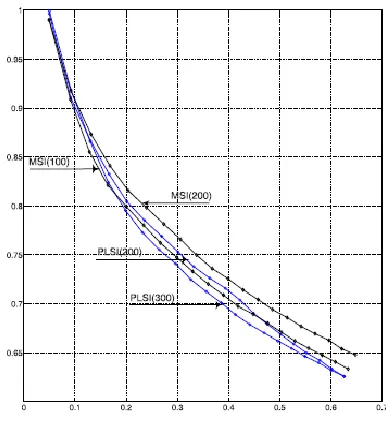
The results of implementation can be calculated according to the recall and precision values. The graph generated as in [1] which can be represented as follows. This graph is computed as Precision verses recall measure.
V. CONCLUSION AND FUTURE WORK
International Journal of Emerging Technology and Advanced Engineering
Website: www.ijetae.com (ISSN 2250-2459,ISO 9001:2008 Certified Journal, Volume 4, Issue 6, June 2014)
562 REFERENCES
[1] Konstantinos A. Raftopoulos, Klimis S. Ntalianis, Dionyssios D. Sourlas, & Stefanos D. Kollias, “Mining User Queries with Markov Chains: Application to Online Image Retrieval”, Ieee Transactions On Knowledge And Data Engineering, Vol. 25, No. 2, February 2011. [2] Raghupathi Gali, M. L. Dewal, R. S. Anand, “Genetic Algorithm for
Content BasedImage Retrieval”, 2012. comScore’s Report Article, “Comscore’s Qsearch 2.0 Service,” comScore’s Report Article, www.comscore.com, 2007.
[3] Chih-Chin Lai, Member, IEEE, and Ying-Chuan Chen,” A User-Oriented Image Retrieval System Based on Interactive Genetic Algorithm”, IEEE transactions on instrumentation and measurement, vol. 60, no. 10, october 2011.
[4] Dr.D.S.Bormane Principal, RSCOE, ,Pune,India, Meenakshi Madugunki, Sonali Bhadoria, Dr. C. G. Dethe,” Comparison of Different CBIR Techniques”, 2011 IEEE Conference.
[5] Gwénolé Quellec, Mathieu Lamard, Guy Cazuguel, Member, IEEE, Béatrice Cochener, and Christian Roux, Fellow, IEEE “Adaptive Nonseparable Wavelet Transform via Lifting and its Application to Content-Based Image Retrieval” IEEE transaction on Image Processing 2010.
[6] Nhu-Van Nguyen, Alain Boucher, Jean-Marc Ogier, Salvatoire Tabbone,” Clustersbased Relevance Feedback for CBIR: a combination of query movement and query expansion”,IEEE Conference 2010.
[7] A.Kannan, Dr.V.Mohan ,Dr.N.Anbazhagan “Image Clustering and Retrieval using Image Mining Techniques” 2010 IEEE Conference. [8] Hua Yuan and Xiao-Ping Zhang, Senior Member, IEEE “Statistical
Modeling in the Wavelet Domain for Compact Feature Extraction and Similarity Measure of Images” IEEE Transaction March 2010. [9] hangxu-bo,” Re-ranking algorithm using clustering and relevance
feedback for image retrieval”, 2010 IEEE Conference.
[10] “A new ROI grouping schema for automatic image annotation” by Rami albatal, Philippe mulhem, Yues chiaramella.
[11] “Technique of Image Retrieval based on Multi--‐label Image Annotation” by Ran Li, YaFei Zhang, Zining Lu, Jianjiang Lu, Yulong Tian--‐2010 Second International Conference on MultiMedia and Information Technology.
[12] “Ensemble Of Multiple Descriptors For Automatic Image Annotation” by Dongjian He & Yu Zheng, Shirui Pan, Jinglei Tang--‐2010 3rd International Congress on Image and Signal Processing. [13] Hamid ansari, Mansour Jamzad “Large--‐Scale Image