3426
AN ENHANCE CNN-RNN MODEL FOR PREDICTING
FUNCTIONAL NON-CODING VARIANTS
1JALILAH ARIJAH MOHD KAMARUDIN, 1NUR AFIFAH AHMAD AHYAD
1AFNIZANFAIZAL ABDULLAH, 2ROSELINA SALLEHUDDIN
1Synthetic Biology Research Group,
2Soft Computing Research Group,
Faculty of Computing, Universiti Teknologi Malaysia, 81310 Johor Bharu, Johor, Malaysia
E-mail: 1[email protected], 1[email protected], 2[email protected]
ABSTRACT
In the era of big data, deep learning has advanced rapidly particularly in the field of computational biology and bioinformatics. In comparison to conventional analysis strategies, deep learning method performs accurate structure prediction because it can handle high coverage biological data such as DNA sequence and RNA measurement using high-level features. However, predicting functions of non-coding DNA sequence using deep learning method have not been widely used and require further study. The purpose of this study is to develop a new algorithm to predict the function of non-coding DNA sequence using deep learning approach. We propose an enhanced CNN-RNN model to predict the function of non-coding DNA sequence. In this model, we train an algorithm to automatically find the optimal initial weight and hyper-parameter to increase prediction accuracy which outperforms other prediction models.
Keywords: Functional Non-coding Variant, Machine Learning, Deep Learning, Convolutional Neural
Network, Recurrent Neural Network
1. INTRODUCTION
DNA strands consist of coding sequence which encodes for proteins and much of the DNA does not encode for proteins which is known as non-coding DNA or junk DNA. The coding DNA are transcribed into messenger RNA (mRNA) which is then used to produce proteins such as ribosomal. Meanwhile, the non-coding DNA sequence often referred as the conserved non-coding sequence (CNS) [1] produces introns, non-coding functional RNA (rRNA and tRNA), cis- and trans-regulatory elements, repeat sequence telomeres, scaffold attachment regions (SARs) and many others. However, the functions of most non-coding sequence have not been determined yet. Additionally, in the process of gene transcription and replication
Additionally, in the process of gene transcription and replication, CNS provides the binding site or regulatory site for proteins such as the promoter region and origin. Mutation in non-coding variant is also believed to be associated with the development of certain diseases.
Genome-wide association study (GWAS) focuses on coding regions and potentially to non-coding variants. Some of the genetic disorder has been identifies based on disease-associated mutations by sequencing the exome or coding region [2,3]. However, many of cases still remain undetermined because of the failure in analysis due to limitation of exome sequencing. This problem gives the strong reason that some of causative variants actually occur outside of coding region and inside regulatory. For example, mutation of the functional regulatory elements such as enhancers and insulators may results in cancer, diabetes, heart disease, obesity [4,5] and a rare disease called Hirschsprung's disease [6].
3427 development and application of computer algorithms is related to the field of machine learning that aims to improve with experience. Machine learning is a supervised learning and used to classify objects in images, match news items, translate speech into text, products or posts with interest of users and select significant results of a search. Generally, all of these applications of machine learning are using a class of approaches known as deep learning [8].
Deep learning has clear potential to make analysis in high-dimensional data by training complex networks with various layers that represent their internal structure. This approach can be applied in image recognition [9-12], speech recognition [13-15], predicting potential drug [16], reconstructing brain circuits and many others. It has a major advance in solving problem including function prediction of non-coding variants. However, the main issue is difficulty and lacking of powerful computational approach in predicting the functional non-coding variants in human genome that potentially leads to detect disease-associated variants.
In order to achieve the aim of this study, we propose an enhanced CNN-RNN model to predict the function of non-coding sequence. This paper provides details explanation on the proposed model specifically on the algorithm used. The comparison between the proposed model and the existing models will also be discussed.
2. LITERATURE REVIEW
In this study, we highlight two deep learning method commonly used includes convolutional neural network (CNN) and recurrent neural network (RNN).
2.1 CNN
The input data of CNN available in the form of multidimensional arrays for example, one-dimensional genomic sequence or two-one-dimensional images. Large dimensional data becomes a challenge for a neural network because it requires a high number of parameters compared to the number of training data that fit in a model. CNN makes change to the network's structure by reducing the number of parameters during learning stage to overcome the challenge.
CNN consists of three layers of network known as convolutional layers, nonlinear layers and pooling layers. The convolutional layer in CNN composeds of various maps of neurons known as feature maps or filters [17]. The size of feature
maps is equivalent to the dimension of the input image. To reduce the number of model parameters, CNN uses the concept of parameter sharing and local connectivity where by each neuron in the feature maps are only connected with a local patch of neurons in the previous layer or receptive field. Next, all neurons in the feature maps share the same parameters and scan for the same features as in the previous layer but at different locations. The weighted sum of input neurons and activation function is computed using discrete convolution to obtain the activity of neuron [18].
Usually, the frequency and exact position of features are irrelevant for final prediction for example, to identify objects in an image. By that, pooling layer summarizes adjacent neurons by calculating the average or maximum activities to represent features activities. This pooling operation effectively reduce the number of model parameters and down-sampled the input image [18]. Mostly, CNN includes several convolutional and pooling layers to learn various numbers of abstract features from small edges to whole objects. The number of convolutional layers, the size of receptive fields and the number of features maps dependently follows the application. Besides, the validation data set need to be strictly selected.
2.2 RNN
Recurrent Neural Network (RNN) was designed with a cyclic connection in the basic structure and used sequential information. Since the cyclic connection exists, RNN was performed in the hidden unit and the input data was processed sequentially. Thus, past information is stored in the hidden units which are known as state vectors [18]. Although RNN is different from CNNs based on their number of layers but it can be considered as deeper structure if unrolled in time. However, researchers is facing up disappear
gradient problem and learning long-term
3428
3. CNN-RNN MODEL
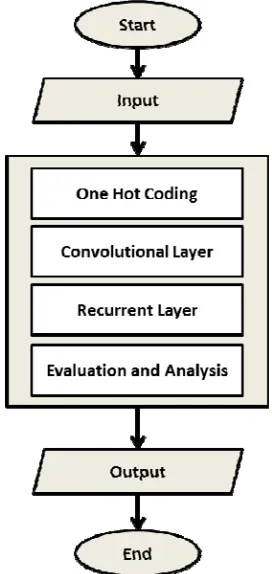
[image:3.612.126.262.186.473.2]We propose a CNN-RNN model, a framework that combines CNN and RNN with additional swarm optimization. This enhanced model uses the same features and framework as the DeepSEA [19] and DanQ [20] models.
Figure 1: Framework of an enhance CNN-RNN
Firstly, an input sequence is encoded into a 4-row bit matrix. Next, the convolutional layer act as a motif scanner and max pooling to reduce the size of the output matrix. Recurrent layer that uses bidirectional long short term memory (BLSTM) considers the orientations and spatial distances among the motifs. Lastly, the dense layers of rectified linear units (ReLU) and a multi-task sigmoid output are used to evaluate the prediction.
3.1 One Hot Coding
We used the raw nucleotide bases A, C, G and T as input and each of the bases is converted into one-hot coding. A binary vectors with matching characters either A, C, G or T were encoded as 1 and the rest as 0s.
Figure 2: Basic structure of one hot encoding
This encoding matrix becomes the input for CNN-RNN algorithm and produce outputs of a vector of fixed dimension.
3.2 Convolutional Neural Network
It is reported that convolutional neural network (CNN) is suitable for predicting function from sequences by DeepSEA and DanQ models. To capture local patterns in the sequences, CNN uses a weight-sharing strategy. This weight-sharing strategy is useful for studying DNA composing convolution filters that able to capture sequence motifs.
Figure 3: Basic structure of convolutional layer
The CNN is trained to predict large-scale chromatin-profiling data such as transcription factors (TF) binding, DNase I sensitivity and histone-mark profiles within various cell types. This method also predicts the regulatory function and the effect of regulatory variation. The CNN consists of one convolution layer and one max pooling layer.
3.2.1 Convolution layer
[image:3.612.314.520.362.496.2]3429 (1)
where X is the input, i is the index of the output
position and k represents the index of kernels. Each
convolutional kernel Wk is M × N (-weight matrix)
which M is the window size and N is the number of
output channel which equals to 4.
3.2.2 Max Pooling layer
Max pooling layer act to reduce the size of the output matrix with the spatial axis by preserving the number of channels. It calculates with a step size equivalent to the size of pooling window. The size of the output is reduced and allows learning sequence feature. The pooling operation is expressed as
(2)
where X is the input, i is the index of output
position, k is the index for kernels and M represents
pooling window size.
3.3 Recurrent Neural Network
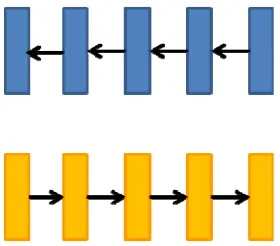
Another layer in CNN-RNN model is RNN that form a directed cycle of connections between units. A variant of RNN which bidirectional long short term memory network (BLSTM) combines the outputs of two RNNs. In other words, one is processing the sequence from left to right and the other one processing the sequence from right to left.
Figure 4 illustrates the basic structure of BLSTM. The two RNNs that contain LSTM blocks are smart network units that can remember a value for an arbitrary length of time.
Figure 4: Basic structure of bidirectional long short term
memory (BLSTM)
BLSTMs effectively capture long term dependencies and powerful for machine learning application [20].
3.4 Evaluation and Analysis CNN-RNN
A dense layer is one of the basic layers of the deep convolutional network. It calculates output using one-dimensional convolutional operation with a specific number of kernel or weight matrices. ReLU represents the rectified linear function
(3)
The fully connected layer calculates ReLU (WX), where X represents the input and W is the weight matrix for a fully connected layer.
The final layer known as sigmoid output layer is used in this framework to makes prediction for 919 chromatin features such as 125 DNase features, 104 histone features and 690 TF features. The scale for predictions range from the 0 to 1 using the function of sigmoid
(4)
where X represents the input and W is the weight matrix for the sigmoid of output layer which calculates for Sigmoid (WX).
4. INITIAL RESULT
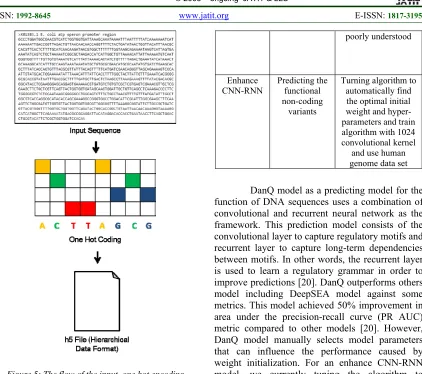
The initial result for this study focuses on the output of one coding algorithm that converts an input sequences into a binary vector.
The dataset of E.coli at operon promoter
[image:4.612.125.265.570.693.2]region retrieved from National Center for Biotechnology Information (NCBI) was used. This dataset consists of 1,150-bp of linear DNA and it is running on one hot coding algorithm as shown in Figure 5 above.
3430
Figure 5: The flow of the input, one hot encoding algorithm and the output
5. DISCUSSION
This study presents an enhanced CNN-RNN model as a suitable method for functional prediction of non-coding variants. In comparison to DeepSEA and DanQ models, we strongly believe that this proposed model can outperform other prediction models and effectively predict the function directly from the sequence.
Table 1: Comparison between propose model and the existing prediction models.
Model Purpose Remarks
DanQ Predicting the functional
DNA sequences
Manually selects model parameters that can influence performance DeepSEA Predicting the
effect of non-coding variants
Non-coding genomic regions and
potential functions of complex disease or trait-associated SNPs are currently
poorly understood
Enhance CNN-RNN
Predicting the functional non-coding
variants
Turning algorithm to automatically find the optimal initial weight and hyper-parameters and train algorithm with 1024 convolutional kernel
and use human genome data set
DanQ model as a predicting model for the function of DNA sequences uses a combination of convolutional and recurrent neural network as the framework. This prediction model consists of the convolutional layer to capture regulatory motifs and recurrent layer to capture long-term dependencies between motifs. In other words, the recurrent layer is used to learn a regulatory grammar in order to improve predictions [20]. DanQ outperforms others model including DeepSEA model against some metrics. This model achieved 50% improvement in area under the precision-recall curve (PR AUC) metric compared to other models [20]. However, DanQ model manually selects model parameters that can influence the performance caused by weight initialization. For an enhance CNN-RNN model, we currently tuning the algorithm to automatically find the optimal initial weight and hyper-parameter.
Slightly different with DeepSEA model, it only uses a convolutional neural network in their framework. As it is used for predicting the effect of non-coding variants, the framework of DeepSEA consists of three convolution layers and two max pooling layers in order to learn motifs [20]. In this model, the non-coding genomic regions and potential functions of complex disease or trait-associated SNPs are still poorly understood and warrant further studies [19]. This is the main reason the convolutional neural network and recurrent neural network were used in our propose model which is to increase the prediction accuracy. Besides, we also uses human genomic sequences as training dataset to provides better training data and insights of functional variants.
3431 proposed model to increase the prediction accuracy. We hope that this proposed model will be utilized in medical applications to identify
disease-associated variants, early diagnosis and
interventions for patients in future.
REFRENCES:
[1] Woolfe, A., Goodson, M., Goode, D. K., Snell, P., McEwen, G. K., Vavouri, T., ... & Walter, K. (2004). Highly conserved non-coding sequences are associated with vertebrate
development. PLoS Biol, 3(1), e7.
[2] Yang, Y., Muzny, D. M., Reid, J. G., Bainbridge, M. N., Willis, A., Ward, P. A., ... & Hardison, M. (2013). Clinical whole-exome sequencing
for the diagnosis of mendelian disorders. New
England Journal of Medicine, 369(16),
1502-1511.
[3] Beaulieu, C. L., Majewski, J., Schwartzentruber, J., Samuels, M. E., Fernandez, B. A., Bernier, F. P., ... & Adam, S. (2014). FORGE Canada Consortium: outcomes of a 2-year national
rare-disease gene-discovery project. The American
Journal of Human Genetics, 94(6), 809-817.
[4] Kundaje, A., Meuleman, W., Ernst, J., Bilenky, M., Yen, A., Heravi-Moussavi, A., ... & Amin, V. (2015). Integrative analysis of 111 reference
human epigenomes. Nature, 518(7539),
317-330.
[5] Corradin, O., & Scacheri, P. C. (2014). Enhancer variants: evaluating functions in common
disease. Genome medicine, 6(10), 85.
[6] Emison, E. S., McCallion, A. S., Kashuk, C. S., Bush, R. T., Grice, E., Lin, S., ... & Chakravarti, A. (2005). A common sex-dependent mutation in a RET enhancer underlies Hirschsprung
disease risk. Nature, 434(7035), 857-863.
[7] Lupski, J. R., Reid, J. G., Gonzaga-Jauregui, C., Rio Deiros, D., Chen, D. C., Nazareth, L., ... & McGuire, A. L. (2010). Whole-genome sequencing in a patient with Charcot–Marie–
Tooth neuropathy. New England Journal of
Medicine, 362(13), 1181-1191.
[8] LeCun, Y., Bengio, Y., & Hinton, G. (2015).
Deep learning. Nature, 521(7553), 436-444.
[9] Krizhevsky, A., Sutskever, I., & Hinton, G. E. (2012). Imagenet classification with deep
convolutional neural networks. In Advances in
neural information processing systems (pp.
1097-1105).
[10]Farabet, C., Couprie, C., Najman, L., & LeCun, Y. (2013). Learning hierarchical features for
scene labeling. IEEE transactions on pattern
analysis and machine intelligence, 35(8),
1915-1929.
[11]Tompson, J. J., Jain, A., LeCun, Y., & Bregler, C. (2014). Joint training of a convolutional network and a graphical model for human pose
estimation. In Advances in neural information
processing systems (pp. 1799-1807).
[12]Szegedy, C. et al. (2014). Going deeper with
convolutions. Preprint at
http://arxiv.org/abs/1409.4842.
[13]Mikolov, T., Deoras, A., Povey, D., Burget, L., & Černocký, J. (2011, December). Strategies for training large scale neural network language
models. In Automatic Speech Recognition and
Understanding (ASRU), 2011 IEEE Workshop
on (pp. 196-201). IEEE.
[14]Hinton, G., Deng, L., Yu, D., Dahl, G. E., Mohamed, A. R., Jaitly, N., ... & Kingsbury, B. (2012). Deep neural networks for acoustic modeling in speech recognition: The shared
views of four research groups. IEEE Signal
Processing Magazine, 29(6), 82-97.
[15]Sainath, T. N., Mohamed, A. R., Kingsbury, B., & Ramabhadran, B. (2013, May). Deep convolutional neural networks for LVCSR. In Acoustics, speech and signal processing (ICASSP), 2013 IEEE international conference
on (pp. 8614-8618). IEEE.
[16]Ma, J., Sheridan, R. P., Liaw, A., Dahl, G. E., & Svetnik, V. (2015). Deep neural nets as a method for quantitative structure–activity
relationships. Journal of chemical information
and modeling, 55(2), 263-274.
[17]Angermueller, C., Pärnamaa, T., Parts, L., & Stegle, O. (2016). Deep learning for
computational biology. Molecular systems
biology, 12(7), 878.
[18]Min, S., Lee, B., & Yoon, S. (2016). Deep
learning in bioinformatics. Briefings in
Bioinformatics, bbw068.
[19]Zhou, J., & Troyanskaya, O. G. (2015). Predicting effects of noncoding variants with
deep learning-based sequence model. Nature
methods, 12(10), 931-934.
[20]Quang, D., & Xie, X. (2016). DanQ: a hybrid convolutional and recurrent deep neural network for quantifying the function of DNA
sequences. Nucleic acids research, 44(11),
e107-e107
3432 differential evolution. In Hybrid Intelligent Systems (HIS), 2011 11th International Conference on (pp. 115-120).
[22]Abdullah, A., Deris, S., Mohamad, M. S., & Anwar, S. (2013). An improved swarm optimization for parameter estimation and biological model selection. PloS one, 8(4), e61258.