BIROn - Birkbeck Institutional Research Online
Dewaele, Jean-Marc (1999) Word order variation in interrogative structures
of native and non-native French.
ITL - International Journal of Applied
Linguistics (123), pp. 161-180. ISSN 0019-0810.
Downloaded from:
Usage Guidelines:
BIROn -
B
irkbeck
I
nstitutional
R
esearch
On
line
Enabling open access to Birkbeck’s published research output
Word order variation in interrogative structures of native
and non-native French
Journal Article
http://eprints.bbk.ac.uk/5144
Version: Accepted (Refereed)
Citation:
© 1999 Peeters Online Journals
Publisher Version
______________________________________________________________
All articles available through Birkbeck ePrints are protected by intellectual property law, including copyright law. Any use made of the contents should comply with the relevant law.
______________________________________________________________
Deposit Guide
Contact: [email protected]
Birkbeck ePrints
Birkbeck ePrints
Dewaele, J.-M. (1999)
Word order variation in interrogative structures of native and
non-native French
WORD ORDER VARIATION IN FRENCH
INTERROGATIVE STRUCTURES
Preprint version. ITL Review of Applied Linguistics, 123/124, pp. 161-180 (1999).
Dr. Jean-Marc Dewaele
French Department
Birkbeck College, University of London
43 Gordon Square
London WC1H 0PD
U.K.
tel./fax (private) +44 181 368 00 86
WORD ORDER VARIATION IN FRENCH
INTERROGATIVE STRUCTURES*
ABSTRACT
Inter-individual variation in the use of direct interrogative structures (N=450) is
explored in a corpus of spoken native and non-native French. A quantitative analysis
of the data reveals that while non-native speakers seem to avoid non-standard
structures, they do not use more formal variants systematically. Comparison with
data from other native and non-native corpora reveals important differences in the
frequency of particular interrogative structures. The choice of interrogative structure
seems to be influenced by a number of situational, pragmatic and socio-stylistic
variables.
1.
INTRODUCTION
French has a wide range of interrogative structures that have very specific
socio-stylistic values. Certain structures are considered formal and are consequently used in
written language or in speech produced in formal situations. However there is, as we
shall see, considerable variation among native speakers in the choice of particular
structures. The variation could be expected to be even higher in non-native speech as
learners struggle to master the sociolinguistic norms of the target language (cf. Regan,
1997). The aim of the present article is to analyse 450 direct interrogative structures
in the spontaneous oral discourse of 5 native speakers (hence NS) and 15 non-native
The following research questions will be addressed:
* Do advanced speakers of French interlanguage differ from NS in their use of
interrogative structures ?
* If there is a difference, do NNS of French prefer the more formal interrogative
structures ?
In an earlier study (Dewaele, 1992) on the variable omission of the negative particle
in the advanced French interlanguage of Flemish students, we found that the 21
subjects omitted the negative particle “ne” much less frequently than NS do. We
concluded that language learners who are still acquiring sociolinguistic competence
and the vernacular style of the target language tend to use more formal structures
when they have the choice between socio-stylistic variants. This finding was
confirmed by Regan (1995, 1997) who found that her 6 advanced Irish learners of
French L2 deleted the “ne” twice as often after they had spent an academic year in
France.
One might therefore expect a higher frequency of interrogative structures considered
as being more formal in the native speaker community, such as those with clitic
inversion, and a lower number of structures considered non-standard in the
interlanguage of the learners.
2.
DEFINITION OF THE VARIABLES
We will not consider indirect interrogatives of which there were only 3 occurrences in
the corpus. Eighteen declarative clauses with interrogative tag (n’est-ce pas) and 154
The remaining 450 direct interrogative structures can be divided in two broad
categories, Yes/No interrogatives (YNQ) and WH interrogatives (WHQ).
Coveney (1996) argues that this division, which reflects that used by Pohl (1965),
Price (1971) and Al (1975), “is motivated both linguistically and sociolinguistically:
linguistically, because the two types of questions have distinct syntactic, semantic,
and pragmatic properties; and sociolinguistically, because (YNQ) has three variants,
whereas (WHQ) have five or more, and these variants have distinct sociolinguistic
values attached to them” (Coveney, 1996: 92).
The structures to be examined here are set out in 1-8, together with an example of
each: (1)
1) [SV] *MAR: vous n’avez pas de difficulté avec l’anglais ?
2) [ESV] *DJE: mais est-ce qu’il y a des cours que vous préférez ?
3) [V-CL] *STE: pouvez-vous donner une description ?
4) [QSV] *XEN: donc pourquoi tu as choisi d’euh d’étudier à Birkbeck ?
5) [QESV] *CHR: qu’est-ce que tu vas aller faire à un cours pareil ?
6) [SVQ] *TAN: tu habites où à Londres ?
7) [QV-CL] *KAR: ben pourquoi as-tu continué tes études ?
8) [QV-NP] *ALI: quelle est votre motiv0 # motivisat0 # motivation ?
(key: S = subject clitic or Noun Phrase; CL = subject clitic; NP = subject Noun
2.1
The prescriptive norms
Grammarians of French such as Wagner & Pinchon (1962) and Grevisse (1980)
present socio-stylistic classifications of interrogative structures. The structures
[V-CL], [QV-CL] and [QV-NP] are generally considered to belong to the careful style,
the structures [ESV] and [QESV] are considered neutral but rather inappropriate in
writing, the structures [SV] and [SVQ] are considered colloquial but correct in speech
(2), the structure [QSV] is generally labelled “working-class” and incorrect.
Coveney (1996) observes that “the stigma attached by grammarians to certain variants
has, via the education system in particular, very probably played a major part in
restricting the use of non-standard structures” (1996: 98). Wagner & Pinchon (1962:
539) link the choice of a particular variant to the background of the speaker (“le degré
de culture de la personne qui parle”), to the situation, the kind of register used and
stylistic requirements (“rythme, harmonie”).
Native speakers of French are conscious of the socio-stylistic value of variants.
Lightbown (1979: 121), for example, found that Canadian adult native speakers of
French speaking to child learners of French used significantly more structures with
inversion ([V-CL], [QV-CL]) when the situation became more formal. One should
not think, however, that the socio-stylistic classification of interrogative structures is
cast in stone. Huot (1997) pointed out that not all interrogative structures with clitic
inversion necessarily belong to a formal style. She illustrated her point with the
example: Pourquoi veux-tu qu’on parte ? which she calls a “tour contestataire” that
2.2
The descriptive norms
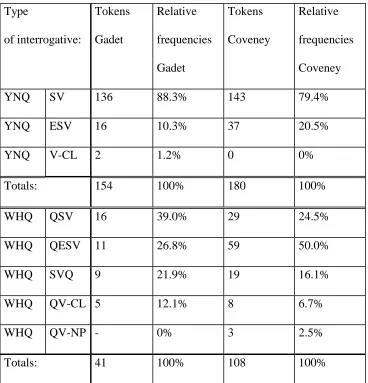
Table 1 presents quantitative data on types of interrogative structures in two corpora
of spoken native French (Gadet, 1989 and Coveney, 1996). We selected these two
corpora because it is recent material and typical of the sort of input to which our own
subjects are exposed to.
Gadet’s corpus is based on 90 minutes of ordinary conversations between native
speakers over the telephone (Gadet, 1989: 142) (3).
Coveney’s corpus of 250,000 words is based on 18 hours of informal interviews
between himself (a non-native speaker of French) and 30 native speakers of French in
a holiday camp in Picardy. There are 16 males and 14 females, aged between 17 and
60, ranging from working class to upper class. The principal topic is the informant’s
experience of holiday camps (1996: 15-16). Coveney analysed the (relatively few)
questions whih the informants asked the fieldworker.
INSERT TABLE 1
As with previous research (4), the number of YNQ tokens is consistently higher than
that of WHQ tokens. Gadet (1989: 144) observes that this difference in her data
cannot be attributed to chance. Coveney (1996) underlines the fact that YNQ are used
for a wider range of communicative functions than are WH interrogatives, hence the
smaller number of the latter (1996: 118). Brown & Yule (1983: 79-83) are of the
opinion that this preponderance may be due in part to the fact that the Yes/No
interrogatives make less presuppositions than WH interrogatives, and are therefore
speaker and the addressee is more limited. Gadet’s data are based on telephone
conversations which have been proved to be less implicit than the face-to-face
conversations from Coveney’s corpus where speakers share the same spatio-temporal
context (cf. Dewaele, 1996). Sadock & Zwicky (1985: 178-84) suggest that Yes/No
interrogatives are more frequent because they are the more basic syntactic structure.
Whereas Yes/No interrogatives seem to be present in all languages, some languages
do without WH interrogatives.
The balance between YNQ and WHQ also seems to be determined by the language
functions of the interrogatives. Lyster (1996) analysed 286 interrogatives produced
by 44 adolescent native speakers of French in the Quebec city area. The subjects
produced requests, complaints and offers in interrogative form addressed to peers and
adults. Lyster counted 270 YNQ tokens and only 16 WHQ tokens.
The data presented in table 1 illustrate the fact that there is no single descriptive norm
of interrogative structures in modern spoken French. A Chi Square analysis revealed
that the proportions of YNQ variants are significantly different between Gadet and
Coveney (Df = 2, Chi2 = 12.1, p < .002), and that the proportions of the WHQ
variants are equally dissimilar (Df = 4, Chi2 = 6487.9, p < .0001).
Coveney (1996) presents relative frequencies for YNQ and WHQ in 10 corpora of
native French gathered by different researchers over the years (Coveney, 1996:
111-12). The variation appears to be even more important. The proportion of [V-CL]
structures in the Yes/No interrogatives, for example, varies between 0.5% and 20%,
whereas among the WH interrogatives, the [QESV] structure varies between 6% and
6%, the [QV-CL] structure between 3% and 50% and the [QV-NP] structure between
The same variation seems to exist in different corpora of non-Continental French such
as the French spoken in Quebec. Lyster’s (1996) study (5) revealed “minimal use of
uninverted questions with rising intonation and considerable use of inversion in
spoken French” (Lyster, 1996: 175). Inverted questions and questions with
interrogative suffix “-ti” (Je peux-ti t’aider?) accounted for 58.4% of the questions
produced (6). Lyster’s findings stand in contrast to those of Lightbown (1980) and
Lightbown & d’Anglejean (1985) (7). The authors report that the speech addressed
by one adult native speaker to child learners of French L2 in Quebec contained almost
no inverted forms -”even in information-eliciting questions” (Lightbown &
d’Anglejean, 1985: 418). A similar absence of inversion was noted in a corpus of 400
questions addressed by one native speaker of French in Montreal to 2 adult French L2
learners (Lightbown & d’Anglejean, 1985: 418). Lightbown (1980) presents the
results of a study on the emergence of question forms in L2 French of 2 boys who
were native speakers of English. The boys used inversion only in a few rote-learned
questions: “There are no examples of full-verb inversion with Q-words (...) and
inversion was rare in Yes/no questions as well” (Lightbown, 1980: 168). The adult
interlocutors who interacted with these learners also rarely used inversion for forming
questions.
2.2.1 Variation within Coveney’s corpus
Coveney (1996) identified a number of factors responsible for the variation he found
in his corpus. Few of these, however, could account for the variation in our corpus
(see infra). The main reason for this is that the questions he identified in his corpus of
250,000 words have a wide range of communicative functions (1996: 123). Our
same propositional content (namely requests for information and for opinions) and of
sub-topic-introducing questions (see next section). Coveney thus writes “that a
significant proportion of the tokens of the YNQ variable were found to be constrained
by various pragmatic factors: i.e. speakers had no choice of structure, given the
communicative function” (1996: 247). Contrary to what our findings, he observed,
for example, that the [ESV] structure “was used only rarely when the speaker
expected an answer from the addressee”(1996: 247). The tokens with clitic inversion
were so limited that he could not analyse the variation, and the [QV NP] structure
appeared to be “constrained principally by linguistic factors” (1996: 247). The choice
between [SVQ] and WH-fronted variant “proved to be conditioned by a strong
discoursal constraint: the less informative the subject and the verb, the higher the
probability of [SVQ] being selected” (1996: 247). Variation linked to social
differentiation was modest and “sex appeared to be the most important
extra-linguistic variable affecting WHQ, with male informants showing a stronger tendency
than females to use the non-standard [QSV] structure” (1996: 248).
The absence of a single descriptive norm in the frequency of usage of different
interrogative structures in native French makes a comparison with non-native French
more difficult. Numerous factors, moreover, appear to be linked to the choice of a
particular structure. However, as our data contain material produced by both NS and
NNS in similar situations and covering similar topics, we consider that variation can
in fact be accounted for and that answers can be found to the research questions which
3.
METHODOLOGY
Nine female and 11 male speakers, aged between 20 and 60, participated in the
experiment. They are full-time students in the French Department of Birkbeck
College, University of London. 5 subjects are NS of French, but have been working
in London for at least 2 years; 15 subjects are native speakers of English. All subjects
use English most frequently. Lightbown & d’Anglejean noted that “it is difficult to
elicit a substantial corpus of spontaneous questions from second language learners”
(Lightbown & d’Anglejean, 1985: 423). To avoid this difficulty our subjects were
asked to choose a partner to interview and be interviewed by (8). By dividing the
subjects into dyads we were confident that a sufficient number of interrogatives
would be produced. 6 NNS-NNS dyads were formed, 2 NS-NS dyads and 3 NNS/NS
dyads during 2 one-hour sessions. 5 dyads were same sex, 7 dyads were mixed. The
researcher handed over a list with topics for discussion and explained that everybody
was free to determine the number of questions, and that the interview should last
about 15 minutes, after which the interviewee would become the interviewer. The
subjects talked about their studies, hobbies, work, family, hopes and fears. Personal
topics of this sort contribute to an informal atmosphere in which authentic speech can
be produced (cf. Reboullet, 1979; Trévise & Noyau, 1984). Each pair of subjects
audio taped their interviews and transcribed them afterwards following the CLAN
format (cf. McWhinney, 1995). The transcriptions were then checked by the
researcher who also participated in the interviews to make up the numbers.
The resulting material (25,068 words) is of a quasi-spontaneous nature, resulting from
peer-group interaction. This is generally considered (cf. Milroy, 1987) the best
All subjects filled out a questionnaire relating to all typical sociobiographical data
such as sex, age, profession and details concerning their linguistic history: first,
second, third, fourth or fifth language, amount of time spent in France, number of
years attending French courses, frequency of speaking, reading, hearing French, and
most frequently used language in their everyday life.
The material of three subjects who were interviewees but not interviewers was
excluded on the basis that the few interrogative structures they produced were
categorical tokens on account of pragmatic factors or lacked a verb as illustrated in
(10):
10) *NEI: (interviewer) tu vas prendre des vacances en Angleterre par exemple ?
*AIC: (interviewee) prendre des vacances ?
In cases of immediate and identical repetition of the interrogative, only the first
occurence was counted, as in example (11):
11) *DEV: (interviewer) est-ce que tu fais+...
*PAT: (interviewee) euh +...
*DEV: est-ce que tu fais un travail à # à temps partiel ?
4.
ANALYSIS
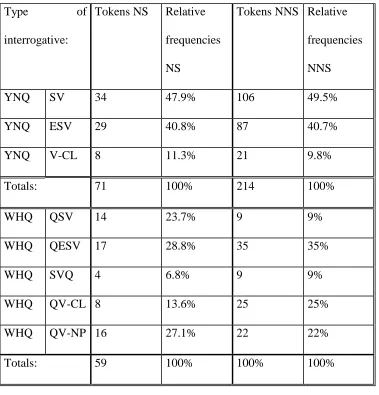
Table 2 presents the quantitative data on the types of interrogative structures in our
corpus of 5 NS and 15 NNS.
4.1
Comparison with the corpora of Gadet (1989) and Coveney (1996)
The differences between the proportions of YNQ and WHQ tokens for our speakers
(NS and NNS) (table 2) and the results of Gadet (1989) and Coveney (1996) (table 1)
are all highly significant (p < 0.001). The most interesting difference, however, is that
whereas Coveney’s subjects produced no clitic inversions in the Yes/No
interrogatives, for the WH interrogatives they produced many more [QESV] and
many fewer [QV-CL] and [QV-NP] variants. The [QV-CL] structures account for
20.6% of the tokens in our corpus whereas this structure accounts for only 6.6% of the
WHQ tokens in Coveney’s corpus and 12% in Gadet’s corpus. The [QV-NP]
structure is also 10 times more frequent in our corpus (25.4%) than in Coveney’s
corpus. The [QV-NP] structure is absent from Gadet’s data.
Different explanations are possible for this phenomenon. Coveney (1996)
interviewed his informants in a holiday camp in a very informal atmosphere (9). It
might thus be that the situation was considered less formal by the speakers and that
they did not feel that the use of formal variants of interrogatives was required. Gadet
(1989) gives less background information about the situation in which her telephone
conversations were recorded, but the examples presented suggest that the interlocutors
knew each other and used vernacular, informal speech.
Our subjects operated inside the university building during class hours.
This might have led them to believe that a more formal style, and thus
interrogative structures with inversion, were appropriate. We analysed
whether there was a correlation in our data between the number of
inversions and the frequency of the “vous” pronoun, which is another
corpus as a whole. An analysis of variance (hence ANOVA) revealed,
however, that NNS used more vouvoiement (Mean = 56.7%, SD =
42.9) than the NS (M = 11.7%, SD = 10.9). This difference was
significant (F = 5.17, p < 0.036). This divergence was reflected in the
number of interrogative structures with clitic inversion of the NNS
which used “vous” twice as frequently (24 “vous” versus 12 “tu”).
The opposite pattern emerged for the NS, the number of inversions
with “tu” being more than twice as frequent as those with “vous” (12
versus 5).
4.2
Sources of variation in our corpus
4.2.1 Inter-individual variation
Let us now look at inter-individual variation in our data. The proportions of the 3
Yes/No interrogatives and of the 5 WH interrogatives were calculated for every
speaker in our corpus. Although the variable NS versus NNS was hypothesised to be
the main source of variation, we checked to see whether other sociobiographical
variables affected the choice of interrogative structures. An ANOVA allowed us to
single out factors responsible for variation. Social background, age, sex, frequency of
speaking, reading or hearing French, type of motivation for learning French and, more
surprisingly, native or non-native status did not appear to be significantly related to
preferences for particular interrogative structures. The lack of significant differences
between NS and NNS could be due to the relative imbalance between the number of
NS (n = 5) and NNS (n = 15). To avoid distortion due to the small number of NS, the
then considered as a whole and compared to Gadet’s and Coveney’s data on native
speakers (cf. table 1). A Chi-Square analysis was performed on the relative values of
interrogative structures of both groups.
The differences in the proportion of the 3 Yes/No interrogatives are non-significant
between our group of NS and NNS (Df = 4; Chi2 = 0.278; ns). The two most striking
differences between the NS and NNS in the WH interrogatives are the relatively
higher proportion of QSV among the NS (+14.7%) and the relatively higher
proportion of [QV-NP] in the speech of the NNS (+11.4%). A Chi Square analysis
reveals that the differences between NS and NNS are highly significant for the WH
interrogatives (Df = 4; Chi2 = 32.1; p <.001). It is surprising that the NS speakers use
more formal interrogatives with inversion [QV-CL] in the WH interrogatives, but that
this preference does not extend to the formal interrogatives with inversion in the
Yes/No interrogatives [V-CL].
4.2.2 Verb types and tenses
Following Lyster’s finding that the verb “vouloir” particularly favoured inversion in
his data (Lyster, 1996 and personal communication), we analysed the type of verbs
that were used in interrogative structures with inversion ([V-CL] [QV-CL]). The
NNS used 14 verb types, the most frequent one being the auxiliary verb “avoir” with
13 occurrences. The NS used 6 verb types among which “avoir” also had the highest
frequency with 10 occurrences. Other verb types used by the NS and NNS in
inversions included “pouvoir” (n = 7), “trouver” (n = 6), “faire” (n = 4), “vouloir” (n
= 3). We also checked to see whether tense affects the choice of interrogative
structures. The majority of the interrogative structures with clitic inversion are in the
352 interrogatives out of 450 are in the present tense (= 78.2%), 72 in the past tense
(= 16%) and 26 in the conditional or future tense (= 5.7%). It thus seems that tense is
not a source of variation in our corpus.
4.2.3 Pragmatic factor
We saw earlier that an ANOVA could not single out any socio-biographical variable
having a significant effect on the variation in our data. One pragmatic factor,
however, was found to be linked to the choice of interrogatives structures with
inversion. The 13 speakers (3 NS and 10 NNS) who used [V-CL] and [QV-CL]
structures chose these in more than 95% of the cases to introduce a new topic or a
new theme within a topic, as illustrated in example (12):
12) *TER: je pense je crois qu'il faut vraiment euh connaître une langue très bien.
*MAR: oui.
*TER: euh assez pour enseigner ça c'est le cas bien sûr.
*MAR: et voudriez-vous euh enseigner dans un collège pour les adultes #
comme Birkbeck ?
The effect of this pragmatic factor on the choice of interrogatives with clitic inversion
seems to exist in Gadet’s (1989) NS corpus too, although she does not mention it.
The two tokens (examples 13 and 14) of the [V-CL] structure in her corpus (Gadet,
1989: 144) clearly indicate the introduction of a new topic:
13) ce week-end / va-t-on voir des trucs ?
Gadet observes similarly that the 5 tokens of the [QV-CL] structure in her corpus
occur at the beginning of the exchange and that the Q-word is the adverb “comment”
in all 5 cases (1989: 145).
In her study on questions produced by one native speaker in the Interfra corpus (cf.
Bartning, 1997) and a corpus of 39 Swedish NNS of French, Larsson Ringqvist
(1997) found that 66% of the clitic inversions in the speech of the native speaker
signalled a change of topic or an expansion inside a topic (10). Larsson Ringqvist did
not find the same patterns in her corpus of 39 NNS.
4.2.4 Possible crosslinguistic influence
Crosslinguistic influence (11) from English might explain the lower proportion of
[QSV] interrogatives in the speech of the NNS. This [QSV] structure is unacceptable
to speakers of standard English. The [SV] structure in YNQ on the other hand is
possible in English (cf. Lightbown & d’Anglejean, 1985: 422), although
subject-auxiliary inversion is generally assumed to be obligatory. The absence of the [QSV]
structure in the speaker’s English combined with the condemnation of the [QSV]
structure in French grammars might explain why NNS of French tend to avoid this
specific interrogative structure. Instead they prefer the more familiar and more formal
[QV-CL] interrogative in WH interrogatives.
All NNS declared in the sociobiographical questionnaire that English was the
language they used most frequently in everyday life, although 7 NNS do not have
English as a L1. We therefore assume that English has a higher level of activation in
the mind of our NNS (cf. Green, 1986). This means that English plays a role in the
ongoing processing, works in parallel to the selected language (French) but has no
lexical inventions in the French interlanguage of 39 Flemish learners (Dewaele, 1998)
that the level of activation of background languages determines possible transfer of
morphological and lexical information to lemmata in the selected language. The
effects of activated background languages can be very subtle. It is possible that a
speaker, having the choice between different structures in the selected language, will
select one that is similar to the structure most frequently used in one of his/her
activated languages. The systematic inversion in English interrogatives might
therefore have raised the probability of the choice of an [QV-CL] interrogative when
speaking French.
5.
CONCLUSION
The fact that no clear-cut answers can be given at this point relates in the first place to
the nature of the linguistic variables we investigated. Contrary to relatively simple
variables with clear socio-stylistic values in French, like the “ne” in the negation,
which can be either present or absent, interrogative structures are inherently more
fluid and complex, as many linguistic, pragmatic and discoursal factors affect the NS
speaker’s choice (cf. Coveney, 1996).
Comparisons between the frequency of use of these structures by NS and NNS are
therefore very difficult.
An analysis of variance (ANOVA) performed on the relative proportions of the 8
variants of Yes/No interrogatives and WH interrogatives did not reveal significant
differences between our 5 NS and 15 NNS. A Chi-Square analysis performed on
group averages revealed no differences between NS and NNS for YNQ tokens, but a
variants that ranked low on the socio-stylistic scale and used more formal WHQ
variants instead.
We found that the number of structures with clitic inversion was much higher for both
the NS and the NNS in our corpus than in the recent corpora of native French
analysed by Gadet (1989) and Coveney (1996). Further analysis revealed that 95% of
interrogatives with inversion in our corpus introduced a new topic or theme within the
topic in the conversation of both NS and NNS.
Since the NNS are still acquiring socio-stylistic competence in the target language,
one could expect a greater inherent variability in their choice of interrogatives. Their
production, moreover, may be affected by a more restricted input in a classroom
context and by possible transfer from English, which could explain their avoidance of
6.
REFERENCES
AL, B. (1975). La notion de grammaticalité en grammaire
générative-transformationnelle. Etude générale et application à la syntaxe de l’interrogation
directe en français parlé. Leiden: Universitaire Pers Leiden.
BARTNING, I. (1997). L’apprenant dit avancé et son acquisition d’une langue
étrangère. Tour d’horizon et esquisse d’une caractérisation de la variété avancée,
Acquisition et Interaction en Langue Etrangère (AILE) 9, 9-50.
BEHNSTEDT, P. (1973). Viens-tu ? Est-ce que tu viens ? Tu viens ? Formen und
Strukturen des direkten Fragessatzes im Französischen. Tübingen: Narr.
BROWN, G. & YULE, G. (1983). Discourse analysis. Cambridge: Cambridge
University Press.
COVENEY, A. (1995). The use of the QU-final interrogative structure in spoken
French. French Language Studies 8, 143-171.
COVENEY, A(1996). Variability in Spoken French. Exeter: Elm Bank Publications.
DEWAELE, J.-M. (1992). L'omission du “ne” dans deux styles d'interlangue
française. Interface. Journal of Applied Linguistics 7 (1), 3-17.
DEWAELE, J.-M. (1996). Variation dans la composition lexicale de styles oraux,
I.R.A.L., International Review of Applied Linguistics XXIV (4), 261-282.
DEWAELE, J.-M. (1998). Lexical inventions: French L2 versus L3. Applied
Linguistics, 19, 4, 471-490.
GREEN, D.W. (1986). Control, activation and resource: a framework and a model for
the control of speech in bilinguals. Brain and language 27, 210-223.
HUOT, H. (1997). Le rôle des corpus dans la recherche linguistique. Paper presented
at the AFLS Conference ‘Les Descriptions du Français: Discours, Corpus,
Analyses, Applications’, Montpellier.
LARSON RINGQVIST, E. (1997). Le questionnement dans le français des
apprenants suédois. Paper presented at the EUROSLA 7 Conference, Barcelona.
LIGHTBOWN, P. (1979). Question form and meaning in the speech of young
children learning French. Working papers on bilingualism / Travaux de recherche
sur le bilinguisme (18), 103-129.
LIGHTBOWN, P. (1980). The acquisition and use of questions by French L2
learners. In Second language development: Trends and issues S.W. Felix (ed.),
151-175. Tübingen: Gunter Narr.
LIGHTBOWN, P. & D’ANGLEJEAN, A. (1985). Some input considerations for
word order in French L1 and L2 acquisition. In Input in second language
acquisition S. Gass & C. Madden (eds.), 415-430. Boston: Heinle.
LYSTER, R. (1996). Questions forms, conditionals, and second-person pronouns
used by adolescent speakers across two levels of formality in written and spoken
French. The Modern Language Journal 80, 2, 165-182.
MACWHINNEY, B. (1995). The CHILDES Project: Computational Tools for
Analyzing Talk. Hillsdale, N.J.: Lawrence Erlbaum.
MILROY, L. (1987). Observing and analysing natural language. Oxford: Blackwell.
POHL, J. (1965). Observations sur les formes d’interrogation dans la langue parlée et
dans la langue écrite non-littéraire. In Actes du Xe Congrès International de
Linguistique et de Philologie Romanes, vol. 2, Paris: Klincksieck.
REBOULLET, A. (1979). De l'écrit authentique à l'oral authentique, Le Français
dans le Monde 145, 15-17.
REGAN, V. (1995). The acquisition of sociolinguistic native speech norms: Effects of
a year abroad on Second Language Learners of French. In Second language in a
study abroad context 245-267. Amsterdam-Philadelpia: John Benjamins.
REGAN, V. (1997). Les apprenants avancés, la lexicalisation et l’acquisition de la
compétence socio-linguistique: une approche variationniste. Acquisition et
Interaction en Langue Etrangère (AILE) 9, 193-210.
SADOCK, J. & ZWICKY, A. (1985). Speech act distinctions in syntax. In T. Shopen
(ed.), Language typology and syntactic description 155-196. vol. 1, Cambridge:
Cambridge University Press.
SHARWOOD SMITH, M. (1994). Second Language Learning. Theoretical
foundations. London - New York: Longman.
TRÉVISE, A. & PORQUIER, R. (1985). Acquisition d'une langue 2 en milieu
naturel: quelles méthodologies de description ? Langue française 68, 18-31.
WAGNER R.L. & PINCHON, J (1962). Grammaire du français classique et
Notes
* This article is based on a paper presented at the XXIIe Congrès International de
Linguistique et de Philologie romane, Université Libre de Bruxelles, July 1998.
(1) The name of the structure, between brackets, is followed by a star with the
abbreviation of the speaker’s name.
(2) For an excellent analysis of the contextual and pragmatic motivations for the use
of the SVQ structure, see Coveney (1995).
(3) The author provides no extra information about her corpus, but adds a word of
caution about its small size: “[le corpus] ne permet bien sûr aucune généralisation,
simplement quelques remarques” (Gadet 1989: 142).
(4) See for example Behnstedt (1973).
(5) Lyster’s material is not completely spontaneous speech. His “oral elicitation tasks
(...) made use of a restricted set of language functions: making requests, complaints
and offers. Consequently, there is evidence of at least two constraints related to
question formation that might not have arisen in less structured conversations” (Lyster
1996: 175).
(6) This particular structure seems to be disappearing in continental French (Gadet
1989: 146).
(7) The differences in size and type of discourse between Lyster’s corpus and
Lightbow & d’Anglejean’s corpus might also explain part of the variation.
(8) Some subjects played only the part of the interviewer, others only the part of the
interviewee.
(9) Coveney (1996: 14) notes that 24 of his 30 subjects addressed him with the
(10) The evidence, based on the material produced by only 1 NS, has to be treated as
an indication rather than a significant trend.
(11) Defined by Sharwood Smith (1994: 198) as “the influence of any other tongue
Table 1: Absolute and relative frequencies of YNQ and WHQ tokens of Native
speakers in the corpora of Gadet (1989) and Coveney (1996)
Type
of interrogative:
Tokens
Gadet
Relative
frequencies
Gadet
Tokens
Coveney
Relative
frequencies
Coveney
YNQ SV 136 88.3% 143 79.4%
YNQ ESV 16 10.3% 37 20.5%
YNQ V-CL 2 1.2% 0 0%
Totals: 154 100% 180 100%
WHQ QSV 16 39.0% 29 24.5%
WHQ QESV 11 26.8% 59 50.0%
WHQ SVQ 9 21.9% 19 16.1%
WHQ QV-CL 5 12.1% 8 6.7%
WHQ QV-NP - 0% 3 2.5%
[image:26.594.86.454.154.537.2]Table 2: Absolute and relative frequencies of YNQ and WHQ tokens of the 5 Native
speakers (NS) and the 15 Non-native Speakers (NNS) in the corpus.
Type of
interrogative:
Tokens NS Relative
frequencies
NS
Tokens NNS Relative
frequencies
NNS
YNQ SV 34 47.9% 106 49.5%
YNQ ESV 29 40.8% 87 40.7%
YNQ V-CL 8 11.3% 21 9.8%
Totals: 71 100% 214 100%
WHQ QSV 14 23.7% 9 9%
WHQ QESV 17 28.8% 35 35%
WHQ SVQ 4 6.8% 9 9%
WHQ QV-CL 8 13.6% 25 25%
WHQ QV-NP 16 27.1% 22 22%