ORIGINAL RESEARCH ARTICLE
FACILITATING AND BARRIER BELIEFS FOR DRUG ADHERENCE IN LIGHT OF THE THEORY OF
PLANNED BEHAVIOR: INTEGRATIVE REVIEW
1*
Tamara Silva,
2Simone Maria Muniz da Silva Bezerra,
1Hirla Vanessa Soares de Araújo,
1Thaisa Remigio Figueiredo,
3Mailson Marques de Sousa,
3Taciana da Costa Farias Almeida
and
4Simone Helena dos Santos Oliveira
1Nurse, PhD student, Associate Nursing Graduate Program, University of Pernambuco, State University of Paraíba/PAPGENF/UPE/UEPB, Recife, PE, Brazil
2PhD, Faculdade de Enfermagem Nossa Senhora das Graças, University of Pernambuco, Recife, PE, Brazil
3Nurse, PhD student, Nursing Graduate Program, Federal University of Paraíba, João Pessoa, PB, Brazil
4PhD. Graduate Nursing Program, Federal University of Paraíba, João Pessoa, PB, Brazil
ARTICLE INFO ABSTRACT
Objective: To analyze the evidence on the use of the Theory of Planned Behavior for the collection of drug adherence-related beliefs. Methods: This is an integrative review carried out on the MEDLINE, Scopus Info Site (SCOPUS) and Cumulative Index to Nursing and Allied Health Literature (CINAHL) platforms. Results: It was evidenced that the control of the disease and the prevention of complications were highlighted among the advantages related to drug adherence, and the side effects were relevant among the disadvantages. As for the social referents, the spouse, children and relatives were highlighted as positive against the medication. Negative referents were relatives who had previous experiences with other medications and patients not adhering to treatments. It is important to note that Among the main control beliefs that facilitate decision making was the medication always in hand, to follow a routine and to have something or someone to remember, and the barriers observed were the use of more than one medication, lack of information, transportation and memory.
Conclusion: The use of the Theory of Planned Behavior was adequate to raise the beliefs inherent in drug adherence, showing the possibility of proposing health strategies aimed at strengthening positive beliefs, promoting adherence to drug therapy.
Copyright © 2018,Tamara Silva et al. This is an open access article distributed under the Creative Commons Attribution License, which permits unrestricted use, distribution, and reproduction in any medium, provided the original work is properly cited.
INTRODUCTI
O
N
Non-adherence to drug therapy has been object of study of health researchers and behavioral scientists in the last decades. This scenario is seen as complex as it is influenced by factors of the disease itself, the type of therapy adopted, the bond with health professionals, the characteristics of the health system, as well as social, environmental, cultural, cognitive and psychological aspects (Mohammed, 2016). In this context, behavioral theories and models can help explaining and predicting one’s behavior towards drug
*Corresponding author: Tamara Silva
Nurse, PhD student, Associate Nursing Graduate Program, University of Pernambuco, State University of Paraíba/ PAPGENF/UPE/UEPB, Recife, PE, Brazil
adherence, thus identifying facilities and barriers, as well as providing support for structuring interventions (counseling, information, education, reminders, family support) to change behaviors and adopting protective health measures. Therefore, individuals and social groups are shown as actors and co-producers of the educational process, the interventions must aim at the development of autonomy and accountability of the subjects and social groups in the care with their own health (Budó, 2009 and Meyer, 2006). From this perspective, in order to seek a better understanding of the factors that may interfere with the adherence to drug therapy, it is important to consider the patient's beliefs regarding potentialities and difficulties, as well as his/her decision to take medication (Cervera, 2012). Among the models that can be used to understand human behavior and
ISSN: 2230-9926
International Journal of Development ResearchVol. 08, Issue, 09, pp.23079-23084, September,2018
Article History:
Received 19th June, 2018 Received in revised form 11th July, 2018
Accepted 06th August, 2018 Published online 30th September,2018
Key Words:
Beliefs, Behavior, Theory of Planned Behavior, Drug adherence.
REVIEW ARTICLE OPEN ACCESS
Citation: Tamara Silva, Simone Maria Muniz da Silva Bezerra, Hirla Vanessa Soares de Araújo et al, 2018. “Facilitating and barrier beliefs for drug
beliefs, we have the Theory of Planned Behavior (TPB), whose method seeks to explain and predict the motivation of an individual in adopting a behavior. This motivation is
evaluated by behavioral intention, an immediate
determinant of behavior, and is preceded by three other
determinants: Attitude –one's assessment of the
consequences of performing a behavior; Subjective Norm – one’s perception about social pressures that make him/her perform or a given behavior; Perceived Behavioral Control –one's perception of how much he/she feels capable and has control on adopting a behavior. Each of the three determinants of Intention is composed of their respective behavioral, normative and control beliefs (Ajzen, 2015). Belief is defined as one’s perception in relation to the understanding about him/herself and the environment that surrounds him/her, that is, the information (correct, incorrect, relevant or irrelevant) he/she has accumulated throughout his life experiences towards agiven behavior (Ajzen, 2015).
Among the elements necessary to study the phenomenon of interest, belief-surveying is an initial step to understand one’s barriers and facilities in performing a behavior. Several factors favor the survey of beliefs, among them: direct observation, information collected from external sources and inferences made by the individual (Ajzen, 2015). Targeting the use of Theory of Planned Behavior (TPB) for drug adherence studies may contribute to the understanding of beliefs that work as facilitators or barriers in taking medication. By identifying these factors, health practitioners, especially nurses, can subsidize the construction of strategies and health interventions anchored in some consistent theoretical models that aim at better drug adherence, justifying the relevance of the study for the care practice. Thus, the objective was of analyzing the evidence on the use of TPB to survey beliefs related to drug adherence.
MATERIALS AND METHODS
This is an integrative review of the literature with the purpose of gathering and synthesizing results of investigations on the subject. It aimed to answer the guiding question: "What are the evidences about the use of the Theory of Planned Behavior for the survey of beliefs related to drug adherence?". Based on this question, we proceeded to the other stages to carry out the integrative review, namely: formulation of the inclusion criteria, definition of the information to be extracted from the selected studies, rigorous assessment of the studies included in the integrative review, interpretation of the results and synthesis of knowledge (Mendes, 2008). The studies were selected based on researches in the databases: Medical
Literature Analysis and Retrieval System Online
(MEDLINE), Scopus and Cumulative Index to Nursing and Allied Health Literature (CINAHL), in the period of January 2018. The selected databases were chosen for their wide range of studies. Medical Subject Headings (MeSH) was consulted. The selected descriptors were Behavior, Beliefs, Medication Adherence, and Theory Planned Behavior, associated with the Boolean operator AND.
The same sequence was used in the insertion of the descriptors for the searches in order to avoid dispersion of the researched subject, as well as a greater number of publications for analysis. In addition, a five-year time cut was established. The selected articles met the following inclusion criteria: studies electronically available in the selected databases, published in peer-reviewed journals, having as theoretical-methodological reference the Theory of Planned Behavior for surveying belief related to drug adherence, complete texts available in Portuguese, English and Spanish languages. After applying the eligibility criteria proposed for the study, 49 articles were identified, 35 in SCOPUS, 13 in MEDLINE and 1 in CINAHL. The selective reading of the articles was carried out, initially with analysis of the title and abstract. Duplicate articles were recorded only once. In order to guarantee the joint registration of information relevant to the theme, an instrument was prepared by the authors to analyze the articles, which included identification data (period of publication, language,and country), methodological aspects of the studies (survey design, data) and main results and conclusions. Then, a detailed analysis of the articles was performed, considering their accuracy and characteristics, followed by the registration of the listed information in the instrument. Such information was interpreted, summarized and organized in a summary table. The results were compared and then propositions about the studies were made.
After reading the titles and abstracts, two publications were excluded, as they were duplicated, and 38 because they did not meet the inclusion criteria. Thus, 11 publications related to TPB and drug adherence were selected and read in full. Eight publications were excluded because despite using TPB for the study of “drug adherence” behavior, they did not have the beliefs identified in the sample studied. Thus, the final sample consisted of three articles. The selected articles were submitted to a classification of level of evidence consisting of seven levels: I) evidence obtained from a systematic review or meta-analysis of randomized controlled clinical trials or clinical guidelines based on systematic reviews of randomized controlled trials; II) evidence from at least one randomized, controlled, well-delineated clinical trial; III) evidence from well well-delineated clinical trials with no randomization; IV) evidence obtained from well-delineated cohort and control case studies; V) evidence from a systematic review of descriptive and qualitative studies; VI) evidence from a single descriptive or qualitative study; VII) evidence from the opinion of authorities or report of expert committees. According to this classification, levels 1 and 2 are considered strong evidence, 3 and 4 moderate and 5 to 7 weak evidence (Stillwell, 2010).
RESULTS
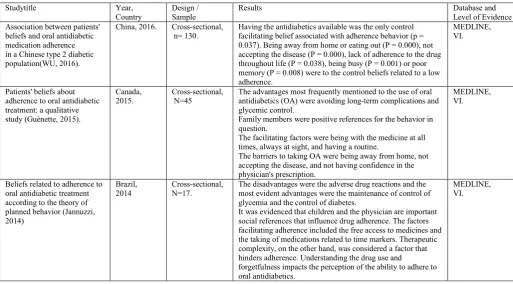
title, year and country of publication, the method used to base the research, sample size, main results and level of evidence and database. The analysis of the objectives of the included articles revealed that two studies aimed at correlating beliefs to drug adherence, and the other study targeted the survey of beliefs related to medication to guide interventions for better adherence. The studies were performed with a minimum of 17 participants and a
[image:3.595.38.552.84.368.2]maximum of 130, presenting different pathologies, but mainly chronic diseases.In carrying out the survey of beliefs, the studies defined the most prominent ones, that is, the most significant and those that can most influence positively or negatively in the decision making regarding the analyzed behavior. Table 2 shows which are the prominent modal beliefs of the studies.
Table 1. Studies included in the integrative review on the evidence of the use of the Theory of Planned Behavior for surveying drug adherence-related beliefs
Studytitle Year,
Country
Design / Sample
Results Database and
Level of Evidence Association between patients'
beliefs and oral antidiabetic medication adherence in a Chinese type 2 diabetic population(WU, 2016).
China, 2016. Cross-sectional, n= 130.
Having the antidiabetics available was the only control facilitating belief associated with adherence behavior (p = 0.037). Being away from home or eating out (P = 0.000), not accepting the disease (P = 0.000), lack of adherence to the drug throughout life (P = 0.038), being busy (P = 0.001) or poor memory (P = 0.008) were to the control beliefs related to a low adherence.
MEDLINE, VI.
Patients' beliefs about adherence to oral antidiabetic treatment: a qualitative study (Guénette, 2015).
Canada, 2015.
Cross-sectional, N=45
The advantages most frequently mentioned to the use of oral antidiabetics (OA) were avoiding long-term complications and glycemic control.
Family members were positive references for the behavior in question.
The facilitating factors were being with the medicine at all times, always at sight, and having a routine.
The barriers to taking OA were being away from home, not accepting the disease, and not having confidence in the physician's prescription.
MEDLINE, VI.
Beliefs related to adherence to oral antidiabetic treatment according to the theory of planned behavior (Jannuzzi, 2014)
Brazil, 2014
Cross-sectional, N=17.
The disadvantages were the adverse drug reactions and the most evident advantages were the maintenance of control of glycemia and the control of diabetes.
It was evidenced that children and the physician are important social references that influence drug adherence. The factors facilitating adherence included the free access to medicines and the taking of medications related to time markers. Therapeutic complexity, on the other hand, was considered a factor that hinders adherence. Understanding the drug use and
forgetfulness impacts the perception of the ability to adhere to oral antidiabetics.
MEDLINE, VI.
Table 2. Behavioral, normative, and control behavioral outgoing modal beliefs raised in the studies
BehavioralBeliefs
Positive beliefs (advantages)
Article 1: Helping to stay well, reducing the chances of developing complications from diabetes, controlling blood glucose, controlling diabetes and avoiding the need to inject insulin.
Article 2: Avoiding long-term complications.
Article 3: Controlling of blood glucose and disease.
Synthesis: Controlling the disease and preventing complications
Negative beliefs (disadvantages)
Article 1:Effects, such as hepatic and renal changes, the prescribed regimen of OA.
Article 2:Side effects.
Article 3:Adverse drug reactions.
Synthesis: Side effects.
NormativeBeliefs
Positive beliefs (facilitators)
Article 1:Physicians and nurses, spouses, and other family members.
Article 2:Spouses, children and family.
Article 3: Children, physicians, spouses and nursing staff.
Synthesis: Spouses, children, family and health practitioners.
Negative beliefs (barriers) Article 1: Not reported.
Article 2:Not reported.
Article 3: Diabetic acquaintances that had not adhered to treatment.
Synthesis: acquaintances non-adherent to therapy.
ControlBeliefs
Positive beliefs (facilitators)
Article 1: Always keeping medication in the same place at home, having a routine, having the medication at hand, receiving personal reminders, using of a tablet dispenser.
Article 2: Always having the medicines at hand, placing the medicines at the kitchen counter, at sight; and having a routine (i.e., associating the moment of taking drugs with something they do every day).
Article 3: Receiving the medicines for free, having routines and control of daily activities, taking medications associated with alarm clocks, taking medications when leaving home.
Synthesis: Having a routine related to the medication, having the medicine always accessible, receiving reminders (from people, alarm clock), receiving the medicines for free).
Negative beliefs (barriers)
Article 1:Being away from home or eating out, not
accepting the disease, ignorance about the drug throughout drug, receiving visits from friends or relatives, being busy and having a poor memory.
Article 2:Not trusting the physician's prescription and not accepting the disease.
Article 3:Having to take the medicines more than once a day.
DISCUSSION
The beliefs survey based on consistent theoretical references encourages the implementation of specific interventions, especially in the health problems in the world. Regarding the age and sex of the patients included in the articles, there was a predominance of age greater than 60 years and women. Regarding marital status, the results show that, on average, 80% of the individuals were married or lived in a common-law marriage (Jannuzzi, 2014 and Wu, 2016). It was identified that the studies were developed in people with chronic diseases, especially diabetes that affect mainly elderly people. Although there was no studies to evaluate the therapeutic adherence, but rather the beliefs related to this behavior, the fact that the sample of the studies analyzed was predominantly married or in stable union is considered positive for adherence since 91% of the elderly adherents to the medication lived with their partners, and elderly people who lived alone were three times more likely to not adhere to the treatment (Cintra, 2010). Although the objective of this study is not to focus on the clinical situations of the individuals, it is important to highlight that the main indications for the use of medications were non-communicable chronic diseases, especially diabetes and the use of oral anti-diabetic drugs. This may have been one of the reasons for the studies to raise the beliefs of this population, in particular, to propose health interventions to improve adherence to treatment and prevent complications or unfavorable clinical outcomes. Regarding the analysis of the studies, it was observed that studies were published between 2014 and 2016, in three different countries of the world, showing the relevance of studying the theme worldwide. As for the methodological design, the cross-sectional studies with a level of VI evidence predominated, considered fragile as regardstheir methodological rigor. Thus, new research with new designs is considered relevant to broaden the state of the art and produce consistent evidence for the adoption of protective health behaviors. To better organize the data, the discussion of this review was grouped in the three theoretical constructs proposed by the TPB.
Behavioral Beliefs: With regard to behavioral beliefs
whose purpose is to identify the advantages and disadvantages of adhering to the behavior of interest, most studies report that the advantages of drug treatment include the improvement of the health status and the prevention of complications. When individuals do not take medications regularly, there are changes in the normality parameters of reference exams, such as glycated hemoglobin, with the possibility of non-control of the disease and worsening of quality of life (Jannuzzi, 2014). On the other hand, the prevention of complications reveals that the participants of the studies received information about the possible complications due to the diseases, specifically diabetes that characterize the diagnosis of the participants. The side effects appear to be major disadvantages in the studies (Jannuzzi, 2014 and Line, 2015 and Mohammed, 2016; Wu, 2016). These reactions should be monitored and clarified and, if they do occur, they should be well managed so that these patients do not interrupt the use of the medication. A previous study with a similar population showed that side
effects are strong predictors of non-adherence to therapy (Mohammed, 2016). Therefore, investing in enlightening medical and nursing consultations about the possible side effects resulting from drug treatment and the importance of patients being attentive to these aspects and manifesting in return visits is very important for health maintenance and better perception of quality of life.
Normative Beliefs: Normative beliefs refer to the social
perception that approves or disapproves the performance of a behavior (Ajzen, 2015). According to the TPB, the opinion of family members, friends and even the people who make up the health service can influence in a positive (facilitative) or negative (barrier) manner the decision making towards the behavior. When spouses, children or friends find adherence to treatment relevant, the individual feels encouraged to follow the correct directions of the proposed treatment. Therefore, family support is a link in encouraging adherence to the established therapy (Mohammed, 2016 and Citra, 2010). In the studies, the spouses, children,and relatives were considered as facilitators and supporters in the adherence of the individuals, and the spouse is the main supporter for these individuals (Jannuzzi, 2014 and Line, 2015 and Mohammed, 2016 and Wu, 2016).These people help patients to take the medication by reminding them of consultations, of taking the medicines and by encouraging them in the decision to adhere to therapy. Patients of the studies in the present review are mostly carriers of chronic diseases that require laboratory follow-up and changes in lifestyle. Having a support network is essential for a successful lifelong treatment. Therefore, when spouses, children or friends find adherence to treatment relevant, the individual feels encouraged to follow the guidelines of the proposed treatment.
Control Beliefs: For patients who take medication on a continuous basis, keeping medications in an easily accessible place and having the medication at hand are facilitators in the life of these individuals (Jannuzzi, 2014 and Line, 2015 and Wu, 2016). To always have a time marker or a person who helps remind the schedule of the prescribed medication have emerged as contributory factors. Acquiring the medications for free is a belief of positive control. The free distribution of medication becomes indispensable for many patients since low financial conditions are limiting factors for drug acquisition, leading to noncompliance with drug treatment. In this perception, the World Health Organization (WHO) has set as a goal that50% of people with chronic diseases should receive free medication and counseling by 2025 to prevent complications (Malta, 2013 and Malta, 2017). On the other hand, oblivion was identified with a factor that may hinder adherence (Jannuzzi, 2014 and Wu, 2016). Significant negative association between adherence and beliefs was identified as being away from home when taking medication, not accepting illness and impaired memory (Wu, 2016). Other studies have shown that they hinder to take medication far from home and interfere with social life (Jannuzzi, 2014 and Line, 2015 and Mohammed, 2016). It is known that in some situations, it is necessary to use one or more drugs for the maintenance of clinical stability. Also, dietary restrictions and tests to control and adjust the dose of the drug are added. This treatment routine often leads to fatigue in the patient, which is a factor that impedes drug adherence (Jannuzzi, 2014 and Mohammed, 2016). Therefore, associating a routine daily medication, such as taking it close to a daily activity such as soap or lunch schedule, may facilitate adherence (Jannuzzi, 2014 and Line, 2015 and Wu, 2016). These patients often need to go to outpatient clinics or health facilities to follow up treatment, having transportation expenses that can be very expensive in the family budget. This factor was a barrier to drug adherence in one of the selected studies (Mohammed, 2016). Thus, it becomes salutary to develop public policies that facilitate the access of these users to health services for the follow-up of the therapeutics instituted. Strategies such as home visits and telephone monitoring can be tested to motivate and strengthen adherence to protective health behaviors, especially drug adherence.
Conclusion
The study allowed analyzing the beliefs related to drug adherence in light of the Theory of Planned Behavior. The main advantages, disadvantages, positive and negative referents, as well as facilities and barriers to the behavior studied were evidenced. The beliefs are elaborated by the individuals from their experiences and relationships built throughout the life and can be modified when the individual goes through new experiences, for example, access to information and health education. For nursing practice, this study opens new perspectives with the purpose of directing strategies to strengthen positive beliefs, as well as changing negative beliefs to favor drug adherence. A reduced number of articles was found as a limitation of this study. Thus, it is suggested that new investigations be developed to deepen the investigated phenomenon, especially in individuals who
coexist with chronic diseases, since non-adherence allows the disease to become uncontrolled, favoring the appearance of incapacities due to non-adherence to established therapeutics.
REFERENCES
Barros, S.M.M., Monteiro, P.A.L.; Neves M.B.; Maciel G.T.S.2017. Fortalecendo a rede de apoio de mães no contexto da síndrome congênita do vírus Zika: relatos de
uma intervenção psicossocial e sistêmica.Nova
perspect. sist., v. 26, n.58, p.38-59.
Budó, M. L. 2009. Educação em saúde e o portador de doença crônica: implicações com as redes sociais. Ciência e cuidado em Saúde, v. 8(supl), p. 142-147. Cervera, D. P. P.; Parreira, B. M., Goulart, B. F.
2011.Educação em saúde:percepção dos enfermeiros da atenção básica em Uberaba (MG). Ciência & Saúde Coletiva, Rio de Janeiro, v. 16, p. 1.547-1.554.
Cintra F. A.,Guariento, M.E., Miyasaki, L.A. 2010. Adesão medicamentosa em idosos em seguimento ambulatorial. Ciência & Saúde Coletiva, v.15 (Supl. 3) p.3507-3515. Gomes-Villas Boas, L.C., Foss, M.C., Freitas. M.C.F.;
Pace, A.E. 2012. Relação entre apoio social, adesão aos tratamentos e controle metabólico de pessoas com
diabetes mellitus. Rev. Latino-Am. Enfermagem., v.20,
n.1:08 telas.
Grah B., Silva A.; Prá K.R.D. 2015.Considerações sobre doenças crônicas, necessidades de cuidado em saúde e a responsabilização das famílias pelas políticas sociais. Seminário nacional de serviço social Trabalho e política social. Universidade Federal de santa Catarina. Florianópolis.
Jannuzzi, F. F., Rodrigues, R.C.M., Cornélio M.E., João T.M.S., Bueno M.C., Gallani J. 2014. Crenças relacionadas à adesão ao tratamento com antidiabéticos orais segundo a Teoria do Comportamento Planejado.
Rev. Latino-Am. Enfermagem, v.22, n.4, p. 529-37.
Laba, T.L., Lehnbom E., Brien J.A., Jan S. 2015. Understanding if, how and why non-adherent decisions are made in an Australian community sample: a key to
sustaining medication adherence in chronic disease?.
Res Social Adm Pharm. v.11, n.2, p. 154-62.
Line, G., Lauzier S., Guillaumie L., Giguère G., Grégoire JP., Moisan J. 2015. Patients’ beliefs about adherence to oral antidiabetic treatment: a qualitative study. Patient Preference and Adherence, v. 9, 413–420.
Malta, D. C., Silva Jr. J. B. 2013. O Plano de Ações Estratégicas para o Enfrentamento das Doenças Crônicas Não Transmissíveis no Brasil e a definição das metas globais para o enfrentamento dessas doenças até 2025: uma revisão. Epidemiol. Serv. Saúde, v.23, n.3, p. 389-39.
Mendes, K.D.S., Silveira R.C.C.P., Galvão C.M. 2008. Revisão integrativa: método de pesquisa para a incorporação de evidências na saúde e na enfermagem. Texto Contexto Enferm, v. 17, n.4, p.758-64.
Mohammed, A.M., Moles, R.J., Chen, T.F.2016.
Medication-related burden and patients’Lived
experience with medicine: a systematic review and metasynthesis of qualitative studies. BMJ Open, v. 6, n.2.
Penaforte, K.L. 2017. Associação entre polifarmácia e adesão ao tratamento farmacológico em pacientes com diabete. Rev Rene. v. 18, n.5, p. 631-8.
Stillwell, S.B, Fineout-Overholt, E., Melnyk, B.M., Williamson K.M. 2010. Searching for the Evidence. Am J Nurs, v.10, n.5, p.41-7.
World Health Organization. Global status report on noncommunicable diseases 2010. Description of the global burden of NCDs, their risk factors and determinants. Geneva: World Health Organization; 2010.
World Health Organization.2011. A Prioritized Research
Agenda for Prevention and Control of
Noncommunicable Diseases. Geneva.
Wu, P.,Liu N. 2016. Association between patients beliefs and oral antidiabetic medication adherence in a chinese type 2 diabetic population. Patient Preference and Adherence, v. 10, p. 1161–1167.