DIVISION OF PERCEPTION IN TRIPLICE HABITANTS (MG BA ES) ON THE USE OF SOLAR
ENERGY AS A MAIN SOURCE OF ELECTRICAL SUPPLY
Macriel Souza Cantão Neres, Bruno Augusto de Rezende, Raiomara Rodrigues Linhares de
Oliveira, Wanessa Soares Luiz Silva, Theresa Cristina Ricardo Soares, Sebastião Ricardo
Terceiro,
Carlos
Henrique Wernersbach Guerra
,
Eugênio Maria Gomes, Deiliane
Lopes de Oliveira, Jurair Rosa de Paula, Juscélio Clemente de Abreu
and
*Daniel Rodrigues Silva
University Center of Caratinga
ARTICLE INFO ABSTRACT
Electrical energy, over time, has Become an essential asset in the daily lives of people, present in the routine of businessmen, ordinary citizens, housewives and workers. Currently, electricity is mostly Obtained from finite natural resources, such as coal, radioactive material, petroleum, among others. Thinking about the future and imagining the end of Them, scientists, Researchers and enthusiasts Began to look for more efficient and renewable alternatives for the energy sector, and one of the solutions found was Obtaining through photovoltaic panels popular solar or energy, but still on the days of today, this technology is little or almost nothing used in the homes of ordinary people. Through a survey to evaluate perception, as a questionnaire, applied to citizens of some cities of MG, ES and BA, it can be seen que 94. 8% of people have heard of solar energy, 42% of Which Have Obtained According to this information through television, 82% state que They are aware of the Possibility of replacing conventional energy with solar and- When asked How They Evaluated Their own knowledge on the subject, on a scale of zero to ten, the majority (77 people) Considered que They are aware That the impacts generated on the environment are lower than the current most used source in Brazil (hydroelectric plants), where 83.3% responded que They That believe such impacts are minor. Another important finding was que, 76.7% of respondents stated que They would consider the Possibility of carrying out the exchange of the conventional by system solar plant, if They Were sought by the professional in the area who Could explain the operation, cost and feasibility of the However.
Copyright © 2019, Daniel Rodrigues Silva. This is an open access article distributed under the Creative Commons Attribution License, which permits unrestricted
use, distribution, and reproduction in any medium, provided the original work is properly cited.
INTRODUCTION
By the year 2017, Brazil had an estimated population of about 207 million people and is expected to reach 228.4 million between the years 2042 and 2043, according to the Brazilian Institute of Geography and Statistics (IBGE, 2017). Given these data, it is clear that the need for resources will also increase, not only those essential to survival such as food and water, but also energy. It is estimated that the demand for electricity in Brazil will triple by 2050, reaching 1,624 terawatt-hours (TWh), according to company data from the Energy Research Company (EPE, 2016). Population growth
*Corresponding author: Daniel Rodrigues Silva,
University Center of Caratinga
and, consequently, increased power consumption, has forced scientists, researchers, students and even enthusiasts to seek sources generating alternative clean and renewable energy, primarily as additional sources, but eventually may even be used as a substitute for current. Currently, 70% of electricity production in Brazil comes from hydroelectric plants, according to energy study data conducted by (EPE, 2016), making it clear that the electricity production sector of the country is almost funneled to a single array. However, the hydroelectric power plants are not only a source of power generation, counting this as well as alternative sources such thermoelectric generators by blades or wind (winds advantage of energy) and solar generators. Energy from the sun is very versatile, which may be exploited in various ways. You can
ISSN: 2230-9926
International Journal of Development Research
Vol. 09, Issue, 09, pp. 29620-29626, September, 2019
Article History:
Received 09th June, 2019 Received in revised form 29th July, 2019
Accepted 19th August, 2019
Published online 28th September, 2019
Key Words:
Solar energy,
The main energy source, Perception survey.
RESEARCH ARTICLE
OPEN ACCESS
use your light to illuminate environments, its heat for heating liquids, drying of grains and others and, according to the National Electric Energy Agency (ANEEL, 2000), it can still be converted into electrical energy and can be a great Alternatively the form of current production, especially because it is a clean and inexhaustible source. Despite presenting such versatility and advantages, this type of production is still little used, as indicated by data from studies conducted by the Solar Energy BlueSol company (2018), showing that in early 2018, in Brazil, there were only 20,897 installed photovoltaic systems (absolute numbers, covering all sectors). In the study area, these numbers were distributed as follows: 638 facilities in the state of the Holy Spirit, 449 in Bahia and standing with the highest amount, the state of Minas Gerais, which has 4,495 facilities. When it comes to renewable energy source such as solar, it is natural for those who do not know or never obtained information on the subject imagine something intangible small-scale, not knowing even that is possible to use it in their homes or businesses. In small towns of the states that have no such facility, did not know exactly where or what reasons its inhabitants did not use this feature leaving wasted. This work was precisely aimed to obtain information on what the main reasons that prevent or discourage people from making use of such technology, addressing ordinary residents of cities located in the tri-border region (Minas Gerais, Bahia and Espirito Santo), with questionnaire with closed questions on the subject of solar energy, in order to learn more about the perception of these people on the subject. Moreover such research may have the potential to open a new energy field and futuristic, making sure that there is viability for such implementation or not.
Theoretical
Energy: Humanity is in a constant process of modernization, where technology assists in just about everything, from the beginning of the day until bedtime. It becomes difficult to calculate the amount of things that involves some kind of technological process, overshadowing the level of presence of this in everyday life. By connecting mobile phones, laptops and televisions, when driving a car, or even the simple act of lighting a lamp, they are technological processes. All this evolution is over, therefore create a certain complacency, and increasingly make people dependent, making it impossible to imagine living in a world without these features. Except that all this convenience requires something in return, something that makes the operation of all of this possible, something of life to the whole study behind a technological project.
Renewable Energy Sources: According P (2005), it is considered renewable energy sources, those that are derived from cycles which are constantly renewed, and no risk of depletion by excessive use, such as biomass, hydro, wind, gravity or tidal , geothermal and solar. Although not having the risk of exhausting, some of these sources may have fluctuations or variations over a given period, for example, the wind can be buoyant with the lack of winds in a given season, the sun in cloudy periods or will overnight, the water may be affected by long periods of drought. These sources as well as renewable can also be considered clean because they produce no harmful gases to the environment, as is the case of fossil fuels, which when burned dump large amounts of greenhouse gases in the atmosphere, or nuclear generating radioactive waste with large polluter and high potential degree of harm that require extreme care storage or disposal. They also feature
a great prospect for the future, and may perhaps even be substituted for complete non-renewable sources, EPE (2016).
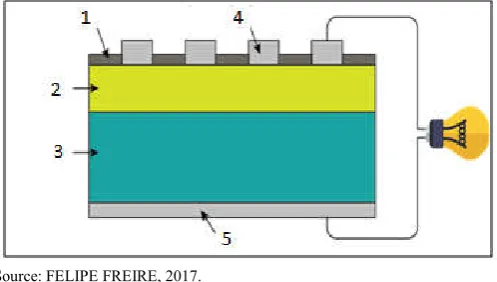
Solar Energy: Get energy through the sun has several advantages over other production processes, such as not produce waste, no floods large areas, just a collector tube installed prevents the flooding of 56 square meters of land, it does not emit toxic gases and besides, It presents quite different mechanisms of other more known processes, the main one being the fact of not having to move any kind of generating turbine. The sun is a source of energy so powerful that just a year can radiate enough energy to supply at 10,000 times all the energy consumed on Earth in the same period of time, and that only part of the energy millionth that only Brazil receives each year is equivalent to a proportional energy reserves to 2 times what you get with the burning of coal, As previously stated, the process of obtaining electricity through the sun is distinguished from others by the fact that no movement of any turbine and generating principle, but since then this energy is converted into electricity? The answer to this question lies in a process called photovoltaic effect, first observed in 1839 by Edmond Bequerel. Edmond noted a potential difference at the ends of a semiconductor structure when light is focused on it. In a simplified way, it can be said then that the photovoltaic effect is the direct conversion of light into electricity (MACHADO, 2014). Described by Nascimento (2004), the process of converting light to electricity takes place through so-called photovoltaic cells, these cells are made of semiconductor materials, ie materials that have intermediate characteristics between conductors and non-current conductors. The cell comprises a thin layer of silicon in pure form plus other materials such as phosphorus, for example, in order to obtain another material having free electrons or negative charge carriers reaching the N-type silicon To make the same process only instead of using boron phosphorus, a material is obtained with the characteristics inverse of the N-type silicon, and this presents absence of free electrons and positive charges, called p-type silicon. The cells are formed by a thinner layer of N-type silicon layer and a thicker material P type layers are separated when they are electrically neutral. When joined together, these layers form the PN region, an electric field occurs that free electrons of the N silicon occupy the voids of the P type silicon When the light reaches the surface of the cell there is a collision between the electrons and photons of silicon structure, providing - energy and transforming them into conductors, (Figure 1). The electrons pass to flow from the P layer to the N layer due to the electric field formed by the PN junction.
[image:2.595.310.559.620.761.2]Source: FELIPE FREIRE, 2017.
By connecting an external conductor layers on the positive and negative generated if an electric current, Machado (2014), writes in his book that the first industrial solar cells were built in 1956, but at the beginning had a very high production cost, which made them impractical for large-scale production, but over time, emergence of energy crises such as oil in 1973, the increase in world energy demand and the consequent need for alternatives to be considered finite sources, this type of technology is becoming more interesting and promising, to the point of doing this even in homes, as shown in Figure 2 scheme.
[image:3.595.45.274.195.325.2]Source: SOLAR ENERGY OF BRAZIL, 2018.
Figure 2. Residential solar power operation scheme: 1 (Switchboard), 2 (Photovoltaic Solar Panel), 3 (Bidirectional
Energy Mete), 4 (Power Distribution Company).
New Technologies: Since its discovery in 1956 until the present day photovoltaic cells and the way to take advantage of the energy comes from the sun evolving and becoming more efficient and less costly from a financial point of view. According to Braga (2018) and published on the website of the Institute Newton C. Braga (2018), 85% of photovoltaic cells are made of silicon base WHAT allows an approximate yield of 33%, which is not nearly be the ideal taking into consideration the great potential radiation that has Brazil. In an article written for Mouser Electronics, Keeping (2018), discusses a new way of producing photovoltaic cells that instead of using silicon as a main raw material, using alternative materials such as semiconductors, gallium arsenide, gallium phosphide and as the mineral perovskite. In addition to using these alternative materials, Keeping also addresses new assembly techniques and architecture that will provide greater energy efficiency and durability occupying less space than conventional cells.
Sunroof: Text Germano (2018), is discussed a new concept of solar panels developed by US company SolarCity, Tesla belonging Inc. ElonMusk enthusiast, famous for investing in new technologies for clean energy generation, among others. The company has developed tiles involving solar panels in order to produce texture and appearance similar to gravel and mud, but with resistance to 4 times longer than common parts, and for use together with the tiles, the SolarCity also developed Powerwall, a kind of home battery that stores energy collected during the day allowing for nighttime use. Each is capable of generating an approximate power of 6W, as they have a cell of 15 cm² each to get an idea of how much it is for non-expert.
Ink Photovoltaic: Increasingly seeking efficiency, low cost and space optimization, researchers and scientists are testing
new technologies. An example of this can be read in Silva (2011), for Tecnoblog, where he publishes a new way of obtaining solar energy discovered by scientists at the University of Notre Dame. The experiment consists of an ink that is capable of capturing from sunlight and converts it into electricity, the ink is made using titanium dioxide nanoparticles with sulphide or cadmium selenide, these compounds have the ability to absorb photons. In initial tests, the paint was passed on a transparent surface and conductive and exposed to the sun thereby generating an electric current, but not everything is perfect, at first, it was observed that only 1% of the captured sunlight is converted into electricity, But on the other hand, scientists say the paint has low production cost and can be done in different textures, and can be produced on a large scale without major problems. Curious to imagine that in the future not so far can be residential, commercial, floors, parks, among others, generating electricity simply by being painted.
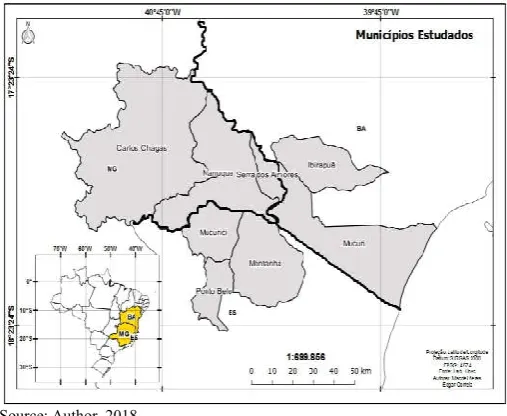
Methodological Approach 3: This study was conducted in the tri-border region between the states of Bahia, Minas Gerais and Espirito Santo, and can be observed in Figure 3, highlighting the cities where it was held. The Holy Spirit, according to the IBGE CITIES (2017), will have until the year 2018, a population of 3,972,388 inhabitants, occupying 14th place in population ranking of Brazil. Population density is 76.25 hab./km² with human development index of 0.740, taking this regard, the 27 ° National position. The state has a land area of 460.86.907 km². The state of Bahia, with an estimated population of 14,812,617 for the year 2018, 4th place in the country, with a population density of 24.82 hab./km². It is the 5th largest Brazilian state, occupying a land area of 564732,450 m², presents human development index of 0.600. IBGE Cities (2017). Finally, Minas Gerais, with 586 520 732 km², 4th largest state in the Federation territory. It has second last IBGE survey 19,597,330 inhabitants, but it is a very large state in area, has a population density of 33.21 hab./km², less than the Holy Spirit.
Source: Author, 2018.
Figure 3. Area of the survey
[image:3.595.307.561.507.715.2]Belo, Mucurici and Motanha) in Minas Gerais (Carlos Chagas, Nanuque and Serra dos Aimorés), according to the statistical criteria obtained in the IBGE site cities (Brazilian Institute of Geography and Statistics), which, depending on the number of permanent residence, it was defined for a margin error of 5%, the amount of people to be addressed in each city. Were chosen to search the profiles of people cumuns, noting only if they were residents of their respective cities where the survey was being applied,
Applied a closed questionnaire for the public chosen with questions about the understanding of ourselves in relation to use of solar energy as the main source of supply to their respective homes on knowledge regarding the use of solar electricity, some issues a little more technical and finally, financial or economic developments;
After obtaining the questionnaire data applied, interviewed public perceptions was discussed about their knowledge and possible impediments to implementation of such technology in their homes and possible viability of a future market.
RESULTS AND DISCUSSION
Perception of general knowledge of the target public about solar energy
Conhecimento public about of soloil energy: The result of the analysis of responses globally questionnaires, points out that the vast majority of people in the study area (94.8%) have heard of solar energy. Overall the trend level of knowledge about the existence of such a feature remains similar between the states, with no major discrepancies. When analyzed the reality in each state, the following results were obtained: Bahia, with 97.7% of people stating they have already heard of solar energy, Minas Gerais, with 91.2% of people who answered yes, and Finally, the Holy Spirit, with 85.7% connoisseurs of the existence of this technology. This similarity in results can occur because of the sources of information are the same, because in general, people heard about on television, (as explained below). Present in almost all currently residences, thereby generating a proximity in the results.
Source of public information: The study also shows that, in general, most people have heard about it through television, which obtained 48% of the general indications, proving to be the most effective means of dissemination, ahead of the internet, friends and even professionals. This result indicates that people do not report through the professionals who really understand the subject, suggesting that a few of these, or a few companies that work with solar energy in the region, and if there are, they do not have audience residential consumption, leaving a gap in this sector, as shown in Figure 4. In all states the trend is repeated, confirming the television as largely responsible for introducing people this feature.
Public perception on knowledge of environmental impacts: According to the Ministry of Mines and energy data (2017), 68% of the electricity consumed in Brazil is produced by hydropower, and only 32% comes from renewable sources such as solar, for example. To produce electricity from hydropower is generated considerable impact on the environment such as flood large areas, fauna and flora
displacement, river diversions courses, among others. The environmental impact of solar energy is positive, because it does not cause deforestation, floods or affects flora and fauna, and does not pose risks to dam collapse (ATP SOLAR, 2017).
[image:4.595.330.533.107.270.2]Source: Author, 2018.
Figure 4. As people heard of solar energy
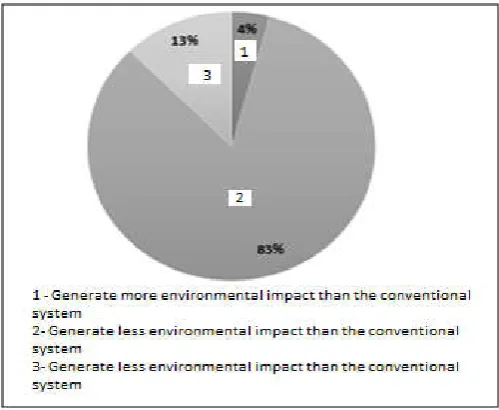
It can be seen in Figure 5, that people's perceptions of the general area of the conduct of research concerning the environmental impacts caused by hydroelectric and solar plants converge with reality, this trend remains constant when the analysis is done by state, but in the sphere municipal, one of cite attention by presenting a high level of ignorance about this fact. The municipality Ibirapuã in Bahia, where 41.2% think that both generate the same amount of impact on the environment, 17.6% believe that solar production more mugs, and 41.2% think that the solar power plants producing less impact that hydropower. This result indicates that the population of Ibirapuã-BA need a bit more information about it, information that apparently not moving consistently in the city, Lack of conheciments about solar energy from this public by professionals, suggests that there is little or no presence of these in the city, leaving open a local market that could be explored. The outreach work of the information and demonstration of the advantages both economic and environmental benefits for the population, can help improve this scenario, in addition to a possible development of the market could increase the regional economy with benefits to the environment.
Source: Author, 2018.
Figura 5. Evaluation of the people on the generation of environmental impacts caused by solar plants, compared
[image:4.595.309.559.553.758.2]Self-evaluation on general knowledge of the public: Another important item on the general knowledge that the research sought to clarify, was the self-assessment of residents on how they consider their own knowledge on the subject solar energy in general, and with the result, it was observed that they see themselves as intermediaries, where 26.0% of people surveyed who reported knowledge about solar energy, believe that on a scale of 1 to 10, their educational level is 5. This result indicates that the public does not have a high level of confidence about their own knowledge, they believe only the basics, leading us to believe that a disclosure policy that much wider and comprehensive sector is still necessary, so that it can grow and develop benefiting as many people as possible. This situation could be changed with dissemination of information and investments in the sector, perhaps a union of municipalities and state and federal governments for the preparation and implementation of projects to produce clean, renewable energy.
Technical knowledge of the target public about solar energy
Degree of perception replacement, installation and installation location: Since the year 2012 approximately, Brazilian consumers can choose to generate their own electricity through solar power plants, which can replace conventional energy or work in parallel with it, called On Grid systems. To be very versatile, this way of producing electricity can be installed almost anywhere, such as houses and apartments, even if they are in isolated areas, for example, without causing any harm or bring any risk to homes where they were installed. To evaluate the perception of people about these things, they were they knew that it is possible to replace the electricity from their homes by solar energy, if they believed that it could be installed in apartments, and thought that the installation could offer some kind of risk to housing. It was found that 82.3% said they know that it is possible to replace the way to get electricity, which is very good, as it shows that this type of information is well known in region das three borders, there is no need of intensive outreach work and this not being an impediment to the use of technology. 78.7% think it is also possible to install in apartments, and 87.9% do not believe that this type of installation can pose risks to residency. this perception is important, therefore rule out a possible prejudice of people to install the system in their homes for fear of possible risks. Analysis of the results shows that people in the region are informed about these criteria, and trends are repeated when analyzed reality in the states and municipalities, with only minor variations in the levels of perception.
knowledge of public on how obtaining solar energy: Second Birth (2004), to obtain solar energy is necessary photons (sunlight particles), relate to a semiconductor material, thus producing an electric current, so the higher the incidence of light, the greater the efficiency of the system generation, that is, the brighter the day, more electricity is generated. In the region where the study was conducted, the population addressed demonstrated not have a clear understanding of how solar energy is obtained. When asked how they thought it was possible to obtain solar energy, 41.6% answered that it is possible only on clear days, 55.4% said that it is possible any day, whether light or dark, and 3% believe that you get solar energy in dark days (Figure 6). For comparison, as can be seen
by the results occurred state, being possible to observe that the largest bias occurred in the mines, Figure 7.
Perception of economic knowledge of the target public about solar energy
Public knowledge about the product solar energy: One of the intentions of the study is to get a clarification on why there are so few homes with solar installations and assess the perception of people about it. For a product to be consumed by a particular target audience it must first of all be released and provided with solar energy is no different, because it is a good that is traded like any other.
[image:5.595.319.536.210.410.2]Source: Author, 2018.
Figure 6. How do people believe what you get overall solar energy
[image:5.595.306.563.437.555.2]Source: Author, 2018.
Figure 7. How people believe you get solar energy, by state
Source: Author, 2018.
[image:5.595.327.534.579.781.2]In order to know if this product is being offered to the citizens of the region, he wondered the same if any professional area (solar energy) had already sought them and offered some kind of service related (Figure 8). It is observed that in general the rate of people who have been sought by professionals is low, but the state of the Holy Spirit further drew attention for not presenting anyone who has been sought, showing that there is a significant weakness in this sector, as shown Figure 9. This result may be generated due to lack of professionals, or companies specializing in residential solar installations, or can occur due to the state to present a certain amount of small municipalities and companies do not consider it economically viable undertaking in the state.
[image:6.595.36.292.215.367.2]Source: Author, 2018.
Figure 9. Answers about have already been sought by professionals to offer related products (by state)
The overall result is impressive the amount of people of the total sample said that they had never been sought by these professionals (82.0%), proving that there is a deficit, or market attention to the region, or specialized professionals. Another important finding revealed, is that the population shows some concern about a possible acquisition of a photovoltaic system. They were asked if the case were sought by a healthcare professional to explain their operation, investment cost, and turnaround time, they would take into account changing the conventional source of energy use for a source of solar electricity, and the result was surprising since 77.7% said yes. Perhaps this concern is justified due to the rising price of conventional electricity, At the state level, the degree of interest of citizens is similar, but the municipal level, there was a trend reversal in the city of Serra dos Aimorés - MG, where 77% of respondents said they did not consider making the switch. It was not possible to see exactly what reason there was this reversal of trend in the city, but perhaps with a professional working in the area, informing and providing information and financing possibilities to people, this trend can be reversed. Still show there is potential for economic exploitation in the global area of study by companies working with this technology.
Science population about costs and financing: According BlueSol (2018), currently in Brazil there are specific funding lines for the purchase of solar energy systems, by public and private banks with low interest rate and flexible terms, moreover, many of these loans still allow payment with own energy saving obtained in the energy bill. Unfortunately most people do not know the existence of these lines of credit, another factor that influence the low amount of residential facilities in the area. When asked if they have heard of the
possibility of financing the system, only 23.6% said yes. If this information was disclosed consistently to residents, perhaps there would be greater interest of people in at least seek information on these lines of credit, and consequently a greater number of such facilities.
Opinion about possible obstacles to investment in their own homes: Finally, citizens were asked why they thought people did not invest in solar energy for their own homes, it is observed in Figure 10. Of the total covered population, 56.0% think it is a lack of financial resources, possibly because most of the cities that make up the bulk sample are not poles of major industries that revolve resources, and in some the largest source of income are the municipalities. 36.0% believe it is due to lack of information, and this factor was evident throughout the study as if not the main, one of the main factors that prevent people from investing, and only 8.0% said that it is for lack of personal interest, ie, there is a clear indication that, although the market worked, and expose people the right information, showing them the advantages that exist in this sector,
[image:6.595.317.540.309.509.2]Source: Author, 2018.
Figure 10. Reasons why people do not invest in solar energy in their homes in the opinion of the public
Conclusion
By observing the results, it can be seen that the population of the studied region has a satisfactory level of awareness about general knowledge related to solar power because they know of its existence, know that it is possible to use it as the main source of electricity they know that generate less environmental impacts, with a little less knowledge just about how to obtain. The results show that there is little use due to lack of information on important aspects such as the possibility of funding, lack of public approach by professionals and the lack of financial resources.
REFERENCES
ANEL, Agência Nacional de Energia Elétrica. Energia solar, 2000. Disponível em: http://www2.aneel.gov.br/ aplicacoes/atlas/pdf/03-energia_solar(3).pdf. Acesso em: 10 jun. 2018.
ATP, Solar. Entenda de maneira simples quis os impactos ambientais da energia solar, 2017. Disponível em:http://www.atpsolar.com.br/impactos-ambientais-da-energia-solar/. Acesso em: 18 nov. 2018.
BLUESOL, Energia solar no Brasil: Um panorama pra você entender tudo, 2018. Disponível em: http://blog.bluesol. com.br/energia-solar-no-brasil-panorama/. acesso em 23 mai. 2018.
BRAGA, Newton C. Instituto NCB. Nova tecnologia de células fotovoltaicas beneficia a obtenção de energia solar 2018. Disponível em: http://www.newtoncbraga.com.br/ index.php/novas-tecnologias/14044-nova-tecnologia-de- celulas-fotovoltaicas-beneficia-a-obtencao-de-energia-solar-art3907. Acesso em: 28 de set. 2018.
CUNHA, Julian, PCH Anhanguera: Energia Renovável, 2009.Disponível em: http://www.celan.com.br/ website_seband/wfArtigosView.aspx?id=18. Acesso em: 26 mai. 2018.
DICIO, Dicionário Online de Português. Significado de energia, 2018. Disponível em: https://www.dicio.com.br/ energia/. Acesso em: 10 jun. 2018.
DO NASCIMENTO, Cássio Araújo. Princípio de
funcionamento da célula fotovoltaica. 2004. Tese de Doutorado. Universidade Federal de Lavras. Disponível
em: http://www.solenerg.com.br/files/monografia_
cassio.pdf. Acesso em: 28 mai. 2018.
EPE, Demanda de energia, 2016. Disponível em:
http://www.epe.gov.br/sites-pt/publicacoes-dados-abertos/publicacoes/PublicacoesArquivos/publicacao-227/ topico-202/DEA%2013-15%20Demanda%20de% 20Energia%202050.pdf#search=demanda%20energetica% 20brasileira. acesso em:23 de mai. 2018.
EPE, Empresa de Pesquisa Energética. Matriz energética e elétrica, 2017. Disponível em: http://www.epe.gov.br/ pt/abcdenergia/matriz-energetica-e-eletrica. Acesso em: 30 mai. 2018.
FREIRE, Felipe. Energia solar ao alcance de todos, 2017.Disponível em: http://sharenergy.com.br/como-funciona-celula-fotovoltaica/. Acesso em: 10 jun. 2018. GERMANO, Felipe. Revista Super Interessante. Edição 388:
O fantástico mundo de Elon. São Paulo, mai. 2018. p. 33-34.
IBGE, Cidades, 2017. Disponível em: https://cidades.ibge. gov.br/ brasil/es/ponto-belo/panorama. Acessoem: 01 jun. 2018.
KEEPING, Steven. New PV Cells Benefit Energy Harvesting 2018. Disponível em: https://br.mouser.com/applications/ New-PV-Cells-Benefit-Energy-Harvesting/?utm_mediu m=email&utm_campaign=elq-17.1004.techapp-energyharvesting-en&utm_source=eloqua&subid= 956793f1b16c4feaa1694c00fab77a30&utm_content=6063 273. Acesso em: 28 de set. 2018.
LAVEZZO, Cézar, Fontes de Energia, 2016. Disponível em:http://www.unifia.edu.br/revista_eletronica/revistas/ge stao_foco/artigos/ano2016/012_fontes_energia.pdf. Acesso em: 26 mai. 2018.
MACHADO, Alexandre, Energia Renovável, 2013.Disponível em:https://desa3nho.wordpress.com/category/energia-renovavel/page/2/. Acesso em: 26 mai. 2018.
MACHADO, Carolina T.; MIRANDA, Fabio S. Energia Solar Fotovoltaica: uma breve revisão. Revista Virtual de Química, v. 7, n. 1, p. 126-143, 2014. Disponível em: http://rvq-sub.sbq.org.br/index.php/rvq/article/
view/664/508. Acesso em: 27 de set. 2018.
MME, Ministério de Minas e Energia. Renováveis devem manter participação de 43% na matriz energética em 2017. Disponível em:http://www.mme.gov.br/web/guest/pagina-inicial/outras-noticas/-/asset_publisher/32hLrOzMKwWb/ content/renovaveis-devemmanter-participacao-de-43-na-matriz-energetica-em-2017. Acesso em: 18 nov. 2018.
PACHECO, Fabiana. Energias Renováveis: breves
conceitos. Conjuntura e Planejamento, v. 149, p. 4-11,
2006. Disponível em: http://files.pet-quimica.
webnode.com/200000109-5ab055bae2/ Conceitos_
Energias_renov%C3%A1veis.pdf. Acesso em 26 de set. de 2018.
PENA, Rodolfo F. Alves. "Fontes não renováveis de energia"; Brasil Escola. Disponível em https://brasilescola.uol.com.br/geografia/fontes-nao-renovaveis-energia.htm. Acesso em 26 de set. de 2018. SILVA, Rafael. Tcnoblog: Cientistas criam tinta que gera
energia elétrica a partir da luz solar. Disponível em: https://tecnoblog.net/86391/tinta-energia-luz-solar/. Acesso em: 29 de set. 2018.
SILVEIRA, Daniel, G1, Brasil tem mais de 207 milhões de habitantes, segundo IBGE. 2017. Disponível em: https://g1.globo.com/economia/noticia/brasil-tem-mais-de-207-milhoes-de-habitantes-segundo-ibge.ghtml. Acesso em mai. 2018.
SOLAR ENERGY DO BRASIL. Como funciona a energia solar residencial, 2018. Disponível em: http://solarenergy. com.br/energia-solar/residencial/. Acesso em: 10 jun. 2018.