7349
WHO THINKS MEMORY MORE VALUABLE IN
E-COMMERCE?
MATING GOAL PRIMING AND IMPLICIT SELF THEORY
JUNSIK KWAK
1Associate Professor, Dongseo University, Division of Global Business Administration, Busan, Korea
E-mail: 1[email protected]
ABSTRACT
What is the value of memory? If I give you money, can you erase your memories? What would you do if you had to erase your memories after a pleasant vacation? In this study, we examined to see how much people appreciate memories. The results show that the value of memory is different with gender and age. First, People like what they can remember rather than current pleasures. Second, men consider current pleasures than memories over women when priming a mating goal. Third, depending on age and gender, the choice of pleasure and memory is different. As men age, the value of memory decreases. But women are no different. Fourth, Mating Goal priming effect is different according to implicit self-theory. The mating goal priming in a group with incremental theory gives higher value for pleasure than a group with entity group.
Keywords: Mating goal priming, Implicit self-theory, Value of memory, Gender difference, Online choice.
1. INTRODUCTION
People live on memories. Memory tells the story of our past and it reminds us of the way we were. It does not matter whether it is a good memory or a bad memory. The fact that there are many memories is proof that I lived hard. What is the purpose of memory? Memory is aid to preserve our past, to learn something from past, to connect or to tell the story. The dictionary definition of memory is to retain and think the previous impression or experience in consciousness. Kronlund et al. (2008) found that the memory is the past recall, and argued that it is a moderating factor of behavior, speech, conceptual knowledge, skillful activities, social actions, and consumption behavior of people[1]. According to Braun (1999), memory is a dynamic and active system used for decision making through information acquisition, storage, and retrieval [2]. Bettman (1979) argues that the use of memory is different for each person, as well as having a variety of strategies [3]. The longer it takes to recall the memorized information, the better it will be used in the purchase plan. People have a high degree of confidence in the memory of past recalled experiences, and consumer decisions are strongly influenced by the memory of previous experiences
How much money do you want to get if you can to sell your memories? If someone tells you to choose between a fun trip and a memorable trip, which trip will you choose?
This study was initiated to investigate whether mating goal priming affects people's value of memory. So far there have been many studies on
the priming effect.
2. THEORETICAL BACKGROUND
2.1 Priming Effect
7350 According to current priming effect studies, the first concept which comes into a persons’ mind easily affect decision and behavior; and this concept has still affect even though it has nothing to do with decision and choice [4]. Many researchers studied the relationship between priming concept and decision when the object is ambiguous in early priming effect study. For example, Yi(1991) studied whether target computer with many functions was evaluated positively (diverse functions) or negatively (complicated functions). Before showing that target computer, he showed one group “Ez-Com” advertisement, which was easy to use; while he showed the other group “Versa-Com” advertisement, which had many different functions. People who see the “Versa-Com” advertisement evaluated target computer positively with concept of “diversity” whereas people who see the “Ez-Com” advertisement evaluated target computer negatively with concept of “convenience” [5].
Evaluating the target in the same direction as the priming concept is called assimilation effect. while contrast effect goes with different direction of priming concept. For example, assimilation effect is people evaluate a product expensive when people was primed with “expensive” concept, while contrast effect is people evaluate a product cheap when people was primed with “expensive” concept. Many researchers studied the conditions that show assimilation effect and contrast effect when specific concept was primed. As a result, the conditions under which the contrast effect appears are as follows: when participant tries to edit the process after knowing the impact of priming concept on a target [6]; when priming concept is too extreme to generalize [7]; when exemplar becomes comparing standard on decision toward target8. Recent studies on priming effect showed more different conditions of assimilation and contrast effect. For example, assimilation effect can be shown on target evaluation when consumers are in positive mood while contrast effect con be shown when consumers are in negative mood [8]. whether priming stimulus is trait or exemplar is not important to assimilation or contrast effect; It is important to focus on similarity or difference during comparison [9]. In other words, assimilation effect appears when people focus on similarity while contrast effect appears when people focus on difference.
Subsequent studies on priming effect have expanded from priming trait or exemplar to goal. Priming goal and priming concept are different in two aspects [10]. First, priming goal can have increasing priming effect until the goal is
accomplished while priming concept can have decreasing priming effect. Second, priming concept influence on every tasks equally when people do multiple tasks while priming goal has no impact after the goal is accomplished. Based on these facts, Chartrand, Huber, Shiv, and Tanner (2008) studied whether people choose premium Nike socks or cheap Hanes socks after priming ‘prestige’ or ‘thrift.’ As a result, a group who take a break time after priming ‘prestige’ select Nike more than a group who do right after priming, which is effect of goal priming [11]. Moreover, when they do two tasks after finishing the first task or after finishing the first task, there is no more priming effect after the first task is finished.
Meanwhile, priming effect can also be shown when priming goal is general action goal or inaction goal rather than specific action or inaction goal. Albarracin and colleagues (2008) showed subjects the words related to general action (action, doing, making, etc.) and that to general inaction (still, pause, etc.). After experiment people who showed general action words are more likely to play origami than rest, to solve SAT problems longer, and to eat grapes more [12].
The tendency or perception that people have implicitly about self or other’s intelligence or ability was called the implicit self-theory. This is a subjective measure that evaluates an individual's intelligence or ability. The implicit theory can be divided into entity theory that intelligence or ability is fixed, and incremental theory that intelligence or ability can develop. So, there are two types of theorists in implicit self-theory. One is entity theorist who thinks that intelligence and ability is fixed and cannot change. The other is incremental theorist who thinks that intelligence and ability can be changed by effort. According to the implicit self-theory, people who have entity theory or incremental theory showed different behavior patterns in the same situation.
The perception or behavior of people can be changed after specific concept or goal was primed. Therefore, people can select differently after mating goal was primed. Especially men are more likely to select more enjoyable task than women. This effect varies with age and implicit theory.
2.2 Mating Goal
7351 exude youth and health because these represent female fertility [14]. On the other hand, women prefer men who have the ability to care for themselves and their children. That is, women preferred men with great ambitions, wealth, and social status.
Reproduction is related to two sub-goals for both men and women. First, the goal of selecting a spouse is related to screening the opposite sex individuals first. In other words, you should exclude the mates who are non-suitable. Second, you should look for a partner to match yourself and show your value to the potential partners you are interested in. This second goal is called as the mate attraction goal. Mate attraction is related to appealing to the fact that I have a property that the opposite sex values.
Goals often lead to a cognitive system that seeks to achieve the desired end goal. When the goal is activated, the evaluation of the object that helps to achieve the activated goal changes positively. For instance, when you are hungry, food becomes more attractive. Once you have a goal to resolve hunger, you will be more interested in what makes you more likely to achieve this goal. For example, a hungry person responds more sensitively to the word bread or sandwich than the word shoes or table. When you are thirsty, you are more sensitive to words such as water and juice than bread or sandwiches.
So when a mate selection goal is activated, it becomes easier to find attractive opposite sex members surrounding it because of perceptual readiness. Women’s perceptual readiness also becomes strong and they find attractive men easily. Furthermore, the intention to show their value increases. The man tries to brag about how economically he is rich. Also, when the mating goal is activated, the male becomes more ambitious and the importance of wealth increases. Because luxury shows how competent and socially high they are, men with mating goals consumes conspicuously. On the other hand, the intention to purchase a functional product is lowered.
There is a previous study that mating goal has an effect on the evaluative readiness in men for status consumption. Kim and colleagues conducted a study to find out that the mating goal also affected the perceptual readiness [15].
For this purpose, 133 male students were manipulated mating goal based on female clothing and appearance. First, in the case of the control group, they met a plainly dressed female experimenter, and in the mating cue group they met a sexily dressed female experimenter.
Male students showed 10 pictures with 6 different products for 1 second. Each photo included one status product (Breitling watch, Porsche, Aston Martin, laser keyboard, exclusive mansion, I-mate, I-pod, Maserati, Mont Blanc pen, and home cinema system) and five functional products (e.g., stapler, towel, mug, umbrella). When researchers asked about how conspicuous and expensive the selected products were in the pretest, people rated status products to be more conspicuous and expensive than functional products. After all the experiments, they were asked to recall and write down as much products possible, not brand name.
After analyzing the current relationship status with a seven-point Likert scale, the analysis was conducted by dividing the single group (response <3) and committed relationship group (response> 3). As a result, three-way interaction between mating cue (sexy vs. plain), relationship status (single vs. committed) and product type (status product vs. functional product) was significant in the proportion of status products recalled. There was no difference in the proportion of status products recalled in committed relationship group depending on what clothes experimenter were worn. However, single group showed a higher proportion of status products recalled after seeing a sexily dressed experimenter than after seeing a plainly dressed experimenter. Single group who saw an experimenter wearing a sexy dress showed a lower proportion of functional products recalled than those who saw a plain dresser.
7352 best act to show men's courage. For this reason, men say that even if hunting is an ineffective way of survival, they demonstrate that they can become good spouses by taking courageous actions in front of women at the risk of their bodies [16]. Men who was primed by mating goal tend to be physically risk takers as well as mentally high risk takers. As a result, men with mating goal have become more inclined to try new things that others have not thought of and have gained a higher score in the test to measure creativity than men who have no mating goal. The physical and mental risk taking of men with mating goal also leads to a low loss aversion of financial decision making. In the case of choosing between high risk-high return option and low risk-low return option, men with a mating goal are more likely to choose high return option than those who have no mating goal, even if they have a loss. When you have to make a financial decision whether to save or not your own money, the men who have a mating goal are said to save less and spend more money. Men have proven that they use more resources to behave better to partner among various consumption [18].
The mating goal has a great influence on the behavior of women as well as the behavior of men. Women with mating goals try to be more kind. This is because men consider how one of the important criteria for female is to be a kind parent to a child. The influence of mating goals is also valid for eco-friendly consumption associated with kindness.
The lipstick effect of women, which is widely studied in economics, can also be explained in terms of evolutionary psychology. The lipstick effect is that and women prefer a cheaper and more relaxed product like lipstick in a depression. There are cosmetics and women's underwear that are representative of these lipstick effects. But the interesting thing is that cosmetics sales increase in recession, but women's underwear sales decrease. In this question, a joint research team from four American universities (Texas Christian University, University of Minnesota, University of Texas at San Antonio, Arizona State University) studied lipstick effect. The researchers described the essence of the lipstick effect based on life history theory, focusing on the fact that cosmetics are products that decorate women's appearance and that underwear is far from decorating their looks. In other words, it is not a desire for low-priced commodity but a phenomenon that is caused by motivation to be attractive to a partner.
According to the theory of life history, since the resources available to an individual are limited, all
living things decide whether to spend resources for their growth and development or for reproduction of species such as marriage, pregnancy, and parenting. The reason the old lady misses the marriage is that she chose her self-development between self-development and reproduction. But in recession, people try to spend resources on reproduction rather than self-development. At this time, men use a strategy of securing a lot of resources, but women try to look attractive to men because they have to choose men who have a lot of resources to invest in themselves and their children. However, depression can lead to unemployment and the number of trustworthy males with abundant resources is decreasing, so news to the women about the recession is taken as a signal to invest more in shaping their appearance. They did a total of five studies. Based on the unemployment rate and consumer purchasing statistics for 20 years, the analysis was divided into products related to decorating the appearance (e.g., cosmetics) and items not relevant to decorating the appearance (e.g., furniture). Analysis shows that as the unemployment rate increases, sales of products that are not related to appearance decorations have decreased, but purchases of decorating products have increased. And after reading the article about recession, men did not show any difference when asked about their preference for cosmetics and non-cosmetics products, but they found that women preferred cosmetics. Experiments on women only showed that depicting the recession-related picture increases the preference for expensive beauty products and financial stable men. lipstick effect is related to the desire for marriage when consider the fact that women like more advertisement with a message appealing to their partner even though the same product. However, this lipstick effect is seen only in younger women than women in their 50s or older [19].
2.3 Implicit Self Theory
7353 believe that intelligence and ability can be changed by effort. They tried their best to solve challenges and solve problems even in situations where they can fail or have no confidence.
This study has three research themes when priming a mating goal. First, we examine whether the mating goal affects the evaluation of memory value. Second, determine whether the effect of mating goal varies with age. Third, we investigate the effect of mating goal priming according to implicit self-theory.
H1. Mating goal priming influences on the value of memory.
H2. The effect of mating goal priming varies with age.
H3. The effect of mating goal priming varies with implicit self-theory
3. Online Experiment
3.1 Experimental Design
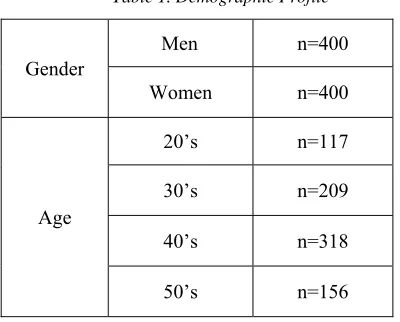
[image:5.612.84.284.468.629.2]Eight hundred people participated in this experiment by online. Demographics of participants are shown in Table 1
Table 1. Demographic Profile
Gender
Men n=400
Women n=400
Age
20’s n=117
30’s n=209
40’s n=318
50’s n=156
Experiment tested the impact of mating goal priming and with gender in the value of memory. To mating goal priming. For men, they are asked to choose one of three attractive actresses who they would like to marry. On the other hand, control group is asked to choose one of three attractive place they want to walk alone. For women, they are asked to choose one of three
attractive actors who they would like to marry. whereas the group is asked to choose one of three attractive place they want to walk alone. After that they are asked to choose between memory focus trip and pleasure focus trip. Gender (men and women) and priming concept (no priming, and mating goal priming) are allocated randomly. The participants show one among the two tour packages.
- A Memory Focus Trip: You can go to Jamestown, Virginia and visit the first English village built in the historic colonial town of 1607, the mainland of North America.
- A Pleasure Focus Trio: You can do everything that you think. This is your dream vacation: tracking in Alaska, tanning in Florida or enjoying Las Vegas, all you have to do is choose. However, you have to take pills that erase all of your vacation memories before you come back home and you will not be able to remember anything about your vacation.
Then, participants were asked to determine which one you select in this condition. After this, participants reported implicit self-score (7 items), age, gender. The implicit self-theory items used in this study are as follows: (1) my intelligence is innate and can no longer be improved. (2) No matter how I try to improve my intelligence, my intelligence will not change in the future. (3) Humans can learn new things, but they cannot change innate intelligence. (4) Even if I have to change my personality, my personality will not change. (5) The personality of the person can be changed for a while, but the nature of the person cannot be changed. (6) A person's personality is a part of the person and can hardly be changed (7) if a friend dislikes me I am a friend of mine rather than trying to fix what I hate. Implicit self-theory was divided two types of theorist with median split(M=3.7).
3.2 Experimental Analysis
3.2.1 Pleasure or Memory
7354 57% of participants select a memory focus trip and only 43% of them select a pleasure focus trip.
3.2.2 Pleasure or Memory with mating goal
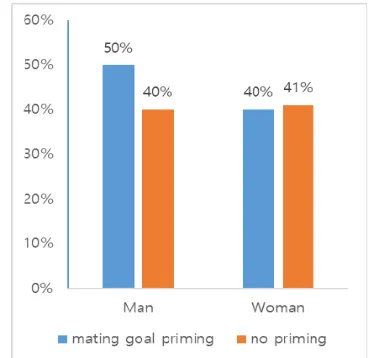
How does a mating goal priming affect their choice? As shown in Figure 1, the result show that men prefer a pleasure focus trip to a memory focus trip than women when they are primed mating goal. The difference of proportion of a pleasure focus trip between men and women in no priming condition is not significant(F(1,398)=.041, p=.840). However, the difference of proportion of a pleasure focus trip between men and women in mating goal priming condition is significant (F(1,398)=4.061, p=.045). That is, men like a pleasure focus trip more than women. 50% of men select a pleasure focus trip even though they have to erase a memory of trip. But only 40% of women select a pleasure focus trip. This results show that women rated memory
[image:6.612.314.524.98.299.2]more valuable than men.
Figure 1. Proportion of a pleasure focus trip with mating goal
How do this result change with age? This analysis was conducted with age. the result show that Depending on age and gender, the choice of pleasure and memory is different. As shown in Figure 2, the ratio of selecting a pleasure focus trip among 20’s was only 36.4%. The ratio of selecting a pleasure focus trip among 30’s was only 37%. However, the rate of 40’s selection of a pleasure focus trip increased sharply to 51.9% and the rate of 50’s selection of that was 51.1%. Men thinks pleasure is more important than memory as they get older.
Figure 2. proportion of selecting a pleasure focus trip of man with age
As shown in Figure 3, The ratio of selecting a pleasure focus trip among 20’s was only 46.6%. The rate of 30’s selection of a pleasure focus trip decreased sharply to 40.6% The ratio of selecting a pleasure focus trip among 30’s was only 39.4%. The rate of 50’s selection of that was 36.4%. Women thinks memory is more important than pleasure as they get older. Specially, the tendency of men that they think pleasure is more important than memory with age is stronger in the mating goal priming condition than in the no priming control condition. As shown in Table 2, The ratio of selecting a pleasure focus trip among 20’s men were only 31.6%. The rate of 30’s men selection of a pleasure focus trip was 41.5%. The ratio of selecting a pleasure focus trip among 40’s men was only 53.8%. The rate of 50’s men selection of that was 60%. Men with mating goal priming thinks pleasure is more important than memory as they get
[image:6.612.100.286.363.542.2]7355 Figure 3. proportion of selecting a pleasure focus trip of
woman with age
However, in no mating goal priming condition, the ratio of selecting a pleasure focus trip among 20’s men were only 40%. The rate of 30’s men selection of a pleasure focus trip was 32.7%. The ratio of selecting a pleasure focus trip among 40’s men was only 50%. The rate of 50’s men selection of that was 40%. the effect is not significant in no
priming condition. (χ2=4.150. p=.246).
Table 2. Proportion of selecting pleasure focus trip with mating goal priming
The ratio of selecting a pleasure focus trip among 20’s women was only 37.1%. The rate of 30’s men selection of a pleasure focus trip was 42.9%. The ratio of selecting a pleasure focus trip among 40’s men was only 37.3%. The rate of 50’s men selection of that was 45.5%. The proportion of selecting a pleasure focus trip of women with
mating goal priming is not significant (χ2=0.938.
p=.816). However, in no mating goal priming condition, the ratio of selecting a pleasure focus trip among 20’s men were only 55.3%. The rate of 30’s men selection of a pleasure focus trip was 38.5%. The ratio of selecting a pleasure focus trip among 40’s men was only 41.6%. The rate of 50’s men selection of that was 27.3%. the effect is not
significant in no priming condition too. (χ2=5.915.
p=.116).
3.2.2 Pleasure or Memory with mating goal and implicit self-theory
Finally, the effect of mating goal priming with implicit self-theory was analyzed. There are two types of implicit self-theory: entity and incremental theorist. As shown Table 3, Entity theorists was not influenced by mating goal priming. 39.1% of entity theorist select a pleasure focus trip in mating priming condition. 41% of them select a pleasure focus trip in no mating priming condition. This
difference is not significant (χ2=0.157. p=.692).
Incremental theorists were influenced by mating goal priming. 51.9.1% of incremental theorist select a pleasure focus trip in mating priming condition. 42.1% of them select a pleasure focus trip in no mating priming condition. This difference is
significant (χ2=3.605. p=.036).
7356 4. Conclusion
This research is conducted to investigate the value of memory with gender, age, mating goal priming and implicit self-theory. The results of the study are as follows. First, People like what they can remember rather than current pleasures. Second, men consider current pleasures than memories over women when priming a mating goal. Third, depending on age and gender, the choice of pleasure and memory is different. As men age, the value of memory decreases. But women are no different. Fourth, Mating Goal priming effect is different according to implicit self-theory. The mating goal priming in a group with incremental theory gives higher value for pleasure than a group with entity group.
There are some limitation and the direction of future research. First, this study was conducted with unrealistic scenario. We can erase our memory with drug. That is illegal and unrealistic. So, we replicate this result with realistic scenario in the future. Second, we don’t know why mating goal priming influence on the implicit theory in detail. We need to study the mechanism of that in the future research. Finally, this study was conducted online and we can’t not control the participants. So we need to check whether a response has been made faithfully in the next time.
ACKNOWLEDGMENTS:
This work was supported by the Ministry of Education of the Republic of Korea and the National Research Foundation of Korea (NRF-2017S1A5A2A01026639)
References and Notes
[1] A. Kronlud, B. Whittlesea, and C. Yoon in
the Handbook of Consumer Psychology, eds. Haugtvedt, Herr, and Kardes, Lawrence Erlbaum Associates (2008), pp. 77-102.
[2] K. A. Braun and G. Zaltman, “Backward framing: A theory of Memory Reconstruction”. MSI’s Working Paper Series, 1998, pp.98-109, [3] J. R. Bettman, “Information Processing Theory
of Consumer Choice”. Addison-Wesley Pub. Co, 1979.
[4] J. Forster, J. and Liberman, N. in Social Psychology: Handbook of Basic Principles, 2nd edition, Edited Arie W. Kruglanski and E.Tory
Higgins, Guilford Press, NewYork, 2007, pp. 201-231 .
[5] Y. Youjae, “The Influence of Contextual
Priming on Advertising Effects”. Journal of
Consumer Research, Vol. 17, No.3, 1990,
pp.215-222.
[6] L. L. Martin, J. J. Seta, and R. A. Crelia, “Assimilation and Contrast as a Function of People’s Willingness and Ability to Expend
Effort in Forming an Impression” Journal of
Personality and Social Psychology. Vol. 59,
No. 1, 1990, 27-37.
[7] P. M. Herr, “Priming Price: Prior Knowledge
and Context Effects”, Journal of Consumer
Research, Vol. 16. No. 1, 1989, pp. 67-75.
[8] D. A. Staple, W. Koomen, and J. Pligt, “Categories of Category Accessibility: The Impact of Trait Concept versus Exemplar
Priming on Person Judgements”, Journal of
Experimental Social Psychology, Vol. 33, No.
1, 1997, pp.47-76.
[9] Y. R. Avramova, and D. A. Stapel, “Moods as Spotlights: The Influence of Mood on
Accessibility Effect”, Journal of Personality
and Social Psychology, Vol. 95, No. 3, 2008,
pp. 542-54.
[10] T. Mussweiler and L. Damisch, “Going Back to Donald: How Comparisons Shape Judgmental
Priming Effects”, Journal Personality and
Social Psychology. Vil. 95. No. 6, 2008, pp.
1295-1315,
[11] T. L. Chartrand, , J. Huber, B. Shiv, and R. J. Tanner, “Nonconscious Goals and Consumer
Choice”, Journal of Consumer Research. Vol.
35, No. 2, 2008, pp. 189-201.
[12] C. S. Dweck, “Motivational Processes Affect
Learning”, American Psychologist, Vol. 41, No.
10, 1986, pp.1040-1048.
[13] D. M. Buss and M. Barnes, “Preferences in
human mate selection”, Journal of Personality
and Social psychology, Vol. 50, No. 3, 1986,
pp.559-570.
[14] D. M. Buss and D. P. Schmitt, “Sexual strategies theory: an evolutionary perspective on
human mating”, Psychological Review, Vol.
100, No. 2, 1993, pp. 204-232.
[15] J. Kim, P. Mario, V. D. B. Bram, M. Kobe, L. Inge, and R. Keith, “Can buy me love: Mate attraction goals lead to perceptual readiness for
status products”, Journal of Experimental
Social Psychology, Vol. 47, No. 1, 2011, pp.
7357 [16] E. A. Smith, and R. L. Bird, “Turtle hunting
and tombstone opening: Public generosity as
costly signaling”, Evolution and Human
Behavior, Vol. 20, 2000, pp. 245-261.
[17] C. S. Dweck, “Motivational processes affecting learning”, American Psychologist, Vol. 41, No.10, 1986. pp. 1040-1048.
[18] V. Griskevicius, J. M. Tybur, and B. Bergh, B. (2010), “Going green to be seen: Status, reputation, and conspicuous conservation,”
Journal of Personality and Social Psychology,
Vol. 98, No. 3, 2000, 392-404.
[19] S. E. Hill, C. D. Christopher. V. Griskevicius, K. Durante, and A. E. White, "Boosting Beauty in an Economic Decline: Mating, Spending, and
the Lipstick Effect," Journal of Personality and
Social Psychology, Vol. 103, No. 2, 2012, pp.