ORGANISING VALUE ANALYSIS VALUE ENGINEERING (VAVE)
DURING NEW PRODUCT DEVELOPMENT (NPD)
Ainul Farahin Binti Abdullah, Erry Yulian Triblas Adestaand Fawaz M. K. H. Al-Fadhli
International Islamic University Malaysia, Kuala Lumpur, Malaysia E-Mail: [email protected]
ABSTRACT
This paper presents one of the methodologies applied during New Product Development (NPD) phase; Value Analysis Value Engineering (VAVE). VAVE can lead to high-quality products which meet customer desires and at the same time increase the operating income requirements for an organisation. The application of VAVE to NPD can enhance the products value by increasing performance without increasing the cost and affecting the quality, saleability or maintainability. A case study has been discussed and an analysis has been made following the fundamentals of VAVE. At the end, results obtained are discussed.
Keywords: value analysis (VA), value engineering (VE), new product development (NPD), job plan.
1. INTRODUCTION
A NPD phase is a stage-gate product development process used by many companies in order to encourage rapid product development and to cull out the least promising projects before large sums of money are committed. Other than that, NPD encompass of the complete engineering design process; conceptual design, embodiment design, detail design, planning for manufacturer, planning for distribution, planning for use and planning for retirement.
Figure-1. The product development process in stage-gate format. [1].
The use of various tools from VAVE into NPD process can ensure the product to be properly developed with the right specification, quality, cost and time.
2. VALUE ANALYSIS VALUE ENGINEERING CIMA Official Terminology: VA is “systematic inter-disciplinary examination of factors affecting the cost of a product or service, in order to devise means of achieving the specified purpose most economically at the required standard of quality and reliability” while VE is “Redesign of an activity, product or service so that value to the customer is enhanced while costs are reduced (or at least increased by less than the resulting price increase)”. [2] In other words, VE is the application of VA to new products.
3. JOB PLAN
Job plan is the technique that used to govern the value studies; VM, VA and VE. The structured job plan technique is very helpful in providing assessment and evaluation for a product and procedures values. The job plan involves three main phases; pre-workshop, workshop and post workshop as shown in figure 2. While pre-workshop phase assign to prepare for the foundation of the studies and post workshop responsible for the follow up action plan, the workshop phase involve six other sub-phases; information gathering phase, function and analysis phase, creative phase, evaluation phase, development phase and presentation phase. [3]
Figure-2. Job plan of value studies. [2] Phase 0:
Planning
Phase 1: Concept Development
Phase 2:
System-Level Design
Phase 3: Detail Design
Phase 4: Testing and Retireme
nt
Phase 5: Productio n
4. REASONS FOR CONDUCTING VAVE
Below are the reasons for conducting VA exercises: [4]
Products with known problems.
Customer demands.
Safety and compliance requirements.
The improvement of product margins.
Corrective action.
Below are the reasons for conducting VE exercises: [5]
To introduce new forms of functionality that did not previously exist.
To meet the target costs which were established during Stage 2 of the NPD stage process.
To improve the value, increase the functionality and lower the cost of the proposed components in order to meet the Target Cost and functionality objectives.
5. ADVANTAGES
The advantages of VA studies are as follows: [4] 1. Speed of getting an effective design into the market
without problems and through error-free manufacturing and assembly processes.
2. Reliability and durability of the product in the market which enhances the reputation of the product and the company.
3. Low overall cost which enhances product margin and also releases finances within the business as well as allowing the ability to engage in price competition. 4. Enhanced quality and compliance with minimal costs
of warranty that allows a company to differentiate its products based this perceived quality (of use and esteem).
5. Differentiation by creating product designs as platforms, which facilitate ‘last minute’ or late configuration of the product to meet customer, orders regional preferences or any other geographical constraint (such as product laws of a certain region). 6. Finally, the VA process satisfies the primary goal of
any business - to make a profit and survive.
While VE is one of the most effective problem-solving methodologies used today to improve: [3] • Design standards
• Procedures • Constructability • Performance
• Operation and maintenance • Processes
• Time • Value • Worth
• Function
• Number of steps involved • Market strength
• Future vision
• Awareness and direction of forces • Directness from one point to another • Company healthiness (project wise) • Profits
• Bottom line • Issues • Relationships
6. VAVE METHODOLOGY
The methodology propose for this study is enhance base on the Value Analysis Study Activity Chart (VASAC) [6] which cover the three out of seven phases from engineering design process; conceptual design, embodiment design and detail design. It is expected that the value of any existing vehicle models can be improved base on its functions while at the same time tried to maintain or reduce the vehicle total cost.
Figure-3. Summarize VAVE methodology.
7. CASE STUDY
a) Detailed information about the part is collected b) Function Analysis Table is prepared
c) Creative/alternative ideas and concepts are developed d) Evaluation is done through Decision Matrix
e) Finding and Recommendation f) Result
i. Collection of information
All of the information regarding the part is given below:
i. Material Carbon Fiber
ii. Pieces produced per month 2 (Pieces/car) x 2,250 (3-door hatchback car/month) = 4,500
iii. Process used Injection Molding iv. Total present cost Rm 8.00/piece v. Product patent referred US 6,719,336 B2
Cost Breakdown of the part:
i. Outside handle Rm 2.00 ii. Base portion Rm 1.00 iii. Grip portion Rm 1.50 iv. Case portion Rm 1.00 v. Bell crank Rm 0.80 vi. Spring Rm 0.50 vii. Pin Rm 0.50 viii.Clip Rm 0.20
ix. Counterweight Rm 0.50
Figure-4. Vehicle outer door handle design.
ii. Functional analysis
Part Name: Vehicle Outer Door Handle
Table-1. Function analysis.
Item Function A
/Rm B /Rm C = (A/B) Outside handle Improve Appearance Provide Surface Provide Strength Improve Aesthetic Provide Protection
2.00 1.50 1.33
Base portion Provide Movement Provide Strength Hold Assembly Support Handle
1.00 0.80 1.25
Grip portion Facilitate Working Open Door Provide Surface Provide Strength Provide Grip Pull Door Pull Handle Provide Ergonomic
1.50 1.50 1.00
Case portion Hold Assembly Provide Movement Provide Locking Provide Safety Provide Strength Support Handle Hold Parts
1.00 0.50 2.00
Bell crank Provide Movement Provide Strength Hold Assembly Facilitate Locking Tug Handle
0.80 0.80 1.00
Spring
Provide Movement Hold Assembly Provide Stiffness
0.50 0.50 1.00
Pin Hold Assembly
Support Load 0.50 0.40 1.25
Clip
Hold Rod Provide Movement
Provide Strength Hold Assembly
0.20 0.20 1.00
Counter
-weight Support Load 0.50 0.30 1.67 Total Target Cost (Rm) = 6.50
(A=Cost, B=Worth, C=Value Index)
Note: Case portion with the highest value index is selected to be part under study.
iii. Creative/Alternative ideas and concepts
Change the mechanism
Reduce the material
Change the part design
Use chrome plated material
Improve safety
Change the part specifications
iv. Decision matrix
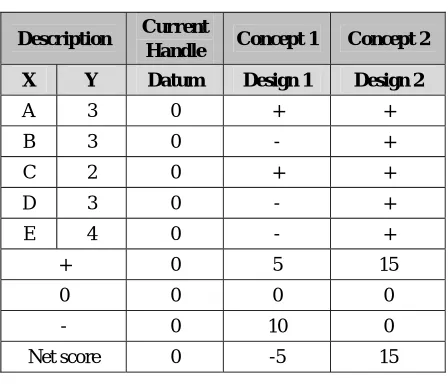
In order to judge the ideas, several performance criteria’s were considered as follows:
A. Simplicity B. Aesthetics C. Material D. Comfortability E. Manufacturability
Alternatives developed are as sketches in Figure-5 and Figure-6.
Figure-5. Sketch for design concept 1.
Figure-6. Sketch for design concept 2.
Table-2. Pugh chart developed for concept selection.
Description Current
Handle Concept 1 Concept 2
X Y Datum Design 1 Design 2
A 3 0 + +
B 3 0 - +
C 2 0 + +
D 3 0 - +
E 4 0 - +
+ 0 5 15
0 0 0 0
- 0 10 0
Net score 0 -5 15
(X= Performance Criteria, Y= Weight)
[image:5.612.70.298.363.564.2]Note: Concept 2 with higher net score is selected to be developed as shown in Figure-7.
Table-3. Performance score.
Item A B C D E
Weight 3 3 2 3 4 Su
m Ran
k
Model
1 1*3 1*3 2*2 1*3 1*4 17 2
2 2*3 2*3 2*2 2*3 2*4 30 1
Table-4. Improvement potential index.
Performance Score a
Cost (Rm) b
Value Score a/b
Model
1 17 6.50 2.62
2 30 6.50 4.62
Note: In this matrix (Table-4) model 2 has the maximum score. So, this is selected as the optimal solution for the investigation phase.
v. Finding and recommendation
Table Improvement Potential Index above shows that model 2 has higher value score out of the two models. It predicts and gives the possibility for this alternative of the current part under study to have lesser cost with the same or better performance. Thus, it is recommended that the Outer Door Handle for vehicle to be redesigned at PROTON with better case portion especially to improve
the aesthetic value, comfortability and manufacturability compare to the current design.
vi. Result
The benefits after the implementation of VAVE are as follows:
Table-5. Cost benefits.
Cost of part before VAVE RM 8.00
Cost of part after VAVE RM 6.50
Savings per part RM 1.50
Value improvement 23.08%
Expected annual savings RM 81,000.00
Other benefits:
Material saving
Reduced material cost
Reduced components
Simplified process
Reduced machining cost
Reduced machining time
Removed plating cost
Better quality
Increased aesthetic value
Increased performance
Better aerodynamics
vii. Summary
The principle of VAVE through NPD can ensure the product produce meet the Voice Of Customer (VOC) while at the same time giving better performance without effecting the quality, saleability and maintainability with which it provide the opportunity to also reduce the total cost with excellent returns to the company or organization. In the case study discussed above it shows how the cost can possibly be reduced using VAVE methodology. Various worksheets are prepared before the analysis can be referred to give strong conclusion. Based on the benefits listed before, design changes should be made so that the product value can be increased while trying to seek opportunity in reducing the cost.
REFERENCES
[1] Dieter G. E. and Schmidt L. C. 2008. Engineering Design. 5th Edn., New York: Mc Graw Hill.
http://www.cimaglobal.com/Documents/Student%20d ocs/2010%20syllabus%20docs/P2/NWhittle%20Value %20Analysis.pdf.
[3] Dekker M. 2003. Value Engineering Analysis and
Methodology. Available from: http://www.fcrm.ir/mads/ebk1085.pdf.
[4] Rich N. 2000. Value Analysis Value Engineering.
Available from: http://www.adi.pt/docs/innoregio_value_analysis.pdf.
[5] Gerhardt D. J. 2011. Managing Value Engineering In New Product Development. Available from:
http://value-eng.org/knowledge_bank/attachments/200611.pdf.