Georgia State University Georgia State University
ScholarWorks @ Georgia State University
ScholarWorks @ Georgia State University
Anthropology Honors Theses Department of Anthropology
Spring 4-25-2011
Socioeconomic and Cultural Aspects of Overweight and Obesity
Socioeconomic and Cultural Aspects of Overweight and Obesity
in Georgia's African American Community
in Georgia's African American Community
Alicia C. Simpson
Follow this and additional works at: https://scholarworks.gsu.edu/anthro_hontheses
Recommended Citation Recommended Citation
Simpson, Alicia C., "Socioeconomic and Cultural Aspects of Overweight and Obesity in Georgia's African American Community." Thesis, Georgia State University, 2011.
https://scholarworks.gsu.edu/anthro_hontheses/7
This Thesis is brought to you for free and open access by the Department of Anthropology at ScholarWorks @ Georgia State University. It has been accepted for inclusion in Anthropology Honors Theses by an authorized administrator of ScholarWorks @ Georgia State University. For more information, please contact
SOCIOECONOMIC AND CULTURAL ASPECTS OF OVERWEIGHT AND OBESITY IN
GEORGIA'S AFRICAN AMERICAN COMMUNITY
By
Alicia C. Simpson
A Thesis Submitted in Partial Fulfillment of the Requirements for Graduation with Undergraduate Research Honors
In Anthropology
Georgia State University
__________________________________________ Honors Thesis Advisor
__________________________________________ Honors Program Director
GEORGIA STATE UNIVERSITY
ABSTRACT
Socioeconomic and cultural aspects of overweight and obesity in Georgia's African American Community
By Alicia C. Simpson
Chairperson of the Supervisory Committee: Cassandra White, PhD Department of Anthropology
TABLE OF CONTENTS
Introduction ... 1
Chapter I: Literature Review ... 3
Body Image... 3
Structural Violence: Slavery and the Poverty Cycle ... 5
Socioeconomic Aspects of Obesity ... 7
Attractiveness ... 7
Chapter II: Methodology ... 10
Chapter III: Results ... 11
Chapter IV: Discussion ... 14
Chapter V: Conclusion ... 22
Appendix A: Pre-Interview Questionnaire for Interview and Focus Group ... 23
Appendix B: Focus Group Questions ... 25
Appendix C: Consent Form ... 27
Appendix D: Table 1 - Descriptive Statistics of the Study Population ... 30
Appendix E: Table 2 – Descriptive Statistics of the Study Population by Gender ... 32
ACKNOWLEDGMENTS
INTRODUCTION
According to the Centers for Disease Control and Prevention (CDC) and The Office of Minority Health, individuals who identified themselves as African-American or Black have the highest rate of obesity in the United States[1, 2]. Fifty-one percent of African-American women over 20 are obese, while 37 percent of American males over 20 are obese; in total 79.1 percent of African-American women are obese or overweight, while 71.8 percent of African-African-American males are obese or overweight[1, 3]. Overweight and obesity have been correlated to “lifestyle” diseases such as cardiovascular disease (including hypertension, coronary artery disease and stroke), type 2 diabetes, and some types of cancer including as well as osteoarthritis, sleep apnea, and gynecological problems such as infertility [4, 5]. This higher prevalence of overweight and obesity among the African-American population puts this cultural and ethnic group at an increased risk for these obesity related diseases and an increased mortality rate for the African American population[6].
Despite the increased risk of heart disease, diabetes, some cancers and mortality associated with overweight and obesity in the African-American community, the rates of overweight and obesity remain markedly higher than that of any other ethnic group in the United States[2]. Obesity has also been shown to shorten one’s lifespan up to 20 years for black men who are obese and 5 years for black women[6]. There appears to be a broader acceptance of overweight and obesity within the African-American culture that is stifling public health efforts to reduce weight and the overall incidence of overweight and obesity.
Overweight and obese body types are more desirable in the African-American culture, especially among women. Black females who are overweight or obese have a more positive view of their weight and their level of attractiveness compared to their white counterparts[7]. Within the African-American culture larger body types are preferred and sought by normal weight, overweight and obese individuals alike while normal weight body types among men and women are held in a less positive regard[8].
more likely to be obese than their white counterparts[7]. This points to a deeper, underlying cultural value system that influences a larger weight in the African-American culture more than the dominant American culture.
C h a p t e r 1
LITERATURE REVIEW
Body Image
African-Americans are the third largest ethnic group in the United States; however, there appears to be a dramatic culture divide in terms of acceptable body weight and shape of white Americans versus black Americans. The greatest emphasis is placed on the female standard of beauty and how that relates to the American culture as a whole and subsequently how it relates to the African-American culture. In a study investigating body image and attitudes toward obesity at a historically black university Gipson et al.[6] found that black women are comfortable with a range of body sizes.
Students who identified as black were asked to compare 9 images of various body types that correlated with a BMI’s ranging from normal range (18-24.9) to obese or morbidly obese (30 or more). Students then choose, from the images, which body type they felt correlated most with their current body type and which image correlated more closely with their desired body type. Male and female participants chose body types that were close to their own when asked to choose their current body type in the images. The mean BMI’s were 26 and 24.7 for male and female students, respectively. However, when males and females were asked to choose an image they preferred to be, both chose larger and heavier images than their current body type. Gipson et al. theorized that the larger body type seen amongst their female study participants could have perhaps occurred because of the broader social acceptance of larger body builds within the culture and also, perhaps, the enhanced sexual attractive of larger body types by black males[6]. It is important to note that the black female students in the study had higher BMI’s than their male counterparts which is typical of the current statistics. This is a theme that is pervasive in the literature when BMI or weight information is collected from participants.
Overstreet et al.[9] explored the theory of normative discontent between black and white females in terms of two body ideals thinness and curvaceous. In recent years, curvaceous has begun to emerge as a socially acceptable body ideal. Although curvaceous has been added to the American cultural body ideal for women, variances between the meanings of this term among ethnic groups varies
whereas black women identified curvy as medium breast, “average” weight, and large buttocks. Many of the current images of the new curvaceous body ideal are of women with medium breasts and thin waists. These images focus more on the curvaceousness of a woman’s breast rather than her entire body. In this way, it appears that black women are less influenced by sociocultural pressures of ideal body types. However, is not to say that black women are protected from all sociocultural images of ideal body types. It appears that black women are affected by the images of other black women in the media. The types of bodies presented in the media are somewhat different when looking at white and black images. This difference oftentimes reflects the ideas of curvaceous that are highlighted in Overstreet’s research[9].
Flynn and Fitzgibbon reviewed the current literature to explore to perceptual and attitudinal body image findings of African-American females. When white and black women looked at the same silhouette, the black women perceived the silhouettes to be much thinner than the white women did. Additionally, black women were more apt to label themselves as thin, regardless of actual body size, than white women. Perceptions of weight were examined by comparing an individual’s perception of their weight category to the medical standard for a weight category. Black females were less likely to perceive their weight category accurately when compared to the medical standard. Looking across various studies up to 60 percent of overweight black females believed they were of normal weight while, in contrast, up to 8 percent of overweight white females believed the perceptions of weight were examined by comparing an individual’s perception of their weight category to the medical standard for a weight category. Black females were less likely to perceive their weight category accurately when compared to the medical standard. Black women 60 years of age or older tended to not care if they were or were not overweight. Looking across various studies up to 60 percent of overweight black females believed they were of normal weight while, in contrast, up to 8 percent of overweight white females believed they were of normal weight. Across multiple studies approximately 19 percent of black females believed they were thinner than what physicians told them they were. However, all obese black females in the literature reviewed correctly identified themselves as obese[7].
body type as the ideal. It is important to note that although participants chose heavier body types than their own as the ideal that these body types were still within the normal range for weight. White women did not show this preference. In questionnaires, black women reported being more satisfied with their bodies even when they were overweight while white women reported being dissatisfied with their bodies regardless of weight. There was a marked dissatisfaction among underweight and normal weight black women with their weight. Researchers found that approximately 53 percent of
underweight black females were dissatisfied with their weight and 81 percent of normal weight black females were dissatisfied with their weight. The primary reason for this dissatisfaction was noted as a desire to be heavier than their current weight. In contrast to other studies looking at weight satisfaction in black women researchers found that 95 percent of overweight black women were dissatisfied with their weight[7].
Le et al. [10] examined the effects of perceptions of weight gain on the physical activity level and eating habits of black, white and Hispanic women using the Health Belief Model. Black women had the highest perceived weight gain out of all the ethnic groups represented in the study, additionally, black women had higher body esteem than white and Hispanic women. Overall, perceived weight gain over 36 months did not have any effect on the rate of physical activity or the eating habits of participants who perceived weight gain. Participants who perceived weight gain did not make an effort to reduce caloric intake and, in fact, were more likely to continue to increase their caloric intake over the duration of the study. Likewise, participants who perceived weight pain over 36 months did not increase their physical activity level.
Structural Violence: Slavery and the Poverty Cycle
the perception that the thin individual is not eating, likely due to poverty and the inability to afford food, is addicted to drugs or has AIDS[7].
Individuals with low socioeconomic status, regardless of ethnicity, tend to have shorter life spans and increased disease risk than individuals living within a higher socioeconomic strata. In Sick of Poverty by Robert Sapolsky[11], the author explores the effects of psychological stress on the physiological being living in poverty. Socioeconomic status is a composite of educational level, income, occupation, and housing conditions. Sapolsky found that disease risk increased for health issues that would not be affected by inadequate healthcare like Type I diabetes or rheumatoid arthritis. Preventive medicine and access to healthcare prior to the onset of these disease would not prevent their occurrence, yet both diseases occur with more frequency within poor communities. What might be a more likely indicator of why such diseases are more prevalent in poor communities are the unhealthy lifestyle factors that are more common among Americas poor. Individuals with low socioeconomic status tend to smoke more, consume alcohol at a greater frequency, are more prone to obesity and it’s related diseases, and also live in more violent and polluted neighborhoods. Access to healthy food, recreational centers and clean water is also limited as well as basic necessities like heating for the home in the winter and air conditioning in the home during the summer months.
Socioeconomic Aspects of Obesity
Akil and Ahmad examined the effects of socioeconomic factors on obesity in four southern states using Colorado, which has the lowest rate of obesity in the U.S., as a control. Through multiple regression analysis the authors were able to show an increased incidence of obesity that was linked to several socioeconomic factors including poverty/low-income, participation in the Supplemental Nutrition Assistance Program (SNAP), and unemployment. African-Americans had the highest rate of obesity and the southern state with the highest rate of obesity, Mississippi, also had the highest percentage of African-American residents. As unemployment rates and poverty levels increased so did the rates of obesity. Nearly 20 percent of African-American’s have a bachelor’s degree; however, the poverty rate for African-American’s is over 24 percent and over 20 percent of African-American’s are without health insurance. African-American families are also three times more likely than white families to have difficulty affording adequate food. Even with the assistance of programs like food stamps African-Americans still continue the cycle of poor eating habits which can be attributed to a number of causes including a lack of neighborhood groceries and supermarkets. Predominantly Hispanic and African-American neighborhoods have up to 70 percent fewer supermarkets than predominantly white neighborhoods[4].
Much of the data comparing perceptions about overweight and obesity with body image satisfaction is conflicting. Flynn and Fitzgibbons reviewed the current data that looked at socioeconomic status differences and women with lower socioeconomic status were more likely to prefer heavier body ideals, saw themselves as being thinner that what their physicians told them they were and were more satisfied with their bodies than women in with high socioeconomic status. However, other studies have found the polar opposite showing that women with high socioeconomic status were prouder of their bodies than women with medium socioeconomic status[7].
Attractiveness
attractiveness in African-American men based on their level of acculturation into the dominant American culture. Acculturation was measured on the African-American Acculturation Scale (AAAS-33) which is a 33 question self-reported form that evaluates the participant’s involvement in various practices common to the African-American cultural and their knowledge of certain cultural norms within the African-American culture. A high score on the AAAS-33 indicated full immersion in the African-American culture and a low-score indicated full immersion in the dominant culture. The sample of participants were taken from African-American students at a predominantly white university and found that those with the highest acculturation shores were not attracted to larger or heavier body figures. The authors believed that the combination of a high acculturation score along with an aversion to larger body types showed a heavy influence of media images of beauty from the dominant culture to be pervasive in the African-American community so much so that one could be completely immersed in the African-American culture yet still have a preference for the body types presented by the dominant American culture. What is very important to note is that even though these men did not find women of heavy or larger body figures to be the most attractive when it came to choosing what body type they felt was more acceptable to date the men chose the heavier/larger body types. The authors hypothesized that this had much to do with the men finding acceptance within their community, despite their own personal beliefs about attractiveness[8].
Flynn and Fitzgibbon’s review on the literature around attractiveness, ideals and satisfaction in relation to body image in black females found that black females were more like than white females to find themselves attractive. Attractiveness was largely tied to weight satisfaction in white females whereas in black females attractiveness was less dependent on weight. One study found that 67 percent of normal weight and 37 percent of overweight white women felt they were attractive. Black women seemed to feel they were attractive even if they were not happy with their weight, only 5 percent of overweight black women were satisfied with their current weight but over 44 percent of them still considered themselves to be attractive despite not being satisfied with their weight. Another study found that 54.5 percent of black women were dissatisfied with their bodies but nearly 56 percent of the same women felt that weight was not an important measure in attractiveness[7].
C h a p t e r 2
METHODOLOGY
Eighty total participants were recruited for this research study. I conducted 4 focus groups and 50 semi-structured interviews with participants of various socioeconomic standing and education levels. Inclusion criteria for this research study were African American men and women, ages 18 to 80 who are current Georgia residents. Interviews and focus groups took place throughout the state of Georgia over a three month period. Each participant in the focus group and one on one interview completed a brief pre-interview questionnaire about their perceptions of their own body image and demographic information including highest level of education completed, household income, height, weight, age, and sex (Appendix A). The pre-interview questionnaire was administered prior to each interview or focus group and was filled out by the participant. Participants for the focus groups were chosen who identified as African-American or Black, and had similar socioeconomic status and education level. A homogenous group of individuals for the focus group was sought to ensure that each person within the group felt as comfortable as possible sharing their experiences with weight and food. Participants from low, middle/working, and upper socioeconomic class were sought out for the initial 3 interviews after which snowball sampling was used to identify additional participants within similar demographics.
C h a p t e r 3
RESULTS
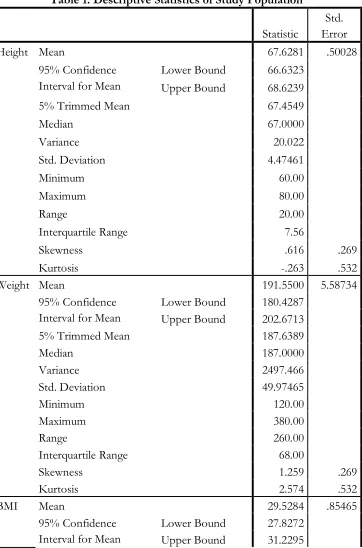
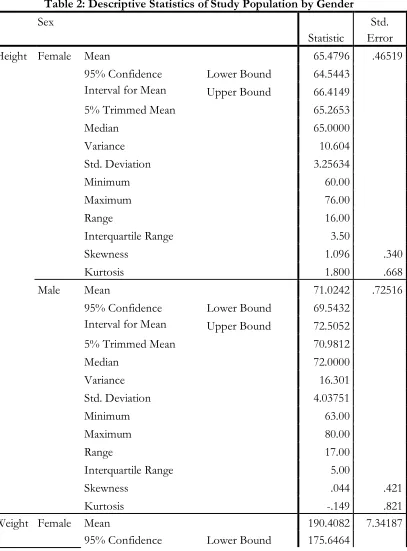
A total of 80 individuals participated in this research study – 50 in one on one semi-structured interviews and 30 in focus groups. Participants ranged in age from 23 to 78 years old with a median age of 43 years. Gender distribution was relatively equitable with a marginally higher percentage of female to male participants. In total 41.25 percent (n=33) of participants were male while 58.75 percent (n=47) of participant’s were female. The median height of participants was 67 inches, median height in females was 65 inches and median height in males was 72 inches. Median weight for the study population was 187 pounds distributed with a median weight of 185 pounds in females and 189 pounds in males. Median BMI for the study population was 28.06. Median BMI distributed by gender was 29.4 in females and 24.41 in males. 65 percent of participants were overweight, obese or morbidly obese. Descriptive statistics for the study population and descriptive statistics distributed by gender can be found in Table 1 and Table 2.
In the pre-interview and pre-focus group questionnaire that was given to each participant there were twelve descriptors for body type that participants were asked to choose from to describe their body type. Participants were given the option to choose as many terms from the list that they felt applicable to their bodies. Forty one percent (n=33) of participants identified as normal weight, 38 percent (n=30) of participants identified as overweight, 20 percent (n=16) identified as athletic 18.7 percent (n=15) identified as average, 16.2 percent (n=13) identified as curvy. A far lower percentage of participants identified themselves as underweight (1.25 percent, n=1), thin (5 percent, n=4), skinny (1.25 percent, n=1), thick (8.75 percent, n=7), fat (5 percent, n=4), obese (5 percent, n=4) and morbidly obese (3.75 percent, n=3). Ninety five percent (n=76) of participants believed there are health risk to being overweight, while 96 percent (n=77) believed there are health risk to being obese.
education, 2.5 percent (n=2) graduated from a technical school or college, 2.5 percent (n=2) graduated from high school and 2.5 percent (n=2) had some high school education.
The majority of participants were of middle class socioeconomic status. Annual household income was divided into seven categories and participants self-reported their annual household income. The majority of participants had a household income between $22,501 and $69,300 per year (53.5 percent, n=43), 5 percent (n=4) had an annual household income of $0 to $10,500; 6.5 percent (n=5) had an annual household income of $10,501 to $22,500; 25 percent (n= 20) had an annual household income of $69,300 to $139,850; 7.5 percent (n=6) had an annual household income of $139,851 to $235,550; 1.25 percent (n=1) had an annual household income of $235,551 to $380,500 and 1.25 percent (n=1) had an annual household income $380,501 or more. Most participants lived alone (36 percent, n=29), while 24 percent (n=19) lived in a 2 person household, 15 percent (n=12) lived in a 3 person household, 10 percent (n=8) lived in a 4 person household, 5 percent (n=4) lived in a 5 person household, 2.5 percent (n=2) lived in a 6 person household, 1.25 percent (n=1) lived in a 7 person household and 6.25 percent (n=5) lived in a household of 8 or more individuals.
During interviews and focus groups 44 descriptive terms were used by participants to describe overweight and obesity. The following terms were identified:
Fat Curvy Voluptuous Thick Rotund Unhealthy Heavy Juicy Chubby
Big, Bigger, Big Boy, Big Girl Big Boned Mildly Fat Pudgy Physically Imbalanced Heavy Set Chunky Plus Size Excessive Plump Out of Shape Stout
Full Figure Huge
Enormous
Ginormous Heavy Duty Mammoth Whopper
Large Tubby Fruitful Round
Hefty Husky
When participants were asked about healthy eating 100 percent of participants were able to identify at least 2 components of a healthy diet or healthy foods. Ninety two percent of participants identified vegetables as a healthy food, 90 percent identified fruits, 33 percent identified whole grains, and 23 percent identified nuts and seeds. Eighteen percent of participants said reducing fat in the diet was important to healthy eating, 25 percent said eating organic was important to healthy eating, and 13 percent said reduced sodium diets were important to healthy eating.
C h a p t e r 4
DISCUSSION
Concepts of thinness, overweight, and obesity are defined culturally more than scientifically. Tools such as the Body Mass Index (BMI) are helpful epidemiologic tools to access the general health of the population but, when it comes to affecting change, there is much more we need to understand about an individual beyond their BMI. Sociocultural aspects of obesity in the African-American community appear to be a major barrier to behavioral changes that would lead to the prevention and treatment of overweight and obesity in this community.
“I feel that poor nutrition, increased stress, sedentary lifestyles and maladaptive coping mechanisms in the African-American population are the main reasons for obesity in [African-Americans].”
-Tonya, 49, Morbidly Obese
In both focus groups and interviews, participants were asked what they felt were the reasons behind the high incidence of overweight and obesity among African-Americans. Poor eating habits, lack of exercise, lack of nutrition education and an unwillingness to change eating behaviors were brought up in nearly every interview and focus group. However, these issues are not unique to the African-American culture and particularly, not unique to the Southern culture of the United States. Slavery and its subsequent consequences to modern life such as the soul food diet, the poverty cycle and stress due to various forms of inequalities were common to the explanatory model of overweight and obesity in African-American’s in Georgia. For example, poor eating habits were related to the soul food diet which is comprised mainly of fried foods, high in fats (including saturated fats), high in sugar, and high in salt and was seen by participants to be a vestige from slavery. Lack of exercise was attributed largely the lack of fitness centers, recreation centers and community centers in African-American neighborhoods which was attributed to poverty, and this poverty was attributed to a cycle that began after slavery with share-cropping.
two types of healthy foods, ways of making one’s diet healthier like reducing sodium, fat and sugar intake and healthy meal preparation techniques like baking, grilling and roasting instead of frying. Although all the participants were able to identify healthy foods about 10 percent of participants felt that healthy foods were expensive, inaccessible and not palatable. Jennifer, a 28 year old female, asserted that “the fact that we, as a people, are on the low end of the economic scale, we are forced to buy the foods we can afford. Those foods are usually the lowest in nutritional value, have a lot of empty calories, and are filled with sugars and fillers. These foods, although not the best nutritionally, are very filling, so we buy them.”
Although poor diet was discussed at length as one of the leading causes of overweight and obesity when the soul food diet was mentioned only a small percentage of participants articulated that the soul food diet might be one that has negative attributes that contribute to overweight and obesity such as being high in sodium, high in saturated and total fat, as well as being calorically but not nutrient dense. Several participants discussed the virtues of aspects of the soul food diet like collard greens, which are traditionally boiled for several hours with hamhocks or fatback. It was said that the “pot liquor” which is the left over broth from cooking collard greens offers medicinal properties that had been used for multiple generations in one family. More often than not, commercial foods (fast food, soda, candy and other sugary foods) were pinpointed as the cause for overweight and obesity.
“Our diets have not improved too much from what we use[d] to eat on slave plantations. Chitterlings, pork, and more pork. That’s what I have been taught.”
–Angela, Age 34, upper middle class
raised eating was not that far removed from the same diet her grandmother’s parents, who were slaves, ate.
Stories like Angela’s were commonplace among participants. Soul food is a deep, abiding expression of a cultural history linked to slavery in the south. African-Americans have had so much of their ancestral history wiped away in the slave trade that these cultural bits that have been passed down from generation to generation from slavery to the present hold a very special meaning. As one participant remarked, when talking about “light” soul food “I don’t want no one tryin’ to pretty up my soul food.” For most participants the very thought of slimming down soul food was out of the question. Many had tried before when dieting or when a physician recommended they lower sodium intake for hypertension or carbohydrate intake for type 2 diabetes but, in the end, it was not the flavors of “home” that they were looking for when they prepared soul food dishes. As Wendy a 28 year old middle class female said “It feels artificial, fake…and I think all that fake stuff is worse than any amount of real sugar I put on my candied yams.” Although it is clear that African-Americans in Georgia have an understanding of the staples of healthy food there is an obvious disconnect in how this food relates, if at all, to the traditional foods of the South and the traditional black soul food diet of the South.
women who were overweight described themselves as normal weight and normal weight women expressed the desire to gain weight[7].
The outward expression of pride and loving one’s self at any weight did not translate to the same feelings in private. A struggle was apparent between being true to the ideals of the African-American culture while also conforming to the ideals of the dominant American culture. Perhaps this very struggle is what has led to an outward approval and acceptance of overweight and obesity in the African American community while many within the community struggle internally with negative feelings about overweight and obesity. Overwhelmingly there seemed to be an effort, perhaps unconscious, to separate all the negative terms associated with overweight and obesity including “fat”, “unhealthy”, “out of shape” and disease states like cardiovascular disease and diabetes with the individual. Individuals who were overweight or obese in the study tended to use more euphemisms for overweight and obesity than did normal weight or morbidly obese individuals. Among the 7 morbidly obese individuals all but 3 labeled themselves as morbidly obese and did not use alternative words for the term.
It is important to note that there was no definition given to the descriptive terms for body types in the pre-interview and pre-focus group questionnaire which allowed for the participants to provide their own interpretation of the meaning and how it best fit their perceived body type. The descriptive term “athletic” was difficult to interpret due to the fact that level of physical activity was not assessed during this study and therefore the definition of athletic was left solely to the interpretation of the study participant and was not expounded upon further in the study.
The perceptual versus attitudinal view of body image became more apparent when looking at the responses of participants prior to their interviews as opposed to their answers in one on one interview or focus groups. Gipson et al. also found this to be indicative in their study of young black college students who desired body types that were much larger than their current one. Although the students desired body types that were closer to that of overweight and obese individuals the perception they had of obese individuals was generally not positive. Students said that obese people are more self-conscious than other people, that obese people did not feel they are as good as other people, that most non-obese people would not want to marry anyone who is obese, obese people are more ashamed of their weight, and obese people are more emotional than other people[6]. Even with all these negative aspects of obesity students still felt that most obese people are not dissatisfied with themselves which perhaps is indicative of a culture where the majority of the population is overweight or obese and the yet happy with their weight and body image.
Euphemisms that were perceived as positive such as “thick”, “curvy” and “voluptuous” were used most often when overweight or obese participants were talking about their own weight and body size or when males were referring to the type of female body type they preferred. When participants talked about overweight and obesity in terms of others such as in talking about the high prevalence of type 2 diabetes among African-Americans or increased mortality rate due to obesity related diseases in African-American’s the terms used to describe the general population were words with negative connotations like fat and unhealthy.
what she considered to be obese or overweight Martha, age 58, middle class said “Someone who is easily 80 to 100 pounds over the BMI. But it depends because Queen Latifah was always a big girl but I always found her attractive since her early days.”
It is also important to note that attractiveness in the African-American culture goes far beyond body type and there is a strong culture value on skin color (light or dark skin), hair length, hair texture and lip size. For many these traits are more important than body size or type and weight can be ignored if a potential mate has a preferable skin color or hair texture[8]. It would be beneficial to look at the role these factors play in attractiveness along with weight.
Awareness of obesity and overweight is not simply a problem within the African-American community. A 2010 Harris poll[12] found that most Americans have a skewed perception of their weight especially overweight Americans. Thirty percent of poll respondents who were overweight believed they were of a normal weight and 70 percent of obese respondents believed they were overweight but not obese. Among the morbidly obese 60 percent said they were obese while 39 percent considered themselves to be overweight. Study analyst believed that this discrepancy is becoming a grander trend in the American population because of the vast numbers of individuals who are overweight or obese. At this point in our history the majority of Americans have grown up in a culture where overweight and obesity is the norm making it difficult to discern from normal weight, overweight and obesity. Ethnic information was not provided about the respondents to this survey.
in weight status and health status but saw it as a “good standard” and “fairly accurate.” Margaret, a 34 year old morbidly obese, upper middle class woman explained her struggle with the BMI scale and eventful acceptance of it “I do not consider myself overweight anymore. Overweight is like 10-20 pounds. I am at least 100 pounds over my correct weight that means that I am very obese. I can see what I look like in a mirror, just straight reality…I think [the BMI scale] is accurate, I had a hard time with it at first, but now that I understand that information how do I turn it into healthy weight loss?”
This was hotly debated in focus groups what seemed to be the underlying tone of dissatisfaction with the BMI scale was that it held all people, of all ethnic backgrounds under the same guidelines. Essentially, the BMI scale was felt to be a tool to determine if a white person is overweight or obese but not a black person. Michael, a 36 year old, middle class participant stated “I do not have all the facts of the BMI system guidelines, but I do know that African-American[s] are judged by standards that are compared to white people which in inherently unfair. African-Americans also have less access to healthier food choices for example, grocery store produce that maybe less sufficient in a white neighborhood, very similar to all things provided to African-Americans labeled 2nd or 3rd class citizens in a 1st world country.”
What do you consider overweight?
“Anyone weighing over 220 pounds regardless of height” – Gerald, 55, lower/working class
Two hundred and twenty pounds seemed to be the number of choice that came to mind for participants when asked what they considered overweight. Often times this was qualified by
participants stating that gender, height and weight did not matter in this assessment. When a specific weight or weight range was not given physical descriptives were used to describe overweight and later obesity. These descriptives mirrored the discussion of attractiveness and beauty in relation to weight. Peggy a 33 year old morbidly obese woman felt that “When you clearly have belly rolls, thighs are touching, and can barely walk up a flight of stairs” you are overweight.
C h a p t e r 5
CONCLUSION
APPENDIX A
PRE-INERVIEW QUESTIONNAIRE FOR INTERVIEW AND FOCUS GROUP
Age:
Sex:
Height:
Weight:
Please circle your highest level of education: Some High school
High school
Some College
College (undergraduate degree)
Graduate School (Masters, Doctorate, etc.)
Technical School or College
Please circle your approximate annual household income: $0 to $10,500
$10,501 to $22,500
$22,500 to 69,300
$69,300 to $139,850
$139,850 to $235,550
$235,550 to $380,500
$380,500 +
APPENDIX B
FOCUS GROUP QUESTIONS
Recent CDC reports show that African Americans have the highest rate of overweight and obesity of all racial identities in the United States, what do you feel is the reason behind this?
Why do you think African Americans have the highest incidence of overweight and obesity compared to other racial and ethnic groups?
A recent poll found that many Americans don’t recognize when they are overweight or obese even when they are classified as so by the current BMI guidelines. What are your perceptions of the BMI system of rating individuals as normal weight, overweight, obese or morbidly obese?
What do you consider overweight?
What do you consider obese?
Do you believe there are any health risks to being overweight?
Do you believe there are any health risks to be obese?
What other terms do you like to use instead of the word “obese” or “overweight”?
What comes to mind when you think of “healthy food” or “healthy eating?”
Is healthy eating appealing to you? Why or Why not?
Do you feel your weight is something that can be controlled or are people just “built” a particular way?
INTERVIEW QUESTIONS
Recent CDC reports show that African Americans have the highest rate of overweight and obesity of all races in the United States, what do you feel is the reason behind this?
Why do you think African Americans have the highest incidence of overweight and obesity compared to other racial and ethnic groups?
A recent poll found that many Americans don’t recognize when they are overweight or obese even when they are classified as so by the current BMI guidelines. What are your perceptions of the BMI system of rating individuals as normal weight, overweight, obese or morbidly obese?
What do you consider overweight?
What do you consider obese?
What other terms do you like to use instead of the word “obese” or “overweight”?
Do you believe there are any health risks to being overweight?
Do you believe there are any health risks to be obese?
What comes to mind when you think of “healthy food” or “healthy eating?”
Is healthy eating appealing to you? Why or Why not?
Do you feel your weight is something you can control or are you just “built” this way?
Would you say that most people in your family are the same weight as you?
APPENDIX C
CONSENT FORM
Georgia State University Department of Anthropology
Informed Consent
Title: Socioeconomic and cultural aspects of overweight and obesity in Georgia's African American Community
Principal Investigator: Cassandra White, PhD
Student P.I.: Alicia C. Simpson
.
I. Purpose:
You are asked to take part in a research study. The purpose of the study is to look into the economic and cultural aspects of overweight and obesity in Georgia's black community. You are asked to take part in this study because you identify as black or African American and live in Georgia. A total of
80 people will be asked to take part in this study. Being in this study will require 1 to 2 hours of your time over the course of 1 day.
II. Procedures:
If you decide to take part in this study, you will be in a small focus group made up of 3 to 10 people of similar economic background or in a one on one interview. In the focus group you will be asked to talk about obesity and overweight. In the one on one interview you will be asked questions about overweight and obesity. Both the focus groups and interviews will be audio recorded. The focus group will last about 1 to 2 hours. The one on one interview will last about 1 to 2 hours as well. You will only take part in either the focus group or the one on one interview, but not both. Focus groups and interviews will take place at a time and place agreed upon by the researcher and participants.
III. Risks:
need further help, the Student PI will provide you with a list of general counseling and weight counseling centers in Atlanta. Georgia State University cannot pay for the costs of a counselor.
IV. Benefits:
Being in this study may not benefit you directly. We hope to learn more about beliefs about overweight and obesity in the black community. This information could benefit black Americans in the future.
V. Voluntary Participation and Withdrawal:
Being in this research study is voluntary. You do not have to be in this study. If you decide to be in the study and change your mind, you have the right to drop out at any time. You may skip questions or stop being in the study at any time. No matter what you decide, you will not lose any benefits to which you are otherwise entitled.
VI. Confidentiality:
We will keep your records private to the extent allowed by law. Cassandra White and Alicia C. Simpson will have access to the data you provide. Data may also be shared with those who make sure the study is done correctly (GSU Institutional Review Board and the Office for Human Research Protection (OHRP). We will use fake names rather than your name on study records. Data will be stored in a locked cabinet. Your name and other facts that might point to you will not appear when we present this study or publish its results. You will not be identified personally. Due to the nature of a focus group each member will know the identity of the other members.
VII. Contact Persons:
Contact Cassandra White, [email protected], or Alicia C. Simpson at [email protected] if you have questions about this study. If you have questions or concerns about your rights as a participant in this research study, you may contact Susan Vogtner in the Office of Research Integrity at 404-413-3513 or [email protected].
VIII. Copy of Consent Form to Subject:
We will give you a copy of this consent form to keep.
If you are willing to volunteer for this research and be audio recorded, please sign below.
Participant Date
_____________________________________________ _________________ Principal Investigator or Researcher Obtaining Consent
APPENDIX D
Table 1: Descriptive Statistics of Study Population
Statistic
Std. Error
Height Mean 67.6281 .50028
95% Confidence Interval for Mean
Lower Bound 66.6323 Upper Bound 68.6239
5% Trimmed Mean 67.4549
Median 67.0000
Variance 20.022
Std. Deviation 4.47461
Minimum 60.00
Maximum 80.00
Range 20.00
Interquartile Range 7.56
Skewness .616 .269
Kurtosis -.263 .532
Weight Mean 191.5500 5.58734
95% Confidence Interval for Mean
Lower Bound 180.4287 Upper Bound 202.6713
5% Trimmed Mean 187.6389
Median 187.0000
Variance 2497.466
Std. Deviation 49.97465
Minimum 120.00
Maximum 380.00
Range 260.00
Interquartile Range 68.00
Skewness 1.259 .269
Kurtosis 2.574 .532
BMI Mean 29.5284 .85465
95% Confidence Interval for Mean
5% Trimmed Mean 28.8063
Median 28.0650
Variance 58.434
Std. Deviation 7.64421
Minimum 19.11
Maximum 54.52
Range 35.41
Interquartile Range 9.65
Skewness 1.331 .269
Kurtosis 1.826 .532
Age Mean 45.4500 1.47317
95% Confidence Interval for Mean
Lower Bound 42.5177 Upper Bound 48.3823
5% Trimmed Mean 45.2083
Median 43.0000
Variance 173.618
Std. Deviation 13.17641
Minimum 23.00
Maximum 78.00
Range 55.00
Interquartile Range 21.75
Skewness .169 .269
APPENDIX E
Table 2: Descriptive Statistics of Study Population by Gender
Sex
Statistic
Std. Error
Height Female Mean 65.4796 .46519
95% Confidence Interval for Mean
Lower Bound 64.5443 Upper Bound 66.4149
5% Trimmed Mean 65.2653
Median 65.0000
Variance 10.604
Std. Deviation 3.25634
Minimum 60.00
Maximum 76.00
Range 16.00
Interquartile Range 3.50
Skewness 1.096 .340
Kurtosis 1.800 .668
Male Mean 71.0242 .72516
95% Confidence Interval for Mean
Lower Bound 69.5432 Upper Bound 72.5052
5% Trimmed Mean 70.9812
Median 72.0000
Variance 16.301
Std. Deviation 4.03751
Minimum 63.00
Maximum 80.00
Range 17.00
Interquartile Range 5.00
Skewness .044 .421
Kurtosis -.149 .821
Weight Female Mean 190.4082 7.34187
Interval for Mean Upper Bound 205.1700
5% Trimmed Mean 186.8333
Median 185.0000
Variance 2641.247
Std. Deviation 51.39306
Minimum 120.00
Maximum 350.00
Range 230.00
Interquartile Range 79.00
Skewness .990 .340
Kurtosis 1.076 .668
Male Mean 193.3548 8.69774
95% Confidence Interval for Mean
Lower Bound 175.5917 Upper Bound 211.1180
5% Trimmed Mean 188.8082
Median 189.0000
Variance 2345.170
Std. Deviation 48.42695
Minimum 129.00
Maximum 380.00
Range 251.00
Interquartile Range 60.00
Skewness 1.873 .421
Kurtosis 6.444 .821
BMI Female Mean 31.1414 1.10881
95% Confidence Interval for Mean
Lower Bound 28.9120 Upper Bound 33.3708
5% Trimmed Mean 30.6143
Median 29.4400
Variance 60.243
Std. Deviation 7.76165
Minimum 19.11
Maximum 53.58
Range 34.47
Skewness .958 .340
Kurtosis .760 .668
Male Mean 26.9787 1.22500
95% Confidence Interval for Mean
Lower Bound 24.4769 Upper Bound 29.4805
5% Trimmed Mean 26.0874
Median 24.4100
Variance 46.520
Std. Deviation 6.82052
Minimum 20.36
Maximum 54.52
Range 34.16
Interquartile Range 6.81
Skewness 2.490 .421
BIBLIOGRAPHY
1. Centers for Disease Control (CDC), Health, United States, 2010: With Special Feature of Death and Dying, National Center for Health Statistics, Editor. 2011: Hyattsville, MD.
2. The Office of Minority Health, Obesity and African Americans, U.S. Department of Health and Human Services, Editor. 2010.
3. Centers for Disease Control (CDC), Health of Black or African American Population, in FASTSTATS, Centers for Disease Control (CDC), Editor. 2011: Atlanta, GA.
4. Luma Akil, H.A.A., Effects of Socioeconomic Factors on Obesity Rates in Four Southern States and Colorado. Ethnicity and Disease, 2011. 21(Winter): p. 58-61.
5. Centers for Disease Control and Prevention (CDC), Health Consequences, in Overweight and Obesity for Professionals, C.f.D.C.a.P. (CDC), Editor. 2011: Atlanta.
6. Gilbert W. Gipson, S.R., Victor R. Vieweg, Emmanuel A. Anum, Anand K. Pandurangi, Mary Ellen Olbrisch, Bela Sood, Joel J. Silverman, Body Image and Attitude toward Obesity in an Historically Black University. Journal of the National Medical Association, 2005. 97(2): p. 225-236.
7. Kristin J. Flynn, M.F., Body Images and Obesity Risk Among Black Females: A Review of the Literature. Annals of Behavioral Medicine, 1998. 20(1): p. 13-24.
8. Webb, T.T., E.J. Looby, and R. Fults-McMurtery, African American Men's Perceptions of Body Figure Attractiveness: An Acculturation Study. Journal of Black Studies, 2004. 34(3): p. 370-385. 9. Overstreet, N.M., Beyond Thinness : The Influence of a Curvaceous Body Ideal on Body Dissatisfaction in
Black and White Women. Sex roles, 2010. 63(1-2): p. 91-103.
10. Le, Y.C.L., Perceived Weight Gain as a Correlate of Physical Activity and Energy Intake Among White, Black, and Hispanic Reproductive-Aged Women. Journal of women's health, 2010. 19(11): p. 1987-1993.
11. Sapolsky, R., Sick of Poverty. Scientific American, 2005. 293(6): p. 92-99.