Reduction in conversion cost of product through reutilizing
waste and using alternate power resources for TDO unit of
BOPP Process
Mr.Navin saw
PG Student Mechanical Department,
Dr.Babasaheb Ambedkar Marathwada University DIEMS Engineering College, Aurangabad [email protected]
Aurangabad, India, 9823031327
Abstract:Conversion cost is the cost required to convert Raw material into finished goods. As the conversion cost is less profits can be increased and it will also help to be competitive in the market. Cost management is the key to survival in a competitive global industry. The quantity of resin converted per year is a good indicator of the capacity of a plastic converter, which is associated with the converting technology in place. It allows interesting comparisons, and should reflect purchasing capabilities as well as potential for economy of scale. This project deals with waste utilization and energy analysis in terms of cost of the stretching process of bi-axially oriented polypropylene films using a hot oil coiler along with stretching unit. Efficient energy use is critical for the success of any industrial facility since reduced energy consumption through energy conservation/saving programs can benefit not only consumers and utilities, but society in general as well. This is very important for companies having cost structures that are highly dependent upon the relative importance of the cost of raw materials, particularly for extrusion-oriented converters active in film making or in sheet manufacturing.
Keywords: Waste, TDO, BOPP, RPG, Thermal Fluid System, Hitherm 500, Heat Exchanger
I INTRODUCTION
BOPP means biaxially oriented polypropylene film which is made up of polypropylene resin. The manufacture of flat film includes a two stage direction stretching process. First stretch in longitudinal direction and second in transverse direction in order to improve its mechanical properties.
BOPP film is one of the most popular raw materials of flexible packaging industry in the world. Lower costs and convenience has added to the growth of
BOPP in the past few years, along with other flexible packaging materials. Moreover, the growth in demand for this film has been substantial both in developed as well as emerging markets on account of its recyclable nature and application in a variety of non- food and food products. BOPP films are ideal for twist-wrap application and in lamination for use on vertical and horizontal machines. BOPP films are used in an a almost limitless array of flexible packaging, pressure sensitive tapes, labels, stationery, metalizing, consumer products and a wide variety of packaging uses. The BOPP film production is based on raw material to be proportioned, mixed and polymerized to produce final product. The BOPP film production plant requires a main processing phase in the following production line order
a. Raw material feeding and dosing unit
b. Extrusion unit c. Film casting unit
d. MDO ( machine direction orientation)
e. TDO ( transverse direction orientation)
f. PRS ( pull roll stand) g. Winder unit
This is overall introductory information about BOPP film producing plant.
Fig.1 BOPP Film
The concept of oil heating in TDO was first introduced by Brueckner Maschinenbau Gmbh, Siegsdorf, Germany [1] has discovered a comprehensive package of ground-breaking energy saving concepts. During numerous conversations with plastic experts, Bruckner identified repeatedly the same challenge for the future: with regard to the price caprioles in energy supply, a change of views in
industry is inevitable. Of course, Bruckner is already ahead of the industry with environmentally friendly systems using “green” solutions across the whole film stretching line. And by the way, saving money is Bruckner offers an energy audit which discloses energy saving potentials at the line. One of the most efficient ways of saving energy and money in the film stretching process is to focus on the biggest energy consumer within the system: the transverse direction orientation (TDO) unit. Heat recovery on the TDO unit leads to tremendous energy saving by recycling the heat of the exhaust air through a heat exchanger and preheating the fresh air required. Not only does this efficient way of using rejected heat save energy; due to the preheated fresh air less condensate is accumulated in the TDO unit, which leads to a higher film quality and to less maintenance. Replacing all electric heating systems of the TDO unit on older lines with a combined oil/electric unit reduces operating costs dramatically. Electrical heating is used during TDO start-up to shorten heat-up time; afterwards during production, the less expensive oil heating starts. This technology enables a saving of about 60% in heating energy costs. M.Tolga Balta and Arif Hepbasli, Ebru Hancioglu, Ertan Yilmazer [2], This paper deals with an exergy analysis of the stretching process of bi-axially oriented polypropylene films using a hot oil coiler along with stretching and crystallizing unit, Exergy destructions and efficiencies in each of the system components are calculated, while the exergy loss and the flow diagram (the so-called Grossmann diagram) is presented for the transverse direction (TD) unit. The so called functional (on the product or benefit/fuel basis) and universal(on the output/inputs basis) exergy efficiency values of the TD unit are calculated to be 26.40% and 28.46% at recommended exhaust air relative humidity of 0.0098kg water/kg air, respectively. In [3], The author explains the energy and energy analysis to indentify the locations and magnitudes of losses in order to maximize the performance of a 500kw open system steam power plant at BOPP. Thermodynamics systems are analyzed using two essential tools (The Energy and Energy Analysis).However, system analysis based on the energy law (quantity) alone is deceptive, because the exergy law shows that energy has quantity as well as quality. The required outputs (work, heat and irreversibility) of the various components are assessed and calculated using mass, energy, and energy balance equations. The results indicate that about 50% of the heat energy generated in the combustor is destroyed. In conclusion, further improvement in the combustor will maximize the plant performance hence the results show how energy and exergy have been used to locate places of inefficiencies in the plant. In [4],The author examines the relationship between futures and spot prices for energy commodities. Moss, S., Pauquet J-R., Zweifel,
H. [5], has discovered Degradation and Stabilization of Polyolefin during Melt Processing.
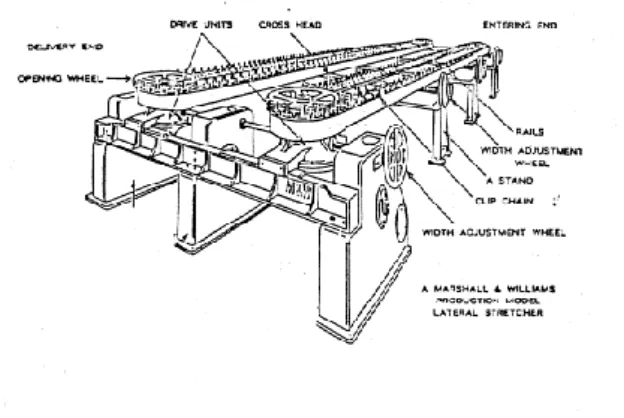
The work in this paper is divided in two stages. 1) RPG utilization 2) Alternate Power Resources in TDO unit. During the manufacturing of BOPP films due to problems in the process or quality waste generates. Company has their own plant to convert waste into raw material form which is called RPG (Reprocessed Granules). The quality of recyclates is recognized as one of the principal challenges that need to be addressed for the success of a long term vision of a green economy and achieving zero waste. Recyclate quality is generally referring to how much of the raw material is made up of target material compared to the amount of non-target material and other non- recyclable materialOnly target material is likely to be recycled, so a higher amount of non-target and non-recyclable material will reduce the quantity of recycling product. The amount of money actually saved through recycling depends on the efficiency of the recycling program used to do it. The transverse direction orienting machine is abbreviated as “TDO”, standing for transverse direction. The TDO is to stretch the film in transverse direction which is already longitudinal oriented film in transverse direction. The film is transported through clips which are fixed on TDO chain. There are three section of TDO.(Preheating Section, Stretching Section, Cooling Section). The spindles are provided at the operator side of the TDO for adjusting the width of the film. There are 12 numbers of spindles, in which first 6 spindles for preheating; next 3 for Stretching and last 3 for annealing are used. The maximum stretching is occurred at spindles number 7 and maximum width after annealing is 4300mm.On the top of the TDO an exhaust system is installed to eliminate vapours, originating from additives from the oven.
Fig. 2 TDO (Transverse direction orienter) II EXISTING HEATING (ELECTRICAL) SYSTEM
OF TDO
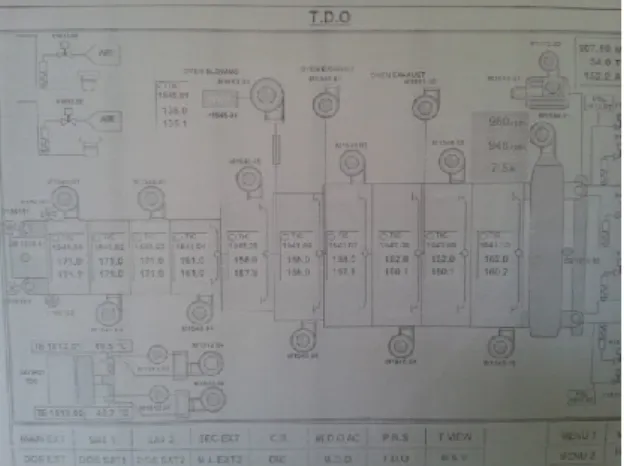
The heating required for stretching is provided by electrical. Basically transverse direction orientation is
process carried out in big oven type structure, which is divided into ten different sections. Each section is been provided with blower and heater. Which provides hot air to maintain the required temperatures in each zone? The blowers are installed at operator side as well as drive side for blowing the air. This air is heated by the heat exchanger (Rectangular block). At the end of the oven cooling blowers are installed to cool down the hot film.
Fig. 3 Existing heating system of TDO III THERMAL FLUID SYSTEM DESIGN
Thermal fluid heating is a type of indirect heating in which a liquid phase heat transfer medium is heated and circulated to one or more heat energy users within a closed loop system.
Piping:
Welded installations are recommended:
Schedule 40 seamless carbon steel pipe. Diameter-4”
Mill scale and protective coatings is removed prior to installation.
Backing rings at pipe to pipe welds is recommended (Robvon or equal). Oil Fired Vertical Thermic Fluid Heater:
The "THERMOTECH" liquid phase fully automatic heating systems.
Thermic fluid can be heated up to 300°C at near atmospheric pressure, with efficiency as high as 87% on NCV of Oil/Gas fuel. The capacity 25 lacs kcal/hr
Furnace Oil used to heat the thermic fluid Thermic Fluid:
Hytherm 500 is recommended. Primary Circulating Pump:
Centrifugal type Heat Exchanger:
Radiator Type
Finned-tube coils (sometimes known as heat transfer coils) have two important parts that convey heat transfer. The first is the tubes, which also are called the “primary surface.” The second is the finned surface, which also is known as the “secondary surface.” Both are ultra-important to creating the designed heat transfer with balanced air- and water-side resistance.
Temperature Control Valve: Two Way Diaphragm Type
A linear motion valve that is used to start, regulate, and stop fluid flow.
Pipe Insulation: Glass Wool Thickness-75mm
Fig. 4 Layout of Oil heating system of TDO IV MODIFIED HEATING (OIL) SYSTEM OF TDO In thermal fluid systems, the produced heat in thermic fluid heater is transferred to the radiator type heat exchanger by means of a heat transfer fluid, usually a Hitherm 500 through an insulated piping system. The primary circulating pump (centrifugal) provides the flow in the system. Heat losses are very
low and are limited to a low level of radiated heat from the well insulated distribution pipe work. There is an expansion tank on the system to allow for the expansion & contraction of the hot oil as it heats up and cools down. To remove particulate from the system has side stream filtration unit. Thermal Fluid, however, remains entirely in the liquid phase throughout the complete operation and is able to achieve a temperature of up to 250ºC at atmospheric conditions. The heat is transferred by turbulent liquid flow at the heat transfer surface. The fluid then passes in a closed circuit back to the Thermal Fluid heater for reheating without further loss of energy. Every zone of TDO Temp is controlled by two way diaphragm type control valve. It controls the flow by movement of diaphragm. The temperature measurement unit consists of the temperature sensor. The system can be expected to detect the preset temperature, to display time, to save and print monitoring data. An alarm will be given by system if the temperature exceeds the upper and lower limit value of the temperature which can be set discretionarily and then automatic control is achieved, thus the temperature is achieved monitoring intelligently within a certain range. The simplicity of the system and the preserving nature of the oil make this a very reliable and low maintenance solution. The system is easy to operate and due to the system design the thermal oil has a long lifetime.
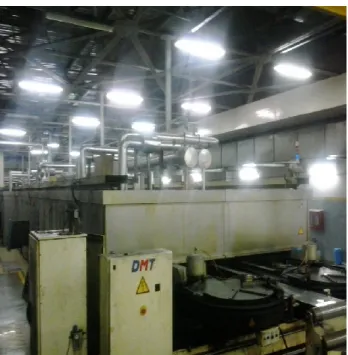
Fig. 5 TDO Unit after modification RESULT AND DISCUSSION
The result shown in terms of profits or cost calculation is subjected to the prices’ of per unit electricity consumed and the cost of required amount oil. Accordingly profit may vary. To overcome loss electrical heating system is not removed from the place for easy switch over. With observations the prices of electricity and oil are mostly constant and the B.E.P (Break even point) of the project is attained in 3months period. There after it is a positive advantage to have the system installed.
RPG is utilized in the manufacturing process in the amount that will not affect the quality of production. So various trials have conducted to check the impact of RPG utilization on quality and waste generated to check feasibility of RPG utilization. Except the trial conducted for Thermal lamination all trials have produced results with acceptable result in terms of quality and waste generation.
Average waste for the month of Oct, Nov, Dec-2013 is 600 kg/day.
During the period of trial conduction: Jan-14 to Mar-14
Average waste is 614 kg. Which is acceptable as amount of savings RPG generates?
Data of per month RPG utilization in January month to March is taken.
Financial difference in cost computing of RPG and PP from Reliance industries.
Company receives Repol at price of: 88.7 Rs/kg RPG production cost included all expenses: 83.2 Rs/kg
Also for selling RPG Company has to pay excise (Tax) which is 7.8 Rs.
So, Total saving on utilizing one Kg of RPG is: Repol price – RPG production cost + Excise =88.7 – 83.2 +7.8 =13.3 Rs/kg.
So it directly reduces per kg manufacturing cost by 13.3 Rs.
For the month of January and February 2014 electrical heating was present and for March 2014 the oil heating project is implemented. The Data has taken during electrical heating & oil heating provides conclusive data summery on the savings in the power
cost which has contributed in reduction of manufacturing cost of BOPP film. For January 2014:
Total units consumed-1270882 units.
Average units used: 42363 For February 2014:
Total units consumed: 1215215 Average units used: 43401 For March 2014:
Total units consumed: 1173677 Average units used: 39122 Comparative savings:
January 2014=42363-39122=3241 units.
Savings in terms of cost: 3241*6.7(rate per unit) =21714 rupees/day.
February 2014 = 43401-39122 =4279 units Savings in terms of cost: 4279*6.7= 28669 rupees/day.
Average savings obtain per day= 25191 rupees. CONCLUSION
On the basis of results and discussions presented in the earlier sections, the following major conclusions are drawn:
PART ONE: RPG utilization.
Per Kg utilization of RPG in manufacturing of BOPP film will reduce manufacturing cost by 13.3 Rs/Kg. PART TWO: Alternate power resources:
After utilizing oil heating instead of electrical heating the Average reduction in electrical units’
consumption is 3731 units which cost 25000/- Rs per day.
REFERENCES
[1] Brueckner Maschinenbau Gmbh, Siegsdorf, Germany, “Bruckner power –frame stenter with integrated
ECO-HEAT back-pack heat recovery unit”March 4, 2009(Germany)
[2] M.Tolga Balta and Arif Hepbasli, Ebru Hancioglu, Ertan Yilmazer,“Exergetic analysis of a continuous Bi-axiallyOrientedPolypropylene (BOPP) film unit in a plastic processing plant,Int. J. Exergy, Vol. 6, No. 3, 2009
[3] C.Mborah and E.K Gbadam“On the Energy and Exergy Analysis of a 500 KW Steam Power Plantat Benson Oil Palm Plantation (BOPP)” Research Journal of Environmental and Earth Sciences 2(4): 239-244, 2010
[4] Menzie Chinn, Michael LeBlanc, Olivier Coibion, “The Predictive Characteristics of Energy Futures: Recent Evidence for Crude Oil, Natural Gas, Gasoline and Heating Oil,The Report of the National Energy Policy Development Group, October 2001 [5] Moss, S., Pauquet J-R., Zweifel, H., "Degradation
and Stabilization of Polyolefins During Melt Processing",Int. Conf. Adv. in the Stabilization & Degradation of Polymers, Lucerne 1991, Conf. Prep. (A. Patsis, Ed.).
[6] Bruckner stenters and ECO-HEAT back-pack, “heat recoveryunit on dryer lower the energy consumption and other inputsat Lucky Tex Processing Mills,34 PTJ October 2012
[7] Serletis, Apostolos, 1991, “Rational Expectations, Risk and Efficiency in Energy Futures Markets,” Energy Economics13(2):111-115
[8] Herbert,John 1993, “The relation of Monthly Spot to Futures Prices for Natural Gas, ”Energy 18(1),pp.1119-1124.
[9] Cengel,Y.A. and A.B.
Micheael,2008.Thermodynamics:An Engineering
Approach. 6th Edn.,McGraw Hill
Companies,Inc.,New York.
[10] Gugumus, F., "Plastic Additives", Chapter 1; 3rd Ed., Hanser Publisher, New York, 1990
[11] Zweifel, H., Moss, S., "Degradation and Stabilization of High Density Polyethylene during Multiple Extrusion", Polymer Degradation and Stability, 25 (1989), 217-245.
[12] Bagdan Levarda and Cristina Budaciu. “The design of Temperature control system”University of Techanical,Gherorghea Sache Tomul 2010