Background
Background
Relapse of depression is
Relapse of depression is
associated with a criticising attitude of the
associated with a criticising attitude of the
patient’s partner.
patient’s partner.
Aims
Aims
To compare the relative efficacy
To compare the relative efficacy
and cost of couple therapy and
and cost of couple therapy and
antidepressant drugs for the treatment
antidepressant drugs for the treatment
and maintenance of people with
and maintenance of people with
depression living with a critical partner.
depression living with a critical partner.
Method
Method
A randomised controlled trial
A randomised controlled trial
of antidepressant drugs
of antidepressant drugs
v
v
. couple therapy.
. couple therapy.
The subjects were 77 people meeting
The subjects were 77 people meeting
criteria for depression living with a critical
criteria for depression living with a critical
partner.
partner.
Results
Results
Drop-outs were 56.8% from
Drop-outs were 56.8% from
drug treatment and15% from couple
drug treatment and15% from couple
therapy. Subjects’depression improved in
therapy. Subjects’depression improved in
both groups, but couple therapy showed a
both groups, but couple therapy showed a
significant advantage, according to the
significant advantage, according to the
Beck Depression Inventory, both
Beck Depression Inventory, both
at the end of treatment and after a
at the end of treatment and after a
second year off treatment. Adding the
second year off treatment. Adding the
costs of the interventions to the costs of
costs of the interventions to the costs of
services used showed there was no
services used showed there was no
appreciable difference between the two
appreciable difference between the two
treatments.
treatments.
Conclusions
Conclusions
For this group couple
For this group couple
therapy is much more acceptable than
therapy is much more acceptable than
antidepressant drugs and is at least as
antidepressant drugs and is at least as
efficacious, if not more so, both in the
efficacious, if not more so, both in the
treatment and maintenance phases.It is no
treatment and maintenance phases.It is no
more expensive overall.
more expensive overall.
Declaration of interest
Declaration of interest
Funding
Funding
from the Medical Research Council.
from the Medical Research Council.
A number of studies of patients living with A number of studies of patients living with partners have shown that the outcome of partners have shown that the outcome of depressive neurosis over 9 months is depressive neurosis over 9 months is asso-ciated with the degree of criticism ciated with the degree of criticism expressed by the partner towards the expressed by the partner towards the patient (Vaughn & Leff, 1976
patient (Vaughn & Leff, 1976bb; Hooley; Hooleyetet al
al, 1986; Okasha, 1986; Okasha et alet al, 1994), although, 1994), although one recent study failed to replicate this one recent study failed to replicate this finding (Hayhurst
finding (Hayhurstet alet al, 1997). This asso-, 1997). This asso-ciation suggests that couple therapy might ciation suggests that couple therapy might be an appropriate form of treatment for be an appropriate form of treatment for patients with depression living with a patients with depression living with a critical partner. A small number of critical partner. A small number of random-ised controlled trials of marital therapy for ised controlled trials of marital therapy for such patients have been published such patients have been published (Friedman, 1975; Waring
(Friedman, 1975; Waring et alet al, 1988;, 1988; O’Leary & Beach, 1990; Jacobson O’Leary & Beach, 1990; Jacobson et alet al,, 1991; Emanuels-Zuurveen & Emmelkamp, 1991; Emanuels-Zuurveen & Emmelkamp, 1996). The duration of these trials varied 1996). The duration of these trials varied between 10 and 20 weeks and none between 10 and 20 weeks and none included a follow-up period after treatment included a follow-up period after treatment to assess any prophylactic effect. There was to assess any prophylactic effect. There was a consistent finding that marital therapy a consistent finding that marital therapy and cognitive therapy were equally effective and cognitive therapy were equally effective in reducing depressive symptoms, but that in reducing depressive symptoms, but that only marital therapy improved the marital only marital therapy improved the marital relationship.
relationship.
METHOD
METHOD
The intention was to compare the optimum The intention was to compare the optimum regime of antidepressants with couple regime of antidepressants with couple therapy delivered by experienced therapists. therapy delivered by experienced therapists. Antidepressant treatment would be Antidepressant treatment would be main-tained for a year, after which it would be tained for a year, after which it would be discontinued. Couple therapy would be discontinued. Couple therapy would be given as an alternative to drugs during given as an alternative to drugs during the first year. The second year of the trial the first year. The second year of the trial would represent the prophylactic phase would represent the prophylactic phase for both treatments, which would end with for both treatments, which would end with a follow-up assessment. A comparison of a follow-up assessment. A comparison of the costs of treatment and other services the costs of treatment and other services received was included, in order to received was included, in order to com- com-pare the cost-effectiveness of the two pare the cost-effectiveness of the two treatments.
treatments.
Subjects
Subjects
Subjects were recruited in different ways. Subjects were recruited in different ways. The majority came through professional The majority came through professional contacts, including general practitioners in contacts, including general practitioners in north and south London, and the Maudsley north and south London, and the Maudsley Hospital out-patient service and emergency Hospital out-patient service and emergency clinic. A minority contacted us in response clinic. A minority contacted us in response to advertisements in local newspapers. to advertisements in local newspapers. Subjects had to be under the age of 65 Subjects had to be under the age of 65 and had to have lived with a heterosexual and had to have lived with a heterosexual partner for at least 1 year. They also needed partner for at least 1 year. They also needed to reach a level of ‘caseness’ (Index of to reach a level of ‘caseness’ (Index of Definition level 5 or above), receive a Definition level 5 or above), receive a pri-mary classification of depression on the mary classification of depression on the Present State Examination – Catego System Present State Examination – Catego System (Wing
(Winget alet al, 1974) and achieve a score on, 1974) and achieve a score on the Hamilton Depression Rating Scale the Hamilton Depression Rating Scale (Hamilton, 1960) of at least 14. These (Hamilton, 1960) of at least 14. These criteria define a major depressive episode. criteria define a major depressive episode. The partner had to be rated as expressing The partner had to be rated as expressing at least two critical comments during the at least two critical comments during the Camberwell Family Interview (Vaughn & Camberwell Family Interview (Vaughn & Leff, 1976
Leff, 1976aa).).
Patients were excluded if they showed Patients were excluded if they showed any psychotic features, or suffered from any psychotic features, or suffered from bipolar illness, organic brain syndrome, bipolar illness, organic brain syndrome, severe suicidal tendencies, primary severe suicidal tendencies, primary sub-stance abuse, learning difficulties, or stance abuse, learning difficulties, or contraindications (such as pregnancy) for contraindications (such as pregnancy) for antidepressants. Those who had during antidepressants. Those who had during the preceding 3 months experienced an the preceding 3 months experienced an adequate course of either of the treatments adequate course of either of the treatments offered in the trial were also excluded. The offered in the trial were also excluded. The criteria for adequacy were 6 weeks of an criteria for adequacy were 6 weeks of an antidepressant at a therapeutic dosage, or antidepressant at a therapeutic dosage, or six sessions of couple therapy.
six sessions of couple therapy.
A power calculation based on the A power calculation based on the relapse rates in the naturalistic studies of relapse rates in the naturalistic studies of critical partners and the course of critical partners and the course of depres-sion indicated that for a significance level sion indicated that for a significance level of
ofPP550.05 and a power of 80%, a sample0.05 and a power of 80%, a sample size of 40 in each group was required. size of 40 in each group was required. The research team made contact with 290 The research team made contact with 290 individuals, of whom 196 were excluded individuals, of whom 196 were excluded because they did not have a stable because they did not have a stable relation-ship or would not accept random allocation ship or would not accept random allocation to treatment. Of the remaining 94 people, to treatment. Of the remaining 94 people, six rejected the possibility of receiving six rejected the possibility of receiving anti-depressants. This left 88 subjects and their depressants. This left 88 subjects and their partners who met our criteria, who were partners who met our criteria, who were randomised to one of the trial groups, using randomised to one of the trial groups, using a computer-generated random number a computer-generated random number table and sealed envelopes. As part of the table and sealed envelopes. As part of the randomisation procedure, subjects were randomisation procedure, subjects were stratified according to whether or not they stratified according to whether or not they had a significant history of depression, had a significant history of depression, defined as a current episode of depression defined as a current episode of depression lasting 6 months or more or a previous lasting 6 months or more or a previous treated episode in the last 3 years. treated episode in the last 3 years.
The London Depression InterventionTrial
The London Depression InterventionTrial
Randomised controlled trial of antidepressants
Randomised controlled trial of antidepressants
vv
. couple
. couple
therapy in the treatment and maintenance of people with
therapy in the treatment and maintenance of people with
depression living with a partner: clinical outcome and costs
depression living with a partner: clinical outcome and costs
{{J. LEFF, S. VEARNALS, C. R. BRE WIN, G. WOLFF, B. ALEXANDER, E. ASEN, J. LEFF, S. VEARNALS, C. R. BRE WIN, G. WOLFF, B. ALEXANDER, E. ASEN, D. DAYSON, E. JONES, D. CHISHOLM and B. EVERIT T
D. DAYSON, E. JONES, D. CHISHOLM and B. EVERIT T
{
Treatments
Treatments
Initially we had intended to compare three Initially we had intended to compare three treatments for depression: antidepressants, treatments for depression: antidepressants, couple therapy and cognitive therapy. We couple therapy and cognitive therapy. We anticipated recruiting three subjects per anticipated recruiting three subjects per month, but the rate actually achieved was month, but the rate actually achieved was two per month, and the drop-out rate from two per month, and the drop-out rate from the cognitive therapy arm was so high (8 the cognitive therapy arm was so high (8 out of 11) that this treatment option was out of 11) that this treatment option was soon deleted from the trial. Hence we soon deleted from the trial. Hence we pre-sent here the results for the 77 subjects sent here the results for the 77 subjects who received antidepressants or couple who received antidepressants or couple therapy. We did not include a group of therapy. We did not include a group of subjects who were assigned to no subjects who were assigned to no treat-ment, as this was considered unethical, ment, as this was considered unethical, given the well-established efficacy of given the well-established efficacy of anti-depressants for major depressive episodes. depressants for major depressive episodes.
Antidepressant regime Antidepressant regime
The pharmacotherapy was the The pharmacotherapy was the respons-ibility of D.D., who selected a regime to ibility of D.D., who selected a regime to represent the best available clinical represent the best available clinical practice, while ensuring compliance. The practice, while ensuring compliance. The initial medication was a tricyclic initial medication was a tricyclic anti-depressant, desipramine, provided there depressant, desipramine, provided there was no contraindication. The dose was was no contraindication. The dose was gradually increased over a few weeks, gradually increased over a few weeks, titrating it against side-effects and symptom titrating it against side-effects and symptom reduction. To monitor compliance reduction. To monitor compliance indepen-dently of the patient’s report, serum levels dently of the patient’s report, serum levels were checked at 4 weeks, 8 weeks, 6 were checked at 4 weeks, 8 weeks, 6 months and 1 year. If, despite taking months and 1 year. If, despite taking desi-pramine for a full 6 weeks in doses that pramine for a full 6 weeks in doses that achieved therapeutic serum levels (125 achieved therapeutic serum levels (125mmg/g/ ml), there was no response, or intolerable ml), there was no response, or intolerable side-effects developed, a second-line side-effects developed, a second-line anti-depressant was substituted: if agitation depressant was substituted: if agitation was prominent, trazodone was prescribed, was prominent, trazodone was prescribed, whereas if the patient showed retardation, whereas if the patient showed retardation, fluvoxamine was given. Once an effective fluvoxamine was given. Once an effective dose had been achieved and symptoms dose had been achieved and symptoms remitted, the patient was continued on this remitted, the patient was continued on this dose for 4 months, following which the dose for 4 months, following which the dose was gradually reduced to between 1/ dose was gradually reduced to between 1/ 2 and 2/3 of the peak dose. Patients were 2 and 2/3 of the peak dose. Patients were maintained on this dose for the rest of the maintained on this dose for the rest of the first year. Alongside medication, during first year. Alongside medication, during the first two sessions an educational the first two sessions an educational pro-gramme about depression and gramme about depression and antidepres-sants was given to the patient and their sants was given to the patient and their partner, to maximise compliance. The partner, to maximise compliance. The sessions lasted 20–30 minutes, those who sessions lasted 20–30 minutes, those who completed the course received between 12 completed the course received between 12 and 20 sessions. After 1 year the and 20 sessions. After 1 year the antidepres-sant was tailed off over 2 weeks, although sant was tailed off over 2 weeks, although two patients chose to remain on two patients chose to remain on medi-cation, and two others relapsed as soon as cation, and two others relapsed as soon as it was stopped, necessitating a resumption. it was stopped, necessitating a resumption.
Couple therapy Couple therapy
Two senior family and couple therapists Two senior family and couple therapists were responsible for developing the form were responsible for developing the form of treatment used in this trial. In their of treatment used in this trial. In their model
model the patients’ depressive symptomsthe patients’ depressive symptoms are conceptualised in interactional terms. are conceptualised in interactional terms. Close relationships are regarded both as Close relationships are regarded both as influencing, and being influenced by, the influencing, and being influenced by, the patient and his/her symptoms. Systemic patient and his/her symptoms. Systemic couple therapy aims to help the patient couple therapy aims to help the patient and partner to gain new perspectives on and partner to gain new perspectives on the presenting problems, to attach different the presenting problems, to attach different meanings
meanings to the depressive types of behav-to the depressive types of behav-iour and to experiment with new ways of iour and to experiment with new ways of relating to each other. During a pilot phase, relating to each other. During a pilot phase, the therapists constructed a manual, and the therapists constructed a manual, and modified it through experience with six modified it through experience with six couples who met the criteria for the trial couples who met the criteria for the trial but were not randomly allocated to but were not randomly allocated to treat-ment. During this phase the therapists ment. During this phase the therapists attempted to design specific interventions attempted to design specific interventions aimed at directly reducing criticism by the aimed at directly reducing criticism by the partner. However, the techniques used partner. However, the techniques used seemed to have little effect on the patient’s seemed to have little effect on the patient’s depressive symptoms and were therefore depressive symptoms and were therefore not included in the final version of the not included in the final version of the protocol.
protocol.
The manual (Jones & Asen, 1999) The manual (Jones & Asen, 1999) specifies in detail the techniques to be specifies in detail the techniques to be employed, such as observation and employed, such as observation and enact-ment of couple issues, attempts to interrupt ment of couple issues, attempts to interrupt problematic cycles of behaviour to shift problematic cycles of behaviour to shift negative attributions, and setting of tasks negative attributions, and setting of tasks to develop less problematic ways of to develop less problematic ways of inter-acting. The manual describes three distinct acting. The manual describes three distinct phases of therapy in which various specific phases of therapy in which various specific interventions are used, while allowing for interventions are used, while allowing for enough flexibility to avoid the therapy enough flexibility to avoid the therapy becoming a strait-jacket for everyone becoming a strait-jacket for everyone con-cerned. The protocol allowed for 12–20 cerned. The protocol allowed for 12–20 sessions, lasting around 50 minutes each. sessions, lasting around 50 minutes each.
Assessments
Assessments
The initial assessment of the patient The initial assessment of the patient in-cluded a full psychiatric history, the Present cluded a full psychiatric history, the Present State Examination (PSE), the Hamilton State Examination (PSE), the Hamilton Rating Scale for Depression (HRSD), and Rating Scale for Depression (HRSD), and the Beck Depression Inventory (BDI) (Beck the Beck Depression Inventory (BDI) (Beck
et al
et al, 1961). The partner was assessed by, 1961). The partner was assessed by means of the Camberwell Family Interview means of the Camberwell Family Interview (CFI), while both patient and partner (CFI), while both patient and partner completed the Dyadic Adjustment Scale completed the Dyadic Adjustment Scale (Spanier, 1976) to measure the quality of (Spanier, 1976) to measure the quality of their relationship. Following the their relationship. Following the com-pletion of treatment, and at the end of a pletion of treatment, and at the end of a second year without treatment, these second year without treatment, these assessments were repeated for patient and assessments were repeated for patient and partner by researchers who were blind to partner by researchers who were blind to the treatment group of the subjects. the treatment group of the subjects.
Changes in the CFI and the Dyadic Changes in the CFI and the Dyadic Adjust-ment Scale will be presented in another ment Scale will be presented in another paper dealing with the mechanisms of paper dealing with the mechanisms of action of the treatments.
action of the treatments.
Economic analysis Economic analysis
The cost of couple therapy was calculated The cost of couple therapy was calculated on the basis of the number (and average on the basis of the number (and average duration) of sessions and the unit cost per duration) of sessions and the unit cost per hour of direct research therapist’s contact hour of direct research therapist’s contact time. All prescribed antidepressants (and time. All prescribed antidepressants (and associated blood tests) over the course of associated blood tests) over the course of the study were recorded and costed, so that the study were recorded and costed, so that drug therapy costs could be estimated. drug therapy costs could be estimated. Service utilisation data were collected using Service utilisation data were collected using a variant of the Client Service Receipt a variant of the Client Service Receipt Inventory (CSRI; Beecham & Knapp, Inventory (CSRI; Beecham & Knapp, 1992), which covered a range of key health 1992), which covered a range of key health and social care services (in-, out-, and day and social care services (in-, out-, and day patient hospital services, day care and patient hospital services, day care and contacts with a general practitioner, contacts with a general practitioner, com-munity psychiatric nurse, social worker munity psychiatric nurse, social worker and counsellor). Unit costs were attached and counsellor). Unit costs were attached to these data, and aggregated to give a total to these data, and aggregated to give a total service cost estimate for each subject in the service cost estimate for each subject in the study. Unit cost figures were calculated to study. Unit cost figures were calculated to represent long-run marginal opportunity represent long-run marginal opportunity costs, and were drawn from national costs, and were drawn from national esti-mates, adjusted for London as necessary mates, adjusted for London as necessary (Netten & Dennett, 1996). Informal (Netten & Dennett, 1996). Informal care-giver support by family members or others, giver support by family members or others, and the indirect consequences of depression and the indirect consequences of depression (lost employment), were not costed in this (lost employment), were not costed in this study. Analysis of cost differences between study. Analysis of cost differences between the two groups focused on the mean (rather the two groups focused on the mean (rather than the median) as the measure of direct than the median) as the measure of direct policy interest, using a non-parametric policy interest, using a non-parametric bootstrap for the estimation of 95% bootstrap for the estimation of 95% confi-dence intervals, owing to the positively dence intervals, owing to the positively skewed distribution observed for service skewed distribution observed for service cost variables (Barber & Thompson, 1998). cost variables (Barber & Thompson, 1998).
Statistical analysis Statistical analysis
Each outcome variable provided data at Each outcome variable provided data at three time points: baseline, 1-year and three time points: baseline, 1-year and 2-year follow-up. Various methods of 2-year follow-up. Various methods of analysis have been proposed for such analysis have been proposed for such longitudinal data (Everitt, 1985, 1998; longitudinal data (Everitt, 1985, 1998; Diggle
produce a less biased analysis than produce a less biased analysis than com-monly used alternatives, such as analysing monly used alternatives, such as analysing only those who complete the course, or only those who complete the course, or re-placing missing values with the last placing missing values with the last avail-able measurement (last observation carried able measurement (last observation carried forward) (Diggle, 1998). The analysis forward) (Diggle, 1998). The analysis in-cluded all patients for whom
cluded all patients for whom data weredata were available for at least one of the available for at least one of the 1-year1-year and 2-year follow-ups in addition to the and 2-year follow-ups in addition to the baseline assessment. The 1-year follow-up baseline assessment. The 1-year follow-up sample comprised only those who had sample comprised only those who had completed the treatment, while the 2-year completed the treatment, while the 2-year follow-up sample also included some follow-up sample also included some patients who had dropped out of treatment patients who had dropped out of treatment prematurely.
prematurely.
We used the BDI and the HRSD as We used the BDI and the HRSD as indi-cators of outcome but excluded the PSE, as cators of outcome but excluded the PSE, as it is primarily a diagnostic instrument and it is primarily a diagnostic instrument and is not sensitive to incremental changes over is not sensitive to incremental changes over time.
time.
RESULTS
RESULTS
Subjects
Subjects
Of the 94 patients assessed as suitable for Of the 94 patients assessed as suitable for the trial over 45 months, only six refused the trial over 45 months, only six refused to enter the study. This is an unusually to enter the study. This is an unusually low refusal rate, but we have to take into low refusal rate, but we have to take into account the large number of patients with account the large number of patients with whom we made contact who refused to be whom we made contact who refused to be assessed. As we have no data on these assessed. As we have no data on these people, we cannot compare them with the people, we cannot compare them with the
trial subjects. A further 11 were lost when trial subjects. A further 11 were lost when the cognitive therapy treatment was deleted the cognitive therapy treatment was deleted early in the trial. Of the 77 patients in the early in the trial. Of the 77 patients in the two-arm trial, just under one quarter two-arm trial, just under one quarter referred themselves in response to referred themselves in response to adver-tisements. The characteristics of the tisements. The characteristics of the patients assigned to the two therapies are patients assigned to the two therapies are shown in Table 1.
shown in Table 1.
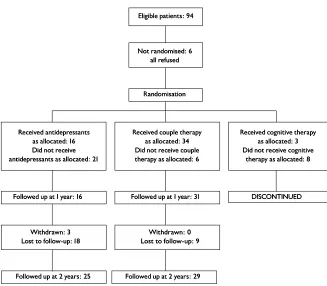
Patients’ progress through the trial is Patients’ progress through the trial is shown in a CONSORT diagram (see shown in a CONSORT diagram (see Fig. 1).
Fig. 1).
Drop-outs
Drop-outs
Of the 37 patients randomly allocated to Of the 37 patients randomly allocated to the drug treatment, nine dropped out the drug treatment, nine dropped out before their first treatment visit, and before their first treatment visit, and another 12 subsequently. Three of these another 12 subsequently. Three of these patients were withdrawn from the trial by patients were withdrawn from the trial by the pharmacotherapist, two because they the pharmacotherapist, two because they developed mania (an exclusion category for developed mania (an exclusion category for the trial) and one on account of intolerable the trial) and one on account of intolerable side-effects. Only two people objected to side-effects. Only two people objected to having blood tests: one had severe needle having blood tests: one had severe needle phobia and the other refused tests, but both phobia and the other refused tests, but both continued with the treatment. All the tests continued with the treatment. All the tests showed that patients had antidepressant showed that patients had antidepressant levels within the therapeutic range. Of the levels within the therapeutic range. Of the 40 patients randomly allocated to couple 40 patients randomly allocated to couple therapy, three dropped out before any therapy, three dropped out before any treatment, and a further three subsequently. treatment, and a further three subsequently. The difference in total drop-out rate The difference in total drop-out rate between drug treatment (56.8%) and between drug treatment (56.8%) and couple therapy (15.0%) is 41.8% (95% couple therapy (15.0%) is 41.8% (95% CI 31.8–51.8) and is highly significant CI 31.8–51.8) and is highly significant ((ww22¼14.72, d.f.14.72, d.f.¼1,1,PP550.001).0.001).
[image:3.596.44.371.72.358.2]Drop-outs were compared with those Drop-outs were compared with those who completed treatment as regards who completed treatment as regards several variables, in order to identify what several variables, in order to identify what might determine failure to complete might determine failure to complete treat-ment. No differences were found between ment. No differences were found between the two groups regarding gender, Dyadic the two groups regarding gender, Dyadic Adjustment Score, partner’s critical Adjustment Score, partner’s critical com-ments or HRSD score. However, the ments or HRSD score. However, the drop-outs were significantly younger than drop-outs were significantly younger than
[image:3.596.216.554.532.760.2]Table 1
Table 1 Characteristics of subjects in the two treatment groupsCharacteristics of subjects in the two treatment groups
Drug treatment Drug treatment
n n¼3737
Couple therapy Couple therapy
n n¼4040
Patient’s mean age, years (s.d.)
Patient’s mean age, years (s.d.) 38.6 (9.2)38.6 (9.2) 39.7 (12.5)39.7 (12.5)
Partner’s mean age, years (s.d.)
Partner’s mean age, years (s.d.) 39.1 (9.8)39.1 (9.8) 40.9 (15.0)40.9 (15.0)
Gender of patient: M/F
Gender of patient: M/F 10/2710/27 17/2317/23
Duration of current relationship, years (s.d.)
Duration of current relationship, years (s.d.) 10.1 (7.8)10.1 (7.8) 10.8 (11.8)10.8 (11.8) Median: percentile (25, 75)
Median: percentile (25, 75) 7.0 (3.5, 15.0)7.0 (3.5, 15.0) 5.0 (3.0, 17.25)5.0 (3.0, 17.25)
Dyadic Adjustment Scale (initial) (s.d.)
Dyadic Adjustment Scale (initial) (s.d.) 96.5 (20.1)96.5 (20.1) 87.3 (24.7)87.3 (24.7)
Partner’s critical comments (initial) (s.d.)
Partner’s critical comments (initial) (s.d.) 8.8 (9.8)8.8 (9.8) 8.3 (6.4)8.3 (6.4) Age of onset of first depression, years (s.d.)
Age of onset of first depression, years (s.d.) 28.6 (9.3)28.6 (9.3) 29.8 (16.1)29.8 (16.1)
Median: percentile (25, 75)
Median: percentile (25, 75) 28.0 (21.0, 34.5)28.0 (21.0, 34.5) 25.0 (16.0, 39.75)25.0 (16.0, 39.75)
Significant history of depression
Significant history of depression 3030 3030 Hamilton Depression Rating Scale (initial) (s.d.)
Hamilton Depression Rating Scale (initial) (s.d.) 18.7 (3.9)18.7 (3.9) 18.1 (3.4)18.1 (3.4)
Beck Depression Inventory (initial) (s.d.)
Beck Depression Inventory (initial) (s.d.) 28.1 (6.0)28.1 (6.0) 25.4 (7.4)25.4 (7.4)
Source of referral (%) Source of referral (%)
Professional
Professional 75.775.7 75.075.0
Advertisement
Advertisement 24.324.3 25.025.0 Not randomised: 6
Not randomised: 6 all refused all refused
Randomisation Randomisation
Followed up at 1 year: 16
Followed up at 1 year: 16 Followed up at 1 year: 31Followed up at 1 year: 31 DISCONTINUEDDISCONTINUED
Withdrawn: 0 Withdrawn: 0 Lost to follow-up: 9 Lost to follow-up: 9 Withdrawn: 3
Withdrawn: 3 Lost to follow-up: 18 Lost to follow-up: 18
Followed up at 2 years: 25
Followed up at 2 years: 25 Followed up at 2 years: 29Followed up at 2 years: 29 Received antidepressants
Received antidepressants as allocated: 16 as allocated: 16 Did not receive Did not receive antidepressants as allocated: 21 antidepressants as allocated: 21
Received couple therapy Received couple therapy
as allocated: 34 as allocated: 34 Did not receive couple Did not receive couple therapy as allocated: 6 therapy as allocated: 6
Received cognitive therapy Received cognitive therapy
as allocated: 3 as allocated: 3 Did not receive cognitive Did not receive cognitive therapy as allocated: 8 therapy as allocated: 8 Eligible patients: 94
Eligible patients: 94
Fig. 1
the completers (34.3
the completers (34.3 vv. 41.8,. 41.8, tt¼3.30,3.30, d.f.
d.f.¼75,75, PP550.002), and had higher BDI0.002), and had higher BDI scores (29.4
scores (29.4 vv. 25.2,. 25.2, tt¼2.99, d.f.2.99, d.f.¼75,75,
P
P550.004). The assessments at the 1-year0.004). The assessments at the 1-year follow-up were only conducted on subjects follow-up were only conducted on subjects who completed treatment. However, at who completed treatment. However, at the 2-year follow-up, a small financial the 2-year follow-up, a small financial inducement persuaded a number of inducement persuaded a number of drop-outs, particularly those in the drug group, outs, particularly those in the drug group, to return for assessment.
to return for assessment.
Effects of treatment
Effects of treatment
The statistical analysis was conducted on The statistical analysis was conducted on an intention-to-treat basis, and any data an intention-to-treat basis, and any data available from drop-outs were included. available from drop-outs were included. The likelihood approach was used to fit a The likelihood approach was used to fit a variety of models for the mean profiles of variety of models for the mean profiles of the BDI outcome variable. The main effects the BDI outcome variable. The main effects
of treatment group and time, and the of treatment group and time, and the interaction of treatment group and time, interaction of treatment group and time, were considered. In addition, the initial were considered. In addition, the initial value of the BDI was introduced as a value of the BDI was introduced as a co-variate, along with age and a small number variate, along with age and a small number of additional covariates such as gender and of additional covariates such as gender and history of depression. Only treatment history of depression. Only treatment group was found to be significant, with an group was found to be significant, with an average difference in BDI scores of 6.4 average difference in BDI scores of 6.4 (95% CI 1.62–11.54). In the absence of a (95% CI 1.62–11.54). In the absence of a significant group
significant group66time interaction, thistime interaction, this implies that from initial assessment to the implies that from initial assessment to the 1-year follow-up, the mean BDI score in 1-year follow-up, the mean BDI score in the couple therapy group falls to between the couple therapy group falls to between 1.62 and 11.54 points lower than the 1.62 and 11.54 points lower than the corresponding mean in the medication corresponding mean in the medication group.
group. This difference is maintained fromThis difference is maintained from the 1-year time point until the 2-year the 1-year time point until the 2-year
follow-up.
follow-up. Figure 2 shows the mean scoresFigure 2 shows the mean scores and standard errors of the means over the and standard errors of the means over the three time points.
three time points.
The same analysis was applied to the The same analysis was applied to the HRSD scores, and produced a different HRSD scores, and produced a different result, namely that a significant result, namely that a significant improve-ment had occurred after treatimprove-ment for both ment had occurred after treatment for both groups, which was sustained during the groups, which was sustained during the year without treatment, but that there was year without treatment, but that there was no significant advantage for couple therapy no significant advantage for couple therapy over medication
over medication..
Economic component
Economic component
The collection of data regarding use of The collection of data regarding use of services, necessary for the economic services, necessary for the economic evalu-ation of the alternative therapy strategies, ation of the alternative therapy strategies, did not form part of the original battery did not form part of the original battery of instruments, so that these data were of instruments, so that these data were missing for initial recruits to the trial (27 missing for initial recruits to the trial (27 cases). Drop-outs during the treatment cases). Drop-outs during the treatment phase who failed to return for the 2-year phase who failed to return for the 2-year up, loss of contact over the up, loss of contact over the follow-up phase with those who had completed up phase with those who had completed treatment, and non-consent at both treatment, and non-consent at both assess-ment points also contributed to a ment points also contributed to a consider-able reduction in the sample availconsider-able for able reduction in the sample available for economic analysis.
economic analysis.
Table 2 gives the costs of therapy and Table 2 gives the costs of therapy and service use over the treatment and service use over the treatment and follow-up phases of the study. It should be noted up phases of the study. It should be noted that the drug treatment costs include the that the drug treatment costs include the cost of the blood tests (a mean of £3.73 cost of the blood tests (a mean of £3.73 per month), which would not be done per month), which would not be done routinely. The mean monthly cost of couple routinely. The mean monthly cost of couple therapy was £106 (s.d.
therapy was £106 (s.d.¼23), compared23), compared with a treatment cost of £48 (s.d. with a treatment cost of £48 (s.d.¼18) for18) for the drug group. This significantly greater the drug group. This significantly greater cost of treatment (£58, 95% CI 45–72) is cost of treatment (£58, 95% CI 45–72) is offset by a reduction in the costs of hospital offset by a reduction in the costs of hospital
Fig. 2
[image:4.596.37.368.75.272.2]Fig. 2 Mean profiles of couple and medical treatment groups.Mean profiles of couple and medical treatment groups.
[image:4.596.38.545.568.740.2]Table 2
Table 2 The costs of therapy and service utilisationThe costs of therapy and service utilisation
Cost component
Cost component Couple therapy groupCouple therapy group Drug therapy groupDrug therapy group Mean differenceMean difference (» per month, 1995^1996)
(» per month, 1995^1996)
n
n MedianMedian MeanMean s.d.s.d. nn MedianMedian MeanMean s.d.s.d. MeanMean 95% CI95% CI22
Treatment period Treatment period
A. Therapy
A. Therapy 2424 108108 106106 2323 1414 4646 4848 1818 +58+58 45 to 7245 to 72
B. Hospital and community services
B. Hospital and community services 2424 1212 2525 3636 1414 1414 7878 134134 775353 77130 to 10130 to 10
Hospital services
Hospital services 11 1717 3535 11 3838 104104 772020 7787 to 2087 to 20 Community services
Community services 55 88 99 77 4141 9595 773232 7791 to 1.491 to 1.4
C. Combined cost (A+B)
C. Combined cost (A+B) 2424 132132 131131 3838 1414 6262 126126 139139 +5+5 7776 to 7176 to 71
Follow-up period Follow-up period11
D. Hospital and community services
D. Hospital and community services 2727 1616 4343 6060 2121 1616 6767 122122 772424 7783 to 2583 to 25
Hospital services
Hospital services 1010 2929 4242 77 5656 121121 772626 7788 to 1988 to 19
Community services
Community services 22 1414 4848 88 1212 1212 +2+2 779 to 209 to 20
1. Includes assessment of people who dropped out of treatment. 1. Includes assessment of people who dropped out of treatment.
and community services (a mean of £53 per and community services (a mean of £53 per month less in the couple therapy group, month less in the couple therapy group, 95% CI
95% CI 77130 to 10). As evidenced by130 to 10). As evidenced by the low median values and large standard the low median values and large standard deviations, however, these service costs deviations, however, these service costs varied markedly, and mean differences varied markedly, and mean differences were not statistically significant. The were not statistically significant. The com-bined mean of therapy and service use is bined mean of therapy and service use is similar for the two groups (£5 higher in similar for the two groups (£5 higher in the couple therapy group; 95% CI the couple therapy group; 95% CI 777676 to 71).
to 71).
The costs of service use were also The costs of service use were also monitored over the follow-up period of monitored over the follow-up period of the study, and included costs incurred by the study, and included costs incurred by treatment-phase drop-outs who agreed to treatment-phase drop-outs who agreed to be interviewed. Mean service costs were be interviewed. Mean service costs were higher in the drug group (£67, s.d. 122) higher in the drug group (£67, s.d. 122) than in the couple therapy group (£43, than in the couple therapy group (£43, s.d. 60), but this difference was not s.d. 60), but this difference was not statisti-cally significant (£24, 95% CI
cally significant (£24, 95% CI7783 to 25),83 to 25), again due to the skewed nature of the data again due to the skewed nature of the data (median costs per month for both groups (median costs per month for both groups were only £16). It is noticeable (but not were only £16). It is noticeable (but not tabulated here) that the cost of hospital tabulated here) that the cost of hospital service use over the follow-up period for service use over the follow-up period for the ten cases who did not engage in either the ten cases who did not engage in either form of therapy (£111, s.d. 170) was three form of therapy (£111, s.d. 170) was three times as great as that for the 38 cases who times as great as that for the 38 cases who did engage in therapy (£38, s.d. 52). did engage in therapy (£38, s.d. 52).
DISCUSSION
DISCUSSION
Reasons for dropping out
Reasons for dropping out
More than half the subjects dropped out of More than half the subjects dropped out of drug treatment, compared with 15% of drug treatment, compared with 15% of those having couple therapy. This finding those having couple therapy. This finding in itself shows that drug treatment was far in itself shows that drug treatment was far less acceptable to the patients in the study less acceptable to the patients in the study than was couple therapy, providing further than was couple therapy, providing further evidence for the popular bias against evidence for the popular bias against anti-depressants which has been documented depressants which has been documented by other studies (Scott & Freeman, 1992; by other studies (Scott & Freeman, 1992; Whitton
Whitton et alet al, 1996). Blood testing did, 1996). Blood testing did not lead to dropping out, and the tests not lead to dropping out, and the tests showed that those who continued with showed that those who continued with medication were fully compliant, an medication were fully compliant, an achievement which must be partly achievement which must be partly attribu-table to the education programme given to table to the education programme given to patients and their partners. The drop-out patients and their partners. The drop-out from the drug arm appears high in relation from the drug arm appears high in relation to other trials of antidepressants (Hollyman to other trials of antidepressants (Hollyman
et al
et al, 1988; Elkin, 1988; Elkinet alet al, 1989), but few have, 1989), but few have continued for as long as 1 year. This continued for as long as 1 year. This duration of treatment was recommended duration of treatment was recommended by the expert we consulted, and seems by the expert we consulted, and seems appropriate, given that three-quarters of appropriate, given that three-quarters of the patients in the trial had been depressed the patients in the trial had been depressed for at least 6 months or had had a treated for at least 6 months or had had a treated episode in the previous 3 years. Patients episode in the previous 3 years. Patients
who dropped out of our trial were younger who dropped out of our trial were younger and more depressed initially than those and more depressed initially than those who completed it. However, the inclusion who completed it. However, the inclusion of these factors as covariates in the of these factors as covariates in the statist-ical analysis accommodates to some extent ical analysis accommodates to some extent for any bias introduced.
for any bias introduced.
Differences between the outcome
Differences between the outcome
assessments
assessments
The analysis demonstrated the superiority The analysis demonstrated the superiority of couple therapy over antidepressant of couple therapy over antidepressant drugs, both for the treatment phase and drugs, both for the treatment phase and for the maintenance phase, as judged by for the maintenance phase, as judged by the BDI scores. By contrast, the HRSD the BDI scores. By contrast, the HRSD scores did not discriminate between the scores did not discriminate between the improvements in the two treatment groups. improvements in the two treatment groups. This may be because the two scales have a This may be because the two scales have a different proportion of cognitive–affective different proportion of cognitive–affective items: 67% of the BDI and 29% of the items: 67% of the BDI and 29% of the HRSD. Furthermore, the BDI has 4-point HRSD. Furthermore, the BDI has 4-point scales for each item, whereas the HRSD scales for each item, whereas the HRSD requires yes/no replies. Senra & Polaino requires yes/no replies. Senra & Polaino (1998) consider that discrepancies between (1998) consider that discrepancies between the HRSD and BDI as regards the degree of the HRSD and BDI as regards the degree of improvement brought about by treatment improvement brought about by treatment are essentially due to differences in scale are essentially due to differences in scale content. Comparison with previous content. Comparison with previous con-trolled
trolled trials of marital therapy is nottrials of marital therapy is not easy, since in three of the five studies easy, since in three of the five studies the other treatment was cognitive therapy, the other treatment was cognitive therapy, a modality which was dropped from our a modality which was dropped from our trial. Of the other two studies, Waring trial. Of the other two studies, Waringetet al
al(1988) included too few subjects in each(1988) included too few subjects in each cell to draw valid conclusions. The cell to draw valid conclusions. The num-bers were reasonably large in the trial by bers were reasonably large in the trial by Friedman (1975) but that continued for Friedman (1975) but that continued for only 12 weeks. It was a four-cell design, only 12 weeks. It was a four-cell design, with random assignment to amitriptyline with random assignment to amitriptyline or placebo, and to weekly marital therapy or placebo, and to weekly marital therapy or to minimal contact. Neither or to minimal contact. Neither amitrip-tyline nor marital therapy showed any tyline nor marital therapy showed any advantage over the control treatment in advantage over the control treatment in alleviating depression. However, patients alleviating depression. However, patients who received marital therapy rated the who received marital therapy rated the marriage as better at follow-up than those marriage as better at follow-up than those in the minimal contact group. In the in the minimal contact group. In the absence of any directly comparable study, absence of any directly comparable study, our finding of an apparent advantage of our finding of an apparent advantage of couple therapy over antidepressants needs couple therapy over antidepressants needs to be replicated in further trials before to be replicated in further trials before being accepted as proven.
being accepted as proven.
Comparative costs
Comparative costs
of the treatments
of the treatments
The addition of a costing component to The addition of a costing component to the study illustrated that the cost of couple the study illustrated that the cost of couple therapy was approximately double that of a therapy was approximately double that of a conventional antidepressants. The observed conventional antidepressants. The observed difference in treatment cost appears to be difference in treatment cost appears to be
moderated by a reduced use of other moderated by a reduced use of other ser-vices. What distinguishes the two groups vices. What distinguishes the two groups more than any difference in total direct more than any difference in total direct cost is the constitution of the costs (couple cost is the constitution of the costs (couple therapy: 81% treatment, 19% service use; therapy: 81% treatment, 19% service use; drug group: 38% treatment, 62% service drug group: 38% treatment, 62% service use). Alongside the improvement in BDI use). Alongside the improvement in BDI scores observed for the couple therapy, scores observed for the couple therapy, thisthis provides encouraging evidence for the provides encouraging evidence for the cost-effectiveness of this intervention. cost-effectiveness of this intervention. However, the post-design addition of the However, the post-design addition of the service utilisation schedule, plus subsequent service utilisation schedule, plus subsequent non-completion and drop-outs, reduced non-completion and drop-outs, reduced the size of the sample for whom costs the size of the sample for whom costs could be estimated to a small one only. could be estimated to a small one only. Taken in conjunction with the highly Taken in conjunction with the highly posi-tively skewed distribution of service costs, tively skewed distribution of service costs, this leaves us much less capable of this leaves us much less capable of com-menting on the findings with any statistical menting on the findings with any statistical confidence. Also, only direct costs of care confidence. Also, only direct costs of care and support were included: the wider and support were included: the wider economic consequences of depression, economic consequences of depression, including the costs associated with work including the costs associated with work disability, were not fully considered. disability, were not fully considered.
Are the results generalisable?
Are the results generalisable?
To what extent can these findings be To what extent can these findings be applied to the general population of applied to the general population of patients with depression? Clearly they patients with depression? Clearly they can-not be extrapolated beyond those living not be extrapolated beyond those living with a heterosexual partner. One selection with a heterosexual partner. One selection criterion for our sample was that the criterion for our sample was that the part-ner had to make more than one critical ner had to make more than one critical comment on the CFI. In fact, only a handful comment on the CFI. In fact, only a handful of patients was excluded on this basis. Not of patients was excluded on this basis. Not only do patients with depression living with only do patients with depression living with a partner greatly prefer couple therapy to a partner greatly prefer couple therapy to antidepressant drugs: it is also at least as antidepressant drugs: it is also at least as ef-ficacious, and may be superior, both in the ficacious, and may be superior, both in the treatment and the maintenance phases. The treatment and the maintenance phases. The economic analysis has to be treated with economic analysis has to be treated with caution because of missing data, but does caution because of missing data, but does suggest that the higher cost of couple suggest that the higher cost of couple ther-apy is compensated for by less expenditure apy is compensated for by less expenditure on other services used by the patients. We on other services used by the patients. We consider that our findings constitute a consider that our findings constitute a strong argument for training primary care strong argument for training primary care personnel in the skills of couple therapy. personnel in the skills of couple therapy.
ACKNOWLEDGEMENT
ACKNOWLEDGEMENT
We are grateful to MrsYvonne Waters for her efforts We are grateful to MrsYvonne Waters for her efforts in maintaining contact with the subjects over the in maintaining contact with the subjects over the 2-year follow-up.
2-year follow-up.
REFERENCES
REFERENCES
Barber, J. A. & Thompson, S. G.
trials: review of published studies.
trials: review of published studies.British Medical JournalBritish Medical Journal,,
317 317, 1195^1200., 1195^1200.
Beck, A. T., Ward, C. H., Mendelson, M., Beck, A. T., Ward, C. H., Mendelson, M.,et alet al(1961)(1961)
An inventory for measuring depression. An inventory for measuring depression.Archives ofArchives of General Psychiatry
General Psychiatry,,44, 561^571., 561^571.
Beecham, J. K. & Knapp, M. R. J.
Beecham, J. K. & Knapp, M. R. J. (1992)(1992)CostingCosting psychiatric interventions. In
psychiatric interventions. InMeasuring Mental HealthMeasuring Mental Health Needs
Needs(eds G. Thornicroft, C. R. Brewin & J. K.Wing).(eds G. Thornicroft, C. R. Brewin & J. K.Wing). London: Gaskell.
London: Gaskell.
Diggle, P. J.
Diggle, P. J. (1998)(1998)Dealing with missing values inDealing with missing values in longitudinal studies. In
longitudinal studies. InStatistical Analysis of Medical DataStatistical Analysis of Medical Data (eds B. S. Everitt & G. Dunn). London: Arnold. (eds B. S. Everitt & G. Dunn). London: Arnold.
_
_, Liang, K. & Zeger, S. L. (1994), Liang, K. & Zeger, S. L. (1994)Analysis ofAnalysis of Longitudinal Data
Longitudinal Data. Oxford: Oxford University Press.. Oxford: Oxford University Press.
Elkin, I., Shea, M. T., Watkins, J. T.,
Elkin, I., Shea, M. T., Watkins, J. T.,et alet al(1989)(1989)
National Institute of Mental HealthTreatment of National Institute of Mental HealthTreatment of Depression Collaborative Research Program. General Depression Collaborative Research Program. General effectiveness of treatments.
effectiveness of treatments.Archives of GeneralArchives of General Psychiatry
Psychiatry,,4646, 971^982., 971^982.
Emanuels-Zuurveen, L. & Emmelkamp, P. M. G. Emanuels-Zuurveen, L. & Emmelkamp, P. M. G. (1996)
(1996)Individual behavioural ^ cognitive therapyIndividual behavioural ^ cognitive therapyv.v. marital therapy for depression in maritally distressed marital therapy for depression in maritally distressed couples.
couples.British Journal of PsychiatryBritish Journal of Psychiatry,,169169, 181^188., 181^188.
Everitt, B. S.
Everitt, B. S. (1985)(1985)The analysis of repeated measures:The analysis of repeated measures: a practical review with examples.
a practical review with examples.StatisticianStatistician,,4444,, 113^135.
113^135.
_
_ (1998)(1998)Analysis of longitudinal data. BeyondAnalysis of longitudinal data. Beyond MANOVA.
MANOVA.British Journal of PsychiatryBritish Journal of Psychiatry,,172172, 7^10., 7^10.
Friedman, A. S.
Friedman, A. S. (1975)(1975)Interaction of drug therapyInteraction of drug therapy with marital therapy in depressive patients. with marital therapy in depressive patients.Archives ofArchives of General Psychiatry
General Psychiatry,,3232, 619^637., 619^637.
Hamilton, M.
Hamilton, M. (1960)(1960)A rating scale for depression.A rating scale for depression. Journal of Neurology, Neurosurgery and Psychiatry Journal of Neurology, Neurosurgery and Psychiatry,,2323,, 59^61.
59^61.
Hayhurst, H., Cooper, Z., Paykel, E. S.,
Hayhurst, H., Cooper, Z., Paykel, E. S.,et alet al(1997)(1997)
Expressed emotion and depression. A longitudinal study. Expressed emotion and depression. A longitudinal study. British Journal of Psychiatry
British Journal of Psychiatry,,171171, 439^443., 439^443.
Hollyman, J. A., Freeling, P., Paykel, E. S., Hollyman, J. A., Freeling, P., Paykel, E. S.,et alet al (1988)
(1988)Double-blind, placebo-controlled trial ofDouble-blind, placebo-controlled trial of amitriptyline among depressed patients in general amitriptyline among depressed patients in general practice.
practice.Journal of the Royal College of GeneralJournal of the Royal College of General Practitioners
Practitioners,,3838, 393^397., 393^397.
Hooley, J. M., Orley, J. & Teasdale, J. D.
Hooley, J. M., Orley, J. & Teasdale, J. D. (1986)(1986)LevelsLevels of expressed emotion and relapse in depressed patients. of expressed emotion and relapse in depressed patients. British Journal of Psychiatry
British Journal of Psychiatry,,14 814 8, 642^647., 642^647.
Jacobson, N. S., Dobson, K., Fruzzetti, A. E., Jacobson, N. S., Dobson, K., Fruzzetti, A. E.,et alet al (1991)
(1991)Marital therapy as a treatment for depression.Marital therapy as a treatment for depression. Journal of Consulting & Clinical Psychology
Journal of Consulting & Clinical Psychology,,5959, 547^557., 547^557.
Jones, E. & Asen, E.
Jones, E. & Asen, E. (1999)(1999)Systemic Couple Therapy andSystemic Couple Therapy and Depression
Depression. London: Karnac.. London: Karnac.
Netten, A. & Dennett, J.
Netten, A. & Dennett, J. (1996)(1996)Unit Costs of HealthUnit Costs of Health and Social Care
and Social Care. Canterbury: Personal Social Services. Canterbury: Personal Social Services Research Unit, University of Kent.
Research Unit, University of Kent.
Okasha, A., El Akabawi, A. S., Snyder, A. S., Okasha, A., El Akabawi, A. S., Snyder, A. S.,et alet al (1994)
(1994)Expressed emotion, perceived criticism, andExpressed emotion, perceived criticism, and relapse in depression: a replication in an Egyptian relapse in depression: a replication in an Egyptian community.
community.American Journal of PsychiatryAmerican Journal of Psychiatry,,151151,, 1001^1005.
1001^1005.
O’Leary, K. D. & Beach, S. R. H.
O’Leary, K. D. & Beach, S. R. H. (1990)(1990)MaritalMarital therapy. A viable treatment for depression and therapy. A viable treatment for depression and marital discord.
marital discord.American Journal of PsychiatryAmerican Journal of Psychiatry,,147147,, 183^186.
183^186.
Schluchter, M. D.
Schluchter, M. D. (1988)(1988)Analysis of incompleteAnalysis of incomplete multivariate data using linear models with structured multivariate data using linear models with structured covariance matrices.
covariance matrices.Statistics in MedicineStatistics in Medicine,,77,, 317^324.
317^324.
Scott, A. I. F. & Freeman, C. P. L.
Scott, A. I. F. & Freeman, C. P. L. (1992)(1992)EdinburghEdinburgh primary care depression study: treatment outcome, primary care depression study: treatment outcome, patients’ satisfaction, and cost after 16 weeks. patients’ satisfaction, and cost after 16 weeks.BritishBritish Medical Journal
Medical Journal,,304304, 883^887., 883^887.
Senra, C. & Polaino, A.
Senra, C. & Polaino, A. (1998)(1998)Assessment ofAssessment of treatment outcome in depressed patients. Concordance treatment outcome in depressed patients. Concordance of methods.
of methods.British Journal of Clinical PsychologyBritish Journal of Clinical Psychology,,3737,, 217^227.
217^227.
Spanier, G. B.
Spanier, G. B. (1976)(1976)Measuring dyadic adjustment: newMeasuring dyadic adjustment: new scales for assessing the quality of marriage and similar scales for assessing the quality of marriage and similar dyads.
dyads.Journal of Marriage & the FamilyJournal of Marriage & the Family,,3838, 15^28., 15^28.
Vaughn, C. & Leff, J. P. (1976
Vaughn, C. & Leff, J. P. (1976aa))The measurement ofThe measurement of expressed emotion in families of psychiatric patients. expressed emotion in families of psychiatric patients. British Journal of Social & Clinical Psychology British Journal of Social & Clinical Psychology,,1515,, 157^165.
157^165.
_
_ &&__ (1976(1976bb))The influence of family and socialThe influence of family and social factors on the course of psychiatric illness. A comparison factors on the course of psychiatric illness. A comparison of schizophrenic and depressed neurotic patients. of schizophrenic and depressed neurotic patients. British Journal of Psychiatry
British Journal of Psychiatry,,129129, 125^137., 125^137.
Waring, G. M., Chamberlaine, C. H., McCrank, E.W., Waring, G. M., Chamberlaine, C. H., McCrank, E. W., et al
et al(1988)(1988)Dysthymia: a randomized study of cognitiveDysthymia: a randomized study of cognitive marital therapy and antidepressants.
marital therapy and antidepressants.Canadian JournalCanadian Journal of Psychiatry
of Psychiatry,,3333, 96^99., 96^99.
Whitton, A., Warner, R. & Appleby, L. Whitton, A., Warner, R. & Appleby, L. (1996)(1996)
The pathway to care in post-natal depression: The pathway to care in post-natal depression: women’s attitudes to post-natal depression and its women’s attitudes to post-natal depression and its treatment.
treatment.British Journal of General PracticeBritish Journal of General Practice,,4646,, 427^428.
427^428.
Wing, J. K., Cooper, J. E. & Sartorius, N. Wing, J. K., Cooper, J. E. & Sartorius, N. (1974)(1974)
The Measurement and Classification of Psychiatric The Measurement and Classification of Psychiatric Symptoms
Symptoms. Cambridge: Cambridge University. Cambridge: Cambridge University Press.
Press.
CLINICAL IMPLICATIONS CLINICAL IMPLICATIONS
&
& Patients with depression living with a critical partner find couple therapy muchPatients with depression living with a critical partner find couple therapy much
more acceptable than antidepressant drugs. more acceptable than antidepressant drugs.
&
& Couple therapy is at least as efficacious as antidepressant drugs, if not more so,Couple therapy is at least as efficacious as antidepressant drugs, if not more so,
both as a treatment for depression and in maintaining patients free of symptoms both as a treatment for depression and in maintaining patients free of symptoms subsequently.
subsequently.
&
& Combining treatment costs with the costs of other services used, couple therapyCombining treatment costs with the costs of other services used, couple therapy
is no more expensive than medication. is no more expensive than medication.
LIMITATIONS LIMITATIONS
&
& Recruitment of subjects was from a wide variety of sources, so that the findingsRecruitment of subjects was from a wide variety of sources, so that the findings
cannot readily be extrapolated to a typical general practice. cannot readily be extrapolated to a typical general practice.
&
& The high drop-out rate from the medication group made statistical comparisonThe high drop-out rate from the medication group made statistical comparison
more difficult, but was partly accommodated by the method of analysis. more difficult, but was partly accommodated by the method of analysis.
&
& The costing of service use did not start at the initiation of the study, leading to aThe costing of service use did not start at the initiation of the study, leading to a
small sample size for this analysis. Furthermore, indirect costs were not assessed. small sample size for this analysis. Furthermore, indirect costs were not assessed.
JULIAN LEFF, FRCPsych, SIMON VEARNALS, BSc, GEOFFREY WOLFF, MD, BARBARA ALEXANDER, DPsych, JULIAN LEFF, FRCPsych, SIMON VEARNALS, BSc, GEOFFREY WOLFF, MD, BARBARA ALEXANDER, DPsych, Social Psychiatry Section; DANIEL CHISHOLM, MA, Centre for the Economics of Mental Health, BRIAN Social Psychiatry Section; DANIEL CHISHOLM, MA, Centre for the Economics of Mental Health, BRIAN EVERITT, PhD, Department of Biostatistics & Computing, Institute of Psychiatry, London; EIA ASEN, FRCPsych, EVERITT, PhD, Department of Biostatistics & Computing, Institute of Psychiatry, London; EIA ASEN, FRCPsych, Psychotherapy Department, Bethlem & Maudsley NHS Trust, London; ELSA JONES, MA, The Family Institute, Psychotherapy Department, Bethlem & Maudsley NHS Trust, London; ELSA JONES, MA, The Family Institute, Cardiff; CHRIS R. BREWIN, PhD, Department of Psychology, Royal Holloway College, Egham; DAVID DAYSON, Cardiff; CHRIS R. BREWIN, PhD, Department of Psychology, Royal Holloway College, Egham; DAVID DAYSON, MRCPsych, Royal South Hants Hospital, Southampton
MRCPsych, Royal South Hants Hospital, Southampton
Correspondence: Professor Julian Leff, Head of Social Psychiatry Section, Institute of Psychiatry, Correspondence: Professor Julian Leff, Head of Social Psychiatry Section, Institute of Psychiatry, De Crespigny Park, Denmark Hill, London SE5 8AF
De Crespigny Park, Denmark Hill, London SE5 8AF