Adaptation Data Selection using Neural Language Models:
Experiments in Machine Translation
Kevin Duh, Graham Neubig Graduate School of Information Science Nara Institute of Science and Technology
8916-5 Takayama, Ikoma, Japan [email protected]
Katsuhito Sudoh, Hajime Tsukada NTT Communication Science Labs.
NTT Corporation
2-4 Hikaridai, Seika, Kyoto, Japan [email protected]
Abstract
Data selection is an effective approach to domain adaptation in statistical ma-chine translation. The idea is to use lan-guage models trained on small in-domain text to select similar sentences from large general-domain corpora, which are then incorporated into the training data. Sub-stantial gains have been demonstrated in previous works, which employ standard n-gram language models. Here, we explore the use of neural language models for data selection. We hypothesize that the con-tinuous vector representation of words in neural language models makes them more effective than n-grams for modeling un-known word contexts, which are prevalent in general-domain text. In a comprehen-sive evaluation of 4 language pairs (En-glish to German, French, Russian, Span-ish), we found that neural language mod-els are indeed viable tools for data se-lection: while the improvements are var-ied (i.e. 0.1 to 1.7 gains in BLEU), they are fast to train on small in-domain data and can sometimes substantially outper-form conventional n-grams.
1 Introduction
A perennial challenge in building Statistical Ma-chine Translation (SMT) systems is the dearth of high-quality bitext in the domain of interest. An effective and practical solution is adaptation data selection: the idea is to use language models (LMs) trained on in-domain text to select similar sentences from large general-domain corpora. The selected sentences are then incorporated into the SMT training data. Analyses have shown that this augmented data can lead to better statistical esti-mation or word coverage (Duh et al., 2010; Had-dow and Koehn, 2012).
Although previous works in data selection (Ax-elrod et al., 2011; Koehn and Haddow, 2012; Ya-suda et al., 2008) have shown substantial gains, we suspect that the commonly-usedn-gramLMs may be sub-optimal. The small size of the in-domain text implies that a large percentage of general-domain sentences will contain words not observed in the LM training data. In fact, as many as 60% of general-domain sentences contain at least one un-known word in our experiments. Although the LM probabilities of these sentences could still be com-puted by resorting to back-off and other smoothing techniques, a natural question remains: will alter-native, more robust LMs do better?
We hypothesize that theneural language model (Bengio et al., 2003) is a viable alternative, since its continuous vector representation of words is well-suited for modeling sentences with frequent unknown words, providing smooth probability es-timates of unseen but similar contexts. Neu-ral LMs have achieved positive results in speech recognition and SMT reranking (Schwenk et al., 2012; Mikolov et al., 2011a). To the best of our knowledge, this paper is the first work that exam-ines neural LMs for adaptation data selection.
2 Data Selection Method
We employ the data selection method of (Ax-elrod et al., 2011), which builds upon (Moore and Lewis, 2010). The intuition is to select general-domain sentences that are similar to in-domain text, while being dis-similar to the average general-domain text.
To do so, one defines the score of an general-domain sentence pair(e, f)as:
[INE(e)−GENE(e)] + [INF(f)−GENF(f)]
(1) where INE(e) is the length-normalized
cross-entropy of e on the English in-domain LM. GENE(e)is the length-normalized cross-entropy
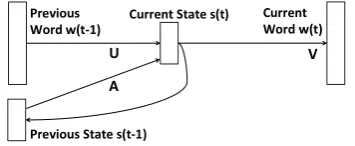
Figure 1: Recurrent neural LM.
of e on the English general-domain LM, which is built from a sub-sample of the general-domain text. Similarly, INF(f) and GENF(f) are the
cross-entropies off on Foreign-side LM. Finally, sentence pairs are ranked according to Eq. 1 and those with scores lower than some empirically-chosen threshold are added to the bitext for trans-lation model training.
2.1 Neural Language Models
The four LMs used to compute Eq. 1 have con-ventionally been n-grams. N-grams of the form p(w(t)|w(t−1), w(t−2), . . .) predict words by using multinomial distributions conditioned on the context(w(t−1), w(t−2), . . .). But when the con-text is rare or contains unknown words, n-grams are forced to back-off to lower-order models, e.g. p(w(t)|w(t − 1)). These backoffs are unfortu-nately very frequent in adaptation data selection.
Neural LMs, in contrast, model word probabili-ties using continuous vector representations. Fig-ure 1 shows a type of neural LMs called recurrent neural networks (Mikolov et al., 2011b).1 Rather
than representing context as an identity (n-gram hit-or-miss) function on[w(t−1), w(t−2), . . .], neural LMs summarize the context by a hidden state vector s(t). This is a continuous vector of dimension |S| whose elements are predicted by the previous word w(t − 1) and previous state s(t−1). This is robust to rare contexts because continuous representations enable sharingof sta-tistical strength between similar contexts. Bengio (2009) shows that such representations are better than multinomials in alleviating sparsity issues.
1Another major type of neural LMs are the so-called feed-forward networks (Bengio et al., 2003; Schwenk, 2007; Nakamura et al., 1990). Both types of neural LMs have seen many improvements recently, in terms of computational scal-ability (Le et al., 2011) and modeling power (Arisoy et al., 2012; Wu et al., 2012; Alexandrescu and Kirchhoff, 2006). We focus on recurrent networks here since there are fewer hyper-parameters and its ability to model infinite context us-ing recursion is theoretically attractive. But we note that feed-forward networks are just as viable.
Now, given state vectors(t), we can predict the probability of the current word. Figure 1 is ex-pressed formally in the following equations:
w(t) = [w0(t), . . . , wk(t), . . . w|W|(t)] (2)
wk(t) =g
|S|
X
j=0
sj(t)Vkj
(3)
sj(t) =f
|W|
X
i=0
wi(t−1)Uji+ |S|
X
i0=0
si0(t−1)Aji0
(4) Here, w(t) is viewed as a vector of dimension
|W|(vocabulary size) where each elementwk(t)
represents the probability of the k-th vocabulary item at sentence positiont. The functiong(zk) =
ezk/P
kezkis a softmax function that ensures the
neural LM outputs are proper probabilities, and f(z) = 1/(1 +e−z) is a sigmoid activation that
induces the non-linearity critical to the neural net-work’s expressive power. The matricesV,U, and Aare trained by maximizing likelihood on train-ing data ustrain-ing a ”backpropagation-through-time” method.2 Intuitively,U andA compress the
con-text (|S| < |W|) such that contexts predictive of the same wordw(t)are close together.
Since proper modeling of unknown contexts is important in our problem, training text for both n-gram and neural LM is pre-processed by convert-ing all low-frequency words in the trainconvert-ing data (frequency=1 in our case) to a special ”unknown” token. This is used only in Eq. 1 for selecting general-domain sentences; these words retain their surface forms in the SMT train pipeline.
3 Experiment Setup
We experimented with four language pairs in the WIT3 corpus (Cettolo et al., 2012), with English
(en) as source and German (de), Spanish (es), French (fr), Russian (ru) as target. This is the in-domain corpus, and consists of TED Talk tran-scripts covering topics in technology, entertain-ment, and design. As general-domain corpora, we collected bitext from the WMT2013 campaign, including CommonCrawl and NewsCommentary for all 4 languages, Europarl for de/es/fr, UN for es/fr, Gigaword for fr, and Yandex for ru. The in-domain data is divided into a training set (for SMT
en-de en-es en-fr en-ru In-domain Training Set
#sentence 129k 140k 139k 117k #token (en) 2.5M 2.7M 2.7M 2.3M #vocab (en) 26k 27k 27k 25k #vocab (f) 42k 39k 34k 58k General-domain Bitext
[image:3.595.72.294.62.201.2]#sentence 4.4M 14.7M 38.9M 2.0M #token (en) 113M 385M 1012M 51M %unknown 60% 58% 64% 65%
Table 1: Data statistics. ”%unknown”=fraction of general-domain sentences with unknown words.
pipeline and neural LM training), a tuning set (for MERT), a validation set (for choosing the optimal threshold in data selection), and finally a testset of 1616 sentences.3Table 1 lists data statistics.
For each language pair, we built a baseline in-dataSMT system trained only on in-domain data, and analldatasystem using combined in-domain and general-domain data.4We then built 3 systems
from augmented data selected by different LMs:
• ngram: Data selection by 4-gram LMs with
Kneser-Ney smoothing (Axelrod et al., 2011)
• neuralnet: Data selection by Recurrent
neu-ral LM, with the RNNLM Toolkit.5
• combine: Data selection by interpolated LM
using n-gram & neuralnet (equal weight). All systems are built using standard settings in the Moses toolkit (GIZA++ alignment, grow-diag-final-and, lexical reordering models, and SRILM). Note that standard n-grams are used as LMs for SMT; neural LMs are only used for data selection. Multiple SMT systems are trained by thresholding on{10k,50k,100k,500k,1M}general-domain sen-tence subsets, and we empirically determine the single system for testing based on results on a sep-arate validation set (in practice, 500k was chosen for fr and 1M for es, de, ru.).
3The original data are provided by http://wit3.fbk.eu and http://www.statmt.org/wmt13/. Our domain adaptation sce-nario is similar to the IWSLT2012 campaign but we used our own random train/test splits, since we wanted to ensure the testset for all languages had identical source sentences for comparison purposes. For replicability, our software is avail-able at http://cl.naist.jp/∼kevinduh/a/acl2013.
4More advanced phrase table adaptation methods are pos-sible. but our interest is in comparing data selection methods. The conclusions should transfer to advanced methods such as (Foster et al., 2010; Niehues and Waibel, 2012).
5http://www.fit.vutbr.cz/
∼imikolov/rnnlm/
4 Results
4.1 LM Perplexity and Training Time
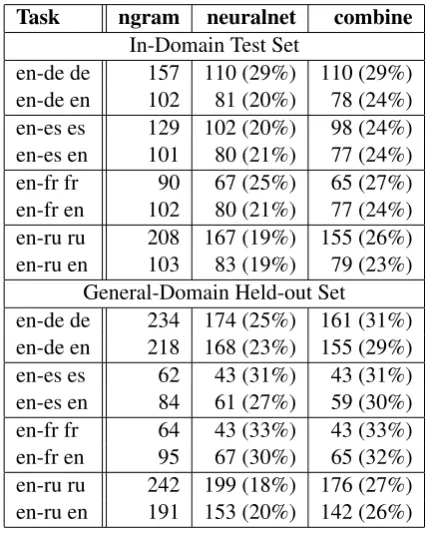
First, we measured perplexity to check the gen-eralization ability of our neural LMs as language models. Recall that we train four LMs to com-pute each of the components of Eq. 1. In Table 2, we compared each of the four versions ofngram, neuralnet, and combine LMs on in-domain test sets or general-domain held-out sets. It re-affirms previous positive results (Mikolov et al., 2011a), withneuralnetoutperformingngramby 20-30% perplexity across all tasks. Also,combineslightly improves the perplexity ofneuralnet.
Task ngram neuralnet combine In-Domain Test Set
en-de de 157 110 (29%) 110 (29%) en-de en 102 81 (20%) 78 (24%) en-es es 129 102 (20%) 98 (24%) en-es en 101 80 (21%) 77 (24%) en-fr fr 90 67 (25%) 65 (27%) en-fr en 102 80 (21%) 77 (24%) en-ru ru 208 167 (19%) 155 (26%) en-ru en 103 83 (19%) 79 (23%)
General-Domain Held-out Set en-de de 234 174 (25%) 161 (31%) en-de en 218 168 (23%) 155 (29%) en-es es 62 43 (31%) 43 (31%) en-es en 84 61 (27%) 59 (30%) en-fr fr 64 43 (33%) 43 (33%) en-fr en 95 67 (30%) 65 (32%) en-ru ru 242 199 (18%) 176 (27%) en-ru en 191 153 (20%) 142 (26%)
Table 2: Perplexity of various LMs. Number in parenthesis is percentage improvement vs. ngram.
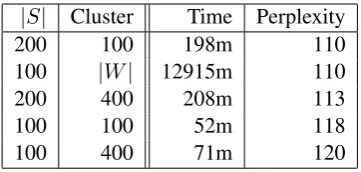
[image:3.595.309.523.260.527.2]|S| Cluster Time Perplexity
200 100 198m 110
100 |W| 12915m 110
200 400 208m 113
100 100 52m 118
[image:4.595.308.527.60.359.2]100 400 71m 120
Table 3: Training time (in minutes) for various neural LM architectures (Task: en-de de).
4.2 End-to-end SMT Evaluation
Table 4 shows translation results in terms of BLEU (Papineni et al., 2002), RIBES (Isozaki et al., 2010), and TER (Snover et al., 2006). We observe that all three data selection methods essentially outperform alldata and indata for all language pairs, andneuralnettend to be the best in all met-rics. E.g., BLEU improvements overngram are in the range of 0.4 for en-de, 0.5 for en-es, 0.1 for en-fr, and 1.7 for en-ru. Although not all im-provements are large in absolute terms, many are statistically significant (95% confidence).
We therefore believe that neural LMs are gen-erally worthwhile to try for data selection, as it rarely underperform n-grams. The open question is: what can explain the significant improvements in, for example Russian, Spanish, German, but the lack thereof in French? One conjecture is that neural LMs succeeded in lowering testset out-of-vocabulary (OOV) rate, but we found that OOV reduction is similar across all selection methods.
The improvements appear to be due to better probability estimatesof the translation/reordering models. We performed a diagnostic by decoding the testset using LMs trained on the same test-set, while varying the translation/reordering ta-bles with those ofngramandneuralnet; this is a kind of pseudo forced-decoding that can inform us about which table has better coverage. We found that across all language pairs, BLEU differences of translations under this diagnostic become insignif-icant, implying that the raw probability value is the differentiating factor betweenngramand neu-ralnet. Manual inspection of en-de revealed that many improvements come from lexical choice in morphological variants (”meinen Sohn” vs. ”mein Sohn”), segmentation changes (”baking soda”→
”Backpulver” vs. ”baken Soda”), and handling of unaligned words at phrase boundaries.
Finally, we measured the intersection between the sentence set selected by ngram vs
neural-Task System BLEU RIBES TER en-de indata 20.8 80.1 59.0 alldata 21.5 80.1 59.1 ngram 21.5 80.3 58.9 neuralnet 21.9+ 80.5+ 58.4
combine 21.5 80.2 58.8 en-es indata 30.4 83.5 48.7 alldata 31.2 83.2 49.9 ngram 32.0 83.7 48.4 neuralnet 32.5+ 83.7 48.3+
combine 32.5+ 83.8 48.3+
en-fr indata 31.4 83.9 51.2 alldata 31.5 83.5 51.4 ngram 32.7 83.7 50.4 neuralnet 32.8 84.2+ 50.3
combine 32.5 84.0 50.5 en-ru indata 14.8 72.5 69.5 alldata 23.4 75.0 62.3 ngram 24.0 75.7 61.4 neuralnet 25.7+ 76.1 60.0+
combine 23.7 75.9 61.9−
Table 4: End-to-end Translation Results. The best results are bold-faced. We also compare neural LMs to ngram using pairwise bootstrap (Koehn, 2004): ”+” means statistically significant im-provement and ”−” means significant degradation.
net. They share 60-75% of the augmented train-ing data. This high overlap means that ngram andneuralnetare actuallynotdrastically different systems, andneuralnetwith its slightly better se-lections represent anincrementalimprovement.6
5 Conclusions
We perform an evaluation of neural LMs for adaptation data selection, based on the hypothe-sis that their continuous vector representations are effective at comparing general-domain sentences, which contain frequent unknown words. Com-pared to conventional n-grams, we observed end-to-end translation improvements from 0.1 to 1.7 BLEU. Since neural LMs are fast to train in the small in-domain data setting and achieve equal or incrementally better results, we conclude that they are an worthwhile option to include in the arsenal of adaptation data selection techniques.
6This is corroborated by another analysis: taking the
[image:4.595.91.272.61.147.2]Acknowledgments
We thank Amittai Axelrod for discussions about data selection implementation details, and an anonymous reviewer for suggesting theunionidea for results analysis. K. D. would like to credit Spy-ros Matsoukas (personal communication, 2010) for the trick of using LM-based pseudo forced-decoding for error analysis.
References
Andrei Alexandrescu and Katrin Kirchhoff. 2006. Factored neural language models. In Proceed-ings of the Human Language Technology Confer-ence of the NAACL, Companion Volume: Short Pa-pers, NAACL-Short ’06, pages 1–4, Stroudsburg, PA, USA. Association for Computational Linguis-tics.
Ebru Arisoy, Tara N. Sainath, Brian Kingsbury, and Bhuvana Ramabhadran. 2012. Deep neural network language models. In Proceedings of the NAACL-HLT 2012 Workshop: Will We Ever Really Replace the N-gram Model? On the Future of Language Modeling for HLT, pages 20–28, Montr´eal, Canada, June. Association for Computational Linguistics.
Amittai Axelrod, Xiaodong He, and Jianfeng Gao. 2011. Domain adaptation via pseudo in-domain data selection. InProceedings of the 2011 Conference on Empirical Methods in Natural Language Process-ing, pages 355–362, Edinburgh, Scotland, UK., July. Association for Computational Linguistics.
Yoshua Bengio, R´ejean Ducharme, Pascal Vincent, and Christian Jauvin. 2003. A neural probabilistic lan-guage models. JMLR.
Yoshua Bengio. 2009. Learning Deep Architectures for AI, volume Foundations and Trends in Machine Learning. NOW Publishers.
Mauro Cettolo, Christian Girardi, and Marcello Fed-erico. 2012. Wit3: Web inventory of transcribed and translated talks. InProceedings of the 16th
Con-ference of the European Association for Machine Translation (EAMT), pages 261–268, Trento, Italy, May.
Kevin Duh, Katsuhito Sudoh, and Hajime Tsukada. 2010. Analysis of translation model adaptation for statistical machine translation. InProceedings of the International Workshop on Spoken Language Trans-lation (IWSLT) - Technical Papers Track.
George Foster, Cyril Goutte, and Roland Kuhn. 2010. Discriminative instance weighting for domain adap-tation in statistical machine translation. InEMNLP.
Barry Haddow and Philipp Koehn. 2012. Analysing the effect of out-of-domain data on smt systems. In
Proceedings of the Seventh Workshop on Statisti-cal Machine Translation, pages 422–432, Montr´eal, Canada, June. Association for Computational Lin-guistics.
Hideki Isozaki, Tsutomu Hirao, Kevin Duh, Katsuhito Sudoh, and Hajime Tsukada. 2010. Automatic evaluation of translation quality for distant language pairs. In Proceedings of the 2010 Conference on Empirical Methods in Natural Language Process-ing, pages 944–952, Cambridge, MA, October. As-sociation for Computational Linguistics.
Philipp Koehn and Barry Haddow. 2012. Towards effective use of training data in statistical machine translation. InWMT.
Philipp Koehn. 2004. Statistical significance tests for machine translation evaluation. InEMNLP.
Hai-Son Le, I. Oparin, A. Allauzen, J. Gauvain, and F. Yvon. 2011. Structured output layer neural net-work language model. InAcoustics, Speech and Sig-nal Processing (ICASSP), 2011 IEEE InternatioSig-nal Conference on, pages 5524–5527.
Tom´a˘s Mikolov, Anoop Deoras, Daniel Povey, Luk´a˘s Burget, and Jan ˘Cernock´y. 2011a. Strategies for training large scale neural network language model. InASRU.
Tom´a˘s Mikolov, Stefan Kombrink, Luk´a˘s Burget, Jan ˇCernock´y, and Sanjeev Khudanpur. 2011b. Exten-sions of recurrent neural network language model. InProceedings of the 2011 IEEE International Con-ference on Acoustics, Speech, and Signal Processing (ICASSP).
Robert C. Moore and William Lewis. 2010. Intelligent selection of language model training data. In Pro-ceedings of the ACL 2010 Conference Short Papers, pages 220–224, Uppsala, Sweden, July. Association for Computational Linguistics.
Masami Nakamura, Katsuteru Maruyama, Takeshi Kawabata, and Kiyohiro Shikano. 1990. Neural network approach to word category prediction for english texts. InProceedings of the 13th conference on Computational linguistics - Volume 3, COLING ’90, pages 213–218, Stroudsburg, PA, USA. Associ-ation for ComputAssoci-ational Linguistics.
Jan Niehues and Alex Waibel. 2012. Detailed analysis of different strategies for phrase table adaptation in SMT. InAMTA.
Kishore Papineni, Salim Roukos, Todd Ward, and Wei-Jing Zhu. 2002. BLEU: A method for automatic evaluation of machine translation. InACL.
HLT, pages 11–19, Montr´eal, Canada, June. Associ-ation for ComputAssoci-ational Linguistics.
Holger Schwenk. 2007. Continuous space language models. Comput. Speech Lang., 21(3):492–518, July.
M. Snover, B. Dorr, R. Schwartz, L. Micciulla, and J. Makhoul. 2006. A study of translation edit rate with targeted human annotation. InAMTA.
Youzheng Wu, Xugang Lu, Hitoshi Yamamoto, Shigeki Matsuda, Chiori Hori, and Hideki Kashioka. 2012. Factored language model based on recurrent neural network. InProceedings of COLING 2012, pages 2835–2850, Mumbai, India, December. The COLING 2012 Organizing Committee.