Proceedings of the 45th Annual Meeting of the Association of Computational Linguistics, pages 696–703,
Sparse Information Extraction:
Unsupervised Language Models to the Rescue
Doug Downey, Stefan Schoenmackers, and Oren Etzioni Turing Center, Department of Computer Science and Engineering
University of Washington, Box 352350 Seattle, WA 98195, USA
{ddowney,stef,etzioni}@cs.washington.edu
Abstract
Even in a massive corpus such as the Web, a substantial fraction of extractions appear in-frequently. This paper shows how to assess the correctness ofsparseextractions by uti-lizing unsupervised language models. The REALM system, which combines HMM-based and n-gram-based language models, ranks candidate extractions by the likeli-hood that they are correct. Our experiments show that REALM reduces extraction error by 39%, on average, when compared with previous work.
Because REALM pre-computes language models based on its corpus and does not re-quireanyhand-tagged seeds, it is far more scalable than approaches that learn mod-els for each individual relation from hand-tagged data. Thus, REALMis ideally suited for open information extraction where the relations of interest are not specified in ad-vance and their number is potentially vast.
1 Introduction
Information Extraction (IE) from text is far from in-fallible. In response, researchers have begun to ex-ploit the redundancy in massive corpora such as the Web in order to assess the veracity of extractions (e.g., (Downey et al., 2005; Etzioni et al., 2005; Feldman et al., 2006)). In essence, such methods uti-lizeextraction patternsto generate candidate extrac-tions (e.g., “Istanbul”) and then assess each candi-date by computing co-occurrence statistics between
the extraction and words or phrases indicative of class membership (e.g., “cities such as”).
However, Zipf’s Law governs the distribution of extractions. Thus, even the Web has limited redun-dancy for less prominent instances of relations. In-deed, 50% of the extractions in the data sets em-ployed by (Downey et al., 2005) appeared only once. As a result, Downey et al.’s model, and re-lated methods, had no way of assessing which ex-traction is more likely to be correct for fully half of the extractions. This problem is particularly acute when moving beyond unary relations. We refer to this challenge as the task ofassessing sparse extrac-tions.
This paper introduces the idea thatlanguage mod-elingtechniques such asn-gram statistics (Manning and Sch¨utze, 1999) and HMMs (Rabiner, 1989) can be used to effectively assess sparse extractions. The paper introduces the REALMsystem, and highlights its unique properties. Notably, REALM does not require anyhand-tagged seeds, which enables it to scale toOpen IE—extraction where the relations of interest are not specified in advance, and their num-ber is potentially vast (Banko et al., 2007).
can be phrased as follows: different instances of the same semantic relation tend to appear in sim-ilar textual contexts. We assess sparse extractions by comparing the contexts in which they appear to those of more common extractions. Sparse extrac-tions whose contexts are more similar to those of common extractions are judged more likely to be correct based on the conjunction of the KnowItAll and the distributional hypotheses.
The contributions of the paper are as follows:
• The paper introduces the insight that the sub-field of language modeling provides unsuper-vised methods that can be leveraged to assess sparse extractions. These methods are more scalable than previous assessment techniques, and require no hand tagging whatsoever.
• The paper introduces an HMM-based tech-nique for checking whether two arguments are of the proper type for a relation.
• The paper introduces a relational n-gram model for the purpose of determining whether a sentence that mentions multiple arguments actually expresses a particular relationship be-tween them.
• The paper introduces a novel language-modeling system called REALMthat combines both HMM-based models and relational n -gram models, and shows that REALMreduces error by an average of 39% over previous meth-ods, when applied to sparse extraction data. The remainder of the paper is organized as fol-lows. Section 2 introduces the IE assessment task, and describes the REALMsystem in detail. Section 3 reports on our experimental results followed by a discussion of related work in Section 4. Finally, we conclude with a discussion of scalability and with directions for future work.
2 IE Assessment
This section formalizes theIE assessmenttask and describes the REALMsystem for solving it. An IE assessor takes as input a list of candidate extractions meant to denote instances of a relation, and outputs a rankingof the extractions with the goal that cor-rect extractions rank higher than incorcor-rect ones. A correctextraction is defined to be a true instance of the relation mentioned in the input text.
More formally, the list of candidate extrac-tions for a relation R is denoted as ER =
{(a1, b1), . . . ,(am, bm)}. An extraction (ai, bi) is
an ordered pair of strings. The extraction iscorrect if and only if the relationRholds between the argu-ments named by ai andbi. For example, forR =
Headquartered, a pair(ai, bi)is correctiffthere
exists an organizationaithat is in fact headquartered
in the locationbi.1
ERis generated by applying an extraction
mech-anism, typically a set of extraction “patterns”, to each sentence in a corpus, and recording the results. Thus, many elements ofERare identical extractions
derived from different sentences in the corpus. This task definition is notable for the minimal inputs required—IE assessment does not require knowing the relation name nor does it require hand-tagged seed examples of the relation. Thus, an IE Assessor is applicable to Open IE.
2.1 System Overview
In this section, we describe the REALM system, which utilizes language modeling techniques to per-form IE Assessment.
REALM takes as input a set of extractions ER,
and outputs a ranking of those extractions. The algorithm REALM follows is outlined in Figure 1. REALMbegins by automatically selecting from ER
a set ofbootstrapped seedsSRintended to serve as
correct examples of the relationR. REALMutilizes the KnowItAll hypothesis, setting SR equal to the
h elements in ER extracted most frequently from
the underlying corpus. This results in a noisy set of seeds, but the methods that use these seeds are noise tolerant.
REALM then proceeds to rank the remaining (non-seed) extractions by utilizing two language-modeling components. Ann-gram language model is a probability distributionP(w1, ..., wn)over
con-secutive word sequences of length n in a corpus. Formally, if we assume a seed(s1, s2) is a correct extraction of a relationR, the distributional hypoth-esis states that the context distribution around the seed extraction, P(w1, ..., wn|wi = s1, wj = s2) for 1 ≤ i, j ≤ n tends to be “more similar” to
1
P(w1, ..., wn|wi = e1, wj = e2) when the extrac-tion (e1, e2) is correct. Naively comparing context distributions is problematic, however, because the arguments to a relation often appear separated by several intervening words. In our experiments, we found that when relation arguments appear together in a sentence, 75% of the time the arguments are separated by at least three words. This implies that nmust be large, and for sparse argument pairs it is not possible to estimate such a large language model accurately, because the number of modeling param-eters is proportional to the vocabulary size raised to thenth power. To mitigate sparsity, REALMutilizes smaller language models in its two components as a means of “backing-off’ from estimating context dis-tributions explicitly, as described below.
First, REALM utilizes an HMM to estimate whether each extraction has arguments of the proper type for the relation. Each relation R has a set of types for its arguments. For example, the rela-tion AuthorOf(a, b) requires that its first ar-gument be an author, and that its second be some kind of written work. Knowing whether extracted arguments are of the proper type for a relation can be quite informative for assessing extractions. The challenge is, however, that this type information is notgiven to the system since the relations (and the types of the arguments) are not known in advance. REALM solves this problem by comparing the dis-tributions of the seed arguments and extraction ar-guments. Type checking mitigates data sparsity by leveragingeveryoccurrence of the individual extrac-tion arguments in the corpus, rather than only those cases in which argument pairs occur near each other. Although argument type checking is invalu-able for extraction assessment, it is not suf-ficient for extracting relationships between ar-guments. For example, an IE system us-ing only type information might determine that
Intel is a corporation and that Seattle is a city, and therefore erroneously conclude that
Headquartered(Intel, Seattle) is cor-rect. Thus, REALM’s second step is to employ an
n-gram-based language model to assess whether the extracted arguments share the appropriate relation. Again, this information is not given to the system, so REALMcompares the context distributions of the extractions to those of the seeds. As described in
REALM(ExtractionsER={e1, ..., em}) SR= thehmost frequent extractions inER
UR=ER-SR
T ypeRankings(UR)←HMM-T(SR,UR)
RelationRankings(UR)←REL-GRAMS(SR,UR) return a ranking ofERwith the elements ofSRat the
top (ranked by frequency) followed by the elements of
UR={u1, ..., um−h}ranked in ascending order of T ypeRanking(ui)∗RelationRanking(ui).
Figure 1: Pseudocode for REALM at run-time. The language models used by the HMM-T and REL-GRAMS components are constructed in a pre-processing step.
Section 2.3, REALM employs a relational n-gram language model in order to accurately compare con-text distributions when extractions are sparse.
REALM executes the type checking and relation assessment components separately; each component takes the seed and non-seed extractions as arguments and returns a ranking of the non-seeds. REALMthen combines the two components’ assessments into a single ranking. Although several such combinations are possible, REALMsimply ranks the extractions in ascending order of the product of the ranks assigned by the two components. The following subsections describe REALM’s two components in detail.
We identify the proper nouns in our corpus us-ing the LEX method (Downey et al., 2007). In ad-dition to locating the proper nouns in the corpus, LEXalso concatenates each multi-token proper noun (e.g.,Los Angeles) together into a single token. Both of REALM’s components construct language models from this tokenized corpus.
2.2 Type Checking withHMM-T
In this section, we describe our type-checking com-ponent, which takes the form of a Hidden Markov Model and is referred to as HMM-T. HMM-T ranks the set UR of non-seed extractions, with a goal of
ranking those extractions with arguments of proper type forRabove extractions containing type errors. Formally, letURidenote the set of theith arguments
of the extractions in UR. Let SRi be defined
simi-larly for the seed setSR.
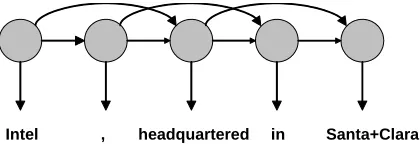
Intel , headquartered in Santa+Clara
Figure 2: Graphical model employed by HMM -T. Shown is the case in which k = 2. Corpus pre-processing results in the proper noun Santa Clarabeing concatenated into a single token.
extraction arguments inURi of the proper type will
likely appear in contexts similar to those in which the seed arguments SRi appear. In order to
iden-tify terms that are distributionally similar, we train a probabilistic generative Hidden Markov Model (HMM), which treats each token in the corpus as generated by a single hidden state variable. Here, the hidden states take integral values from{1, . . . , T}, and each hidden state variable is itself generated by some number k of previous hidden states.2 For-mally, the joint distribution of the corpus, repre-sented as a vector of tokensw, given a correspond-ing vector of statestis:
P(w|t) =Y
i
P(wi|ti)P(ti|ti−1, . . . , ti−k) (1)
The distributions on the right side of Equation 1 can be learned from a corpus in an unsupervised manner, such that words which are distributed sim-ilarly in the corpus tend to be generated by simi-lar hidden states (Rabiner, 1989). The generative model is depicted as a Bayesian network in Figure 2. The figure also illustrates the one way in which our implementation is distinct from a standard HMM, namely that proper nouns are detecteda prioriand modeled as single tokens (e.g., Santa Clara is generated by a single hidden state). This allows the type checker to compare the state distributions of different proper nouns directly, even when the proper nouns contain differing numbers of words.
To generate a ranking of UR using the learned
HMM parameters, we rank the argumentsei
accord-ing to how similar their state distributions P(t|ei)
2
Our implementation makes the simplifying assumption that each sentence in the corpus is generated independently.
are to those of the seed arguments.3 Specifically, we define a function:
f(e) =X
ei∈e
KL(
P
w0∈S
RiP(t|w
0)
|SRi|
, P(t|ei)) (2)
whereKLrepresents KL divergence, and the outer sum is taken over the argumentsei of the extraction
e. We rank the elements ofURin ascending order of
f(e).
HMM-T has two advantages over a more tradi-tional type checking approach of simply counting the number of times in the corpus that each extrac-tion appears in a context in which a seed also ap-pears (cf. (Ravichandran et al., 2005)). The first advantage of HMM-T is efficiency, as the traditional approach involves a computationally expensive step of retrieving the potentially large set of contexts in which the extractions and seeds appear. In our ex-periments, using HMM-T instead of a context-based approach results in a 10-50x reduction in the amount of data that is retrieved to perform type checking. Secondly, on sparse data HMM-T has the poten-tial to improve type checking accuracy. For exam-ple, consider comparingPickerington, a sparse candidate argument of the type City, to the seed argument Chicago, for which the following two phrases appear in the corpus:
(i) “Pickerington, Ohio” (ii) “Chicago, Illinois”
In these phrases, the textual contexts surrounding
Chicagoand Pickeringtonare not identical, so to the traditional approach these contexts offer no evidence that Pickerington and Chicago
are of the same type. For a sparse token like
Pickerington, this is problematic because the token may never occur in a context that precisely matches that of a seed. In contrast, in the HMM, the non-sparse tokensOhioandIllinoisare likely to have similar state distributions, as they are both the names of U.S. States. Thus, in the state space employed by the HMM, the contexts in phrases (i) and (ii) are in fact quite similar, allowing HMM -T to detect that Pickerington and Chicago
are likely of the same type. Our experiments quan-tify the performance improvements that HMM-T
of-3
[image:4.612.81.291.71.144.2]fers over the traditional approach for type checking sparse data.
The time required to learn HMM-T’s parameters scales proportional to Tk+1 times the corpus size. Thus, for tractability, HMM-T uses a relatively small state space ofT = 20states and a limitedkvalue of 3. While these settings are sufficient for type checking (e.g., determining thatSanta Clarais a city) they are too coarse-grained to assess relations between arguments (e.g., determining that Santa Clara is the particular city in which Intel is headquartered). We now turn to the REL-GRAMS component, which performs the latter task.
2.3 Relation Assessment withREL-GRAMS REALM’s relation assessment component, called REL-GRAMS, tests whether the extracted arguments have a desired relationship, but given REALM’s min-imal input it has no a prioriinformation about the relationship. REL-GRAMSrelies instead on the dis-tributional hypothesis to test each extraction.
As argued in Section 2.1, it is intractable to build an accurate language model for context distributions surrounding sparse argument pairs. To overcome this problem, we introducerelationaln-gram mod-els. Rather than simply modeling the context distri-bution around a given argument, a relationaln-gram model specifies separate context distributions for an arguments conditioned on each of the other argu-ments with which it appears. The relationaln-gram model allows us to estimate context distributions for pairs of arguments, even when the arguments do not appear together within a fixed window ofnwords. Further, by considering only consecutive argument pairs, the number of distinct argument pairs in the model grows at most linearly with the number of sentences in the corpus. Thus, the relationaln-gram model can scale.
Formally, for a pair of arguments (e1, e2), a re-lational n-gram model estimates the distributions P(w1, ..., wn|wi = e1, e1 ↔ e2) for each1 ≤ i≤ n, where the notatione1 ↔ e2 indicates the event thate2 is the next argument to either the right or the left ofe1in the corpus.
REL-GRAMS begins by building a relational n -gram model of the arguments in the corpus. For notational convenience, we represent the model’s distributions in terms of “context vectors” for each
pair of arguments. Formally, for a given sentence containing arguments e1 and e2 consecutively, we define a context of the ordered pair (e1, e2) to be any window of n tokens around e1. Let C =
{c1, c2, ..., c|C|}be the set of all contexts of all
ar-gument pairs found in the corpus.4 For a pair of ar-guments (ej,ek), we model their relationship using
a|C|dimensional context vectorv(ej,ek), whosei-th
dimension corresponds to the number of times con-textci occurred with the pair (ej,ek) in the corpus.
These context vectors are similar to document vec-tors from Information Retrieval (IR), and we lever-age IR research to compare them, as described be-low.
To assess each extraction, we determine how sim-ilar its context vector is to a canonical seed vec-tor (created by summing the context vecvec-tors of the seeds). While there are many potential methods for determining similarity, in this work we rank ex-tractions by decreasing values of the BM25 dis-tance metric. BM25 is a TF-IDF variant intro-duced in TREC-3(Robertson et al., 1992), which outperformed both the standard cosine distance and a smoothed KL divergence on our data.
3 Experimental Results
This section describes our experiments on IE assess-ment for sparse data. We start by describing our experimental methodology, and then present our re-sults. The first experiment tests the hypothesis that HMM-T outperforms an n-gram-based method on the task of type checking. The second experiment tests the hypothesis that REALMoutperforms multi-ple approaches from previous work, and also outper-forms each of its HMM-T and REL-GRAMS compo-nents taken in isolation.
3.1 Experimental Methodology
The corpus used for our experiments consisted of a sample of sentences taken from Web pages. From an initial crawl of nine million Web pages, we se-lected sentences containing relations between proper nouns. The resulting text corpus consisted of about
4
three million sentences, and was tokenized as de-scribed in Section 2. For tractability, before and after performing tokenization, we replaced each token oc-curring fewer than five times in the corpus with one of two “unknown word” markers (one for capital-ized words, and one for uncapitalcapital-ized words). This preprocessing resulted in a corpus containing about sixty-five million total tokens, and 214,787 unique tokens.
We evaluated performance on four relations:
Conquered, Founded, Headquartered, and
Merged. These four relations were chosen because they typically take proper nouns as arguments, and included a large number of sparse extractions. For each relationR, the candidate extraction listERwas
obtained using TEXTRUNNER(Banko et al., 2007). TEXTRUNNERis an IE system that computes an in-dex of all extracted relationships it recognizes, in the form of (object, predicate, object) triples. For each of our target relations, we executed a single query to the TEXTRUNNER index for extractions whose predicate contained a phrase indicative of the rela-tion (e.g., “founded by”, “headquartered in”), and the results formed our extraction list. For each rela-tion, the 10 most frequent extractions served as boot-strapped seeds. All of the non-seed extractions were sparse (no argument pairs were extracted more than twice for a given relation). These test sets contained a total of 361 extractions.
3.2 Type Checking Experiments
As discussed in Section 2.2, on sparse data HMM-T has the potential to outperform type checking meth-ods that rely on textual similarities of context vec-tors. To evaluate this claim, we tested the HMM-T system against anN-GRAMStype checking method on the task of type-checking the arguments to a re-lation. TheN-GRAMSmethod compares the context vectors of extractions in the same way as the REL -GRAMSmethod described in Section 2.3, but is not relational (N-GRAMS considers the distribution of each extraction argument independently, similar to HMM-T). We tagged an extraction as type correctiff both arguments were valid for the relation, ignoring whether the relation held between the arguments.
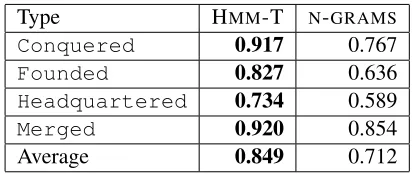
The results of our type checking experiments are shown in Table 1. For all types, HMM-T outper-forms N-GRAMS, and HMM-T reduces error
(mea-Type HMM-T N-GRAMS
Conquered 0.917 0.767
Founded 0.827 0.636
Headquartered 0.734 0.589
Merged 0.920 0.854
[image:6.612.323.529.70.157.2]Average 0.849 0.712
Table 1: Type Checking Performance. Listed is area under the precision/recall curve. HMM-T outper-forms N-GRAMS for all relations, and reduces the error in terms of missing area under the curve by 46% on average.
sured in missing area under the precision/recall curve) by 46%. The performance difference on each relation is statistically significant (p < 0.01, two-sampled t-test), using the methodology for measur-ing the standard deviation of area under the preci-sion/recall curve given in (Richardson and Domin-gos, 2006). N-GRAMS, like REL-GRAMS, employs the BM-25 metric to measure distributional similar-ity between extractions and seeds. Replacing BM-25 with cosine distance cuts HMM-T’s advantage overN-GRAMS, but HMM-T’s error rate is still 23% lower on average.
3.3 Experiments withREALM
The REALM system combines the type checking and relation assessment components to assess ex-tractions. Here, we test the ability of REALM to improve the ranking of a state of the art IE system, TEXTRUNNER. For these experiments, we evalu-ate REALM against the TEXTRUNNER frequency-based ordering, a pattern-learning approach, and the HMM-T and REL-GRAMScomponents taken in iso-lation. The TEXTRUNNER frequency-based order-ing ranks extractions in decreasorder-ing order of their ex-traction frequency, and importantly, for our task this ordering is essentially equivalent to that produced by the “Urns” (Downey et al., 2005) and Pointwise Mu-tual Information (Etzioni et al., 2005) approaches employed in previous work.
re-Conquered Founded Headquartered Merged Average
Avg. Prec. 0.698 0.578 0.400 0.742 0.605
TEXTRUNNER 0.738 0.699 0.710 0.784 0.733
PL 0.885 0.633 0.651 0.852 0.785
PL+ HMM-T 0.883 0.722 0.727 0.900 0.808
HMM-T 0.830 0.776 0.678 0.864 0.787
REL-GRAMS 0.929 (39%) 0.713 0.758 0.886 0.822
[image:7.612.80.534.72.184.2]REALM 0.907 (19%) 0.781 (27%) 0.810 (35%) 0.908 (38%) 0.851 (39%)
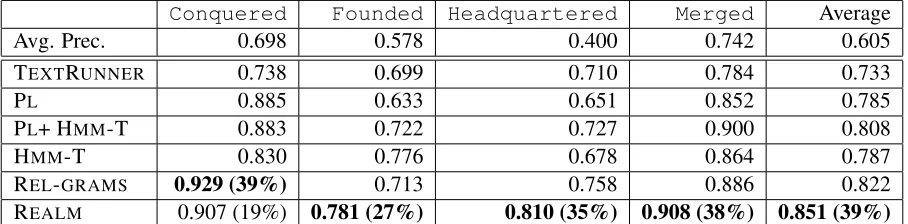
Table 2: Performance of REALM for assessment of sparse extractions. Listed is area under the preci-sion/recall curve for each method. In parentheses is the percentage reduction in error over the strongest baseline method (TEXTRUNNER or PL) for each relation. “Avg. Prec.” denotes the fraction of correct examples in the test set for each relation. REALMoutperforms its REL-GRAMSand HMM-T components taken in isolation, as well as the TEXTRUNNERand PLsystems from previous work.
sults are sensitive to the parameter settings. How-ever, we found no parameter settings that performed significantly better, and many settings performed significantly worse. As such, we believe our re-sults reasonably reflect the performance of a pattern learning system on this task. Because PLperforms relation assessment, we also attempted combining PLwith HMM-T in a hybrid method (PL+ HMM-T) analogous to REALM.
The results of these experiments are shown in Ta-ble 2. REALMoutperforms the TEXTRUNNER and PLbaselines for all relations, and reduces the miss-ing area under the curve by an average of 39% rel-ative to the strongest baseline. The performance differences between REALMand TEXTRUNNERare statistically significant for all relations, as are differ-ences between REALMand PL for all relations ex-cept Conquered (p < 0.01, two-sampled t-test). The hybrid REALM system also outperforms each of its components in isolation.
4 Related Work
To our knowledge, REALMis the first system to use language modeling techniques for IE Assessment.
Redundancy-based approaches to pattern-based IE assessment (Downey et al., 2005; Etzioni et al., 2005) require that extractions appear relatively fre-quently with a limited set of patterns. In contrast, REALMutilizesallcontexts to build a model of ex-tractions, rather than a limited set of patterns. Our experiments demonstrate that REALM outperforms these approaches on sparse data.
Type checking using named-entity taggers has been previously shown to improve the precision of pattern-based IE systems (Agichtein, 2005; Feld-man et al., 2006), but the HMM-T type-checking component we develop differs from this work in im-portant ways. Named-entity taggers are limited in that they typically recognize only small set of types (e.g., ORGANIZATION, LOCATION, PERSON), and they require hand-tagged training data for each type. HMM-T, by contrast, performs type check-ing foranytype. Finally, HMM-T does not require hand-tagged training data.
A second distinction of REALM is that its type checker, unlike the named entity taggers employed in pattern learning systems (e.g., Snowball), can be used to identify arbitrary types. A final distinction is that the language models REALM employs require fewer parameters and heuristics than pattern learn-ing techniques.
Similar distinctions exist between REALMand a recent system designed to assess sparse extractions by bootstrapping aclassifierfor each target relation (Feldman et al., 2006). As in pattern learning, con-structing the classifiers requires substantial process-ing after the target relations have been specified, and a set of hand-tagged examples per relation, making it unsuitable for Open IE.
5 Conclusions
This paper demonstrated that unsupervised language models, as embodied in the REALMsystem, are an effective means of assessing sparse extractions.
Another attractive feature of REALM is its scal-ability. Scalability is a particularly important con-cern forOpen Information Extraction, the task of ex-tracting large numbers of relations that are not spec-ified in advance. Because HMM-T and REL-GRAMS both pre-compute language models, REALMcan be queried efficiently to perform IE Assessment. Fur-ther, the language models are constructed indepen-dently of the target relations, allowing REALM to perform IE Assessment even when relations are not specified in advance.
In future work, we plan to develop a probabilistic model of the information computed by REALM. We also plan to evaluate the use of non-local context for IE Assessment by integrating document-level mod-eling techniques (e.g., Latent Dirichlet Allocation).
Acknowledgements
This research was supported in part by NSF grants IIS-0535284 and IIS-0312988, DARPA contract NBCHD030010, ONR grant N00014-05-1-0185 as well as a gift from Google. The first author is sup-ported by an MSR graduate fellowship sponsored by Microsoft Live Labs. We thank Michele Banko, Jeff Bilmes, Katrin Kirchhoff, and Alex Yates for helpful comments.
References
E. Agichtein. 2005. Extracting Relations From Large Text Collections. Ph.D. thesis, Department of Com-puter Science, Columbia University.
E. Agichtein. 2006. Confidence estimation methods for partially supervised relation extraction. InSDM 2006.
M. Banko, M. Cararella, S. Soderland, M. Broadhead, and O. Etzioni. 2007. Open information extraction from the web. InProcs. of IJCAI 2007.
D. Downey, O. Etzioni, and S. Soderland. 2005. A Prob-abilistic Model of Redundancy in Information Extrac-tion. InProcs. of IJCAI 2005.
D. Downey, M. Broadhead, and O. Etzioni. 2007. Locat-ing complex named entities in web text. InProcs. of IJCAI 2007.
O. Etzioni, M. Cafarella, D. Downey, S. Kok, A. Popescu, T. Shaked, S. Soderland, D. Weld, and A. Yates. 2005. Unsupervised named-entity extraction from the web: An experimental study. Artificial Intelligence, 165(1):91–134.
R. Feldman, B. Rosenfeld, S. Soderland, and O. Etzioni. 2006. Self-supervised relation extraction from the web. InISMIS, pages 755–764.
Z. Harris. 1985. Distributional structure. In J. J. Katz, editor, The Philosophy of Linguistics, pages 26–47. New York: Oxford University Press.
C. D. Manning and H. Sch¨utze. 1999. Foundations of Statistical Natural Language Processing.
M. Pas¸ca, D. Lin, J. Bigham, A. Lifchits, and A. Jain. 2006. Names and similarities on the web: Fact extrac-tion in the fast lane. InProcs. of ACL/COLING 2006.
L. R. Rabiner. 1989. A tutorial on hidden markov models and selected applications in speech recognition. Pro-ceedings of the IEEE, 77(2):257–286.
D. Ravichandran, P. Pantel, and E. H. Hovy. 2005. Ran-domized Algorithms and NLP: Using Locality Sensi-tive Hash Functions for High Speed Noun Clustering. InProcs. of ACL 2005.
M. Richardson and P. Domingos. 2006. Markov Logic Networks.Machine Learning, 62(1-2):107–136.
E. Riloff and R. Jones. 1999. Learning Dictionaries for Information Extraction by Multi-level Boot-strapping. InProcs. of AAAI-99, pages 1044–1049.
S. E. Robertson, S. Walker, M. Hancock-Beaulieu, A. Gull, and M. Lau. 1992. Okapi at TREC-3. In