Abstract—This paper presents the validation of TRNSYS models for a high temperature air-water heat pump and a thermal energy storage based on field trial data. This validation aims at clarifying strengths and weaknesses of the models and verifying the model accuracy which can support further studies conducting advanced models related to HTAWHP-TES. Results show good agreements with field trial results for condenser water outlet temperatures and Coefficient of Performance of the validated model, with CV(RMSE) of 4.14% and 11.6% respectively. Discrepancies caused in start-up operation of the heat pump are the main disadvantage that the model cannot address and have been discussed. The storage model was validated in three modes: charge, discharge and standby. Very strong coincidences of tank node temperatures are observed between simulation and collected data in both charging and discharging mode. In standby mode, less than 2.5˚C difference is observed in top tank nodes, whereas bottom nodes are within 1˚C uncertainty. Stratification in standby loss has been discussed.
Index Terms—High temperature air-water heat pump, thermal energy storage, validation, TRNSYS.
I. INTRODUCTION
Large number of households in the UK have gas and oil boilers to meet space heating and domestic hot water, which accounts for nearly 78% in domestic energy consumption and 40% domestic greenhouse gas emissions [1]. Heat pump which is a promising technology for heating/cooling can play a vital role to meet carbon emission reduction target in domestic sector. However, conventional heat pumps (low/medium temperature) cannot work well with existing radiator system as conventional radiators require high temperature to achieve desirable thermal comfort. Therefore, high temperature heat pumps providing flow temperature above 65°C as boilers can be a retrofit since it can avoid replacement cost for existing radiators,
Manuscript received June 29, 2017; revised August 15, 2017. This work was supported by Research Councils UK (RCUK) under i-STUTE project.
K. X. Le is PhD student with the Centre for Sustainable Technologies, University of Ulster, Newtownabbey, Co Antrim, BT37 0QB, the UK
(corresponding author, phone: +44-2890366122; e-mail:
N. Shah is with the Centre for Sustainable Technologies, University of Ulster, Newtownabbey, Co Antrim, BT37 0QB, the UK (e-mail: [email protected]).
M. J. Huang is with the Centre for Sustainable Technologies, University of Ulster, Newtownabbey, Co Antrim, BT37 0QB, the UK (e-mail: [email protected]).
N. J. Hewitt is with the Centre for Sustainable Technologies, University of Ulster, Newtownabbey, Co Antrim, BT37 0QB, the UK (e-mail: [email protected]).
controllers, etc. with satisfactory thermal comfort.
It is undeniable that energy storage combined with heat pump has brought valuable benefits for demand side management which may have a significant role in future non-dispatchable renewable energy electrical supply systems [2]. Off-peak electricity can be used to run heat pumps to store energy in storage, and this energy is then drawn to buildings for heating demands, which may help to reduce peak electricity demand for grid and utility bills for consumers. In addition, building thermal comfort can be maximized if a storage tank is coupled with an air source heat pump in cold climate whereby frost happens. This is because the energy used for defrost can be extracted from the storage instead of the house.
Dynamic energy building simulation in TRNSYS (Transient System Simulation Tool) [3] has been widely used for designing new buildings and investigating retrofit technologies which can enhance energy efficiency of existing buildings. However, building energy simulation in TRNSYS is highly complicated as it can perform dynamic interaction of building physical characteristics and heating/cooling systems, so calibration/validation of building energy models is truly difficult to obtain [4]. In order to reduce time consumption and effort involving in calibration/validation, individual component such as heat pump and storage should be validated before integrating into whole building energy models [5].
The objective of this paper is to present validation of TRNSYS models for a high temperature air-water heat pump with a storage tank, both of which will be coupled in the building model for future work. A series of field trial data has been used for model validation. Arising difficulties throughout validation process are highlighted, which can be helpful for other similar studies.
The paper highlights field trial description in Section II. Methodologies and results of validated TRNSYS models for the heat pump and the storage tank are presented in Section III and Section IV, respectively. Conclusions and future work are drawn in Section V.
II. FIELD TRIAL DESCRIPTION
High temperature air-water heat pump (HTAWHP) integrated with thermal energy storage was installed and tested in different modes as a retrofit technology in Terraced Street Test Houses at Ulster University in Northern Ireland. Test set-up was installed in separate shed on back side of the houses to accommodate instrumentation and monitoring system. Fig. 1 shows test houses, shed (platform) and test-rig or heat pump and thermal energy storage. Heat pump and
High Temperature Air-Water Heat Pump and
Energy Storage: Validation of TRNSYS Models
Khoa Xuan Le,
Member, IAENG
, Nikhilkumar Shah, Ming Jun Huang, and Neil J. Hewitt
Fig. 2.Schematic of custom designed thermal storage tank [8]
thermal storage operation was controlled as per operation strategy. For example, energy was stored in storage using heat pump during night time (between 1 am to 5 am) and then discharged during morning for time of use (6 am), and after that heat pump took over to meet heating/hot water demand of test houses. More detail about heat pump and thermal energy storage and operation can be found from [6].
The selected HTAWHP has a rated COP of 2.5 with heat capacity of 11 kW and electrical power of 4.4 kW according to the manufacturer’s specifications [7]. Rated conditions are fixed outdoor temperature (7°CDB/6°CWB) and entering/leaving water temperature (70/80°C). The heat pump with variable speed compressor works as cascade unit enabling flow temperature to reach 80°C approximately.
Schematic of the storage tank is shown in Fig. 2. The storage tank was custom made with 600 liters of storage capacity, with 2 m height, 0.6 m diameter and 75 mm thick insulation. It contains two copper heat exchanger coils (3.5m2/each) and seven temperature probes for monitoring
purpose at equal distance. Additionally, a circulating pump was used to prevent temperature stratification in the storage during charging and discharging mode. Tank charge/discharge was decided based on set-point and temperature sensed at bottom of the tank.
Totally 19 sensors (Table I) combined with wireless radio telemetry type data loggers and transmitters were used to monitor the system performance. The data were logged 24x7 with the time step of one minute and stored in a devoted PC as well as sky drive for the purpose of data analysis.
TABLE I INSTRUMENT SPECIFICATIONS
Instrument Model Uncertainty Range
Fluid temperature sensor Eltek GD 24 0.2 ˚C
Flow meter sensor Eltek GT 62 1.5 %
Energy meter Landis and Gr P350 1.5 %
III. HEAT PUMP MODEL VALIDATION
A. Heat Pump Model Description
Before the thermal storage tank could be modeled, a model including only the heat pump was developed first. TRNSYS Type 1271 from TESS libraries [9] was obtained to predict the performance of high temperature air-water heat pump. This variable speed heat pump model linearly interpolates between inputs based on a performance map which comprises heating capacity and electrical power at different part load ratios in accordance with given evaporator air temperatures and condenser inlet/outlet water temperatures. Due to the reluctance of the manufacture in providing the detailed those data, performance curve was adapted from field data collection.
One-minute step same as the time interval of data loggers was used for simulations. Real time hourly weather data of Belfast Aldergrove station (17 miles from the field trial) [10] were utilized for TRNSYS Type 99 [3], with air temperature and relative humidity as inputs for the heat pump model.
Taking defrost effect of air source heat pumps should be included in models since it can lead to predict exactly the degradation of seasonal performance factor [11]. Operation of defrost was therefore considered in our heat pump model. Exact algorithms for the operation between normal and defrost were not published by the manufacturer so that there were difficulties to model this effect. Based on literature [12]-[15] and our collected data, defrost algorithm in the present work was assumed in the manner which the heat pump went to cooling mode, with capacity and electrical power of 5.57 kW and 1.75 kW respectively, for a certain defrosting time (3 minutes). Depending on air temperature (under 6°C) and relative humidity (over 40%), numbers of defrost cycle were calculated hourly.
B. Calibration of the Model
Scheme of the heat pump model for calibration in TRNSYS is illustrated in Fig. 3. Data reader Type 9a [3] containing experimental data of mass flow rates and entering water temperatures were obtained as inputs for the heat
pump model. Simulated results for condenser leaving water temperature (LWT) and Coefficient of Performance (COP) were compared with field trial data.
Accuracy of the model was quantified by Coefficient of Variation of the Root Mean Squared Error, CV(RMSE), which is expressed in (1) according to ASHRAE Guideline 14 [7]. For optimization-based calibration, sum of CV(RMSE)s of LWT and COP was a cost function in (2) used to adjust selected parameters to minimize the uncertainties between model and experiment through generic optimization tool GenOpt [16] linking with TRNOPT type (TESS libraries) [9]. Optimization in GenOpt was done by Hook-Jeeves algorithm which is recommended for solving continuous and differentiable cost function [17].
100
*
)
(
2
m s m
Y
n
Y
Y
RMSE
CV
(1)where Ym is measured value; Ys is simulated value; n is number of observations;
Y
m is mean measured value.COP LWT
CV
RMSE
RMSE
CV
f
(
)
(
)
(2)where f is cost function; CV(RMSE)LWT is CV(RMSE) of leaving water temperature; CV(RMSE)COP is CV(RMSE) of COP.
In order to verify the model, first six days (8th to 13rd May 2015) were chosen for calibration, and the calibrated model was then validated in the next six days (14th to 19th May 2015). Weather conditions during these periods are shown in Fig. 4. The ambient temperature altered from 1.9°C to 15.3°C, and the relative humidity changed between 43.7% and 100%. Initial model with parameters obtaining from technical documentation and monitored data did not
0 10 20 30 40 50 60 70 80 90 100
°C
/
%
Date
Ambient Temperature (°C) Relative Humidity (%)
Fig. 4. Weather data collection from 8th to 19th May 2015
acquire the good coincidence with data collection since the defrost algorithm was assumed. Therefore, such parameters related to defrost were chosen to optimize the cost function.
C. Heat Pump Model Results and Discussion
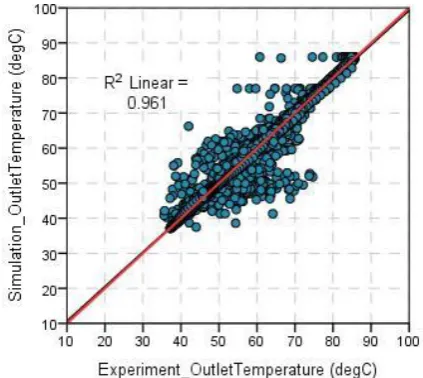
Figs. 5 and Fig. 6 show the quality of simulation versus monitoring results in terms of LWT at the condenser side. Results show strong agreements for calibration and validation, with R2 values of 0.961 and 0.955 respectively.
[image:3.595.309.521.168.357.2]
Fig. 5. Simulation versus monitoring results of LWT for calibrated model
Fig. 6. Simulation versus monitoring results of LWT for validated model
[image:3.595.317.532.385.575.2]To assess if adapted performance map of the heat pump model is acceptable with monitored data, COPs versus air temperatures at different condenser LWTs are analyzed. Fig. 7 and Fig. 8 illustrate all data points of COP values versus air temperatures at LWT of 55 ± 1°C and 65 ± 1°C, respectively. It is likely that all simulated COPs coincide with most of experimental COPs except some out-of-fit points which can be described by start-up duration of the heat pump. This phenomenon is further explained in the next paragraph. TRNSYS Type 1271 cannot reflect start-up transients so that those large differences remain. Looking at Fig. 9, all COP values of the model with LWT of 80 ± 1°C highly correlate with those of the monitored data. In short, it can be said that the adapted performance map relatively coincides with the monitored data in steady-state, whereas
[image:3.595.47.291.617.776.2]there remain large discrepancies due to start-up transients.
[image:4.595.200.542.114.657.2]Fig. 7. COP versus air temperature, with LWT of 55 ± 1°C
[image:4.595.304.550.129.492.2]Fig. 8.COP versus air temperature, with LWT of 65 ± 1°C
Fig. 9. COP versus air temperature, with LWT of 80 ± 1°C
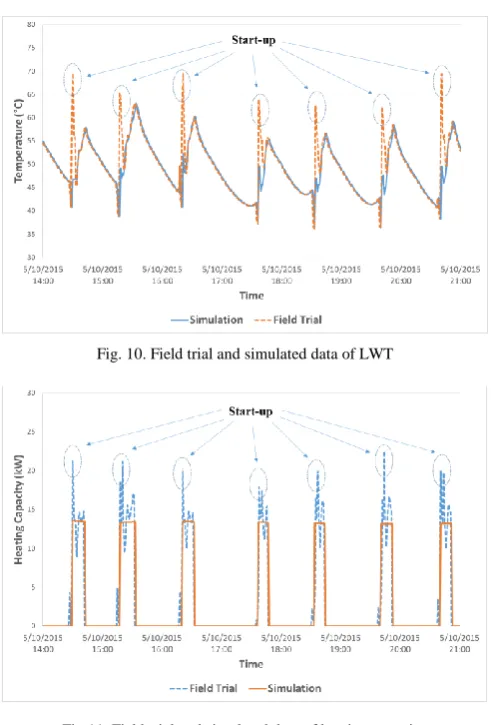
Fig. 10, Fig. 11 and Fig. 12 depict the comparison between model and field trial results of condenser LWT, heating capacity and electrical power respectively from 2 pm to 9 pm on 10th May 2015. Both condenser LWT and heating capacity of monitored data observe high sudden increases in start-up transients, whereas model results do not. This is because in reality heat transfer rate from compressor fluid to condenser water in start-up transients is maximum, whereas condenser water flow rate is relatively slower in start-up transients than in steady-state, all of which result in high sudden rise of condenser LWT in respective to sudden increase of heating capacity. In TRNSYS, however, heat pump capacity and electrical power are linearly interpolated based on evaporator air temperatures with proper condenser entering water temperatures contained in the performance map, so there is not any noticeable increase
in the start-up. Additionally, field trial heating capacity is much higher in start-up transients than in steady-state, whereas its consumed electrical power is not much different in both states, resulting in much higher COPs in start-up transients than in steady-state helping to explain why big different COPs in Figs. 7 and Fig. 8 are observed.
0 1 2 3 4 5 6 7
5/10/2015 14:00
5/10/2015 15:00
5/10/2015 16:00
5/10/2015 17:00
5/10/2015 18:00
5/10/2015 19:00
5/10/2015 20:00
5/10/2015 21:00
P
o
w
er
(
kW
)
[image:4.595.54.287.424.569.2]Time Simulation Field Trial
Fig. 12. Field trial and simulated data of electric power
In Table II, accuracy of the calibrated and validated model for both LWT and COP is improved compared with that of the initial model. CV(RMSE)s of the validated model, 4.14% for LWT and 11.6% for COP, were slightly higher than those of the calibrated (3.84% for LWT and 11% for COP), so it seems that the calibrated parameters can be reliable.
Fig. 10. Field trial and simulated data of LWT
[image:4.595.305.550.495.663.2]TABLE II
RESULTS OF HEAT PUMP MODEL
CV(RMSE) Initial Model Calibrated Model Validated Model
LWT 6.26% 3.84% 4.14%
COP 17.69% 11% 11.6%
IV. STORAGE MODEL VALIDATION
A. Storage Model Description
TRNSYS Type 534 from TESS libraries [9] was utilized to model the storage tank. There were seven thermocouples along the vertical line of the cylinder so that seven nodes were set up in the tank model. Two coiled tube heat exchangers were obtained for charging and discharging the tank. The charging heat exchanger was immersed in the three nodes placed at the tank's bottom, whilst the discharging was in the other four nodes.
The tank was heated up to 75°C by the heat pump during night time and then in standby mode (3.5 hours on the average). When the first heating demand of the house was called, the tank discharged heat to the house until its temperature dropped to 55°C. After that, the storage was in standby mode (the average of 18 hours) waiting for the heat pump charging again. Based on this operation, experimental data can allow the storage model to be validated as of three modes: (1) charge, (2) discharge and (3) thermal standby losses. There was a pump forcing convection of water inside the tank. Consequently, a circulating pump Type 3d [3] was implemented into the model to prevent stratification effect. This pump was run only in the period of charge and discharge so that stratification process only happened in standby mode around 18 hours of a day.
B. Input and Output for Model Validation
Inputs of the storage model were obtained as follows:
➢ Inlet of the charging heat exchanger was connected to outlet of the validated heat pump model including water flow rates and condenser leaving water temperatures.
➢ Experimental data of water flow rates and inlet temperatures of the discharging heat exchanger were obtained as input data for that heat exchanger of the model.
Predicted seven node temperatures as well as outlet temperatures of charging and discharging heat exchanger were compared with experimental data. Those parameters were chosen for validation since they can influence entering water temperatures of the validated heat pump in charging mode and inlet temperatures of radiators in discharging mode for future work, all of which may cause propagation uncertainties in the future building model.
C. Storage Model Results and Discussion
Normal operation for charging and discharging tank is repeatable every day, so model results of one particular day (8th May 2015) is chosen for model validation analysis. Tank node temperatures between model and monitoring results on 8th May 2015 are illustrated in Fig. 13, with only temperatures at top and bottom nodes shown to make the graph easier to look. Both the charge (1.02 am to 2.10 am) and discharge (5.29 am to 6.18 am) show a good agreement between field trial and model. The standby loss 1 attains a good correlation, but there are some discrepancies during the standby loss 2 (after 6.18 am) and stratification is noticed. The simulated top node temperature in standby loss 2 gradually overestimates the monitored top temperature with the maximum of 2.5 °C, whereas bottom temperatures seem to coincide within 1 °C uncertainty.
The differences during standby loss 2 were highly challenging to address, although the model parameters were fine-tuning. This is because the tank nodes in TRNSYS were
40 45 50 55 60 65 70 75 80
Temp
er
a
tu
re
(°
C
)
Time (hr)
Simulation - Top Monitor - Top Monitor - Bottom Simulation - Bottom
Charge
Discharge
Standby Loss 2 Standby Loss 1
consistent, while the experiment measured temperatures at different heights of the tank by thermocouples which were not uniform. In other words, there were inlets/outlets of heat exchangers and supply water along the tank which caused natural heat conduction with connected pipes as well as heat convection within the tank, and therefore temperature at thermocouples close to those pipes decreased more suddenly than temperature at others. For example, top tank node temperature of monitored data in Fig. 13 decreased quickly after 4 pm. Such TRNSYS tank model, in contrast, did not consider this effect. Fortunately, these discrepancies were minor, and it was also mentioned in the work [18].
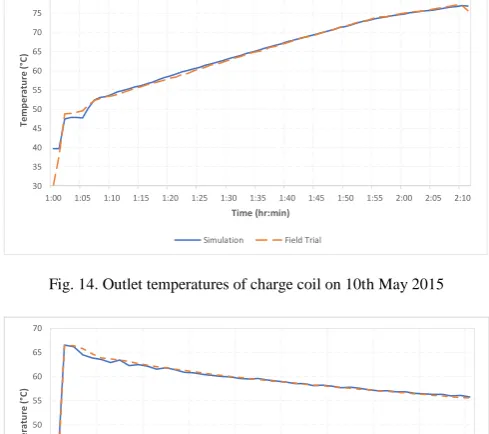
Comparisons of outlet temperatures of two heat exchangers are showed in Fig. 14 and Fig. 15. Results show very good agreements in both charging and discharging mode, with the maximum discrepancy of 1°C and 0.5°C respectively.
30 35 40 45 50 55 60 65 70 75 80
1:00 1:05 1:10 1:15 1:20 1:25 1:30 1:35 1:40 1:45 1:50 1:55 2:00 2:05 2:10
Te
m
p
er
atu
re
(
°C
)
Time (hr:min)
Simulation Field Trial
Fig. 14. Outlet temperatures of charge coil on 10th May 2015
30 35 40 45 50 55 60 65 70
5:28 5:33 5:38 5:43 5:48 5:53 5:58 6:03 6:08 6:13
Te
m
p
er
atu
re
(
°C
)
Time (hr:min)
[image:6.595.45.290.271.488.2]Field Trial Simulation
Fig. 15. Outlet temperatures of discharge coil on 10th May 2015
V. CONCLUSION AND FUTURE WORK
Model validation of a high temperature air-water heat pump and an energy storage tank is presented in this paper. Heat pump model was calibrated and validated over twelve days. Results showed good agreements between simulation and experiment in terms of water outlet temperatures and overall COP including degradation of defrost. Differences observed during start-up transients were difficult to solve in TRNSYS model, but they were relatively minor in steady state. The model of storage tank obtained a very strong coincidence with monitored data in both charging and discharging mode. The stratification occurring in standby loss was considerably complex so that the discrepancies between model and experiment remained. Future work will focus on coupling the HTAWHP and TES model with the
building model, and the prospective model will be validated against experimental results before improving its energy efficiency.
REFERENCES
[1] “Digest of UK Energy Statistics 2015”, Department of Energy and Climate Change, Tech. Rep.
[2] N. J. Hewitt, “Heat pumps and energy storage the challenges of Implementation,” Applied Energy, vol. 89, no. 1, pp. 37 – 44, 2012.
[3] Trnsys 17, a transient system simulation program vol. 3- component
library overview. Available:
http://www.trnsys.com/assets/docs/03-ComponentLibraryOverview.pdf [Accessed 01-06-2017].
[4] E. Carlon, V. K. Verma, M. Schwarz, L. Golicza, A. Prada, M.
Baratieri, W. Haslinger, and C. Schmidl, “Experimental validation of a thermodynamic boiler model under steady state and dynamic conditions,” Applied Energy, vol. 138, pp. 505 – 516, 2015.
[5] E. M. Ryan and T. F. Sanquist, “Validation of building energy
modeling tools under idealized and realistic conditions,” Energy and
Buildings, vol. 47, pp. 375 – 382, 2012.
[6] N. Shah and N. Hewitt, “High temperature heat pump operational
experience as a retrofit technology in domestic sector,” in 2015 IEEE International Conference on Engineering, Technology and Innovation/International Technology Management Conference (ICE/ITMC), June 2015, pp. 1–7.
[7] “Daikin Altherma HT 11, Daikin UK Limited,” Available:
http://www.daikin.co.uk/domestic/needs/heating/air-waterheatpumps-ht/index.jsp. [Accessed 01-06-2017].
[8] N. Shah, M. J. Huang, and N. Hewitt, “Heat pump demand side
management. Work pakage LE1. SPIRE,” Tech. Rep., Available:
http://projectspire.eu/wp-content/uploads/2016/07/LE1-SS-FINAL-REPORT.pdf. [Accessed 04-06-2017].
[9] Tess component libraries. Available:
http://www.trnsys.com/tess-libraries. [Accessed 01-06-2017].
[10] Metoffice. Available:
http://www.metoffice.gov.uk/public/weather/forecast/gcewftffc.
[Accessed 01-06-2017].
[11] K. Januˇseviˇcius and G. Streckien˙e, “Analysis of air-to-water heat pump in cold climate: comparison between experiment and simulation,” Science–Future of Lithuania/Mokslas–Lietuvos Ateitis, vol. 7, no. 4, pp. 468–474, 2015.
[12] Y. Guang Chen and X. min Guo, “Dynamic defrosting characteristics
of air source heat pump and effects of outdoor air parameters on defrost cycle performance,” Applied Thermal Engineering, vol. 29, no. 13, pp. 2701 – 2707, 2009.
[13] X.-M. Guo, Y.-G. Chen, W.-H. Wang, and C.-Z. Chen,
“Experimental study on frost growth and dynamic performance of air source heat pump system,” Applied Thermal Engineering, vol. 28, no. 1718, pp. 2267 – 2278, 2008.
[14] P. Vocale, G. L. Morini, and M. Spiga, “Influence of outdoor air
conditions on the air source heat pumps performance,” Energy
Procedia, vol. 45, pp. 653 – 662, 2014.
[15] N. Hewitt and M. J. Huang, “Defrost cycle performance for a circular
shape evaporator air source heat pump,” International Journal of Refrigeration, vol. 31, no. 3, pp. 444 – 452, 2008.
[16] L. B. N. Laboratory. Genopt. Available:
https://simulationresearch.lbl.gov/GO. [Accessed 01-06-2017].
[17] A. Cacabelos, P. Egua, J. L. Mguez, E. Granada, and M. E. Arce, “Calibrated simulation of a public library HVAC system with a ground-source heat pump and a radiant floor using TRNSYS and genopt,” Energy and Buildings, vol. 108, pp. 114 – 126, 2015.
[18] C. J. Banister, W. R. Wagar, and M. R. Collins, “Solar-assisted heat
![Fig. 2. Schematic of custom designed thermal storage tank [8]](https://thumb-us.123doks.com/thumbv2/123dok_us/413587.538904/2.595.55.297.52.389/fig-schematic-custom-designed-thermal-storage-tank.webp)