ISSN Online: 1945-3124 ISSN Print: 1945-3116
DOI: 10.4236/jsea.2019.125007 May 21, 2019 85 Journal of Software Engineering and Applications
Software Defect Prediction Using Supervised
Machine Learning and Ensemble Techniques:
A Comparative Study
Abdullah Alsaeedi, Mohammad Zubair Khan
Department of Computer Science, College of Computer Science and Engineering, Taibah University, Madinah, KSA
Abstract
An essential objective of software development is to locate and fix defects ahead of schedule that could be expected under diverse circumstances. Many software development activities are performed by individuals, which may lead to different software bugs over the development to occur, causing disap-pointments in the not-so-distant future. Thus, the prediction of software de-fects in the first stages has become a primary interest in the field of software engineering. Various software defect prediction (SDP) approaches that rely on software metrics have been proposed in the last two decades. Bagging, support vector machines (SVM), decision tree (DS), and random forest (RF) classifiers are known to perform well to predict defects. This paper studies and compares these supervised machine learning and ensemble classifiers on 10 NASA datasets. The experimental results showed that, in the majority of cases, RF was the best performing classifier compared to the others.
Keywords
Machine Learning, Ensembles, Prediction, Software Metrics, Software Defect
1. Introduction
A software defect is a bug, fault, or error in a program that causes improper outcomes. Software defects are programming errors that may occur because of errors in the source code, requirements, or design. Defects negatively affect software quality and software reliability [1]. Hence, they increase maintenance costs and efforts to resolve them. Software development teams can detect bugs by analyzing software testing results, but it is costly and time-consuming by testing entire software modules. As such, identifying defective modules in early How to cite this paper: Alsaeedi, A. and
Khan, M.Z. (2019) Software Defect Predic-tion Using Supervised Machine Learning and Ensemble Techniques: A Comparative Study. Journal of Software Engineering and Applications, 12, 85-100.
https://doi.org/10.4236/jsea.2019.125007
Received: April 10, 2019 Accepted: May 18, 2019 Published: May 21, 2019
Copyright © 2019 by author(s) and Scientific Research Publishing Inc. This work is licensed under the Creative Commons Attribution International License (CC BY 4.0).
DOI: 10.4236/jsea.2019.125007 86 Journal of Software Engineering and Applications stages is necessary to aid software testers in detecting modules that required in-tensive testing [2] [3].
In the field of software engineering, software defect prediction (SDP) in early stages is vital for software reliability and quality [1] [4]. The intention of SDP is to predict defects before software products are released, as detecting bugs after release is an exhausting and time-consuming process. In addition, SDP ap-proaches have been demonstrated to improve software quality, as they help de-velopers predict the most likely defective modules [5] [6]. SDP is considered a significant challenge, so various machine learning algorithms have been used to predict and determine defective modules [7]. With the end goal of expanding the viability of software testing, SDP is utilized to distinguish defective modules in current and subsequent versions of a software product. Therefore, SDP ap-proaches are very helpful in allocating more efforts and resources for testing and examining likely-defective modules [8].
Commonly-used SDP strategies are regression and classification strategies. The objective of regression techniques is to predict the number of software de-fects [5]. In the literature, there are a number of regression models used for SDP [9] [10] [11] [12]. In contrast, classification approaches aim to decide whether a software module is faulty or not. Classification models can be trained from the defect data of the previous version of the same software. The trained models can then be used to predict further potential software defects. Mining software repo-sitory becomes a vital topic in research for predicting defects [13] [14].
Supervised machine learning classifiers are commonly employed to predict software defects such as support vector machines [15] [16] [17], k-nearest neighbors (KNN) [18] [19], Naive Bayes [19] [20] [21], and so on. In addition, Bowes [22] suggested the use of classifier ensembles to effectively predict defects. A number of works have been accomplished in the field of SDP utilizing ensem-ble methods such as bagging [23] [24] [25], voting [22] [26], boosting [23] [24] [25], random tree [22], RF [27] [28], and stacking [22]. Neural networks (NN) can be used to predict defect prone software modules [29] [30] [31] [32].
Clustering algorithms such as k-means, x-means, and expectation maximiza-tion (EM) have also been applied to predict defects [33] [34] [35]. In addition, the experiment outcomes in [34] [35] showed that x-means clustering performed better than fuzzy clustering, EM, and k-means clustering at identifying software defects. Aside from those, transfer learning is a machine learning approach that expects to exchange the information learned in one dataset and utilize that learning to help tackle issues in an alternate dataset [36]. Transfer learning has also been introduced to the field of SDP [37] [38].
DOI: 10.4236/jsea.2019.125007 87 Journal of Software Engineering and Applications approaches can be either oversampling and under-sampling methods, and these can add or remove instances from the training data only. Several previous stu-dies [40] [41] [42] in SDP utilized oversampling approaches, especially, Synthet-ic Minority Over-sampling Technique (SMOTE). Pelayo and DSynthet-ick [40] com-bined SMOTE with DS to study the effect of oversampling on the accuracy of predictive models at detecting software defects. The results showed that SMOTE led to improvements in the classification accuracy, especially when the percen-tage of resampling was 300%.
Cost-sensitive learning is another approach to dealing with data imbalance. It works by adding weight to samples or resampling them by allocating cost to each class in a predefined matrix. However, the issue with cost-sensitive classifiers is that there is no intelligent and systematic way to set the cost matrices [39]. En-semble approaches combine multiple models to obtain better predictions. Three ensemble methods are widely used in SDP includes: bagging, boosting, and stacking. The common boosting algorithm for SDP is adaptive boosting (Ada-Boost). On the other hand, hybrid approaches [39], such as SMOTEBoost and RUSBoost are known approaches for dealing with the problem of class imbal-ance. In this paper, we will use the SMOTE oversampling approach to deal with class imbalance, with the intent to compare the performance of supervised ma-chine learning and Ensemble techniques in predicting software defects.
Section 2 summarizes software metrics that can be used as attributes to iden-tify software defects. Section 3 presents evaluation metrics that can be used to measure the performance of SDP models. Sections 4 and 5 detail the experimen-tal methodology and results, respectively. Section 6 presents the threats to valid-ity. Related works are described in Section 7.
2. Software Metrics
A software metric is a proportion of quantifiable or countable characteristics that can be used to measure and predict the quality of software. A metric is an indicator describing a specific feature of a software [6]. Identifying and measur-ing software metrics is vital for various reasons, includmeasur-ing estimatmeasur-ing program-ming execution, measuring the effectiveness of software processes, estimating required efforts for processes, deduction of defects during software develop-ment, and monitoring and controlling software project executions [5].
DOI: 10.4236/jsea.2019.125007 88 Journal of Software Engineering and Applications connected components. Ohlsson and Alberg [46] used McCabe’s cyclomatic metrics to predict defect-prone modules before starting coding. Many previous studies have used McCabe’s cyclomatic metrics to build SDP models [47] [48], as well. Another set of software metrics are the software size metrics proposed by Halstead [49]. Halstead software size metrics are based on the number of ope-rands and operators from source codes [49]. In addition, these metrics are re-lated to program size of program vocabulary, length, volume, difficulty, effort, and time [49] and have been used in SDP [48] [50].
According to [51], the majority of software fault prediction approaches rely on object-oriented software metrics. Chidamber and Kemerer [52] proposed several software metrics called CK object-oriented metrics, which include the depth of inheritance tree (DIT), weighted method per class (WMC), number of children (NOC), and so on. Many studies using object-oriented metrics have been used in SDP [53] [54] [55]. Radjenovic etal.[51] identified effective soft-ware metrics used in SDP and aimed to enhance softsoft-ware quality by finding de-fects. The outcome of their study [51] outlined that object-oriented and process metrics were more effective in finding defects compared to other size and com-plexity metrics.
3. Evaluation Measures for Software Bugs Prediction
In this section, we will discuss different measurements for software defect pre-diction such as true positive (TP), true negative (TN), false positive (FP) and false negative (FN). TP denotes the number of defective software instances that are correctly classified as defective, while TN is the number of clean software in-stances that are correctly classified as clean. FP denotes the number of clean software instances that are wrongly classified as defective, and FN denotes the number of defective software instances that are mistakenly classified as clean
One of the primary simple metrics to evaluate the performance of predictive models is classification accuracy, also called the correct classification rate. It is utilized to quantify the extent of the effectively classified instances to the aggre-gate instances. Another measure is called precision, and it is calculated by divid-ing the number of instances correctly classified as defective (TP) by the total number of instances classified as defective (TP + FP) [16]. In addition, recall measures the percentage of the number of instances correctly classified as defec-tive (TP) to the total number of faulty instances (TP + FN) [16]. F-score is a harmonic mean of precision and recall, and many studies in the literature used F-score metrics [56] [57]. ROC-AUC calculates the area under the receiver op-erating characteristic (ROC) curve by computing trade-offs between TPR and FPR.
(
) (
)
Accuracy= TP TN TP TN FP FN+ + + + (1)
(
)
Precision TP TP FP= + (2)
(
)
DOI: 10.4236/jsea.2019.125007 89 Journal of Software Engineering and Applications
(
) (
)
F-Score= 2 Precision Recall Precision Recall∗ ∗ + (4)
(
)
TPR TP TP FN= + (5)
(
)
FPR FP TN FP= + (6)
G-measure is another measure used in software defect prediction. It is defined as a harmonic mean of recall and specificity. Probability of false alarm (PF) is the ratio of clean instances wrongly classified as defective (FP) among the total clean instances (FP + TN).
(
)
PF FP FP TN= + (7)
Specificity 1 PF TN FP TN= − = + (8)
G-measure 2 Recall Specificity Recall Specificity= ∗ ∗ + (9)
4. Experimental Methodology
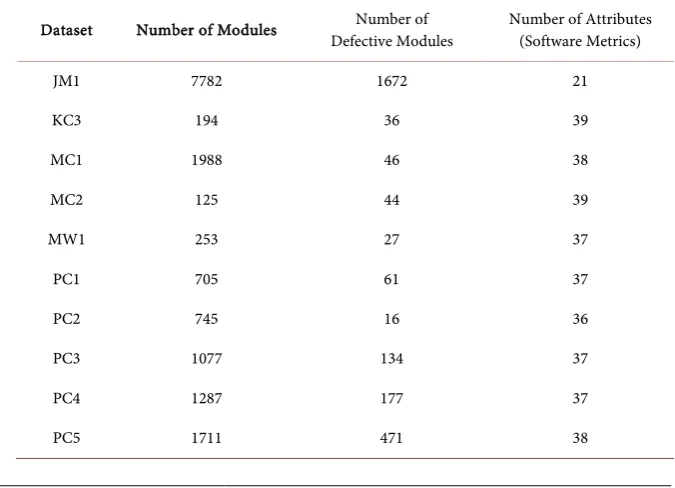
[image:5.595.201.539.495.739.2]For the experiments, 10 well-known software defect datasets [62] were selected. The majority of related works used these datasets to evaluate the performance of their SDP techniques and this is the reason behind selecting the above-mentioned dataset for further comparisons. Table 1 reports the datasets used in the experi-ments along with the statistics. RF, DS, Linear SVC SVM, and LR were chosen to be the base classifiers. Boosting and bagging classifiers for all the base classifiers were also considered. The experiments were conducted on a Python environ-ment. The classifiers’ performances in this study were measured using classifica-tion accuracy, precision, recall, F-score, and ROC-AUC score. It is important to highlight that these metrics were computed using the weighted average. The in-tuition behind selecting the weighted average was to calculate metrics for each class label and take the label imbalance into the account.
Table 1. Dataset summaries.
Dataset Number of Modules Defective Modules Number of Number of Attributes (Software Metrics)
JM1 7782 1672 21
KC3 194 36 39
MC1 1988 46 38
MC2 125 44 39
MW1 253 27 37
PC1 705 61 37
PC2 745 16 36
PC3 1077 134 37
PC4 1287 177 37
DOI: 10.4236/jsea.2019.125007 90 Journal of Software Engineering and Applications The performance of classifiers was evaluated based on 10-fold cross-validation to split the datasets into 10 consecutive folds. One of them for testing and the remaining folds for training. Afterwards, features were standardized and scaled using the standard Scaler function in Python, which works by removing the mean and scaling the features into unit variance. Since the datasets were very imbalanced, the oversampling approach using SMOTE was performed for the training data only, as it has been widely used in the literature to mitigate imbal-ance issues in training data for SDP.
The following Algorithm 1 was used for the experiments. It began by provid-ing a list of datasets and a list of classifiers and then proceeded to iterate over all datasets, as shown in Line 8. The datasets were split into training and testing da-ta based on 10-fold cross-validation with shuffling of the dada-ta before splitting, as shown in Line 9. One the dataset was split, the perform Standard Scaler function was utilized to standardize and scale the features.
Once the features were standardized, the training data for each fold were re-sampled using the SMOTE technique, as shown in Line 11. As mentioned above, SMOTE oversampling has been widely used in SDP. The loop in Lines 12 - 25 aimed to train the classifiers, obtain predictions, and compute evaluation metrics. The average metrics were computed in Lines (27 - 31) as the datasets were split using 10-folds. The process from Lines 9 - 31 was iterated throughout all provided datasets.
DOI: 10.4236/jsea.2019.125007 91 Journal of Software Engineering and Applications
5. Experimental Results and Discussion
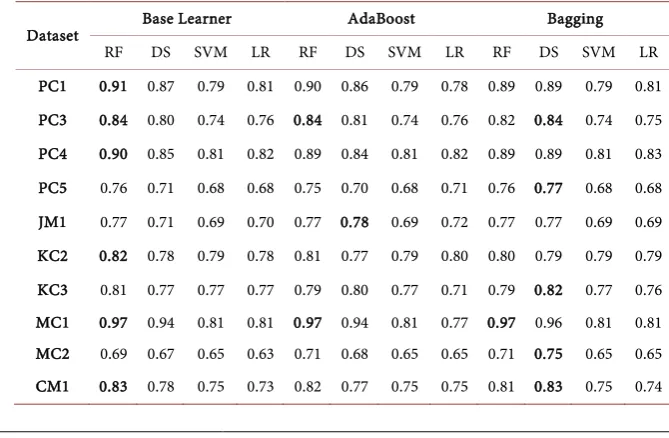
Table 2 summarizes the performance of the different classifiers based on the classification accuracy. The RF classifier achieved accuracies of 0.91, 0.84, 0.90, 0.82, 0.97, and 0.83 for the PC1, PC3, PC4, KC2, MC1, and CM1 datasets, re-spectively. In addition, it is obvious that the RF classifier attained the highest accuracy scores for the PC1, PC3, PC4, KC2, MC1, and CM1 datasets compared to other classifiers, indicating better predictions of defective instances performed by the RF classifiers in these datasets. Moreover, the reported scores in Table 2 show that the bagging classifier with DS as a base learner performed well on the PC5, KC3, and MC2 datasets as compared to the other classifiers.
[image:7.595.209.539.284.474.2]In Figure 1, it is clear that the RF classifier obtained the highest accuracy scores for all datasets, except PC5, JM1, KC3 and MC2. Furthermore, the maxi-mum accuracy attained for PC1 was 0.91 whereas the minimaxi-mum value was 0.78
[image:7.595.202.537.522.741.2]Figure 1. Classification accuracy scores of different classifiers.
Table 2. The accuracy scores obtained using different classifiers.
Dataset Base Learner AdaBoost Bagging
RF DS SVM LR RF DS SVM LR RF DS SVM LR
PC1 0.91 0.87 0.79 0.81 0.90 0.86 0.79 0.78 0.89 0.89 0.79 0.81
PC3 0.84 0.80 0.74 0.76 0.84 0.81 0.74 0.76 0.82 0.84 0.74 0.75
PC4 0.90 0.85 0.81 0.82 0.89 0.84 0.81 0.82 0.89 0.89 0.81 0.83
PC5 0.76 0.71 0.68 0.68 0.75 0.70 0.68 0.71 0.76 0.77 0.68 0.68
JM1 0.77 0.71 0.69 0.70 0.77 0.78 0.69 0.72 0.77 0.77 0.69 0.69
KC2 0.82 0.78 0.79 0.78 0.81 0.77 0.79 0.80 0.80 0.79 0.79 0.79
KC3 0.81 0.77 0.77 0.77 0.79 0.80 0.77 0.71 0.79 0.82 0.77 0.76
MC1 0.97 0.94 0.81 0.81 0.97 0.94 0.81 0.77 0.97 0.96 0.81 0.81
MC2 0.69 0.67 0.65 0.63 0.71 0.68 0.65 0.65 0.71 0.75 0.65 0.65
DOI: 10.4236/jsea.2019.125007 92 Journal of Software Engineering and Applications obtained by LR for the same dataset. Among the base learners, RF was the best performing classifier for all datasets, while SVM was the worst classifier for all datasets, except KC2, MC2, and CM1. Besides, Bagging with DS achieves higher accuracy scores for PC3, PC5, KC3, MC2, CM1 compared to the other bagging and boosting methods.
Table 3 reports the F-scores attained using different classifiers. In general, it is apparent that the RF classifier was the best performing for six different datasets, as illustrated in Table 2 and Table 3. For PC1, PC3, PC4, KC2, MC1, and CM1, the RF classifier attained the highest F-scores compared to the other classifiers, indicating better predictions obtained by RF. In addition, the reported F-scores presented that AdaBoost classifier with RF as a base learner attained similar scores to RF for the PC3, PC4, KC2, and MC1 datasets. Furthermore, bagging with DS achieved higher F-scores compared to other classifiers for PC5, KC, and MC2.
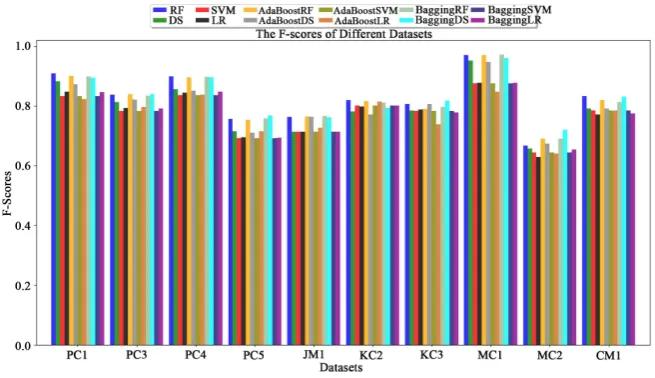
Figure 2 illustrates bar plots of the F-scores attained using classifiers for all datasets. For the PC3, PC4, PC5, and JM1 datasets, it is obvious that the SVM,
[image:8.595.211.539.563.733.2]Figure 2. F-scores attained by different classifiers.
Table 3. The F-scores obtained using different classifier.
Dataset Base Learner AdaBoost Bagging
RF DS SVM LR RF DS SVM LR RF DS SVM LR
PC1 0.91 0.88 0.83 0.85 0.90 0.87 0.83 0.82 0.90 0.89 0.83 0.85
PC3 0.84 0.81 0.78 0.79 0.84 0.82 0.78 0.80 0.83 0.84 0.78 0.79
PC4 0.90 0.86 0.84 0.84 0.90 0.85 0.84 0.84 0.90 0.90 0.84 0.85
PC5 0.76 0.72 0.69 0.70 0.75 0.71 0.69 0.71 0.76 0.77 0.69 0.69
JM1 0.76 0.71 0.71 0.71 0.76 0.76 0.71 0.73 0.77 0.76 0.71 0.71
KC2 0.82 0.78 0.80 0.80 0.82 0.77 0.80 0.81 0.81 0.79 0.80 0.80
KC3 0.81 0.78 0.78 0.79 0.79 0.81 0.78 0.74 0.80 0.82 0.78 0.78
MC1 0.97 0.95 0.88 0.88 0.97 0.95 0.88 0.85 0.97 0.96 0.88 0.88
MC2 0.67 0.66 0.64 0.63 0.69 0.67 0.64 0.64 0.69 0.72 0.64 0.65
DOI: 10.4236/jsea.2019.125007 93 Journal of Software Engineering and Applications AdaBoost (SVM), and bagging (SVM) classifiers performed badly, as reported in Table 3. For JM1, the highest F-score was 0.77, attained by bagging (RF). Addi-tionally, the lowest score was 0.71, which was attained using six different clas-sifiers. Furthermore, the F-scores achieved by bagging (LR) were the minimum for KC3 and MC1. LR was the worst classifier for the MC2 and CM1 datasets.
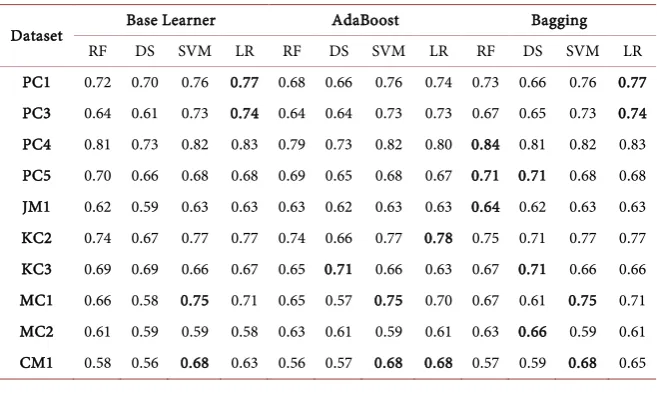
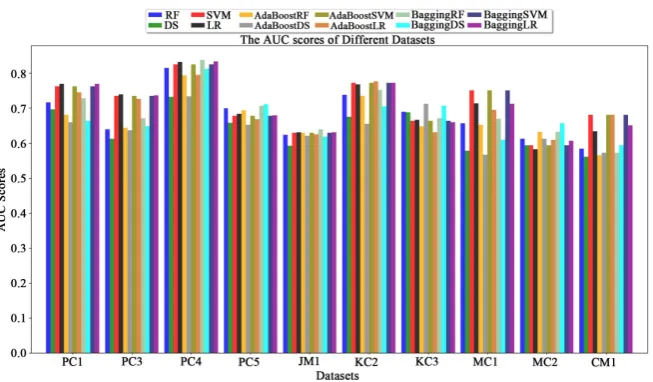
[image:9.595.210.539.536.733.2]The ROC-AUC scores achieved by all participating classifiers are shown in Table 4. For PC1 and PC3, the LR and bagging with LR classifiers attained the highest ROC-AUC scores, achieving 0.77 for PC1 and 0.74 for PC3. The bagging with the RF algorithm as base estimator performed well in terms of ROC-AUC scores, reaching 0.84, 0.71, and 0.64 for the PC4, PC5, and JM1 datasets, respec-tively. The ROC-AUC score of AdaBoost with the LR classifier on data set KC2 was the best among all the classifiers, achieving a score of 0.78, while the lowest value was 0.66 and was attained by the AdaBoost with DS. The SVM, AdaBoost (SVM), and bagging (SVM) classifiers achieved the highest ROC-AUC scores for the CM1 and MC1 datasets.
Figure 3 shows the bar plots of ROC-AUC scores attained by all classifiers. It is clear there is no dominant classifier and this may due to the nature of datasets. For instance, LR and bagging (LR) classifiers performed well on PC1 and PC3 datasets, while these classifiers did not achieve the highest ROC-AUC scores for other datasets.
Our findings demonstrate that there was uncertainty in the classifiers’ per-formances, as some classifiers performed well in specific datasets but worse in others. Similar to other studies [6] [22] [58], our results recommend using en-sembles as predictive models to detect software defects. Additionally, their find-ings [6] [22] [58] agreed with our outcome that RF performed well. However, the experiments conducted by Hammouri et al. [61] purported that the best performing algorithm was DS, while our study’s findings confirmed that DS performed badly, unless it was used as a base learner with bagging classifiers for some datasets, as reported in Table 2 and Table 3.
Table 4. The ROC-AUC scores obtained using classifiers.
Dataset Base Learner AdaBoost Bagging
RF DS SVM LR RF DS SVM LR RF DS SVM LR
PC1 0.72 0.70 0.76 0.77 0.68 0.66 0.76 0.74 0.73 0.66 0.76 0.77
PC3 0.64 0.61 0.73 0.74 0.64 0.64 0.73 0.73 0.67 0.65 0.73 0.74
PC4 0.81 0.73 0.82 0.83 0.79 0.73 0.82 0.80 0.84 0.81 0.82 0.83
PC5 0.70 0.66 0.68 0.68 0.69 0.65 0.68 0.67 0.71 0.71 0.68 0.68
JM1 0.62 0.59 0.63 0.63 0.63 0.62 0.63 0.63 0.64 0.62 0.63 0.63
KC2 0.74 0.67 0.77 0.77 0.74 0.66 0.77 0.78 0.75 0.71 0.77 0.77
KC3 0.69 0.69 0.66 0.67 0.65 0.71 0.66 0.63 0.67 0.71 0.66 0.66
MC1 0.66 0.58 0.75 0.71 0.65 0.57 0.75 0.70 0.67 0.61 0.75 0.71
MC2 0.61 0.59 0.59 0.58 0.63 0.61 0.59 0.61 0.63 0.66 0.59 0.61
DOI: 10.4236/jsea.2019.125007 94 Journal of Software Engineering and Applications
Figure 3. ROC-AUC scores of different classifiers.
6. Threats to Validity
In this section, we list some potential threats in our study and responses to con-struct validity.
1) The selection of datasets may not be representative. One potential threat to validity is the selection of datasets where they might not be representative. In our study, this threat is mitigated by evaluating the performance of the classifiers on ten well-known datasets that are commonly used in the literature review.
2) The generalization of our results. We have attempted to mitigate this threat by measuring the performance of the base learners, boosting, and bagging clas-sifier on diverse datasets that have different sizes.
3) The trained classifiers may over-fitting and bias the results. Instead of split-ting the datasets randomly using the simple test split (70% - 80% for train-ing and 30% - 20% for testtrain-ing), we split the dataset into traintrain-ing and testtrain-ing sets using the 10-fold cross validation to avoid the over-fitting issue that might be caused using the random splitting.
7. Related Works
Kalai Magal etal.[28] combined feature selection with RF to improve the accu-racy of software defect predication. Feature selection was based on correlation computation and aimed to choose the ideal subset of features. The selected fea-tures using correlation-based feature selection were then used with RF to predict software defects. Various experiments were conducted on open NASA datasets from the PROMISE repository. The outcome showed clear improvements ob-tained using the improved RF compared to the traditional RF.
correla-DOI: 10.4236/jsea.2019.125007 95 Journal of Software Engineering and Applications tion-based feature selection technique with 1-rule classifier led to improvements in classification accuracy.
Anuradha and Shafali [58] investigated three supervised classifiers: J48, NB, and RF. Various datasets were selected to assess the classifiers efficiency at de-tecting defective modules. The conducted experiments demonstrated that the RF classifier outperformed the others. Moreover, Ge etal.[6] showed that RF per-formed well compared to LWL, C4.5, SVM, NB, and multilayer feed forward neural networks. On the other hand, Singh and Chug [59] analyzed five classifi-ers—ANN, particle swarm optimization (PSO), DS, NB, Linear classifier (LC)—and compared their performance in terms of detecting software defects. The experiment results showed that LC outperformed the other classifiers.
Aleem etal.[27] compared the performance of 11 machine learning methods and used 15 NASA datasets from the PROMISE repository. NB, MLP, SVM, AdaBoost, bagging, DS, RF, J48, KNN, RBF, and k-means were applied in their study. The results showed that bagging and SVM performed well in the majority of datasets. Meanwhile, Wang etal. [22] carried out a comparative analysis of ensemble classifiers for SDP and demonstrated that voting ensemble and RF at-tained the highest classification accuracy results compared to AdaBoost, NB, stacking, and bagging. Perreault etal.[19] compared NB, SVM, ANN, LR, and KNN on five NASA datasets. The outcomes of the conducted experiments did not show a superior classifier at identifying software defects. Hussain etal.[60] used the AdaboostM1, Vote and StackingC ensemble classifier with five base classifiers: NB, LR, J48, Voted-Perceptron and SMO in Weka tool for SDP. The experimental results showed that StackingC performed well compared to the other classifiers.
Hammouri etal.[61] assessed NB, ANN, and DS for SDP. Three real debug-ging datasets were used in their study. Measurements such as accuracy, preci-sion, recall, F-measure, and RMSE were utilized to analyze the results. The re-sults of their study showed that DS performed well.
The above-mentioned approaches differ from the proposed approach in this paper in two ways. Firstly, we compared the performance of different supervised and Ensemble methods on the oversampled training data, while other works such as Kalai Magal etal.[28] and Venkata et al.[9] focused on the impact of feature selection and attribute reduction on the performance of classifiers. Se-condly, a very similar study to our approach presented in this paper was con-ducted by Alsawalqah etal.[63], where they studied the impact of SMOTE on the Adaboost ensemble method with J48 as a base classifier. Their findings demonstrated that SMOTE can help to boost the performance of the ensemble method on four NASA datasets. This differs from our study presented in this paper is that we compared varieties of ensemble methods on the oversampled training dataset, while Alsawalqah etal. [63] used only Adaboost with J48 as a base classifier.
fo-DOI: 10.4236/jsea.2019.125007 96 Journal of Software Engineering and Applications cused on studying the performance of these classifiers on the condition that SMOTE oversampling techniques were applied to training data only.
8. Conclusions and Future Works
This paper focused on comparing the most well-known machine learning algo-rithms that are widely used to predict software defects. The performances of dif-ferent algorithms were evaluated using classification accuracy, F-measure, and ROC-AUC metrics. The SMOTE resampling strategy was used to mitigate the data imbalance issues. The outcomes of the conducted experiment showed that RF, AdaBoost with RF, and bagging with DS generally performed well.
Interesting future extensions could include studying the impact of various metaheuristic feature selection approaches to select the optimal set of features for SDP. One future direction is to explore and compare the performance of deep learning approaches and ensemble classifiers with other resampling tech-niques, as data imbalance is still an issue that badly affects the performance of the existing SDP approaches.
Conflicts of Interest
The authors declare no conflicts of interest regarding the publication of this pa-per.
References
[1] Rawat, M.S. and Dubey, S.K. (2012) Software Defect Prediction Models for Quality Improvement: A Literature Study. International Journalof Computer Science Is-sues, 9, 288-296.
[2] Li, J., He, P., Zhu, J. and Lyu, M.R. (2017) Software Defect Prediction via Convolu-tional Neural Network. 2017 IEEEInternational ConferenceonSoftwareQuality,
ReliabilityandSecurity, 25-29 July 2017, Prague, 318-328.
https://doi.org/10.1109/QRS.2017.42
[3] Hassan, F., Farhan, S., Fahiem, M.A. and Tauseef, H. (2018) A Review on Machine Learning Techniques for Software Defect Prediction. TechnicalJournal, 23, 63-71. [4] Punitha, K. and Chitra, S. (2013) Software Defect Prediction Using Software
Me-trics: A Survey. 2013 InternationalConferenceonInformationCommunicationand EmbeddedSystems, 21-22 February 2013, Chennai, 555-558.
https://doi.org/10.1109/ICICES.2013.6508369
[5] Kalaivani, N. and Beena, R. (2018) Overview of Software Defect Prediction Using Machine Learning Algorithms. InternationalJournalof PureandApplied Mathe-matics, 118, 3863-3873.
[6] Ge, J., Liu, J. and Liu, W. (2018) Comparative Study on Defect Prediction Algo-rithms of Supervised Learning Software Based on Imbalanced Classification Data Sets. 2018 19thIEEE/ACISInternationalConferenceonSoftwareEngineering, Ar-tificial Intelligence, Networking and Parallel/Distributed Computing, 27-29 June 2018, Busan, 399-406. https://doi.org/10.1109/SNPD.2018.8441143
DOI: 10.4236/jsea.2019.125007 97 Journal of Software Engineering and Applications
[8] Chang, R.H., Mu, X.D. and Zhang, L. (2011) Software Defect Prediction Using Non-Negative Matrix Factorization. JournalofSoftware, 6, 2114-2120.
https://doi.org/10.4304/jsw.6.11.2114-2120
[9] Challagulla, V.U.B., Bastani, F.B., Yen, I.L. and Paul, R.A. (2005) Empirical Assess-ment of Machine Learning Based Software Defect Prediction Techniques. Proceed-ingsofthe 10thIEEEInternationalWorkshoponObject-OrientedReal-Time De-pendableSystems, 2-4 February 2005, Sedona, 263-270.
https://doi.org/10.1109/WORDS.2005.32
[10] Yan, Z., Chen, X. and Guo, P. (2010) Software Defect Prediction Using Fuzzy Sup-port Vector Regression. In: Zhang, L., Lu, B. and Kwok, J., Eds., AdvancesinNeural Networks, Springer, Berlin, 17-24.
https://doi.org/10.1007/978-3-642-13318-3_3
[11] Rathore, S.S. and Kumar, S. (2016) A Decision Tree Regression Based Approach for the Number of Software Faults Prediction. ACMSIGSOFTSoftwAreEngineering Notes, 41, 1-6. https://doi.org/10.1145/2853073.2853083
[12] Rathore, S.S. and Kumar, S. (2017) An Empirical Study of Some Software Fault Pre-diction Techniques for the Number of Faults PrePre-diction. Soft Computing, 21, 7417-7434. https://doi.org/10.1007/s00500-016-2284-x
[13] Wang, H. (2014) Software Defects Classification Prediction Based on Mining Soft-ware Repository. Master’s Thesis, Uppsala University, Department of Information Technology.
[14] Vandecruys, O., Martens, D., Baesens, B., Mues, C., Backer, M.D. and Haesen, R. (2008) Mining Software Repositories for Comprehensible Software Fault Prediction Models. JournalofSystemsandSoftware, 81, 823-839.
https://doi.org/10.1016/j.jss.2007.07.034
http://www.sciencedirect.com/science/article/pii/S0164121207001902
[15] Vapnik, V. (2013) The Nature of Statistical Learning Theory. Springer, Berlin. [16] Elish, K.O. and Elish, M.O. (2008) Predicting Defect-Prone Software Modules Using
Support Vector Machines. JournalofSystemsandSoftware, 81, 649-660.
https://doi.org/10.1016/j.jss.2007.07.040
http://www.sciencedirect.com/science/article/pii/S016412120700235X
[17] Gray, D., Bowes, D., Davey, N., Sun, Y. and Christianson, B. (2009) Using the Sup-port Vector Machine as a Classification Method for Software Defect Prediction with Static Code Metrics. In: Palmer-Brown, D., Draganova, C., Pimenidis, E. and Mou-ratidis, H., Eds., EngineeringApplications of Neural Networks, Springer, Berlin, 223-234. https://doi.org/10.1007/978-3-642-03969-0_21
[18] Wang, H., Khoshgoftaar, T.M. and Seliya, N. (2011) How Many Software Metrics Should Be Selected for Defect Prediction? 24thInternationalFLAIRSConference, 18-20 May 2011, Palm Beach, 69-74.
[19] Perreault, L., Berardinelli, S., Izurieta, C. and Sheppard, J. (2017) Using Classifiers for Software Defect Detection. 26th International Conference onSoftware Engi-neeringandDataEngineering, 2-4 October 2017,Sydney, 2-4.
[20] Wang, T. and Li, W. (2010) Naive Bayes Software Defect Prediction Model. 2010
InternationalConferenceonComputationalIntelligenceandSoftwareEngineering, 10-12 December 2010, Wuhan, 1-4. https://doi.org/10.1109/CISE.2010.5677057
[21] Jiang, Y., Cukic, B. and Menzies, T. (2007) Fault Prediction Using Early Lifecycle Data. 18thIEEE InternationalSymposiumonSoftware Reliability, 5-9 November 2007, Trollhättan, 237-246. https://doi.org/10.1109/ISSRE.2007.24
DOI: 10.4236/jsea.2019.125007 98 Journal of Software Engineering and Applications
Classifiers Ensemble. Journal of Information & Computational Science, 8, 4241-4254.
[23] Jiang, Y., Cukic, B. and Menzies, T. (2008) Cost Curve Evaluation of Fault Predic-tion Models. 2008 19thInternationalSymposiumonSoftwareReliability Engineer-ing, 10-14 November 2008, Seattle, 197-206.
https://doi.org/10.1109/ISSRE.2008.54
[24] Jiang, Y., Lin, J., Cukic, B. and Menzies, T. (2009) Variance Analysis in Software Fault Prediction Models. 2009 20thInternationalSymposiumonSoftware Reliabili-tyEngineering, 16-19 November 2009, San Jose, 99-108.
https://doi.org/10.1109/ISSRE.2009.13
[25] Abdou, A. and Darwish, N. (2018) Early Prediction of Software Defect Using En-semble Learning: A Comparative Study. InternationalJournalofComputer Appli-cations, 179, 29-40. https://doi.org/10.5120/ijca2018917185
[26] Moustafa, S., El Nainay, M., El Makky, N. and Abougabal, M.S. (2018) Software Bug Prediction Using Weighted Majority Voting Techniques. Alexandria Engineering Journal, 57, 2763-2774. https://doi.org/10.1016/j.aej.2018.01.003
http://www.sciencedirect.com/science/article/pii/S1110016818300747
[27] Aleem, S., Capretz, L. and Ahmed, F. (2015) Benchmarking Machine Learning Technologies for Software Defect Detection. InternationalJournalofSoftware En-gineering&Applications, 6, 11-23. https://doi.org/10.5121/ijsea.2015.6302
[28] Jacob, S.G., etal. (2015) Improved Random Forest Algorithm for Software Defect Prediction through Data Mining Techniques. International Journal of Computer Applications, 117,18-22. https://doi.org/10.5120/20693-3582
[29] Kumar, R. and Gupta, D.L. (2016) Software Bug Prediction System Using Neural Network. EuropeanJournalofAdvancesinEngineeringandTechnology, 3, 78-84. [30] Jindal, R., Malhotra, R. and Jain, A. (2014) Software Defect Prediction Using Neural
Networks. Proceedings of 3rd International Conference on Reliability, Infocom TechnologiesandOptimization, 8-10 October 2014, Noida, 1-6.
https://doi.org/10.1109/ICRITO.2014.7014673
[31] Sethi, T. (2016) Improved Approach for Software Defect Prediction Using Artificial Neural Networks. 2016 5thInternationalConferenceonReliability, Infocom Tech-nologiesandOptimization, 7-9 September 2016, Noida, 480-485.
https://doi.org/10.1109/ICRITO.2016.7785003
[32] Jayanthi, R. and Florence, L. (2018) Software Defect Prediction Techniques Using Metrics Based on Neural Network Classifier. ClusterComputing, 1-12.
https://doi.org/10.1007/s10586-018-1730-1
[33] Bishnu, P.S. and Bhattacherjee, V. (2012) Software Fault Prediction Using Quad Tree-Based K-Means Clustering Algorithm. IEEETransactionsonKnowledgeand DataEngineering, 24, 1146-1150. https://doi.org/10.1109/TKDE.2011.163
[34] Park, M. and Hong, E. (2014) Software Fault Prediction Model Using Clustering Algorithms Determining the Number of Clusters Automatically. International JournalofSoftwareEngineeringandItsApplications, 8, 199-204.
[35] Catal, C., Sevim, U. and Diri, B. (2009) Software Fault Prediction of Unlabeled Pro-gram Modules. ProceedingsoftheWorldCongressonEngineering, 1, 1-3.
https://doi.org/10.1109/ITNG.2009.12
[36] Han, J., Pei, J. and Kamber, M. (2011) DataMining: ConceptsandTechniques. The Morgan Kaufmann Series in Data Management Systems.
https://books.google.com.sa/books?id=pQws07tdpjoC
DOI: 10.4236/jsea.2019.125007 99 Journal of Software Engineering and Applications
Software Defect Prediction. InformationandSoftwareTechnology, 54, 248-256.
http://www.sciencedirect.com/science/article/pii/S0950584911001996 https://doi.org/10.1016/j.infsof.2011.09.007
[38] Cao, Q., Sun, Q., Cao, Q. and Tan, H. (2015) Software Defect Prediction via Trans-fer Learning Based Neural Network. 2015 1stInternationalConferenceon Reliabil-itySystemsEngineering, 21-23 October 2015, Beijing, 1-10.
https://doi.org/10.1109/ICRSE.2015.7366475
[39] Rodriguez, D., Herraiz, I., Harrison, R., Dolado, J. and Riquelme, J.C. (2014) Pre-liminary Comparison of Techniques for Dealing with Imbalance in Software Defect Prediction. Proceedingsof the 18th International Conferenceon Evaluationand AssessmentinSoftwareEngineering, 13-14 May 2014, London, 1-10.
https://doi.org/10.1145/2601248.2601294
[40] Pelayo, L. and Dick, S. (2007) Applying Novel Resampling Strategies to Software Defect Prediction. NAFIPS 2007 AnnualMeetingoftheNorthAmericanFuzzy In-formationProcessingSociety, 24-27 June 2007, San Diego, 69-72.
https://doi.org/10.1109/NAFIPS.2007.383813
[41] Pak, C., Wang, T. and Su, X.H. (2018) An Empirical Study on Software Defect Pre-diction Using Over-Sampling by Smote. International Journal of Software Engi-neeringandKnowledgeEngineering, 28, 811-830.
https://doi.org/10.1142/S0218194018500237
[42] Shatnawi, R. (2012) Improving Software Fault-Prediction for Imbalanced Data. 2012 International ConferenceonInnovationsinInformation Technology, 18-20 March 2012, London, 54-59. https://doi.org/10.1109/INNOVATIONS.2012.6207774
[43] Zhang, H. (2009) An Investigation of the Relationships between Lines of Code and Defects. 2009 IEEEInternationalConferenceonSoftwareMaintenance, 20-26 Sep-tember 2009, Edmonton, 274-283. https://doi.org/10.1109/ICSM.2009.5306304
[44] Mende, T. and Koschke, R. (2009) Revisiting the Evaluation of Defect Prediction Models. Proceedingsofthe 5th International ConferenceonPredictorModelsin SoftwareEngineering, 18-19 May 2009, Canada, 1-10.
https://doi.org/10.1145/1540438.1540448
[45] McCabe, T.J. (1976) A Complexity Measure. IEEETransactionsonSoftware Engi-neering, 2, 308-320. https://doi.org/10.1109/TSE.1976.233837
[46] Ohlsson, N. and Alberg, H. (1996) Predicting Fault-Prone Software Modules in Telephone Switches. IEEETransactionsonSoftwareEngineering, 22, 886-894.
https://doi.org/10.1109/32.553637
[47] Lessmann, S., Baesens, B., Mues, C. and Pietsch, S. (2008) Benchmarking Classifica-tion Models for Software Defect PredicClassifica-tion: A Proposed Framework and Novel Findings. IEEETransactionsonSoftwareEngineering, 34, 485-496.
https://doi.org/10.1109/TSE.2008.35
[48] Song, Q., Jia, Z., Shepperd, M., Ying, S. and Liu, J. (2011) A General Software De-fect-Proneness Prediction Framework. IEEETransactionsonSoftwareEngineering, 37, 356-370. https://doi.org/10.1109/TSE.2010.90
[49] Halstead, M.H. (1977) Elements of Software Science (Operating and Programming Systems Series).
[50] Menzies, T., Greenwald, J. and Frank, A. (2007) Data Mining Static Code Attributes to Learn Defect Predictors. IEEETransactionsonSoftwareEngineering, 33, 2-13.
https://doi.org/10.1109/TSE.2007.256941
Tech-DOI: 10.4236/jsea.2019.125007 100 Journal of Software Engineering and Applications nology, 55, 1397-1418. https://doi.org/10.1016/j.infsof.2013.02.009
http://www.sciencedirect.com/science/article/pii/S0950584913000426
[52] Chidamber, S.R. and Kemerer, C.F. (1994) A Metrics Suite for Object Oriented De-sign. IEEETransactionsonSoftwareEngineering, 20, 476-493.
https://doi.org/10.1109/32.295895
[53] Jureczko, M. and Spinellis, D.D. (2010) Using Object-Oriented Design Metrics to Predict Software Defects.
[54] Gupta, D.L. and Saxena, K. (2017) Software Bug Prediction Using Object-Oriented Metrics.Sadhana, 42, 655-669.
[55] Singh, A., Bhatia, R. and Singhrova, A. (2018) Taxonomy of Machine Learning Al-gorithms in Software Fault Prediction Using Object Oriented Metrics. Procedia ComputerScience, 132, 993-1001.
http://www.sciencedirect.com/science/article/pii/S1877050918308470
[56] Kim, S., Zhang, H., Wu, R. and Gong, L. (2011) Dealing with Noise in Defect Pre-diction. 2011 33rdInternationalConferenceonSoftwareEngineering, 21-28 May 2011, Waikiki, 481-490. https://doi.org/10.1145/1985793.1985859
[57] Lee, T., Nam, J., Han, D., Kim, S. and In, H. (2011) Micro Interaction Metrics for Defect Prediction. Proceedingsof the 19th ACM SIGSOFT Symposium andthe
13thEuropeanConferenceonFoundationsofSoftwareEngineering, 5-9 September 2011, Szeged, 311-321. https://doi.org/10.1145/2025113.2025156
[58] Chug, A. and Dhall, S. (2013) Software Defect Prediction Using Supervised Learn-ing Algorithm and Unsupervised LearnLearn-ing Algorithm. Confluence 2013: TheNext Generation Information Technology Summit, 26-27 September 2013, Uttar Pra-desh, 173-179. https://doi.org/10.1049/cp.2013.2313
[59] Deep Singh, P. and Chug, A. (2017) Software Defect Prediction Analysis Using Machine Learning Algorithms. 2017 7thInternationalConferenceonCloud Com-puting, DataScienceEngineering-Confluence, 12-13 January 2017, Noida, 775-781.
https://doi.org/10.1109/CONFLUENCE.2017.7943255
[60] Hussain, S., Keung, J., Khan, A. and Bennin, K. (2015) Performance Evaluation of Ensemble Methods for Software Fault Prediction: An Experiment. Proceedingsof theASWEC 2015 24thAustralasianSoftwareEngineeringConference, 2, 91-95.
https://doi.org/10.1145/2811681.2811699
[61] Hammouri, A., Hammad, M., Alnabhan, M. and Alsarayra, F. (2018) Software Bug Prediction Using Machine Learning Approach. InternationalJournalofAdvanced ComputerScienceandApplications, 9, 78-83.
https://doi.org/10.14569/IJACSA.2018.090212
[62] Tantithamthavorn. An R package of Defect Prediction Datasets for Software Engi-neering Research.
[63] Alsawalqah, H., Faris, H., Aljarah, I., Alnemer, L. and Alhindawi, N. (2017) Hybrid Smote-Ensemble Approach for Software Defect Prediction. In: Silhavy, R., Silhavy, P., Prokopova, Z., Senkerik, R. and Oplatkova, Z., Eds., Software Engineering TrendsandTechniquesinIntelligentSystems, Springer, Berlin, 355-366.