DOI 10.1007/s10766-017-0503-4
The Missing Link! A New Skeleton for Evolutionary
Multi-agent Systems in Erlang
Jan Stypka1 · Wojciech Turek1 · Aleksander Byrski1 · Marek Kisiel-Dorohinicki1 · Adam D. Barwell2 ·
Christopher Brown2 · Kevin Hammond2 · Vladimir Janjic2
Received: 4 October 2016 / Accepted: 11 April 2017
© The Author(s) 2017. This article is an open access publication
Abstract Evolutionary multi-agent systems (EMAS) play a critical role in many artificial intelligence applications that are in use today. In this paper, we present a new generic skeleton in Erlang for parallel EMAS computations. The skeleton enables us to capture a wide variety of concrete evolutionary computations that can exploit the same underlying parallel implementation. We demonstrate the use of our skeleton on two different evolutionary computing applications: (1) computing the minimum of the Rastrigin function; and (2) solving an urban traffic optimisation problem. We show that we can obtain very good speedups (up to 142.44×the sequential performance)
B
Christopher Brown [email protected] Jan Stypka[email protected] Wojciech Turek
[email protected] Aleksander Byrski [email protected] Marek Kisiel-Dorohinicki [email protected] Adam D. Barwell [email protected] Kevin Hammond [email protected] Vladimir Janjic [email protected]
on a variety of different parallel hardware, while requiring very little parallelisation effort.
Keywords Multi-core programming·Erlang·Agent-based computing· Metaheuris-tics·Many-core programming·Algorithmic skeletons
1 Introduction
Evolutionary Multi-Agent Systems [9] (EMAS) are a critical part of many modern artificial intelligence systems. The computations that they perform are usually very expensive and, since they involve individual autonomous entities (agents) with no central authority involved in their operation, they should be highly amenable to paral-lelisation. Desipite this, there has been relatively little effort spent to date on developing parallel solutions for EMASs and the solutions that are available are usually tailored to a specific instance of a more general problem. At the same time, we are witnessing the emergence of many-core systems across various levels of the computing spectrum, from low-power devices targeting data-centres on a chip/cyber-physical systems all the way to high-performance supercomputers. These systems offer significant process-ing potential and are ideally suited to improve the performance of EMAS. However, harnessing that potential is still a huge issue, both for EMAS and for many other applications. This is mainly due to the widespread use of low-level native parallel pro-gramming models that are commonly used to program these systems (e.g. pThreads and OpenMP).
In this paper, we present a new implementation of an algorithmic skeleton for evo-lutionary multi-agent systems. Algorithmic skeletons are implementations of common parallel patterns, parameterised over worker functions and other implementation-specific information. A skeleton can be specialised to a implementation-specific problem by providing concrete instantiations of worker functions and other required information. Our EMAS skeleton is implemented in the functional programming language Erlang. Erlang is widely used in the telecommunications industry, but is also beginning to be used more widely for high-reliability/ highly-concurrent systems, e.g. databases [27], AOL’s
Marketplace by Adtech [31] and WhatsApp [28]. It has excellent support for con-currency and distribution, including built-in fault tolerance. The latter is critical for long-running computations such as evolutionary computations. Functional program-ming approaches naturally provide high-level abstractions through e.g. higher-order functions and Erlang was therefore an ideal choice for developing a new generic par-allel skeleton.
The specific research contributions of this paper are:
1. We design and implement three versions of a newdomain-specific parallel skeleton
for Evolutionary Multi-Agent Systems (EMAS) using Erlang;
2. We implement two realistic evolutionary computing use cases that use our skeleton; and,
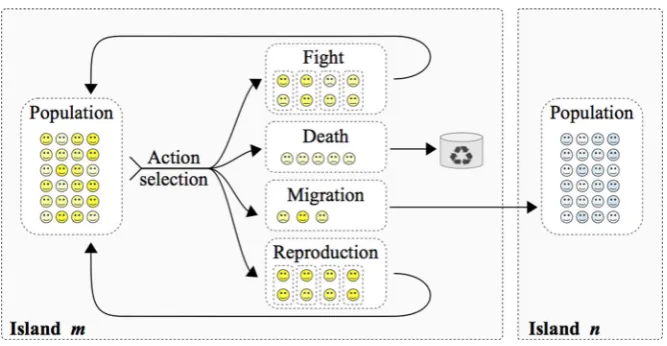
Fig. 1 The general structure of an evolutionary multi-agent system
machines, demonstrating that we can obtain very good performance improvements of up to a factor of 142 over the sequential implementations.
2 Evolutionary Multi-agent Systems and Parallel Skeletons
In Agent-oriented programming (AOP), the construction of the software is based on the concept of specialised, independent, autonomous softwareagents. There are many different agent-based programming frameworks, ranging from general-purpose ones, like RePast [25], MASON [23], MadKit [19], JADE [6] to more specialised ones, like ParadisEO [10] or AgE [26]. Some of these frameworks leverage existing multi-core architectures (e.g. ParadisEO). However, their scalability to larger systems has not been explored. In this paper, we focus on applications where agents useevolutionary algorithmsin their operation, most frequently for learning/reasoning or coordination of some group activity.
[image:3.439.53.387.53.226.2]to be decentralised. Using agent terminology, we can say that selective pressure is required to emerge from peer-to-peer interactions between agents instead of being globally-driven. In EMAS, emergent selective pressure is achieved by giving agents a single non-renewable resource called energy. Agents with high energy are more likely to reproduce whereas agents with low energy are more likely to die. The algorithm is designed to transfer energy from better to worse agents without central control.
In a basic EMAS implementation, every agent is provided with a real-valued vector representing a potential solution to the optimisation problem, along with the cor-responding fitness metric. Agents start with an initial amount of energy and meet randomly. If their energy is below a death threshold, they die. If it is above some reproduction threshold, they reproduce and yield new agents—the genotype of the children is derived from their parents using variation operators and some amount of energy is also inherited. If neither of these two conditions is met, agents fight in tournaments by comparing their fitness values. The better (winning) agents then sap energy from the worse (losing) ones [9]. The system as a whole isstable, since the total energy remains constant. However, the number of agents may vary in order to adapt to the difficulty of the problem—small numbers of agents with high energy or large numbers of agents with low energy, for example. The number of agents can also be altered dynamically by varying the total energy of the system. As in other evo-lutionary algorithms, agents can be split into separate populations, orislands. Such islands help preserve diversity by introducing allopatric speciation and can also exe-cute in parallel. Information is exchanged between islands through agent migrations. Evolutionary multi-agent systems have been formally shown to be a general opti-misation tool by constructing a detailed Markov-chain based model and proving its ergodicity [8].
2.1 Parallel Programming in Erlang
Erlang [3] is a strict, impure, functional programming language with built-in support for concurrency. It supports alightweight threading model, whereprocesses model small units of computation. The scheduling of processes is handled automatically by the Erlang Virtual Machine, which also provides basic load balancing mechanisms. A key aspect of the Erlang design is ashared-nothingapproach, in which processes do not implicitly share state—all data is communicated via channels, using explicitsendand
receiveprimitives. It has proven to be an efficient tool for building large-scale systems for multi-core processors. Erlang is widely used in the telecommunications industry, but is also beginning to be used more widely for high-reliability/highly-concurrent systems, e.g. databases [27], AOLs Market-place by Adtech [31], and WhatsApp [28]. Most of the industrial applications written in Erlang are deployed on systems with up to 24 CPU cores. Scalability of solutions is usually provided by using clusters of multicores and running Erlang in distributed configuration.
high number of cores and schedulers. The problem of Erlang Term Storage scalability on a computer with 32 physical cores have been considered in [29]. Promising results of using Erlang on a Intel Xeon Phi co-processor have been shown in [32]. Basic benchmarks show good scalability up to 60 cores, which is the number of physical cores of the co-processor. However, there are hardly any reports on scaling complex, computationally intensive Erlang applications on many-core architectures.
Our main motivation for using Erlang for evolutionary computations is to achieve scalability. While the performance on single-core machines of Erlang is still behind more mature and established languages, like C and C++, it is designed to be easily and transparently scalable across distributed systems. In the era of many-core architectures, the ability of scaling the performance with the growing number of cores/nodes will become far more important than the effectiveness of single core utilisation.
2.2 Algorithmic Skeletons
Algorithmic skeletonsabstract commonly-used patterns of parallel computation, com-munication, and interaction [13] into parameterised templates. For example, we might define aparallel map skeleton, whose functionality is identical to a standardmap
function, but which creates a number of Erlangworker processes to execute each element of the map in parallel. Using a skeleton approach allows the programmer to adopt a top-downstructuredapproach to parallel programming, where skeletons are composed to give the overall parallel structure of the program. Details such as communication, task creation, task or data migration and scheduling are embedded within the skeleton implementation, which may be tailored to a specific architecture or class of architectures. This offers an improved level of portability over typical low-level approaches. A recent survey of algorithmic skeleton approaches can be found in [18].
2.3 TheSkelLibrary for Erlang
In our previous work, we have developed theSkel [7,20] library, which defines a small set of classical skeletons for Erlang. Each skeleton operates over a stream of input values, producing a corresponding stream of results. Skel also allows simple composition of skeletons. Skel supports the following skeletons:
– funcis a simple wrapper skeleton that encapsulates a sequential function as a streaming skeleton.
– pipemodels a composition of skeletonss1,s2, . . . ,sn over a stream of inputs. Within the pipeline, each of thesi is applied in parallel to the result of thesi−1. – farmmodels the application of the same operation over a stream of inputs. Each
of thenfarmworkersis a skeleton that operates in parallel over independent values of the input stream.
– feedbackwraps a skeletons, feeding the results of applyings back as new inputs tos, provided they match a filter function, f.
3 A New Skeleton for Evolutionary Multi-agent Systems
At the base of our skeleton for Evolutionary Multi-Agent Systems is a skeleton for Multi-Agent Systems (MAS). Pseudocode for sequential implementation of the MAS system is given in Algorithm1, where function with names prepended byEnvare specific for each instance of the skeleton.
Algorithm 1Pseudocode for Multi Agent System (MAS) skeleton
fori in [1..nr_islands]do
forj in [1..nr_agents_per_island]do newagent[j] = Env:initialise_agent() add agent[j] to island[i]
end for end for
whilenot finished()do for allI∈Islandsdo
for allagent∈Ido
ifrand()<migration_probabilitythen
agent.behaviour = migration
else
agent.behaviour = Env:behaviour_function(agent, Env)
end if end for
Emigrants = collect_emigrants(I) Env:migration_function(I, Env) I = I∪Emigrants
end for end while
In this skeleton, a number of agents is created and divided into islands. In each iteration of the algorithm, each agent either migrates to another island or performs a behaviour function. This decision is based on some predefined probability (migra-tion_probability). After all the agents decide which of these two functions to perform, a migration function is performed on groups of agents that end up in the same island. EMAS skeleton is a specialisation of the MAS skeleton, with particular versions of initialisation, behaviour and migration functions. The behaviour of this skeleton was explained in Sect.2. The pseudocode for the sequential EMAS skeleton is given in Algorithm2. Functions with names prepended withProbare specific to each problem that is solved using the skeleton. Therefore, the EMAS skeleton accepts two types of input:
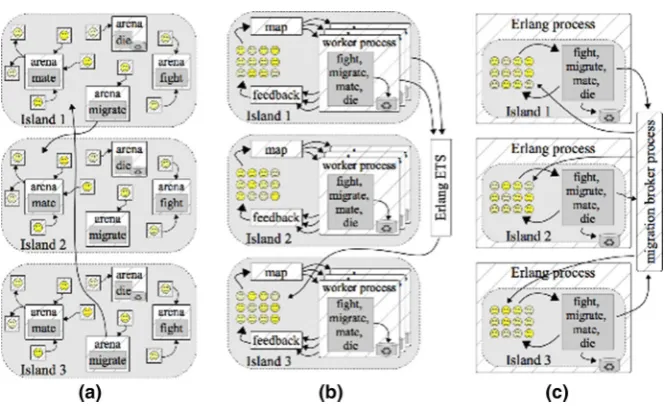
Fig. 2 Three versions of EMAS in Erlang:athe concurrent version with each solution represented by autonomous process;bthe skel version with configurable number of concurrent workers;cthe hybrid version with sequential islands computed concurrently
– problem-specific solution, evaluation, mutation and recombinationfunctions.
We have implemented three different versions of the skeleton, which differ in the precise way in which agents are captured by Erlang processes:
a. The Concurrent version(Fig.2a), where each agent is represented by a separate Erlang process. The agents use dedicated arena processes to trigger the behaviour, mutation and recombination functions. This is a fine-grained implementation of the EMAS computation, where we potentially have a very large number of very small Erlang processes;
b. The Skel version(Fig.2b), which uses thefeedbackparallel pattern from the Skel pattern library (described in Sect.2.3). Here, we set a fixed number of Erlang processes that will be created (usually matching the number of OS threads that we want to use) and then distribute agents from a population to these worker processes. When one generation finishes computing, the resulting new population is merged by the feedback process. Separate Erlang processes are created to handle the fighting, migration, reproduction and dying parts of the computation. c. The Hybrid version(Fig.2c), which represents an optimised version of theSkel
[image:7.439.53.388.51.254.2]Algorithm 2Pseudocode for specialisation of MAS skeleton into EMAS skeleton
functioninitialise_agent
Prob:solve()
end function
functionbehaviour_function(ReprodThr,Energy)
ifEnergy == 0then returndeath
else ifEnergy>ReprodThrthen returnreproduction
else returnfight
end if end function
functionmeeting_function(Agents, Behaviour, Env)
ifBehaviour == deaththen return[]
else ifBehaviour == reproductionthendo_reproduction(Agents, Env)
else ifBehaviour == fightthendo_fight(Agents, Env)
end if end function
functiondo_fight(Agents) Agents={{Agent1, Ev1, En1},{Agent2, Ev2, En2}}
ifEv1>Ev2thenTransferEng = En2
else TransferEng = En1
end if
return{{Agent1, Ev1, En1 + TransferEng}, {Agent2, Ev2, En2 - TransferEnf}}
end function
functiondo_reproduction(Agents)
ifAgents={{Agent1, Ev1, En1}}then
NewAgent = reproduction(Agent1) NewEval = Prob:evaluation(Agent1) TransEng = min(reproduction_transfer, En1)
return[{Agent1, Ev1, En1 - TransEn},{NewAgent, NewEval, TransEn}]
else ifAgents={Agent1, Agent2}then
[NewAg1, NewAg2] = reproduction(Agent1,Agent2) [NewEv1, NewEv2] = Prob:evaluation(Agent1, Agent2) Transfer energy from old to new agents
return[Agent1, Agent2, NewAg1, NewAg2]
end if end function
functionreproduction(Agents)
ifAgents={Agent}then
ifrand()<mutation_chancethenProb:mutation(Agent)
else returnAgent
end if
else ifAgents={ {Agent1, Agent2} }then ifrand()<recombination_chancethen
[R1,R2] = Prob:recombination(Agent1, Agent2)
else [R1,R2] = [Agent1, Agent2]
end if
...Probabilistic mutation of Agent1 and Agent2, similarly to above...
Fig. 3 Example of the use of the EMAS skeleton (traffic)
Since it is most coarse-grained and has the least synchronisation between processes, we expectHybridto give the best performance of these three versions.
3.1 Use of the EMAS Skeleton
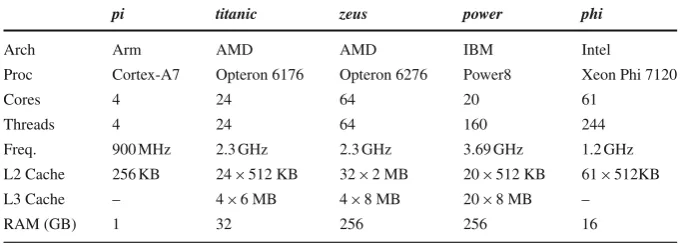
Table 1 Experimental platforms
pi titanic zeus power phi
Arch Arm AMD AMD IBM Intel
Proc Cortex-A7 Opteron 6176 Opteron 6276 Power8 Xeon Phi 7120
Cores 4 24 64 20 61
Threads 4 24 64 160 244
Freq. 900 MHz 2.3 GHz 2.3 GHz 3.69 GHz 1.2 GHz
L2 Cache 256 KB 24×512 KB 32×2 MB 20×512 KB 61×512KB
L3 Cache – 4×6 MB 4×8 MB 20×8 MB –
RAM (GB) 1 32 256 256 16
4 Evaluation
We have evaluated the performance of our EMAS skeleton on two different optimisa-tion examples that typify agent-based evoluoptimisa-tionary computaoptimisa-tions:
1. Finding the minimum of the Rastrigin function, a popular global optimisation benchmark [15];
2. A complex problem of urban traffic optimisation, a multi-variant simulation [21] that is applied to the mobile robotics domain. Our model anticipates possible situations on the road, preparing plans to deal with certain situations and apply these plans when certain traffic conditions arise.
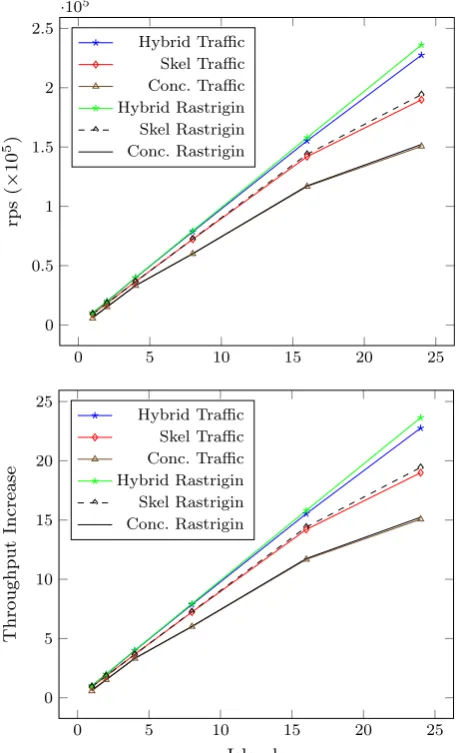
Fig. 4 Reproductions per second (rps,above) and throughput increase (below) for traffic and rastrigin on titanic
4.1titanicResults
The titanicsystem is an example of a medium-scale parallel server, with 24 cores and 32 GB of RAM. Figure4 shows the number of reproductions per second (rps) and the increases in throughput for Traffic and Rastrigin on this machine. For both applications, we observe that the Hybrid version achieves almost linear increases in throughput (and, therefore, performance). For Rastrigin, the Hybrid version achieves 236,140rpson 24 cores versus 10,038rpson one core, yielding 23.52×the throughput (or 23.64×the base sequential throughput). For Traffic, the Hybrid version ontitanic
[image:11.439.105.335.58.435.2]the throughput (or 22.76× the base sequential throughput of 9996rps). The Skel and Concurrent versions initially also perform well, but start to tail off after about 16 cores (islands) for both applications. This is consistent with other applications we have run on this machine, and is probably due to cache contention. Although the Hybrid version is always best, the untuned Skel version always performs better than the Concurrent version. This shows the benefit of reducing the number of Erlang processes by grouping the computations that multiple agents perform into a single process.
4.2zeusResults
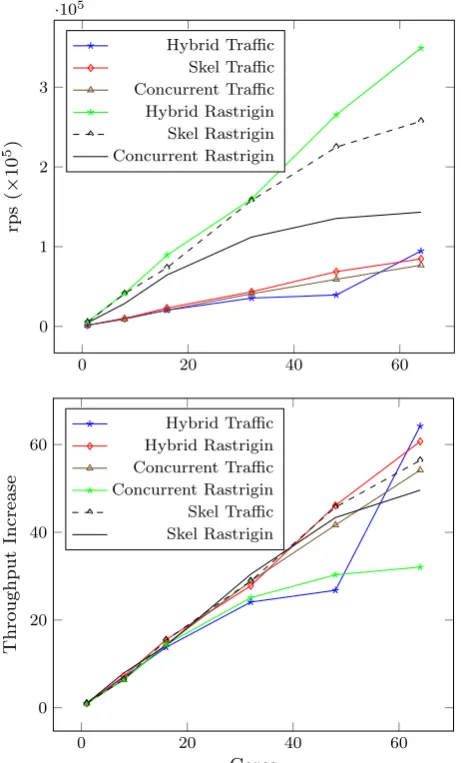
Thezeussystem is an example of a larger-scale multicore system, with 64 cores and 256 GB of RAM. Figure5shows therpsand corresponding throughput increase for all the tested versions. Here, Rastrigin achieves 349,226rpson 64 cores versus 5752
rpson one core, for a throughput increase of 60.71×the sequential version. Traffic achieves 94,950rpson 64 cores versus 1473rpson one core, for a throughput increase of 64×the sequential version. There is clearly a tail-off in throughput increase for Traffic at 32 and 48 cores, but further experiments are required to explain the reasons for this, given the clear improvement with 64 cores. A slight dip can also be observed for Rastrigin at 32 cores (27.8×throughput increase), but this has recovered at 48 cores (46.13×throughput increase). In comparison withtitanic, the raw performance per core is lower for both applications (despite a nominally similar processor architecture), butzeusdelivers higher total throughput.
4.3phiResults
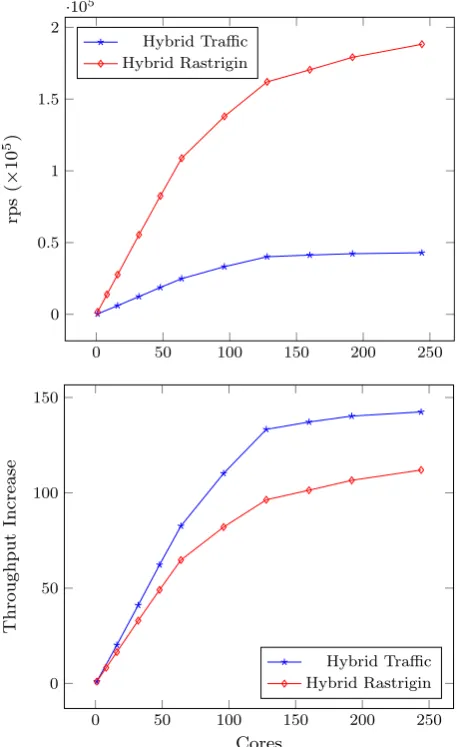
Our motivation for considering the phisystem was to evaluate the performance of our skeletons (and, generally, of the Erlang runtime system) on a many-core acceler-ator. We have therefore focused on using just the accelerator, without also using the multi-core host system. Figure6shows the reproductions per second and throughput increase for the Hybrid version of the two use cases. We were unfortunately unable to run experiments with the Concurrent and Skel versions on the Xeon Phi as detailed adaptation of the Concurrent and Skel code for Xeon Phi was required, and we wanted to retain code compatibility among the significant number of different processors we used during the experiments. This is left as an area of future work. Note that the system has 61 physical cores, but can run 244 simultaneous threads via 4 way hyper-threading. Due to the sharing of resources between multiple threads, we do not expect to see 244 times increase in throughput on this architecture. Indeed, we can clearly see that the performance improvement decreases above 61 cores and tails off when more than 122 threads are used. Even so, we were able to achieve very good results, improving per-formance more than 100 times (compared to the sequential version) when 244 threads were used for both applications, and achieving excellent improvements up to 61 cores for both applications. Here, Rastrigin achieves 188,240rpson 244 cores versus 1681
Fig. 5 Reproductions per second (rps,above) and throughput increase (below) for traffic and rastrigin on zeus
achieves 42,902rpson 244 cores versus 302rpson one core, for a throughput increase of 142.44×the sequential version.
[image:13.439.105.336.56.438.2]Fig. 6 Reproductions per second (rps,above) and throughput increase (below) for traffic and rastrigin on phi
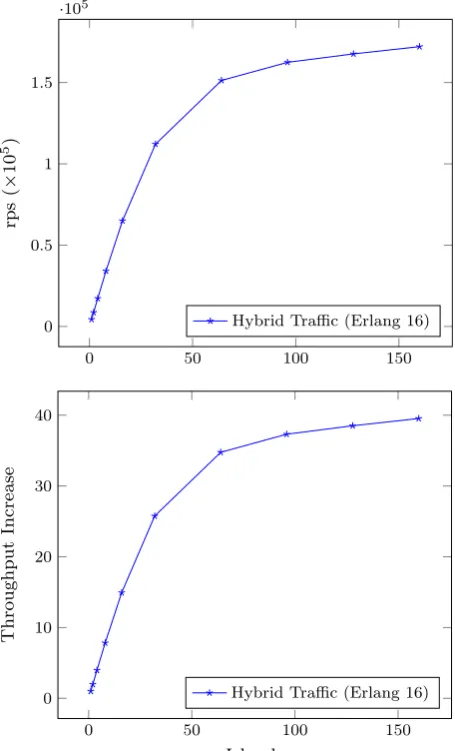
4.4 PreliminarypowerResults
[image:14.439.105.336.58.432.2]Fig. 7 Reproductions per second (rps,above) and throughput increase (below) for traffic onpower(Erlang 16)
[image:15.439.106.334.57.433.2]Fig. 8 Reproductions per second (rps,above) and throughput increase (below) for traffic and rastrigin on pi
4.5piResults
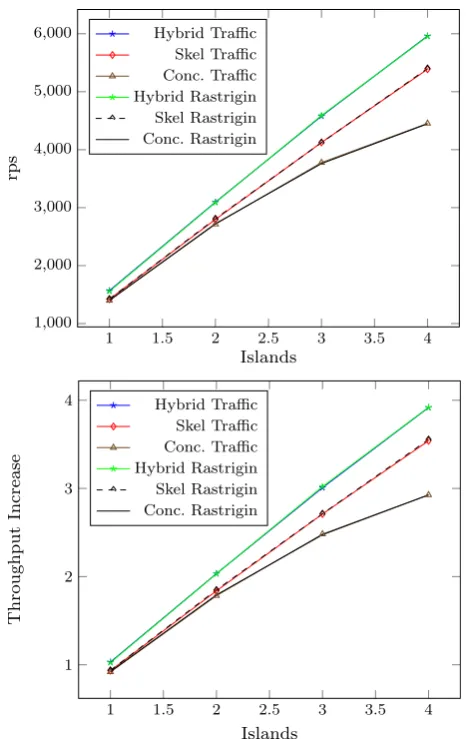
Thepisystem is a quad-core Raspberry Pi 2, model B. We have chosen it as an exam-ple of a low-power parallel architecture, that is intended to be used in e.g. high-end embedded systems. While we expect the absolute performance of this system to be significantly lower than the other, heavyweight, parallel systems we have studied, it is still interesting to in evaluating how well our skeletons perform on such a system. Figure8shows the results forpi. We have considered all three versions of the EMAS skeleton. As fortitanic, the Hybrid version gives the best performance, and theSkel
version outperforms theConcurrentversion. For Traffic, the Hybrid version ontitanic
[image:16.439.102.338.52.422.2]through-put. For Rastrigin, the Hybrid version achieves almost identical results of 5954rpson 4 cores versus 1556rpson one core, also yielding 3.92×the throughput. We observe similar results for the other two versions: with throughput improvements of 3.54/3.54 for the Skel version on Traffic/Rastrigin (5387/5401rps), and 2.93 for the Concur-rent version (4453/4447rps). Although, as expected, the absolute peak performance (about 6000 reproductions per second) was orders of magnitude weaker than on other systems; however, it is worth noting that Pi power consumption is just a fraction of these of heavyweight servers, so it gives the best performance-per-watt ratio of all systems we tested.
5 Related Work
Algorithmic skeletons [13] have been the focus of much research since the 1980s, with a number of skeleton libraries being produced in a range of languages [1,18]. These include our own Skel library [7], which is currently the only available skeleton library for Erlang. A recent alternative approach is to define an embedded domain-specific lan-guage (EDSL) [12,22], This can provide a structured approach to parallelism, similar to our approach using skeletons. Skeletons, however, have the advantage of represent-inglanguage-independentpatterns of parallelism, that can more easily be transferred to other language settings. Other high-level approaches that hide the low-level parallel mechanics from the programmer include: futures [16], evaluation strategies [30], and parallel monads [24].
There have been a few attempts to parallelise agent systems. For example Al-Jaroodiet al.have presented an implementation of a Java-based agent-oriented system, achieving linear scalability up to 8 cores [2], and Cicirelli and Nigri have achieved similar scale-up in a system that is aimed at simulation [11]. Cosenzaet al.describe an implementation of a C++/MPI scalable simulation platform for spatial simulations of particle movement, achieving linear scalability up to 64 cores [14]. Finally, Cahon
et al. have achieved linear speedup on up to 10 cores for a C++ implementation of ParadisEO [10]. All of these systems were tested on either small scale parallel systems, or are tailored to a specific evolutionary computing application. In contrast, our skeleton is sufficiently general to cover a wide class of evolutionary computing applications, and we have also demonstrated its scalability on systems with up to 244 hardware threads, achieving maximum throughput improvements of up to 142.44× the sequential version.
6 Conclusions and Future Work
porta-bility. We have developed three different versions of the skeleton—the Concurrent
version that is based on Erlang processes, theSkelversion that is based on the Skel library of parallel skeletons, and theHybrid tuned version of the Skelversion. We evaluated these different versions of the skeleton on two different evolutionary com-puting applications: (1) finding the minimum of the Rastrigin function; and (2) an urban traffic optimisation. These applications come from different domains and were adapted to use the same skeleton. We have achieved very good improvements in per-formance on a number of different architectures, ranging from small-scale low-power multi-core systems (a quad-core Raspberry Pi) to larger multi-core servers (a 64-core AMD Opteron) and a many-core accelerator (Intel Xeon Phi) with very little coding effort. This showed the scalability and adaptability of our skeleton implementation in a number of different deployment settings. As expected, the best implementation was consistently the Hybrid version. Our results show that we can achieve throughput improvements for this version of up to a factor of 142.44 compared to the sequential version (for the Xeon Phi), with near-linear improvements on the servers and Rasp-berry Pi. Overall, the 64-core multi-core system (zeus) gave the best result for Rastrigin (349,226rps). However, rather surprisingly, the 24-core server (titanic) achieves the best result for Traffic (227,509rpsvs. 94,950rps). Given their pricing relative to the other architectures, the results for the Xeon Phi and Raspberry Pi are very creditable. Although the OpenPower results are a little disappointing in absolute terms, this is largely because an older version of Erlang was used. If the newest version of Erlang was available, we would expect this architecture to deliver the best absolute results. Finally, we had not expected the architectures to have such widely varying perfor-mance. The fact that our skeletons (notably the Hybrid version) dealt well and, on the whole, predictably with all of these architectures is a positive result.
Our main line of future work is to adapt our skeleton to distributed-memory sys-tems, so allowing further scaling to supercomputers. This would, however, require significant reengineering of the skeleton. We also plan to consider more complex real-life applications that conform to the skeleton, to investigate the anomalies that we have observed on e.g. thezeusandphisystems, and to retry the results for thepower
system once Erlang 18 is available.
Open Access This article is distributed under the terms of the Creative Commons Attribution 4.0 Interna-tional License (http://creativecommons.org/licenses/by/4.0/), which permits unrestricted use, distribution, and reproduction in any medium, provided you give appropriate credit to the original author(s) and the source, provide a link to the Creative Commons license, and indicate if changes were made.
References
1. Aldinucci, M., Campa, S., Danelutto, M., Kilpatrick, P., Torquati, M.: Pool evolution: a parallel pattern for evolutionary and symbolic computing. IJPP44(3), 531–551 (2016)
2. Al-Jaroodi, J., Mohamed, N., Jiang, H., Swanson, D.: Agent-based parallel computing in java proof of concept. Technical Report TR-UNL-CSE-2001-1004, University of Nebraska—Lincoln (2001) 3. Armstrong, J., Virding, S., Williams, M.: Concurrent Programming in Erlang. Prentice-Hall,
4. Aronis, S., Papaspyrou, N., Roukounaki, K., Sagonas, K., Tsiouris, Y., Venetis, I.E.: A scalability benchmark suite for Erlang/OTP. In: Proceedings of the Erlang Workshop, ACM, Erlang ’12, pp. 33–42 (2012)
5. Back, T.: Selective pressure in evolutionary algorithms: a characterization of selection mechanisms. In: Proceedings of the WCCI, IEEE, vol. 1, pp. 57–62 (1994)
6. Bellifemine, F., Poggi, A., Rimassa, G.: Jade: a FIPA2000 compliant agent development environment. In: Proceedings of the Agents ’01, pp. 216–217 (2001)
7. Brown, C., Danelutto, M., Hammond, K., Kilpatrick, P., Elliott, A.: Cost-directed refactoring for parallel Erlang programs. IJPP42(4), 564–582 (2014)
8. Byrski, A., Schaefer, R., Smołka, M.: Asymptotic guarantee of success for multi-agent memetic sys-tems. Bull. Polish Acad. Sci. Tech. Sci.61(1), 257–278 (2013)
9. Byrski, A., Drezewski, R., Siwik, L., Kisiel-Dorohinicki, M.: Evolutionary multi-agent systems. Knowl. Eng. Rev.30, 171–186 (2015)
10. Cahon, S., Melab, N., Talbi, E.: Paradiseo: a framework for the reusable design of parallel and dis-tributed metaheuristics. J. Heuristics10(3), 357–380 (2004)
11. Cicirelli, F., Nigro, L.: An agent framework for high performance simulations over multi-core clusters. In: Proceedings of the AsiaSim 2013, Springer, pp. 49–60 (2013)
12. Claessen, K., Sheeran, M., Svensson, B.J.: Expressive array constructs in an embedded GPU kernel programming language. In: Proceedings of the DAMP, pp. 21–30 (2012)
13. Cole, M.: Bringing skeletons out of the closet: a pragmatic manifesto for skeletal parallel programming. Elsevier30, 389–406 (2004)
14. Cosenza, B., Cordasco, G., De Chiara, R., Scarano, V.: Distributed load balancing for parallel agent-based simulations. In: Proceedings of PDP 2011, pp. 62–69 (2011)
15. Digalakis, J., Margaritis, K.: An experimental study of benchmarking functions for evolutionary algo-rithms. Int. J. Comput. Math.79(4), 403–416 (2002)
16. Fluet, M., Rainey, M., Reppy, J., Shaw, A., Xiao, Y.: Manticore: a heterogeneous parallel language. In: Proceedings of DAMP ’07, ACM, pp. 37–44 (2007)
17. Fogel, D.B.: What is evolutionary computation? IEEE Spectr.37(2), 26, 28–32 (2000)
18. González-Vélez, H., Leyton, M.: A survey of algorithmic skeleton frameworks: high-level structured parallel programming enablers. Softw. Pract. Exp.40(12), 1135–1160 (2010)
19. Gutknecht, O., Ferber, J.: Madkit: a generic multi-agent platform. In: Proceedings of AGENTS ’00, pp. 78–79 (2000)
20. Janjic, V., Brown, C., Hammond, K.: Lapedo: Hybrid skeletons for programming heterogeneous mul-ticore machines in Erlang. In: Proceedings of ParCo 2015, IOS Press (2015)
21. Krzywicki, D., et al.: Massively concurrent agent-based evolutionary computing. J. Comput. Sci.11, 153–162 (2015)
22. Lee, H.J., et al.: Implementing domain-specific languages for heterogeneous parallel computing. Micro IEEE31(5), 42–53 (2011)
23. Luke, S., Cioffi-Revilla, C., Panait, L., Sullivan, K., Balan, G.: MASON: a multiagent simulation environment. Simulation81(7), 517–527 (2005)
24. Marlow, S., Newton, R., Peyton Jones, S.: A monad for deterministic parallelism. In: Proceedings of Haskell ’11, pp. 71–82 (2011)
25. North, M., Collier, N., Ozik, J., Tatara, E., Macal, C., Bragen, M., Sydelko, P.: Complex adaptive systems modeling with repast simphony. Complex Adapt. Syst. Model.1(1), 3 (2013)
26. Pie˛tak, K., Kisiel-Dorohinicki, M.: Transactions on computational collective intelligence X, springer, chap agent-based framework facilitating component-based implementation of distributed computa-tional intelligence systems (2013)
27. Rashkovskii, Y.: Genomu: a concurrency-oriented database. In: Erlang Factory SF 2013 (2013) 28. Reed, R.: Scaling to millions of simultaneous connections. In: Erlang Factory SF (2012)
29. Sagonas, K., Winblad, K.: More scalable ordered set for ETS using adaptation. In: Proceedings of Erlang Workshop, Erlang ’14 (2014)
30. Trinder, P.W., Hammond, K., Loidl, H.W., Peyton Jones, S.L.: Algorithm+strategy=parallelism. J. Funct. Program.8(1), 23–60 (1998)
31. Wilson, K.: Migrating a C++ team to using Erlang to deliver a real-time bidding ad system. In: Erlang Factory SF (2012)