Drift Mobility, Diffusion Coefficient of Randomly Moving
Charge Carriers in Metals and Other Materials with
Degenerated Electron Gas
Vilius Palenskis
Physics Faculty, Vilnius University, Vilnius, Lithuania. Email: [email protected]
Received October 25th, 2012; revised December 5th, 2012; accepted December 21st, 2012
ABSTRACT
In this short review some aspects of applications of free electron theory on the ground of the Fermi statistics will be analyzed. There it is an intention to attempt somebody’s attention to problems in widespread literature of interpretation of conductivity of metals, superconductor in the normal state and semiconductors with degenerated electron gas. In lite- rature there are many cases when to these materials the classical statistics is applied. It is well known that the electron heat capacity and thermal noise (and as a consequence the electrical conductivity) are determined by randomly moving electrons, which energy is close to the Fermi energy level, and the other part of electrons, which energy is well below the Fermi level can not be scattered and change its energy. Therefore there was tried as simple as possible on the ground of Fermi distribution, and on random motion of charge carriers, and on the well known experimental results to take general expressions for various kinetic parameters which are applicable for materials both without and with degenerated electron gas. It is shown, that drift mobility of randomly moving charge carriers, depending on the degree degeneracy, can considerably exceed the Hall mobility. Also it is shown that the Einstein relation between the diffusion coefficient and the drift mobility of charge carriers is valid even in the case of degeneracy. There also will be presented the main kinetic parameter values for different metals.
Keywords: Conductivity; Thermal Noise; Diffusion Coefficient; Drift Mobility; Hall Mobility
1. Introduction
In this review it is an attempt to call somebody’s atten- tion to some problems of conductivity interpretation of metals, normal superconductors and semiconductors with degenerated electron gas. Every experimenter knows that conductivity of homogeneous materials can be defined by free randomly moving charge carrier (electron) den- sity and by their drift mobility. They also know that elec- trons obey the Pauli principle and that electrons are de- scribed by the Fermi-Dirac statistics. The latter principles let to ones explain the experimental results of the heat capacity of electrons in metals [1-8]. The main conclu- sions of these investigations were that randomly move only the small part of electrons, which energy is close to the Fermi level, and that electrons, which energy is well below the Fermi level, can not be scattered and change their energy E because the Fermi distribution function
f(E) = 1. It is very strange that till now (during about 80 years) in many books [1-8] for solid state physics in ex- pression for conductivity of metals and for superconduc-
tors in the normal state [9-13] the total density of free electrons is included. On the other hand, it is well also known that the thermal noise due to random moving of electrons is completely described by the real part of conductance (Nyquist formula) [14,15]. Thus, electron heat capacity and thermal noise of metals unambiguously show that in all kinetic phenomena take place only that part of free electrons, which energy is close to the Fermi level, because only these electrons can change their en-ergy under influence of external fields. There are many questions: how from measurement of the Hall effect of metals we can get the total density of free electrons, how find the density neff of randomly moving electrons, their
diffusion coefficient D and drift mobility drift, the Fermi energy EF, velocity of electrons vF at the Fermi level, the
2. Presentation Details and Analysis
2.1. The Diffusion Coefficient of RandomlyMoving Charge Carriers and the Einstein Relation
It is well known that Fermi distribution function for elec- trons reads as
1
1 exp
f E
E k
T , (1)
where E is the electron energy, is the chemical poten-tial, k is the Boltzmann’s constant, and T is the absolute temperature. This function means the probability that energy E level is occupied by electron.
The total density of valence (free) electrons n in con- duction band is
0
d ,
n g E f E E
(2)where g(E) is the density of states in the conduction band.
The conductivity and the diffusion coefficient D of charge carriers are related by the following expression [16]
2
T
n e D
. (3) By simple calculation of the derivative n on parameter (chemical potential) μ we have
1 2
0 2
2 0
1 exp
d
exp
d . 1 exp
E kT
e D g E E
E kT
e D g E E
kT E kT
(4)
On the other hand, it can be shown that the expression in the angle brackets can be replaced by
21
1 1 1
1 exp 1 exp
exp 1 exp
f E f E
E kT E kT
E kT
E kT
. (5)
Thus, the Equation (4), accounting Equation (5), can be presented in the following form
2
eff 0
1 d
e D e D2
g E f E f E E n
kT kT
dE
, (6)
where
eff 0
1
n g E f E f E
. (7)This expression in comparison to Equation (2) can be
named as effective density of randomly moving charge
carriers. The Equation (6) unambiguously shows that
conductivity in all cases is determined by the effective density of randomly moving charge carriers (Equation (7)), but not by the total free electron density in the con-duction band (Equation (2)). The total free electron den-sity for determination of conductivity can be used only for materials with non-degenerated electron gas.
Thus, the conductivity (Equation (6)) can also be pre- sented as
2 eff drift eff
e D
en n
kT
, (8)
where drift is the drift mobility of randomly moving
charge carriers in homogeneous materials with one type of charge carriers (electrons or holes). From this general relationship (Equation (8)) we get the Einstein’s relation
drift
D kT
e
. (9)
This expression is true for both degenerated and non- degenerated homogeneous materials with one type of free randomly moving charge carriers (for electrons or for holes). The same conclusion also follows from the thermal noise investigations. The spectral density of the current fluctuations of the thermal noise at low frequen- cies f 1 2
π
, here τ is the relaxation time of charge carriers) can be presented as [14,17,18]2
0 e
1
4 4 4
i ff
A A
S kT kT e n D
R L
L , (10)
where R is the resistance of the sample of the test mate- rial; A and L are respectively the cross-section and the length of the sample. This relation is right for all homo- geneous materials at equilibrium state. The equalities of Equation (10) also can be obtained from the general Kubo formula for conductivity [2,15]
0
1 0 d
x j tx jx t
kT
, (11)i.e. in general the conductivity is defined by the correla- tion function on time j tx
jx 0 of the current den- sity fluctuation due to random motion of charge carriers. Considering the Wiener-Khintchine theorem and the dis-placement x t
of charge carriers due to Brownian2.2. Effective Density of Randomly Moving Charge Carriers
From Equation (7) directly follows that effective density of randomly moving electrons neff and which causes the
conductivity depends not only on the density of states and Fermi function f E
that the energy level E is occupied by electron, but it also depends on the probabi- lity f E1
1 f E
that any of such electron can leave the occupied energy level at a given temperature.Usually for calculation different kinetic processes in materials instead of probability function
1
1
f E f E f E f E ones use the deriva-
tive of the Fermi distribution function
f
(here E kT) [2-6], but
1
f f E
kT f E f E
E
(12)
The probability function is more
understandable in the case of the interpretation of the effective density of randomly moving charge carriers (Equation (7)). Function
1
f E f E
f
means that only such electrons can be scattered and change its energy for which
f 0
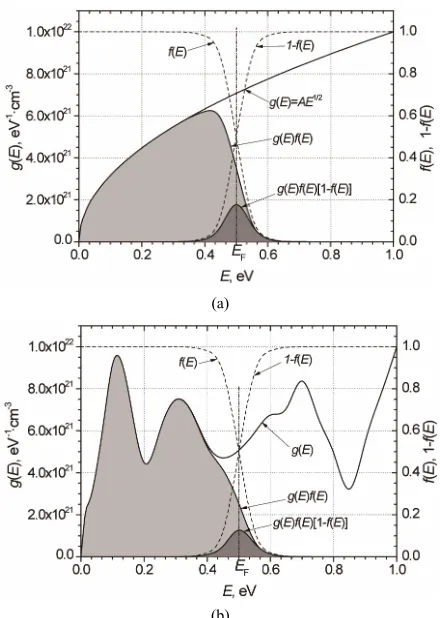
.Illustrations of Equations (1), (2) and (7) are presented in Figure 1. From this figure it is clearly seen that the
effective density of randomly moving electrons neff (7) is
many times smaller than the total density of free elec- trons n.
Now let ones to evaluate the Equation (7). For non-degenerated materials the probability
, because , and,
there-fore, all electrons in the conduction band n participate in the random motion and in the conduction process
1 1
f E f E 1
E
n
1f E
eff 0
d
n n g E f E
. (13)This is the case where the classical statistics is appli-cable.
In the case of high degeneracy and considering that
Equation (12) has a sharp maximum at the energy E
equal to the chemical potential , the Equation (7) can be written as
eff F
n g kTg E kT , (14) where g E
F g E
at EEF.The chemical potential and the Fermi energy EF are
related by the following relation [5]
2
1 π
1 3 2
F
F
kT E
E
,
(15)
and the difference between these quantities is only about
(a)
[image:3.595.313.533.91.400.2](b)
Figure 1. Illustration of density of states g(E) and functions
g E f E and g E f E
1 f E
dependency on energy for (a) metals with spherical Fermi surfaces
g E AE1 2
; (b) for metals and normal state supercon- ductors with composite density of states dependency on energy. The light grey area represents the total density of electrons n (Equation (2)) and the dark grey area represents the effective density of randomly moving electrons neff(Equation (7)). Additionally there are represented the Fermi functions f(E) and
1 f E
dependency on energy (dashed curves, right scale).0.01% even at room temperature. So, in many cases for calculation of different quantities ones use the Fermi distribution function in the following form
11 exp F
f E E E kT . (16)
The density of states at Fermi energy g E
F can be determined from of the experimental results of the elec-tron heat capacity [5,6]
2 2
2
eff
π π
3 3
V F
c T g E k T k n , (17) where
2
2 π
3 g E kF
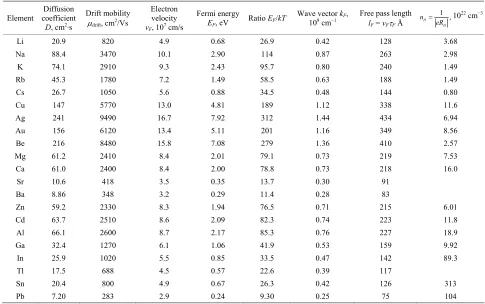
and Thus, on the ground of experimental results of the conductivity and the electron heat capacity we can evalu- ate the diffusion coefficient D (from Equation (21)) and drift mobility drift (from Equation (8) or (9)) for ran- domly moving charge carriers in materials with highly degenerated electron gas. The calculated results for dif- ferent metals at T = 295 K are presented in Table 2.
32 2π
F
g E
k
. (19)
Thus, for metals and other materials with high degen-erated electron gas
eff 2 2
3 3
π π
V F
c T
n g E kT
k k
, (20) The diffusion coefficient usually also is determined by
the average of square velocity of charge carriers and by their average relaxation time (for metals free pass time)
i.e. neff is proportional to temperature. Experimental re-
sults of conductivity and electron heat capacity and cal- culated effective density neff of randomly moving elec-
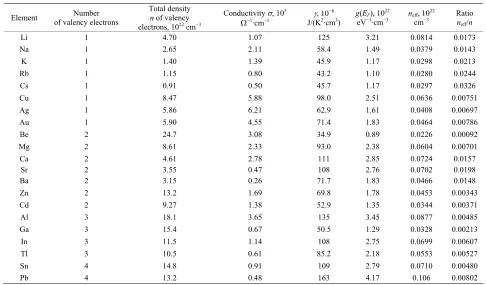
trons from the Equation (20) at T = 295 K for different metals are presented in Table 1. The ratio neff n obvi-
ously shows that neff amount in the total free electron
density n is about a few percents and smaller. From
Equation (20) it is seen that the effective density of ran- domly moving charge carriers neff is completely defined
quantity for materials with high degeneracy of electron gas and can be simply obtained from electron heat capa- city measurements.
2
1 3
D v . (22)
For highly degenerated electron gas
2
2 0
0
1 d
1 1
3 3
1 d
F F
g E v f E f E E
D v
g E f E f E E
, (23)
i.e. the diffusion coefficient is determined by the square velocity and free pass time of randomly moving charge carriers at the Fermi level. From the Equations (21) and (23) follows that conductivity
From Equations (8) and (20) for highly degenerated materials we obtain that diffusion coefficient of ran- domly moving electrons
2
F
D
e g E
. (21) 1 2
23e g E vF FF F
[image:4.595.54.540.441.726.2] . (24)
Table 1. Conductivity and heat capacity parameters of different metals.
Element of valency electrons Number
Total density
n of valency electrons, 1022 cm−3
Conductivity , 105
−1·cm−1 , 10
−6
J/(K2·cm3) g(EF), 10 22
eV−1·cm−3 neff, 10 22
cm−3 Ratio n eff/n
Li 1 4.70 1.07 125 3.21 0.0814 0.0173
Na 1 2.65 2.11 58.4 1.49 0.0379 0.0143
K 1 1.40 1.39 45.9 1.17 0.0298 0.0213
Rb 1 1.15 0.80 43.2 1.10 0.0280 0.0244
Cs 1 0.91 0.50 45.7 1.17 0.0297 0.0326
Cu 1 8.47 5.88 98.0 2.51 0.0636 0.00751
Ag 1 5.86 6.21 62.9 1.61 0.0408 0.00697
Au 1 5.90 4.55 71.4 1.83 0.0464 0.00786
Be 2 24.7 3.08 34.9 0.89 0.0226 0.00092
Mg 2 8.61 2.33 93.0 2.38 0.0604 0.00701
Ca 2 4.61 2.78 111 2.85 0.0724 0.0157
Sr 2 3.55 0.47 108 2.76 0.0702 0.0198
Ba 2 3.15 0.26 71.7 1.83 0.0466 0.0148
Zn 2 13.2 1.69 69.8 1.78 0.0453 0.00343
Cd 2 9.27 1.38 52.9 1.35 0.0344 0.00371
Al 3 18.1 3.65 135 3.45 0.0877 0.00485
Ga 3 15.4 0.67 50.5 1.29 0.0328 0.00213
In 3 11.5 1.14 108 2.75 0.0699 0.00607
Tl 3 10.5 0.61 85.2 2.18 0.0553 0.00527
Sn 4 14.8 0.91 109 2.79 0.0710 0.00480
Pb 4 13.2 0.48 163 4.17 0.106 0.00802
Table 2. Kinetic parameters of different metals.
Element
Diffusion coefficient
D, cm2·s
Drift mobility
drift, cm2/Vs
Electron velocity
vF, 107 cm/s
Fermi energy
EF, eV Ratio EF/kT
Wave vector kF, 108 cm−1
Free pass length
lF= vFF Å
1 , H
H n
eR
1022 cm−3
Li 20.9 820 4.9 0.68 26.9 0.42 128 3.68
Na 88.4 3470 10.1 2.90 114 0.87 263 2.98
K 74.1 2910 9.3 2.43 95.7 0.80 240 1.49
Rb 45.3 1780 7.2 1.49 58.5 0.63 188 1.49
Cs 26.7 1050 5.6 0.88 34.5 0.48 144 0.80
Cu 147 5770 13.0 4.81 189 1.12 338 11.6
Ag 241 9490 16.7 7.92 312 1.44 434 6.94
Au 156 6120 13.4 5.11 201 1.16 349 8.56
Be 216 8480 15.8 7.08 279 1.36 410 2.57
Mg 61.2 2410 8.4 2.01 79.1 0.73 219 7.53
Ca 61.0 2400 8.4 2.00 78.8 0.73 218 16.0
Sr 10.6 418 3.5 0.35 13.7 0.30 91
Ba 8.86 348 3.2 0.29 11.4 0.28 83
Zn 59.2 2330 8.3 1.94 76.5 0.71 215 6.01
Cd 63.7 2510 8.6 2.09 82.3 0.74 223 11.8
Al 66.1 2600 8.7 2.17 85.3 0.76 227 18.9
Ga 32.4 1270 6.1 1.06 41.9 0.53 159 9.92
In 25.9 1020 5.5 0.85 33.5 0.47 142 89.3
Tl 17.5 688 4.5 0.57 22.6 0.39 117
Sn 20.4 800 4.9 0.67 26.3 0.42 126 313
Pb 7.20 283 2.9 0.24 9.30 0.25 75 104
The data for calculation at T = 295 K were used from Table 1. The data of Tables 1 and 2 give the very clear view, why some of metal conductivity is larger than other one. For example, the effective density of randomly moving charge carriers neff of Pb is about two times larger than one of Au, but the conductivity
of Au is about ten times larger than that of Pb. It is because the Fermi energy of Au is about twenty times larger than that of Pb, and, as a consequence, the drift mobility of randomly moving charge carriers in Au is about twenty times higher than one in Pb.
This expression is well known for metals and is ob-tained by solving the kinetic equation [2,3].
The correctness of presented diffusion coefficient and drift mobility values in Table 2 also follows from the
electron heat conductivity for randomly moving elec-trons in metals [1-6]
2
2 2
2 2
eff
1 1
3 3
1 π π
3 3 3
V F F
F F F
lvc v T
v g E k T Dn
k
. (25)
From Equations (24) and (25) one obtains the well known Wiedemann-Franz law
2 2
π
3
k
T e
. (26)
The diffusion coefficient calculated from Equation (25) gives the same results as from Equation (21). In behalf that Einstein relation also is valid for metals shows this fact that Einstein relation for metals can be obtained from the Wiedemann-Franz law
2
2 2 2
eff
eff drift drift
π π π
3 3 3
Dn k k D k
T en T e T e
, (27)
and now
drift
D kT
e
.
2.3. Drift Mobility of Randomly Moving Charge Carriers and Conductivity of Homogeneous Materials with Highly Degenerated Electron Gas
From Equations (9) and (22) follows that drift mobility
2
drift 3 e v
kT
. (28)
Including into this relation the effective mass m* of
charge carriers the drift mobility can be presented in the following form
2
drift
1 2 3 2
m v e
kT m
or
drift
3 2
e W e
kT
m m
; (30)
where W
1 2 m v2 is the average kinetic energyof randomly moving charge carriers. Thus, the Equation (29) is the general relation for drift mobility of randomly moving charge carriers in homogeneous materials with one type of charge carriers (electrons or holes). This rela- tion is true for degenerated and for non-degenerated ma- terials, including metals. The Equation (28) shows that drift mobility of randomly moving electrons in materials is proportional to the square of the electron random ve- locity, i.e. the electrons with high random velocity con- tribution into conductivity is larger than that of slow electrons. The factor
3 2 WkT
(31)
shows, how many times the mean kinetic energy W
of randomly moving charge carriers is larger than
3 2 kT. For non-degenerated material 1 anddrift
e m
, (32)
but for highly degenerated semiconductors, metals and superconductors in the normal state
2 1
3
F
E kT
, (33)
i.e. the drift mobility (Equation (30)) of random moving charge carriers in metals at room temperature in many cases is about a hundred times larger (see the ratio
F
E kT values in Table 2) than it follows from the
clas-sical Equation (32).
From the Equation (29) follows that the drift velocity
drift of electrons in the electric field E can be presented
as v
2
drift drift
1 2 3 2
m v e
v E
m kT
E. (34)
A very important behavior of electrons in materials follows from this expression: the drift velocity of elec-trons in the electric field E is proportional to the square velocity of randomly moving electrons. This result in principle can not be explained by application of New-ton’s law for calculation of acceleration of electrons in the electric field E in materials.
From the Equations (8) and (30) follows that the gen-eral expression for conductivity
eff drift eff
3 2
e W
en en
kT m
. (35)
For non-degenerated material ( 1 and neff n)
e en
m
(36)
but for highly degenerated semiconductors and metals
neff g E kTF
2
eff
1
3 2 3
F 2
F F F
e E
en e g E v
kT m
. (37)
2.4. Hall Mobility and Its Comparison with the Drift Mobility
Now compare the obtained drift mobility results with that from the Hall effect measurements. On the ground of the Hall effect for highly degenerated materials the Hall mo-bility [20]
2
2 ,
yH F
H H
Ε e e e
r
Ε B m m
m
x
(38)
where EyH is the Hall electric field strength in y
direc-tion perpendicular to the current flow direcdirec-tion; Ex is
the applied external electric field strength in x direction; is the Hall factor, which depends on charge car-rier scattering mechanism, but for high degenerated charge carriers
1
H
r
1
H
r . From Equation (37) it is seen that Hall mobility is determined by average relaxation time of electrons at Fermi level.
According to investigations in the work [21], for all homogeneous metals and highly degenerated semicon-ductors the charge carrier relaxation time at Fermi level at room temperature is general and equal
F kT
; (39) where h2π is the Plank constant. At T = 295 K
. So, at T = 295 K for m* = m
0
14 2.6 10 s
F
2 H 46cm Vs
, while the drift mobility depends also
on the kinetic energy of the random moving charge car-riers. Now from Equation (23) or from Equation (24) it is possible to find the electron velocity vF at the Fermi level
and the Fermi energy EF considering that the effective
mass m* of electron is equal to the free electron mass m 0, i.e. 2
0 2
F F
E m v . The calculation results for different
metals are presented in Table 2. In this table for different
metals there also are presented the free pass length of electron lF vF F , the latter obtained values are close
to experimental data [22].
Usually for evaluation of the Fermi energy it is con-sidered that Fermi surface is spherical, i.e. [5,15]
3 2π
2g E m m
E (40)
2
2
2 32 3π
F
E m n
. (41)
But for many metals and superconductors in normal state the density of states has composite view (Figure 1(b)), and there is no definite relation between the total
density of charge carriers n and the Fermi energy EF. So,
as it was mentioned above in order to evaluate the Fermi energy the sure way is from Equation (24) to find the electron velocity at the Fermi level vF and than the Fermi
energy EF.
The obtained mobility results clearly show that for high degenerated materials the drift mobility can tens or hundred times be larger than the Hall mobility.
From Equations (37) and (38) the conductivity and Hall mobility for metals are related with the following expression
eff
2 3
F H
E en
kT
. (42)
Thus, the charge carrier density in highly degenerated materials, determined by using the Hall mobility
eff eff
2 3
F H
H
E
n n n
e kT
n. (43)
The charge carrier density nH obtained from Hall effect
measurements only in particular cases is equal to the total free charge density for metals with spherical Fermi sur-faces, but even in these cases the factor
character-izes not the charge density, but the drift mobility. For multivalent metals and superconductors in the normal state with composite density of states dependency on energy there is no definite relation between n and nH.
Equation (14) shows that the randomly moving charge carrier density eff in high degenerated materials is not
constant but is proportional to the temperature and the relaxation time close to room temperature
n
~ 1
F T
, so
in this temperature range the Hall mobility H ~ 1T ,
while the drift mobility 2
drift ~ 1T
. Hence, one can be
very careful in the interpretation of the Hall effect and conductivity measurement results. For example, there are many strange interpretations of charge carrier density and drift mobility of superconductors in the normal state from Hall effect and conductivity temperature measure-ments [9-13].
Considering that Pauli principle and Fermi distribution is known over 80 years, and knowing that only the elec-trons, which energy is close to the Fermi energy, can be scattered and can change their energy and take part in random moving and in kinetic processes, it is strange that till now in many books of solid state physics the conduc-tivity of metals and superconductors in the normal state is presented in the form of classical expression (Equation (36)? As it is presented in Tables 1 and 2 sometimes the
charge carrier density of metals obtained from Hall measurement nH is close to the total density of electrons
n, and the conductivity is near to experimental results, but for multivalent metal there is no such coincidence. This conductivity expression gives the increased values of randomly moving charge carriers and decreased values of their drift mobility. Sometimes these two errors com-pensate one other. In spite of these coincidences the ex-pression (Equation (36)) for metals from the view of the Pauli principle and the Fermi statistics is completely wrong, because the electrical field has no effect to elec-trons, which are well below the Fermi level.
3. Conclusion
In this review it is tried to call somebody’s attention to problems of conductivity interpretation of metals, normal superconductors and degenerated semiconductors. It is shown that application of classical statistics for these materials in many cases gives the colossal errors in de-termination of their parameters. On the ground of the Fermi distribution and on the random motion of charge carriers there are presented the general expressions for effective density of randomly moving charge carriers, their diffusion coefficient and drift mobility, and conduc-tivity which are correct for materials without degenerated electron gas, and materials with any degree of degener-acy of electron gas. There also it is presented the ap-proximations of these expressions for materials without degenerated electron gas (classical case), and for materi-als with high degeneration of electron gas (metmateri-als, nor-mal superconductors, highly degenerated semiconduc-tors). The real values of effective density of randomly moving electrons, their diffusion coefficient and drift mobility there are presented for different metals at first time. These parameters were obtained by using the well known conductivity, electron heat conductivity and ther-mal noise measurement results. There also it is presented the comparison between the Hall and the drift mobility of randomly moving charge carriers, and explained their differences in the case of high degeneration of electron gas. There also is evaluated the Fermi level energy and velocity of electrons at the Fermi energy level for differ-ent of metals.
REFERENCES
[1] Ch. Wert and A. R. M. Thomson, “Physics of Solids,” McGraw-Hill Book Company, New York, 1964.
[2] J. M. Ziman, “Principles of the Theory of Solids,” Cam- bridge University Press, Cambridge, 1972.
[3] A. A. Abrikosov, “Principles of the Theory of Metals,” Nauka Press, Moscow, 1987.
versity Press, Cambridge, 1985.
[5] N. Ashcroft and W. N. D. Mermin, “Solid State Physics,” Holt, Rinehart and Winston, New York, 1976.
[6] Ch. Kittel, “Introduction to Solid State Physics,” John Wiley and Sons, Inc., New York, 1976.
[7] G. E. R. Schulze, “Metallphysik,” Akademie-Verlage, Ber- lin, 1967.
[8] W. A. Harrison, “Solid State Theory,” McGraw-Hill, New York, 1970.
[9] J. R. Waldram, “Superconductivity of Metals and Cu- prates,” Institute of Physics Publishing, London, 1996. [10] D. M. Eagles, “Concentrations and Mobilities of Holes
and Electrons in a Crystal of a 90 K Oxide Superconduc- tors from Analysis of ab-Plane Resistivity and Hall Data,” Solid State Communications, Vol. 69, No. 3, 1989, pp. 229-234. doi:10.1016/0038-1098(89)90840-5
[11] A. T. Fiory and G. S. Grader, “Extraordinary Hall Effect in YBa2Cu3O7−x Superconductors,” Physical Review B, Vol. 38, No. 13, 1988, pp. 9198-9200.
doi:10.1103/PhysRevB.38.9198
[12] Y. Lu, Y. F. Yan, H. M. Duan, L. Lu and L. Li, “Hall Coefficient of Single-Crystal Bi2Sr2CaCu2Oy,” Physical
ReviewB, Vol. 39, No. 1, 1989, pp. 729-731.
doi:10.1103/PhysRevB.39.729
[13] J. Clayhold, N. P. Ong, P. H. Hor and C. W. Chu, “Hall
Effect of the High-Tc Superconducting Oxides Bi-Ca- Sr-Cu-O and Tl2Ca2Ba2Cu3Ox,” Physical ReviewB, Vol. 38, No. 10, 1988, pp. 7016-718.
doi:10.1103/PhysRevB.38.7016
[14] A. Van der Ziel, “Noise in Solid State Devices and Cir- cuits,” John Wiley & Sons, Inc., New York, 1986. [15] R. Kubo, “Statistical Mechanics,” North-Holland Pub-
lishing Company, Amsterdam, 1965.
[16] V. L. Bonch-Bruevitch and S. G. Kalashnikov, “The Phy- sics of Semiconductors,” Nauka Press, Moscow, 1990. [17] H. L. Hartnagel, R. Katilius and A. Matulionis, “Micro-
wave Noise in Semiconductor Devices,” John Wiley & Sons, Inc., New York, 2001.
[18] V. Palenskis, “Flicker Noise Problem,” Lithuanian
Jour-nal of Physics, Vol. 30, No. 2, 1990, pp. 107-152.
[19] I. K. Kikoin, “Catalogue of Physical Quantities,” Ato- mizdat, Moscow, 1976.
[20] R. A. Smith, “Semiconductors,” Cambridge University Press, Cambridge, 1978.
[21] M. A. C. Devillers, “Lifetime of Electrons in Metals at Room Temperature,” Solid State Communications, Vol. 49, No. 11, 1990, pp. 1019-1022.
doi:10.1016/0038-1098(84)90413-7d
Appendix
The Kubo formula for conductivity in x direction reads as [2,15]
1
0
1 d
x kT j tx j tx 1
. (A1)i.e. the conductivity is defined by the correlation function on time kjx
1 j tx
1
jx t of the currentden-sity fluctuations due to random motion of charge carriers. For stationary processes the correlation function depends only on time difference 1 Equation (A1) can be
pre-sented in the form of Nyquist formula (Equation (10))
10
4kTxA L 4kT R 4 A L kjx d1
. (A2)The right side of this expression according to Wie-ner-Khintchine theorem is the spectral density of the cur-rent fluctuations at low frequencies f 1 2
πk , be-cause cos k 1 (here k is the correlation time).In Equation (A1), the current density fluctuations can be replaced by the independent charge carrier velocity fluctuations
eff 2
1 1
1 0 2
eff 1 1
0
d
d
n
x l l
v
e kT v t v t
e n kT k
l
(A3)
Considering Wiener-Khintchine theorem at low fre-quencies f 1 2
πk
the Equation (A2) can be pre-sented as:
2eff 4
0x e n kT Sv
(A4)
where v0 is the spectral density of charge carrier
ve-locity fluctuations at low frequencies
S
1 2π k
f .
The particle random (Brownian) motion (the variance of the displacement) during time t can be described by Einstein’s relation:
2 2
x t Dt, (A5) where D is the diffusion coefficient of the particles. If the charge carrier random velocity is v(t), then the displace-ment
0
d
t
x t
v t t (A6)and
2
0 0
d d
t t
x t
v t v t t t. (A7)Now one can transform the variables: t0t and
1 t t
0
0 2
0 1
0
d
t t t
v t
x t t k d1
, (A8)where kv
1 is the autocorrelation function of thecharge carrier velocity fluctuations. If the observation time is much longer than the correlation time k, i.e.
0 k
t and t t 0 k, then
2
0
0 0
d d 2
t
v v
x t t k t k d
. (A9)Considering the Wiener-Khintchine theorem the spec-tral density of charge carrier velocity fluctuations can be expressed as
0
4 cos 2π d
v v
S f k f
. (A10)At low frequencies
2πfk 1
0 0
4
v v
S
k d . (A11)From (A5), (A9) and (A11) follows that
0 4
v
S D, (A12) and from (A4) and (A12)
2
eff eff drift
x e n D kT en
. (A13)
and
drift
D kT e.