ISSN Print: 1947-3931
DOI: 10.4236/eng.2019.114017 Apr. 11, 2019 240 Engineering
Taking into Account of Functional Constraints
in Optimization of Modes of Power Systems by
Genetic Algorithms
Gayibov Tulkin Shernazarovich, Latipov Sherkhon Shuxratovich
Department of Power Plants, Networks and Systems, Tashkent State Technical University, Tashkent, Uzbekistan
Abstract
The development of the capabilities of computational tools has created up new possibilities for the effective use of a number of classical mathematical methods and algorithms for solving many important problems in the power engineering. In particular, a set of algorithms are developed to optimize the modes of electric power systems based on genetic algorithms. At the same time, the issues of taking into account functional constraints in solving such problems by genetic algorithms need to be improved. In accordance with it in this article the problems of taking into account of different constraints in op-timization of modes of power systems using genetic algorithms are consi-dered. The algorithm of optimization by genetic algorithm taking into ac-count of functional constraints in forms of equality and inequality by penalty functions is proposed. The results of research of proposed algorithm’s effi-ciency in example of optimization of mode of power system with 8 buses, 4 thermal power plants and 3 transmission lines with controlled power flow are presented.
Keywords
Optimization, Power System, Power Plant, Objective Function, Constraint
1. Introduction
Optimization of modes of modern power systems on active power is a complex task of nonlinear mathematical programming with a set of simple and functional constraints in the forms of equality and inequality. Therefore, the effectiveness of algorithms of its solution is determined, in particular, by the possibility of ef-fectively taking into account such constraints.
The main constraints that are taken into account in solving the problem of How to cite this paper: Shernazarovich,
G.T. and Shuxratovich, L.S. (2019) Taking into Account of Functional Constraints in Optimization of Modes of Power Systems by Genetic Algorithms. Engineering, 11, 240-246.
https://doi.org/10.4236/eng.2019.114017
Received: March 5, 2019 Accepted: April 8, 2019 Published: April 11, 2019
Copyright © 2019 by author(s) and Scientific Research Publishing Inc. This work is licensed under the Creative Commons Attribution International License (CC BY 4.0).
http://creativecommons.org/licenses/by/4.0/
DOI: 10.4236/eng.2019.114017 241 Engineering optimal planning of modes of power systems with thermal power plants for a certain period of time are:
- constraints in the form of inequality on minimum and maximum possible loads of power plants (simple constraints)
min max, 1, 2, ,
i i i
P ≤P P≤ i= n; (1) - condition of active power balance in power system (functional constraint in
the form of equality)
1
n
i L
i= P P
=
∑
, (2)where n is the number of power plants, which participate in optimization; Pi—power of ith plant; PL—the total load of consumers in power system;
- constraints on power flows along certain controlled transmission lines (func-tional constraints in the form of inequality)
min max, 1, 2, ,
l l l
P ≤P P≤ l= L, (3) where L is the number of lines in which active power flows are limited; Pl-active
power flow along the lth controlled line.
At present, the methods for taking into account such constraints in optimiza-tion of modes of power systems by tradioptimiza-tional algorithms are quite developed [1] [2] [3] [4]. However, the issues of taking into account functional constraints in solving of optimization problems using nontraditional algorithms, in particular, genetic algorithms [5] [6] [7] [8], require additional research.
Genetic algorithms offer a new and powerful approach to solving optimiza-tion problems. Their use was made possible by expanding the capabilities of computational tools at relatively low costs. Recently, these algorithms are used in solving global problems of search optimization, when traditional optimization algorithms cannot be used. They use parallel and global search methods that mimic natural genetic operators. The probability of convergence of a genetic al-gorithm to the global solution of the problem is the highest, since it simulta-neously evaluates a set of points in the parameter space. These algorithms also do not require differentiability and continuity of the search space. At the same time, the issues of taking into account of functional constraints in the form of equality and inequality in optimization of power system modes by these algo-rithms are researched not sufficiently.
2. The Algorithms of Taking into Account of Functional
Constraints
minimiza-DOI: 10.4236/eng.2019.114017 242 Engineering tion of a function, which is a function of total fuel costs or total consumption of reference fuel B in thermal power plants of the power system, is reduced to un-conditional minimization of a generalized function consisting of sum of the ob-jective function of the initial problem and the penalty functions that take into account constraints (2) and (3). Simple constraints (1) are taken into account in accordance with the procedure of the genetic algorithm automatically.
The value of penalty function that take into account of the constraint should be equal to zero when it is satisfied and increase proportionally to the degree of violation when the constraint is not satisfied.
In accordance with it, in order to take into account the constraint in the form of equality (2), the penalty function is taken in the form of
2
1
n
P i L
i
S α P P
=
= −
∑
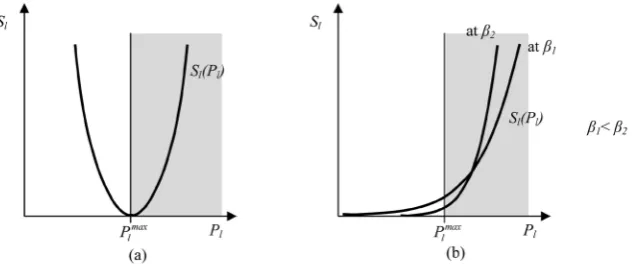
. (4) Particular difficult is the problem of taking into account of functional con-straints in the form of inequality (3). In many traditional algorithms of power systems mode optimization such constraints are also taken into account by qua-dratic penalty functions as(
max)
2l l l
S =α P P− or
(
min)
2l l l
S =α − +P P . (5)
This form of the penalty function is adapted for taking into account of con-straints in the form of equality. For example, to take into account of constraint
max
l l
P P≤ in the task of finding the minimum of an objective function, the pe-nalty function has a positive value and grows even when the constraint is satis-fied (Figure 1(a)).
To overcome this difficulty in traditional algorithms of optimization after each iteration of the optimization process, the constraint is checked out. In the case of its satisfying the next step of calculation is carried out without taking into account of this constraint. Otherwise, it is carried out with taking into account of the constraint using the penalty function.
[image:3.595.218.536.562.694.2]The results of research show that taking into account of functional constraints in the form of inequality using such penalty functions in optimization by traditional
DOI: 10.4236/eng.2019.114017 243 Engineering algorithms generally cause some difficulties connected with choosing the penalty coefficients and ensuring the convergence of the iterative calculating process, which is often oscillatory in nature [1].
There are some difficulties for taking into account the constraints in the form of inequality (3) using penalty functions (5) in optimization by genetic algo-rithms. Since the use of the objective function and the corresponding fitness function, which do not include such constraints may lead to unacceptable re-sults, where some of these constraints are not satisfied. Therefore, for overcome of such difficulties in this work the use of the exponential form of penalty func-tion is recommended:
(
max)
l l P P lS =
α
eβ − or(
P Pl lmin)
lS =
α
eβ− + , (6) where α, β are weight (penalty) coefficients.This form of penalty function is very closely meets the requirements set for it—equality to zero when the constraint is satisfied and increase proportionally to degree of violation when it is not satisfied (Figure 1(b)).
By selecting the values of the penalty coefficients α and β, it is possible to take into account the constraints with sufficient accuracy.
Thus, the generalized objective function when optimized by the genetic algo-rithm taking into account of constraints is presented in the following form:
P l
l
F B S= + +
∑
S . (7)3. Example and Evaluation of Results
The efficiency of the described algorithm is researched in example of optimiza-tion of mode of power system with 8 buses and 13 power transmission lines (PTL) (Figure 2). In 4 buses there are thermal power plants (TPP) with the fol-lowing fuel consumption characteristics of equivalent fuel, toe/h:
2
0 70 0.14 0 0.0014 0
B = + P + P , 2
1 84 0.14 1 0.00175 1
B = + P+ P ,
2
6 42 0.105 6 0.00105 6
B = + P + P , 2
7 56 0.175 7 0.0007 7
B = + P + P .
The constraints on the minimum and maximum loads of TPPs are the same and Pmin = 200 MW, Pmах = 700 MW. Capacities of consumers are: P
2 = 400 MW,
P3 = 600 MW, P4 = 200 MW, P5 = 500 MW.
Three power transmission lines have limited active power flows: P6-3 ≤ 450 MW, P6-5 ≤ 65 MW, P0-3 ≤ 95 MW.
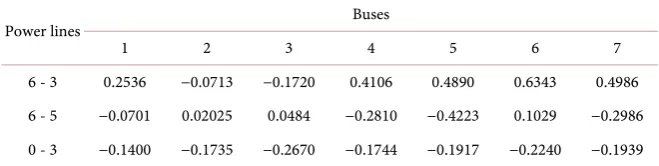
Power flows for these controlled transmission lines are determined using dis-tribution coefficients Cli, given in Table 1, on following expression:
0 1
n
l li i l
i
P C P P
=
=
∑
+ .To compare the results of optimization on the proposed algorithm, Table 2 shows the reference result obtained by the classical gradient method.
DOI: 10.4236/eng.2019.114017 244 Engineering
Table 1. Distribution coefficients of buses power over controlled transmission lines.
Power lines Buses
1 2 3 4 5 6 7
[image:5.595.210.540.207.305.2]6 - 3 0.2536 −0.0713 −0.1720 0.4106 0.4890 0.6343 0.4986 6 - 5 −0.0701 0.02025 0.0484 −0.2810 −0.4223 0.1029 −0.2986 0 - 3 −0.1400 −0.1735 −0.2670 −0.1744 −0.1917 −0.2240 −0.1939
Table 2. Reference result of optimization.
TPP Power of TPP, MW Fuel consumption, toe/h.
TPP at bus 0 234.7 179.97
TPP at bus 1 505.6 602.14
TPP at bus 6 281.3 154.55
TPP at bus 7 678.4 496.88
[image:5.595.213.534.334.484.2]Total fuel consumption in power system - 1433.54 Power flow on controlled lines Р6-3 = 450.0 MW, Р6-5 = 21.2 MW, Р0-3 = 95.0 MW.
Figure 2. Power system circuit.
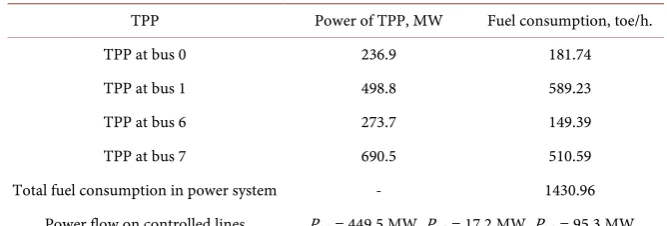
constraints using proposed algorithm at values of weighting coefficients α = 10, β = 2 are given in Table 3.
Comparing the obtained results of optimization by proposed algorithm with the reference result, we will verify the sufficiently high accuracy of the proposed algorithm.
Thus, the proposed algorithm of taking into account of functional constraints in the form of equality and inequality in optimization of power systems mode by genetic algorithms is highly efficient. It allows you to reliably determine the op-timal mode of power system taking into account simple and functional con-straints in the form of equality and inequality with acceptable accuracy for prac-tical purposes.
4. Conclusions
1) The efficient algorithm for taking into account of functional constraints in 0
3 1
2
4
5
6
DOI: 10.4236/eng.2019.114017 245 Engineering
Table 3. Optimization results with taking into account of constraints by proposed algo-rithm.
TPP Power of TPP, MW Fuel consumption, toe/h.
TPP at bus 0 236.9 181.74
TPP at bus 1 498.8 589.23
TPP at bus 6 273.7 149.39
TPP at bus 7 690.5 510.59
Total fuel consumption in power system - 1430.96 Power flow on controlled lines Р6-3 = 449.5 MW, Р6-5 = 17.2 MW, Р0-3 = 95.3 MW.
the form of equality and inequality in optimization of modes of power systems by genetic algorithm is proposed.
2) Genetic algorithm for optimization of modes of power systems taking into account the functional constraints in the form of inequalities by exponential form of penalty function has a reliable convergence of an iterative calculation process. It also does not require differentiability and continuity of the search space.
3) The proposed algorithm of taking into account of functional constraints in optimization by genetic algorithms can be effectively used for optimal planning of short-term modes of power systems.
Conflicts of Interest
The authors declare no conflicts of interest regarding the publication of this pa-per.
References
[1] Nasirov, T.Kh. and Gayibov, T.Sh. (2014) Teoreticheskie osnovi optimizatsii reji-mov energosystem [Theoretical Foundations of Optimization of Modes of Power Systems]. Fan va Texnologiya Publishing, Tashkent. (In Russian)
[2] Rudenko, Yu.N. and Semyonov, V.A. (2000) Avtomatizatsiya dispetcherskogo uprav-leniya v elektroenergetike [Automation of Dispatching Control in Electric Power Industry]. MEI Publishing, Moscow. (In Russian)
[3] Murty, P.S.R. (2008) Operation and Control in Power Systems. B.S. Publications, Hyderabad.
[4] Tulkin, G. and Kamal, R. (2017) Optimal Planning of Short-Term Modes of Power Systems with Control of Loads of Electric Consumers Taking into Account of Net-work Factor. European Science Review, 9-10, 86-91.
[5] Yuryevich, J. and Wong, K.P. (1999) Evolutionary Programming Based Optimal Power Flow Algorithm. IEEE Transaction on Power Systems, 14, 1245-1250.
https://doi.org/10.1109/59.801880
[6] Lai, L.L., Ma, J.T., Yokoma, R. and Zhao, M. (1997) Improved Genetic Algorithms for Optimal Power Flow under Both Normal and Contingent Operation States. Electrical Power & Energy System, 19, 287-292.
DOI: 10.4236/eng.2019.114017 246 Engineering [7] Amin, N., Marowan, A.Q. and Ghosh, B.C. (2017) Application of Genetic Algo-rithm in Power System Optimization with Multi-Type FACTS. International Jour-nal of Research Publications, 7, 748-754.
[8] Bhaskar, K., Vijay, M., William, A. and Bhattacharya, D. (2013) Mathematical Modeling of Optimizing Power Stream Measurement Using Genetic Algorithm. American Journal of Engineering Research (AJER), 2, 71-79.