Radar Sensing in Human-Computer Interaction
The exploration of novel sensing to facilitate new interaction modalities remains an active research topic in Human-Computer Interaction. Across the breadth of HCI conferences, we can see the development of new forms of interaction underpinned by the appropriation or adaptation of sensing techniques based on the measurement of sound, light, electric fields, radio waves, biosignals etc. Commercially, we see extensive industrial developments of radar sensing in vehicular/automotive and military settings. At very long range, radar technology has been used for many decades in weather and aircraft tracking. At long-, mid- and short-range radar has been used for ACC, EBA, security scanners, pedestrian detection and blind spot detection. Radar is often considered a long-range sensing technology, which is all-weather, offering 3D position information, operating at all-times as it doesn’t require lighting and can penetrate surfaces and objects.
At very short range radar has been employed in disbond detection, corrosion detection and foam insulation flaw identification. In addition, radar technology has been explored by the research community for various purposes, such as presence sensing and indoor user tracking [5], vital signs monitoring [6] and emotion recognition. At this range, radar is touted as addressing problems in privacy, occlusion, lighting and limited field-of-view that are suffered by vision-based approaches, or for uses in medical conditions where traditional approaches such as capacitive and galvanic skin response sensing do not work well.
Within the HCI context, Doppler radar was used as early as 1997 in The Magic Carpet [4] for sensing coarse body motion. However, complicated hardware and signal processing knowledge are required, which present a high barrier for entry. Hence, it is the more recent development in low-cost, miniaturized radar-on-chip devices with developer-friendly SDK that truly opened the potential of radar sensing more broadly in HCI. Such sensing is exemplified in the Google Soli [1] for tracking micro gestures (such as finger wiggle, hand tilt, check-mark or thumb slide) and has led to increased interest in radar for gesture detection.
Project Soli
The Google Soli significantly lowers the barrier to entry and broadens radar out for the HCI community in providing a plug-and-play SDK with gesture support and software examples. Radar, however, presents a number of challenges and opportunities which this article aims to introduce as a primer for those seeking to explore radar for interaction, tangible computing, gestures or in sensor fusion.
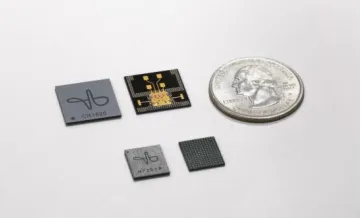
Figure 1: Soli radar chips with antennas-in-package, (top) 12 x 12 mm, FMCW SiGe chip (bottom) 9 x 9mm DSSS CMOS chip, figure extracted from the Soli paper, used with permission.
Figure 2: Exploded view of the Soli alpha hardware (not to scale, image adapted from Soli alpha SDK). In RadarCat, an object is placed on top of the sensor where raw radar signals are extracted and classified using machine learning techniques.
Figure 3: Soli is designed end-to-end for ubiquitous and intuitive fine gesture interaction, figure extracted from the Soli paper, used with permission.
Radar Signal Processing
[image:2.612.87.539.424.539.2]along with deep convolutional and recurrent neural networks [3]. This research and development allow the Google Soli team to propose a ubiquitous gesture interaction language that can allow people to control any device with a simple, yet universal set of in-air hand gestures.
Basic radar sensing systems for long and short use typically provide access to uncompressed raw data from the various channels. However, radar systems with hardware and software offer pre-processing in terms of noise subtraction, error correction or filtering while signal processing affords developers more enriched views of the radar signal including image formation, clutter removal, range-Doppler map, elevation estimation, object tracking or target detection. Radar, as we have noted, is not a new technology and its use at varying ranges results in an abundance of techniques, methods and approaches which researchers in HCI might learn from and adapt.
However, when considering the Soli it is advised to understand the Soli Processing Pipeline (SPP), from hardware, software and application. A further distinction is made between the hardware specific transmitter, receiver, analog signal pre-processing and digital signal pre-processing in software, which is hardware specific. Hardware agnostic signal transformations such as a range-Doppler, range profile, Doppler profile (micro-Doppler), and spectrogram, followed by feature extraction and gesture recognition which can be provided to an application. The Soli SDK enables developers to easily access and build upon the gesture recognition pipeline. The Soli libraries extract real-time signals from radar hardware, outputting signal transformations, high precision position and motion data, and gesture labels and parameters at frame rates from 100 to 10,000 frames per second.
Radar Applications Area
Currently, the main application of Soli is centered around close-range sensing of fine and fluid gestures [1, 3]. In addition, the team also suggested potential use cases in wearable, mobile, VR/AR systems, smart appliances and IoT, as well as scanning and imaging, wayfinding, accessibility, security and spectroscopy. While in research work, there are concrete examples developed by the alpha developers, which were shown at the Google I/O 20161, such as material and object recognition [2], 3D imaging, predictive drawing, in-car gestures, gesture unlock, visualization and musical application. More recent work also demonstrated interesting use cases, such as the world's smallest violin2, free-hand keyboard3, biometric user identification, fluid/powder identification and glucose monitoring4.
The small, low-power, single package size of the Google Soli radar chip can be embedded in a myriad of consumer devices from smart watches to home control stations. As a technology which can be embedded beneath surfaces and without requiring light, it can be incorporated into both wearables and a range of objects such as cars or IoT devices where an exposed sensor would not be permissible. Such a sensing technology can afford a paradigm shift in how we interact in a touchless manner with any computation, embedded into any device. Examples of virtual tools, smartwatch interaction, loudspeaker interaction along with musical applications have been demonstrated.
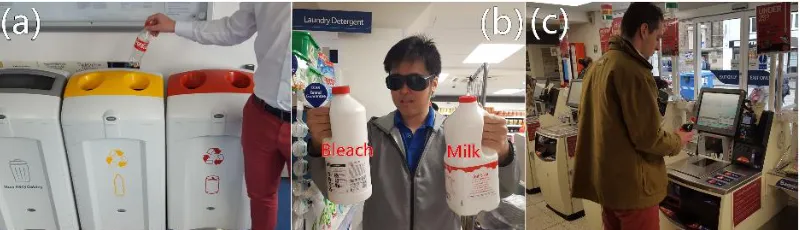
RadarCat [2] is a small, versatile system for material and object classification which enables new forms of everyday proximate interaction with digital devices. RadarCat exploits the raw radar signals that are unique when different material and objects are placed on the sensor. By using machine learning techniques, these objects can be accurately recognized. Object’s thickness, state (filled or empty mug) and different body parts can also be recognized. This gives rise to research and applications in context-aware computing (Figure 4), tangible interaction (with tokens and objects), and in industrial automation (e.g., recycling, Figure 5), or laboratory process control (e.g., traceability). In addition, radar-on-chip systems have also been demonstrated in presence sensing and breath monitoring.
1 Bridging the physical and digital. Imagine the possibilities. ATAP. - Google I/O 2016,
https://www.youtube.com/watch?v=8LO59eN9om4
2 Project Soli - World’s Tiniest Violin, https://vimeo.com/155570863 3 SoliType, https://www.youtube.com/watch?v=EoCyfl_TlMI
4 MobileHCI 2017: Workshop on Object Recognition for Input and Mobile Interaction
Figure 4: Four example applications to demonstrate the interaction possibilities of RadarCat, from left to right a) physical object dictionary b) tangible painting app c) context-aware interaction and body shortcuts d) automatic refill.
Figure 5: Three potential future applications of RadarCat, from left to right a) automatic waste sorting in recycling center b) assisting the visually impaired c) automatic check-out machine.
What is down the road?
The authors of this column were selected to participate in the Google Soli Alpha Developers program, for which we thank the Google ATAP Soli team. This provided us access, at the time, to the raw radar signal which afforded us the opportunity to explore radar sensing and machine learning for object and material classification in novel ways. This developer program demonstrates what is possible for the HCI community when it considers radar-on-chip or higher levels of processed data, such as with the Google Soli gestures. We suggest that avenues of research in healthcare, on- and around-body interaction and object interaction are now opening up. Challenges with radar remain, energy consumption, dealing with noisy signals processing and high recognition rates. The implication is that HCI researchers can use this new sensing technology to achieve more. Although radar is not a Swiss army knife solution to every problem but with sensor fusion, it can form part of a rich sensing space for new forms of interaction.
While the current availability of Soli developer kit is limited, we hope and believe that it will be soon available to more developers and researchers. Indeed, at the Google I/O last year, the Soli team announced a newer, beta developer kit with a built-in processing unit and swappable modules. In the meantime, the readers of this article can buy alternative radar sensor module for 1-2 dollars such as the HB-100 (10 GHz), RCWL-0516, and etc. A great comparison video can be found here5. Alternative plug-and-play, portable radar also available, such as from Walabot or Xethru. Other high-end, custom radar modules are also available, which we will not cover within the scope of this article.
Acknowledgement
We thank the Soli team for the feedback and correction during the drafting of this article. References
[1] Jaime Lien, Nicholas Gillian, M. Emre Karagozler, Patrick Amihood, Carsten Schwesig, Erik Olson, Hakim Raja, and Ivan Poupyrev. 2016. Soli: ubiquitous gesture sensing with millimeter wave radar. ACM Trans. Graph. 35, 4, Article 142 (July 2016), 19 pages. DOI: https://doi.org/10.1145/2897824.2925953
[2] Hui-Shyong Yeo, Gergely Flamich, Patrick Schrempf, David Harris-Birtill, and Aaron Quigley. 2016. RadarCat: Radar Categorization for Input & Interaction. In Proceedings of the 29th Annual Symposium on
[image:4.612.107.507.185.300.2]
User Interface Software and Technology (UIST '16). ACM, New York, NY, USA, 833-841. DOI: https://doi.org/10.1145/2984511.2984515
[3] Saiwen Wang, Jie Song, Jaime Lien, Ivan Poupyrev, and Otmar Hilliges. 2016. Interacting with Soli: Exploring Fine-Grained Dynamic Gesture Recognition in the Radio-Frequency Spectrum. In Proceedings of the 29th Annual Symposium on User Interface Software and Technology (UIST '16). ACM, New York, NY, USA, 851-860. DOI: https://doi.org/10.1145/2984511.2984565
[4] Joseph Paradiso, Craig Abler, Kai-yuh Hsiao, and Matthew Reynolds. 1997. The magic carpet: physical sensing for immersive environments. In CHI '97 Extended Abstracts on Human Factors in Computing Systems (CHI EA '97). ACM, New York, NY, USA, 277-278. DOI: https://doi.org/10.1145/1120212.1120391
[5] P. Bahl and V. N. Padmanabhan, "RADAR: an in-building RF-based user location and tracking system," Proceedings IEEE INFOCOM 2000. Conference on Computer Communications. Nineteenth Annual Joint Conference of the IEEE Computer and Communications Societies (Cat. No.00CH37064), Tel Aviv, 2000, pp. 775-784 vol.2.