Di-Hu Chen & Sheng Yang
Department of Precision Machinery & Instrumentation, University of Science and Technology of China, Hefei 230027, China. * Correspondence should be addressed to Di-Hu Chen ([email protected]).
relations like video signals with intra-frame and
ABSTRACT
inter-frame correlations, video codec technology can be used for ECG compression. For ECG signals, there
In this paper, we present a method using
is a little difference, so some pre-process will be
video codec technology to compress ECG
needed: ECG signals should be segmented and period
signals. This method exploits both intra-beat
normalized to a sequence of beat cycles with the
and inter-beat correlations of the ECG
sig-same size. Then these beat cycles can be treated as
nals to achieve high compression ratios (CR)
'picture frames' and compressed with a video codec.
and a low percent root mean square
differ-In this work, we present a method using video
ence (PRD). Since ECG signals have both
codec technology to compress ECG signals. This
intra-beat and inter-beat redundancies like
method exploits both intra-beat and inter-beat
corre-video signals, which have both intra-frame
lations of the ECG signals to achieve high
compres-and inter-frame correlation, video codec
tech-sion ratios (CR) and a low percent root mean square
nology can be used for ECG compression. In
difference (PRD). Although video codec technology
order to do this, some pre-process will be
was developed to compress video signals, it can be
needed. The ECG signals should firstly be
used to compress other signals as well, and we
illus-segmented and normalized to a sequence of
trate how video codec technology can be used to
com-beat cycles with the same length, and then
press ECG signals. In Section II, we take a brief
over-these beat cycles can be treated as picture
view of video codec technology. Section III presents
frames and compressed with video codec
the coding algorithm. Experimental results and
com-technology. We have used records from
MIT-parisons with other algorithm are presented in
Sec-BIH arrhythmia database to evaluate our
algo-tion IV. At last, we provide conclusions.
rithm. Results show that, besides compres-sion efficiently, this algorithm has the
advan-t a g e s o f r e s o l u advan-t i o n a d j u s advan-t a b l e , r a n d o m
2. OVERVIEW OF VIDEO CODEC
TECH-access and flexibility for irregular period and
NOLOGY
QRS false detection. R e p r e s e n t i n g v i d e o m a t e r i a l i n a d i g i t a l f o r m
requires a large number of bits. The volume of data generated by digitizing a video signal is too large for most storage and transmission systems. This means that compression is essential for most digital video applications. Statistical analysis of video signals
indi-1. INTRODUCTION
cates that there is a strong correlation both between The electrocardiogram (ECG) is an important tool for
successive picture frames and within the picture ele-diagnosis of heart diseases. The volume of ECG data
ments themselves. Theoretically decorrelation of these produced by modern monitoring system can be quite
signals can lead to bandwidth compression without large over a long period of time and data compression
significantly affecting image resolution. A video sig-is often needed for efficient process, store and
trans-nal consists of a sequence of individual frames. Each mit of such data. In the past, many ECG compression
frame may be compressed individually using an methods were proposed and could be classified into
image CODEC, such as JPEG. This is described as three major categories [1]: a) Parameter extraction
intra-frame coding for each frame is intra coded with-t e c h n i q u e s . b ) T r a n s f o r m - d o m a i n with-t e c h n i q u e s . c )
out any reference to other frames. However, better Direct time-domain techniques.
c o m p r e s s i o n p e r f o r m a n c e m a y b e a c h i e v e d b y In this paper, we present a method for compression
e x p l o i t i n g t h e t e m p o r a l r e d u n d a n c y i n a v i d e o of ECG data using video codec technology. Since
sequence or the similarities between successive ECG signals have both intra-beat and inter-beat
cor-K e y w o r d s : E C G c o m p r e s s i o n ; V i d e o CODEC; QRS detection; Arithmetic coding
Compression of ECG signal using video codec
technology-like scheme
Compression of ECG signal using video codec
technology-like scheme
Publishing
SciRes
Copyright
©
video frames. This may be achieved by introducing sequence of individual frames and these frames are of two functions: 1. Prediction: create a prediction of the same size. But for ECG signals, these 'frames' or the current frame based on one or more previously beat cycles are jointed together, and even the sizes of transmitted frames. 2. Compensation: subtract the them are not the same. The comparability of the ECG prediction from the current frame to produce a resid- signals and video signals motivates us to design a ual frame. Then the residual frame is compressed by novel ECG compression scheme using video codec an image CODEC. In order to decode the frame the technology, in which the scheme employs the arith-decoder adds the prediction to the decoded residual metic coding for intra-beat redundancies, and a pre-frame. This is described as inter-frame coding for dictor using cross correlation for inter-beat redun-frames are coded based on some relationship with dancies.
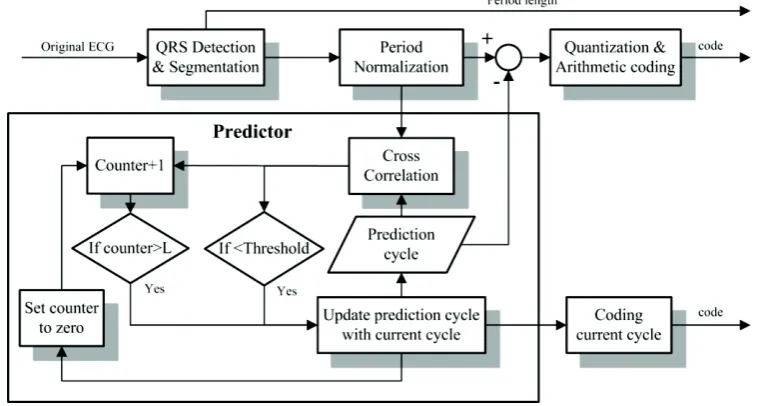
other video frames. show s the proc ess The functional block diagram of the proposed
cod-above. ing scheme is shown in . The encoder system
consists mainly four parts: segmentation, period nor-malization, predictor and residual coding. The
pro-3. METHOD
posed encoding algorithm is briefly described as fol-3.1. System overview
lows. Since ECG signals are continuous and in order The redundancies in ECG signals can be broadly
clas-to use compress them using a video codec scheme, sified into two types: The redundancies in a single
firstly we should segment them to a sequence of ECG cycle and the redundancies across ECG cycles.
cycles, by noting that the length of each beat cycle These redundancies are sometimes referred to as
may be varying, a period normalization process is intra-beat and inter-beat redundancies [2]. These are
then proceeded to ensure that the size of each beat the same with redundancies in video signals. On the
cycle is adjusted to be the same. Initially, the counter other hand, there is a little difference between video
[image:2.595.59.535.75.247.2]is set to zero and we select the first cycle as the pre-signals and ECG pre-signals: A video signal consists of a
[image:2.595.107.490.541.744.2]Figure 1
Figure 2
Figure 1. Video CODEC with prediction.
diction cycle and compress this cycle with no predic- nology, we normalize each ECG period to the same tion, then any time when there is a new cycle, the length. We implement this using a method similar to counter is added by one and the cross correlation the one described in [4]. Letxk=[xk(1)xk(2) xk(Nk)] coefficient of the new cycle and the prediction cycle denote thek-th ECG cycle. Then the period-normalized ECG is calculated. If the result is less than the threshold, cycley=[y (1)y(2) y (N)] is computing using
k k k k
which indicates that this new cycle and the prediction cycle have little similarity, or the count is larger than
L(used for random access), we set the counter to zero and set this new cycle as the prediction cycle and
com-press it with no prediction, else the prediction cycle Where is an interpolate version of the samples is subtracted from this new cycle, and the residual xk(n) , and t'= ,Nk is the period of the k-th cycle is then quantized and compressed with the ECG cycle, and N is the normalized period. We uti-arithmetic coding. lize cubic-spline interpolation [5] to determine .
TheNabove can be thought as the resolution, like 3.2. QRS detection and segmentation the spatial resolution (typically 352 288 or 352 To cut continuous ECG signals to individual beats, 240 pixels in MPEG-1) in a video encoder. The value the peaks of QRS waves should be detected firstly to ofNis predefined in consideration of the sample fre-identify each heartbeat. We use a different method to quency and it can affect the CR and the PRD.
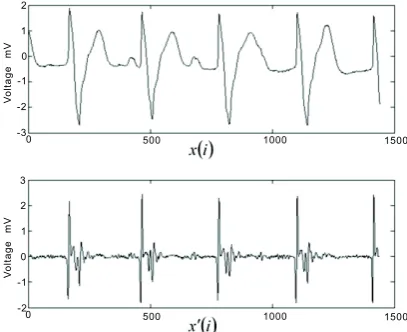
do this: Letx(i) denote the ECG signal, and a corre- After period normalization, each ECG period will sponding different signal x'(i) is given by be with the same length like video frames with the
same size. Then we can use similar video CODEC technology to compress them.
3.4. Prediction wheren is a small integer determined by the sampling
In part 2 we know that, in order to exploit the similar-frequency (typically a value between 0.01f and 0.02f
ities between successive video frames, two functions is used, where f is the sampling frequency). Several
prediction and compensation are introduced. The key zero points are added to the front and the end of the
to this approach is the prediction function: if the pre-ECG signals for calculation of the first and last few
diction is accurate, the residual frame will be con-points ofx'(i). When select proper n for different
sam-taining little data and will hence be compressed to a ple frequency, (1) is like a band pass filter. It makes
very small size by the image CODEC. the QRS waves be amplified and the other waves be
For video compression, the simplest predictor is weaken. shows a typical ECG signal and its
just the previous transmitted frame. We can utilize corresponding difference signal generating by (1).
this in ECG compression. Since successive ECG The sample frequency is 360Hz withn equals to 5.
cycles are very similar all the times, we make a small For the different signal x'(i), we can use a similar
change and introduce the cross correlation coeffi-scan algorithm in [3] for the QRS detection. Results
cient. Cross correlation coefficient is a standard show that, our method has a higher detection rate.
method of estimating the degree to which two series After each QRS peak of heartbeat cycles is
identi-are correlated. Consider two series x and y where fied, the original ECG signal is cut at every QRS peak. i i
i=0,1,2 N 1, the cross correlation coefficient is defined as
3.3. Period normalization
Since each ECG period can have a different duration, and in order to compress them using video codec
tech-Wherex and y are the means of the corresponding series.
[image:3.595.70.274.573.739.2]Prediction with cross correlation is shown in . Initially we set the counter to zero. The first ECG beat cycle is set as the prediction beat cycle and compressed with no prediction. Any time when there is a new beat cycle, the counter is added by one and the cross correlation coefficient of the new beat cycle and the prediction beat cycle is calculated. If the counter is smaller than L (predefined for random access) and the correlation result is higher than the threshold (typically 0.95 or more), which indicates that the prediction beat is similar with the current beat to a great extent, then we use it as the prediction
Figure 3
Fig-ure 2
(3) (2)
(1)
Figure 3.ECG signal and corresponding different signal. 2
1
-1
-2
Vo
lt
a
g
e
m
V
3
1 2
0
Vo
lt
a
g
e
m
V
500 1000 1500
0 -3
-1
500 1000 1500
-2 0 0
k
k
of the current beat. Otherwise, we use the current picture. It is followed by an arrangement for P- and beat to replace the prediction beat and compress it B-pi ctur es. Li kewi se, we intr oduc e the g roup o f with no prediction and set the counter to zero again. cycles in our scheme to assist random access into the
ECG data. The group of cycles length is defined as the distance between I-cycles, which is represented 3.5. Quantization and Coding
by parameter Lin . A short group of cycles The quantization stage removes less important
infor-may support random access well at the cost reducing mation, such as information that does not have a
sig-the compression ratio. shows a typical nificant influence on the appearance of the
recon-group of cycles. structed ECG signals, making it possible to compress
the remaining data.
In this paper, we use the arithmetic coding [6] for
4. RESULT
compression of the residual signal and the period infor- We used the MIT-BIH arrhythmia database to evalu-mation. An arithmetic encoder converts a sequence of ate the performance of the proposed scheme. The data symbols in to a single fractional number. The lon- ECG data used in our experiments are sampled at 360 ger the sequence of the symbols, the greater the preci- Hz and each sample has a resolution of 12 bit per sam-sion required to represent the fractional number. ple. Through period normalization, we have made the Arithmetic coding provides a practical alternative to number of samples in each beat cycle equal 240. Huffman coding and can more closely approach the Although for a typical hart rate of 75 beat per minute, theoretical maximum compression [7]. 288 samples in each beat cycle will be good, but a
rel-ative small samples will increase compression ratio 3.6. Coding of beat cycles without obviously affecting the reconstruction qual-In the video coding standard MPEG-1, each frame of ity.
video is encoded to produce a coded picture. There We use two widely used measures, the compres-are three main types: I-pictures, P-pictures and B- sion ratio (CR) and the percent root mean square dif-pictures. I-pictures are intra-coded without any ference (PRD) to evaluate our scheme. The CR and motion-compensated prediction. An I-picture is used PRD are defined as
as a reference for further predicted pictures. P-pictures are inter-coded using motion-compensated prediction from a reference picture. B-pictures are
WhereB is the total bits of the original ECG sig-inter-coded using motion-compensated prediction ori
from two reference pictures, the P- and/or I-pictures nal,Bcp is the total bits of the ECG signal after com-before and after the current B-picture. However, in pression.
our proposed scheme for ECG compression, we only introduced two types: I-cycles and P-cycles.
I-cycles are useful resynchronization points in the coded bit stream: because it is coded without predic-tion, an I-cycle may be decoded independently of any other coded cycles. This support random access by a
Wherex and x are the original and the recon-decoder in some degree (a recon-decoder may start decod- ori rec
ing the bit stream at any I-cycle position). However, structed ECG signals, andndenotes the length of the an I-cycle has poor compression efficiency because signals.
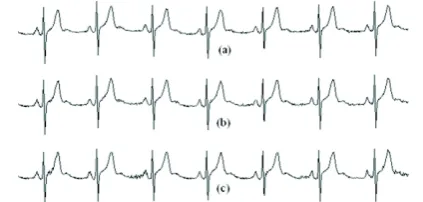
no prediction is used. and show example of ECG data
In MPEG-1 due to the existence of several picture from record 117 and record 119 with irregular period types, a group of pictures (GOP) is the highest level before and after compression.
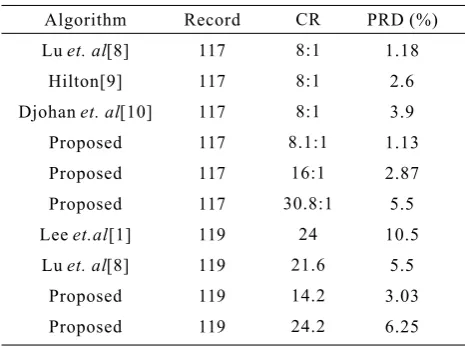
of the hierarchy. A GOP is a series of one or more pic- In , the proposed method is compared with t u r e t o a s s i s t r a n d o m l y a c c e s s i n t o t h e p i c t u r e other methods in literature for record 117 and 119. sequence. The first coded picture in the group is an
[image:4.595.314.526.601.702.2]I-Figure 2
Figure 4
Figure 5 Figure 6
[image:4.595.59.284.633.723.2]Table 1
Figure 4.Group of cycles in coded bit stream.
(5)
Figure 5.Reconstruction example of MIT-BIH record 117 with quantization level of 10 V and 20 V : (a) original signal of channel 1, (b) reconstruction signal of channel 1 with quantization level of 10 V, CR=16 and PRD=2.87, (c) reconstruction signal of channel 1 with quantization level of 20 V ,CR=30.79 and PRD=5.50.
5. CONCLUSION
[image:5.595.57.290.311.484.2]The main contribution of this paper is to provide an effective and efficient ECG compression scheme using video codec technology. We have tested the per-formance of the proposed scheme by compressing record from the MIT-BIH arrhythmia database and compared the results with other methods. The results show that the proposed algorithm compares favorable to other methods in literature. Besides compression efficiently, the proposed algorithm benefits from char-acteristics of the video codec and has the following advantages: a) Resolution adjustable. By changing the length Nin section 3.3, we can achieve different resolution just like spatial resolution in a video codec; b) Random accessible. In coding stream of the ECG data, the I-cycles are intra-coded without any predic-tion, thus we can access the ECG data from every I-cycle. c) Flexibility for irregular period and QRS false detection. In our scheme, the irregular periods or the QRS false detection beat cycles will be treated as the new prediction cycles and compressed with no prediction if they don't have enough similarity with the formal prediction cycle.
Figure 6. Reconstruction example of MIT-BIH record 119 with quantization level of 10 Vand 20 V: (a) original signal of c h a n n e l 1 , ( b ) r e c o n s t r u c t i o n s i g n a l o f c h a n n e l 1 w i t h quantization level of 10 V, CR=14.2 and PRD=3.03, (c) reconstruction signal of channel 1 with quantization level of 20 V ,CR=24.2 and PRD=6.25.
Algorithm
Luet. al[8]
Hilton[9]
Djohanet. al[10]
Proposed
Proposed
Proposed
Leeet.al[1]
Luet. al[8]
Proposed
Proposed
Record
117
117
117
117
117
117
119
119
119
119
CR
8:1
8:1
8:1
8.1:1
16:1
30.8:1
24
21.6
14.2
24.2
PRD (%)
1.18
2.6
3.9
1.13
2.87
5.5
10.5
5.5
3.03
6.25
Table1.PRD comparison of different algorithms for record 117 and 119.
REFERENCE
[1] H. Lee & K. M. Buckley. ECG data compression using cut and
align beats approach and 2-D transforms.IEEE Trans-Biomed.
Eng. 1999, (46):556-565.
[2]Ali Bilgin & W. Marcellin. Compression of electrocardiogram
signals using JPEG2000.IEEE Transaction on Consumer
Elec-tronics.2003, 49(4).
[3] Engelse, W.A.H. & Zeelenberg, C. (). A single scan algorithm
for QRS detection and feature extraction.IEEE Computers in
Cardiology 1979, pages 37-42.
[4] Wei, J. J., Chang, C. J., Chou, N. K. & Jan, G. J. ECG data
com-pression using truncated singular value decomposition.IEEE
Trans. on Information Technology in Biomedicine2001, 5:290-299.
[5] T. M. Lehman, C. Gonner, & K. Spitzer. Survey: interpolation methods in medical image processing. IEEE Trans. on Medical Imaging1999, 18:1049-1075.
[6] James A. Storer,ed. Practical implementations of arithmetic
coding.Image and text compression, MA, 1992 pages 85-112.
[7] I. Witten, R. Neal & J. Cleary. Arithmetic coding for data
com-pression.Communications of the ACM 1987, 30(6).
[8] Lu, Z., D. Y. Kim, & W. A. Pearlman. Wavelet compression of ECG signals by the set partitioning in hierarchical trees
algo-rithm.IEEE Trans. on Biomedical Engineering2000,
47:849-856.
[9] M. L. Hilton. Wavelet and wavelet packet compression of
elec-trocardiograms.IEEE Trans. on Biomedical Engineering1997,
44:394-402.
[10] A. Djohan, T. Q. Nguyen & W. J. Tompkins. ECG compression
using discrete symmetric wavelet transform. Proc. of 17th