Published online 15 January 2016 in Wiley Online Library (wileyonlinelibrary.com). DOI: 10.1002/cpe.3746
HPC-GAP: engineering a 21st-century high-performance
computer algebra system
‡Reimer Behrends
1, Kevin Hammond
2, Vladimir Janjic
2, Alexander Konovalov
2,
Steve Linton
2, Hans-Wolfgang Loidl
3, Patrick Maier
4and Phil Trinder
4,*,†1Department of Mathematics, University of Kaiserslautern, Kaiserslautern, Germany 2School of Computer Science, University of St Andrews, Fife, UK
3School of Mathematical and Computer Sciences, Heriot-Watt University, Edinburgh, UK 4School of Computing Science, University of Glasgow, Glasgow, UK
SUMMARY
Symbolic computation has underpinned a number of key advances in Mathematics and Computer Science. Applications are typically large and potentially highly parallel, making them good candidates for parallel execution at a variety of scales from multi-core to high-performance computing systems. However, much existing work on parallel computing is based around numeric rather than symbolic computations. In particu-lar, symbolic computing presents particular problems in terms of varying granularity and irregular task sizes that do not match conventional approaches to parallelisation. It also presents problems in terms of the struc-ture of the algorithms and data. This paper describes a new implementation of the free open-source GAP computational algebra system that places parallelism at the heart of the design, dealing with the key scala-bility and cross-platform portascala-bility problems. We provide three system layers that deal with the three most important classes of hardware: individual shared memory multi-core nodes, mid-scale distributed clusters of (multi-core) nodes and full-blown high-performance computing systems, comprising large-scale tightly con-nected networks of multi-core nodes. This requires us to develop new cross-layer programming abstractions in the form of new domain-specific skeletons that allow us to seamlessly target different hardware levels. Our results show that, using our approach, we can achieve good scalability and speedups for two realistic exemplars, on high-performance systems comprising up to 32 000 cores, as well as on ubiquitous multi-core systems and distributed clusters. The work reported here paves the way towards full-scale exploitation of symbolic computation by high-performance computing systems, and we demonstrate the potential with two major case studies. © 2016 The Authors.Concurrency and Computation: Practice and ExperiencePublished by John Wiley & Sons Ltd.
Received 5 May 2015; Revised 27 October 2015; Accepted 2 November 2015
KEY WORDS: parallelism; multicore; high-performance computing; computational algebra
1. INTRODUCTION
This paper considers how parallelism can be provided in a production symbolic computation system, GAP (Groups, Algorithms, Programming [1]), to meet the demands of a variety of users. Sym-bolic computation has underpinned several key advances in Mathematics and Computer Science, for example, in number theory, cryptography and coding theory. Computational algebra is an impor-tant class of symbolic computation, where applications are typically characterised by complex and expensive computations.
*Correspondence to: Phil Trinder, School of Computing Science, University of Glasgow, Glasgow G12 8QQ, UK. †E-mail: [email protected]
This is an open access article under the terms of the Creative Commons Attribution License, which permits use, distribution and reproduction in any medium, provided the original work is properly cited.
Many symbolic problems are extremely large, and the algorithms often exhibit a high degree of potential parallelism. This makes them good candidates for execution on both large and small-scale parallel systems, including high-performance computing (HPC) systems. With the widespread availability of multi-core systems, there is an increasing need to provide effective support for sym-bolic computation on small shared-memory computers. The size and complexity of the problems that are being tackled means, however, that there is also a significant demand for symbolic compu-tation on clusters of distributed-memory systems and potentially for full-blown HPC systems. The HPC–GAP systems described in this paper aim to meet those diverse needs in a way that is idiomatic for the GAP programmer and easy for the domain specialist to exploit.
There are, however, numerous practical challenges that must be overcome if the parallelism potential is to be exploited. Firstly, symbolic algorithms tend to employ complex data and control structures that are not generally studied by the parallel programming community. Secondly, the par-allelism that is present is often both dynamically generated and highly irregular, for example, the number and sizes of subtasks may vary by several orders of magnitude. These properties present significant challenges to conventional parallelisation techniques. Finally, the developers of sym-bolic computing applications are not parallelism experts: they are typically mathematicians or other domain experts, who usually do not possess a background in computer science and who have lim-ited time and inclination to learn complex system interfaces. What is needed is a simple, but highly scalable, way to deal with massive parallelism in symbolic computing systems, which is consistent with existing symbolic programming approaches.
This paper studies how these challenges may be overcome in the context of the widely used GAP computational algebra system. Our work establishes symbolic computation as a new and exciting application domain for HPC. It also provides avade mecumfor the process of producing effective high-performance versions of large legacy systems. The primary research contributions of this paper are as follows:
1. The systematic description of HPC-GAP as an integrated suite of new language extensions and libraries for parallel symbolic computation. These are a thread-safe multi-core implemen-tation, GAP5 (Section 2); an MPI binding to exploit clusters (Section 3) and the SymGridPar2 framework that provides symbolic computation at HPC scale (Section 4). Collectively, these allow us to address scalability at multiple levels of abstraction up to large-scale HPC systems (Section 5).
2. We provide two substantial case studies to demonstrate the effectiveness of the language mech-anisms for irregular symbolic computations. Specifically, we consider Orbit calculations and a Hecke Algebra representation theory calculation on the HECToR HPC system. The datasets for these, and other experiments in the paper, are available at [2] (Section 6).
3. SymGridPar2 re-establishes symbolic computation as an application domain for HPC for the first time in 20 years (Sections 4, 5.3 and 6).
Novelty:We provide the first complete and systematic description of HPC-GAP. Many of the individual components of HPC-GAP and associated case studies have been previously reported piecemeal: with descriptions of GAP5 [3], SymGridPar2 [4], the MPI-GAP case study [5] and the SymGridPar2 case study [6]. A key part of the systematic presentation of the HPC-GAP components is to provide a common SumEuler benchmark to facilitate comparison of the programming models and performance at different scales. Moreover, some key aspects of the components are presented for the first time, for example, Section 4.2, describing the interface between GAP and SymGridPar2. Section 5 that uses SumEuler as a basis for a performance evaluation of the HPC-GAP components, and discusses their interworking, is almost entirely new.
1.1. Computational algebra and the GAP system
date, GAP has been installed at over 2000 sites and is cited in more than 1000 publications. GAP has been used in such landmark computations as the ‘Millennium Project’ to classify all finite groups of order up to 2000 [7]. From its inception, GAP was designed to be natural to use for mathemati-cians, powerful and flexible for expert users and freely extensible so that it can encompass new areas of mathematics as needed. All three objectives have been met comprehensively. Our achievements were recently recognised by the award of the ACM/SIGSAM Richard D. Jenks Memorial Prize for Excellence in Software Engineering applied to Computer Algebra.
GAP fills an important need in the computer algebra community. Unlike GAP, general ‘computer algebra systems’ such as Maple [8], Mathematica [9] or MATLAB [10] simply do not address com-putation in abstract algebra in any serious way. Maple, for example, can compute with some finite permutation groups, but is many orders of magnitude slower than GAP and can handle only ‘toy’ examples. Only MAGMA [11] and Sage [12] have any significant overlap with GAP in its core areas of computational algebra and discrete mathematics. MAGMA has a strong focus on number theory and cryptography, and unlike GAP, is closed source, monolithic and difficult to extend. Sage [12] incorporates and derives much of its algebraic functionality from GAP, as permitted by the GNU Public License. Neither of these systems supports parallelism well: Sage has limited support for client-server style distributed computing, but does not support large-scale parallel computing; and MAGMA currently has no support for parallelism.
1.2. Parallelism and high-performance computing
With the widespread adoption of multi-core processors, parallelism has become mainstream. While most laptops, desktops and even mobile platforms comprise single multi-core systems, higher-performance systems willclusterseveral multi-cores into a single coherent system, connected either by a high-speed network or by a shared memory bus. HPC systems provide a further level of hier-archy, connecting multiple clusters into a coherent, highly parallel supercomputing platform. While the general problems of identifying and controlling parallelism are similar in each level, the increas-ing scale and complexity of larger systems means that more powerful programmincreas-ing models are needed to deal with them effectively. These models should abstract over low-level architectures, in order to provide scalable parallelism up to HPC-size architectures.
While low-level programming models are still dominant for HPC applications, this low level of abstraction is in stark contrast to the high level of abstraction sought for in the domain of symbolic computation. A typical user of a computational algebra system will naturally aim to develop theories and programs in a style close to mathematical notations and therefore refrain from (prematurely) constraining how the theories are executed. In fact, the bigger gap between model and implementa-tion found in symbolic computaimplementa-tion makes parallel realisaimplementa-tion of these problems relatively rare, and some exceptions are discussed in [13].
While there are instances of explicit coordination infrastructures in this domain, and we discuss them in the following sections, the most natural combination of technology and domain is a mostly declarative programming style, and the main part of our survey here focuses on such systems.
1.2.1. Threading and message-passing approaches. The most commonly used technologies on today’s HPC systems start from established, if not dated, sequential host languages, such as For-tran or C, and provide added functionality for parallelism in the form of libraries or compiler annotations. Different technologies are often combined, reflecting the underlying architecture, for example, using an explicit message passing library (e.g. MPI) between nodes combined with a dedi-cated shared memory model (e.g. OpenMP in the form of compiler annotations) within a multi-core node. This combination aims to use the most efficient technology on each level, but necessarily complicates software design. This development is aggravated by the heavy use of Graphic Pro-cessing Units (GPUs) and many-core co-processors, such as Xeon Phis, on the latest generation of supercomputers.
is becoming increasingly important with modern applications often being extremely data intensive and the memory-per-core ratio falling. In this aspect, symbolic computation software technology is ahead of mainstream HPC, because symbolic applications often require enormous and complex intermediate data structures. Hence, bespoke libraries have been developed to deal with huge data structures efficiently have been developed, for example, the Roomy library discussed in Section 1.3. Hence, control of data, in addition to control of tasks, features prominently in the design of HPC-GAP.
1.2.2. Parallel patterns and skeletons. Parallel pattern that abstracts and re-uses common paral-lelism idioms is an increasingly important technology [14]. Algorithmic skeletons [15] provide specific implementations of patterns in the form of functions that have effective parallel implemen-tations and that are instantiated with concrete parameters to specify functionality and behaviour. The practical relevance of such approaches is underlined by recent practitioner oriented textbooks on parallel patterns [16, 17] and by high levels of activity in projects such as Google’s MapReduce [18] and Apache’s Hadoop [19].
Well-known skeleton systems include P3L [20], Skil [21] and the SCL coordination lan-guage [22], which are all based on a functional coordination lanlan-guage. Moreover, numerous skeleton libraries provide skeletons that can be used from a mainstream sequential host language, for example, SkePU [23], Müsli [24] and eSkel [25], which are all embedded in C/C++.
While general purpose skeleton libraries like those mentioned previously can be used across domains, some packages encode domain-specific patterns. One such example is the LinBox [26] exact linear algebra library, which provides a wide selection of linear algebra operations operating over arbitrary precision numbers. Another example is our work on the Orbit pattern [5], a commonly occurring pattern in symbolic computation applications used as a case study in Section 6.1.
An important development in the area of programming languages for HPC systems is the emer-gence of partitioned global address space (PGAS) languages as a new model of high-level parallel programming. The basic idea in these languages is to provide language support for distributing large data structures, typically flat arrays, over a collection of distributed memory nodes. Paral-lelism is then expressed in the form of data paralParal-lelism, with constructs to place a computation on the machine that holds the relevant segment of the data structure, and synchronisation and com-munication become implicit. While the focus is on data parallel constructs, general fork-and-join parallelism is also available, although less frequently used. First generation PGAS languages that defined these concepts have been developed by major HPC vendors: Chapel [27] by Cray, X10 [28] by IBM and Fortress [29] by Sun/Oracle. More recently, PGAS constructs have been integrated into mainstream languages: Unified Parallel C [30] and Coarray Fortran [31].
1.3. Parallel computational algebra
Several computer algebra systems offer dedicated support for parallelism and/or distribution ([32, Sec 2.18] and [33]). Early systems focused on shared-memory architectures, and some promi-nent examples are Aldor [34], PARSAC2 [35] and PACLIB [36]. Because our focus is on distributed memory systems, we do not discuss these further.
Distributed Maple [37] provides a portable Java-based communication layer to permit the interac-tion of Maple instances over a network. It uses future-based language constructs for synchronisainterac-tion and communication and has been used to parallelise several computational geometry algorithms. Unlike our system, it does not provide specific multi-core or HPC support, however. The Sugarbush [38] system is another distributed memory extension of Maple, which uses Linda as a coordination language. The GAPMPI [39] package is a distributed-memory parallel extension to GAP, which pro-vides access to the MPI interface from within GAP. Unlike our work, no higher-level abstractions are provided to the programmer.
The TOP-C system provides task-oriented parallelism on top of a distributed shared memory sys-tem [40], implementing several symbolic applications, including parallel computations over Hecke algebras [41] on networks of workstations.
on top of the MPI message passing library. Example applications implemented on top of Roomy include a determinisation algorithm for non-deterministic finite state automata.
Two decades ago, there were several projects that parallelised algebraic computations, but there has been little work in this area since. Sibertet al.[43] describe the implementation of basic arith-metic over finite fields on a Connection Machine. Rochet al.[44] discuss the implementation of the parallel computer algebra system PAC on the Floating Point System hypercube Tesseract 20 and study the performance of a parallel Gröbner Basis algorithm on up to 16 nodes. Another parallel Gröbner Basis algorithm is implemented on a Cray Y-MP by Neun and Melenek [45] and later on a Connection Machine by Loustaunau and Wang [46]. We are not aware of any other work within the last 20 years that targets HPC for computational algebra.
More recently mainstream computer algebra systems have developed interfaces for large-scale distribution, aiming to exploit Grid infrastructures [47]. The community effort of defining the Sym-bolic Computation Software Composability Protocol (SCSCP) for symSym-bolic data exchange on such infrastructures supports distributed execution and interchange between different computer algebra systems [48]. In contrast to these Grid-based infrastructures, our SymGridPar2 framework targets massively parallel supercomputers.
2. PARALLELISM SUPPORT IN GAP5
The shared-memory component of HPC-GAP, which we refer to for this paper as GAP5 reimple-ments the latest version of GAP (GAP4) to include support for parallelism at a number of levels [3]. This has a number of implications for the language design and implementation. Distributed mem-ory implementations of memmem-ory hungry symbolic computations can duplicate large data structures and may even lead to memory exhaustion. For example, the standard GAP library already requires several 100 MB of memory per process, much of which is data stored in read-only tables; a multi-threaded implementation can provide access to that data to multiple threads concurrently without replicating it for each thread. This is why it is crucial to use shared memory to achieve efficient fine-grained parallelisation of GAP applications. Secondly, we need to maintain consistency with the previous version of the GAP system, refactoring it to make itthread-safe. Achieving this has involved rewriting significant amounts of legacy code to eliminate common, but unsafe, practices such as using global variables to store parameters, having mutable data structures that appear to be immutable to the programmer, and so on.
The overall GAP5 system architecture aims to expose an interface to the programmer that is as close to the existing GAP4 implementation as possible in order to facilitate the porting of algorithms and libraries. The two primary new concepts that a GAP5 programmer may need to understand is that oftasks(an implementation of futures [49]) andregions, a GAP-level abstraction for areas of shared memory. Existing sequential code will run largely unchanged, and sequential code can also use parallelised libraries transparently. Only code that exploits GAP5 concurrency or kernel functionality needs to be adapted to the new programming model.
2.1. Task introduction and management
GAP5 adopts a future-based task model [49], identifying tasks using the RunTask primitive: td := RunTask(f, x1, ... xn);Here,f is a GAP function, and thexiare the arguments to be passed to that function. A call toRunTaskintroduces afutureinto the runtime system, which will eventually yield a parallel task executingf .x1; : : : ; xn/.RunTaskreturns a task descriptor, td, which can be used to further control or observe the task behaviour. In particular, the result of a task can be obtained using a blocking call to theTaskResult primitive;WaitAnyTaskcan be used to block until one of a number of tasks has completed; andScheduleTaskis a variant ofRunTaskthat allows the creation of a task at some future point when the specified condition becomes true.
result := TaskResult(td); ...
td1 := ScheduleTask(cond, f, x1, ..., xn); ...
The return value of TaskResult is the value returned by the task. The return value of ScheduleTaskis a task descriptor.WaitAnyTaskreturns a positive integer that denotes which of the tasks passed as arguments (via their descriptors) completed first, starting with 1 for the first argument. In the aforementioned example,tdxwould be 1 iftd1completes first, 2 iftd2 completes first or 3 iftd3completes first.
2.2. SumEuler in GAP5
We use the SumEuler computation as a common example to demonstrate the GAP5, MPI-GAP and SymGridPar2 components of HPC-GAP. SumEuler is a symbolic computation that computes the sum of Euler’s totient function over an integer interval. The computation is a fold (the sum) of a map (of the totient function). The computation is irregular as the time required to compute the totient of a large integer is greater than for a small integer. We use chunked data parallel versions here. That is, the time to compute the totient of a single integer is small, so tasks typically compute the totients for a ’chunk’ or interval of integers.
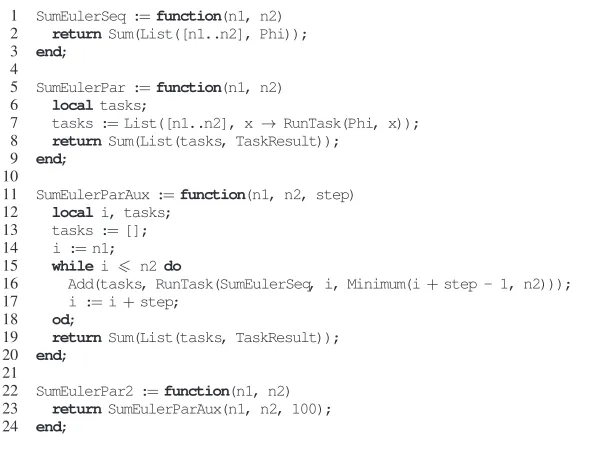
Figure 1 illustrates how to express SumEuler in GAP5, the source cade for this and all other exam-ples is available at [2]. SumEulerSeqis a simple sequential implementation, using the standard GAP implementation of the totient function,Phi. The GAPListfunction implements a functional
mapoperation: taking a list as its first argument and a function or closure as its second, applying that function to each element in the list and returning the resulting list.SumEulerParis a very simple parallelisation of the same code. It starts a task for each number in the rangen1throughn2, then collects the results of those tasks. While simple, this is also inefficient because most computations ofPhi(x)will be very short and the overhead will therefore be high.SumEulerPar2is a more efficient implementation that reduces the overhead by aggregating the data into intervals of size 100.
2.3. Shared regions in GAP5
[image:6.594.155.450.475.700.2]Safe mutable state in GAP5 is handled through the concept of shared regions. A region is a set of GAP objects; each object in GAP5 belongs to exactly one region, and each region has exactly one associated read-write lock. The GAP5 runtime ensures that an object is only accessed by a thread that has either a read or write lock on the region containing the object. Each thread has an
associatedthread-local region, on which it has a permanent write lock. By default, newly created GAP objects are created in the thread-local region of the current thread. The goal of thread-local regions (in particular, the thread-local region of the main thread) is to present programmers with a quasi-sequential environment. This environment is protected against unexpected interference from other threads, because only the thread associated with the thread-local region can ever access it, thus allowing programmers controlled use of concurrency features.
A programmer can create any number ofshared regions. TheShareObj(ob)primitive takes a GAP object as an argument, creates a new shared region andmigratesthe object and all its sub-objects to the shared region. TheShareSingleObj(ob)variant migrates onlyoband not any sub-objects. Objects in a shared region must be accessed using the GAP5atomic statement, as shown as follows.
1 S h a r e d L i s t : = S h a r e O b j ( [ ] ) ; 2
3 AddShared : = f u n c t i o n( x )
4 a t o m i c r e a d w r i t e S h a r e d L i s t do
5 Add ( S h a r e d L i s t , x ) ;
6 od;
7 end; 8
9 L a s t S h a r e d : = f u n c t i o n( )
10 a t o m i c r e a d o n l y S h a r e d L i s t do
11 r e t u r n S h a r e d L i s t [ L e n g t h ( S h a r e d L i s t ) ] ;
12 od;
13 end;
Note that we never operate on a region directly. Theatomicstatement operates on GAP objects, and the corresponding region is inferred by the runtime system. Theatomicstatement also allows the simultaneous locking of multiple regions by providing multiple arguments. These regions are then guaranteed to be acquired atomically and without causing deadlock. The following code fragment illustrates this usage ofatomic.
1 a t o m i c ob1 , ob2 do
2 DoSomethingWith ( ob1 , ob2 ) ; 3 od;
A special case of a shared region is theread-only region. Every thread holds a permanent read-lock for that region, and objects can be migrated to it using theMakeReadOnlyprimitive. This is primarily intended for the convenient storage of large, constant tables in order to access them without the overhead and inconvenience of anatomicstatement.
Objects can be migrated between shared regions or between the current thread-local region and a shared region. Unlike copying, migration is generally a cheap operation, which only changes the region descriptor of the underlying GAP object (a single word). As already men-tioned, ShareObj(ob) implicitly migrates its argument to the new region. More generally, MigrateObj(ob1, ob2)migratesob1and any sub-objects to the region containingob2. For this to succeed, the current thread must have a write lock on both regions. TheAdoptObj(ob) primitive is a special case of MigrateObj that migratesob and any sub-objects to the current thread-local region.
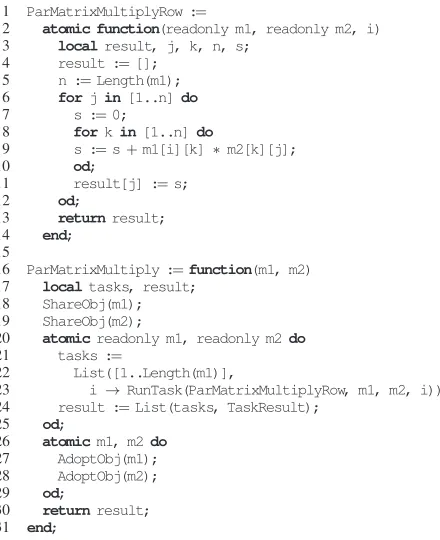
Figure 2. Parallel matrix multiplication in GAP5.
Firstly, in lines 18–19, m1 and m2 are placed in shared regions. Then, in lines 21–23, each row vector of m1 is multiplied withm2 using its own GAP task. Line 24 collects the results. Finally, in lines 26–30, m1 and m2 are migrated to the current thread-local region using atomic calls toAdoptObj.
2.4. Comparison with other parallel computational algebra systems
Symbolic Computation Software Composability Protocol.The computational algebra commu-nity has defined a common protocol for combining computer algebra systems, the SCSCP [48]. Essentially, it is possible to make a remote procedure call from one system to another, and both protocol messages and data are encoded in the OpenMath format. SCSCP compliant components may be combined to solve scientific problems that cannot be solved within a single CAS, or may be organised into a system for distributed parallel computations. The SCSCP has become a
de facto standard for mathematical software with implementations available for seven CAS and libraries for C/C++, Java Haskell, and so on. On a single multicore, GAP5 provides higher per-formance by allowing direct functions manipulating GAP objects, rather than an SCSCP RPC where the function and arguments are encoded as OpenMath XML objects. Moreover, while SCSCP’s explicit RPC mechanism is suitable for small-scale parallel execution, SymGridPar2 scales onto HPCs.
GAP4.The current stable release of GAP4 provides two ways to run distributed memory par-allel computations: (i) the ParGAP package that uses MPI and (ii) an SCSCP package. Both provide basic implementations of theParListskeleton plus low-level tools to develop new par-allel GAP code. Both approaches are prone to limitations of the distributed memory approach concerning serialisation, and so on. In particular, it may not be straightforward or may even be impossible to transmit complex GAP objects from one node to another, limiting performance [50].
decorator concept to add parallel execution functionality to existing methods. While this adds concurrency to the programming model, it does not provide means of explicit synchronisation or communication. Another parallelism primitive is a parallel iterator. The implementation of paral-lelism is also seriously hampered by the central scheduler lock in the Python runtime-system.
Maple supports multithreading on shared memory architectures through a task program-ming model. While its kernel is thread-safe, work on a thread-safe library is still in progress. On distributed memory architectures parallelism is supported by the Maple Grid Toolbox [47]. It is implemented on top of MPI and can be configured in either MPI (cluster) or HPC mode. The latter allows for integration with batch job scheduling middleware, whereas the former is targeted at dynamic, self-assembling Grid infrastructures. In terms of language support for parallelism, the Maple Grid Toolbox mainly provides MPI-level primitives for synchronisation and communication. Support for higher-level primitives is rudimentary and at the moment restricted to a parallel map operation. The older Distributed Maple [37] system, with its higher-level coordination primitives, has been discussed in Section 1.3.
MAGMA is a single-threaded application that does not support parallelism [11]. Distributed memory computations could be emulated by, for example, interfacing multiple copies to Sage, or by using an SCSCP wrapper for MAGMA [48].
TRIP is dedicated to celestial mechanics, specialising in operations with polynomials [51]. Its single-core implementation is multithreaded, reporting good parallel performance on sparse polynomial operations [52], and SCSCP can be used for small-scale distributed memory parallelism.
MATLAB.The MATLAB parallel computing toolbox supports multicores, GPUs and clusters using a number of simple primitives to expose data parallelism and loop-parallelism, based on parallel for-loops [10]. Support for heterogeneous devices is provided through a Cuda interface.
Using the MATLAB Distributed Computing Server, parallelism can be orchestrated on large-scale, distributed memory configurations. The preferred programming mode is data parallelism over the pre-defined data structure of distributed arrays. Additionally, a general map-reduce structure is available. On a lower level, primitives for single-program multiple-data parallelism and explicit message passing are also available.
The current version of MATLAB’s symbolic computation toolbox, MuPAD, does not support parallel computing. However, earlier versions of MuPAD provided master-work parallelism on distributed systems in the form of ‘macro parallelism’ [53].
Mathematica.Starting with Mathematica 7, the internal Wolfram Language also supports paral-lel computation. The focus of the language support is on data-paralparal-lelism, with pre-defined paralparal-lel map and combine operations. Parallel iterators are provided for common data structures. Specu-lative parallelism is also supported, enabling the programmer to try several approaches to solve a problem and pick up the first successful computation. More generally, fork-and-join parallelism can be defined, using lower-level thread creation and synchronisation primitives. However, the language design favours the usage of the higher-level primitives, in particular for defining map-reduce-style computations. Support for heterogeneous devices is provided through separate interfaces to Cuda and to OpenCL. In a distributed memory setting, the parallelism generated by the primitives is man-aged by the gridMathematica system, originally developed for large-scale Grid architectures [54]. This system automatically handles marshalling and communication of data structures, as well as retrieving the results from a remote execution. Through the usage of the higher-level parallelism primitives, the details of the architecture are mostly hidden, although aspects such as communication latency need to be taken into account for parallel performance tuning.
a major technical challenge: GAP is a large dynamically typed, interpreted system, with a complex implementation that manipulates large and complex data structures.
3. MPI-GAP DESIGN AND IMPLEMENTATION
MPI-GAP is an extension of GAP5, which targets distributed-memory systems by building on the
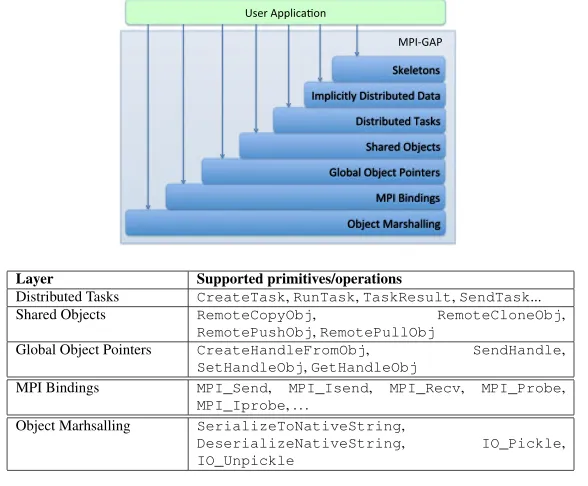
de factostandard MPI message passing library. MPI-GAP provides both a high-level programming model that supports the same set of high-level parallel task constructs as the shared-memory ver-sion of GAP5,CreateTask,RunTask,TaskResult, and so on, and a low-level programming model that offers more control of distributed task and data placement when required. MPI-GAP is implemented in a layered manner (Figure 3), where each layer builds on the constructs provided by the layer below to offer a higher level of abstraction.
Object marshalling layer.This layer consists of operations that transform GAP objects into an equivalent binary representation that can be transmitted using MPI primitives. MPI-GAP currently supports two classes of marshalling operations:native serialisation, implemented as kernel opera-tions, andIO pickling, implemented as GAP-level operations. Native serialisation is much faster, but it is architecture dependent and currently only allows certain GAP objects to be marshalled. IO pick-ling is significantly slower but is architecture independent and more customisable – more data struc-tures are supported, and programmers can provide functions to marshal custom data strucstruc-tures. In general, if an application needs to transfer large amounts of ‘simple’ data (e.g. lists of simple objects and matrices) and the underlying data processing is sufficiently fine-grained, native serialisation is preferred. Conversely, when transferring smaller objects or when the underlying data processing is coarse-grained, IO pickling should be used.
MPI binding layer.This layer consists of GAP bindings to raw MPI functions to send and receive messages, based largely on ParGAP [55]. Currently, only a small subset of MPI functions are sup-ported on the GAP side, including blocking and non-blocking MPI send and receive functions, probing, and so on. Object marshalling primitives must be used to marshal GAP objects so that they can be transmitted using these operations.
[image:10.594.153.447.457.700.2]Global object pointer layer.This layer supports operations on GAP objects (handles) that repre-sent pointers to other GAP objects that may live on remote computing nodes. Handles can be copied
between different GAP processes and can then be used to access the same physical GAP object from different nodes. Handles, and the underlying GAP objects, are managed in a semi-automatic way – handles are created, opened, closed and destroyed manually, but a reference-counting mecha-nism prevents unsafe operations, for example, destroying a handle that exists on multiple distributed nodes and, so, possibly garbage-collecting the underlying object.
Handles are created using theCreateHandleFromObj operation that takes a GAP object and returns a handle to it. Depending on the required level of automatic control, handles can be
read-only, read-write or volatile. Objects referred to by read-only handles can be freely copied between nodes, but cannot be modified using SendHandle, GetHandleObj or SetHandleObj. Objects referred to by read-write handles can be freely modified, but the underlying objects cannot be copied between nodes. They can, however, be migrated. Finally,
volatilehandles are unrestricted, that is, a programmer has full control and is responsible for han-dling consistency of cached copies, and so on. Handles can be transferred between nodes using the SendHandle operation. They can be read and modified using the GetHandleObj and SetHandleObjoperations.
[image:11.594.157.439.357.708.2]Shared object layer.This layer supports operations on objects that are shared between multi-ple distributed nodes and accessed via handles from the global object pointer layer. Objects can be copied using theRemoteCopyObjorRemoteCloneObjoperations and migrated using the RemotePushObj and RemotePullObj operations, where, in each case, the first version is used by the sender and the second by the recipient. Depending on the handle type, certain oper-ations might be prohibited for safety reasons, for example, RemoteCopyObj is prohibited on read-write handles.
Distributed task layer.This layer supports the same task creation and management operations as shared-memory GAP5, for example,CreateTask,RunTaskandTaskResult. In addition, it also supports explicit task placement using theSendTaskoperation. Task distribution between nodes in MPI-GAP uses a random work stealingwork stealing approach, which has been shown to perform well in low-latency settings. Tasks that are not yet executed are kept in node-localtask pools. Each node apart from the master starts in theidle mode and requests work from another randomly chosen node. If a node that has more than one task receives a message requesting work, it offloads one of its tasks. This distributes tasks among the nodes on an as-needed basis.
3.1. SumEuler in MPI-GAP
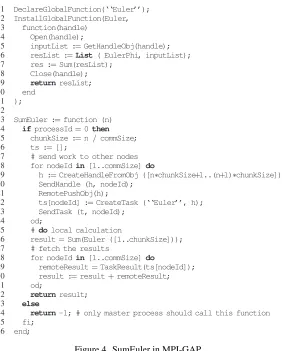
Figure 4 shows the implementation of SumEuler in MPI-GAP. Line 1 declares a global function to map the Euler totient function over a list of values and sum the results. In lines 2–11, we implement this function, passing it a handle to a list of positive integers. We first open the handle (line 4), in order to inform the reference-counting mechanism that the handle is in use by the current thread. We then read the list that the handle points to (line 5). After applying the EulerPhi function to all of the elements of the list, to produce a list of results resList (line 6), we close the handle (line 8) to inform the reference-counting mechanism that the current thread has finished using the handle.
The main function, SumEuler (lines 12–35), is only called by a master GAP process (i.e. the GAP instance that controls the execution). We first determine the sizes of the chunks of work that will be sent to each worker GAP process (line 15) and initialise a list of tasks (line 16). For each worker process, we create a handle to a list of positive integers (line 19), send the handle to the worker process (line 20), migrate the actual list (line 21), create a task that calls the Euler function on the handle (line 22) and finally send the task.
The program implementseagerwork distribution by explicitly assigning tasks to the processes. After sending work to each worker process, the master process does its own chunk of work (line 26), and then fetches and sums the results of the tasks (lines 28–31).
4. THE DESIGN AND IMPLEMENTATION OF SYMGRIDPAR2
SymGridPar2 (SGP2) is middleware for coordinating large-scale task-parallel computations distributed over many networked GAP instances. SymGridPar2 inherits its architecture, and specifi-cally, its skeleton-based programming model, from SymGridPar [56]. The key new feature is the use of HdpH (Haskell distributed parallel Haskell), a novel domain-specific language(DSL) for task-parallel programming on large-scale networks, including HPC platforms. The SGP2 middleware comprises three layers:
1. the HdpH DSL for parallel coordination, embedded into Haskell (Section 4.1); 2. a Haskell binding for GAP (Section 4.2); and
3. a set of algorithmic skeletons, written in HdpH and calling into GAP (Section 4.3).
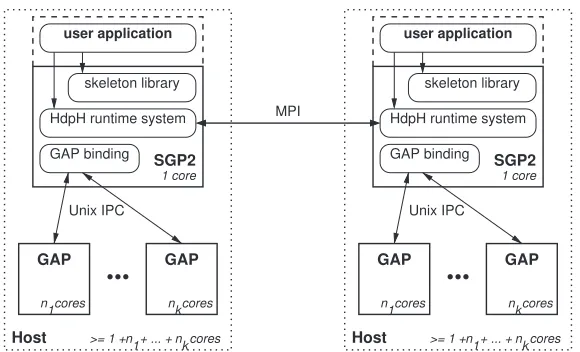
Figure 5 illustrates the SGP2 architecture and its interaction with GAP. In the figure, the outer dotted rectangles represent a host, possibly multi-core, and while two instances are shown, there may be an arbitrary number. The solid rectangles represent operating system processes, and the arrows represent communication.
The intention is that a GAP program invokes appropriate skeletons, essentially GAP functions with parallel semantics, for example,parList([40..60], fibonacci)may create 21 tasks to compute the Fibonacci function of the integers between 40 and 60. The GAP skeleton corresponds to an HdpH skeleton that distributes the subproblems to multiple hosts where they are passed to local GAP instances to be solved, and the solutions are returned to the caller.
Figure 5. SymGridPar2 architecture.
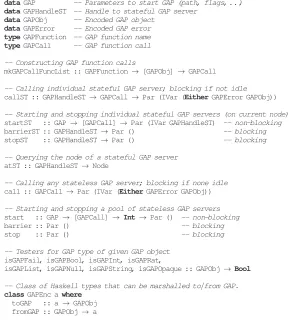
Figure 6. Type signatures of a minimal HdpH API.
communication layer. Tasks will typically call GAP functions through the GAP binding. Each SGP2 instance can transparently coordinate a pool of several GAP4 or GAP5 servers running on the same host. Communication between SGP2 and these GAP servers is via Unix IPC. SGP2 requires one dedicated core per host, the remaining cores can be used by GAP servers. On ann-core host, one SGP2 instance will typically coordinaten1GAP4 instances or a single GAP5 instance running
n1threads. To reduce memory bus contention on large Non-Uniform Memory Access (NUMA) servers, it is also possible to coordinate several multi-threaded GAP5 instances, each bound to its own NUMA region. Section 5.4 contains some example deployments.
4.1. Coordination DSL
SGP2 exposes parallel patterns to the programmer asalgorithmic skeletons[15], implemented in
HdpH. HdpH is described in detail elsewhere [57, 58], and here, we discuss only the small part of the API which users of the SGP2 skeleton library are exposed to, as outlined in Figure 6. As is cus-tomary in functional programming languages, the HdpH DSL is embedded into the host language, Haskell, by wrapping DSLcomputationsin a special computation type. In HdpH, this is performed by the Partype constructor, which forms a monad, the standard Haskell construct for effectful computations. Almost all HdpH and SGP2 primitives create or transformParcomputations; ulti-mately, an SGP2 program is one largeParcomputation. The primitiverunParIOtakes such a computation and executes it on the HdpH runtime system.
As a distributed DSL, HdpH exposes locations (i.e. hosts) as values of type Node. SGP2 programs can query the current node and obtain a list of all nodes by calling the primitives myNodeandallNodes, respectively. Crucially, the API in Figure 6 does not list any primitives for creating or distributing paralleltasks. This functionality is hidden in the skeletons discussed in Section 4.3.
4.2. GAP binding
HdpH is a DSL for coordinating task-parallel computations. Ordinarily, HdpH tasks evaluate function calls in Haskell. To coordinate computations in GAP, SGP2 has to provide a way to call from HdpH into GAP. This is performed by providing aGAP binding, that is, a library of Haskell functions to call GAP functions, including marshalling arguments from Haskell to GAP and results from GAP to Haskell.
Additionally, the GAP binding also provides functions for starting and stopping GAP servers. Each HdpH node can launch one or more GAP servers, running as independent operating system processes on the same host as the HdpH node and communicating via pipes. The API distinguishes between statefulGAP servers, each with a distinct identity, andstatelessGAP servers, which are anonymous and interchangeable.
[image:14.594.152.441.377.703.2]4.2.1. Controlling stateful GAP servers. Figure 7 shows the HdpH API for controlling GAP servers; primitives ending inSTare concerned with stateful servers. HdpH can start a GAP server by calling startST, which expects information on how to call GAP and a list of GAP function calls used to initialise the server. The primitive startSTimmediately returns a future that will eventually provide a handle to the GAP server, once the server is up and running. The primitive
barrierSTtakes a server handle and blocks until the server isidle, that is, no longer busy execut-ing a previous function call. Similarly,stopSTblocks until the server is idle and then terminates the server (after which the handle is void). Finally, the primitivecallSTposts a function call to the given server. It blocks until the server is idle and then immediately returns a future that will eventually yield either an error or the result of the call. GAP function calls (type GAPCall) are simply strings. For convenience, they can be constructed by applying a GAP function name (type GAPFunction) to a list of encoded GAP objects using the functionmkGAPCallFuncList; the encoding is discussed in Section 4.2.3.
Note that all primitives operate on stateful GAP servers running on the same host as the calling HdpH node; calls to distributed stateful GAP servers are provided by the higher-level skeletons discussed in Section 4.3. More precisely, any stateful GAP server can only be controlled by the HdpH node that started it, as identified by the primitiveatST, and a GAP handle is only valid on the node indicated byatST.
4.2.2. Controlling stateless GAP servers. Many SGP2 applications interact with GAP in a stateless fashion, that is, GAP calls are proper function calls that do not manipulate hidden state on the server. For this case, HdpH offers primitives to coordinate a pool of stateless GAP servers.
The stateless primitives mirror the stateful ones (Figure 7). Thestartprimitive takes the same information about calling and initialising GAP. Of course, the GAP calls used to initialise a state-less GAP server, like startST, change the system state, that is, are themselves stateful. The start function takes an additional pool size argument and returns nothing. The choice of pool size is critical for performance, for example, performance suffers if the pool size exceeds the num-ber of physical cores. Because stateless servers are interchangeable, they can be anonymous, so there is no need to return a handle. The primitivesbarrierand stopbehave like their state-ful counterparts, except that they block until the whole pool of servers is idle, and terminate the whole pool.
The primitivecallposts a function call to any stateless server. It blocks until a server is idle and then immediately returns an IVar that will eventually yield either an error or the result of the call. Note that the GAP function call is expected to be stateless in the sense that any side effects on the GAP server do not affect subsequent calls. Violating this restriction may result in unpredictable behaviour.
4.2.3. Marshalling data to and from GAP. Marshalling data between GAP and HdpH requires an encoding and a Haskell representation of encoded GAP objects; the latter is provided by the data typeGAPObj. AGAPObjcan represent the GAP constantFail, GAP Booleans, GAP integers, GAP rationals, lists of GAP objects, the empty GAP list[], GAP strings oropaqueGAP objects; opaque objects are all those that are not explicitly listed in the aforementioned enumeration. The encoding assumes that GAP can print the object to be marshalled into a string that can be parsed back later; objects that do not support this need to be explicitly serialised to a GAP string prior to marshalling.
The bottom of Figure 7 displays the API for accessingGAPObjs. There are a number of func-tions testing which GAP type the encoded GAPObj represents. And there are two overloaded functions toGAP and fromGAP, defined on types instantiating class GAPEnc, for encoding to and decoding fromGAPObj. The Haskell types, which are instances ofGAPEnc, are the standard base types(),Bool,IntegerandRational, as well asByteString(which encodes GAP strings). Standard list, pair andMaybedata types can also be encoded, provided their components are encodable.
4.3. The SymGridPar2 programming model
SGP2 exposes parallel patterns to the programmer as algorithmic skeletons [15] where the com-putations coordinated are GAP functions. Figure 8 lists some basic SGP2 skeletons for starting, stopping and calling stateful and stateless GAP servers. These skeletons use the coordination features of HdpH to extend the scope of the GAP binding in that they transparently control GAP servers beyond the current node.
ThestartGAP skeleton initiates starting a stateful GAP server on a remote node (using the primitive startST); it returns a future that will eventually, when the server is up and running, yield a handle. ThestartGAPEverywhereskeleton starts pools of stateless GAP servers on all nodes (using the primitivestart). However, unlikestartGAP, this skeleton blocks until all GAP servers are up and running, and then returns nothing. The started GAP servers can be terminated bystopGAPandstopGAPEverywhere; both skeletons block until the servers in question have actually quit.
ThepushGAPCallskeleton is a generalisation of the primitivecallSTfor calling a stateful GAP server on any node, transparently marshalling call and result across the network. The skeleton returns a future, which will eventually hold the result of the call. In contrast, theparGAPCalls skeleton is a generalisation of thecallprimitive for calling stateless GAP servers, handling both lists of calls as well as balancing load between all GAP servers in the system (relying on HdpH ran-dom work stealing). UnlikepushGAPCall, theparGAPCallsskeleton blocks and only returns the list of results after the last result has come in; the skeleton will return the empty list if any of the GAP calls failed.
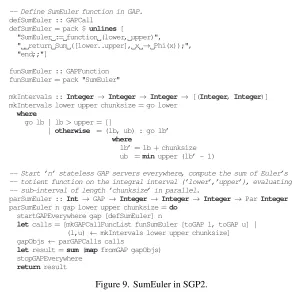
4.3.1. SumEuler in SymGridPar2. Figure 9 shows the implementation of the SumEuler example in SGP2. The parSumEulerstarts a number of GAP servers before computing the sum of Euler’s totients in parallel. The computation divides the input interval into smaller chunks and then pro-ceeds by using the skeleton parGAPCalls, converting its results (GAPObjs encoding integers) into Haskell integers, and summing up. Incidentally starting GAP servers may take several sec-onds and hence is usually performed at the start of an application rather than immediately before parGAPCallsas here.
The list of GAP calls passed toparGAPCallsconsists of calls to the GAP functionSumEuler, the definition of which is passed to every GAP server during the start up phase coordinated by startGAPEverywhere. In Haskell, this function definition is a literal string embedded into the Haskell code. Alternatively, the definition can be read from a file.
Figure 9. SumEuler in SGP2.
4.4. Advanced features
The capabilities of SymGridPar2 described so far match largely those of SymGridPar. SGP2 goes beyond SGP in its support for large architectures. Where SGP assumes a uniform communication latency between any two cores, SGP2’s scheduling algorithm can take into account a non-uniform hierarchy of latencies; such latency hierarchies are common in large compute clusters.
Abstract model of hierarchical distances. The coordination DSL HdpH exposes node-to-node latencies abstractly to the programmer as distances in a metric space. More precisely, the distance between nodes is a real-valued binary function satisfying the axioms ofultrametric spaces. As a result, the programmer need not be concerned with actual latencies and can instead express task scheduling constraints in terms of relative distances likehere,close byorfar away. We refer the reader to [58] for more detail about ultrametric distances in HdpH.
Task schedulingHdpH offers two modes of work distribution: on-demand implicit task placement and eager explicit task placement.
On-demand implicit task placementis realised by a distributed work stealing algorithm. Upon creation, a task is stored in the creating node’s local task pool. Stored with the task is itsradius, as chosen by the programmer. The task radius is the maximum distance the task may travel away from its originating node. HdpH’s work stealing algorithm is based on random stealing and has two properties relating to radii: the task radius is a strict bound on the distance between victim and thief; thieves prefer to steal tasks within small radii. The radius can be viewed as expressing asize constrainton a task, where larger radii mean bigger tasks. Adopting this view, HdpH’s work stealing algorithm prefers to keep small tasks near their originating nodes, similar to [59], in the hope of minimising communication overheads related to work stealing.
On-demand random task placement performs well with irregular parallelism. However, it tends to under-utilise large scale architectures at the beginning of the computation. To combat this drawback, HdpH offerseager explicit task placementas a complementary placement mode. Explicit placement ships tasks to selected nodes, where they are executed immediately, taking priority over any implic-itly placed tasks. Eager execution implies that these tasks are meant to perform coordination, e. g. create further tasks, rather than actual computation.
The downside of explicit placement is that the programmer has to select target nodes, which may jeopardise portability. Fortunately, HdpH’s abstract ultrametric distances offer some help for the purpose of flooding large architectures with work. More precisely, the HdpH runtime iden-tifies an equidistant basis, that is, a maximal set of nodes such that any two basis nodes are maximally far apart. At the beginning of a parallel computation, the programmer can explicitly place large tasks at the basis nodes, where each will generate smaller tasks that can be stolen quickly by nearby nodes; stealing may or may not be bounded, depending on the irregularity of the small tasks.
SGP2 offers a number of skeletons implementing such atwo-level task distribution, for example, theparMap2LevelandparMap2LevelRelaxedskeletons used in Section 5.3, and detailed in [4].
Reliability. The coordination DSL HdpH is designed for transparent fault tolerance and [60] presents an alternative work stealing scheduler that monitors nodes and pessimistically replicates tasks that may have been lost to node failure. The fault tolerant work stealing is shown to have low runtime overheads. The fault tolerance properties of HdpH are, however, not yet inherited by SGP2 because the current GAP binding is not fault tolerant.
5. PERFORMANCE EVALUATION
This section reports a performance and interworking evaluation of the HPC-GAP components. The primary comparators are the SumEuler benchmark implementations from the preceding sections, although we investigate some GAP5 concurrency overheads using microbenchmarks. We measure strong scaling, that is, speedups and runtimes, for GAP5 on a multicore (Section 5.1), and for MPI-GAP and SymGridPar2 (Sections 5.2 and 5.4) on Beowulf clusters. Only weak scaling is appropriate for large architectures, and we measure SymGridPar2 on up to 32K cores of the HECToR HPC (Section 5.3).
Section 5.2 demonstrates the interworking MPI-GAP and GAP4, and Section 5.4 demonstrates the interworking SymGridPar2 with both GAP4 and GAP5.
5.1. GAP5 evaluation
We consider both the overheads on sequential programs introduced by managing concurrency in GAP5 and demonstrate the performance gains that can be obtained through parallelisation.
5.1.1. Sources of concurrency overheads. GAP5 exposes essentially the same programming language and libraries as GAP4, augmented with the task and region features described in Section 2. However, supporting multithreading requires many, and often significant, changes even where the functionality is unchanged. While these changes should be transparent to GAP programmers, they affect the performance of purely sequential code. These performance differences can be attributed to one or more of the following factors.
2. Memory allocation in GAP4 occurs through a very fast bump allocator made possible by the compacting garbage collector. Memory allocation in GAP5 is more complicated in that it has to support concurrent allocation, which incurs a small, but non-zero, overhead. Most allocations occur through the thread-local allocator, which is nearly as fast as the GAP4 bump allocator, but larger chunks of memory cannot be handled this way and require that their allocation be serialised.
3. To ensure memory safety, the GAP5 kernel code had to be instrumented with checks that no GAP object is being accessed without the corresponding lock being held. Like bound checks for arrays, this incurs an unavoidable overhead. While this instrumentation can be disabled if speed is essential, it is generally assumed that users want these checks to be enabled when running parallel code. The instrumentation is currently performed (almost) fully automatically by a separate tool as part of the build process that performs dataflow analysis and attempts to optimise the instrumentation (such as hoisting checks out of loops). This automated instru-mentation can be manually overridden where the optimiser fails to correctly identify such possibilities, though so far, we make very little use of that.
4. The current GAP5 implementation does not yet fully support GAP-to-C compilation for all new features. As a result, some core GAP modules that are compiled in GAP4 are still being interpreted in GAP5.
5. A few internal data structures of the GAP kernel had to be redesigned in order to make them thread-safe. One example is the implementation of global variables in GAP, which required non-trivial changes to ensure that multiple threads can access them concurrently, even where they, and their contents, are immutable.
The overhead varies from program to program, and the combined effect of the concurrency over-heads is that sequential code typically executes between 10% and 40% more slowly in GAP5 than in GAP4, based on our observations with various synthetic benchmarks and existing GAP code. Sections 5.1.3 and 5.3 report the overheads for specific programs, and it is reassuring to see that the overheads fall as the parallel system scales. We also expect to be able to eliminate the remain-ing avoidable overheads in the medium term. Nevertheless, our plans for GAP5 include a purely sequential build option for code that cannot effectively exploit parallelism.
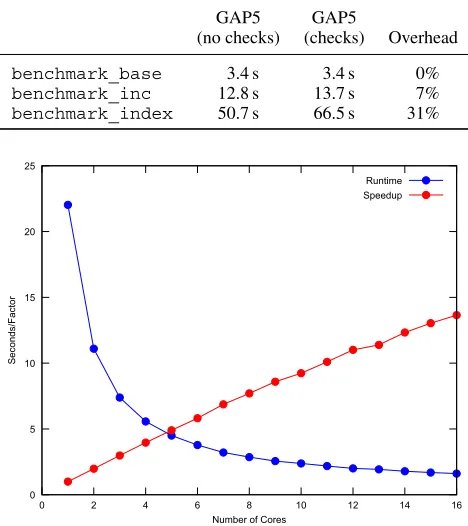
[image:19.594.225.368.491.696.2]5.1.2. Quantifying concurrency overheads. The first GAP 5 concurrency overhead we investigate is that of instrumenting the GAP5 kernel with guards against race conditions. We execute the
Table I. GAP5 instrumentation runtime overheads.
GAP5 GAP5
(no checks) (checks) Overhead
benchmark_base 3.4 s 3.4 s 0%
benchmark_inc 12.8 s 13.7 s 7%
benchmark_index 50.7 s 66.5 s 31%
Figure 11. GAP5 SumEuler runtimes and speedups (multicore).
micro-benchmarks in Figure 10 with and without instrumentation, taking the median value over five runs. All of the micro-benchmarks allocate only a small and fixed amount of memory and do not access global variables, so neither garbage collection nor global variable access has a measurable effect on their performance. Measurements in this section are performed on a 64-core machine with AMD Opteron 6376 processors.
The results in Table I show that forbenchmark_basethere is almost no overhead for a basic for loop. The benchmark_inc result shows that there is a small amount of overhead for performing local variable increments. Thebenchmark_indexresult shows that there is around a 33% overhead (after subtracting the time for the for loop) for performing increments on an array element. In fact, there are no checks in the C code that performs local variable increments, so the performance differences forbenchmark_incare probably due to other effects, such as changes in memory locality as a side effect of instrumentation.
The overhead forbenchmark_indexis not surprising, because for each iteration, three checks are performed. This is suboptimal as our tool inserts two checks for the assignment (one, before checking that the length of the list is at least 1, and another, before performing the assignment) where one would suffice. So the overhead could be reduced by a third.
Garbage collection overhead can vary greatly by workload. Allocating many short-lived objects can result in an overhead of 30% or more; more typical for GAP applications is an overhead in the range of 10%–20%. In cases where allocations of long-lived objects dominate, the GAP5 garbage collector can also be faster than the GAP4 garbage collector, as it can parallelise its work, while the GAP4 garbage collector gains little from its generational features.
Figure 11 shows the runtime and relative speedup of the GAP5 SumEuler up to 16 cores, taking the median value of three successive runs. The sequential SumEuler runs in 16.5 s on GAP4, so GAP5 (22.0 s) is 33% slower.
5.2. MPI-GAP evaluation
We investigate the performance of the MPI-GAP version of SumEuler outlined in Section 3.1 (page 3617). The evaluation was conducted on a 32-node Beowulf cluster, with each node having 8-core Intel Xeon E5504 2 GHz processor with 16 GB RAM. One node was designated as a master node, and it distributes chunks of work to the slave nodes, who then execute them on a single-threaded GAP4 instance. To exercise a cluster, the input is larger than that for a single GAP5 instance in Section 5.1.3.
The runtime for a single-threaded GAP4 SumEuler computation is 211.7 s, and for the MPI-GAP version on one node is 217.3 s. So the overhead incurred by the MPI-GAP on a single node is approximately 3% for this benchmark. The MPI-GAP runtime on 32-nodes is 9.9 s. These runtimes are reflected in the speedup graph in Figure 12, which shows near-linear speedups up to a maximum of 22 on 32 cores.
5.3. SGP2 evaluation
[image:21.594.224.368.398.520.2]We investigate the performance of the SymGridPar2 version of SumEuler outlined in Section 4.3.1 (page 16) on the HECToR supercomputer. At the time (2013), HECToR was the UK’s largest pub-lic HPC with approximately 90 000 cores [61]. Figure 13 studies weak scalingof two variants of the SumEuler benchmark from 1 to 1024 HECToR nodes (i.e. 32 to 32K cores). The two variants differ only in their use of the underlying skeleton: One usesparMap2Level, and the other uses parMap2LevelRelaxedboth outlined in Section 4.4.
Figure 12. MPIGAP SumEuler speedups (Beowulf cluster).
[image:21.594.181.407.555.692.2]The benchmarks start with an input interval of 6.25 million integers on 32 cores, doubling the size of the interval as the number of cores doubles, so that on 32K cores, for example, the interval is 6.4 billion integers long. Doubling the size of the input interval increases the amount of work by more than a factor of 2; by sampling the sequential runtime of small subintervals, we estimate a runtime curve for ideal scaling.
The runtime graphs in Figure 13 show that the two benchmarks do not scale perfectly. However, even on 32K cores, their runtimes are still within 50% of the ideal. Efficiency is calculated with respect to the estimated ideal scaling, and the curves show that efficiency declines steadily, yet remains above 70% even on 32K cores. These graphs also show that theparMap2LevelRelaxed skeleton offers a small efficiency advantage (of 3–4%) over parMap2Level. This is probably becauseparMap2LevelRelaxedcopes better with the irregularity of the benchmark in the final stages of the computation, because unlikeparMap2Level, it can utilise nodes that have run out of work early.
5.4. HPC-GAP interworking
Section 5.2 demonstrated MPI-GAP coordinating single-threaded GAP4 servers, and this section focuses on the performance implications of SymGridPar2 coordinating GAP4 (version 4.7.6) and multi-threaded GAP5 (version alpha_2015_01_24) servers. We investigate the speedup of SumEuler on the interval Œ1; 108 on a Beowulf cluster with 256 cores, distributed over 16 nodes (Intel Xeon CPUs, 2 GHz, 64 GB RAM per node). The input interval is subdivided evenly into subintervals, and the SGP2 instances distribute the resulting SGP2 tasks by work steal-ing. When co-ordinating GAP4, each SGP2 instance further subdivides the current task interval and distributes calls to function SumEulerSeq(Figure 1) to 15 single-threaded GAP4 servers. When co-ordinating GAP5, each SGP2 instance calls a single GAP5 server (running on 15 cores) which in turn subdivides the interval and uses the GAP5RunTaskprimitive to evaluate calls to SumEulerSeqon subintervals in parallel.
[image:22.594.140.460.477.694.2]Table II records optimal values for the numbers of SGP2 tasks, GAP calls per SGP2 task and GAP tasks per GAP call. These optima are determined by exhaustive experiment. The table also reports sequential runtimes for GAP4 and GAP5, from which the average runtime of a GAP task, that is, mean time to computeSumEulerSeq, is derived. Given the discussion of GAP5 overheads in Section 5.1, it is unsurprising that the sequential GAP5 runtime is 24% greater than for GAP4.
Table II. SGP2 with GAP4/GAP5 optimal configurations and runtimes.
Seq. SGP2 GAP calls per GAP tasks per Mean GAP runtime tasks SGP2 task GAP call task runtime
SGP2/GAP4 2160.0 s 320 15 1 450 ms
SGP2/GAP5 2836.1 s 400 1 300 24 ms
Figure 15. SGP2 with GAP4 and GAP5 SumEuler speedups (Beowulf).
Figures 14 and 15 show log/log plots of runtime and absolute speedup for SGP2/GAP4 and SGP2/GAP5. The numbers of SGP2 tasks, GAP calls and GAP tasks are fixed to the optimal values from Table II, and the runtime data is the median over 11 runs. We find that variance, measured as standard error, is consistently between 1% and 2%.
Figure 14 shows that while SGP2/GAP4 has consistently lower runtime, the advantage falls from about 24% on one core to 6% on one node to only about 2% on 16 nodes. The absolute speedups in Figure 15 are computed with respect to the sequential runtime of the respective GAP version. The curves show that both systems scale similarly, yet the speedup of SGP2/GAP5 is consistently about 25% greater than for SGP2/GAP4. On 1 node, SGP2/GAP5 achieves an absolute speedup of 11.5, corresponding to 76% efficiency: ideal speedup is 15 because only 15 cores are available to GAP while the 16th core is dedicated to SGP2. On 16 nodes, SGP2/GAP5 efficiency drops to 71%, corresponding to a speedup of 170.
Symbolic computations are memory hungry, and on large shared-memory architectures, SGP2/GAP5 can use a small number of GAP processes (possibly just one), where SGP2/GAP4 must use as many GAP4 processes as there are cores. Sampling memory residency for SumEuler (using Unix tools like ps) consistently shows a total per-node residency of SGP2/GAP4 (i.e. 15 GAP4 processes plus 1 SGP2 process) of about 2 GB. In contrast, the residency of SGP2/GAP5 (one GAP5 process plus one SGP2 process) is only 240 MB, or approximately 1/8th of the residency of SGP2/GAP4.
In conclusion, SGP2/GAP5 is able to almost entirely eliminate the GAP5 overheads by achiev-ing better speedups even on mid-scale parallel architectures. While we have not been able to demonstrate SGP2/GAP 5 outperforming SGP2/GAP4, we anticipate this may happen on larger architectures. A second advantage of SGP2/GAP5 over SGP2/GAP4 is greatly reduced memory residency on large shared-memory architectures.
6. CASE STUDIES
We present two case studies to demonstrate the capability of the HPC-GAP components to deliver good parallel performance for typically irregular algebraic computations on both NUMA and HPC architectures.
6.1. Orbits in GAP5
Enumerating an orbit is a typical algebraic computation and can be described as follows.
Definition 1 (Orbit of an element)
LetXbe a set of points,Ga set of generators,f WXG!Xa function (wheref .x; g/will be denoted byxg) andx02Xa point inX. Theorbitofx0, denoted byOG.x0/, is the smallest set
Figure 16. Sequential Orbit pseudocode.
1. x0 2T
2. for ally2T and allg2Gwe haveyg2T.
Often the setXcan be very large and is not givena priori.
The sequential orbit algorithm in Figure 16 maintains a hash tableT of orbit points discovered so far and a listU of unprocessed points. The hash table facilitates a fast duplicate test (line 6). Initially bothT andU contain onlyx0, and thereafter, we iterate, in each step removing the first pointxfromU, applying all generatorsg 2Gtox and adding any new points to bothT andU. The computation terminates when there are no unprocessed points (line 2).
As an example of how the algorithm works, letXD ¹1; 2; 3; 4; 5º,x0 D2,GD ¹g1; g2ºandf be given by the following table:
x 1 2 3 4 5
xg1 1 3 2 4 5
xg2 5 2 4 3 1
The following table shows the steps in evaluating the orbitT ofx0:
Step 1 2 3 4
T ¹2º ¹2; 3º ¹2; 3; 4º ¹2; 3; 4º
U Œ2 Œ3 Œ4 ;
6.1.1. The parallel orbit skeleton. At first glance, it may seem that the sequential Orbit algorithm can be parallelised by carrying out step 5 for all generators and all points inU independently. How-ever, synchronisation is required to avoid duplicates (steps 6–8), and this requires communication among the tasks that apply generators to different elements ofU.
Our Parallel Orbit skeleton uses two different kinds of threads:
Hash serverthreads, which use hash tables to determine which points are duplicates, and Workerthreads that obtain chunks of points from hash servers and apply generators to them,
so producing new points.
Figure 17. Parallel Orbit worker pseudocode.
Figure 18. Parallel Orbit hash server pseudocode.
can write to any of these channels. We also maintain a single shared channel for the work queue. Because of the chunking mechanism, this is not a bottleneck.
6.1.2. Performance results. This section presents a preliminary evaluation of our Parallel Orbit skeleton on a shared-memory machine consisting of four AMD Opteron 6376 processors, each comprising 16 cores (giving us a 64-core system). Each core runs at 1.4 GHz and has 16 Kb of pri-vate L1 data cache. In addition, each processor has 864 Kb of L1 instruction caches and 82 Mb of L2 caches (shared between two cores) and 28 Mb of L3 caches (shared between eight cores). As an instance of an Orbit enumeration, we consider the sporadic finite simple Harada-Norton group in its 760-dimensional representation over the field with two elements, acting on vectors. The setX of all possible points consists of about10228 elements. The size of the orbit is 1.4 mil-lion points, and we are using ten random generators. On each figure, we consider mean speedups over five runs of the same instance. We have also added error bars in the cases where error margin was notable.
The sequential runtime of this orbit calculation on our test machine was 250 s. Additional exper-iments with larger instances and a sequential runtime of 1514 s produced similar runtimes and speedups. Figure 19 shows the absolute speedups over the sequential Orbit algorithm that we have obtained with 1 to 4 hash server threads, and 1 to 32 worker threads. We can observe good speedups, up to 23 with four hash servers and 28 worker threads (so, using 32 cores in total). We can also observe that about seven workers produce enough points to fully load one hash server. Also, for a fixed number of hash serversh, the speedups grow almost linearly with the increase in the number of workers. Once the number of workers reaches7h, we do not observe further increase in speedups. Note further that, on our testbed, it is not possible to obtain linear speedups, because of frequency scaling of cores when multiple cores are used at the same time. Therefore, the figure also shows the ideal speedups that could be obtained. The ideal speedup onncores was estimated by taking the runtime of the sequential Orbit algorithm in one thread‡and then dividing it byn. We obtain similar results on other shared-memory architectures [5].
[image:25.594.154.438.210.311.2]Figure 19. GAP5 Harada-Norton Orbit speedups (NUMA).
Figure 20. GAP5 Harada-Norton Orbit speedups with seven or eight hash servers (NUMA).
To test the scalability further, Figure 20 shows the speedups obtained on the same machine with seven and eight hash servers, and up to 57 workers, therefore using all 64 cores in the system. The speedups steadily increase in both cases from 18 to 35 (with seven hash servers) and 36 (with eight hash servers). The fact that the speedup obtained is suboptimal can be attributed both to the problem itself, because in these cases, the bootstrapping and finishing phases (where not enough points are available to utilise all workers) become dominant, and to the hardware, because there are only 16 memory channels, which limits the memory access when more hash servers and workers are used.
6.2. Hecke algebras in SGP2
[image:26.594.143.457.400.541.2]