Munich Personal RePEc Archive
Identity, Authority and Evolution of
Order: the trajectory of dueling
simulated
Behrooz Hassani-Mahmooei, Behrooz and Vahabi, Mehrdad
Department of Econometrics and Business Statistics, Monash
University, Department of Economics, University of Paris 8 and
Centre d’Economie de la Sorbonne
January 2013
1
Identity, Authority and Evolution of Order:
the trajectory of dueling simulated
Behrooz Hassani-Mahmooei and Mehrdad Vahabi
Department of Econometrics and Business Statistics, Monash University
Department of Economics, University of Paris 8 and Centre d’Economie de la Sorbonne Phone: (0061) (03) 9905 8416
Email: [email protected]
Abstract
Borrowing from public choice literature, while aristocratic civil wars can be regarded as anarchy,
and the monopoly of violence by the state as Leviathan, duel of honor is an orderly anarchy. The
sudden or gradual withering of duel of honor as an institution marks the transition to the monopoly
of violence by the state in Europe. In this paper, we endeavor to capture this transition by
introducing a computational model where a simulated agent considers three sets of factors to make
its dueling decision: 1) its own characteristics such as dueling skill; 2) its identity such as the
reaction received from other members of its own social group; and finally 3) the reaction of the
authority such as the possible punishment that could be inflicted by the state against dueler. These
factors then interact through a dynamic utility function affected by both optimization and learning
processes. The results of our agent-based computational model which are validated against the
historical evidence from England, France, and Germany show that a complex, aggregative historical
process may be consistently explained on the basis of rational choice of heterogeneous individual
agents conditioned by their group identity and authority (organizational) influence.
Keywords: Agent-based Computational Economics, Conflict theory, Duel of honor, Identity
Economics, Orderly anarchy.
2 I. Introduction
In July 2012, the journal of Public Choice published a manuscript by Richard Wallick on the potential advantages of applying agent-based modeling (ABM) in analyzing public choice systems where he also reviewed the significant legacy of Gordon Tullock as “one of the founders” of using ABM in social sciences. Wallick insightfully discusses how over his fruitful research career, Tullock “never loses sight of the fact that agent behavior is the key to understanding any problem in the public choice” (Wallick, 2012, 236).
In this paper, following the approach that Tullock and many other scholars have practiced over the
last few decades, we present a model which to our knowledge for the first time, borrowing Schelling’s (1978) terms, associates individual economic “micro-motives” of duel of honor with the socio-political patterns of dueling “macro-behavior” – presented as duration and intensity of
practicing dueling in a simulated environment.
Duel of honor is one of the best indicators of political transition from the older feudalism of
fragmented political power to a stronger, centralizing monarchy that lasted much longer in France than in England, and longer in Germany than in France. This process corresponds to Hobbes’s transition from anarchy to Leviathan. Borrowing from public choice literature, while aristocratic
civil wars can be regarded as anarchy, and the monopoly of violence by the state as Leviathan, duel of honor is an ‘orderly anarchy,’1
because it entails extra legal or illegal strictly codified and
regulated private conflict.
Duel of honor is “a fight between two or several individuals (but always equal numbers on either side), equally armed, for the purpose of proving either the truth of a disputed question or the valor,
courage and honor of each combatant. The encounter must be decided or accepted jointly by both
parties and must respect certain formal rules, be they tacit, oral or written, which will give it the weight of a legal proceeding, at least in the eyes of the two adversaries” (Billacois, 1990, 5). Dueling is thus a strictly codified private fight2, negotiated and mediated by seconds. Duel of honor should be distinguished from both the judicial duel (trial by combat)3 and dueling for chivalry
1For a detailed discussion of ‘orderly anarchy’, see Powell and Stringham (2009). 2
Two treaties about the code of dueling were published in the 1590s (Stone, 1965, 245). Many codes of dueling were published since, including the code duello adopted at the Clonmel Summer Assizes, 1777; this contained 26 rules which were reprinted in Truman (1883, 48–53).
3
The eminent French sociologist, Gabriel Tarde (1892, 30) distinguished judicialduel from German’s divinatory duel,
3
(Baldick, 1965, 11–32). The judicial duel was presided over by a public authority, i.e. the sovereign
prince, whereas duel of honor was usually illegal4 and privately organized.
The judicial duel can be traced back to A.D. 501, but the duel of honor was first described in Italy by ‘doctors of duels’ or ‘professors of honor’ from the 1360s (Giovanni da Legnano) until around 1560 (Muzio, Possevino). Their theories became known as chivalric science (scienza cavalleresca). Duels were popular in Italy, but the practice particularly flourished in France as a particular
aristocratic social institution during the sixteenth and the seventeenth centuries and continued until
the First World War. Dueling was introduced in England as a French fashion and persisted there
until the first half of the nineteenth century. Germany also imported this French fashion, where it
experienced a kind of golden age at the end of the nineteenth century (McAleer, 1994, 22–23).
Dueling later spread to English colonies including the United States and Canada.
It should be noticed that duel of honor is a particular type of conflictual procedure that is not about
appropriating a subject of predation such as a resource, wealth or any other kind of endowment as
reported in Garfinkel and Skaperdas (2007). It is rather a private arrangement of violence
management through self-organizing and self-regulating collective action of influential social
groups such as aristocrats. Thus, duel of honor is an institution in itself during the transitional
period between anarchy and order. The sudden or gradual withering of this institution marks the
transition to the monopoly of violence by the state.
The analysis of this institution helps understand at least two major questions of current relevance
that will be the focus of the present paper: 1) what is the role of identity investment of
heterogeneous individual agents in shortening or lengthening the transition from anarchy to order?
2) To what extent, the emergence of an order is related to the place of army within the state and the
ability of the state to enforce its rules precluding private arrangement of violence management? The
historical importance of both issues notwithstanding, they are still relevant in emerging and
developing countries traversing political transitions.
Understanding the duel of honor involves three levels: individuals (duelers), their identity (lower
and higher nobility, officers, and later on middle-classes), and state organization particularly the
army and the judicial or royal power. Empirical quantitative evidence on the emergence of dueling
Leeson (2011) analyzes the judicial duel or ‘trial by battle’ within a Coasean paradigm in allocating contested property rights.
4
4
in Europe in the sixteenth century and its evolution all throughout the end of the nineteenth century
in Europe is scarce. Although we have explored all the available statistics regarding the duel of
honor in Europe, the paucity of data brings us to use other methods to illustrate this complex
interaction of different variables. In our opinion, a simulated experience through ABM is a
promising avenue.
As defined by Heckbert et al. (2010, p.40), agent-based modeling is “the computational study of systems of interacting autonomous entities, each with dynamic behavior and heterogeneous
characteristics” which in economics is known as Agent-based Computational Economics (ACE): “the computational study of economies modeled as evolving systems of autonomous interacting agents” (Tesfatsion et al., 2006, 264).
Within this approach, the economic model is considered to be a complex adaptive system, where
macro-level phenomena are the emergent outcomes of micro-level decisions and interactions. In such models the computer acts as a simulator (Holland 1992) and the ‘agent’ is a set of features and functions that can represent different entities, ranging from an individual to a community, an
organization, or even a physical object (LeBaron and Tesfatsion, 2008). To date, ABM models have
been used to address the complexities involved in various social and economic models such as
economic growth and business cycles (Dosi et al., 2009 and Dosi et al., 2010), civil violence and conflict (Epstien, 2002, Hassani-Mahmooei and Parris, 2013) and consumer behavior (Kirman and
Vriend, 2001).
As Wallick (2012, p.224) argues and we present in this paper, ABM provides us with two main
features, namely: “support for arbitrarily heterogeneous actors” and “support for adaptive behavior”. ABM enables us to study how interactions at the individual level, based on heterogeneous features, result in shifts from one equilibrium state to another, allowing us to trace
the dynamics back to their original causes at the micro level. As our model also deals substantially with “heterogeneity”, “network effects”, and “emergence”, ABM seems to be an adequate approach for modeling gradual changes as well as punctuated equilibriums, and the impacts of individual
decisions as well as social multipliers.
In the next section, we first present a modeled theory of dueling in four steps. In every step, we add
a new feature to our model trying to build and present a replication of dueling trajectory as observed
in Europe. Then, in section three we validate the model against the historical evidence from
5 II. A Modeled Theory
In this section and over four steps, we introduce a theory regarding the potential factors that have
affected the duration and lethality of dueling. Accordingly, we develop a model which can show the
dynamics of a simulated environment based on the investigated factors. At each step, we verify how
successful the model is in replicating the available historical evidence on dueling.
While some scholars have studied the pre-engagement decision of dueling (Kingston and Wright,
2010), in this paper we focus on how the dueling engagement decision is made in the presence of a
conflictual situation between two agents. Borrowing upon Boulding (1962), our model assumes
three main levels in decision-making, namely 1) the individual; 2) the group; and 3) the
organization.
Step 1: An Individual
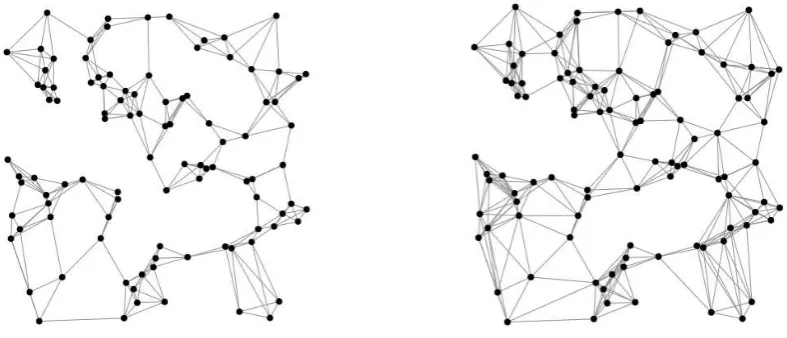
We start the model with n agents. Each agent, i, is connected to a network consisting of a group of agents, Ni, representing the social community with whom each agent is going to interact during the simulation. The network provides us with two things: first, the opportunity to implement an
information-sharing framework closer to the real world experience that an agent might experiment;
second, it ensures that agent’s decision is affected not only by its own, but also by monitoring others’ experiences. The size of the network for each agent is a random value uniformly distributed between 0 and a variable called network-size. Two sample network structures are presented in Figure 1.
[image:6.595.100.494.520.689.2]
6
When encountered with a conflict situation, each agent has different options to undertake. We call
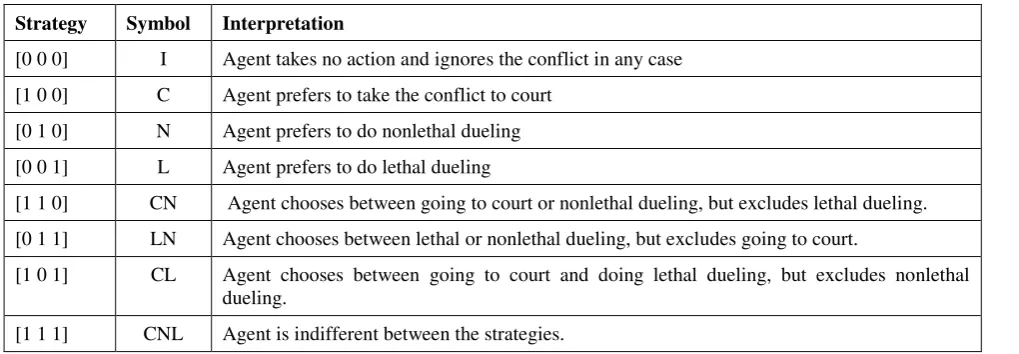
each of these options a strategy. The strategy of each agent is selected from a pool of strategies, represented by a three-bit vector such as [X1 X2 X3]. Each bit can be 0 or 1 leading to a pool with
eight different strategies. The first bit, X1, is 1 if the agent is interested in taking the conflict to the
court, X2 is 1 if non-lethal dueling is preferred and X3 is 1 if agent is interested in lethal dueling. For
instance, if agent i's strategy is [1 0 1], it means that when there is a conflict between agent i and another agent, he5 prefers that conflict to be taken to the court or settled in a lethal duel.
Lethal and non-lethal duels are separated since as the historical evidence indicates, while pistol
duels could only be terminated by death or by the exchange of agreed-upon number of shots, sword
duel (either by épée or sabre) could be stopped when an injury produced a flow of blood6. In
Europe, the sabre was more practiced by army officers and required a certain level of skill, whereas
épée was more accessible to commoners (Jeanneney, 2004, p. 35). That is why the épée, which was
probably the least favored of the three sanctioned weapons in the period before 1848, rose to
prominence as the proper weapon for settling disputes of honor in the Third Republic (Guillet,
2008, p. 202; Reddy, 1997, p. 257). Table 1 summarizes the percentage of using each of the three
major dueling weapons during the 1880s to provide an example regarding the application of each of
[image:7.595.140.457.463.506.2]the instruments.
Table 1: Duel’s instruments in 1880s in France
Epée Sabre Pistol*
89% 1% 10%
Source: the data are based on Nye (1993, 186). All the pistol duels were not murderous, particularly because they were often fought at a greater and safer distance during this period.
The list of all potential options in the strategy pool is presented in Table 2. Later in this section it is
discussed why this framework is chosen for presenting the strategy. Along with his strategies, each agent has also a variable called best-strategy which keeps record of the strategy which has led to the highest utility over the simulation. This means that our agent does not have an infinite memory,
5
The duelers were generally male, since it was banned to women in all European countries. However, female duels occurred occasionally (Frevert, 1991, 287). Tarde (1892, 42) documents such duels as an exotic phenomenon.
6
The choice of pistol versus épée was not only a technical matter, but also a philosophical issue on which two different
schools opposed. One recommended pistol, since its outcome depended on mere ‘luck’; and the other, épée, because of
its insistence on ‘bravery’ (Jeanneney, 2004, pp. 34-39). Guy de Maupassant who considered the duel as “a stupid
7
since it can only remember the last best strategy it has experienced and replace it with a new
[image:8.595.51.561.148.325.2]strategy, if it leads to a higher level of utility.
Table 2: List of strategies in the strategy pool and their symbols
Strategy Symbol Interpretation
[0 0 0] I Agent takes no action and ignores the conflict in any case
[1 0 0] C Agent prefers to take the conflict to court
[0 1 0] N Agent prefers to do nonlethal dueling
[0 0 1] L Agent prefers to do lethal dueling
[1 1 0] CN Agent chooses between going to court or nonlethal dueling, but excludes lethal dueling.
[0 1 1] LN Agent chooses between lethal or nonlethal dueling, but excludes going to court.
[1 0 1] CL Agent chooses between going to court and doing lethal dueling, but excludes nonlethal dueling.
[1 1 1] CNL Agent is indifferent between the strategies.
I: Ignore, C: Court, N: Nonlethal, L: Lethal.
Each agent has a variable called skill indicating his expertise in dueling. Agent’s skill is not fixed over the simulation time. When an agent engages in a duel and wins, his skill increases with a diminishing rate as presented in Equation 1, where skill of agent i at time t (skillit) is a function of
his initial skill (skilli0) and number of his duel wins so far (Wit).
√ (1)
Although different weapons have been used for dueling over the studied period and across the considered countries, for simplicity we consider that skill represents agent’s average skill in using all the possible instruments whether the duel is lethal or nonlethal.
The unit of time is a ‘tick’, which designates a time frame in which the probability of each of the
simulation functions to be executed is more than zero. To provide a sense of real world, we consider
each tick to represent the duration of one week. The model starts with tick = 1 and runs for 100
years, so the total simulation is 5200 ticks7 long.
Over the simulation agents reproduce with a fixed rate, r. The initial population, n, is 200 agents, which grows by 100% over the simulation time following the population growth between 1800 (203
million) and 1900 (408 million) in Europe (United Nations, 2008) which pertains to the three main
case studies we will introduce later.
7
8
When the model initializes, at every tick, there is a probability of conflict, Pconflict, that an agent is
involved in a conflict. Pconflict isbetween zero and 1 and is similar for all the agents. For every tick,
each agent can engage into conflict with any, but only one, other agent in the environment. When
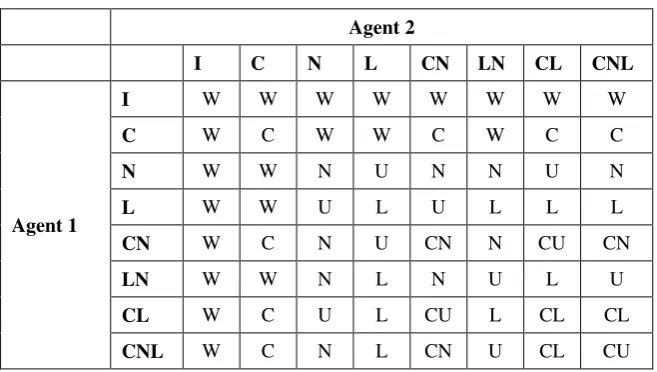
two agents are involved in a conflict, and considering that each of them has one of the eight
[image:9.595.134.463.208.394.2]possible discussed strategies, there exist 64 possible outcomes as presented in Table 3.
Table 3: Strategy combination and the final outcome
Agent 2
I C N L CN LN CL CNL
Agent 1
I W W W W W W W W
C W C W W C W C C
N W W N U N N U N
L W W U L U L L L
CN W C N U CN N CU CN
LN W W N L N U L U
CL W C U L CU L CL CL
CNL W C N L CN U CL CU
W: Withdraw, I: Ignore, C: Court, L: Lethal, N: Non-lethal, U: Undetermined
As can be seen, there are four outcome categories in the model. First, when at least one agent
ignores the conflict (I), no further action will be taken by the agents and they will both withdraw.
Second, if no common strategy is shared between the agents, for example when one wants to go to
court and the other prefers lethal dueling, again both parties ignore the conflict. Third, when both
agents have similar strategies (e.g. C and C), or there is only one common letter in their strategies
(e.g. CNL and C), then that common action will be adopted by both agents. Finally, if there is more
than one common strategy (e.g. CL vs. CNL or CNL vs. CNL), the final outcome will be chosen
randomly with an equal probability given to each possible outcome.
At the end of this process, the agents agree on how they want the conflict to be settled with four
possible outcomes: 1) ignore, 2) court, 3) non-lethal duel, and 4) lethal duel. If the agents decide to
withdraw, no further actions will be undertaken. If they decide to go to court, it is assumed that one
of them will win and the other one loses with each having 50% chance to win. If two agents decide
9
function (CSF)8 where the probability of agent i winning agent j, Pi(Wj) is determined through a
function presented in Equation 2. In our model m is considered to be 1.
(2)
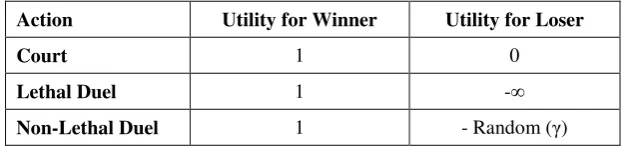
When the winner is identified, the utility of winning or losing a duel will follow Table 4. According
to the table, in a lethal duel while the winner wins all, the loser loses his life presented by using -∞.
However, in the non-lethal dueling, the outcomes are less uncertain. Here, Random, is a function that returns a random real number between 0 and γ, so that in the nonlethal case the loser loses a
random amount between 0 and –γ (due to a nonfatal injury). As -∞ may not be accommodated in
later mathematical analysis, when the model is implemented, it is replaced with a large negative but
finite number equal to the average of network-size. This implies that if an agent dies in a duel, on average, he would only make one level of his network to change their decision in the next round. At
the end of this stage, each agent gains a utility based on his own and his opponent’s decision and
[image:10.595.141.456.403.476.2]action. Since agents know the utility they derive from their actions, they undertake two more steps.
Table 4: Utility for each of the potential conflictual actions of an agent
Action Utility for Winner Utility for Loser
Court 1 0
Lethal Duel 1 -∞
Non-Lethal Duel 1 - Random (γ)
Firstly, each agent shares his findings with the other agents in his network. In this process, each
agent i, who has a strategy such as strategyi, will measure the average utility of his network
members who have chosen the same strategy in their last conflict situation9. Through this process,
agents calibrate their perception regarding the likely utility that can be gained from adopting that
strategy. Secondly, agents apply a learning module to improve their decision based on their own
gained utility. The learning process is captured by using a genetic framework. As it was discussed
earlier, agent’s strategy is presented as [X1 X2 X3]. The implemented framework has one mutation
8
Hirshleifer (1989) distinguished two types of contest success functions, namely ratio versus difference models of relative success. Skaperdas (1996) axiomatized the additive CSF employed in most contests as well as two frequently used functional forms of this function. Clark and Riis (1998) extended the axiomatization of Skaperdas. Kooreman and Schoonbeek (1997) provide an alternative set of axioms leading to a modified version of the Tullock CSF regarding the asymmetry between players. For an analysis of three classes of CSF and their relevance in different types of contests see, Konrad (2009, chapter 2).
9
10
and one crossover operator. Over the simulation time, the agents randomly change bits of their
strategy by mutating a randomly-selected bit in their strategy from 0 to 1 or vice versa in an attempt
to experience the other available strategies in the pool and shift to a strategy with higher utility, if
such a strategy exists. At the same time, they keep record of the strategy with the highest utility10
(best-strategy) and do a crossover between their current strategy and the best, to ensure that they are optimizing their actions constantly by learning from their past experiences11.
The model is implemented using NetLogo 5.0.2 (Wilensky, 1999) that has been widely used and
suggested for agent-based modeling in social sciences12. Considering the above-mentioned rules
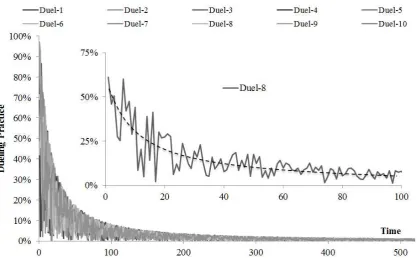
and conditions discussed for Step 1, Figure 1 presents the duration of dueling era under 10
individual single model runs, each representing a sample randomly taken from 100 simulations. The
trends illustrate the sum of both lethal and non-lethal dueling.
Figure 2: Dueling when only individual is taken into account. The figure is resulted from 1000 simulations, each line randomly representing one out of 100 runs. The largest graph shows the changes in dueling over the shortened time period of 260 (5% of total duration). As the figure is not very clear in presenting the dynamics of runs, in the middle graph the time scale has changed to 52 ticks (1% of the total simulation). Finally the smallest (top) graph, presents the average trends for the presented simulations.
10
Agents do not record all the utility values derived from each strategy but they only keep record of the strategy with the highest utility. This means that they do not need an infinite memory or the ability to remember the maximum utility for each possible strategy. They simply need to keep the best strategy, represented by a [X1 X2 X3] format.
11
Further detail and examples on these two processes are provided in the supplementary material. 12
[image:11.595.83.519.322.581.2]11
As Figure 2 shows, if the agents only take into account their gained utilities and even consider the
experiences of their network members and learn through the model, the dueling would not survive
for a long time. According to the model results, the Step 1 model will settle down on equilibrium
where less than 1% of the agents will duel, and more than 80% will choose going to court. The
model will not produce a zero-dueling environment since the mutation operator will keep activating
the dueling bits and the probability of having two duelers encounter will be very small but not zero.
The average trend can be well estimated using a power model with a formula such as y = ρxγ representing the sudden fall in the dueling practice. This fall can be mainly due to the combined
individual learning process and information-sharing through the network that leads agents not to
partake in a low-utility activity for a long time.
Step 2: Adding Identity
As it was shown in Step 1, it is not possible to use a simple utility model, even when enriched with
learning and networking, to describe the appearance and disappearance of dueling in our simulated
environment. So, how can the economist’s rational choice theoretical framework handle the
preference of individuals for dueling and its long persistence in various countries when considered
as an emerging public choice issue?
It should not be forgotten that in the heydays of dueling, choosing dueling meant to answer the existential question of ‘to be or not to be’: a choice that mainly belonged to the aristocracy (and not to commoners) who behaved in compliance with the code of honor.
Obviously, the dueling decision is not like the usual economic choice of apple versus orange, but it is rather a choice dependent on the agent’s identity. By identity, we mean the social categories to which an individual belongs as introduced by Akerlof and Kranton (2000, 2010).
These categories are associated with particular socially determined ‘self-images’ that include an ensemble of ‘prescriptions’ or behavioral rules to which an individual complies in accordance with its attachment to these categories. Accordingly, the norms of how to behave depend on people’s
12
During the sixteenth and seventeenth centuries, Europe underwent a period of intense social,
political, and religious tension and conflict. The aristocracy, the old ruling class, was in crisis and
disintegrating into its various strata. It needed something to unite its ranks and restore cohesion. In
other words, the collective action of the aristocracy needed a mechanism to shun free-riding and
strategic behavior among its individual members. Dueling and its code of honor provided a social
glue to unite lower and upper aristocracy in this transitional period. According to Demeter, the duel “strengthened their sense of belonging to a single privileged class” (1965, 119). Borrowing some terminology from identity economics (Akerlof and Kranton, 2010), the duel of honor provided
identity, purity, and distinction to the aristocracy as the legitimate heir of the nobility of the sword
from feudal times. It gave the entire class a military character and encouraged its patronage of new
mass armies, while the new parliament and Courts enabled the nascent bourgeoisie and lawyers to
have an increasingly strong influence.
Both upper and lower aristocracy benefited from dueling. By claiming the right to duel, the high
nobility was symbolically showing that it had not surrendered its independent spirit to the monarchy. Dueling only appeared when the nobility was the “principal nerve of our state” (Billacois, 1990, 98), and “when the monarchial model blurs, when the model of a deliberating assembly, a parliament in the most etymological sense of the word, takes over” (Ibid, 30).
Lower aristocracy benefited from dueling for another reason. The practice was most common among minor country gentry or squires, “who hunt in the day, get drunk in the evening, and fight the next morning” (Young, 1925, 205). The enjoyment factor cannot be discounted, as the lives of country gentry tended to be monotonous,13 but the major advantage of dueling was its leveling effect: “The duel was the sign and seal of a mystic equality between higher and lower, a fraternal bond uniting the whole multifarious class. It was, in short, a leveler, even though in practice a peer
would oftenest be embroiled with one of his own kind, a squire with another of the squires (…) A
duke ought to accept a challenge from a simple gentleman, Selden argued, because by treating him improperly the duke brought himself to the same level” (Kiernan, 1988, 52).
Considering the available evidence on the role of identity in how micro-economic decisions will
lead to a macro-level public choice dueling phenomenon and following Boulding (1962)
framework, a new level is added to the model called group (G). Each agent now belongs to a group of: 1) the aristocrats (A); 2) the middle class (M); 3) and the commoners (C).
13
To accommodate the identity module in the model, four variables are added to the model. Three
variables control the proportion of agents who belong to each of these three groups, PA, PM and PC,
standing respectively for aristocrats, middle-class and commoners, where PA + PM + PC = 1. Then,
aristocrats have a variable, aristo-level, representing their level of aristocracy, which is set to zero for commoners and middle-class and distributed normally with a mean of 1 and a flexible standard
deviation, called sd, between 0 and 0.2514 for aristocrats. Higher values of standard deviation indicate wider social differences between the aristocrats themselves and thus less unity among
them. Middle-class agents are separated from the commoners by a Boolean variable called
midclass? which is True for middle-class agents and False for commoners.
Some of already-defined variables in Step 1 are also updated. Firstly, following the historical
evidence (Nye, 1993; Jeanneney, 2004), we expect the average skill to be higher for aristocrats than middle-class and commoners and so if Ai represents agent i and G represents the identity groups15,
we have:
〈 〉 〈 〉 (3)
Secondly, for each agent, the network is formed so that the majority of its members are from the
similar group and fewer members are from the agents who belong to other groups. For instance, if
agent i is an aristocrat, then majority of its network members will be aristocrats and so from GA and smaller portion will belong to GM and GC. Here, the probability of agent j being a member of agent
i’s social network if agent i belongs to GX is shown in Equation 1, where ̅ presents the agents
belonging to a different group. In such a setting, if ( ) is equal to ρ, then (
̅) will be 1 –ρ.
( ) ( ̅) (4)
The decision process for the agents is similar to what was introduced in Tables 2 and 3. But how
does adding identity affect the outcome table?
14
The value is selected in a way to ensure that the aristocracy-level is always between 0 and 2 and for majority of the individuals it is located between 0.5 and 1.5.
15
It should be noted that while we allow the agents to have different levels of dueling skills linked to their identity (and
later authority), we do not allow the agents to make their dueling decisions based on the their own or their opponent’s
14
According to Akerlof and Kranton (2000, p.728), if an agent belonging to an identity group takes an
action which is not his group’s activity, it would lose its identity which then leads to “a reduction in
utility of Is, where the subscript s stands for self” and other members of that group will also
experience “a loss in utility Io, where the subscript o denotes other”. In this paper, we follow the
same pattern. The updated values of outcome are presented in Table 5. As can be seen, two major
changes are introduced in comparison with Step 1. First, now for every action taken by agents, ISi
and IOi provide the identity component of the utility. Second, sd ensures that if aristocrats duel, then
the advantages of their action will appear in their utility function. Coefficients, α1, α2 and α3 are used
[image:15.595.57.540.293.372.2]to calibrate the impacts of each factor on the utility.
Table 5: Utility for each of the potential conflictual actions of an agent
Action Utility for Winner Utility for Loser
Court 1 + α1.ISi + α2.IOi 0 + α1.ISi+ α2.IOi
Lethal Duel 1 + α1.ISi+ α2.IOi+α3 sd - ∞ + α1.ISi+ α2.IOi+α3 sd
Non-Lethal Duel 1 + α1.ISi+ α2.IOi+ α3 sd - Random (1) + α1.ISi+ α2.IOi+ α3 sd
In the model, ISi will be a randomly distributed number between 0 and 1, if the agent chooses an
action in line with its group (duel for aristocrats and court for non-aristocrats) and between -1 and 0, if the agent’s activity does not match with his identity (duel for non-aristocrats and court for aristocrats). As presented in Equation 5, when agent i takes action ai at time t, IOi|ait is measured by
dividing the number of agents in his network who have adopted the same action by the total number
of his related agents. IOi which is between 0 and 1, indirectly provides us with a value for how the
decision of one agent who undertakes a specific action, may affect the utility gained by other agents
considering the action they have taken.
(5)
The results of the model under Step 2 configuration are presented in Figure 3. As the figure shows,
compared to Step 1, the dueling persists much longer in the model since the identity component
incentivizes the aristocrats to duel more. Also, while minor changes in sd may not affect the duration of dueling period, the higher differences and hence the larger values of sd motivates more agents, specifically aristocrats, to consider dueling as an activity with high utility, at least for short
15
Figure 3: Dueling trend in an environment with identity. The outside figure shows the changes for 10 randomly-selected sample simulations out of 1000 runs and the smaller plot presents the trends for one randomly-selected simulation.
It should also be noted that the IS, IO and sd affectivity is highly related to the size of aristocracy group, so if aristocrats are not a large part of the whole simulated community, then the role of
identity will be less significant.
Step 3: Adding Authority
As it was shown in the previous steps, while adding identity can help to some extent explain better
the dueling phenomenon, we have not yet formulated an integral model to explore the dueling
macro patterns. Then, what other evidence do we have which can be used to improve the model?
Historians have identified a link between weakened royal authority, civil war, and increased
dueling. A strong and stable absolutist monarchy was more able to control dueling; the practice
never took root in Spain, where the undisputed authority of the Catholic Church and the monarchy
were united in banishing the duel. The Spanish aristocracy preferred bullfighting, as did
commoners.16
16
16
No exact and reliable statistics are available about numbers of duels and the number of people killed
during duels, but French and English historians have collected many ‘impressionistic statistics’
(Billacois, 1990) about the emergence of dueling from the second half of the sixteenth century until
the second half of the seventeenth century (Billacois, 1990; Cockburn, 1720; Kiernan, 1988;
McAleer, 1994; Stone, 1965). Table 6 presents the trough periods and Table 7 presents the peak
periods of dueling in France where dueling originated, based on these impressionistic statistics.
Table 6: Through periods of dueling in France
Trough period Political situation
1618–1621 Resurgence of politico-religious conflict in Europe
[image:17.595.56.538.334.629.2]1637–1649 France’s open participation in the general European conflict
Table 7: Peak periods of dueling in France
Peak
period Political situation
Estimated number of deaths
1562–1598 Valois dynasty, crippled royal authority
Chain of civil wars under religious pretext 8000*
1604–1607 Peace at home and abroad (Peace of Vervain)
Disputed authority of Henry IV 6000 **
1611–1614 Minority of Louis XIII
Meeting of the Estates General
25000***
1621–1626 Richelieu as a strong minister
Military operations against the Protestant fraction
1631–1633 Period of ‘covert war,’ France managing to delay its entry in the Thirty Years’ War
1649–1653
Following the Treaty of Westphalia and the partial re-establishment of peace abroad, civil wars collectively known as the Fronde (Catapult) of the princes
Total 39000
*Kiernan (1988, 75); Chesnais (1981, p. 104) estimated 7000 to 8000 deaths during the 1590s. **Stone (1965, 246)
reported 6000 pardons by the king from 1600–1610; Tarde (1892, p. 43) estimated 7000 to 8000 deaths during the
period 1589-1608. ***McAleer (1988, 18) estimated an average of 500 deaths annually from 1610–1660. Major
17
An overview of the peak and trough periods reveals two findings. First, increased dueling is likely
to be related to weakened royal authority, either because a monarch was too young (e.g., Louis XIII and Louis XIV), or because a monarch’s right to rule was disputed (e.g., Henri III and Henri IV until 1598). Second, civil war stimulated dueling, whereas foreign war usually reduced the number of duels. The Thirty Years’ War and the civil wars collectively known as the Fronde (catapult) encouraged dueling, especially because they undermined the authority of the sovereign. Foreign
wars, if supported by public opinion, were a source of internal unity and effectively discouraged
dueling among gentlemen. Similar results appear for Britain; duel of honor appeared in England
around 1590 (Cockburn, 1720), and as in France, increased in prevalence until 1620. The rates of
increase were similar in the two countries until 1600, when the rate in France increased faster than
in England. The disparity was especially obvious from 1610–1620 (Billacois, 1990), and dueling
rates declined sharply in England after 1620 (Stone, 1965). Dueling experienced a resurgence in
England from 1644–1655,17 before and during the English Civil War.
Historical evidence also show that the existence of a double standard or contradictory orders have
also encouraged dueling, as for example, it has been widely observed in Germany, where social
militarization happened causing the formation of a state within a state. From its inception in the last third of the sixteenth century, the duel was regarded as part of ‘caste honor’ (standesehre) among persons worthy of carrying swords (satisfaktionsfähig): aristocrats and officers, state officials, and students. Friedrich Wilhelm I of Prussia, the so-called ‘Soldier-King’ (1713–1740) adumbrated the fundamental link between dueling and militarism, and McAleer noted, “Duels were undertaken out of a feeling of co-responsibility for the collective reputation of Germany’s social elite, out of a sort of tribal egotism, and not from a selfish amour proper” (1994, 35).
A double standard between ‘military honor’ and ‘civilian honor’ was instituted after the Prussian Law Code of 1794: a duel could only exist among officers and noblemen; armed clashes among
other civilians, including the bourgeoisie, were handled by criminal law. Civilians were thus denied
treatment under the dueling statutes. The conflict of principle between military and civil concepts of
honor became strikingly public when Eritz Anneke, a Prussian second lieutenant, was dismissed
from the army in 1846 based on his refusal to duel with a fellow officer. After its investigation, the
military court of honor ruled out the possibility of cowardice and attributed Anneke’s decision to
his “communist and democratic notions” (McAleer, 1994, p. 26-35).
17
Cromwell banned the duel in 1654. In the United States, the War of Independence stimulated the practice of dueling,
18
Taking into account the presented evidence and again following Boulding (1962), a new level is
added to our model called “organization” represented by two major authorities, namely: state and
military; the state runs the courts and the military is in charge of the army. If an individual follows
the state laws, it is a “civilian”, but if it belongs to the army and so follows both the state and
military laws, it is called “officer”. We believe that adding the authority to the model, to some
extent addresses the concern stated by Buchanan and Tollison (1984, p. 13) and discussed by
Wallick (2012, p.232) regarding the monolithic modeling of political entities such as government,
separated from the agents, as in our model both organizations, state and army, are able to affect how
the individuals make decisions.
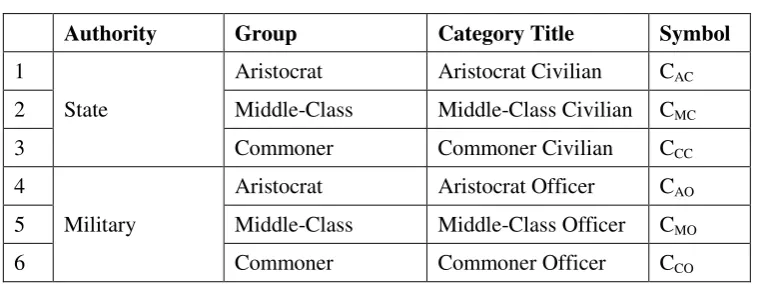
Considering the introduced groups in Step 2 and these two organizations (i.e. state and army), six
[image:19.595.109.490.341.483.2]different identity-authority categories can be defined for as indicated in Table 8.
Table 8: Identity categories of the model in Step 3
Authority Group Category Title Symbol
1
State
Aristocrat Aristocrat Civilian CAC
2 Middle-Class Middle-Class Civilian CMC
3 Commoner Commoner Civilian CCC
4
Military
Aristocrat Aristocrat Officer CAO
5 Middle-Class Middle-Class Officer CMO
6 Commoner Commoner Officer CCO
The organization level features are accommodated in the model using three variables. First,
officers-to-civilians shows how agents are distributed between the officers and civilians. The state is presented using a variable, Pstate, ranging between 0 and 1, which shows the probability of a
wrongdoing to be detected and punished by the state. The army’s power is presented with a
variable, Pmilitary, again between 0 and 1, indicating the military’s supremacy in the simulated society and its ability to punish the officers which do not respect the military rules.
The definition of skill initially introduced in Step 2 is now updated. Following the historical
evidence, we expect the average skill to be higher for aristocrats than non-aristocrats, and higher for officers than civilians so
19
Also, using the same symbols as used in Step 2, the network structure and connection probabilities
are updated as presented in Equation 7.
( ) ( ̅ ̅ ) ( ̅ ̅) (7)
According to Equation 7, the probability of agent j being a member of agent i’s social network if agent i belongs to CXY can be shown as Equation 1, where ̅ presents the agents from a similar
group as Ai but following a different authority and ̅ is representing the agents of similar authority as Ai but belonging to a different group. This time, if agent i is an aristocrat civilian, then
majority of his social network members will be aristocrat civilians and so from CAC, smaller
proportion will belong to CMC, CCC and CAO and the lowest proportion will come from CMO and
CCO. In such a setting, if ( ) is equal to ρ, then ( ̅ ̅ )
will be nρ, and ( ̅ ̅) will be mρ, where ρ+ nρ + mρ = 1 and n > m and n + m > (1 -
n - m). The values of ρ, n and m are set as initial conditions and vary across the experiments.
To include the authority responses to the action undertaken by agents, a new component is added to
the outcome table called AR, representing the net responses received from the state and the military (Table 9). Here, ARi = β1.Random (Pstate) + β2.Random (Pmilitary), where the values of β1 and β1 are
dependent on the agent’s category and action as presented in Table 10.
Table 9: Utility for each of the potential conflictual actions of an agent
Action Utility for Winner
Court 1 + α1.ISi + α2.IOi+ α3.ARi
Lethal Duel 1 + α1.ISi+ α2.IOi+α3 sd (Aristo) + α4.ARi
Non-Lethal Duel 1 + α1.ISi+ α2.IOi+ α3 sd (Aristo) + α4.ARi
Action Utility for Loser
Court 0 + α1.ISi+ α2.IOi+ α3.ARi
Lethal Duel - ∞ + α1.ISi+ α2.IOi+α3 sd (Aristo) + α4.ARi
[image:20.595.119.477.459.745.2]Non-Lethal Duel - Random (1) + α1.ISi+ α2.IOi+ α3 sd (Aristo) + α4.ARi
Table 10: Utility coefficients
Civilian Officer
Duel (lethal or non-lethal) β1 = -τ
β2 = 0
β1 = -τ
β2 = τ
Court β1 = 0
β2 = 0
β1 = 0
β2 = -τ
20
What Table 9 provides us with is a set of simple rules: if a civilian or an officer duels, it will be
punished by the government whereas if an officer goes to court it might be punished by the military.
Considering the modules added during Step 3, we expect the model to have more complex
processes since, for instance, for every agent, at any point in time, four different factors will affect
the decision, including: 1) its personal learning, 2) the experience of its network members, 3) its
identity, and finally 4) the reaction received from the authorities. These factors then will lead to a
final decision made over time and across the agents.
The results of this step are summarized into two figures. Firstly, Figure 4 shows how overall
dueling trend changes in the model across three sample simulations. The full line in the figure
presents a case where state and military authorities almost neutralize each other and so the model
response pattern is very similar to what was observed in Step 2. Then, as the military gains further
authority power, the fall of dueling trend will be delayed (dashed and dotted lines), although the
fixed dueling rate is not sustainable and the dueling finally disappears from the model over time.
The main reason behind the delay and change in the pattern from the full to the other two lines is
that as military gains more power dueling will be encouraged, both directly through the further
pressure on officers and also indirectly due to increasing returns in investment identity. But this line
of conflictual action will be undermined as more agents (especially aristocrats and officers) find the
disadvantages of dueling and share it with others. Once this countertendency is triggered, it can
even go to the point that the officers may also join the rest of agents in not adopting dueling
[image:21.595.83.514.506.714.2]strategy.
21
As discussed earlier, we have separated the lethal and non-lethal dueling in this paper to see if it is
possible to investigate their patterns individually. Now, the question is, out of what has been
presented in Figure 4 (for example, Sample 1), how much does each lethal and non-lethal dueling
[image:22.595.158.434.170.324.2]contribute? Figure 5 decomposes the total dueling trend into lethal and non-lethal trends.
Figure 5: The trends of overall, lethal and non-lethal dueling for a sample model in Step 3.
As Figure 5 shows, while lethal dueling quickly disappears from the model, non-lethal dueling
initially increases slightly. This can be due to the fact that some agent who witness how the lethal
duelers lose their life, abandon lethal dueling and so the choice set shrinks from (Withdraw, Lethal,
Non-lethal, Court) to (Withdraw, Non-lethal, Court).
Step 4: Embourgeoisement
In addition to the identity and authority components (discussed in Steps 2 and 3) that mainly affect
the dueling decision among the aristocrats and officers; there are some historical evidence that
dueling has been widely practiced by other social groups. In fact, the adoption of duel of honor by
middle-classes has been named ‘duel’s embourgeoisement’ by certain historians. This expression
describes the process through which the ‘limited access’ of the aristocracy to a particular intangible asset, namely ‘honor’ was gradually converted into an ‘open access’ asset.
The term was initially coined by Weberian Frevert (1995)18 to characterize the social nature of the
duel of honor in Germany as a “middle-class” institution during the nineteenth century. The expression was also used by Nye (1993, p. 133) to describe the duel’s status in nineteenth century France.
22
Frevert formulated the concept of duel’s embourgeoisement against Marxist Kiernan who defended the thesis that the European duel in modern times was the last stronghold of aristocratic privileges
against the invasion of mass industrialized society represented by an ascending middle class. He
labeled dueling in the nineteenth century as “the phantom virtue of a bygone era” (Kiernan, 1988, p.
274). The focus of debate was about the social nature of dueling during its evolution in the
nineteenth century, particularly in the second half of this century. Frevert questioned Kiernan’s
thesis by raising a few preliminary questions: who did duel with whom? Why? And to what end?
Did the social strata, which supported dueling, change during the processes of social change?
Which institutions, political parties or groups did support dueling and which ones did endeavor to
restrict or forbid it? According to her, the central question of whether or not the duel of honor in the
nineteenth century was merely a relic of the feudal era, or was a middle-class institution could not
be answered without tackling these preliminary issues.
By reminding the large numbers of middle-class duelers and advocates of dueling such as Max
Weber, Heinrich Simon, Heinrich Heine, and Ferdinand Lassalle, Frevert asks whether it can be
assumed that there must have been strong tendencies on the part of the German middle class to
incorporate dueling, originally the privilege of the aristocracy, into their own way of life. She
doubts the validity of such an assumption in view of the proven anti-aristocratic stance adopted by these men: “it is at least doubtful whether it is possible to interpret this fact as a drive towards feudalization on the part of the middle class” (Frevert, 1995, p. 7).
Accordingly, she suggests the concept of “duel’s embourgeoisement” instead of the “feudalization of German’s bourgeoisie”19. Blackbourn (1991, p. 14) also advocates Frevert’s thesis by
acknowledging that it “shows that those German bourgeois who engaged in duels were not simply
imitating aristocratic norms; the meaning of the duel for middle-class Germans was shaped by the
place it occupied within a specifically bourgeois code of honor.”
To embed the embourgeoisement in the model, a new variable is added, Pimit, which ranges between
0 and 1 indicating the likelihood of a non-aristocrat civilian to imitate the dueling behavior. The
variable is accommodated in the model by updating the Table 10 values as now presented in Table
11. The changes will ensure that the civilians who duel will be less likely punished by the state.
19
23
Table 11: Changes in the utility coefficients to accommodate embourgeoisement
Civilian Officer
Duel (lethal or non-lethal) β1 = Pimit - τ
β2 = 0
β1 = -τ
β2 = 1
Court β1 = 0
β2 = 0
β1 = 0
β2 = - τ
As changes in Pimit have significant impacts on the model responses, we test three different models
to show how embourgeoisement may have long-term impacts on the likelihood of dueling.
Figure 6: Dueling with low (Sample 1), medium (Sample 2) and high (Sample 3) levels of imitation probability
While the low or even moderate values of imitation do not affect the model substantially, as Sample
3 (full line) in Figure 6 shows, higher probability of imitation can make the dueling so popular that
it could persist at a significant level in the model.
Model Validation
To validate our model’s results, the model is run according to three specific scenarios derived from
historical evidence. We then test whether our results match the historical trends. The cases are about
[image:24.595.71.528.253.476.2]24
English case: duel as undesired anarchy
In the early Tudor period, England had a dual military system: one quasi-feudal, composed of
private aristocratic armies, and the other national, under the auspices of the Crown. The greatest
achievement of the Tudors was shifting the structure of power from the Lords to the Crown and the
Commons (Stone, 1965). This shift meant a royal monopoly of violence, both public and private.
However, even during the reign of Elizabeth, this monopoly was far from complete and it needed to
balance the rival factions to avoid the constant menace of aristocratic civil war. In this context,
dueling was a better option than blood feuds, because it was more effective at regulating violence
than the authority of the central government.
Dueling was thus an inevitable vice, because it was a leveler between upper and lower aristocracy.
In the eyes of the Crown and nobility, it represented undesired anarchy and an infringement on the hierarchy of rank. The Crown was not alone in viewing dueling as undesired anarchy; the
revolutionaries, Cromwell and his army, shared this view because dueling was against the law and
the state. Since the adoption of the Magna Carta, collective action of the English ruling classes was
instituted in the name of law. Magistrates and laws were central to English political thought from
the Tudors onwards. The state was so distinct from the holders of power that Charles I could be
tried and condemned for High Treason. The King was perceived (by himself and others) more as a
magistrate than as the first among gentlemen, which explains why the revolutionaries justified their
insurrection in the name of law. “In England, where Puritanism, capitalism, free enterprise and
freedom of thought were important in a society which was otherwise very hierarchical, only isolated
and more or less anti-social individuals felt the need to fight duels. The English revolutionaries
were not duelers because duelers are rebels” (Billacois, 1990, 32).
The industrial revolution and the early rise of the industrial bourgeoisie in England gave this class a
far more intransigent faith in its own ways and ideas than the previous capitalist class, mercantile or
financial. Earlier versions of bourgeoisie found it natural to gravitate toward aristocracy, but later
versions had a collective identity represented by the liberalism of the Manchester school20 and the
anti-corn law movement led by Cobden and Bright. Early industrialization saved the English industrial bourgeoisie from subsequent workers’ movements because the bourgeoisie did not need to unite with the aristocracy against the working class (Lang, 1999, p. 26). At the heyday of
industrial capitalism, the bourgeoisie allied with the working class against the landed aristocracy. In
25
England, the bourgeoisie could only get its real representative, Bright, into the government by an
extension of the franchise (Acemoglu and Robinson, 2005, pp. 2-5). Parallel with its increasing
economic power, English bourgeoisie gained increasing political power. It indirectly shared
political power with the aristocracy, through its influence on the Crown and its direct participation
in the Parliament, but the capital importance of law and magistrates and the strength of parliamentary institutions helped control the army’s political influence. Consequently, the rising bourgeoisie was not threatened with exclusion from power.
The army, the second chief stronghold of dueling, was never overinflated in England despite its great prestige after its victories over Napoleon. In fact, the army’s impact on society was much weaker than in Germany, especially in Prussia (Frevert, 1993, p. 224). Moreover, in England, the
second influential anti-dueling association was founded by the active participation of 35 generals
and admirals in 1843 (Baldick, 1965, 113).
Embourgeoisement of dueling did not occur in England for two reasons: first, the
semi-constitutional monarchy had strong parliamentary institutions and a relatively small and
law-abiding army; and second, the early industrial bourgeoisie had a collective identity that was
unthreatened by the working class and confident in its increasing economic and political power.
Under such circumstances, dueling could only be tolerated insofar as blood feuds were still a
menace; it remained an undesired form of anarchy with regard to order and law. The economic
domination of the bourgeoisie under a state of law did not leave any room for this social institution,
which was extinct by 1852. Abandonment of the duel was a clear sign of the approaching demise of
the decadent aristocracy in England. Less than a generation later, the sharp decline of land rents
from the 1870s onward completed its suppression by a very mixed plutocracy (Kiernan, 1988).
The emergence of dueling in England curbed blood feuds and contributed to a more regulated and
restricted violence. Because the aristocracy and the army were bound to respect the state and laws,
they could not prolong dueling beyond a certain level of maturity of the new order. Contradictory
orders had a relatively short historical period that were dissolved and gave way to the rule of law.
French case: dueling as desired anarchy
As noted in the previous section, after the third quarter of the sixteenth century, only the French
recklessly engaged in duels. The engagement was with such an ardor that no other country showed
26
(Billacois, 1990, 24). This schism of the French population between two faiths, Catholics and
Protestants (which was aggravated by civil wars)21, and the French path to absolute monarchy, were
two reasons for dueling being embraced so vigorously in France.
As the Revolution approached, aristocracy and haute mercantile and financial bourgeoisie
increasingly mingled. Their sense of fraternity and equality grew to the point that they could
challenge each other freely; men without coats of arms could challenge or be challenged to a duel
(Kiernan, 1988, 29). Dueling in France was a desired anarchy both for aristocrats and
middle-classes; it represented a libertarian individualist anarchism as well as a leveler. Carlyle (1837) noted this leveling effect of dueling, “[A]ll Frenchmen have the ‘right of duel’; the Hackney-coachman with the Peer, if insult be given! Such is the law of Public Opinion. Equality at least in death!” The
duel was a flexible or imitable tradition in France and had a longer duration compared with England due to its embourgeoisement.
Contrarily to the English aristocracy, the French nobility adapted to the duel’s embourgeoisement
during the Restoration period. In contrast to the British Code of Duel, the publication of a new code of dueling in 1836 by the Comte de Chatauvillard and countersigned by men representing France’s most illustrious families, including eleven peers of France and the cream of military elite (Jeanneney, 2004, p. 78) facilitated the duel’s embourgeoisement. The widespread acceptance of this new code, the first of its kind since the seventeenth century, contributed largely to the predominance of a nonlethal type of dueling that is known as the “first blood duel” (duel aupremier sang). As Chatauvillard put it in the Essai sur le duel, “in the present state of our manners, an ordinary duel (au premier sang) suffices the noble need to expunge an offense.” (1836, p. 122). The author claimed that he was publishing this code because he regarded it as his “humanitarian duty to modernize and regularize a practice that was a necessary and inevitable feature of civilized life” (Nye, 1993, p. 137). It should be noted that first-blood duels were necessarily sword duels.
The predominance of first-blood duels is clearly reflected in the rise of épée dueling and that explains much of fencing’s popularity: “Politicians, journalists, writers and businessmen -men in high risk categories- frequented the fencing halls to learn basic technique and stay fit” (Nye, 1990,
21
27
p. 371). Comte de Chatauvillard’s code of dueling or the French aristocracy’s adaptation to the idea of modernizing the duel was a major source of duel’s embourgeoisement in France22.
The French ministry of Justice, Tarde (1892), and Chesnais (1981) afford some statistics regarding
the first half of the century, while Nye (1990, 1993) has compiled a master inventory of duels
between 1860 and 1914 from a number of sources. The numerous shortcomings of these data
notwithstanding23, they provide a general scheme of what we name the duel’s embourgeoisement.
Borrowing upon the afore-mentioned sources, we have constructed a recapitulative table (Table 12)
that documents the evolution of dueling from 1819 till 1900 with respect to the frequency of duels
and their lethality rate. According to Chesnais (1981, p. 103), there were more than 832 deaths in
the army for more than one hundred duels annually during the period 1819-1826. The number of
total deaths decreased to 228 for the period of 1826-1834. It should be noted that Tarde’s estimation
is 189 deaths for the same period (1892, p. 51). The lethality rate was one third in this period. Since
1835 the average number of duels per year declines to one hundred (Nye, 1990, p. 371), and their
lethality ratio also decreases from an initial rate of one third (33 percent) to almost 6 percent (three
deaths over fifty three combats) in the 1870s (Chesnais, 1981, p. 109). Starting from 1880s until
well into the 1900s, the dueling frequency began to increase rapidly, reaching a high of between 400 and 500 per year (Nye, 1990, p. 371). Tarde’s estimate of 60 duels per year in the 1880s is far too low. According to Nye’s conservative estimation, the average might be 200 duels per year between 1875 and 1900, and as late as 1911 one could still find as many as 5 duels taking place in
[image:28.595.54.544.533.591.2]Paris alone in a span of twenty days (Nye, 1993, p. 185).
Table 12: Evolution of dueling in France from the early nineteenth century till the First World War
Period 1819-1826 1827-1834 1835-1880 1880-1914
Frequency per year >100 >100 100 on average 200 on average
Number and/or percentage of deaths 832 228 (33%) >6% to ≤33% < 2%
While the dueling frequency augmented rapidly after 1880s, its lethality rate drastically decreased
to less than two percents for the period 1880-1914. This estimation is derived from Tarde’s study (1892, p. 52) on the 1880s decade based on Ferréus’s Annuaire du duel (see Table 13).
22It is noteworthy that when Chatauvillard’s code was translated four years later (1840) into English, the Britannic press despised it as an evidence of the blossoming of a ‘barbarous’ practice (Kiernan, 1988, p. 262).
23
28
As this table indicates, only 431 duels over a total of 598 were fought, and the rest (almost a third) were ‘arranged’ and ‘shunned’ thanks to the active role of conscientious seconds in conformity with the rules of Chatauvillard’s code of dueling. The total number of 16 deaths for 431 duels that were consummated in combats amounts to one death for 26 combats. The fact that dueling frequency
doubled since 1880s, and nonlethal duels by épée became predominant indicate the prominence of
[image:29.595.58.531.216.259.2]civilian duels.
Table 13:Dueling frequency and its lethality in 1880s
Duels consummated in combats Arranged duels Total number of duels Total number of deaths
431 167 598 16
To sum up, while the aristocratic duel was potlatch destruction (Vahabi, 2011), dueling in the Third Republic was a phenomenon of ‘civilized’ society of Parisian journalists, politicians and middle classes to build up a reputation capital.
German case: dueling as military order
The duel was imported to Germany as a French fashion, but it never represented anarchy; it always incarnated order, particularly military order. A double standard between ‘military honor’ and ‘civilian honor’ was instituted after the Prussian Law Code of 1794: a duel could only exist among officers and noblemen; armed clashes among other civilians, including the bourgeoisie, were
handled by criminal law. Civilians were thus denied treatment under the dueling statutes. In the
1820s and 1830s, the German Bürger achieved the right to duel, and the switch from swords to
pistols facilitated his participation. As in France, the duel became bourgeois in Germany, but the army, the one undeniably non liberal, non bourgeois institution in Germany, remained the duel’s chief procurator24. The German army permeated civilian life in a multitude of ways and on a large scale; Frevet coined the term ‘social militarization’ to describe this process (1995, 36). Dueling blossomed in Germany especially from 1870–1914; social militarization thus led to the longest continuation of dueling in Germany, compared with England and France.
24
As long as the officer corps had been recruited exclusively from the aristocracy, its honor had been aristocratic. But
this altered with the growing recruitment of the officers from middle classes. “By 1861, nearly 20 percent of higher -ranking German army officers were bourgeois; although some regiments (notably the cavalry) had managed to maintain their exclusively aristocratic composition, others (such as the engineers, artillery, or supplies) had a higher than average number of middle-class officers. By the eve of the First World War, the proportions had shifted much further in favour of the bourgeoisie. By then, as many as 48 percent of Prussian generals and colonels were middle class, while three-quarters of the majors and first and second lieutenants were of bourgeois origin. Middle-class representation was particularly high in the naval officer corps, which had only been created under the Empire and had no aristocratic