Retraction Notice
Title of retracted article: The Open Mind: A Phenomenology
Author(s): Josh Adler
* Corresponding author. Email: [email protected]
Journal: Open Journal of Philosophy (OJPP)
Year: 2017
Volume: 7
Number: 2
Pages (from - to): 126 - 167
DOI (to PDF): http://doi.org/10.4236/ojpp.2017.72009
Article page: https://www.scirp.org/Journal/PaperInformation.aspx?PaperID=76669
Retraction date: 2019-6-28
Retraction initiative (multiple responses allowed; mark with X): XAll authors
Some of the authors:
Editor with hints from Journal owner (publisher) Institution:
Reader:
Other:
Date initiative is launched: 2018-6-19
Retraction type (multiple responses allowed): Unreliable findings
Lab error Inconsistent data Analytical error Biased interpretation Other:
Irreproducible results
Failure to disclose a major competing interest likely to influence interpretations or recommendations Unethical research
Fraud
Data fabrication Fake publication Other:
Plagiarism Self plagiarism Overlap Redundant publication * Copyright infringement Other legal concern:
Editorial reasons
Handling error Unreliable review(s) Decision error Other:
X Other:
Results of publication (only one response allowed): are still valid.
Xwere found to be overall invalid.
Author's conduct (only one response allowed): honest error
academic misconduct
Xnone (not applicable in this case – e.g. in case of editorial reasons)
Expression of Concern: yes, date: yyyy-mm-dd
Xno
Correction:
yes, date: yyyy-mm-dd
Xno
Comments:
Large-scale corrections should be made to the paper.
This article has been retracted to straighten the academic record. In making this decision the Editorial Board follows COPE's Retraction Guidelines. Aim is to promote the circulation of scientific research by offering an ideal research publication platform with due consideration of internationally accepted standards on publication ethics. The Editorial Board would like to extend its sincere apologies for any inconvenience this retraction may have caused.
ISSN Online: 2163-9442 ISSN Print: 2163-9434
The Open Mind: A Phenomenology
Josh Adler
The Shantigar Foundation, Rowe, MA, USA
Abstract
What does it mean to keep an “open mind”? In casual conversation it’s a pop-ular phrase with enough common sense to negate much need for debate about what the speaker means. Someone with an open mind might be considered considerate, equanimous, empathetic, a good listener, curious, or flexible in opinion. In Western culture an open-minded person might be receptive to new ideas, possibilities, and interpretations, suggesting that they successfully maintain an engaged yet dynamic mental relationship to various subjects or challenges. Yet in science’s nascent study of consciousness, the notion of a mind “opening” is complicated by the field’s inability to clearly articulate what a mind is, let alone how, or into what, it might open. It is the purpose of this research to present the biological significance of “open-mindedness” in order to discuss possible phenomenological implications pertaining to neural correlates of consciousness (NCC). In his seminal book The Open Work, Umberto Eco describes “openness” as a phenomenon of conscious organiza-tion that “locates the infinite at the very core of the finite,” and “invites us to conceive, feel, and thus see the world as possibility.” Utilizing the methods of MDA analysis, my critical phenomenological inquiry extends Eco’s lens of cultural semiotics into quantum biology to provide key insights for under-standing the aesthetic role of field dynamics in qualia physics—as interpretive events (i.e., watching a film, tasting a dessert, or drawing). In particular, pair-ing Eco’s semiotic analyses of openness with Hameroff and Penrose’s OR Theory concerning cognitive qualia-producing architectures such as micro-tubules, raises how sensations (i.e., interpretive events) between organisms and the ZPF are—as Antero Alli conceives—absorbed, integrated, and trans-mitted through quantum SED information states proposed by Joachim Kepp-ler. Therefore, we can say that living systems are those systems that have adapted their material capabilities (including fundamental principles of self-organization and complexity in common cognitive architectures like awareness and attention) to perceive and interpret coherently. That is to say—biology has evolved to make meaning through its very aliveness. Our conscious ability to open our minds in order to interpret and communicate How to cite this paper: Adler, J. (2017).
The Open Mind: A Phenomenology. Open Journal of Philosophy, 7, 126-167. https://doi.org/10.4236/ojpp.2017.72009
Received: April 4, 2017 Accepted: May 28, 2017 Published: May 31, 2017
Copyright © 2017 by author and Scientific Research Publishing Inc. This work is licensed under the Creative Commons Attribution-NonCommercial International License (CC BY-NC-SA 4.0).
http://creativecommons.org/licenses/by-nc/4.0/
Open Access
our sensations, thoughts, and complete experiences, therefore reveals a radi-cally multidimensional bio-geometry and biolinguistics based on a phenome-nological field dynamics Eco’s work constructs. Via an aesthetic information theory, Eco describes as, “a practical level of poetics that acts as programmatic projects for creation.” The writings of Rumi, Husserl, Dewey, Emerson, Mer-leau-Ponty, Hegel, and others confer depth to the emergent mechanics of per-ception found throughout biotic systems. Eco’s ideas thereby provoke discourse on the role of openness within recent theoretical works by Jeremy England, Anirban Bandyopadhyay, Robert Lanza, Deepak Chopra, Ervin Laszlo, Giulio Tononi, Stuart Kauffman, Walter J. Freeman, Robin Carhart-Harris, Mark P. Mattson, Robert R McCrae, Selen Atasoy, Katherine Peil, Terence Deacon, and David Chalmers. Unlike models of consciousness that arise from closed, local computation, I argue that the phenomenon of open mindedness unifies cultural and scientific concepts of consciousness as life’s integrative force.
Keywords
Consciousness Systems Theory, Field Dynamics, Openness, Phenomenology, Aesthetic Information, Philosophy of Mind, Biolinguistics
1. Introduction
“Open mind” is a contemporary concept rife in popular cultural memetics since at least the late 1950s, when “father of the atomic bomb” J. Robert Oppenheimer applied it to governance, as “an indispensable, perhaps in some ways the indis-pensable, element in giving meaning to the dignity of man…” Later in the same article Oppenhemier concludes, “The style, the perceptiveness, the imagination, and the open-mindedness with which we need to conduct our [governmental] affairs can only pervade… if they are a reflection of a deep and widespread pub-lic understanding” (Oppenheimer, 1949).
self in the continuous possibility of interpretation” (Eco, 1989). Eco’s under-standing here of aesthetic contemplation as a significant process in conscious-ness’ dynamic organization of a perceptual continuum outlines its faculty as the primary receptive interpreter between indeterminate and deterministic fields. For instance, the process of “harmonious coordination” he describes can be challenged by competing views that result in “cognitive dissonance” if the inter-preter is unable to remain open to co-emergently different, yet viable, perspec-tives. His position therefore supports an understanding of open-mindedness as a compositional phenomenon that allows consciousness to combine into ever more complex activity, as well as a creative source of new physical possibilities.
More recently in 1989, psychologist Robert R. McCraeconducted the study, “Social Consequences of Experiential Openness,” which revealed the deep social and political implications of individual trends in intrapsychical and interperson-al aspects of openness. He writes, “Openness is manifested in ‘the breadth, depth, and permeability of consciousness, and in the recurrent need to enlarge and examine experience’” (McCrae, 1996). Within the domain of what Eco deems, “structural homologies” McCrae includes within the phenomenology of openness: processes of intuition, thin mental boundaries, and typical intellectual engagement. “Openness,” he writes, “is a psychological construct centered on intellectual engagement and aesthetic experience and only secondarily reflected in social and political attitudes.” Overall his research deepens the perception of openness as “a fundamental way of approaching the world that affects not only internal experience but also interpersonal interactions and social behavior” (McCrae, 1996). Whereas current psychological investigation is now tracing the “genetic and phenotypically distinct” factors of Openness’ personality dimen-sions, which relate cognitive engagement to creativity and intellect as “reflecting the tendency toward cognitive exploration” (Kaufman et al., 2015).
In order to provide an integrative analysis of these previous cultural and psy-chological studies of openness with current biological models, this work will build a phenomenologically based Conscious Systems Theory (CST) upon vari-ous, even disjointed, correlations between mechanics, dynamics, and aesthetics (MDA) in conscious systems. The discussion proposes a common field dynam-ics, which establishes a coherent harmonic structure capable of transmitting in-formation within observed physical and mental phenomena. This “Mechanics, Dynamics, Aesthetics (MDA)” methodology entails a great deal of cross-discip- linary aggregation, and was generously introduced to me by Jerry McGrath, Di-rector of Innovation and Program Partnerships for Leadership Development at the Banff Centre. I have adapted this scientific discipline for framing systems from game theory in order to effectively examine and constitute the associations between current theories of quantum biology and cultural semiotics into a common phenomenology.
Such disciplinary opposition seems to be rather common, and rightfully often considered an ill-fitting endeavor. In Lacan Between Cultural Studies and Cog-nitivism, Slavoj Zizek advocates against the temptation that lies within cultural studies to mix-and-match paradigms from hard sciences. He writes, “… the moment one wants to provide an ontological account of quantum physics (what notion of reality fits its results), paradoxes emerge… cultural studies denounce the very attempt to draw a clear line of distinction between, say, true science and prescientific mythology” (Zizek, 2002). However, in the emerging science of consciousness, linguistics of preceding philosophical hegemony may play an ob-structive role in the capacity of the field to recognize key aspects of its own signi-ficance. As Eco points out: “While science, today, limits itself to suggesting a probable structure of things, art tries to give us a possible image of this new world, an image that our sensibility has not yet been able to formulate, since it always lags a few steps behind intelligence—indeed, so much so, that we still say the sun ‘rises’ when for three centuries we have known it does not budge” (Eco, 1989).
One rife epistemological example for expanding our biolinguistic under-standing is the perceived phenomenon of “security”. As a driver of both pain and pleasure principles throughout living systems, conscious attitudes towards “security” reveals an opportunity to frame the thermodynamic and harmonic variabilities that order attractors and qualia transfers, or imprinting, via ho-meostasis’ regulatory pathways. The bounds of security percepts compel biody-namic effects as complex as geopolitics in human affairs, and as basic as bacterial binary fission. In Drosophilia embryo, development patterns are secured by waveforms clearing genetic “dead zones” through transcript patterns that “yield progressively finer grained positional information” (Kauffman & Goodwin, 1990). Exploring, questioning, and expanding our scientific and cultural con-sciousness of such a biolinguistic phenomenon opens adjacent organizational possibilities not only in terms of meaning, but also recalibrate improbable qualia producing combinations of awareness and attention (Kauffman, 2012). There are vital questions in understanding how “security” affects biological predictive possibilities in the generation of feed forward loops that supercausally impact experiential properties and probabilities by primitive “Merge” operations (Chomsky, 2007). How does perceptual planning alter the actualities of reality across genetic regulatory networks? Investigating these deeper structures of lan-guage, according to Chomsky, shows how “… acquisition of language involves not just a few years of experience and millions of years of evolution, yielding the genetic endowment, but also principles of neural organization that may be even more deeply grounded in physical law (Chomsky, 2007). Furthermore, Chomsky resonates with Eco in commenting that “An elementary fact about the language faculty is that it is a system of discrete infinity.” But how does open mindedness impact evolutionary adaptation via cognitive engagement? How open can the biotic agents of attention or awareness be, and how does its dynamic positioning during imprinting affect the quality of living experiences?
Crucial to Eco’s semiotic recontextualization of consciousness as biology’s in-tegrative/interpretive force is an enhanced understanding of the nature of “in-formation” to implicate physics as much as semiotics (Kauffman, 2012). Often regarded in contemporary culture as equivalent to “data,” which refers merely to an algorithmic, reductive functionality, information’s definition here must be expanded to include all aspects of biological perception, such as sensation, and the poetic aspects of non-algorithmic, aesthetic interpretation; noted by both Roger Penrose and Umberto Eco as key indicators of consciousness’s true mul-tifaceted significance as a primary force of agency and creation. Therefore, the term information should be regarded in this study as any stimulus that can be biologically communicated, organized, or interpreted. It is my hope to suggest abio linguistically generative syntactic shift that may move researchers towards a dynamic framework rife with greater articulation for both physical and expe-riential NCCs. Joachim Keppler is one quantum physicist who is effectively tak-ing up this call to “re-code” our ltak-inguistic approach to understandtak-ing the me-chanics of consciousness as a phenomenal extraction from qualia producing “information states.” His work with Stochastic Electrodynamics (SED) intro-duces the brain as dynamically “coupled”; or crudely put, somewhat like modern “wifi” devices with a fundamental background field from which consciousness adapted to interpret useful information, such as identifying food sources or mu-sic, from noise. More on Keppler’s work to follow.
In further research of this linguistic reassessment, John Wheeler, J. Keppler, E. Laszlo, and others have argued in favor of viewing the Zero-Point Field (ZPF) as a “plenum” rather than the more prevalent conception of a “vacuum”. In sup-port of their arguments, current studies reveal that our universe is filled with enough energy waves, light, gravitation, and matter (including dark forms) to belie any claims of physical “emptiness” implied by correlating the ZPF with a vacuum. As for Zizek, he self-describes the Lacanian concept of subjectivity as an ongoing process of misidentification, and therefore might support my asser-tion that perhaps the “self” would be better represented and evaluated in terms of its receptivity to information processing, communications abilities, or in other words “openness.”
no means to communicate compositionally, no awareness to share, and thereby no self-determining means to transmit our experience. It is the basic openness of our reality—a fundamental phenomenon providing the field, context, or back-ground for dynamic combinatorial interactions to create unprecedented compo-sitional states, forms, and complexity—that allows for local and non-local cohe-rence between quantum and standard models, self-organizational synchrony in evolutionary systems, the integrated receptivity and expressiveness of con-sciousness; and until now has gone largely unstudied in biological terms.
Kafatos, Tanzi, and Chopra are enlightening of Eco’s ethos when they rec-ommend, “In our view, it may well be that the subject-object dichotomy is false to begin with and that consciousness is primary in the cosmos, not just an epi-phenomenon of physical processes in a nervous system” (Kafatos, Tanzi, & Chopra, 2011). Therefore, perhaps we can finally distend any epistemological need for a “ghost in the machine” by adopting a theoretical consideration of the “conscious system” into: a continuous system of interconnected systems, nested within the finely tuned quantum plenum (i.e., ZPF) across all scales of order in varying, dynamic states of openness and localities to each other. Within such a consideration, an individual organism’s consciousness, which is regulated by its sense of “openness,” would constitute its veritable agency, (i.e., its force, or po-tential impact) within the total system, which correlatively generates its unique inner life.
Openness, unlike the semiotics of emptiness, can be evaluated in terms of the ability of conscious systems to process “aesthetic information.” Aesthetic infor-mation, a term provided by Eco in counterpoint to quantitative inforinfor-mation, perhaps provides the “non-algorithmic” neural-linguistic potency suggested by the qualia geometry of IIT, and longed for by Roger Penrose in his investigation into the mathematical correlates of “free-will” (Eco, 1989; Penrose, 1999; Tono-ni, 2008). In contrast to quantitative information that “consists in drawing as many suggestions as possible out of a totality of signs with all the personal reac-tions that might be compatible” within an established system, Eco unveils the richness of aesthetic information as consistent in “referring the results drawn from the former type [quantitative information] back to their original organic qualities, in seizing, behind the suggestive wealth we exploit, a conscious organ-ization, a formative intention, and in enjoying this new awareness. This aware-ness of the project that underlies the work will, in turn, be another inexhaustible source of pleasure and surprise,” for all intents and purposes describing the ac-crual of meaning and agency attributed to an open, complex, and conscious sys-tem wherein interrelated coherent fields and organizational compounds can communicate through dynamic responsiveness.
As an example of an open system dependent on the perception of aesthetic information, Eco puts forward Joyce’s Finnegan’s Wake:
closing word of the last page of the novel. Thus, the work is finite in one sense, but in another sense it is unlimited. Each occurrence, each word stands in a series of possible relations with all the others in the text. Ac-cording to the semantic choice that we make in the case of one unit, so goes the way we interpret all the other units in the text. This does not mean that the book lacks specific sense. If Joyce does introduce some keys into the text, it is precisely because he wants the work to be read in a certain sense. But this particular “sense” has all the richness of the cosmos itself (Eco, 1989).
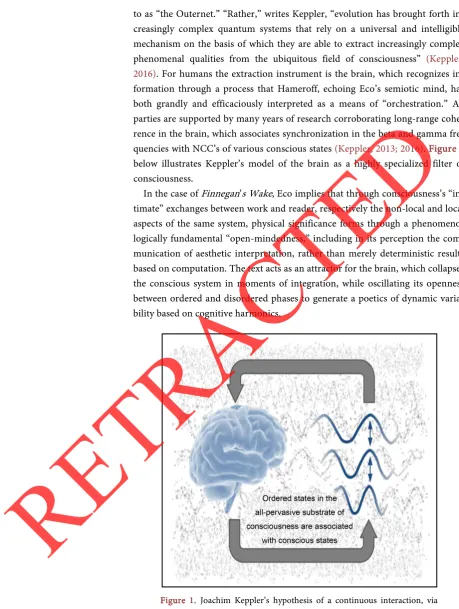
to as “the Outernet.” “Rather,” writes Keppler, “evolution has brought forth in-creasingly complex quantum systems that rely on a universal and intelligible mechanism on the basis of which they are able to extract increasingly complex phenomenal qualities from the ubiquitous field of consciousness” (Keppler, 2016). For humans the extraction instrument is the brain, which recognizes in-formation through a process that Hameroff, echoing Eco’s semiotic mind, has both grandly and efficaciously interpreted as a means of “orchestration.” All parties are supported by many years of research corroborating long-range cohe-rence in the brain, which associates synchronization in the beta and gamma fre-quencies with NCC’s of various conscious states (Keppler, 2013; 2016). Figure 1 below illustrates Keppler’s model of the brain as a highly specialized filter of consciousness.
In the case of Finnegan’s Wake, Eco implies that through consciousness’s “in-timate” exchanges between work and reader, respectively the non-local and local aspects of the same system, physical significance forms through a phenomeno-logically fundamental “open-mindedness,” including in its perception the com-munication of aesthetic interpretation, rather than merely deterministic results based on computation. The text acts as an attractor for the brain, which collapses the conscious system in moments of integration, while oscillating its openness between ordered and disordered phases to generate a poetics of dynamic varia-bility based on cognitive harmonics.
Figure 1. Joachim Keppler’s hypothesis of a continuous interaction, via SED coupling, between the brain, and an all-pervasive background field which acts as the substrate of consciousness (Keppler, 2016. On the Uni-versal Mechanism Underlying Conscious Systems and the Foundations for a Theory of Consciousness. Open Journal of Philosophy, 6, 346-367. doi: 10.4236/ojpp.2016.64034.).
[image:10.595.73.533.66.676.2]2. The Infinite at the Core of the Finite (How Do Expansions
in Consciousness Adapt Living Systems?)
In his discussion of the similarities and convergences within linguistic systems of an “open work,” Umberto Eco writes:
What is at stake is a convergence of new canons and requirements, which the forms of art reflect by way of what we could term structural homologies. This need not commit us to assembling a rigorous parallelism—it is simply a case of phenomena like the “work in movement” simultaneously reflect-ing mutually contrasted epistemological situations, as yet contradictory and not satisfactorily reconciled. Thus, the concepts of “openness” and dynam-ism may recall the terminology of quantum physics: indeterminacy and discontinuity (Eco, 1989).
In speaking compositionally (i.e. capable of constituting new possibilities via pattern recombination) about the “reciprocal play of problems” within the en-gagement of complex systems of awareness with art forms, Eco finds, “The pos-sibilities which the work’s openness makes available always work within a given field of relations.” A quantum biological implication of Eco’s compositional concept of openness and dynamism, involves living organisms’ diverse abilities to organize the infinite variability of experience through communicable methods of aesthetic information.
One example is the pattern recognition process of our brain’s control neurons, as they consciously navigate the field of our sensory awareness in the interplay of attentional behaviors. Pattern recognition starts with special neurons called “control neurons” that unconsciously map potentially interesting parts of a scene. When an “attractor” catches someone’s attention, the control neurons make a “window” that focuses around the subject of interest by strengthening the synaptic connections that lead to other parts of the brain. As one’s attention increases, the control neurons balance the flow of memory feedback and visual information to interpret stimulation (Olshausen et al., 1993).
Husserl, with a prescient sense of control neurons writes:
Each state of consciousness implies the existence of a horizon which varies with the modification of its connections together with other states, and also with its own phases of duration… In each external perception, for instance, the sides of the objects which are actually perceived suggest to the viewer’s attention the unperceived sides which, at the present, are viewed only in a nonintuitive manner and are expected to become elements of the succeed-ing perception. This process is similar to a continuous projection which takes on a new meaning with each phase of the perceptive process. Moreo-ver, perception itself includes horizons which encompass other perceptive possibilities, such as a person might experience deliberately the direction of his perception, by turning his eyes one way instead of another, or by taking a step forward or sideways, and so forth (Eco, 1989).
As an example of biological perception’s ability to involve the nonlocal ab-sorption, integration, and transmission of “OR moments,” encoded by disconti-nuities in space-time curvatures, gravitational dynamics, symmetries, and ma-terial states in resonance with information processing forms in the fine-scale structure of the universe; the role of control neurons in perception’s integration of Stuart Kauffman’s “adjacent possibilities” can account for even weak force organization of “proto-conscious” events into qualia producing architectures via stochastic electrodynamics (SED) (Penrose & Hameroff, 2011). As Kauffman points out when interpreting the causal and acausal possibilities of two people meeting for coffee—just because one coffee shop closes, doesn’t mean another across town won’t be open. Therein he reveals how consciousness enables “changing actuals to change what is possible” (Kauffman, 2016).
Living systems are those that have evolved dynamic sensitivities that are “open” to receiving possible moments of awareness as they emanate from col-lapses in the fine scale or superstructure of the universe, which convert “pro-to-conscious” signals into SED information states. Organisms make imprints of aesthetic information, “what Penrose termed ‘non-computable Platonic values’ embedded in fundamental space-time geometry” (Hameroff, 2014). Keppler supports Penrose’s description by adding:
It is widely accepted that consciousness is associated with long-range cohe-rence in the brain, particularly with synchronized activity in the gamma frequency band. In more detail, new results suggest that “discrete moments of perceptual experience are implemented by transient gamma-band syn-chronization of relevant cortical regions, and that disintegration and rein-tegration of these assemblies is time-locked to ongoing theta oscillations” (Doesburg et al., 2009). Moreover, it was found that gamma synchrony shows up not only during attention to an external stimulus, but also in al-tered states of consciousness, such as meditation and REM sleep.
As for the characteristics of the gamma oscillations, a time-frequency anal-ysis of the local field potentials (LFP) revealed that “the source of gam-ma-band peaks is of stochastic nature” (Burns et al., 2010) and that “gamma activity is indistinguishable from filtered noise” (Burns et al., 2011). Hence, gamma activity cannot be understood on the basis of deterministic network models. Rather, noise seems to play an essential role in the generation of gamma synchrony, so that in a realistic model the brain should be “viewed as a resonant stochastic oscillator” (Burns et al., 2010). Furthermore, also experiments investigating stochastic resonance (SR) within and between brain areas imply that “SR-mediated neural synchronization is a general mechanism of brain functioning” (Ward et al., 2006) and that “noise could play a fundamental role in biological information processing” (Keppler, 2013).
posed by Giulio Tononi, suggests how consciousness’s role plays out transac-tionally in the interdependent phenomenal fields of possibility, probability, awareness, attention, and experience (Keppler, 2016; Tononi, 2008). The first two form what Merleau-Ponty describes as the perceptual fields, and the latter three he describes as the sensorial fields (Merleau-Ponty & Landers, 2014).
This dynamic, yet harmonic, field structuretherefore suggests a “bootstrap” approach to understanding how consciousness might universally weave through quantum processes of complex systems both micro and macro cosmically (Wolchover, 2017). Within living systems, the ubiquitous access to these back-ground signals means that self-organizing information can plausibly be repre- sented across entropic discontinuities via stochastic resonance (SR) processing to drive biological development of agency in close correlation to the thermody-namic work energy driving reproduction (Perunov, Marsland, & England, 2016). A plant that is open to processing energetic dynamics of light from the sun through photosynthesis, corresponds to the same long-range coherence of SR physical processes described by Hameroff’s studies of microtubule organization of qualia within neurons. Eco confers that openness is a phenomenon of con-scious organization that “locates the infinite at the very core of the finite” and “invites us to conceive, feel, and thus see the world as possibility” (Eco, 1989).
Conscious Systems Theory (CST)
By grounding its mechanics in a dynamic network of harmonic phenomenolog-ical fields (i.e., an Outernet), a Conscious Systems Theory (CST) proposes a non-panpsychic view of consciousness’ operation. This hypothesis arrives at a view similar to IIT’s sense of “here, there, but not everywhere” approach, which characterizes consciousness as, “a fundamental property possessed by physical systems having specific causal properties. It predicts that consciousness is graded, is common among biological organisms and can occur in some very simple systems. Conversely, it predicts that feed-forward networks, even com-plex ones, are not conscious, nor are aggregates such as groups of individuals or heaps of sand” (Tononi & Koch, 2015). A CST also considers the qualitative bonding aspect running through a “Quantum Underground,” which Penrose describes as a realm where, “Individual particles then do not have ‘states’ on their own, but exist only in complicated ‘entanglements’ with other particles, re-ferred to as correlations” (Penrose, 1999). As life’s integrative force, conscious-ness co-relates its fundamental causes with its quantum effects, by existing as an aesthetically-based recombinator field phenomenon, featuring emergent, dy-namic, multidimensional harmonic bonding (i.e., tunable) agency within all le-vels of order, that forms into living, embodied, self-organized, self-determining, sustained, occurrences with measureable internal resonance and radiance processes—including the inner (albeit open) life of the mind with attractor feedback loops that organize cognition.
the way the human brain chunks together phone numbers. Via the interrelated-ness of a common field dynamics between aesthetics and mechanics responsive to opening and closing biofeedback (Hunicke, LeBlanc, & Zubek, 2004). As dy-namics are integrated throughout the system via events of collapse, conscious-ness regenerates its own coherence through perceivable aperiodic projections of space and time.
By allowing for aesthetic harmonics in conscious systems, CST recognizes the constitutive (i.e., mechanical) underpinnings of the co-relative variance indy-namically acquired agents, or subjects, to remain “open” or “closed” in terms of probabilistic and perceptive feedback, dependent on local biphasic cognitive processes of awareness, attention, and qualia. Generally, the basis of agency in conscious systems is their ability to choose to “stay open” to suffering or pain despite experiencing loads of discomfort, perturbations, or unpreferable states, or vice versa with regards to pleasurable experiences. Meanwhile, adaptive bene-fits of responsiveness gleaned from “staying open,” are proven to allow for the development of self-modifiable, constitutional, or creative, or mindful pleasure principles based on Eco’s understanding of “appreciation,” which phenomeno-logically and neuro-correlatively requires less energy or reward potential to fire, yet permeates into much higher and subtler orders at play within a conscious system. This concurs with Hameroff’s attitude of the “quantum pleasure prin-ciple,” which cogently argues that life and the brain have evolved “to feel good” (Hameroff, 2015).
locally in classical physical forms, as well as non-locally in radiant quantum field encoding (Tononi, 2008).
Life in multidimenional, dynamic, variant states generates the contours of consciousness’ ability to “play” within complex systems through endless specia-tion of equally endless combinaspecia-tions, structures, pathways, and its emergent in-terpretations of experience (Kak, Chopra, & Kafatos, 2014). Narrating the trans-formational experience of a single atom named “X” in Odyssey, Aldo Leopold writes:
From his berth in the Indian’s bones, X joined again in chase and flight, feast and famine, hope and fear. He felt these things as changes in the little chemical pushes and pulls that tug timelessly at every atom. When the In-dian took his leave of the prairie, X moldered briefly underground, only to embark on a second trip through the bloodstream of the land (Leopold, 1949).
Speaking from a co-emergently reproductive and probabilistic perspective of biological recombinatory expressiveness throughout the vast scales of life’s com-plex systems, Annie Dillard writes in Fecundity:
The faster death goes, the faster evolution goes. If an aphid lays a million eggs, several might survive. Now, my right hand, in all its human cunning, could not make one aphid in a thousand years. But these aphid eggs— which run less than a dime a dozen, which run absolutely free—can make aphids as effortlessly as the sea makes waves. Wonderful things, wasted. It’s a wretched system. Arthur Stanley Eddington, the British physicist and as-tronomer who died in 1944, suggested that all of “Nature” could conceiva-bly run on the same scheme. “If indeed she has no greater aim than to pro-vide a home for her greatest experiment, Man, it would be just like her me-thods to scatter a million stars whereof one might haply achieve her pur-pose.” I doubt very much that this is the aim, but it seems clear on all fronts that this is the method (Dillard, 1974).
described as gratitude, emptiness, attunement, vibrancy, saturation, exhaustion, awake, and many other qualia forms. Yet in order to understand truth in our experiences, such as the qualia of “emptiness,” according to CST, a conscious system must be fundamentally open or receptive to the state’s subjective mean-ing, or feeling.
3. Sources of Nature (How Does Expanding Awareness
Affect the Mechanics, Dynamics, and Aesthetics of
Conscious Experience?)
In consciousness’ quest to understand itself and its relationship to its context (in the universe):
(
)
?
corr
PΦ
∫
U ∇Rwhere P? is an expression of pure possibility, Φ is the rate of conscious
integra-tion, U expresses the totality of the universe, and R is the stochastic field reso-nator. In this equation it is the correlation between the mechanics of possibility and stochastic resonance that allow openness to permeate many aspects of bio-logical systems as experience’s means of “quantum leaping” corporal disconti-nuities, such as attention, sleep, aging, and perhaps even death. A fundamentally open conscious system can potentially transcend “ship in a bottle” challenges ar-ticulated brilliantly by David Chalmers as, “phenomenal bonding or quantum holism (to solve the subject combination problem), small qualitative palettes (to address the quality combination problem), principles of informational composi-tion (to address the structure combinacomposi-tion problem), and a somewhat deflatio-nary account of awareness of qualities to tie all these aspects together” (Chalmers, 2013; England, 2013). By treating such phenomena as composition-ally integrated systems (with adaptive access to an entangled awareness de-scribed in ancient India as “Akasha”), which identify as individuals by correla-tive quantum mechanical means of self-awareness and communication, Eco’s “poetics of open work,” emerges as a frame for the quantum biological interpre-tation of conscious experience (i.e., a semiotics of “being alive”) on the basis of his representation of compositional works of art as aesthetic information ve-hicles, and coherent, open systems organized by consciousness for perceptual transmission and recombination into innovative forms (Eco, 1989). Eco’s poetics include aspects of interpretability, communicability, sensitivity, formativity, and composition, which comprise the aesthetic basis for my MDA integrated systems approach.
since the ancient philosophies of Aristotle and Buddhism, and later Anglicized in Transcendentalist writings of Emerson by such claims as “The sources of na-ture are in our own minds,” and “It [consciousness] contradicts all experience.” “How?” is a matter of transactional field dynamics, which communicate, organ-ize and amplify resonance (i.e., information carrying signals) and radiance (i.e., energetic carrying signals) patterns throughout conscious systems.
Open systems can utilize patterns of attractors to tune Attentional capacities (a) into the interplay between Awareness (A’) and Probability (Pr), and in doing so loop in, constitute, and/or absorb the correlative nature of adjacent Possibili-ties (P?), ranging beyond its total radiance into unknown spaces of “no collapse.”
This is a notion constituted from John Wheeler’s late assertion that, “the un-iverse is filled with huge clouds of uncertainty, that have not yet interacted with a conscious observer or even some lump of inanimate matter. In all these places the cosmos is a vast arena containing realms where the past is not yet the past” (Lanza, 2010). Anopen mind can transcend itself by cohering various modes of perception, which as Lanza explains, “in terms of biology, the brain turns elec-trochemical impulses from our five senses into an order, into a sequence, into a face, into a room, into an environment” (Lanza, 2010). The co-relative nature of observation is co-creative, and co-generative as well; and “Everything we observe is the direct interaction of energy and mind. Anything that we do not observe directly exists only as potential or mathematically speaking—as a haze of proba-bility” (Lanza, 2010). To Lanza consciousness also resolves into an integrated holograph, always in interdependent movement with its trends, or tides—de- pendent on how much harmonic force—as to prolong the dynamics of a univer-sal projection (U). Lanza paints the picture further by reminding that, “Dreams and schizophrenia attest to the mind’s compositional abilities to construct con-vincing realities,” as well as, “The mind’s awareness is the ultimate reality—pa- ramount and limitless” (Lanza, 2010).
song, or painting has the agency to become emotionally moving and phenome-nologically relevant, even 2000 years after its creation, the perceiver now parti-cipates in expanding the total field of conscious awareness, or the spirit of the work into new Possibility. Eco remarks, “To appreciate a work as a perceptible form means to react to the physical stimuli of the object, not just intellectually but also—so to speak—physically. Fraught with a variety of responses, our ap-preciation of the work will never assume the univocal exactitude and characte-ristic of intellectual understanding and will be at once personal, changeable, and open” (Eco, 1989). When experience imprints upon perceiver via their capacity for integrating Attention and Awareness, the interpretive process effectively ex-tends the Awareness of composer, composition, and perceiver in Probabilistic and Possibility functions of universe (U). The phenomenal fields of perception therefore enact, channel, or play out constitutional movements of aesthetic in-formation via the quantum mechanics of SR, as they ripple through the sensorial fields.
While materialist systems might contend that Beethoven’s 9th symphony was composed in three or four dimensions, CST recognizes that the force of con-sciousness amplifies the musical score’s integrative properties into quale that imprint the listener in perhaps sixteen dimensions of dynamic sensory informa-tion (Tononi, 2008). The effect of the performed music is transcendent of its material perspective via its ability to awaken higher order energetic and resonant senses in its audience, who absorb its aesthetic information in probabilistic realms beyond mere local embodiment—where the music can be heard—ven- turing into vast, subtler interplays of cultural, epigenetic, and subconscious Awareness entanglements—and therefore richer phenomenal potentials.
Information Processing Dynamics and Syntropic Organization in
Biological Systems
Hameroff and Penrose’s quantum biological model of orchestrated conscious-ness via superposition events reveals a vulnerability within the standard model’s negation of internal radiation factors when considering fluid mechanics within the differential equation of energy, and internal resonance factors within field dynamics of aesthetic information processes (Hameroff, 2014).
Eco cautiously considers that, “few people are willing to speak of meaning in relation to the kind of communication provided by a nonfigurative pictorial sign or a constellation of sounds. This kind of openness is therefore best defined as an increase in information” (Eco, 1989). Yet, if in conscious systems, which are theoretically open (i.e., receptive), the energy coefficient of thermal conductivity, k, must consider
q k T= ∇
where viscous dissipation function φ may be positive due to properties of quan-tum processing, which augment the velocity field
V
* *
(
∇
T
O)
+
ϕ
to(
)
* *
OV
∇
T
−
ϕ
, thus opening Newton’s 2nd Law to reversible, albeit ultimatelypercausality) of internal radiation factors (White, 1999; Laszlo, 2007; Vannini, 2009).
In terms of IIT and OR correlative information processing effects (IPE), the standard model, which relies on elemental Cartesian controls, cannot account for the phenomenon of correlative field coherence (i.e., the quantum leap effect) in cognitive structures of living organisms. Phenomena such as language, bird song, neurogenesis in psychedelic interactions, neuroplasticity, epileptic sei-zures, musical scales, flight patterns of bees, and pattern encoding in water, transmit info via nonlocal fields and entanglement pathways to aggregate har-monic organization of internal resonance patterns into higher order behaviors through SED field dynamics (Keppler, 2016). IPE such as feelings, thoughts, ep-igenetics, memory, and dreams composite experience into forms of perceivable matter resistant to empirical methodology due to their irreducible internal qua-lia (q!).
It can be said that biological systems that absorb, integrate, and transmit in-formation via quantum processing architectures (i.e., microtubules) may also defy classical processes of velocity, acceleration, impulse, and entropy through conscious interpretive access to correlative fields of possibility (P?), probability
(Pr), awareness (A’), attention (a), and experience (q!) where rate of processing (φ) maintains an integrated coherence rate (i.e. homeostasis) of both radiance and resonance between all systematic dynamics (Q). Keppler predicts that this correlation can be tested by measuring “the photon intensity and the theta rhythm,” which theoretically aligns with Anirban Bandyopadhyay’s research into orders of synchronization. Bandyopadhyay posits that every resonance in a con-scious system creates a mental “singularity phase’ with both a classical and quantum component. Yet spinning and nested within points of observation, re-sonant vibrations coherently transmit through the phase space’s orders. Like Hameroff, he points to the role of tubulin proteins “dancing” within the micro-tubule resonance cavities as fractal resonance chains, that connect the biological “clocks” of conscious systems, while allowing for multivarient responsiveness based on cycles of geometrically natural number systems (Bandyopadhyay, 2016).
Overlapping phase stimulation triggering neural spikes allows axons to trans-late resonance into integrated composite formations from the interplay of field dynamics within the particular receptivity of different conscious systems. These qualia compositions and their IPE can be expressed in terms of harmonic beha-vioral dimensions and interactions of their fields correlative to φ and ZPF (Benzi, Sutera, & Vulpiani, 1981; Kanai, Minemoto, & Sakai, 2005). Whereas, “For a machine there is no other principle but physics—unlike a man or a pig-eon they do not have the unitary sense experience necessary for perception and self-awareness” (Lanza & Berman, 2010).
143 nication or cooperation, water’s role in thermodynamic regulation of quantum biological processes, sensory deprivation and neuroplasticity adaptation (i.e. hypoxic training techniques in mountain climbers), mental health benefits of exposure to non-tempered music forms, evolution of migratory patterns and/or diet and/or reproductive habits in animals, mycelium connectivity functions in forests, and the morphological evolution of “top-down” visual processing in mammals and humans (Kozhevnikov, Elliott, Shepard, & Gramann, 2013).
Entropy, however, provides an important and inevitable balance—a cosmic tide, or push to consciousness’ pull—correlative to its total perceivable radiance, which is aggregated by Awareness. For instance, most people believe the likelih-ood that there’s other life in the universe, and our mathematical probabilities encourage this belief, so it may be that if we currently find no other evidence of life in the universe but our own planet’s, it isn’t so much that it fails to exist, ra-ther, we might agree that our local consciousness hasn’t yet learned to recognize itself in certain non-localized forms. One precedent exists in cultural studies of an evolutionarily emergent awareness of the color “blue” in some ancient socie- ties.1 Much possibility for undiscovered extraterrestrial life is left open, since due
to entropic discontinuities, or interference, it could be aware, or not aware, of us as well. That’s the balance.
As Rumi describes, “Consciousness sleeps in minerals, dreams in plants, wakes up in animals, and becomes self-aware in humans” (Chopra, 2013). It is in consciousness’ awakening (i.e., dynamic self-awareness) that we formulate and enfold our relations to all of creation, even as all of creation unfolds. In everyday life, choices are narrowed down to specific possibilities. Superposition is routine. It is the same phenomenon that leads Aristotle to proclaim, “To be conscious that we are perceiving is to be conscious of one’s own existence,” even as Emer-son cautions in The Over-Soul,
The influence of the senses has, in most men, overpowered the mind to that degree, that the walls of space and time have come to look solid, real and insurmountable; and to speak with levity of these limits is, in the world, the sign of insanity. Yet time and space are but inverse measures of the force of the soul. A man is capable of abolishing them both (Emerson, 2004).
Social habits of Attention and Awareness, as studied in ethical philosophies, therefore have a great impact on what’s perceptively true at any given time or place in our existence. Lanza points out that, “Until Jules Verne and others wrote about humans going to the moon in the 19th Century, it was too fantastic a
notion to spread widely. By the 1960s however man’s space travel had become such a common sci-fi theme that it was an easy sell to the public, who readily agreed to fork over taxpayer dollars to turn it into a reality during the Kennedy, Johnson, and Nixon administrations” (Lanza & Berman, 2010). It’s a dynamic of the evolutionary indeterminacy of perception, discussed by both Lanza and Eco,
1If it’s true, as posited by philologist Lazarus Geiger, that Egyptians were the first society to develop
awareness and a word for the color blue.
that transcends the random physical notions of mere “relativity”—in play as Einsteinian principles are (Eco, 1989). The quantum layers of our existence therefore are not just relative, but also “co-relative.” Instead of being ontologi-cally hemmed in at observation, consciousness, and its chariot of embodied life, can transmit crystalline holographic projections of experience in poly-dimen- sional resolution. Eco calls on the writings of Sébag commenting on Marx:
As Marx writes, consciousness is not only the consciousness of a reality outside itself but also its own being. This does not mean the subject is im-mediately and intuitively present to itself, but rather implies a system of laws that are not imitated but rather are acquired from and through the progressive use of an intelligence that is coming to grips with a universe of objects. These laws can in turn be transformed into instruments, since the organization of reality, as well as the discovery of the order that underlies it, depends entirely on them; on the other hand, this reality is none other than the very source out of which the intellect draws the meaning of its own log-ical organization (Eco, 1989).
Consciousness’ responsive ability to evaluate feedback within the body’s re-sonance chamber, or to cry at a film’s tragic ending, shines light on the resonant quantum biological dimensions of transcendence. Examples include resonant schema within the semiotic composition of various ontological systems from acupuncture to yogic astral planes to Leary’s “8-Circuit Intelligence.” These sys-tems organize and articulate subtleties of existence co-relatively mirrored in the dynamics of butterfly effects, the structures of quasars, or democratic elections (Mitchell, 2013). Regardless of form—for the force of consciousness to appear throughout our perceptions, we must “stay open” to the compositional possibili-ties of new forms, which augment systemic dynamics, and engage all commu-nicable operants. As Eco says,
How often have new creative modes changed the meaning of form, people’s aesthetic expectations, and the very way in which humans perceive reality? The poetics of the open work is an expression of such a historical possibili-ty: here is a culture that, confronting the universe of perceivable forms and interpretive operations, allows for the complementarity of different studies and different solutions; here is a culture that upholds the value of disconti-nuity against that of a more conventional contidisconti-nuity; here is a culture that allows for different methods of research not because they may come up with identical results but because they contradict and complement each other in a dialectic opposition that will generate new perspectives and a greater quantity of information.
After all, the crisis of contemporary bourgeois civilization is partly due to the fact that the average man has been unable to elude the systems of assumptions that are imposed on him from the outside, and to the fact that he has not formed himself through a direct exploration of reality (Eco, 1989).
When every part of existence is playing its part, special relativity is only the most dynamic, observable, physical aspect of a materialistic epistemology. By cluding the phenomenological realms of perception formulated by aesthetic in-formation, “The distance between a plurality of formal worlds and undifferen-tiated chaos, totally devoid of all possibility of aesthetic pleasure, is minimal” (Eco, 1989). Interpreting what is felt as much as what is quantified during con-scious integrative processing, the poetics of experience becomes richer by mag-nitudes, and much more attuned to the wonders long-articulated in spiritual traditions and art. The explanation for all the processing power in our guts sud-denly makes a lot more sense too; not as a matter relative to “what you are,” so much as co-relative to “how open you are” cognitively during imprinting of conscious experiences. The co-relative factor of a perceiver’s “openness” as they integrate experience into co-reality, affects the quality of the information they receive and transmit. There is also a self-regulatory aspect to the feedback of such systems that favors openness in modes of survival. Eventually openness provides greater agency of will than predominantly “closed” systems. Concen-trated or narrowed systems, or dissonant systems, will facilitate fewer orders of aesthetic complexity when integrating an evolving spectrum of conscious infor-mation, since they are less adept at accommodating a comparable bandwidth for processing qualia and IPE. Confronting the artistic exercise of will sparks Eco into more radical modes. “The moment an artist realizes that the system of communication at his disposal is extraneous to the historical situation he wants to depict,” Eco writes, “he must understand that the only way he will be able to solve his problem is through the invention of new formal structures that will embody the situation and become its model” (Eco, 1989).
He’s speaking to a communicative factor that might correlatively view myce-lium as more effective communicators for a thriving forest, than perhaps a cor-rupt government for its oppressed constituents. The artist’s ability to approach their own fulfillment with an open mind is Eco’s key to an awareness which transcends material limitations, locio-temporalized physical existence, and other improbable discontinuities in order to sense connective possibilities in all expe-rience, while simultaneously sculpting new forms from life’s choices as they arise. When getting one’s way and not getting one’s way are consciously, equi-vocally interesting outcomes on the same Maslowian “plateau”, consciousness opens to new integration imprints and composition of higher ordered expe-rience. Skillful interpreters can thereby innovate narrative structures which up-date understanding and promote internal radiance factors (i.e., syntropic pro- cesses) non-locally.
their visage, their weight, their smell and feel, their total field presence (TFP) of radiance and resonance factors—cannot be substituted via mediated experience. For in ‘digital’ there are no (or at least reduced) pathways for the resonant fac-tors of touch as a communications medium. If TFP constitutes the entire radiant spectrum of an organism’s aesthetic information transmissions, the system’s conscious integration rate, or coherence can be expressed at φ where:
?
1
P U
ϕ
≥
An organism’s ability to remain in coherent attentive states affects
∫
(
Ucorr∇R)
in terms of total radiance. If reflection forces us to choose and focus on just a few attractors of a given situation, “the undefined pervasive quality of an experience is that which binds together all the defined elements, the objects of which we are focally aware, making them a whole” (Eco, 1989). When inevitable trends of de-coherence occur during processing variations, radiation in total terms of U wa-vefunction (ψ) persists during all phases of consciousness. Thereby, an event
such as death can have varying circles of supercausal impact dependent upon the superposition gap in total generative radiance and resonance of U. Such a phe-nomenon suggests one way to understand the impact of a public figure’s passing in relation to the intimacy of someone passing from within more private spheres. Nonetheless, all systems eventually lose coherence—even David Bowie, stars, quasars, and memes. All systems eventually fail in application: open, closed, radiant, irradiant, organic, synthesized, or transcendent. One day the projection of the universe will likely go dark.
For now, one’s Attention has become a precious human resource (just look at contemporary advertising strategies, given to historical compositional factors that “affect attitude formation and circumstances that enhance or diminish the need for cognitive closure [that] can affect thought processes and outcomes in ways that mimic dispositional openness (MacKenzie, 1986). Readily manipu-lated conditions, such as ambient noise, threats of physical violence, danger, pa-ranoia, dullness of task, or imposed time limits, can make individuals function-ally closed” (McCrae, 1996). Clearly Attention plays a significant role as the ga-teway to the liberation or dissolution of the richness of conscious experience, whose bandwidth greatly fragments within conditions such as highly mediated interfaces and the cultural scenarios dreamed by Kerzweil and other Transhu-manists (Schneider, 2008; Kauffman, Quilty, Grazioplene, Hirsh, Gray, Peterson, & DeYoung, 2015). As the eyes have evolved to become humans’ primary direc-tors of information gathering, “likely due an evolutionary transition from being nocturnal, arboreal and relatively solitary, to being diurnal, ground-based and social,” the harnessing of that direction into ever more galleries of digital ab-sorption drives even more co-opting of our total sensory attentiveness into con-centrated sensory pathways, which potentially condenses P?(φ) by limiting the
dynamic imprinting of SED harmonics during aesthetic absorption, effectively causing some attentional preferences to underdevelop, while others exhaust overstimulated pathways, and therefore cause habituation of underutilized spec-trums among other sensory pathways (Passingham & Wise, 2012).
For instance, the colonialist hegemony in Western attitudes towards “touch” between two humans, has largely minimized openness to touch, as well as social awareness or consciousness of the possibilities of dynamics in “how we touch” or why (Butler, Laclau, & Žižek, 2000). It is clear that “Being touched by another person influences our readiness to empathize with and support that person.” In a 2011 study, “touch enhanced event-related potential (ERP) correlates of pic-ture processing. Picpic-tures elicited a larger posterior N100 and a late positivity discriminated more strongly between pictures of neutral and negative content when participants were touched” (Schirmer, Teh, Wang, Vijayakumar, Ching, Nithianantham, Cheok et al., 2011). The source of the prevalent contemporary semiotic dynamics of “touch” can be traced to Puritan and Victorian morality systems whose communicability through the hegemonic influences of Colonial-ism, has led to current social constraints (regardless of ethical stances within the topic) trending towards the disapproval of being touched by “a stranger,” or preferring being touched by a “lover” to another individual. There are well known morphological implications written into cortical structures and neuro-logical behavior that are major evolutionary contributors to these preferences and their conscious transmission as “attractors” of attention2 (Raju, 1980;
Eccles, 2005; Vannini, 2009; Mattson, 2014). Furthermore, research into the cognitive ethology of “vigilance or scanning behavior in highly social birds” also reveals related dynamics in the philosophy of mind in processes of gathering in-formation and representation” (Bekoff, 1995).
In general, the more open we are to our experience via the interplay of our aesthetic information absorbing attention, as it accesses quantum events from dynamics in fields of awareness, probabilities and possibility, the more richly we experience the mechanically attuned fine structures of our consciousness radiat-ing or emanatradiat-ing in its many phases and forms throughout the universe. In her book The Quantum Self, Dana Zohar claims, “Our minds are interwoven with memory. Our bodies—apart from skills—are blind to all but the moment” (Zohar & Marshall, 1990). I would argue this claim is false, and that our bodies are as ancient as “the moment.” Do we not contain stardust from the big bang itself? Don’t we still live and perceive even the slightest mundanity embedded within a CMB dependent reality (Kohri, Lin, & Matsuda, 2014)?
Or consider how Eco puts the moment of experience and attention in terms of works of art:
Now it [the open work] appears as the concrete solution of the “quarrel” between the “question of poetics” (here understood as a formal model which has been and can be elaborated within the context of a cultural
dis-2Vannini deftly covers morphological attractors in cognition by stating: “This model implies that all
course, and which need not assume the form of a concrete artistic object) and a “physical organism” (which in numerous cases is really only a tem-porary and inessential vehicle for the ingenious solution of a question of poetics).
And this is precisely why those works that investigate contemporary poetics have a validity that takes precedence over other critical processes: they make room for choice—provided this choice is not expected from the theo-retical investigations of aesthetics, on which the very conditions of the choice rest, or from the investigations of cultural history, which are mostly concerned with the historical developments of both poetics and criteria of choice (Eco, 1989).
In scientific exploration for a “criteria of choice,” Penrose turns to cricket balls to suggest the evolution of our theoretical views:
Cricket balls are indeed well approximated by the descriptions of classical physics. They have reasonably well-defined locations, and are not seen to be in two places at once, as the linear laws of quantum mechanics would allow them to be. If the procedures U and R are to be replaced by a more com-prehensive law, then, unlike Schrodinger’s equation, this new law would have to be non-linear in character (because R itself acts non-linearly). Some people object to this, quite rightly pointing out that much of the profound mathematical elegance of standard quantum theory results from its lineari-ty. However, I feel that it would be surprising if quantum theory were not to undergo some fundamental change in the future—to something for which this linearity would be only an approximation. There are certainly prece-dents for this kind of change. Newton’s elegant and powerful theory of universal gravitation owed much to the fact that the forces of the theory add up in a linear way. Yet, with Einstein’s general relativity, this linearity was seen to be only an (albeit excellent) approximation—and the elegance of Einstein’s theory exceeds even that of Newton’s (Penrose, 1999)!
It may be that Penrose’s openness evokes a theoretical shift into a paradigm of “leaky” poetics that in some respects “chooses us.” Also, Eco’s perspective com-pounds the potential for theoretical adaption within OR Theory’s scenarios by correlating qualia in terms of receptivity to IIT’s sixteen dimensions of absorp-tion, integraabsorp-tion, and transmission. Eco’s “criteria” factors into the perceptual that, “Like Proust’s or Whitehead’s or Einstein’s world, “Joyce’s world is always changing as it is perceived by different observers and by them at different times,” bringing an important twist to Penrose’s helical modeling by identifying that “…contemporary poetics rebels against the psychic inertia that has been hiding behind the idea of a recovered order” (Wilson, 1961; Eco, 1989).
4. Perception’s Bridge (What Are the Neural Correlates of an
“Open Mind”?)
tures within qualia producing systems, such as microtubules in the human brain, photosynthesis in plants, and information patterns in water and light; the per-ceivable existence and nature of living systems of radiant energy within the ZPF, creates within our universe qualitative coherence in terms of SED resonance and the anthropic principles, which allows sensory processes to imprint information [P?φ from Q states] between nonlocal, indeterminate, and discontinuous fields
via responsiveness to multidimensional dynamics integrated into organically re-ceptive, compositional aesthetic patterns (such as synchronization, mimesis, and projection), which contribute increasingly complex, rich, orchestrated, and open transmissions, or effects, of phenomenal experience to the total radiant projec-tion’s force, experience, and presence throughout the system.
In humans, in order to “bridge” the psycho-physical restrictions of animal perception, consciousness acts as an integrative force between somatic activities including cortical and basic laws of the universe, which are both discontinuous and indeterminately dependent on SED state oscillations and range coherence. Qualia result as highly organized mental forms with “actual” multidimensional capabilities for synthesizing and storing raw aesthetic components in richly or-chestrated patterns of information such as feelings, emotions, thoughts, memo-ries, and habits.
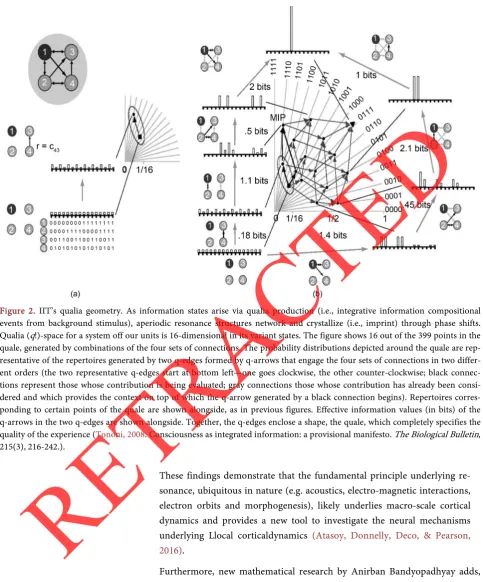
An open mind gains amplification via the senses, biofeedback (i.e., thought), directionality (i.e., spin), and through both local and nonlocal systematic reson-ances (e.g., gravitational)—thus arriving at a geometrical aesthetics proportio-nate to Tononi’s 16-D qualia shapes as illustrated below in Figure 2(Nystrom, 2004; Tononi, 2008; Sarkar & Bhattacharyay, 2014).
The orders of probabilistic experience give rise to Sébag’s “progressive use of intelligence,” which allows experience to generate “instruments” or “technolo-gies” of perception from recursive qualia interpretation. Eco adds to the critique of formativity, “The moment consciousness recognizes the object, it gets rid of its alienation by negating the object itself” (Eco, 1989). However, in light of Keppler’s research, the object and observer are both imprinted depending on their SR interface, and openness. These transactional amplification processes, when represented in frequency-specific, harmonic wave patterns, as found in the 2016 study Exploring Neural Correlates of Consciousness with Connectome- specific Harmonic Waves, (Atasoy et al., 2016) shows that:
Figure 2. IIT’s qualia geometry. As information states arise via qualia production (i.e., integrative information compositional events from background stimulus), aperiodic resonance structures network and crystallize (i.e., imprint) through phase shifts. Qualia (q!)-space for a system off our units is 16-dimensional in its variant states. The figure shows 16 out of the 399 points in the quale, generated by combinations of the four sets of connections. The probability distributions depicted around the quale are rep-resentative of the repertoires generated by two q-edges formed by q-arrows that engage the four sets of connections in two differ-ent orders (the two represdiffer-entative q-edges start at bottom left—one goes clockwise, the other counter-clockwise; black connec-tions represent those whose contribution is being evaluated; gray connecconnec-tions those whose contribution has already been consi-dered and which provides the context on top of which the q-arrow generated by a black connection begins). Repertoires corres-ponding to certain points of the quale are shown alongside, as in previous figures. Effective information values (in bits) of the q-arrows in the two q-edges are shown alongside. Together, the q-edges enclose a shape, the quale, which completely specifies the quality of the experience (Tononi, 2008. Consciousness as integrated information: a provisional manifesto. The Biological Bulletin, 215(3), 216-242.).
These findings demonstrate that the fundamental principle underlying re-sonance, ubiquitous in nature (e.g. acoustics, electro-magnetic interactions, electron orbits and morphogenesis), likely underlies macro-scale cortical dynamics and provides a new tool to investigate the neural mechanisms underlying Llocal corticaldynamics (Atasoy, Donnelly, Deco, & Pearson, 2016).
Furthermore, new mathematical research by Anirban Bandyopadhyay adds, “We have determined the mathematical origin of distribution of resonance fre-quencies, and it appears that nature relies on the number system [i.e., Platonic, non-algorithmic] to create materials and composition of frequencies is an exam-ple of a beautiful mathematics (Bandyopadhyay, 2016)”.
[image:27.595.57.541.65.648.2]