Munich Personal RePEc Archive
Towards Understanding the
Normalization in Structural VAR Models
Kociecki, Andrzej
National Bank of Poland
17 June 2013
Online at
https://mpra.ub.uni-muenchen.de/47645/
T
OWARDS
U
NDERSTANDING
THE
N
ORMALIZATION
IN
S
TRUCTURAL
VAR
M
ODELS
Andrzej Kocięcki
National Bank of Poland
e–mail: andrzej.kociecki@nbp.pl
First version: November 2012
This version: November 2012
Abstract: The aim of the paper is to study the nature of normalization in Structural VAR models. Noting that normalization is the integral part of
identification of a model, we provide a general characterization of the
normalization. In consequence some the easy–to–check conditions for a
Structural VAR to be normalized are worked out. Extensive comparison
between our approach and that of Waggoner and Zha (2003a) is made.
Lastly we illustrate our approach with the help of five variables monetary
Structural VAR model.
I.
I
NTRODUCTIONThe great merit of Waggoner and Zha (2003a) and Hamilton et al (2007) is
that they made us realize how subtle the normalization in Structural VAR (SVAR)
models is. That is contrary to the common view normalization can influence the small
sample probabilistic inference in an uncontrollable and strange way. Poor
normalization can lead to multimodal small sample distributions of maximum
likelihood estimates or multimodal posterior distributions (of function) of parameters
of interest. This phenomenon will manifest itself in a rather inaccurate description of
statistical uncertainty.
The reaction to the normalization puzzle in SVAR models was the so–called
likelihood preserving (LP) normalization proposed by Waggoner and Zha (2003a).
sign of each equation, the likelihood possesses a multitude of global modes. In order
to make the probabilistic statements reliable we should choose one mode and focus on
the shape of the likelihood in the appropriate area around this mode (we should not
mix “contents” of two or several modes in terms of their statistical uncertainty).
Our position is different. We take seriously the statement of Hamilton et al.
(2007) that “the normalization problem is fundamentally a question of identification”.
Although Waggoner and Zha (2003a) motivated and justified their normalization rule
in the context of well–behaved impulse response functions (IRF’s), our contribution is
the remark that ill–behaved IRF’s are consequence of the lack of global identification.
Building on this we proposed different normalization rule whose primary role is to
achieve this global identification. The merit of our normalization rule is that it is
mathematically deduced straight from the very basic definition of normalization. On the other hand the LP normalization is based on informal reasoning (though it
possesses some desirable properties). Moreover our normalization is ordinal. That is
we lay down a priori permissible sign for a subset of coefficients in the
contemporaneous matrix. In contrast using the LP normalization we sometimes
multiply coefficients in a given equation by 1 but sometimes by minus 1 (depending
on what is closer to the mode).
We offer theoretical insight (which is contrary to the common understanding)
that sometimes it is not sufficient to restrict the sign of one coefficient in every
equation to normalize a model. As we will show in non–recursive SVAR models we
usually need more sign restrictions. In fact this may be also perceived as the
significant contribution of our paper since at this level of the SVAR model design the
economic theory must enter the scene e.g. you must take a stand a priori on whether supply is downward or upward sloping.
It turns out that our normalization also sheds some new light on more and
more popular sign restrictions used to identify the impact of some shocks in a SVAR,
see e.g. Uhlig (2005). Although it is well understood that using only sign restrictions
is insufficient to identify a model we claim that they may be necessary for
identification. That is according to our theory sign restrictions may constitute
inevitable part of the identification of a model i.e. without them a model may be
unidentified even if the conditions given in Rubio–Ramírez et al. (2010) are met.
Since the articles of Waggoner and Zha (2003a) and Hamilton, Waggoner and
Zha (2007) are frequently cited in the sequel they will be referred to as WZ and
II. G
ENERALD
EFINITION OFN
ORMALIZATION INSVAR
M
ODEL The subject of this paper is to understand the nature of normalization in thefollowing SVAR model
1 1
t t t p p t
y A′ = +c y A′− + +y′− A +ε′; for t =1,…,T (1)
where A: (m×m) is the nonsingular matrix of contemporaneous relations between the data yt : (m×1), Ai : (m×m), c : (1×m) is a vector of constants and
1 2 1
| , , (0 , I )
t yt yt N m m
ε − − … ∼ × . Let us define B′=[c′A1′…Ap′]. Further let Om denote
the space of (m×m) orthogonal matrices i.e. { m m | I }
m m
O = g ∈ × g g′ =gg′= .
Assume that restrictions identify a SVAR model up to arbitrary sign of each
equation. Let us denote this restricted parameter space as , r A B
Θ . To distinguish the identification up to arbitrary sign of each equation from the concept of global
identification we term the former as the regional identification. The label “regional”
prompts that this is more than local property. Formally
Definition 1: The SVAR is regionally identified at ( , ) r, A B
A B ∈ Θ if and only if (ifif)1
, { | ( , ) , } r
A B m A B
S = g ∈O Ag Bg ∈ Θ =D, where D ={diag( ,...,δ1 δm) |δi = ±1}.
Following the literature we confine ourselves to the normalization put only on
elements of A. Hence we restrict permissible A’s to some subset n m m A
×
Θ ⊂ which
entails inequalities on some entries in A matrix. It just amounts to augmenting , r A B
Θ with inequality constraints n
A
Θ . Let R be the space of all regionally identified parameter points such that n
A
A∈ Θ i.e. {( , ) , |
r n
A B A
R = A B ∈ Θ A∈ Θ and ( , )A B is regionally identified} . Of course we must assume that R ≠ ∅. Hence we have intuitively clear
Definition 2: A normalization is a subset Θ ⊂nA m m× such that for all ( , )A B ∈R we
have { | ( , ) , , } {I }
r n
m A B A m
g ∈O Ag Bg ∈ Θ Ag ∈ Θ = .
1
Hence to normalize a model means to achieve global identification on R (uniformly). That is when a normalization is imposed the point that is regionally identified
becomes globally identified.
Let ( , )A B ∈R. Since
, ,
{ | ( , ) r , n} { | ( , ) r } { | n}
m A B A m A B m A
g ∈O Ag Bg ∈ Θ Ag ∈ Θ = g ∈O Ag Bg ∈ Θ ∩ g ∈O Ag ∈ Θ
We obtain by definition 1
,
{ | ( , ) r , n} { | n}
m A B A m A
g ∈O Ag Bg ∈ Θ Ag ∈ Θ =D∩ g ∈O Ag∈ Θ ⊆D (2)
Hence equivalent definition of normalization is
Definition 2A: A normalization is a subset Θ ⊂nA m m× such that for all ( , )A B ∈R we
have { | ( , ) , , } {I }
r n
A B A m
g ∈D Ag Bg ∈ Θ Ag∈ Θ = .
WZ refer to “conventional” normalization as the sign choice of arbitrary
(nonzero) element in each equation. With the help of simple 2–dimensional recursive
model they demonstrate that “conventional” normalization may entail apparent ill–
behavior of the probability statements for impulse responses. Since this example
constitutes the motivation to develop “appropriate” normalization rule by WZ we
first analyze this example from our perspective (which is complementary to that
adopted by WZ). To this end we ignore any lags in SVAR since they do not play any
role in our reasoning. Consider the simple SVAR y At′ =εt′, where
11 21 22
0 a A=⎡⎢a a ⎤⎥
⎢ ⎥
⎣ ⎦ i.e. 0
r A
⎡ ⎤
Θ = ⎢ ⎥
⎢ ⎥
⎣ ⎦. Evidently I2
r A
∈ Θ and
2
I { 2 | I2 } r A
S = g ∈O g ∈ Θ =D. Hence the model
is regionally identified at A=I2. As noted by WZ if we employ the normalization
that all diagonal elements in A are positive i.e. { 2 2 | 11 0, 22 0} n
A A a a
×
Θ = ∈ > > ,
which leads to { r | n} r n 0
A A A A
R A A
+ +
⎡ ⎤
⎢ ⎥
= ∈ Θ ∈ Θ = Θ ∩ Θ = ⎢ ⎥
⎣ ⎦, then I2
r n
A A
∈ Θ ∩ Θ and
2 2 2
{ | I r n} {I }
A A
g ∈O g ∈ Θ ∩ Θ = i.e. the model is globally identified at A=I2. Using the “conventional” normalization argument we could replace n
A
Θ with
2 2
21 22
{ | 0, 0}
n
A A a a
×
Θ = ∈ > > , which induces { r | n}
A A
R= A∈ Θ A∈ Θ = 0
r n
A A + +
⎡ ⎤
⎢ ⎥
= Θ ∩ Θ =
⎢ ⎥
⎣ ⎦. WZ show how strange results may appear when normalization
n A
Θ is used. However to point out clear unreasonableness of normalization n A
identified using n A
Θ ceased to be so with n A
Θ . Hence using n A
Θ we “lose” from potentially normalized (globally identified) set some regionally identified points. The
general question is this: Is it reasonable to sacrifice some points from globally
identified set when they are economically reasonable? This suggests that the
arbitrariness of “conventional” normalization is illusory and must be abandoned.
Formal analysis is calling for.
Using definition 2 we have a useful alternative characterization of
normalization
Proposition 1: A normalization is a subset n m m A
×
Θ ⊂ such that for all ( , )A B ∈R;
1
{I }
n
A m
D∩A−Θ = , where 1 n { 1 | n}
A A
A−Θ = A A A− ∈ Θ .
Proof: Let ( , )A B ∈R. We have { | ( , ) , , }
r n
m A B A
g ∈O Ag Bg ∈ Θ Ag ∈ Θ =
{ | n}
m A
D g O Ag
= ∩ ∈ ∈ Θ by (2). We shall prove { | n}
m A
g ∈O Ag ∈ Θ =
1
{ | n}
m A
g O g A−
= ∈ ∈ Θ . We get
n A
Ag ∈ Θ ⇒ Ag =A for some n
A
A∈ Θ ⇔g =A A−1 for some n A
A∈ Θ ⇒ 1 n
A
g ∈A−Θ On the other hand
1 n A
g ∈A−Θ ⇒ g =A A−1 for some n A
A∈ Θ ⇔Ag =A for some n
A
A∈ Θ ⇒ n
A
Ag ∈ Θ Then for arbitrary ( , )A B ∈R
1 1
,
{ | ( , ) r , n} { | n} n
m A B A m A m A
g ∈O Ag Bg ∈ Θ Ag ∈ Θ =D∩ g ∈O g ∈A−Θ =D∩O ∩A−Θ =
1 n A
D A−
= ∩ Θ
The result follows by replacing { | ( , ) r, , n}
m A B A
g ∈O Ag Bg ∈ Θ Ag ∈ Θ with 1 n
A
D∩A−Θ in definition 2.
Proposition 1 is the most general and valid for all kinds of homogenous restrictions (i.e. linear or nonlinear, whether the restricted parameter space is
variation free or not etc.). However if the restricted parameter space is variation free
i.e. when restrictions on A and B are independent of each other, then more intuitive
and easily checkable condition is available (see below). Proposition 1 says that a
model is normalized ifif for all ( , )A B ∈R the only common element of the two subsets D and 1 n
A
A−Θ is the identity matrix. In principle, to achieve this global identification we must have that ( , )∀ A B ∈R, 1 n
A
A−Θ is a subset with all diagonal elements strictly greater than minus one (since D={diag( ,...,δ1 δm) |δi = ±1}).
However even in very special cases this is not feasible e.g. when A is lower triangular
must ensure that ( , )∀ A B ∈R, 1 n A
A−Θ is a subset with strictly positive diagonal elements. Using proposition 1 we automatically rule out cases when A is singular
and/or 1 n
A
A−Θ is empty. The very reason for this is that our definition of normalization is uniform i.e. it has to be fulfilled for all ( , )A B ∈R.
In the rest of paper we focus on the case when ,
r r r
A B A B
Θ = Θ ×Θ i.e. restricted parameter space is variation free so as the restrictions on A and B are independent
of each other. This covers unquestionably the most common use of SVAR model in
which restrictions are confined to A matrix only. The main reason for that is to have
a close contact with WZ (and to be concise).
Anyway though in general case our starting point to study normalization
would be proposition 1, when ,
r r r
A B A B
Θ = Θ ×Θ we have
Proposition 2: Suppose ΘrA B, = Θ ×ΘrA rB. If ∀( , )A B ∈R; ∩ −1 Θ ∩ Θ =
( r n) {I }
A A m
D A
then n A
Θ is a normalization, where −1(Θ ∩ Θ =r n) { −1 | ∈ Θ ∩ Θr n}
A A A A
A A A A .
Proof: First note that given ,
r r r
A B A B
Θ = Θ ×Θ we have
,
{ | ( , ) r , n} { | r n, r}
A B A A A B
g ∈D Ag Bg ∈ Θ Ag∈ Θ = g ∈D Ag ∈ Θ ∩ Θ Bg ∈ Θ =
{ | r n} { | r}
A A B
D g D Ag g D Bg
= ∩ ∈ ∈ Θ ∩ Θ ∩ ∈ ∈ Θ
Analogously as in the proof of proposition 1 we can show { | r n}
A A
g ∈D Ag ∈ Θ ∩ Θ
1
{ | ( r n)}
A A
g D g A−
= ∈ ∈ Θ ∩ Θ . Hence
1 ,
{ | ( , ) r , n} ( r n) { | r }
A B A A A B
g ∈D Ag Bg ∈ Θ Ag∈ Θ =D∩A− Θ ∩ Θ ∩ g ∈D Bg ∈ Θ
Note that if r, r r
A B A B
Θ = Θ ×Θ then { r n, r |
A A B
R= A∈ Θ ∩ Θ B ∈ Θ ( , )A B is regionally identified}. Let A B, ∈R be arbitrary. It follows
1 ,
{ | ( , ) r , n} ( r n) { | r }
A B A A A B
g ∈D Ag Bg ∈ Θ Ag∈ Θ =D∩A− Θ ∩ Θ ∩ g ∈D Bg ∈ Θ
If 1( r n) {I }
A A m
D∩A− Θ ∩ Θ = then { | ( , ) , , } {I }
r n
A B A m
g ∈D Ag Bg ∈ Θ Ag ∈ Θ = since
∈ ∈ Θ
{ | r}
B
g D Bg is non–empty and contains Im. This proves that n
A
Θ is a
normalization.
Proposition 2 gives sufficient condition for normalization when ,
r r r
A B A B
Θ = Θ ×Θ and there are some restrictions imposed on B. However if the restrictions are confined to
A only, then proposition 2 constitutes necessary and sufficient condition for
normalization. For future reference let us denote rn r n
A A A
Θ ≡ Θ ∩ Θ .
A normalization consistent with proposition 2 will be refereed to as PL
normalization (you can think of PL as an abbreviation for “plain” or alternatively as
is appropriate when restricted parameter space is variation free and requires that for
all ( , )A B ∈R, the only common element from two subsets D and 1 rn A
A−Θ is the identity matrix. This will be achieved by the condition that all elements in 1 rn
A
A−Θ have strictly positive diagonal elements. In the important special case when all
restrictions are confined to A only we must ensure that for all A∈ΘrnA such that A is regionally identified, 1 rn
A
A−Θ has strictly positive diagonal elements. Or simply for
every , rn
A
A A∈ Θ , 1
A A− has strictly positive diagonal elements.
The inevitable question from which we could not escape is how PL
normalization looks like when using recursive SVAR models i.e. A is lower or upper
triangular and B unrestricted. It is easy to note that restricting all elements on the
diagonal of A to be positive or negative works well. Let us show this. Without loss of generality assume A is lower triangular with positive diagonal elements. Then 1
A− is lower triangular with positive diagonal elements too. If we postmultiply 1
A− by any A, which is also lower triangular with positive diagonal elements, then a product
1
A A− is lower triangular with positive diagonal elements. Lastly the only common element of D and the space of lower triangular matrices with positive elements is the
identity matrix.
III. F
IRSTI
LLUSTRATION OFPL
N
ORMALIZATIONAs a first illustration of our approach we use the example of orange demand
and supply discussed in detail in HWZ. Let yt′ =( , ,q p wt t t), where qt denotes the log
of the number of oranges sold in year t, pt is the log of the price and wt is the
number of days with below–freezing temperatures in year t. The model is as follows
11 12
21 22 1 1
31 33
0 0 0
t t t p p t
a a
y a a c y A y A
a a
ε
− −
⎡ ⎤
⎢ ⎥
⎢ ⎥
′⎢ ⎥ = + ′ + + ′ + ′
⎢ ⎥
⎣ ⎦
(3)
where Ai’s are unrestricted. Of course the restricted parameter space is variation free
hence proposition 2 applies. First equation represents a supply, second – a demand
and the last one depicts the exogenous process wt. One may show that the model (3)
is regionally identified almost everywhere [Lebesgue] (in fact provided that 11 12
21 22
a a a a
⎡ ⎤
⎢ ⎥
⎢ ⎥
⎣ ⎦ is
nonsingular and a31 ≠0). By assumption A must be also non–singular hence
33 0
11 12 21 22 31 33 0 0 0 a a A a a
a a ⎡ ⎤ ⎢ ⎥ ⎢ ⎥ = ⎢ ⎥ ⎢ ⎥ ⎣ ⎦ ⇒ 1
A− =
22 33 12 33 1
21 33 11 33
31 22 31 12 11 22 21 12
0
[det( )] 0
a a a a
A a a a a
a a a a a a a a
− ⎡ − ⎤ ⎢ ⎥ ⎢ ⎥ ⋅ − ⎢− − ⎥ ⎢ ⎥ ⎣ ⎦
where det( )A =a a a11 22 33−a a a33 12 21.
Let 11 12 21 22 31 33 0 0 0 a a A a a
a a ⎡ ⎤ ⎢ ⎥ ⎢ ⎥ = ⎢ ⎥ ⎢ ⎥ ⎣ ⎦
be arbitrary. Then diagonal elements of 1
A A− are given as
11 ( 22 33 11 12 33 21)/( 11 22 33 33 12 21)
d = a a a −a a a a a a −a a a
22 ( 11 33 22 21 33 12)/( 11 22 33 33 12 21)
d = a a a −a a a a a a −a a a (4)
33 ( 11 22 33 21 12 33)/( 11 22 33 33 12 21)
d = a a a −a a a a a a −a a a
Our goal is to guess n A
Θ such that for every , rn A
A A∈ Θ , 1
A A− has strictly positive diagonal elements i.e. dii >0; ∀i. It is easily verified that taking n
A
Θ to be the space of A’s with strictly positive diagonal elements is insufficient to complete the global
identification of the model. We need one more assumption: a12 is positive and a21 is
negative (or vice versa). Interestingly this requires economic reasoning. Since the first
equation is a supply and the second is a demand it is natural to assume a21 <0 and
12 0
a > (note that all coefficients of each contemporaneous relation are on the left side in SVAR (1))2. Hence
11 22 33 21 12
{ | 0, 0, 0, 0, 0}
n m m
A A a a a a a
×
Θ = ∈ > > > < > (5)
Imposing PL normalization allows us to postmultiply (3) by 1 1 1 11 22 33
( , , )
diag a− a− a− to get (with some abuse of notation)
1 1
1 0
1 0 0 1
t t t p p t
y c y A y A u
h
η
γ − −
⎡ ⎤ ⎢ ⎥ ⎢ ⎥ ′⎢ ⎥ = + ′ + + ′ + ′ ⎢ ⎥ ⎣ ⎦ (6)
Note that with PL normalization η =a12/a22 >0, γ =a21/a11 <0, h =a31/a11 and 2 2 2
3 1 11 22 33
(0 , ( , , ))
t
u ∼N × diag a− a− a− . The notation used in (6) is not accidental. The specification (6) “almost” corresponds to the so–called η−normalization in HWZ.
2
We wrote “almost” since η−normalization in HWZ does not take into account the sign restrictions η>0 and γ <0, which are in fact necessary for global identification. The interesting fact about (6) under the PL normalization is that it
roughly conforms to the so–called identification principle i.e. normalization rule
proposed by HWZ. Identification principle applied to (6) says that boundaries for
allowable entries of A matrix should correspond to the loci along which the log
likelihood is −∞. In our case this locus is γη =13. Although the locus of γη =1 is
not on the boundary of the parameter space in (6) what PL normalization does
instead is to exclude the parameter points for which γη =1 holds (since η>0 and 0
γ < ).
To illustrate all these issues we simulated the sample of 100 observations from
1
1 0.1 0 0.2 0.5 0 0.1
0.5 1 0 0.12 0.3 1 0.1
0.5 0 1 0.3 0 0.1 0.4
t t t
y y− ε
′
⎡ ⎤ ⎡ ⎤ ⎡ − ⎤
⎢ ⎥ ⎢ ⎥ ⎢ ⎥
⎢ ⎥ ⎢ ⎥ ⎢ ⎥
′⎢− ⎥ =⎢ ⎥ + ′ ⎢ ⎥+ ′
⎢ ⎥ ⎢ ⎥ ⎢ ⎥
⎣ ⎦ ⎣ ⎦ ⎣ ⎦
; εt ∼N(0 , I )3 1× 3 (7)
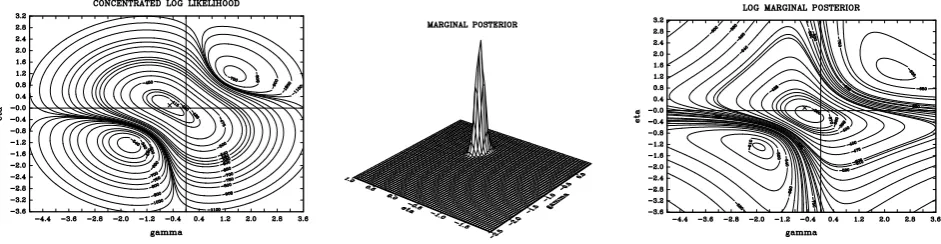
Since aii =1 for i =1,2, 3; we have a12 ≡ =η 0.1, a21 ≡ = −γ 0.5 and a31 ≡ =h 0.5. The first picture in Figure 1 shows the contours of concentrated log likelihood for η
and γ evaluated at the true values for h =0.5 and aii =1, for i =1,2, 3. The true values of η and γ are marked with “×”. The likelihood has one global maximum and two local peaks (of unequal height). The areas of great concentration of the
contour levels correspond to the loci along γη =1 (at which the log likelihood approaches −∞). Using the PL normalization we restrict the support to the second quadrant i.e. η>0 and γ <0. Thus we automatically exclude parameters along and in the vicinity of γη =1 that are situated both in the first and the third quadrant. It is instructive to find out how these problems carry over into the posterior results.
Although the multimodality naturally characterizes the marginal posterior of η and
γ (derived under the flat prior for all parameters in SVAR), see the last picture in Figure 1, the contribution of these modes to the visible shape of the posterior is none,
see the middle picture in Figure 1. The reason is that the ratio of the height of the
marginal posterior of η and γ at the global maximum to that of the second largest
peak (around γ = −2, 1.2η = − ) is about 150
e . In consequence the IRF’s computed
from (6) even without inequality constraints η>0 and γ <0 are well behaved too
3
i.e. the error bands for IRF’s are not too wide and quite conclusive, see HWZ.
However in contrast to HWZ we interpret these results differently. For HWZ the
parameterization (6) without inequality restrictions η>0 and γ <0 is acceptable since “for practical purposes it is sufficiently close […] to a true identification–based
normalization”. As we will show in section VI, this conclusion is case–sensitive. In
this particular 3–dimensional SVAR subject to the particular identifying scheme,
restricting the diagonal elements in A results in well behaved posterior of parameters
and its functions e.g. IRF’s. In general this is not a rule. In fact this is the message
from WZ. Using the PL normalization guarantees well behaved posteriors of
parameter and its functions in larger models when the simple visual inspection of the
shapes of the likelihood and/or posterior is not readily available and ad–hoc
normalization rules are not an option.
Quite obviously those inequality constraints turn out to be also sign
restrictions for impulse responses. For example instantaneous response of the price to
a one standard deviation positive shock to a quantity supplied is
12 a a12 33/(a a a11 22 33 a a a33 12 21)
ϕ = − − . Using PL normalization we have ϕ12 <0.
Moreover the instantaneous effect of a one standard deviation increase in quantity
demanded on the price is strictly positive under PL normalization (since
22 a a11 33/(a a a11 22 33 a a a33 12 21) 0
ϕ = − > ). This ensures that we avoid all pitfalls
connected with “conventional” normalizing rules which were convincingly illustrated
[image:11.595.59.530.515.637.2]in Figure 4 in HWZ.
Figure 1: From the left: a) contours of concentrated log likelihood of γ and η evaluated at the true value of h=0.5 and the diagonal elements in A matrix i.e. aii =1 for i=1, 2, 3; b) marginal posterior of γ and η under the flat prior for all
parameters in SVAR; c) contours of the log marginal posterior of γ and η under the flat prior for all parameters in SVAR.
IV. S
UFFICIENTC
ONDITION FORPL
N
ORMALIZATION In our example of the orange demand–supply, nA
Θ turns out to be equivalent
to assumption that rn
A
A
provided that the restricted parameter space is variation free this requirement is all
we need to complete the global identification of SVAR model.
Among basic model assumptions is that det( )A ≠0. Commonly this assumption was thought as unimportant because the set of singular matrices has zero
Lebesgue measure. For instance using Bayesian simulation methods to estimate
SVAR, in practice we could not encounter a draw which entails singular A. However
the theoretical importance of the singularity of A has been recognized and discussed
by WZ and HWZ. The message from these both articles is that the permitted
parameter space should exclude the subspace on which the likelihood vanishes. The
goal of this section is to demonstrate that the latter informal statement can be
formally justified.
To proceed further we need one more notation. Given two matrices X =( )xij
and ( )Y = yij of the same dimension we write X ≤cY if xij ≤yij for each ,i j. Hence
“≤c” denotes component–wise inequality. We have
Proposition 3: Assume ,
r r r
A B A B
Θ = Θ ×Θ . Let A and A be given matrices in ΘrA.
Assume that rn { r | }
A A A A c A c A
Θ = ∈ Θ ≤ ≤ is such that each A∈ ΘrnA is nonsingular. Then for every A∈ ΘrnA , A−1ΘrnA is a subset with strictly positive diagonal elements.
Proof: This is the application of theorem 1.2 in Rohn (1989), which states that
under hypothesis of our proposition, 1 1 2
A∗ =A A− , for every 1, 2 rn A
A A ∈ Θ , is the so– called P −matrix (a square matrix A∗ is the P −matrix if all its principal minors are positive). In particular since each diagonal element is the principal minor, the
proposition follows.
Needless to say some entries in A may be set to ∞ and that in A to minus ∞. Proposition 3 forms a basis for useful sufficient condition to achieve global
identification. One has to derive analytically det( )A . If it happens that imposing inequalities on some or all entries in A restricts the latter so as det( )A >0 or
det( )A <0 then setting rn { r | det( ) 0}
A A A A
Θ = ∈ Θ > or rn { r | det( ) 0}
A A A A
Θ = ∈ Θ <
will complete the identification of a model. The choice between
{ | det( ) 0}
n
A A A A
Θ = ∈ Θ > and n { | det( ) 0}
A A A A
Θ = ∈ Θ < depends on the model at
hand (but is only illusory, see right below). Thus instead of finding n A
Θ such that
rn A
A
∀ ∈ Θ ; 1 rn A
elements of A in the form A≤c A≤c A so as det( )A >0 or det( )A <0. Note that derivation of det( )A even in large SVAR model is usually not very difficult. This is
because of many zero restrictions imposed on A. In fact prior to derivation of
det( )A , we can permute the rows and columns of A so as there appear blocks of
zeros (which usually simplify derivation of det( )A ). The permutation operation is
permissible since it only changes the sign of the determinant but both det( )A >0 and det( )A <0 restriction is acceptable.
Note that when A is lower or upper triangular (or its subset) then if diagonal
elements of A are restricted to be positive we immediately get det( )A >0. This justifies our conviction that the correct normalization is the same for recursive and
non–recursive model provided that we follow the rule to restrict A so as det( )A >0.
V. C
OMPARISON OFPL
N
ORMALIZATION TOLP
N
ORMALIZATIONIt is instructive and desirable to compare our theory with the LP
normalization proposed by WZ. The first step to apply LP normalization is the
derivation of the maximum likelihood (ML) estimator of A to be denoted as ˆA.
Proposition 4: Assume that r, r r A B A B
Θ = Θ ×Θ . Suppose there is a mode A in ˆ rn A
Θ . Then the PL normalization implies the LP normalization restricted to rn r
A B
Θ ×Θ . Proof: PL normalization implies that for every two distinct , rn
A
A A∈ Θ , A A−1 must have strictly positive diagonal elements. Since a mode ˆA belongs to rn
A
Θ it follows that for every rn
A
A∈ Θ , 1ˆ
A A− has also strictly positive diagonal elements. The latter is the LP normalization.
Otherwise, if we operate on ,
r r r
A B A B
Θ = Θ ×Θ (and not on rn r
A B
Θ ×Θ ), the LP and PL normalizations are incomparable notions. However if ˆ rn
A
A∈ Θ , by proposition 4, any
rn A
A∈ Θ is consistent with the LP normalization. On the other hand the parameter points that are chosen using the LP normalization may not belong to rn
A
Θ 4. Thus as a
general principle we may expect that error bands for IRF’s in a model under PL
normalization will be narrower than those in a model under the LP normalization.
4
Consider the model of the orange demand–supply from section III. Let us focus on the first diagonal element of 1ˆ
A A− . Suppose aii=1;∀i, a12=0.1 and a21=0.2 (note that a21 violates the PL normalization). Further suppose that ML estimators are aˆ11=1 and aˆ21= −0.1. Then the first diagonal element of
1ˆ
A A− is
Utilizing the PL normalization we may hope for more clear–cut economic conclusions
as far as IRF’s are concerned. That this hope is justified will be illustrated in section
VI.
Without loss of generality assume rn { r | det( ) 0}
A A A A
Θ = ∈ Θ > . Then we have
the following
Proposition 5: Assume that ,
r r r
A B A B
Θ = Θ ×Θ . Suppose rn { r | det( ) 0}
A A A A
Θ = ∈ Θ >
entails the inequalities so as proposition 3 holds. Let Γ =diag(γ11,…,γmm) be any matrix with γii ∈[0,1]. Then for all , rn
A
A A∈ Θ we have det(AΓ +A(Im− Γ >)) 0.
Proof: By assumption 1
det(AΓ +A(Im− Γ =)) det( ) det((IA ⋅ m − Γ +) A A− Γ). Then det(AΓ +A(Im − Γ >)) 0 ifif 1
det((Im − Γ +) A A− Γ >) 0. By theorem 1.2 in Rohn (1989), for all , rn
A
A A∈ Θ , 1
A A− is a P−matrix (hence all principal minors of
1
A A− are positive). Proposition follows by expansion of 1
det((Im− Γ +) A A− Γ) by the diagonal (Im− Γ) (see e.g. Seber (2008), pp. 61–62 or Harville (1997), p. 196) and noting that for every Γ and , rn
A
A A∈ Θ , the determinant is positive.
In particular under hypothesis of proposition 5 and provided that ˆ rn A
A∈ Θ we get det(AˆΓ +A(Im − Γ =)) det([γ11 1aˆ + −(1 γ11) ,a1 …,γmm maˆ + −(1 γmm)am])>0 for all
[0,1]
ii
γ ∈ , where ˆai denotes the i−th column of ˆA and ai that of A. In contrast the LP normalization works column–wise so as given a1…ai−1,ai+1…am, we choose ai
such that det([ ,a1 …,ai−1,γaˆi + −(1 γ) ,a ai i+1,…,am])>0, for all γ ∈[0,1], i.e. ˆai and
i
a lie on the same side of the hyperplane { m | det( ) 0,
i
a ∈ A = given
1 i 1, i 1 m}
a …a− a+ …a . Evidently the PL normalization ensures that ˆai and ai lie on the
same side of the hyperplane but simultaneously for all i=1,…,m and unconditionally (i.e. without conditioning on a1…ai−1,ai+1…am).
VI. A
M
ONETARYP
OLICYE
XAMPLEAs a second (real–data) example we consider a monetary SVAR proposed by
Kim (1999). The contemporaneous matrix A is restricted as follows (B unrestricted) MP MD PS PS Inf
A= log log log log c R M P Y P
11 12 15 21 22 25 32 33 35 42 43 44 45
51 55
0 0 0 0
0 0
0
0 0 0
a a a
a a a
a a a
a a a a
The identifying scheme is quite similar to that used in Waggoner and Zha (2003b)
(except that (8) does not include unemployment). The model includes 5 variables: the
federal funds rate (R), logarithm of the monetary aggregate M2 ( logM ), logarithm of
the consumer price index ( logP), logarithm of the real GDP interpolated on a
monthly frequency and logarithm of the Commodity Research Bureau price index for
raw industrial commodities (logPc). Each column in (8) represents a behavioral
equation that is signified at the top. “MP” stands for monetary policy (or money
supply) equation and “MD” stands for money demand. Equations labeled with “PS”
succinctly describe production sector and “Inf” stands for the information market.
We employed the US dataset used in Waggoner and Zha (2003b), which is
available at http://www.tzha.net/computercode (where detailed description of the data may be also found). The data are monthly and cover 01.1959–12.2000.
By theorem 7 in Rubio–Ramírez et al. (2010) the model under the identifying
scheme (8) is exactly identified i.e. globally identified almost everywhere. In our
language it means that we can define the set of regionally identified parameter points.
Since the restricted parameter space is variation free, to get complete identification
we need to impose the PL normalization. To this end we use proposition 3 and we
have to derive the determinant of A. We easily get
det( )A =a a a∗ 44 55 −a44(a a a a51 22 33 15−a a a a51 12 33 25)
where a∗ =a a a11 22 33−a a a33 21 12. Kim (1999) implicitly assumed that all diagonal
elements in A are strictly positive. However it is not sufficient for global
identification (i.e. PL normalization). We need to find inequalities on the parameters
so as det( )A >0. Hence in addition to aii >0 (i=1,…, 5), we must assume that
21 12 0
a a < , a a51 15 <0 and a a a51 12 25 >0. To use proposition 3 we must derive from the last three inequalities the implied inequalities for single elements. This should be in
principle assisted by the economic theory. Using standard economic reasoning since
the second equation is money demand we assume a12 >0 (by assumption a22 >0 and
we use a convention that all contemporaneous variables are on the left in SVAR).
Moreover a21 <0 is also reasonable since we can think of the first equation as money
supply (note that we also assume a11 >0). Since Pc is the commodity price index in
dollars we should expect that monetary authority should increase the interest rates
when world commodity price rises. Hence a51 <0. Then we must assume a15 >0 to
fulfill a a51 15 <0. With these choices we must also restrict a25 <0 (so as
51 12 25 0
equation as “an arbitrage equation which describes a kind of financial market
equilibrium”. Thus in case of large economy (like US) domestic interest rates and
money aggregates may affect Pc through the direct pressure on world commodity
price. When the interest rate rises in large economy it should have tendency towards
lowering the commodity prices. That is a15 >0. Moreover when the money aggregate
increases in large economy there is a natural pressure to increase the commodity
prices, hence a25 <0. Needless to say the above inequality restrictions put on A give
rise to sign restrictions for IRF’s (at least for immediate responses).
We estimated the model with p =12 lags using Bayesian approach. To this end we used the flat prior for A and B in order to preserve the likelihood shape.
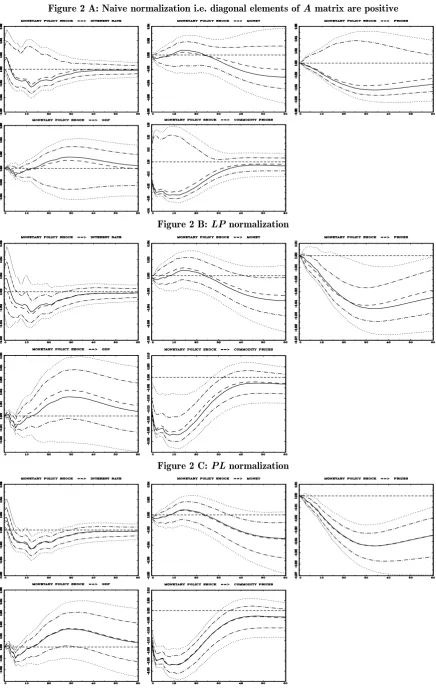
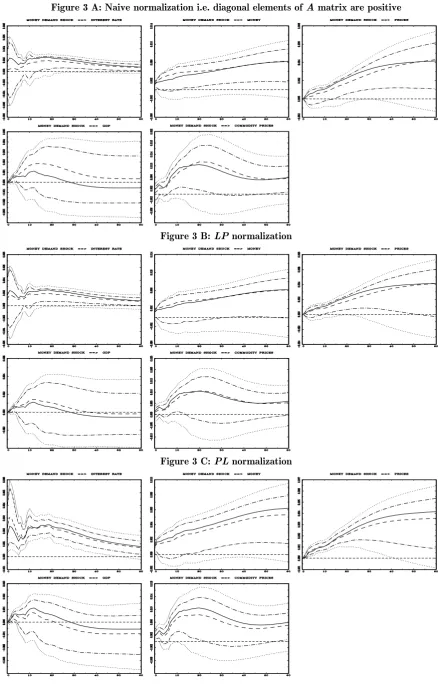
Figures 2 and 3 present IRF’s of all variables to a one standard deviation
contractionary monetary policy shock and a money demand shock, respectively. These are shocks identified with the first two equations. The solid line presents the
IRF evaluated at the maximum likelihood (ML) estimators of A and B. The dashed
line (usually very close to the solid one) is median response, two “dots–dashes” lines
cover 68% of the posterior probability (point–wise). Lastly two dotted lines are 90%
posterior probability bands. In each figure a panel A shows results using naïve
normalization i.e. diagonal elements in (8) are positive, panel B demonstrates the
output using LP normalization and panel C – the PL normalization.
The ML estimates imply IRF’s expected by economists. For instance, the
interest rate rises and a money falls initially, the real GDP declines quite quickly
reaching the minimum within half a year and consumer prices decline persistently.
Since error bands are meant to describe uncertainty around “mean” response, the
probabilistic conclusion may not be so certain and depends on how you normalize the model. With naïve normalization the matter is hopeless which was already nicely
demonstrated in WZ. We found out nothing about the most important aspects of the
monetary policy shock i.e. its impact on interest rate, real GDP and consumer prices.
In general probability bands of all IRF’s are suspiciously wide. As we emphasized this
is a consequence of the methodological fault and not the “uninformativeness” of the
data. Adoption of the LP normalization results in more conclusive probability
statements for IRF’s. However the question of great importance is how LP and PL
normalizations differ from each other and whether these differences are economically
important. Firstly using the PL normalization we get particularly well determined
IRF of the interest rate to a monetary policy shock. We are quite certain that the
anticipation of falling prices and by realizing by monetary policy decision makers that
output has already declined). In contrast the analogous IRF using the LP
normalization gives an ambiguous impression5. Secondly with the PL normalization
we definitely get rid of the “price puzzle” i.e. prices move up after a contractionary
monetary policy shock. In this respect probabilistic conclusions are much sharper
with PL normalization than LP normalization.
In fact in all cases PL normalization makes the probabilistic statement more
informative than when employing the LP normalization. Sometimes it is not a critical
difference but sometimes it is economically crucial (e.g. compare the response of
consumer prices to a money demand shock).
VII. C
ONCLUSIONOur goal was to properly grasp the notion of normalization in SVAR models. Using basic definition of normalization in SVAR models we proposed the easy
working condition for normalization in SVAR models when the restricted parameter
space is variation free. It was called the PL normalization. We emphasized that
normalization is an integral part of the identification of SVAR. To put it another
way, only properly normalized parameter point becomes globally identified.
We compared our theory to the likelihood preserving (LP) normalization
proposed by Waggoner and Zha (2003a). Our basic attitudes to normalization are
quite different. We maintain that a correct approach is to trace the overall shape of
the likelihood of the globally identified model whereas Waggoner and Zha (2003a)
focus on its shape in the close area around the mode in a model which is “almost”
identified (up to arbitrary sign of each equation). In our opinion a proper
normalization is not a matter of appropriate description of uncertainty around the maximum likelihood estimate of IRF (as suggested by Waggoner and Zha (2003a)),
but is the last and necessary step towards achieving the global identification of
SVAR model.
However our theoretical findings are in line with the recommendation of
Waggoner and Zha (2003a) and Hamilton et al. (2007) to put the parameter points
which imply the zero likelihood or failure of local identification on the boundary of
5
the parameter space. On the other hand we disagree with Waggoner and Zha (2003a)
claim that “the correct normalization for recursive models turns out to be, in general,
inappropriate for nonrecursive models”. Our conclusion is that the correct
normalization is the same for recursive and non–recursive SVAR provided that we
fully understand what the normalization is (the appropriate normalization rule is the
same).
We demonstrated theoretically and in practice that using PL normalization we
get narrower IRF’s error bands than when employing the LP normalization. Hence
the PL normalization may be welcomed by applied macroeconomists as it will tend to
confirm more firmly their intuition.
Although general nonlinear identifying restrictions may make the
normalization irrelevant (see e.g. Waggoner and Zha (2003a)) there is an important
class of nonlinear restrictions (e.g. short–run and long–run impulse response restrictions) that also require normalization rule. Though we provided useful
characterization of normalization in such a case (see proposition 1) we really did not
study it and leave these aspects of normalization for future research.
REFERENCES:
Hamilton, J.D., D.F. Waggoner and T. Zha (2007), “Normalization in Econometrics”, Econometric Reviews, 26, pp. 221–252.
Harville, D.A. (1997), Matrix Algebra from a Statistician’s Perspective, Springer–Verlag, New York.
Kim, S. (1999), “Do Monetary Policy Shocks Matter in the G–7 Countries? Using Common Identifying Assumptions about Monetary Policy Across Countries”, Journal of International Economics, 48, pp. 387–412. Rohn, J. (1989), “Systems of Linear Interval Equations”, Linear Algebra and Its Applications, 126, pp. 39–78. Rubio–Ramírez, J.F, D.F. Waggoner and T. Zha (2010), “Structural Vector Autoregressions: Theory of
Identification and Algorithms for Inference”, The Review of Economic Studies, 77, pp. 665–696. Seber, G.A.F (2008), A Matrix Handbook for Statisticians, John Wiley & Sons, Inc., Hoboken, New Jersey. Uhlig, H. (2005), “What Are the Effects of Monetary Policy on Output? Results From an Agnostic Identification
Procedure,” Journal of Monetary Economics, 52, pp. 381–419.
Waggoner, D.F., and T. Zha (2003a), “Likelihood Preserving Normalization in Multiple Equation Models”, Journal of Econometrics, 114, pp. 329–347.
Figure 2 A: Naive normalization i.e. diagonal elements of A matrix are positive
Figure 2 B: LP normalization
Figure 3 A: Naive normalization i.e. diagonal elements of A matrix are positive
Figure 3 B: LP normalization