Situating 1816, the
‘
year without summer
’
,
in the UK
LUCY VEALE AND GEORGINA H ENDFIELD
School of Geography, University of Nottingham, University Park, Nottingham NG7 2RD E-mail: [email protected]; georgina.endfi[email protected]
This paper was accepted for publication in June 2016
The immediate local impacts of the eruption of Mount Tambora, Sumbawa, Indonesia in April 1815 were devastating, resulting in the loss of an estimated 60 000 lives on this and neighbouring islands. However, the longer term effects of the largest known historical eruption on global weather and climate and the related consequences for human health and wellbeing have maintained the prominence of the eruption in public memory. Among the most notable effects were global weather anomalies the following year, which has come to be referred to as‘the year
without summer’. Scholars across the sciences and humanities continue to investigate the
eruption, seeking insights into the likely meteorological and societal impacts of future volcanic eruptions. The bicentenary of the ‘year without summer’ in 2016 provides a timely moment to revisit this weather episode. In this paper, we draw on a range of archival materials and contemporary publications to reconstruct the weather year and explore how the summer of 1816 was experienced and recorded across the UK. We also wish to demonstrate the importance of historical contingency in understanding the potential implications of the event at the local level, and of situating events within their appropriate temporal context. We do this by considering the summer of 1816 as set against the wider weather and cultural contexts of the 1810s. Ourfindings illustrate that in a UK context, summer 1816 was characterised by unusual and extreme weather events. Importantly it also took place within a sequence of years that were similarly replete with anomalous and challenging weather conditions.
KEY WORDS: UK, Tambora, ‘year without summer’, documentary record, extreme weather, 1816
Tambora and the‘year without summer’
‘
V
olcanic eruptions represent some of themost climatically important and societally disruptive short-term events in human history’ (LeGrande and Anchukaitis 2015, 46). The eruption of Mount Tambora, Indonesia represents the largest known eruption in recorded history (Lamb 1970; Newhall and Self 1982). It released an estimated 53–58 Tg (5.3–5.8 9 1013 g) of sulphur
dioxide within a period of about 24 h on 10–11
April 1815 (Self et al. 2004). Sulphate aerosols entered the stratosphere and made their way around the world, temporarily cooling the atmosphere in what was already proving to be a cold decade. The effects were felt across the northern hemisphere (Raible et al. 2016), and have led to the following year being referred to as the ‘year without summer’
(Harington 1992). Two centuries on, there is still much to learn from Tambora, particularly its effects on global climate and local weather as well as the associated consequences for human health and wellbeing (Robock 2015).
The bicentenary of the eruption in April 2015 renewed scholarly and popular interest in the climatic consequences of eruptions and so-called super eruptions (Hegerl et al. 2011; Luterbacher
et al. 2016; Raible et al. 2016; Timmreck 2012;
Zanchettin et al. 2013)1. Recent research has
focused on the possible correlations between
volcanic activity and El Nino events (Adams~ et al.
2003; Emile-Geay et al. 2008), and positive NAO
conditions and winter warming two years after
strong volcanic eruptions (Ortega et al. 2015).
Following significant disruption in Europe from
smaller recent eruptions (Donovan and Oppenheimer 2011) some used the moment to ask whether the
world was prepared for ‘the next volcanic
catastrophe’ (Kandlbaeur 2013; McGuire 2015). It is thus timely to revisit summer 1816, a season that
constitutes ‘a remarkable case study for the
exploration of various direct and indirect interactions
between climate variability and human history’
(Luterbacher and Pfister 2015, 247).
However, as Sadler and Grattan (1999) warn, eruptions are too regularly invoked as major causal
factors in a range of studies that examine palaeoenvironmental processes. There has been a tendency to conflate volcanic events with ‘major turning points in world history’(Oppenheimer 2015, 244)2and to overlook the role of prevailing climatic,
social and environmental conditions (Hansen and Lacis 1990; Nicholls 1988 1990). As Grattan (2006, 11) explains, the processes operate on ‘quite an intimate scale’, and it is thus important to also explore the impacts at the local scale, paying attention to the particularities of weather (Piper
2004), but also socio-economic and cultural
circumstances in specific places and at particular
points in time (Endfield 2011 2014; Hulme 2008
2009; Livingstone 2012). Moreover, as we begin to understand more about the specifics of the eruption, discovering more about Tambora’s effects on distant places and peoples through‘forensic interdisciplinary
studies’ (Oppenheimer 2015, 245) may well prove
useful in determining the risk of, and vulnerability and response to future events.
In this paper we explore geographically grounded narratives of the weather of 1816, contextualise the emergent weather history within a longer reconstruction of weather and weather-related events for the second decade of the nineteenth century, and situate these reports within the socio-economic context in which they were produced.
Volcano weather and impacts in context
Recent review articles have summarised what is
known about the Tambora eruption and its
implications for the Earth system as recorded through early instrumental observations, climate proxies, geological evidence, climate reconstructions and model simulations. The 1816 climate anomaly has been relatively well studied in the United States (particularly in New England) and parts of Europe. In the UK the summer of 1816 has long been recognised as one of the most unseasonable on record, and the July is the coldest July within the Central England Temperature series (extending back to 1659). However, 1695 and 1725 had colder
summers (Manley 1974; Raible et al. 2016). The
known cooling effect of volcanic particles in the atmosphere means that most research has looked at the impact of volcanic eruptions on temperature. Dawson et al.’s (1997) analysis of a gale record for Edinburgh indicates a possible link between high magnitude volcanism and winter storminess, whilst recent studies suggest that global rainfall decreases following large eruptions (Iles et al. 2015). The
England and Wales precipitation series (1766–
present day) places summer 1816 23rd wettest, with
1817 wetter (Wigley et al. 1984; Alexander and
Jones 2001; HadUKP 2016).
As well as considering the range of
meteorological effects it is thus also important to
explore the weather of 1816 relative to that of
preceding and succeeding years. Tierney et al.
(2015, 226) describe the early 1800s as an
‘exceptionally cold period in the Indo-Pacific
region’. The 1810s are also among the coldest
decades recorded over Europe and the northern
hemisphere (Rampino et al. 1988, 83), since
comparable records began about 1750 (Briffa and Jones 1992), and perhaps even in the last 500 years
(Guevara-Murua et al. 2014). Oppenheimer (2003)
recognises the summers of 1817 and 1818 as abnormally cold in the northern hemisphere. Yet, as Briffa and Jones (1992) point out, many studies of
the ‘year without summer’ have neglected to
consider the weather and climate of the rest of 1816 let alone the decade of the 1810s. Several reasons have been forwarded for the cool decade. One is
the so-called Dalton minimum of solar activity
between 1790 and 1830 (Solankiet al. 2004), when sunspot numbers were reduced (Hoyt and Schatten 1998; Vaquero 2007) and solar irradiance was lower (Lean et al. 1995; Mann et al. 1998; Stendel
et al. 2006; Wagner and Zorita 2005). A second is a period of unusually high levels of volcanic activity
(Guevara-Murua et al. 2014; Lamb 1970). In a UK
context, ‘the bad weather phenomena reported
cannot be indiscriminately assigned to the eruption of Tambora’(Sadler and Grattan 1999, 187).
The socio-economic and political context in which this unusually cold period played out was significant, coinciding with the‘dislocations’associated with the Napoleonic wars (Post 1977) and the profound and pervasive effects on local, national and international
economies and trade (O’Rourke 2006). However,
Wood (1965, 6–7) supposes that, ‘In 1816 there occurred depths of suffering among the people beyond the limits that could rightfully have been expected even in a transition from war to peace’, concluding that a‘chance coalescence’of the paths of the worsening economy, agricultural depression, post-war adjustment and thefluctuating but generally inclement climate was to blame. Disentangling the cultural impacts of the possible weather event associated with Tambora from this context of disruption and hardship is challenging.
Documenting Tambora
There are a number of well known documents
detailing both the eruption of Tambora (Raffles
1817 1830; reviewed in Oppenheimer 2003;
and Stommel 1979) to reconstruct a series of unseasonable frosts in June and July 1816. In Europe, the writing of Mary Shelley and Lord Byron has been used to provide insight into summer 1816
in Geneva (Wood 2014), while Luke Howard’s
meteorological observations (1806–17) provide an instrumental record of pressure, temperature and rainfall for London, with reference to events
throughout continental Europe (Howard 1818).
Other analyses relate to documentary sources in
Iberia (Trigo et al. 2009) and Canada (Hamilton
1986). Ship logbooks also provide valuable insight into the worldwide pattern of weather and climate in 1816 (Chenoweth 1996). It is now possible to create synoptic weather maps for particular events within 1816 from historic instrumental data (Brugnara et al. 2015) and to use reanalysis to create visualisations
of surface pressure for that year (Compo et al.
2015)3.
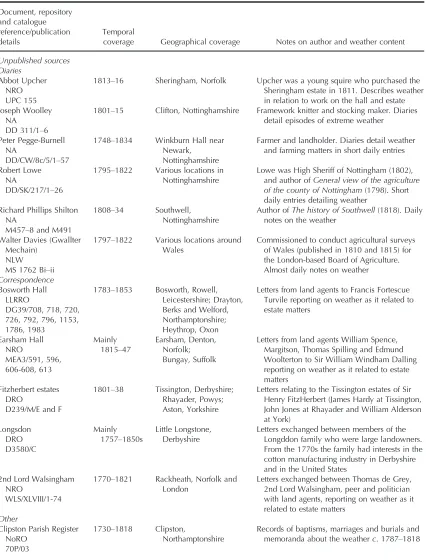
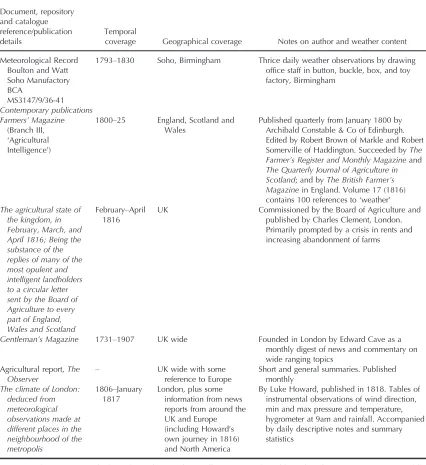
Given the wealth of potential source material there has been surprisingly little use of archival documents to reconstruct the weather of 1816 in the UK, exceptions working with single diary sources (Lee and MacKenzie 2010; Wheeler 2016). In the sections below we draw on diaries, correspondence, and other unpublished documents (Table 1) to revisit the weather of the summer of 1816, and the 1810s4.
Documents have been identified as providing
narrative information on the weather for the study
period and are not exhaustive so much as
representative of that available in the collections consulted. We deliberately avoided searching for Tambora as a known event. Manuscript sources are supplemented with extracts from contemporary publications in order to give a sense of the circulation of weather information.
Situating Tambora
As Tann (1980, 45) has argued, ‘crop failure was a
fact of life’ for many people across the UK
throughout the eighteenth century. Runs of poor harvests, such as those of the 1790s and early 1800s (notably 1798–1801), which have been linked to the generally cold conditions that prevailed at the end of the eighteenth century (Luterbacher et al. 2004), were far more damaging than single bad years. Grain shortages in the early 1800s (Corrigan 1847; Hopkinson 1800; Post 1977) provide a context in which the weather anomalies of the second decade of the nineteenth century took effect. Table S1 in the Supplementary Information provides a summary of extreme weather events in the UK during the period 1809–1818.
Before Tambora: January 1809–April 1815January 1809 was characterised by very low temperatures and frequent and heavy falls of snow. A Worcester newspaper reported on 1 February:
In consequence of the sudden and rapid thaw which commenced yesterday . . . almost every river in the Kingdom has overflowed its banks and immense tracts of land have been land under water. . .On Sunday the water on the north Parade was only 9 inches lower than it was in the great flood of 1795 and about 18 inches below the edge of the plate which is placed, near the Cathedral to commemorate the greatflood of 1770.
WRO, 899/749xii5
Temperaturesfluctuated dramatically in spring and summer with some violent storms. In Clifton, Nottingham, Joseph Woolley noted on 10 August:
there was a very bad thundering and lighting night. . . about‘alf past ten o’clock of night it was very terrible almost all of the night there‘as been a deal of thunder and rain and‘ail this week more than of ever remember at this time of the year in my life.
NA, DD 311/4
The winter was relatively mild and 1810 began, according to Robert Lowe, ‘summer like’ (NA, DD/ SK/217/14). However, in the Midlands from the 13
January throughout February and into March,
freezing conditions with snow and hard frost affected young crops. Peter Pegge Burnell reported on 25 February how there were ‘very severe storms of hail & snow’, whilst the middle of the month had been
‘very severe, vegetables terribly cut up of all sorts’ (NA, DD/CW/8c/5/28).May brought night frosts and very little rain, checking vegetation growth. Summer was generally hot and dry with some areas in drought conditions.
A severe gale and high tide on 9–10 November
caused coastal flooding, shipwrecks and significant loss of life and livestock in the east of England, as well as damage to trees and buildings across the Midland counties. Reverend James Windsor, clerk of Uffculme, Devon, recorded how the weather was
‘unusually boisterous’at this time,‘violent hailstorms accompanied with vivid lightning & loud thunder happened frequently’(DeRO, 1920A/PI/16). Britain’s strongest tornado on record struck Hampshire on 14 December (Doe 2016).
Winter 1810–1811 was cold with sharp frosts,
high winds, and deep snow. Freezing weather combined with depressed economic wellbeing, a function in part of trade embargos and restrictions at the tail end of the Napoleonic wars, meant that life
was becoming extremely difficult for the poorer
Table 1 Key sources for the weather of 1809–18 Document, repository
and catalogue reference/publication details
Temporal
coverage Geographical coverage Notes on author and weather content
Unpublished sources Diaries
Abbot Upcher NRO UPC 155
1813–16 Sheringham, Norfolk Upcher was a young squire who purchased the Sheringham estate in 1811. Describes weather in relation to work on the hall and estate Joseph Woolley
NA DD 311/1–6
1801–15 Clifton, Nottinghamshire Framework knitter and stocking maker. Diaries detail episodes of extreme weather
Peter Pegge-Burnell NA
DD/CW/8c/5/1–57
1748–1834 Winkburn Hall near Newark, Nottinghamshire
Farmer and landholder. Diaries detail weather and farming matters in short daily entries
Robert Lowe NA
DD/SK/217/1–26
1795–1822 Various locations in Nottinghamshire
Lowe was High Sheriff of Nottingham (1802), and author ofGeneral view of the agriculture of the county of Nottingham(1798). Short daily entries detailing weather
Richard Phillips Shilton NA
M457–8 and M491
1808–34 Southwell, Nottinghamshire
Author ofThe history of Southwell(1818). Daily notes on the weather
Walter Davies (Gwallter Mechain)
NLW MS 1762 Bi–ii
1797–1822 Various locations around Wales
Commissioned to conduct agricultural surveys of Wales (published in 1810 and 1815) for the London-based Board of Agriculture. Almost daily notes on weather Correspondence
Bosworth Hall LLRRO
DG39/708, 718, 720, 726, 792, 796, 1153, 1786, 1983
1783–1853 Bosworth, Rowell, Leicestershire; Drayton, Berks and Welford, Northamptonshire; Heythrop, Oxon
Letters from land agents to Francis Fortescue Turvile reporting on weather as it related to estate matters
Earsham Hall NRO
MEA3/591, 596, 606-608, 613
Mainly 1815–47
Earsham, Denton, Norfolk; Bungay, Suffolk
Letters from land agents William Spence, Margitson, Thomas Spilling and Edmund Woolterton to Sir William Windham Dalling reporting on weather as it related to estate matters
Fitzherbert estates DRO
D239/M/E and F
1801–38 Tissington, Derbyshire; Rhayader, Powys; Aston, Yorkshire
Letters relating to the Tissington estates of Sir Henry FitzHerbert (James Hardy at Tissington, John Jones at Rhayader and William Alderson at York)
Longsdon DRO D3580/C
Mainly 1757–1850s
Little Longstone, Derbyshire
Letters exchanged between members of the Longddon family who were large landowners. From the 1770s the family had interests in the cotton manufacturing industry in Derbyshire and in the United States
2nd Lord Walsingham NRO
WLS/XLVIII/1-74
1770–1821 Rackheath, Norfolk and London
Letters exchanged between Thomas de Grey, 2nd Lord Walsingham, peer and politician with land agents, reporting on weather as it related to estate matters
Other
Clipston Parish Register NoRO
70P/03
1730–1818 Clipston,
Northamptonshire
Mary’s6, the workhouse being too full to receive their families, and no other employment presenting itself’ (Sutton 1852, 289). The spring that followed was little better, with frosts and snow on the 7–10
[image:5.516.44.470.92.557.2]April. On 13 May a tornado struck Derbyshire tearing up large trees, whilst violent hail broke glass in Herefordshire and Worcestershire. Two weeks later another damaging hailstorm affected the same
Table 1Continued Document, repository
and catalogue reference/publication details
Temporal
coverage Geographical coverage Notes on author and weather content
Meteorological Record Boulton and Watt Soho Manufactory BCA
MS3147/9/36-41
1793–1830 Soho, Birmingham Thrice daily weather observations by drawing office staff in button, buckle, box, and toy factory, Birmingham
Contemporary publications Farmers’Magazine
(Branch III, ‘Agricultural Intelligence’)
1800–25 England, Scotland and Wales
Published quarterly from January 1800 by Archibald Constable & Co of Edinburgh. Edited by Robert Brown of Markle and Robert Somerville of Haddington. Succeeded byThe Farmer’s Register and Monthly Magazineand The Quarterly Journal of Agriculture in Scotland; and byThe British Farmer’s
Magazinein England. Volume 17 (1816)
contains 100 references to‘weather’ The agricultural state of
the kingdom, in February, March, and April 1816; Being the substance of the replies of many of the most opulent and intelligent landholders to a circular letter sent by the Board of Agriculture to every part of England, Wales and Scotland
February–April 1816
UK Commissioned by the Board of Agriculture and published by Charles Clement, London. Primarily prompted by a crisis in rents and increasing abandonment of farms
Gentleman’s Magazine 1731–1907 UK wide Founded in London by Edward Cave as a
monthly digest of news and commentary on wide ranging topics
Agricultural report,The Observer
– UK wide with some reference to Europe
Short and general summaries. Published monthly
The climate of London: deduced from meteorological observations made at different places in the neighbourhood of the metropolis
1806–January 1817
London, plus some information from news reports from around the UK and Europe (including Howard’s own journey in 1816) and North America
By Luke Howard, published in 1818. Tables of instrumental observations of wind direction, min and max pressure and temperature, hygrometer at 9am and rainfall. Accompanied by daily descriptive notes and summary statistics
Source: Only sources on which we have drawn substantially appear in this table. Other documentary sources are fully
vicinity, this time accompanied by flooding that swept away a number of people and buildings.
The summer of 1811, like that of the previous year, was predominantly wet across the UK and Ireland. Heavy rains on 20–22 July caused serious localisedflooding and washed hay from thefields in Leicestershire, though for the most part both hay and corn harvests were regarded as good this year. Across much of Wales, however, this summer was one of great heat and drought and the situation was described by Walter Davies as ‘precarious’ (NLW, MS 1762 B ii). The autumn was generally mild across England, and in Wales finally wet, while the
final days of the year were very cold with snow in many parts. This cold spell was to be prolonged and hard frosts and snow prevailed into the summer of 1812.
Civil disturbance was not uncommon in late eighteenth and early nineteenth century England and has been attributed to a range of complex factors (Thompson 1971). The calamitous state of trade and pitiable harvests of 1809–12 were among the key drivers of several waves of rioting as ‘banks failed and export trade collapsed’ (Rude 1959, 80). The hosiery centres of Nottinghamshire, Derbyshire and Leicestershire were severely affected, and rioting occurred, including that associated with the Luddite uprising (Lindholdt 1997). For example, on 11 September 1812 in Nottingham, ‘a riot, engendered by the prevailing famine, commenced in the morning’ (Sutton 1852, 301). There were generally favourable conditions in autumn, and a plentiful, albeit delayed wheat harvest triggered a temporary fall in prices.
1813 also began very fine before a short cold
snap. February brought stormy conditions with strong winds, particularly on 16 February when
Woolley recorded ‘maney stacktops blown off and
some were blown over the wind had been very boisterous for a fortnite or more but it was the worst on that day. . .’(NA, DD/311/5). While March 1813 was fine and from 8 April it was hot and likened to summer, the last 10 days of the month brought cold, frost and hail storms, and May was dominated by
heavy showers and flooding. Pegge Burnell notes
how 17 June was ‘black and cold as xmas’, and the
‘very cool and gloomy’ conditions resulted in
‘backward’ vegetation (NA, DD/CW/8c/5/31). There
are indications that conditions improved to
contribute to a relatively successful harvest in some areas. A very rainy and windy start to September, however, damaged and delayed the harvesting of some crops, including hops. Worse was to come, as one of the most severe winters in English history was about to grip the country.
The winter of 1813–14 has been discussed
elsewhere as exceptionally cold (Pearson 1975). A severely cold spell began at Christmas 1813 and continued for eight weeks. By 14 January it was
‘very cold and the hardest frost ever known’ so
much so that ‘many people froze to death’ (NA,
DD/SK/217/18). William Haynes, in Bosworth,
Leicestershire, felt that the snow which was 2 or 3 ft thick would at least‘preserve many things’, and lead to a drop in the price of some grains, specifically oats (LLRRO, DG39/737). Pegge Burnell was driven
to exclaim at the end of the month, ‘God have
mercy on thine creatures, this day towards night still worse, the barometer almost out of sight–snow 10 inches deep upon the level – drifts as many feet’
(NA, DD/CW/8c/5/33).
Such heavy snowfalls caused disruption and drama across the country. On 10 January, seven boys drowned in the River Trent in consequence of the breaking of the ice (Toone 1826). Fuel was in short supply, coal prices escalated and agricultural operations were delayed. Around the country, efforts were made to relieve the poorer sectors of society. A meeting of the inhabitants of the town and parish of Cullompton, Devon was held on 22 January,‘for the purpose of considering the best means to be adopted to relieve the poor of the said Parish from the distressed and necessitous situation in which they are at present from the inclemency of the weather’. It was resolved that ‘all persons whose ability will enable them will compassionate the sufferings of the poor to whom it is intended to give more than ordinary relief’(DeRO, 2404A/PO 215–216). Similar moral economic responses are noted in other parts of the country. Local land owner Francis Fortescue Turvile ‘distributed to 55 famerlys [sic] in bread to the amount of 4£ 7s –d witch [sic] was received
with a many thanks’ in Husbands Bosworth,
Leicestershire (LLRRO, DG39/720).
After a dark, wet and cold start to spring, it remained very cold with some snow and sharp frosts though May, while June was also cold. July brought storms, including what for Richard Phillips Shilton was ‘the most violent storm of hail and rain ever
remembered’ (NA, M491). The storm caused
extensive damage to crops in Leicestershire and Nottinghamshire and, according to local council minutes, seems to have represented something of a
tipping point for an already afflicted agrarian
population who stood ‘in need to assistance’ at this time (LLRRO, QS118/6). By the end of August the weather became very hot though the wheat crop was poor and mildewed. Low temperatures characterised the year, while frost and snow heralded 1815 and continued into March and April.
The calamity continued with the severe winter of
1813–14. This context of socio-economic and
environmental crisis provides the backdrop for the years of cooling, harvest failure and famine that have tended to be associated with the eruption of Tambora.
After Tambora: April 1815–1818Summer 1815 was hot and dry. Edmund Woolterton wrote from Denton, Norfolk on 7 August,‘the drought has been so severe the park is short of feed . . .’ and at High Wycombe, Buckinghamshire, spring water was sold for 3d per pail, about 1d a gallon (NRO, MEA 3/ 591). Across the country, violent winds and storms were experienced throughout the autumn.
Winter 1815–16 was severe, with heavy snowfalls
interspersed with periods of flooding and strong
[image:7.516.263.470.100.250.2]winds, contradicting Stothers’(1999, 716) declaration that the‘first winters after the eruptions of AD 1815 [and AD1285] were quite normal’. Flooding on 5 and 6 January 1816 in the Irwell catchment was deemed greater than that experienced in 1768:
washing down bridges, overflowing the banks of rivers, and carrying away cattle, banks, &c. The wind was nearly equally severe, and the snow was drifted into the roads so as to make them impassable for about two days, till opened by the spade, which is very unusual here. . .
Farmer’s Magazine[17 (1816), 125]
Some of the most severe conditions of the winter were experienced between 6 and 9 February. Lowe recorded, ‘6 Feb – it snowed hard all day & begun to frose (sic); 7 Feb – it snowed most of the night wind NE sharp frost; 8 Feb – a very deep snow & hard frost, about home all day’(NA, DD/SK/217/20). The severe winter weather was set against a depressed agricultural sector, as The Observer’s monthly agricultural report explained: ‘. . . many industrious and economical families, formerly in prosperous circumstances, are reduced to the lowest state of poverty’(4 February 1816, 4).
Spring was described as cold and ‘backward’
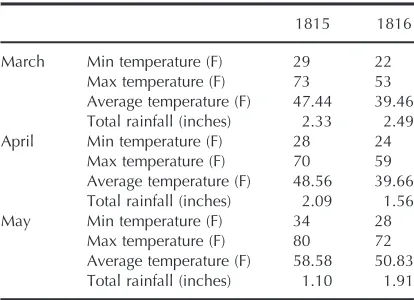
affecting vegetation growth. Luke Howard’s
observations in London suggested the average
temperature was 8° lower than that of the
corresponding period for 1815 (Table 2).
Geological and hydrological events may have contributed to a general sense of foreboding during spring 1816. An earthquake was felt across the Midlands and as far north as Liverpool on 17 March.
Heavy downpours on 7, 12 and 13 April (the latter Good Friday and Easter Saturday) resulted in widespread flooding. That on the River Witham cut off Lincoln, and on the Trent and tributaries, washed away ‘considerable quantities of soil, filling up soughs and ditches; and some Sheep have been lost’ [Farmer’s Magazine17 (1816), 252]. Shilton thought
it the ‘greatest Greet flood known for 40 years’, while Pegge-Burnell asked himself‘whatflood–sure was never seen at this season, the glass nearly at changeable not withstanding it rained upwards of 30
hours’ (NA, M/491; NA, DD/CW/8c/5/35). Hard
night frosts damaged turnips, resulting in poor fodder
for cattle. In Northumberland, ‘there never was
greater distress for want of food for livestock’
[Farmer’s Magazine17 (1816), 252].
The unusually cold and black weather continued, with snow falling across the Midlands and Wales on
12 May. The parish register for Clipston,
Northamptonshire records 28 May as a day of great hope:
today may be called the 1st of summer . . . nature around us smiles & rejoices . . . trees of the blossoms which are now heaving will we hope in a few days boldly appear & in the summer being forth abundance.
NoRO, CLIPSTON 70P/3
But June began cold; ‘many wheat crops getting
more and more yellow’and Lowe was forced to wear his‘great coat’for walking on the green in Southwell (NLW, MS 1762 B ii; NA, DD/SK/217/20).
A low-pressure system dominated in July,
giving rise to very wet conditions. There were some hot days across the Midlands and Wales on 19–25 July, before continuous rains set in for 6–8 weeks:
On 31 July [in Norfolk] the rain descended in such torrents as to prostrate the heavy crops in many places, & by the violent effects of a water spout, acres of turnips
Table 2 Luke Howard’s monthly meteorological observations for spring 1815 and 1816 (Howard 1818)
1815 1816
March Min temperature (F) 29 22 Max temperature (F) 73 53 Average temperature (F) 47.44 39.46 Total rainfall (inches) 2.33 2.49 April Min temperature (F) 28 24
Max temperature (F) 70 59 Average temperature (F) 48.56 39.66 Total rainfall (inches) 2.09 1.56 May Min temperature (F) 34 28
Max temperature (F) 80 72 Average temperature (F) 58.58 50.83 Total rainfall (inches) 1.10 1.91
were washed away, & in some villages the ditches & lanes were so full of water that boats might have been rowed in them.
Matchett (1822, 146)
Pastures were now‘full of grass’but continuous rain prevented cutting as Pegge Burnell recorded in his diary:
21 Aug–acres spoiling hay; 31 Aug–it began again to rain this morn about 3 o’clock & continued a dismal wet & cold day, night wind north west and very high– this was a most unseasonable month – pray God the next prove more favourable.
NA, DD/CW/8c/5/35
The cumulative problems of a cold, wet summer were aggravated by crop-damaging storms.
September remained cold with sharp frosts. Abbot Upcher in Sheringham, Norfolk reflected: ‘During this year there was no summer whatsoever. Incessant rains during June, July & August, and tremendous gales’, whilst nurseryman Samuel Curtis wrote from Clumber Park, Nottinghamshire:
The weather has been for a week past worse than ever, in addition to wet every day we have had frosty nights, Tuesday morning it was so severe that it has nearly killed all the French Beans & Potatoe tops, & I fear the Hops have suffered very much . . . I think we have the most unpropitious season ever remembered . . .
NRO, UPC 155; UNMSC, Ne C 6396
Perseverance paid off for some: Susan Farington wrote to her cousin Antony Hamond (the former Sheriff of Norfolk) on 30 September to congratulate him for getting in the harvest, ‘after a summer more
unseasonable than any former one in my
remembrance’ (NRO, HMN 4/58/18). Those, like
Hamond, who managed to harvest early were fortunate as on 7 October ‘the rain fell in such torrents, as to occasion most alarming floods, and
beat down the Barleys and others’ [Farmer’s
Magazine 17 (1816), 519]. A great hurricane and
snowstorm affected northeast Scotland on 20
October, and November was wet and very cold with severe frosts and snow, as Edward Stracey described:
On the eighth of November I had apricots hanging on the trees waiting for the sun to ripen them; and on that day the frost was so severe as to freeze the water, the ice being an inch thick – In many fields in this neighbourhood the wheat standing in the sheaves is covered over with snow.
NRO, WLS/XLVIII/30
The Farmer’s Magazine[17 (1816), 481] summarised the harvest as ‘uncommonly unpropitious’, some comparing this with‘the memorable year 1799’, others judging it beyond ‘the recollection of the oldest person’.
Further discussion in the Farmer’s Magazine
centred on farmers’inability to pay rents, and many
landlords were unwilling to offer abatement.
Prompted by increasing farm abandonment the Board of Agriculture implemented a nationwide
survey at the end of April 18167 . Responses
described the lack of employment opportunities, with poor rates so high that in Wales the tax was collected in certain districts in goods rather than money. There is some suggestion in the Farmer’s Magazine [17 (1816), 465] that the publication of thefinal report was supressed, possibly as part of a broader strategy‘to dampen grain speculation and to avoid social unrest’(Post 1977, 17).
Weather observers in 1816 were clearly aware of human distress across the country. On 18 March Davies wrote in his diary, ‘Never or at least within memory of man, was such a time for general distress
of the Nation . . .’ (NLW, MS 1762 B ii). On 13
April, Lowe noted: ‘was at the justice room many poor came for relief’ (NA, DD/SK/217/20). Between 22 and 24 May, following a sudden rise in prices, farmworkers rioted in Littleport, Ely, Downham and Norwich in East Anglia (Griffin 2009; Oppenheimer 2003; Peacock 1965; Post 1977). As Peacock explains, ‘the agricultural labourer was always the last to bestir himself–and when he did so it was a
real indication of the deplorable conditions
prevailing at the time, whether they were political,
social, or economic’ (1965, 11). At Tissington,
Derbyshire, bailiff James Hardy suggested that if not for the kindness of Sir Henry Fitzherbert,‘more than two thirds of the Tissington labourers would want relief at this time’(DRO, D239/M/E/4535). Reverend William Alderson feared the winter would produce
‘disturbances throu’out the country’(DRO, D239/M/ F/8395). Stracey commented in a letter of 17
November that he endeavoured ‘to find work for
many hands’, commenting that ‘the people here
[Rackheath, Norfolk] do not seem to be at all riotously inclined’ (NRO, WLS/XLVIII/30). W. Palethorpe of Kirton in Holland included a postscript to his letter to his landlord that ‘we have had extreme bad weather for the harvest and most shocking complaints of poverty’(NA, DD/1461/212).
Press reports detail the moral economic responses
that followed. The Gentleman’s Magazine [86
(1816), 79] reported that in Barnet:
supplied with half a quartern loaf8, and to come back next morning for another. On Friday the number that applied for relief was 338, when they got the same bounty. On Saturday morning those (all strangers) who applied were 776, who each received one-third of a quartern loaf, and from the parish a quarter of a pound of cheese each . . .
On 10 December in Nottingham:
Owing to the scarcity of bread, good wheat readily realising 140sper quarter, there was much suffering and a great deficiency of employment. A public meeting on the subject was held in the Town Hall. . .The amount raised was 4,184l9. In addition to this liberal amount, the London Association contributed twenty tons of red herrings, Lord Middleton gave three hundred tons of coal, and the parish of St Nicholas expended 500lon a separate soup establishment.
Sutton (1852, 326)
A system of night policing of the city was also introduced about this time as a result of an increase in robberies and disturbances. The Barnet and
Nottingham situations appear typical – Wood
calculated that during the winter of 1816–17 a total of 10 parishes of Dumfriesshire’s 38, ‘officially recorded the operation of a soup kitchen or the distribution of oatmeal to the poor’(1965, 9).
For the fourth successive year, spring 1817 was cold and sunless. It was also dry. Great heat was experienced from 19 to 25 June across the UK, an event that was subsequently remembered among Orion’s ‘remarkable phenomena’. However, at the end of July the weather turned very wet and remained so through August and into September, once again spoiling hay and corn crops. The failure
of the harvest meant that 1817 was ‘a period of
famine for virtually all North Wales and, while popular disturbances seldom duplicated the events in Amlwch10, violence and social protest became
endemic’ (Post 1977, 72). October and November
were dominated by high pressure and fine weather. December was stormy with some resultantflooding.
High winds characterised the start of 1818 with a severe gale on 14–15 January and winds to gale or hurricane strength across much of the UK
between 4 and 8 March, as the Hereford Journal
reported:
. . . the upper part of one of the pinnacles of the
cathedral was thrown down–the chimnies [sic] of the Kings Head inn & of Mr Newton in the High Street were blown down . . . in all directions through the county trees of the largest dimensions were torn up by the roots or stripped of theirfinest branches, the orchards suffered severely. . .
HeRO, BG99/3/4
By the second week of April many places were cut
off as floods became widespread, though June and
July were hot and dry and for some the summer of 1818 was the longest, driest and warmest in living memory. By August, drought had been declared in an event that became a ‘benchmark’ against which to assess the drought of 1868. Whistlecraft’sWeather Almanacwould later report on a good crop of wheat as the outcome of the shower-free harvest.
While the second decade of the century has been recognised as being cold and wet, this period was also one of numerous localised extreme weather events. These events acted cumulatively, and in combination with prevailing socio-economic circumstances, to challenge the wellbeing of most cross sections of society but especially the poorest sectors. ‘For the people who lived through these events – especially those to whom it seemed the summer had never come
at all – autumn [1816] was not the end’ (Munger
2014, 43–4).
Contextualising the‘year without summer’
The magnitude, timing and geography of the impacts of large volcanic eruptions on climate and society are still not fully understood. Discriminating between weather effects linked to volcanic events, and the natural variability of the climate is fraught with difficulty. Disentangling the event-related socio-economic and ecological implications from ongoing changes in the historical record is problematic. It is
perhaps not surprising that after almost two
centuries, the‘year without summer’, long held to be an upshot of the eruption of Tambora, is facing renewed scrutiny.
This paper has explored the weather of 1816 within the UK and at the local level, but contextualised within a longer period of weather anomalies and a prolonged episode of societal hardship and upheaval between 1809 and 1818. The archival sources present a narrative for summer 1816 in the UK that supports existing literature: cold, very wet and sunless with frequent strong winds and storms. More importantly, they provide a detailed picture of the timing, geography and magnitude of
specific extreme weather events within the year
1816 and throughout the period 1809–18. This is a timeframe that incorporates some very notable and
well documented anomalously cold seasons,
including the record breaking winter of 1813–14 (Manley 1947; Smith 1979).
were a function of normal weather, or of volcanic aerosols which would have produced a marked drop in surface pressure across the mid latitudes across the North Atlantic (Keyye et al. 1984, cited in Rampino
et al. 1988, 84). Interpreting documentary sources of the type we have drawn upon in this research is an inherently subjective exercise, but we would argue that, despite the long run of generally cold wet conditions experienced in the 1810s, extreme weather recorded in the spring, summer and autumn months of 1816 may have been ‘truly exceptional’
and‘of a degree for which it is reasonable to invoke an external forcing mechanism’ (Sadler and Grattan 1999, 187).
Our sources also add further evidence in support
of 1816 being a difficult year for many people
across the UK. In Upper Annandale (Dumfries and
Galloway), the correspondent to the Farmer’s
Magazine (17, 483) described a year‘having neither spring, nor summer, nor harvest’and our sources too emphasise the need to recognise a sequence of unusual weather, most of it unfavourable for agriculture, within 1816. The weather hampered agricultural (and other outdoor) work, and harvests of grass, grain and vegetables were of poor quality and quantity. There was a shortage of fodder and livestock was lost in floods or heavy snowfall in some places. Storms and floods uprooted trees, and damaged homes and other buildings. Normal routines were disrupted and travel difficult. An impact on physical and emotional wellbeing is also inferred.
It is important to situate these disruptions in the social, economic and political context within which they occurred. In 1816 society was facing severe hardship and food shortages as a result of the war years (Oppenheimer 2003), and the economy was stagnating as over 400 000 men from the armed services entered the labour market and the country failed to recapture European markets (Post 1977).
‘The coincidence of agriculture and industrial
depression made 1815–16 one of the most difficult
periods in the history of the British economy’
(Rostow 1953, cited in Wood 1965). It is thus very difficult to disentangle the specific weather and related effects of Tambora from the context of ongoing calamity in which it took place. As Grattan
(2006, 16) concludes, ‘The influences volcanic
eruptions bring to bear on peoples and cultures must be seen operating within a system which may contain pre-existing vulnerabilities, which can be
social and economic as well as climatic.’ The
sequential extremes experienced during the so-called
‘year without summer’ exacerbated an already
heightened level societal vulnerability – and
represented something of a ‘tipping point’ against a
backdrop of prolonged weather – and war-related
hardship.
The context in which Tambora took place
represents something of a special case and ‘its
circumstances cannot be immediately generalized’ (Stothers 1999, 714). The example of the UK experience of the ‘year without summer’ presented here, however, does illustrate the value of positioning volcanic events and associated weather anomalies within a more focused local, and yet extended temporal context. Piecing together fragmentary and subjective sources has allowed us to create a detailed, geographically referenced and personal reconstruction of the weather, its impacts and the societal response, adding specifics to the all too often generalised weather narratives of this time.
Acknowledgements
This paper is one outcome of the project ‘Spaces of
experience and horizons of expectation: the
implications of extreme weather events, past, present
and future’, funded by the Arts and Humanities
Research Council (AHRC) through grant number AH/ K005782/1. Further information about the project
can be found at http://www.nottingham.ac.uk/
weatherextremes. We would like to acknowledge the help and support of other members of the project team and staff in all of the archival repositories mentioned. The authors would also like to thank
Professor Keith Richards and two anonymous
reviewers for their constructive comments and careful reading of the manuscript. An early version of this paper was presented at the International Conference on Volcanoes, Climate, and Society at the University of Bern in April 2015.
Notes
1 The anniversary was marked by a festival on Sumbawa; the International Conference on Volcanoes, Climate and Society at the University of Bern, Switzerland (Br€onnimann et al. 2015); a BBC Radio 4 programme High explosive: the Tambora story; and numerous articles online and in press including ‘Volcanoes and climate: after Tambora’ in The Economist(2015). New books include D’Arcy Wood (2014) and Behringer (2015).
2 Oppenheimer (2015) critiques proposed connections between Tambora and the invention of the bicycle; shifts to more profitable opium production in China; and an interest among the British in navigating the Northwest Passage. Others have suggested Tambora might have even been responsible for Napoleon’s defeat at the battle of Waterloo (McWilliam 1996).
3 An example visualisation by Philip Brohan is https:// vimeo.com/120792719
5 All archival sources are identified in the text using abbreviations explained in the caption of Table 1. Further detail is available in the supplementary material available online (Table S1).
6 St Mary’s is the oldest religious foundation in the City of Nottingham. The church ran a workhouse in the city from 1726 until 1834 when responsibility for workhouses was transferred from parishes to Boards of Guardians.
7 There are few weather references withinAgricultural state of the kingdom in February, March and April 1816 but those present emphasise that extreme weather and difficulty were experienced long before the summer.
8 Loaf of bread weighing four pounds. 9lindicates pounds sterling.
10 The failure of much of the corn harvest in 1817, and the continued export of what grain there was to England led to riots in Amlwch, Anglesey, and the stealing of the rudder of the corn shipThe Wellington(Jones 1966).
References
Adams J B, Mann M E and Ammann C M2003 Proxy evidence for an El Ni~no-like response to volcanic forcingNature426 274–8
Alexander L V and Jones P D 2001 Updated precipitation series for the UK and discussion of recent extremes Atmospheric Science Letters142–50
Baron W R 1992 1816 in perspective: the view from the Northeastern United States in Harington C R edThe year
without a summer? World climate in 1816 Canadian
Museum of Nature, Ottawa 124–44
Behringer W 2015 Tambora und das Jahr Ohne Sommer Verlag C.H. Beck, Munich
Briffa K R and Jones P D1992 The climate of Europe during the 1810s with special reference to 1816 inHarington C R
ed The year without a summer? World climate in 1816
Canadian Museum of Nature, Ottawa 372–91
Br€onnimann S, Grosjean M, Joos F, Tinner W and Rohr C
2015 Lessons from Tambora workshop report Past Global Changes Magazine: Volcanoes and Climate23 69
Brugnara Y, Auchmann R, Br€onnimann S, Allan R J, Auer I, Barriendos M, Bhend J, Brazdil R, Compo G P, Cornes R C, Dominguez-Castro F, van Engelen A F V, Filipiak J, Holopainen J, Jones P D, Kunz M, Luterbacher J, Maugeri M, Mercalli L, Moberg A, Mock C J, Pichard G, Reznıckova L, Slonosky V, Ustrnul Z, Valente M A, Winkler P, Wypych A and Xungang Y2015 A collection of sub-daily pressure and temperature observations for the early instrumental period with a focus on the‘year without a summer’ 1816 Climate of the Past11 1027–47
Chenoweth M 1996 Ships’ logbooks and‘the year without a summer’Bulletin of the American Meteorological Society77 2077–93
Compo G P, Brohan P, Whitaker J S, Bronnimann S, Brugnara€ Y, Allan R and Sardeshmukh P D 2015 20CR-1815: Extending reanalysis back to Tambora Paper presentation at the International Conference on Volcanoes, Climate, and Society, University of Bern, April 2015 (http://cpo.noaa.gov/ sites/cpo/MAPP/workshops/rtf_technical_ws/presentations/ 16_Gil_Compo.pdf) Accessed 1 July 2016
Corrigan D J 1847Famine and fever as cause and effect in IrelandJ Fannin & Co, Dublin
Dawson A G, Hickey K, McKenna J and Foster I D L1997 A 200-year record of gale frequency, Edinburgh, Scotland: possible link with high-magnitude volcanic eruptions The Holocene7 337–41
Donovan A R and Oppenheimer C 2011 The Eyjafjallajokull eruption and the reconstruction of geography The Geographical Journal177 4–11
Doe R Ked 2016Extreme weather: forty years of the Tornado
and Storm Research Organisation (TORRO)John Wiley and
Sons, Hoboken
Emile-Geay J, Seager R, Cane M A and Cook E R 2008 Volcanoes and ENSO over the past millennium Journal of Climate21 3134–48
Endfield G 2011 Reculturing and particularizing climate discourses: weather, identity, and the work of Gordon ManleyOsiris26 142–62
Endfield G 2014 Exploring particularity: vulnerability, resilience, and memory in climate change discourses Environmental History19 301–10
Grattan J2006 Aspects of Armageddon: an exploration of the role of volcanic eruptions in human history and civilisation Quaternary International151 10–18
Grattan J and Brayshay M 1995 An amazing and portentous summer: environmental and social responses in Britain to the 1783 eruption of an Iceland volcano The Geographical Journal161 125–34
Griffin C2009 East Anglian wheat country riots, 1816 inNess I ed International encyclopedia of revolution and protest Wiley-Blackwell, Oxford 1040–2
Guevara-Murua A, Williams C A, Hendy E J, Rust A C and Cashman K V 2014 Observations of a stratospheric aerosol veil from a tropical volcanic eruption in December 1808: is this the unknown~1809 eruption? Climate of the Past10 1707–22
HadUKP 2016 England and Wales precipitation data (www.metoffice.gov.uk/hadobs/hadukp/data/download.html) Accessed 1 July 2016
Hamilton K 1986 Early Canadian weather observers and the ‘Year without a summer’ Bulletin of the American Meteorological Society67 524–32
Hansen J E and Lacis A A 1990 Sun and dust versus greenhouse gases: an assessment of their relative roles in global climate changeNature346 713–19
Harington C R ed 1992 The year without a summer? World climate in 1816Canadian Museum of Nature, Ottawa
Hegerl G, Luterbacher J, Gonzalez-Rouco F J, Tett S, Crowley T and Xoplaki E 2011 Influence of human and natural forcing on European seasonal temperatures Nature Geosciences4 99–103
Hopkinson S1800Causes of the scarcity investigated: also an account of the most striking variations in the weather from
October 1798 to September 1800R. Newcomb, Stamford
Howard L 1818 The climate of London deduced from meteorological observations, made in the metropolis and at various places around itW. Phillips, London
Hoyt D V and Schatten K H1998 Group sunspot numbers: a new solar activity reconstructionSolar Physics181 491
Hughes P 1979 1816 the year without a summer: low temperatures, snow and frostWeatherwise32 108–11
Hulme M2008 The conquering of climate: discourses of fear and their dissolutionGeographical Journal174 5–16
Hulme M 2009 Why we disagree about climate change Cambridge University Press, Cambridge
Iles C E, Hegerl G C and Schurer AP2015 Volcanic eruptions and the global hydrological cycle Past Global Changes Magazine: Volcanoes and Climate23 56–7
Jones D J V 1966 The Amlwch riots of 1817 Anglesey Antiquarian Society and Field Club Transactions93–102
Kandlbauer J2013‘Environmental impact of a 1815 Tambora-style eruption in the modern world’Unpublished PhD thesis School of Geographical Sciences, University of Bristol
Lamb H H 1970 Volcanic dust in the atmosphere; with a chronology and assessment of its meteorological significance Philosophical Transactions of the Royal Society of London, Series A 266 425–533
Lean J, Beer J and Bradley R 1995 Reconstruction of solar irradiance since 1610: implications for climate change Geophysical Research Letters22 3195–8
Lee D S and MacKenzie A R2010 Trans-hemispheric effects of large volcanic eruptions as recorded by an early 19thcentury diaryInternational Journal of Climatology30 2217–28
LeGrande A N and Anchukaitis K J2015 Volcanic eruptions and climatePast Global Changes Magazine: Volcanoes and Climate23 46–7
Lindholdt P 1997 Luddism and its discontents American Quarterly49 866–73
Livingstone D N 2012 Reflections on the cultural spaces of climateClimatic Change113 91–3
Ludlum D M 1966 Early American winters, volume 1 1604–
1820American Meteorological Society, Boston
Luterbacher J, Dietrich D, Xoplaki E, Grosjean M and Wanner H 2004 European seasonal and annual temperature variability, trends, and extremes since 1500 Science 303 1499–503
Luterbacher J and Pfister C2015 The year without a summer Nature Geoscience8 246–8
Luterbacher J, Werner P, Smerdon J E, Fernandez-Donado L, Gonzalez-Rouco F J, Barriopedro D, Ljungqvist F C, B€untgen U, Zorita E and Wagner S2016 European summer temperatures since Roman times Environmental Research Letters11 024001
Manley G1947 Looking back at last winter (a) February 1947: its place in meteorological historyWeather2 267–72
Manley G1974 Central England temperatures: monthly means 1659 to 1973Quarterly Journal of the Royal Meteorological Society100 389–405
Mann M E Bradley R S and Hughes M K1998 Global-scale temperature patterns and climate forcing over the past six-centuriesNature392 779–87
Matchett J1822The Norfolk and Norwich Remembrancer and Vade-Mecus2nd ed Matchett and Stevenson, Norwich
McGuire B2015 Are we ready for the next volcanic catastrophe?
The Guardian 28 March 2015 (www.theguardian.com/world/
2015/mar/28/are-we-ready-for-the-next-big-volcanic-eruption-tambora-bill-mcguire) Accessed 1 July 2016
McWilliam F 1996 Late arrival at Waterloo Geographical Magazine68 7
Munger S 2014 1816: ‘The mighty operations of nature’: societal effects of the year without a summer Madison Historical Review10 30–50
Munger S2015 The weather watchers: amateur climatologists and environmental consciousness, 1810–20 History of Meteorology7 14–24
Newhall C G and Self S1982 The Volcanic Explosivity Index (VEI): an estimate of explosive magnitude for historical volcanismJournal of Geophysical Research87 1231–8
Nicholls N1988 Low latitude volcanic eruptions and the El Ni~no-Southern Oscillation International Journal of Climatology8 91–5
Nicholls N1990 Low latitude volcanic eruptions and the El Ni~no-Southern Oscillation: a reply International Journal of Climatology10 425–9
Oppenheimer C 2003 Climatic, environmental and human consequences of the largest known historical eruption: Tambora volcano (Indonesia) 1815 Progress in Physical Geography27 230–59
Oppenheimer C2015 Eruption politics Nature Geoscience8 244–5
O’Rourke K H 2006 The worldwide impact of the French Revolutionary and Napoleonic Wars, 1793–1815Journal of Global History1 123–49
Ortega P, Lehner F, Swingedouw D, Masson-Delmotte V, Raible C C, Casado M and Yiou P2015 A multiproxy model-tested NAO reconstruction for the last millennium Nature 523 71–5
Peacock A J1965Bread or blood. A study of the agrarian riots in East Anglia in 1816Victor Gollancz Ltd, London
Pearson M G1975 Never had it so badWeather30 14–21
Piper L 2004 Backward seasons and remarkable cold: the weather over Long Reach, New Brunswick, 1812–1821 Acadiensis34 31–55
Post J D1977The last great subsistence crisis in the western worldThe Johns Hopkins University Press, Baltimore MD
Raffles T S1817The history of JavaBlack, Parbury and Allen, London
Raffles T S 1830Memoir of the life and public services of Sir Thomas Stamford RafflesJohn Murray, London
Raible C C, Broennimann S, Auchmann R, Brohan P, Froelicher T L, Graf H F, Jones P, Luterbacher J, Muthers S, Neukom R, Robock A, Self S, Sudrajat A, Timmreck C and Wegmann M 2016 Tambora 1815 as a test case for high impact volcanic eruptions: Earth system effects Wiley Interdisciplinary Reviews: Climate Change7 569–89
Rampino M R, Self S and Stothers R B1988 Volcanic winters Annual Review of Earth and Planetary Sciences16 73–99
Robock A 2015 Important research questions on volcanic eruptions and climatePast Global Changes Magazine23 68
Rude G1959The crowd in the French RevolutionClarendon, Oxford
Self S, Gertisser R, Thordarson T, Rampino M R and Wolff J A
2004 Magma volume, volatile emissions, and stratospheric aerosols from the 1815 eruption of Tambora Geophysical Research Letters31 L20608
Skeen E 1981 The year without a summer: a historical view Journal of the Early Republic1 51–67
Smith C G1979 The cold winters of 1767–68, 1776 and 1814 as observed at OxfordWeather34 346–58
Solanki S K, Usoskin I G, Kromer B M, Schussler M and Beer J 2004 Unusual activity of the Sun during recent decades compared to the previous 11,000 years Nature 431 1084–7
Stendel M, Mogensen I A and Christensen J H2006 Influence of various forcings on global climate in historical times using a coupled atmosphere-ocean general circulation model Climate Dynamics26 1–15
Stommel H and Stommel E1979 The year without a summer Scientific American240 176–86
Stothers R1984 The great Tambora eruption in 1815 and its aftermathScience224 1191–8
Stothers R 1999 Volcanic dry fogs, climatic cooling, and plague pandemics in Europe and the Middle East Climatic Change42 713–23
Sutton J F1852The date-book of remarkable and memorable events connected with Nottingham and its neighbourhood, 1750–1850London and Nottingham
Tann J 1980 Cooperative corn milling: self-help during the grain crises of the Napoleonic warsThe Agricultural History Review28 45–57
The Economist2015 Volcanoes and climate: after Tambora 11 April 2015
Thompson E P1971 The moral economy of the English crowd in the eighteenth centuryPast & Present50 76–136
Tierney J E, Abram N J, Anchukatis K J, Evans M N, Giry C, Halimeda Kilbourne K, Saenger C P, Wu H C and Zinke J
2015 Tropical sea surface temperatures for the past four centuries reconstructed from coral archives Paleoceanography30 226–52
Timmreck C 2012 Modelling the climatic effects of large explosive volcanic eruptions Wiley Interdisciplinary Reviews Climate Change3 545–64
Toone W 1826 The chronological historian: or a record of
public events Volume II Messrs Longman, Rees, Orme,
Brown and Green, London
Trigo R M, Vaquero J M, Alcoforado M, Barriendos M, Taborda J, Garcia-Herrera R and Luterbacher J2009 Iberia in 1816, the year without a summerInternational Journal of Climatology29 99–115
Vaquero J M 2007 Historical sunspot observations: a review Advances in Space Research40 929–41
Von Clausewitz C1922Politische Schriften und BriefeRothfels Hed Drei Masken, Munich 189–91
Wagner S and Zorita E2005 The influence of volcanic, solar and CO2 forcing on the temperatures in the Dalton Minimum (1790–1830): a model studyClimate Dynamics25 205–18
Wheeler D 2016 1816 – the year without summer: the experience of Newcastle-upon-TyneWeather71 108–14
Wigley T M L, Lought J M and Jones P1984 Spatial patterns of precipitation in England and Wales and a revised, homogenous England and Wales precipitation series Journal of Climatology4 1–25
Wood J D 1965 The complicity of climate in the 1816 depression in DumfriesshireScottish Geographical Magazine 81 5–17
Wood G D 2014 TAMBORA: the eruption that changed the worldPrinceton University Press, Princeton and Oxford
Zanchettin D, Bothe O, Graf H-F, Luterbacher J, Jungclaus J H and Timmreck C 2013 Background conditions influence decadal climate response to strong volcanic eruptionsJournal of Geophysical Research118 4090–106
Supporting Information
[image:13.516.41.255.69.562.2]Additional Supporting Information may be found in the online version of this article at the publisher’s web-site:
Table S1 Extreme weather events in the UK, 1809–