Linguistic Knowledge-driven Approach to Chinese Comparative
Elements Extraction
Minjun Park
Dept. of Chinese Language and Literature Peking University
Beijing, 100871, China [email protected]
Yulin Yuan
Dept. of Chinese Language and Literature Peking University
Beijing, 100871, China [email protected]
Abstract
The BI ( 比 )-structure, which highlights a contrasting characteristic between two items, is the key comparative sentence structure in Chinese. In this paper, we explore the methods of extracting the 6 constituents of the BI-structure. Previous studies are often restricted to probabilistic classification methods, where the feature used hardly embodies linguistic knowledge, therefore unintuitive. As an alternative, we propose the use of two linguistic knowledge-driven approaches, namely the POS chunking-based and TBL-based methods. The first model effectively captures grammatical restrictions over POS sequential patterns. The second model set up on new and lesser templates performs better than Brill’s (1995). Experimental results show that the proposed models are simple and effective methods for Chinese comparative element extraction task.
1
Introduction
Comparison is the most representative figure of evaluation. Much of evaluative information is now available in the web, and comparative sen-tences prevail in Chinese web texts in increasing numbers. A significant amount of research has been conducted on automatic identification of Chinese comparative sentence and its semantic elements. However, the techniques proposed in earlier works are mostly based on statistical clas-sification method. Due to the opaque nature of stochastic features, it is often difficult to com-prehend what linguistic aspects are applied to the model.
In this paper, we present a detailed analysis on linguistic behavior of the BI (比)-structure, which is the key comparative structure in Chi-nese. The application of the two rule-based ap-proaches suggested in this paper are different from previous models in that they fully use
syn-tactic and lexical features which are intrinsic to the structure.
This paper first presents a brief literature review on the subject. The target of extraction task, i.e. Comparative Elements (CE) is then de-fined before demonstration of the two proposed approaches, i.e. POS chunking-based and TBL-based extraction models. Finally, we discuss the experiment’s results and present our conclusion.
2
Related Work
The research on comparative sentence has been a main concern from the beginning of modern Chinese linguistics research. The different types of Chinese comparative sentences were first mentioned in Mashi Wentong (1898) and their classification was elaborated later by Chinese grammarians such as Lü (1942), Ding (1961) and Liu (1983). Following by their preliminary work, a series of research focused on defining syntactic and semantic structure of the Chinese compara-tive sentence was conducted. Li (1986) demon-strates the Chinese BI-structure simplifying rules. Shao (1990) investigates the rule of replacing and omitting elements in Chinese comparative structure.
On the other hand, Studies in Natural Lan-guage Processing mainly dealt with the identifi-cation of comparative sentence and its elements. Based on Jindal and Liu’s research (2006) on comparative sentences in English, Huang(2008) and Song(2009) made a stochastic classifier based on SVMs and CRFs to tackle the Chinese comparative sentence identification and element extraction task. Besides, many models were also suggested in the fifth Chinese Opinion Analysis Evaluation (COAE2013) track. Zhou(2014) and Li(2013) made use of pattern matching technique, and Wei(2013) proposed a rule-based decision making approach based on CRF sequential
ging. Despite all these models, their performance has not shown satisfying results1. The
identifica-tion of Chinese comparative elements especially still remains as a big challenge. A TBL-based approach, which showed good performance in Korean (Yang and Ko, 2011), would be an alter-native to usual methods.
3
Task Description
3.1 Comparative Elements (CE)
We refer to Comparative Elements (CE) as enti-ties and attributes which directly occur within comparative sentences. We defined 6 CEs as be-low.
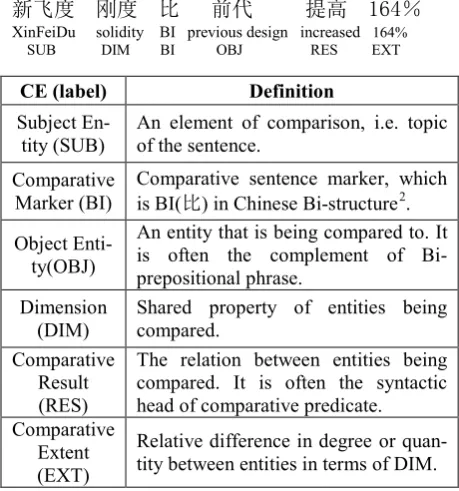
e.g. 新飞度车身结构的刚度比前代提高了164%。
The solidity of XinFeiDu’s body structure has increased 164% than the previous design.
新飞度 刚度 比 前代 提高 164% XinFeiDu solidity BI previous design increased 164%
SUB DIM BI OBJ RES EXT
CE (label) Definition Subject
En-tity (SUB) An element of comparison, i.e. topic of the sentence. Comparative
Marker (BI) Comparative sentence marker, which is BI(比) in Chinese Bi-structure2. Object
Enti-ty(OBJ)
An entity that is being compared to. It is often the complement of Bi-prepositional phrase.
Dimension
(DIM) Shared property of entities being compared. Comparative
Result (RES)
The relation between entities being compared. It is often the syntactic head of comparative predicate. Comparative
Extent (EXT)
[image:2.595.65.295.316.562.2]Relative difference in degree or quan-tity between entities in terms of DIM.
Table 1: Comparative Elements (CE) in BI-structure
Our task is to automatically extract these 6 CEs from the sentences. Note that these elements cannot simply be determined by syntactic criteria. They are involved with semantic category to some extent, but we do not use additional seman-tic features such as semanseman-tic role labels or lexical taxonomies in this paper.
1 In COAE 2013 Task 2 (Chinese Comparative Element Identifi-cation), the best performance F1-score was 0.35 (Tan et al. 2013:25).
2 There are other comparative markers such as 比不过, 不如, 优 于 which are sometimes combined with RES morphologically. However, BI(比) is the only comparative marker in the scope of this paper.
3.2 Corpus
The corpus used in this experiment consists of 1,036 Chinese BI-structure sentences, coming from the open dataset of COAE 2013 Task 2 (Tan et al. 2013). The sentences are a collection of customer reviews and opinions from different Chinese websites pertaining to cars and electron-ics.
1) Preprocessing: We first conduct word segmentation and POS tagging by using ICTCLAS3. Second, we had to manually revise
to avoid any errors because of the informal lan-guage used on the web. Three annotators were appointed to revise typos. In addition, 3,000 word-size domain-specific lexicons4 are also
uti-lized to guarantee the quality of word segmenta-tion and POS tagging.
2) CE labeling: The 6 types of Comparative Elements (CE) in the 1,036 sentences were man-ually annotated with the corresponding CE labels of Table 1. This task was done by three trained annotators of Chinese linguistics major. Their work was double-checked by one another, and any inconsistencies between annotators were dis-cussed before reaching an agreement. The anno-tated corpus was then transformed to IOB format.
4
Two methods of Comparative
Ele-ments Extraction
We now present two different proposed tech-niques. Model 1 uses basic part-of-speech chunk-ing-based method and Model 2 employs Trans-formation-Based Error-Driven Learning (TBL) (Brill, 1995) for identifying CEs.
4.1 POS chunking-based CE extraction 4 elements of CEs, i.e. BI, OBJ, RES and EXT, form a regular sequential pattern across the sen-tences. First, OBJ generally occurs as comple-ments of BI-prepositional phrase, which is most-ly a noun phrase. Second, RES and EXT usualmost-ly form predicates, modified by the BI-prepositional phrase, i.e. [ [比 OBJ]prep [RES EXT]pred]. Noticing this pattern, we can define
chunk patterns with regular expressions as below.
Punctuation as delimiter, the sentence is divided into small clauses
If the clause contains“比/p”, the following chunk rules are applied to create chunks.
3 http://ictclas.nlpir.org/downloads 4 Acquired from Sougou’s open database.
http://pinyin.sogou.com/dict/
Rule1. BI:{<P><.*>*}
Rule2. RES:<.*>}{<V>|<A[DN]*>|<D> Rule3. RES:<D>|<V>|<VSHI>|<VYOU>| <A[DN]*>{}<V>|<A[DN]*>|<D> Rule4. RES:<.*>{}<.*>*?<UDE1>[^<W
J>][^$]
Label the items in the first chunk as BI and OBJ, and label the second chunk as RES.
For RES chunks, Rule 5 is applied to chunk EXT.
[image:3.595.307.525.89.147.2]Rule 5. EXT:<A>|<V[N]*>|<Y>{(<MQ>|< M>|<Q>|<RY>|<X>|<D>)<.*>*} Table 2: chunking-based CE extraction process5
We now give a step-by-step illustration of the actual extraction process of Table 2.
Step 1 Detecting BI (比)-Chunk
For clauses containing the comparative marker BI (比), we create a chunk that begins with it (Rule 1). We call it BI (比)-Chunk.
Step 2 Splitting into Two Phrases
BI (比)-Chunk can be divided into two chunks, i.e. BI-prepositional phrase and predicate be-cause they belong to very distinctive syntactic categories. The former cannot appear inde-pendently, usually taking a noun as its object. The latter functions as the predicate, and is most-ly an adjective or a verb6. Therefore, we
de-signed Rule 2 to split them.
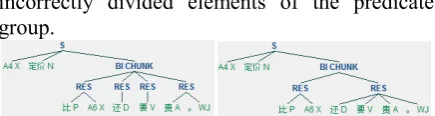
Step 3 Merging Incorrectly Separated Predicates In most cases, however, the predicate is a com-plex phrasal structure. Therefore, Rule 2 incor-rectly splits chunk that should have not been
sep-5 For specifying chunk rules intuitively, we directly quote NLTK’s description of chunking operator (Bird et al. 2009).
(1) <T> represents for any token tagged with T.
(2) {<pattern >} represents for Chunk Rule, which means cre-ating a chunk with the given regex pattern within curly braces.
(3) <pattern1>}{<pattern2> represents for Split Rule, which means splitting a chunk into two chunks based on the speci-fied pattern.
(4) <pattern1>{}<pattern2> represents for Merge Rule, which means merging two chunks together based on the specified pattern.
6 Strictly speaking, verb and adjective are also able to occur in BI- prepositional phrase. Such a case will be handled in Step 4.
arated. To solve this, we employ Rule 3 to merge incorrectly divided elements of the predicate group.
Step 4 Dealing with DE (的)-Structure
In Chinese, DE (的) is often used to mark modi-fication7. It can be attached to various types of
syntactic categories and modify the following word. DE (的)-structure can be simplified as [ [ XP 的 ] NP ]. When a verb or adjective phrase takes the position of XP, the same error as in Step 3 occurs. To tackle this problem, we use Rule 4 that enunciates the unity of modifying elements occurring at the position of XP.
Note that DE (的) is not necessarily restrict-ed to modification marker. When occurring at the end of the sentence, it simply marks a subjective tone. Rule 4 makes use of punctuation tag (WJ) to discern this modal particle of DE (的) from modification marker.
Step 5 CE Labeling
After successfully extracting the two chunks (BI-prepositional phrase and predicate) following the above mentioned 4 steps, we label each item in these chunks with BI, OBJ and RES tags.
Step 6 (optional) EXT Identification
Comparative Extent (EXT) usually begins with numerals, following the head of the predicate. Rule 5 detects possible EXTs in RES chunk.
4.2 TBL-based CE extraction
The advantage of using the POS chunking-based method is that it allows direct capture of linguis-tic information. However, (a) it requires pains-taking process of manual rule construction; (b)
7 It may be an inadequate way of defining DE (的) because of its flexible and diverse nature. Exceptional cases will be discussed in 5.1. See Zhu(1961) for further details.
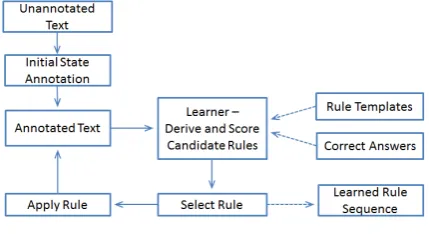
and an error in any step could damage the per-formance of the whole CE extraction process. 4.2.1 Transformation-Based Learning We tested an automated learning method, known as Transformation-Based Error-Driven Learning (TBL) (Brill, 1995). The basic idea of TBL is “learning from mistakes”. First, the researcher may apply an initial-state annotator to the train-ing corpus. Second, the set of user-defined tem-plates are then used to form candidate rules. Third, each of the rules is in turn applied to the training corpus. At the same time, the net im-provement of the rule is calculated and recorded for evaluation of candidate rules. Throughout the training, the process of deriving rules, scoring and selecting rules and applying them is iterated, creating an ordered sequence of transformation rules.
Figure 1: Learning Procedure of TBL Modified from Brill(1995), Ramshaw and Marcus(1999) TBL has a well-known advantage, i.e. perspicui-ty of linguistically meaningful rules. Different from the POS chunking-based model, the TBL-based model is more robust and possibly cap-tures useful information that may not be noticed by the human engineer (Brill, 1995:552). There-fore, the use of TBL allows us to capture some otherwise ignored CE patterns.
4.2.2 Preliminary TBL-based CE Tagger We treated CE extraction task as a tagging prob-lem. Each token in training data is given an ini-tial tag by ICTCLAS tagger. The TBL learner with user-defined templates is then trained on the training data. Consequently, we obtain the TBL-based CE tagger as a CE extraction model.
The templates play a key role in this model because the TBL-learner uses these templates to generate possible rules, which directly affect the overall performance. In order to see which type of feature contributes more to the TBL-based model accuracy rate, we divide the original tem-plate proposed in Brill (1995:553, 556) into three template subsets: (a) tag features template; (b)
lexical features template; (c) both features tem-plate.
Type of
features # of tem-plates # of candi-date rules Accuracy (%)
(a) Tag 11 21,815 83.15
(b) Lexicon 15 59,442 85.39
(c) Tag & Lexicon 26 81,257 88.38
Table 3: CE Extraction Accuracy based on different feature templates
Since the result of (c) is the best, we take it as a standard template. Table 4 shows evaluation results using TBL-based model with 26 tem-plates (c). We regard this score as our baseline performance.
SUB DIM BI OBJ RES EXT Pre. 53.48 60.90 97.08 77.24 88.02 82.04 Rec. 19.31 38.07 97.22 80.82 69.86 69.57 F. 28.24 46.37 97.14 78.97 77.86 75.16
Table 4: The result of baseline system (%)
4.2.3 Search for Optimal Template
We now present how we obtained our proposed TBL-based CE extraction model. The baseline system is based on a relatively large amount of rules and templates. Therefore, the reduction of rules is preferable for efficient application of TBL. According to Brill (1995: 560), although the accuracy of TBL-based tagger increases with the number of transformation rules, its marginal effect dramatically decreases, and leads to com-putational cost. We found that 200~300 rules are desirable for our CE detecting task. As for tem-plates, we achieved the best performance when using tag and lexicon sequences within a radius of 3 tokens as features.
For every token in BI-structure, change tag a to tag b when:
1. The current word is w. W0 2. One of the three preceding words
is tagged z. T-3,-2,-1 3. One of the three following words
is tagged z. T1, 2, 3 4. The word two after is tagged z. T2 5. The word two before is tagged z. T-2 6. The following word is tagged z. T1 7. The preceding word is tagged z. T-1 8. The preceding word is w. W-1 9. The current word is w, and the
preceding tag is t. W0 & T-1 10. The preceding tag is t, the current
tag is t2 and the following word is w.
T-1 &T0&W1
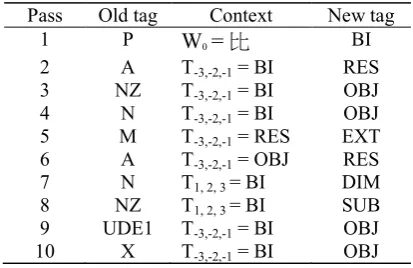
[image:4.595.73.288.321.438.2]Based on the above-mentioned templates, the TBL-based model generates a set of possible candidate rules. Table 6 lists 10 transformation rules of highest score.
[image:5.595.76.283.133.267.2]Pass Old tag Context New tag 1 P W0= 比 BI 2 A T-3,-2,-1 = BI RES 3 NZ T-3,-2,-1 = BI OBJ 4 N T-3,-2,-1 = BI OBJ 5 M T-3,-2,-1 = RES EXT 6 A T-3,-2,-1 = OBJ RES 7 N T1, 2, 3 = BI DIM 8 NZ T1, 2, 3 = BI SUB 9 UDE1 T-3,-2,-1 = BI OBJ 10 X T-3,-2,-1 = BI OBJ
Table 6: 10 Rules of highest score
With the rules given above, the model takes example (1a) as an input, and applies the rules in order of 1 → 2 → 3 → 5 → 7 → 8 → 9,
produc-ing the CE-tagged result of example (1b).
(1a) E1-471/nz ,/wd 声音/n 比/p AS4752/nz 的/ude1 好/a 多/m 了/y 哦/e
(1b) E1-471/sub ,/wd 声 音/dim 比/bi AS4752/obj 的/obj 好/res 多/ext 了/y 哦/e
In addition, Examples (2-5) below illustrate some of the linguistically meaningful transfor-mation rules that the TBL model based on 10 templates (Table 5) has captured.
(2) VYOU->RES if Word:更@[-1]
比/bi 同价位/obj 机型/obj 更/d 有/res 分量/res 。/wj
BI same-price model more have amount
(This product) has more amounts for the same price. (3) EXT->RES if Word:要@[-1]
比/bi 捷达/obj 的/obj 要/v 多/res 得/ude3 多/ext 。/wj
BI Jetta DE should more DE much
(A car model’s something) should be much more than a Jetta’s.
In (2-3), “更” is equivalent to “more” in English, and “要” conveys subjective meaning of differ-ence in degree. The proposed model makes use of them as an RES marker because they frequent-ly occur before RES.
(4) RZ->OBJ if Word:比@[-1]
诺基亚/sub 5230/sub 同等/b 价位/n 下/f 比/bi 其它/obj
手机/obj 都/d 好/res
Nokia 5230 is even better than the equivalent class of other cellphones. (5) RES->EXT if Word:好@[0]& Pos:RES@[-1]
比/bi 老/obj 天籁/obj 的/ude1 油漆/dim 硬/res 好/ext
多/ext 。/wj
(A car model’s coating) is much stronger than the coatings of Teana.
In (4), the pronoun following BI “其它” is likely to be a constituent of OBJ. “好” is very likely to be a degree complement, i.e. EXT, if RES pre-cedes it. Instead of functioning as RES, it stress-es the degree of RES as shown in example (5).
5
Results
5.1 Result of POS Chunking-based Model The overall performance of the chunking-based CE extraction model (Section 4.1) is as follow.
BI OBJ RES EXT Precision 96.94 75.96 42.03 63.33
[image:5.595.302.529.225.275.2]Recall 96.94 82.63 86.65 60.03 F-score 96.94 79.15 56.60 61.63
Table 7: The results of chunking-based CE extraction (%)
The CE mining process of chunking-based model is based on simplistic grammatical assumptions: (a) Only nominal elements serve as the comple-ment of BI-prepositional phrase; (b) Predicates can be a word or a group of words (phrase) that are adjectives or verbs; (c) Within the BI (比 )-Chunk, the elements occurring before the modi-fier marker DE (的) are all regarded as modifier. These assumptions, of course, are somewhat over-generalized, and do not fit in many real cas-es8. However, the 5 Rules applied based on these
assumptions show a fair performance in Table 7 when applied to a limited scope of BI-Chunk. 5.2 Result of TBL-based Model
All evaluations of TBL-based model in this paper are based on a 5-fold cross validation. The proposed TBL-based model with 10 templates shows the results below.
SUB DIM BI OBJ RES EXT Pre. 53.35 62.13 97.41 77.16 87.94 79.78 Rec. 23.04 40.70 97.04 83.15 69.50 72.31 F. 31.88 48.46 97.22 80.01 77.58 75.79 Table 8: The results of TBL-based CE extraction (%)
Guided by our new templates (Table 5), the model first locates comparative marker BI (比), then searches the surroundings for the tag/lexical features while gradually narrowing its scope. As a result, the 10 templates enable an effective de-tection of elusive CE instances such as those in example (2-7).
8 Under many circumstances in Chinese, a noun (or noun phrase) can also serve as predicate; Transferred-designation(转指) “XP的” construction can also act as subject other than as a modifier.
Model SUB DIM BI OBJ RES EXT POS
chunk-ing-based - - 96.94 79.15 56.60 61.63 TBL-based
(baseline, 26
Templates) 28.24 46.37 97.14 78.97 77.86 75.16 TBL-based
(proposed, 10
Templates) 31.88 48.46 97.22 80.01 77.58 75.79
Table 9: Comparison between models (f-score, %)
Table 9 compares the scores of two CE mining methods, the POS chunking-based and the TBL-based approach. Compared to the TBL-TBL-based model, the POS chunking-based model is unable to extract SUB and DIM. Because these two el-ements frequently occur outside a BI-prepositional phrase, it is hard to capture their irregular occurrence positions in the sentence. In contrast, the TBL-based model is able to detect SUB and DIM. However, their identification rate is relatively low.
Nevertheless, our proposed TBL-based model outperforms the baseline system by using much smaller templates. It shows we found a simple and more expressive set of rule templates. Moreover, the proposed TBL-based model achieved an increase of 21% for RES and 14% for EXT f-score in comparison with the POS chunking-based model. This improvement main-ly benefits from the proper use of both tag and lexical information.
(6) 市场/nz 中/f 比/p 它/rr 靓/a 的/ude1 产品/n 很/d 少/a 。/wj
There are very few products prettier than that one in the market. (a) 市场/n 中/f 比/bi 它/obj 靓/obj 的/ude1 产品/obj
很/res 少/res 。/WJ
(b) RES->A if Word:很@[-1]
市场/n 中/f 比/bi 它/obj 靓/res 的/ude1 产品/n 很/d 少/a 。/WJ
(7) 花冠/nz 比/p 伊兰特/nz 贵/a 近/a 3万/m
Corollas are more expensive than Elantras by nearly 30 thou-sand RMB.
(a) 花冠/nz 比/bi 伊兰特/obj 贵/res 近/res 3万/ext (b) RES->EXT if Word:近@[0]
花冠/nz 比/bi 伊兰特/obj 贵/res 近/ext 3万/ext
As for examples (6-7), the POS chunking-based model (Section 4.1) incorrectly identifies “少, 近” as RES. As we can see in example (6a), the POS chunking-based model wrongly identifies “很少” as RES because the BI-chunk “比它靓” occurs in front of the modification marker “的”. In (7a),
the model mistook “近” for RES because it can-not discern “近” from “贵” only with the tag in-formation. In contrast, TBL-based model makes a correct decision of (6b) and (7b) based on lexi-cal information.
6
Conclusion
In order to make the best use of meaningful fea-tures in linguistic context, we have proposed the use of two rule-based methods for Chinese com-parative element (CE) extraction. The POS chunking-based model performs well with basic Chinese grammatical rules. We then use the TBL-based method to extract other linguistic patterns that the first model can hardly detect. Results showed that our TBL-based model achieved higher score than Brill’s (1995), demonstrating that our new 10 templates can ef-fectively extract the distinct features of Chinese BI-structure as shown in examples (1-7).
Chinese comparative element mining in-volves techniques of various domains including coreference resolution, named entity recognition and parsing. However, the linguistic features used in this paper are limited to instances of reg-ular (type-3) grammars. In our future work, we plan to investigate some feasible Chinese linguis-tic features on the level of context-free grammars.
References
Bird, Steven, Edward Loper and Ewan Klein. 2009. Natural Language Processing with Python. O’Reilly Media Inc.
Brill, Eric. 1992. A Simple Rule-Based Part of Speech Tagger. In Proceedings of the workshop on Speech and Natural Language, pp.112-116.
Brill, Eric. 1995. Transformation-Based Error-Driven Learning and Natural Language Processing: A Case Study in Part-of-Speech Tagging. Computa-tional Linguistics, 21(4): 543-565.
Ding, Shengshu. 1961. Xiandai Hanyu Yufa Jianghua. Beijing: Commercial Press.
Huang, Xiaojiang et al. 2008. Learning to Identify Chinese Comparative Sentences. Journal of Chi-nese Information Processing, 22(5): 30-37. Jindal, Nitin and Bing Liu. 2006. Identifying
Com-parative Sentences in Text Documents. In Proceed-ings of SIGIR’06, pp.244-251.
Li, Linding. 1986. Hanyu Jufa Juxing. Beijing: Com-mercial Press, pp.285-301.
Li, Yan et al. 2013. PRIS_COAE at COAE 2013 Track. In Proceedings of the fifth Chinese Opinion Analysis Evaluation, pp. 53-69.
Liu, Yuehua. 1983. Shiyong Xiandai Hanyu Yufa. Beijing: Foreign Language Teaching and Research Press, pp.833-854.
Lü, Shuxiang. 1942. Zhongguo Wenfa Yaolüe. Bei-jing: Commercial Press, pp.352-370.
Ma, JianZhong. 1989. Mashi Wentong. Beijing: Commercial Press, pp. 134-142.
Ramshaw, Lance. A. and Mitchell P. Marcus. 1999. Text Chunking Using Transformation-based Learn-ing. In Natural language processing using very large corpora, pp. 157-176. Springer Netherlands. Shao, Jingmin. 1990. Biziju Tihuan Guilü Chuyi.
Zhongguo yuwen, vol.6.
Song, Rui et al. 2009. Chinese Comparative Sentenc-es Identification and Comparative Relations Ex-traction. Journal of Chinese Information Pro-cessing, 23(2): 102-122.
Tan, Songbo et al. 2013. Overview of Chinese Opin-ion Analysis EvaluatOpin-ion 2013. In Proceedings of the fifth Chinese Opinion Analysis Evaluation, pp. 5-33.
Wei, Xianhui et al. 2013. DUTIR: Method Research of Sentiment Analysis and Elements Extraction of Chinese Short Text. In Proceedings of the fifth Chinese Opinion Analysis Evaluation, pp. 116-128. Yang, Seon and Youngjoong Ko. 2011. Extracting
Comparative Entities and Predicates from Text Us-ing Comparative Type Classification. In Proceed-ings of the 49th Annual Meeting of the Association for Computational Linguistics: Human Language Technologies, pp. 1636-1644.
Zhou, Hongzhao et al. 2014. Chinese Comparative Sentences Identification and Comparative Ele-ments Extraction Based on Semantic Classification. Journal of Chinese Information Processing, 28(3): 136-141.
Zhu, Dexi. 1961. Shuo De. Zhongguo yuwen, 12:1-15.
Appendix
ICTCLAS Part-of-Speech Tags
Tag Part-of-speech
A Adjective 形容词
AD Adverbial adjective 副形词 AN Nominal adjective 名形词
D Adverb 副词
E Exclamative particle 叹词
M Numeral 数词
N Noun 名词
NZ Proper noun 专有名词
P Preposition 介词
Q Classifier 量词
RY Wh-pronoun 疑问代词
UDE1 “De” 的
VSHI “Shi” 是
VN Gerund 名动词
VYOU “You” 有
WJ Period 句号
X Character 字符