ECONOMIC
THE
RESEARCH
INSTITUTE
Public Debt and Economic Development
by
EDWARD NEVIN
December, 1962
Paper No. II.
THE
ECONOMIC
E X E C U T I V E
RESEARCH
INSTITUTE
BOARD I961-62- ~ "
J. J. MCELLmOT% M.A., LL.D.
President of the Institute.
G. O’BRIEN, D.LITT., LITT.D.
Chairman of. the Executive Board.
\
%\-C. S. ANDREWS, B.COMM., D.ECON.S%\-C., Chairman, Coras Iompair ]~ireann.
J. P. BEDDY, M.COMM., D.ECON.SC.,
Chairman and Managing Director, The Industrial Credit Company Ltd.
R. D. C. BLACK, PH.D.
Professor,. Department of Economics,. The QuEen’s Univemity, Belfast.
J. BUSTEEDi M.COMM,
Professor, Department of Economics, University College, Cork.
G. A. DUNCAN, S.F.T.C.D.,
Professor of Political Economy, Trinity College, Dublin.
R. C. GEARY~ D.SC., D.ECON.SC.,
Director of the ~Institute.
W. A. HONOHAN, M.^., F.LA.,
Secretary, Department of Social Welfare.
M. D. MCCARTtlY, M.A., PH.D., Director, Central Statistics Office.
J. F. MEm~AN, M.A.; B~L.,
Professor of Political Economy,~University College, Dublin.
C. K. ]~SIILL, B.A., D.SC.,
Joint Managing Director, Arthur Guinness Son & Company (Dublin) Ltd.
¯ ¯ . . .... -.
; - _ .’.
, ¯ F
D. N~3’IN,
ResarchOfficer, Irish Congress of Trad~ Unions.
, : ..’ .. /J} -"- :¯. / f~, :: ,
L. O’BuAcIIALLA, M.COMM., ....
Professor, Department of Economics, University College, Galway.
. " ’, i Cople~ of thla paper may be obtained from The E6on¢~mie and¯Social Research in~titute, 4 Burl~nEtan Road.
Dublin4 ... price 28p a copy
G~ALD WILSON,
Governor, Bank of Ireland, Dublin. T. K. WHITAKERi M.SC. (ECON.), D.ECON.SC.,
Secretary, Depa.rtment of Finance.
J. C. TONCE,
Federation of Irish Industries,
T. WALSH, D.SC.,
Public Debt and Economic Development
by EDWARD NEVIN*
I. The role of tile public debt
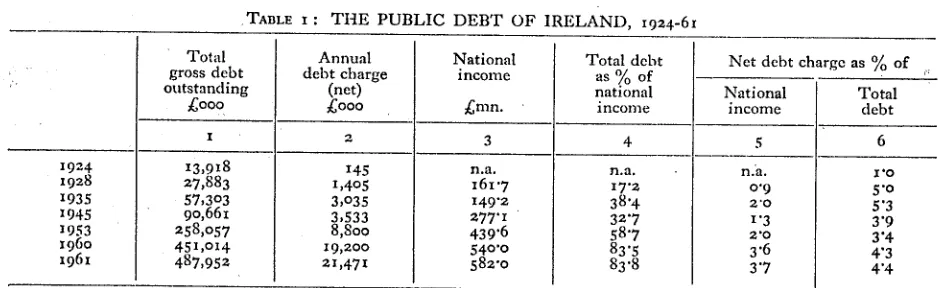
Until the Keynesian revolution in economic thought, an increasing public debt was regarded by most commentators as one of the evils of war and as an indicator of fiscal and economic folly in times of peace. The Irish Banking Commission was therefore very much in the prevailing stream of international thought on this subject when it took a:gr’ave view in 1938 of the growth of Ireland’s public debt since 1924; the magnitude of this may be seen from Table I. It led the Commission to the firm conclusion that
Our considered view is that no increase whatever beyond the existing volume of net dead-weight debt should be permitted, and that volume should be reduced from year to year at such rate as general financial circumstances permit,t
As may be seen from Table I, their hope that the public debt would decline was in vain. Certainly during the decade 1935-45 the expansion was relatively modest, and the debt in fact declined substantially in relation to the national income. Thereafter, however, the increase in th.e debt took on gigantic proportions: between 1945 and 1953 it nearly trebled, and between 1983 and 1961 it rose by a further 89 per cent. By 1961 it was more than twice as large in relation to the national income as it had been in 1935 ; the rise in the net annual debt charge (interest payments, management expenses and sinking funds) was a little less pronounced--from 2"o per cent. of the national income in 1935 to 3"7 per cent. in 1961.2
Even from a rigorously orthodox point of view, however, tlm position is not as bad in reality as these figures might suggest. In the first place, a proportion of the gross debt (unfortunately of unknown magnitude) rests in the hands of the government itself or in those of agencies under its
*The author of this paper is a Senior Research Officer of The Economic Research Institute. The paper has been accepted for publication by the Institute. The author is responsible for the contents of the paper including the views expressed therein.
1Reports of the Connnission of Inquiry into Banking, Currency and Credit (P. 2628), Stationery Office, Dublin 1938, Chap. X,
para. 489, PP. 305-6.
~In 1961-2 the net debt service showed an increase of x2 per cent. ; the estimates for I96Z-3 predict an increase of ~3 per cent. in the gross debt charge.
control--as backing to the currency issue, for example--so that the net debt outstanding is smaller than the gross total. Secondly, a substantial growth has naturally occurred in the assets held by the government in the acquisition of which much of the debt was originally issued. At March 31st, 1961, for example (excluding double reckoning) these amounted to some £221 million,a
On the other hand, the debt total shown does not include contingent liabilities or guarantees; these excluding the capitalised value of housing loan subsidies-included in the debt totals shown in Table 1--amounted to about £84 million in March 1961.a
Obviously these facts need to be borne in mind when the growth of the total gross debt is being considered. It is perhaps worth noting also that the marked increase in the gross debt during recent years has not been attended by the calamitous results sometimes believed to follow from govern-ment borrowing as a matter of necessity. As the data in the Appendix Table show, by European standards Ireland has not experienced art especially marked rise of prices, its money sUpply is not particularly large in relation to national income, and its official reserves abroad continue to be relatively high.
The present paper therefore seeks to summarise the trend of recent thinking in relation to the public debt, and especially the change in attitudes towards its functions in a growing economy. Traditional economic and fiscal theory tended to apply similar principles to both private and public indebtedness, but a deeper understanding of the role of govern-ment in economic developgovern-ment in more recent days has done much to change this. It is true that in the past few years a resurgence of rico-laissez-faire economic doctrines has had some effect, in this particular context as in others, of clouding the distinction between private and social good which analytical welfare economics had previously
suc-ceeded in establishing. Nevertheless there still remains wide acceptance of the proposition that to
°Statistical Abstract of Ireland, 196i (Pr. 5984), Stationery
Office, Dublin I961, Table 258, p, 27o.
4Ibid., Tables 258-9, pp. 27o-1.
TABLE I : THE PUBLIC DEBT OF IRELAND, 1924-61 1924 1928 1935 1945 1953 196o 1961 Total gross debt outstanding £000 Annual debt charge (net) ~000 National income Total debt as ~/o of national £nm. income
x 2 3 4
n.a. 161"7 149"2 277’1 439’6 540"0 582"0 n.a. 17"2 38’4 32"7 58"7 83"5 83 "8
Net debt charge as ~/o of
I3,918 27,883 57,303 9o,661 258,057 45I,O14 487,952 145 1,4o5 3,035 3,533 8,800 19,2OO 21,47I National Total income debt 5 6 n.a. 1"o
0"9 5 "o
2’o 5’3
I’3 3"9
2 ’o 3 "4
3 "6 4"3 3 "7 4 "4
Sources: Cols. 1-2 : Data supplied by Department of Finance. The debt totals include the State liability element of
Land Bonds and the capitalised value of housing loan subsidies but excludeaccrued interest on Savings Certificates, and elements of double-counting. Debt charge totals refer to net charges provided in both Central Fund and Supply Services. The data refer to fiscal years ending on March 3ISt in the 3’ears succeeding those shown except for 1924 and i928, which refer to fiscal years 1923124 and i927128 respectively.
Col. 3 : For 1925-35, Reports of the Commission of Inquiry into Banking, Currency and Credits, (P. 2628), Stationery
Office, Dublin 1938, Ch. X, paras. 482-4 pp. 3Ol-2 and Appx. 7, Table XXXV, p. 45z. For 1945-61, Statistical Abstract and
Economic Statistics, 1962.
treat private and public finance as closely analogous is at best dangerous and at worst positively disastrous.5 The cconomic role of government cannot be defined in terms identical with those applicable to individual components of the economy. Similarly, the choice of government between current and capital finance for any given expenditure project cannot be governed solely by the criteria appropriate for a private enterprise; the public debt cannot validly be treated as no more than private debt writ large.6
Along with the awareness of the special position of government in the economy has developed a greater appreciation of the complex role played by the public debt in arty financial system. It is not only the criteria by which expenditure is judged which may differ between government and the remainder of ttie economy ; the place of the public debt itself in the asset-structure of a developing society is of crucial significance, quite apart from the effects of the expenditure which its issue may have permitted or prevented. The size, structure, terms and distribution of the debt itself all play a critical role in the operation of a country’s financial structure--the currency, the banking system, savings and financial institutions, and indeed the budgetary policies of individual citizens.
~The error involved is, of course, the:error of composition--i.e. the assumption that what is true of persons or enterprises acting individually is necessarily true of them acting collectively. Expositions of the point can be found in any elementary
text ; for reasons of space its acceptance has to be taken for
granted here. ¯
alt is perhaps necessary to emphasise that this paragraph contains no suggestion whatever that govermnent expenditure is inherently or necessarily beneficial. Spending by govern-ments may be wise or wasteful, just as spending by private persons or enterprises may be wise Or wasteful. This paper ts concerned, however, with the means of raising funds, not with the details of how those funds are spent. Obviously a discussion of the one Cannot always avoid reference to the other, but nevertheless the principles of government expenditure are not the prim:try issue here.
Any assessment of the role of the public debt in economic development must therefore consider three separate, although obviously inter-related, aspects; first, its part in the financing of central government expenditures themselves ; secondly, its role in the indirect financing of expenditures on the part of semi-government or private agencies ; and, finally, the asset-effect of the public debt in the
encouragement or control of the finance of projects in the private sector. The discussion which follows will consider each of these three aspects in turn in general terms; wherever possible, however, the general conclusions will be related to the particular case of Ireland.
2. The debt and government expenditure
In principle, the same basic considerations are applicable to the public debt in economies at .’ill stages of economic growth. In the more highly developed economies, however, governments Often find themselves concentrating more on the stability than on the expansion of the economy, whether that stability is in terms of a constant national product or of a rate of growth in the national product. Accordingly, in such economies the macro-econ0mic role of public finance may tend to be the rather passive one of compensating for oscillations in the private sector; tile government’s own commitments are, for the large part, fairly regular current ex-penditures continuing from year to year. In such a situation the role Of government--and therefore of the public debt--may often be a relatively marginal, or neutral, one.7
The position may be different, however, in a society which feels that its existing rate of economic
growth is substantially below what is both desirable and feasible, and where the acceleration of such growth takes precedence over the maintenance of stability in policy formulation. It seems reasonable that this category should be taken to include Ireland for present purposes. By definition, in this type of situation the private sector cannot be left as the sole determinant of the overall pace of economic activity, precisely because the existing rate of growth is inadequate by the standards which the society has set itself. Of necessity, therefore, the government has to take upon itself the responsibility for stimula-ting the rate of economic expatision. It may do this in one of two ways : by means involving no expenditure on its own part--controls, tariff legislation, exhortation, etc.--or by expenditures of a capital or current nature. With the former set of measures this essay will not be concerned, since they have little bearing on the question of public debt.s The latter is in any case likely to be of dominant importance in reality.
The range of expenditures for which government is responsible will naturally vary from country to country according to existing states of development, industrial patterns, political attitudes and so on. (The fact that many countries in Europe and America have been involved in two world wars during the present century, for example, is obviously relevant to their public debt totals.) Further, the comparative importance of government intervention in different economies is exceedingly difficult,, if not impossible, to measure. If the relationship between government expenditure and national income is
8Although, as is argued below, it should not be inferred that the public debt is of importance only when its absolute volume is changed : adjustments in its structure of distribution may also have important effects.
taken as a very rough guide, however, the data presented in Table II may be of some interest. They indicate that by international standards the relative importance of central government expenditures is distinctly on the high side in Ireland. As a propor-tion of the napropor-tional income they are larger in only two of the thirteen European countries listed--Austria and the United Kingdom--and New Zealand is the only one of the thirteen non-European countries shown in which the proportion exceeds the Irish figure.° In only two of the twenty-six countries--Belglum and the United Kingdom--is the public debt as large in relation to the national income as in Ireland, and the accumulation of war debt previously mentioned is obviously of relevance here. The actual content of such government expenditures is not material to the present discussion however.1° The relevant point is that, whether they are current or capital in nature, they have to be financed in some way.
It is appropriate to examine first a situation in which it is considered that the resources necessary for a government’s economic development expendi-tures must be found internally. This is, of course, the most important situation in practice. In the particular ease of Ireland, for example, government external capital transactions during the years 1956-6o represented a net inflow of only some £Ii million, at a time when its overall net capital
DAlthough impossible to verify statistically, it seems likely that the comparison would become even more striking if allowance could be made for the role of semi-government agencies in the economy.
x8See footnote (6) page 2, There’seems no reason, in a paper of this kind, why one should not assume that a society knows what it is doing when it chooses to spend some of its income colleetively--i.e., in the form of government expenditure--rather than individually.
TnBt, n II : CENTRAL GOVERNMENT EXPENDITURE AND PUBLIC DEBT AS A PERCENTAGE OF NATIONAL INCOME i96o
Total central Total central
COUNTRY government Gross COUNTRY government Gross expenditure public debt expenditure public debt
x. Europe 2. Other
Austria 35’6 18’9 Australia 2I’I
Belgium 29’4 88’6 *Brazil 13’I 32"57’6 Denmark 2x’2 24"7 Canada 2I’2 76’9 France 26’7 39’5 Ceylon 3o’8
Germany (F.R.) 20’4 12’2 Costa Riea 16’2 39’42I°0
Greece 23’0 15"5 Ghana I6’2 Ireland 33’9 80’5 Guatemala 16’3 Italy 27’5 *India 13’I
Netherlands 24"8 37’354’8 Japan 16’3 38"7 Norway 12’8 38’9 Mexico 8’7 4’54’8"
Sweden 28.5 36’4 New Zealand 37’3
Switzerland 8.3 I8’9 Philippines 11’7 75’922’1
United Kingdom 38’4
[ 136"9
United States 18’5 69’3
’1959.
Source : Statistical Yearbook 1961, United Nations, New York 1962 (62-XVII-I), Table 163, pp. 486-7, and Table t75,
liabilities (excluding contingencies and guarantees) roseby £46 million,n To secure resources in any country, of course, government has to lexT taxation and/or expand the public debt--including in this latter category an expansion of the currency or in bank borrowing.
The subject of taxation of various kinds is a very large and complex one, and little will be said on the matter here. It is widely be!ieved that in almost every economy there are serious, if undefinable, practical limits to the extent to which taxation can be raised without injurious effects on its growth. Where unemployed or underemployed resources exist, indeed, it can be argued that the use of taxation to finance expenditure may result in the positive wastage of resources, partly through disincentive effects on the propensity to invest and partly through a " dampening " of the raultiplier.
In a fully-employed economy these latter effects may be in themselves desirable, and popular discussion tends to concentrate on the adverse effects of relatively high taxation on the incentive to work, on the one hand, and on the incentive to save, on the other.
The fact of the matter is, however, that the validity of this type of argument cannot be satis-factorily established, either empirically or on
a priori grounds. The collection of factual data on
the effects of taxation is immensely difficult and has seldom produced unambiguous findings. Analyti-cally, it is obvious that taxation must have substitu-tion effects and income effects which operate in opposite directions, the one discouraging work (or saving) because its net reward is lower, the other encouraging it because the taxpayer is poorer, an effect which is especially likely amongst primary producers. In any ease it is manifestly unlikely that taxation will have the same effects whatever its form--whether proportional or poll taxes, and whether imposed on income, capital or expenditure,x2 Nevertheless, so far as the direct role of the debt in financing expenditure from internal resources is concerned, the case in its favour is largely identified with the case against the use of taxation, debatable and ambiguous as the latter may be. The more serious that case is believed to be, the stronger the
xlStatistical Abstract of Ireland, 196I, Table 252, p. 264,
¯ Table 258, p. 27o. It is of course true that capital may be borrowed externally in an indirect way if internal debt issues, new or existing, are taken up by foreign investors. The balance ",of payments statistics do not enable an estimate to be made of External private transactions in the Irish public debt, but the
statistics of applications for National Loans during 1957-61
given in the annual report of the Central Bank of Ireland for the. year ending 3ist March, 1962 (Statistical Appendix, Table XV.2, p, 65) indicate that applications for loan issues from outside the State amounted to some £9"6 million, or about x3 per cent. of all applications.
t2These issues are thoroughly explored in A. R. Prest,
Public Finance in theory and practice, Weidenfeld and Nicolson,
London x96o, Chap. 4, PP. 70-9°. 4
case for the use of debt issues. (The question of the limits to the expansion of the public debt is discussed at a later stage.) It is important to remember, ~i~ course, that some of the disincentive effects attributed to taxation may well be associated With debt issues. Expansion of the money supply, for example, may significantly affect propensities to save or to work through its influence on the general price level; similarly, the same propensities will react to a rise in interest rates, or fall in capital values, resulting from an increase in the stock of long-term bonds in the market.
[image:7.591.297.522.431.543.2]Given all this, it remains true to say that debt issues can be judged as an alternative to increased taxation. Unfortunately, as has just been emphasised, there is no general agreement as to what, if any, is the critical level beyond which taxation cannot rise without causing serious damage to an economy through its effects on incentives to work and save. It is widely believed in Ireland, for example, that the level of taxation in the country is too high, by some undefined standard. The comparison with other fairly small European countries shown in Table III would not appear to substantiate this view. The average level of direct taxation in Ireland is in fact unusually low, while the incidence of total central government taxation would certainly not seem to be particularly high by contemporary European standards.
TAnLE III: THE INCIDENCE OF TAXATION, x96o
Country
Austria Belgium Denmark Ireland Netherlands Sweden
Taxes on income and wealth as % of
national income
lO’4 9"3 8"9 7"8 16"6 11"3
Total Central Government tax revenue % of national
income 29"5
23 "3 21 "9
23 "4 27 ’4
2I"7
Source : Statistical Yearbook, 1961, United Nations, New,
York 1962, Tables 163 and 175.
was not even through society. Thirdly, a rate of taxation which is tolerable for a country at one stage of economic development, or with an extensive system of (say) social services, may be unduly high for another country whose economic development or general circumstances are different or even for the same country at a lower or higher stage of develop-ment. The question of whether the level of taxation in a particular country, such as Ireland, is above or below the critical point at which further increases become inadvisable must therefore remain in the reahn of opinion.
When external resources are sought for develop-ment the case for the public debt naturally becomes a positive one. Except in the virtually extinct situation of an imperial power with colonial territories which it is prepared to exploit--using this word in its dispassionate, technical sense--it is not possible for an economy to secure resources from overseas by taxation. If an external con-tribution to development is thought necessary or desirable, therefore, foreign debt becomes an important device of economic policy ; the question of its possible limits is again left on one side for the moment.
All this goes to confirm the inadequacy of the view that an economy experiencing rapid growth in its pub.lic debt in time of peace is necessarily doomed to disaster. An individual whose indebted-ness increases pari passu with his income may indeed often be headed for trouble. The position of a government in a growing economy is almost the reverse. Unlike an individual, a government must have regard to the national income, rather than its own, and whereas an individual’s indebted-ness can be offset against his income or wealth in some meaningful sense, the process becomes meaningless if translated to the public debt owned in the greater part by the community itself. Indeed an increasing public debt may be a prerequisite for the proper contribution of a government to the growth of its economy--evidence of a responsible, not irresponsible, administration.
3. Structure of tile debt
In most pre-Keynesian fiscal analysis, the public debt was treated o11 much the same lines as private debt: except for short-term " floating debt" to even out annual revenue and expenditure flows, its issue would have been regarded as theoretically justifiable for productive capital purposes but not otherwise, while its optimum maturity would have been regarded as dependent on the period over which the net revenue from the underlyingcapital assets was expected to repay their cost. There is obviously an element of sound commonsense underlying this view; no prudent enterprise will
burden itself with a stream of future interest payments, and ultimate capital repayment, without a reasonable expectation that its income would be simultaneously increased in order to meet these commitments. Nevertheless, for two reasons, in a government of a developing economy this type of attitude would be manifestly inadequate.
In the first place, there is no real justification for the complete identification of public debt with long-term capital expenditure. It will be argued in a later section that the issue of debt may be required even though no necessity exists to finance any government expenditure on goods and services. This type of consideration apart, however, it is still incorrect to assume that the issue of debt is justified if the proceeds are used for capital expenditure but not otherwise. The task of government in economic development is to determine the volume of resources which, over a given period, are to be devoted to specified purposes. These may well be of a capital nature--roads, harbours, airports, schools and so on. Equally, they may be of a current nature the provision of educational facilities, expenditure on agricultural extension services, the prevention and eradication of disease, etc. The development of an economy knows no rigid distinction between current and capital,la
It is scarcely necessary to add, of course,-that the expenditure should be worthwhile and efficiently
applied, but this dictum holds whether the expendi-ture itself, or its financing, is of a current or a capital nature. The question of what criteria are adopted for determining the merits of government expendi-tures is in itself a highly complex one.1~ Assuming for present purposes that the government has determined the shape and size of its development programme, the next task is to decide What volume of resources it will be necessary to divert from private use--capital as well as current--in order to fulfil this programme, having due regard to ad-ditional resources becoming available from higher productivity or the activisation of under-utilised capacity in the economy; and having regard also to resources which it is possible and desirable to obtain from abroad.
The second consideration which necessitates a clear distinction between a private enterprise and government in the matter of debt policy is, of course, that for the former the debt charge represents a reduction in its disposable income whereas for the community as a whole the annual service of internal public debt represents a redistribution of the national X3This point is developed at some length by David Walker,
The allocation of public funds for social development, The
Economic Research Institute, Paper No. 8, Dublin, September I96z.
x4See Prest, op. cir., Ch. 3, PP" 60-64’
income, not a reduction of it.Is In assessing the balance between current use of resources and future income flows, therefore, private enterprises and government are in fundamentally different positions. This of course raises the issue of the " burden " of the public debt; Classical doctrines on this matter were undoubtedly confused and frequently erroneous.Is It does not follow, however, that the concept of a burden of debt is entirely devoid of meaning. Recent analysis, in clarifying this issue, has tended to restore to the forefront, in particular, the old classical doctrine that if, and to the extent that, issues of public debt result in corresponding reductions in private capital formation then the flow of income to "future generations " will be smaller. The magnitude of this reduction will be measured by the difference between the annual yield on the expenditure financed through public borrowing and the yield which would have been obtained from tile private investment which that borrowing disp’aced. It can be argued that this difference can validly be regarded as the " burden" of the public debt on future generations.Iv
This argument supposes that, in contrast to taxation, public borrowing will reduce private capital formation, rather than current consumption. Obviously this is by no means necessarily the case, but it is nevertheless plausible. In a fully-employed economy the government can secure additional resources only by withdrawing them from the private sector; it can be assumed likely that additional taxation will withdraw resources mainly from private consumption, whereas additional borrowing (by raising interest rates, etc.) will withdraw them mainly from private investment. Certainly, in reaching its decision regarding debt
policy, a government must have regard to the effects which its borrowingmay have on private investment, and consider how far such effects are
acceptable.
How serious a consideration this would be in reality will naturally depend on the country con-cerned and on its current situation. It is difficult to conceive of it playing a significant role in contem-porai-y Ireland, for example. In the first place, it is
if’It should perhaps be stressed that this sentence is not tO be taken as implying that because it is a mere transfer, the service of the public debt is unimportant. An annual debt charge carries implications for both the level of taxation and the distribution of income, both of which do matter.
16See R. A. Musgrave, The Theory of Public Finance, McGraw-Hill, New York, i959, Ch.:23.
17This is an extremely truncated summary. Of a complex and not entirely uneontroversial analysis. The view which
it seeks to summarise is most clearly set out by F.
Modigliani, "Long-run implications of alternative fiscal
policies and the burden of the National Debt," Economic
ffournal, Vol. LXXI, No. 284, December, 1961, pp. 73o-755.
See also J. M. Buchanan, Public Principles of Public Debt, Irwin, Homewood, Illinois, 1958 and " Easy budgets and tight money ", Lloyd’s Bank Rovfow~ No 64, April, I962, pp. 17-3o.
6, ,~,
not convincing to think of a country experiencing continuous and substantial emigration as fully-employed; additional public capital expenditi!re might well generate noticeable balance-of-payments effects, but there is no obvious reason for believing that it would necessarily cause a corresponding reduction in private capital formation. Similarly, the Irish monetary system is so open vls-~-vt’s the United Kingdom that the effects of public borrowing on internal monetary conditions would surely be unimportant in comparison with the influence of contemporaneous British monetary developments. Finally, the statistics scarcely support .the view that aggregate capital funds in Ireland are so limited in supply that any additional public borrowing would reduce private borrowing to an equal extent. In 1951 and 1955, it is true, externally-held funds fell substantially in response to the severely adverse balance-of-payments situation of those years; between December, I955 and March, 1962, however, official and banking external assets rose by some £3° million and, fis the Appendix Table shows, by Europeanstandards Ireland is singularly comfortably-off in the matter of official external reserves. Such evidence as is available also suggests that the value of private external security holdings has risen in recent ye~irs; by contrast, new issues of marketable securitiesl within Ireland by industry and commerce averaged the ludicrous total of £o.9 million a year from 1955-6o.Is These are notthe symptoms of an economy experiencing, or bordering on, capital scarcity.
The effect of increased public debt cannot be assessed, however, only in terms of its impact on private capital formation through higher interest rates. An increase in the debt will raise the total of net assets in the hands of the private sector, and if it is assumed~as seems reasonable that a rise in theratio of assets to income will tend to reduce the propensity to save, the final effect on private investment will be a matter of great complexity. It is conceivable that a reduction of private investment caused by the initial debt issue may be offset in subsequent periods by the repercussions on aggregate demand of its asset-effect. Much will also depend on the form which the debt issue takes; if it comprises a mixture of money and (relatively) long-term securities it is not possible to say on
a priori grounds whether the overall net effect on
private capital formation will be positive or negative.1D
Having considered these various factors in the
¯ XSFor all these official data see Statistical Abstract of Ireland,
1961, Tables 253-4, p. 265. The report of the Central Bank
of Ireland for the year etaded 3ISt March, 1962, gives an average of £1"3 million for new issues by industry and commerce during I95I-6r (Statistical Appendix, Table XV, p. 64.)
~’ABLE IV: PUBLIC DEBT AND THE INFLATIONARY GAP, x954-6I
I. G.N.P. at current market prices 2. G.N.P. at previous year’s prices 3. Inflationary gap(I--Z) 4. Net government borrowing (ai
£ million
... .
1954 x955 I956 1957 1958 I959 196o x96x 529 552 56I 583 I 599 [ "635 I 662 1
532 539 543 568 559 626 665 ~
--3 I X31 I8 I I5 I 40] 9 I --3I IZ
3I I 25 I 3x
] 30 I 2z t 3x I 39[ 45
(a) Money raised by creation of debt less issues for debt redemption, to March 3Ist of year succeeding that shown.
Sources : Based on data in Statistical Abstract of Ireland, 1961 (Pr. 5984), Stationery Office, Dublin 196I, Tables 245
and 255-6, pp. 26I and 266-7, Report of the Central Bank of Irelandjfor the year ended 3Ist March 1962, Statistical Appendix, Table XVI, p. 66 and Economic Statistics (Pr. 65o9), Stationery Office, Dublin 1962, Appendix, Tables i2(a) and i2(b), p. 27.
situation, the authorities of any country must arrive at a final judgement concerning the manner in which the available resources are to be diverted from private use (assuming an initial state of full employment) in order to ensure that total demand--public and private--is neither too great nor too small in relation to tile capacity of the economy. They must determine how much it is possible and desirable to extract by means of taxation, bearing in mind all they know about tile prospective relation of current incomes and the flow of goods likely to be available to meet them, and the fact that increased borrowing now usually implies a claim on future tax revenue for its annual service
and possibly repayment. Havi)lg decided the proper level of current taxation, the necessary volume of debt issue or retirement is determined as a residual. (This, of course, is in the context of financing government expenditure only; other factors, to be discussed below, will also enter into the formulation of debt policy as a whole.)
It follows from all this that there need be no correlation between debt issue over a particular period and government capital expenditure over the same period. It may be that the proceeds of borrowing are used to finance current expenditure if a relatively low level of taxation is considered appropriate; conversely, taxes on current income may be used to finance capital formation or debt retirement if a high rate of taxation is needed. In general, there is no way in which the proceeds of debt issue can be linked with any particular expenditure. The spending needs of the govern-ment, in other words, cannot be the sole determinant of the volume of the public debt ; rather it is the level of taxation necessary to maintain equilibrium or achieve a desired rate of growth in the economy, the level of government expenditure naturally being an important element in the existing and prospective state of that economy.
How far has recent public debt policy in Ireland been linked with stability considerations only ? A firm answer to this question is scarcely possible
because of the complexity of the factors entering into debt operations, but the data shown in Table IV may nevertheless be of some interest in this context. The measurement of the " inflationary gap " there attempted is inevitably a crude one but it probably gives some impression of the orders of magnitude involved. If so, it would be difficult to argue that there has been any necessary connection in recent years between public debt policy and the overall pressure on resources of the kind indicated in the previous paragraph. Debt issues were positive in all the eight years shown, despite the considerable variation in the pressure of demand on available resources. Indeed, the relative constancy of central government borrowing during these years suggests that the predominant influences on debt operations have not been what might be called Keynesian macro-economic considerations. The analysis cannot be conclusive. A good deal turns, for example, on the distribution of the debt, as well as its volume; an increase in the total outstanding could conceivably be associated with a decline in the holdings of the private sector. There appear to be no detailed data available on the distribution of the Irish public debt, however, so that the aggregate figures shown in Table IV cannot be qualified by
distributive criteria.
A second factor separating the structure of the public debt from the pattern of government expenditure is the special responsibility of govern-ment in relation to the asset needs of the economy. A private enterprise is normally governed in its borrowing policy by the nature of its expenditure plans ; ordinary considerations of cost-minimisation usually prevent it from issuing long-term debt to finance essentially short-term expenditures, while common prudence usually prevents it from using short-term borrowings to finance long-run capital formation. For at least four reasons, however, governments are not in a comparable position.
consequences. Secondly, their debt, unlike that of private enterprises, is widely utilised in the modern economy and, indeed, usually forms the foundation of the asset-structure of the currency, banking and financial systems. Changes in its size and structure, therefore, have widespread consequences which do not arise in the Case of private enterprises.
Thirdly, the scale on which governments operate, and the scope of their policy horizons, are so much greater than those of a private enterprise as to introduce a difference of kind rather than of degree. In particular, the sources from which govermnents draw short-term funds are so dispersed that with-drawals in one direction are frequently offset by deposits in another, a collection of nominally short-term loans cart thus become a semi-permanent source of finance. Irish Exchequer Bills, for example, are nominally very short,term liabilities, but the volume outstanding has remained well over £Iz million between March I957 and March I96z. Com,ersely, the market in government debt is often so extensive that the authorities may be able to operate in it and secure the redemption of long-term debt long before nominal maturity if they so desire. Finally, a government, unlike any other agency in the economy, has not only mandatory taxing powers but also ultimate control over the monetary unit and the currency supply, the very basis of the entire credit system. (The special relationship of the Irish currency to the British pound sterling renders this generalisation subject to perhaps more qualification than would be the case with most other currencies, but its basic validity remains nevertheless.) Unlike private agencies, therefore, it need never find itself unable to service or redeem its own debt in the legally-enforceable currency of the country. This is not to say that this power is never subject to serious practical limitations, or that dangers may not be associated with either increases of taxation or expansion of the money supply to meet debt obligations. The power is there, however, giving the government both opportunities and respon-sibilities not present for any other agency in the economic system.
For all these reasons, then, the assumption of a rigid connecting-link between type of borrowing and use of funds is inappropriate in the context of the public debt. Further, the considerations set out in the preceding paragraphs indicate the alternative basis on which public debt policy can be formulated --namely, the requirements of the asset-structure of the economy as a whole, rather than the simple relationship between expenditure and tax revenues. In its narrowest sense such a policy could be interpreted to mean "tailoring " the debt, to use the American expression, so as to minimise its cost. By issuing the type of secl~rjties demanded by
particular groups, that is to say, the rate of interest could be held at the lowest feasible level, and certainly at a lower level than would be needed if, say, long-term securities were issued when investible funds were held predominantly by investors seeking
¯ short-term outlets. This interpretation of the
concept would be unduly narrow, however, in any economy where the minimisation of debt costs is regarded as an inadequate Criterion for government policy. In such a context the word" requirements " cannot necessarily be interpreted to mean "desires"; the requirements of a particular sector, as conceived by the government, may conflict with--or even be opposed to--the desires of that sector as conceived by itself.
An example may make this clear. Suppose that an economy is growing less rapidly than physically possible because of a chronic unemployment or under-employment of some of its resources. In such a situation a government might choose to finance some of its current expenditure not by means of taxation (which would reduce aggregate demand), but by the expansion of the very short-term end of the public debt--that is, the currency supply or indebtedness to the central bank. This could have the effect of reducing interest rates, expanding the volume of commercial bank credit, and generating additional demand to bring idle resources into activity,z° Here the policy of shaping debt policy to meet the requirements of the economy -in the widest sense of the word--would involve
little or no debt cost.
Suppose, however, that the opposite situation prevailed--i.e., that the pressure of demand upon available resources was excessive, With a consequent threat to the stability of the economy and the balance of payments. If in such a situation debt policy is to be used to support and reinforce tax policy, it would involve the aggressive replacement of short-term debt by long-term securities, even though investors’ preferences might well lie in the opposite direction. The aim of such a policy would be to raise interest rates and reduce the liquidity of the private sector ; this would be the requirement of the economy as a whole as seen by the monetary authorities. The policy would probably not coincide with the desires of the investing world, and it would certainly not minimise the interest charges on the public debt.
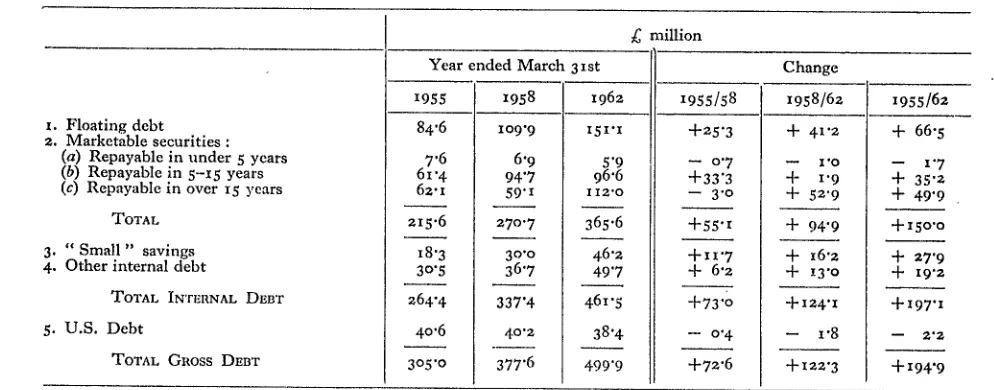
It may be of some relevance to examine recent debt policy in Ireland in the light of this considera-tion. The statistics are shown in Table V. Since the period as a whole was an inflationary one,
TABLE V: THE STRUCTURE OF THE IRISH GROSS PUBLIC DEBT, 1955--62"
£ million
Year ended March 31st Change
I. Floating debt 2. Marketable securities :
(a) Repayable in under 5 years (b) Repayable in 5-I5 years (c) Repayable in over 15 years
TOTAL 3. " Small " savings 4. Other internal debt
TOTAL INTERNAL DEBT 5. U.S. Debt
TOTAL GROSS DEBT
1955 84’6 7’6 61"4 62"1 215.6 18"3 30"5 264"4 4o’6 3o5"o
1958 1962 lO9"9 151"1 6"9 5’9 94’7 96’6 59"1 112.o 270"7 365.6 30"0 46"2 36’7 49’7 337"4 461"5 4.0.2 38’4 377"6 499"9
1955/58 +25"3 0.7 +33"3 3.o +55"1 +II"7 + 6’2 +73"0
-- o.4
+72"6
1958/62 + 41"2
1"0
-{- 1"9 + 52’9 + 94"9 + 16"2 + I3"o +124"1
-- 1"8
+122"3
1955/62 + 66"5
1.7 + 35"2 + 49"9 +15o"o + 27’9
+ 19’2
+I97"1
-- 2’2
+194"9
*Excludes capitalised liabilities in respect of subsidies on housing and sanitary services loans (£42 million in 1962).
Source : Statistical Abstract of Ireland, 1960 (Pr. 5492), Table 25I, p. 268 and Statistical Abstract of Ireland 1961
(Pr. 5984), Table 258, p. 27o, and Tables in connection with the Financial Statement, 1962 (Pr. 6493), Table XI, p. 14.
equilibrium policy as such21 would have implied a lengthening of the debt structure in an effort to reduce the liquidity of the economy. It will be seen that the actual drift of the debt structure during I955158 was in the opposite direction, partly, of course, through the re-classification of outstanding debt with the passage of time. Of the increase of about £73 million in the gross debt between March 1955 and March 1958, floating debt and relatively liquid " small savings" securities
to-gether accounted for £37 million. The longest-term marketable security issue actually fell by £3 million. During 1958/61, however, the change tended to be in the opposite direction, since roughly a half of the increase in the total debt occurred in marketable securities having a maturity of over 15 years. Over the period as a whole, however, the liquidity of the debt structure has been somewhat increased rather than diminished.
There is another sense in which the policy of " tailoring " the debt differs from one of simply minimising debt charges. Different groups of investors seek different types of security. Funds may be available for short-term investment, for example, which would in no circumstances be used to purchase long-term assets--even if an active market existed in them, which is not Mways the case. If the appropriate type of security is not forthcoming, such fimds will lie sterile, or perhaps be remitted to foreign money markets; in either case they are lost to tbe internal development of
21The proviso is important, since growth policy as such might have implied an opposite course, and policy as a whole could involve a delicate balancing of advantages. It is also worth recalling the obvious fact that the type of debt which a government can sell is not entirely within its own control.
the economy. In these circumstances a sound public debt policy would result in an expansion of the money supply or the issue of short term securities irrespective of the extent or nature of the govern-ment’s financing problem at that particular moment. In this way a circulating flow of short-term funds may be mobilised for investment ; the interest cost may be lower than would result from conventional debt policy.
In other cases, however, the opposite will be true. Some groups of investors--insurance companies and pension funds are important examples--need long-term securities for their proper operation. If such securities are not forthcoming, the flow of funds into internal development may again be hampered. In this case, debt policy may involve the issue of long-term securities against short-run expenditures ; the interest cost of the debt will be raised.
In its broadest sense, then, the shaping of debt policy on the basis of the asset-requirements,o’(the economy as a whole, rather tllan on the basis of the use made of the proceeds, may or may not result in the reduction of the debt cost as commonly understood. This must be a relatively minor consideration, however; of infinitely greater im-portance is the fact that tile public debt can be employed positively in the development of the economy, both in the sense of contributing towards equilibrium in the balance of real resources and in the sense of assisting the financial flows of the economy to attain the closest possible integration with its physical development needs.
it must therefore ipso facto facilitate the movement of funds out of it, a process which might well occur at an awkward moment from the government’s point of view. This is merely to say, however, that a policy for growth will always involve risks ; it is always safer--at least apparently--to stand still. One reaction is therefore that of negative caution--to do nothing which is not safe. The alternative is to become reconciled to the fact that if policy is to be positive and energetic it may well have to be energetic in both directions. That a movement once started may subsequently need to be checked, or even reversed, is not a self-evident justification for preferring not to embark on the movement at all.22
4. Special selling features
At this point it may be worthwhile to mention briefly some of the special conditions which may be attached to public debt issues in order to attract and retain both domestic and external investors. Tailoring the debt, in the ordinary sense of maturity dates and interest rates, may not in itself be sufficient if the aim is to attract not merely funds already seeking investment--wh0se owners are often already favourably disposed towards government securities --but also fimds which would otherwise find outlets either internally in directions which are undesirable from the point of view of sound economic develop-’ ment, or in external investments or even iu " con-spicuous consumption" expenditure.2a In economies with sophisticated structures of financial institutions this problem will usually be a marginal one; in others, however, it can attain serious dimensions and the public debt can have a major role to play in connection with it.
A long-established device in this context is the concession of tax remission on interest payments. For external lenders, indeed, it is a virtually indispensable feature; justification in this case is not difficult, however, since the beneficiary, being a citizen of another country, will normally be taxed on the interest payments by his own fiscal authorities. Justification is also not difficult in the case of small investors ; frequently their.p’rofound reluctance to come into contact with the machinery of tax collec-tion-and the relatively trivial revenues which can
’21~ace the Radcliffe Committee which appears to have
argued 1hat measures which would remedy a slump should not be adopted if they would complicate the problem of controlling a future boom--Report of the Committee on the
~t,orking of the monetary system, Cmd. 827, H.M.S.O. London,
1959, para. 49o, p. 175.
23Two examples are hoards of " precious " metals (see
Measures for the economic development of under-developed countries, United Nations, New York. 1951, Chap. VI) and
Professor Arthur Lewis’ pyramids (W. A. Lewis, The theory
of economic growth, Allen & Unwin, London, I955, Chap. V,
p. 236).
I0 ’~’
be collected from them at high administrative cost--make a de jure recognition of a de facto situation of tax exemption a worthwhile psychological weapon having little real cost. It is difficult to extend the justification much beyond such special cases, however. The practice of tax exemption to special groups of rentiers is not easily reconciled with social justice ; further, it is in effect a concealed subsidy on official borrowing rates which may distort the pattern of the economy’s capital charges. The payment of a sufficiently high interest rate could presumably exert an "equal attraction for the investor and would have the importa.nt advantage of accurately reflecting the true cost of capital to the borrower.
Much the same is true of the technique of offering issues at a price below their redemption value, which is used extensively in many countries and which involves a tax-free capital gain. Like income-tax-exemption, it amounts to a concealed subsidy, having the effect of holding the apparent interest cost below its true level, and it confers a fiscal privilege on a particular section of society.
A third possibility which has been much discussed in recent years is the linking of the interest payments on, and maturity value of, public debt issues to the general price-level (or to gold) so as to preserve their real value. Inflation is undoubtedly a major enemy of the acceptability of the public debt as art investment, and a psychological situation may be reached in which debt issues to the general public become impossible without some stich concession.94 In anything short of so desperate a situation, however, there is general agreement that this is a device to be avoided. It is one more weak link in the chain of forces restraining inflation, an animal never far removed in a growing economy; it is one more claim on revenue which must increase as prices rise but which is unlikely in practice to diminish if prices fail; above all, it is a clear admission of the expectation of defeat by the one agency in the economy which has both the power
and the responsibility for combating inflation. A much stronger argument can be made out, however, for linking public debt issue terms with the growth of productivity--~for example, real output per head. The problem of establishing acceptable statistical indicators is not an easy one, but the advantages of the technique could be substantial. An argument can be made out on grounds of social justice for extending to a government’s creditors some guarantee of a share in the improved standard
of living of society as whole.2~ More prosaically, in a growing economy the prudent investor will seek " growth" assets, and if the public debt cannot offer growth, he may well look elsewhere ; however high the rate offered currently by public debt issues, he may still prefer an asset whose yield can grow
pari passu with the national output as a whole.
Finally, the technique represents an announcement by the authorities of the probability, not of inflation, but of continued econothic growth; the psycho-logical effect of this would be of value in promoting that growth itself.
Fourthly, the offer of attractive redemption terms, especially to the small investor, may have consider-able practical effect. Just as the erosion of values through inflation can weaken the attraction of government securities for investors--as opposed to speculative operators having little interest in long-term holding--so the same effect can result from an instability of market values which robs the
investor of the assurance that his resources are substantially recoverable in an emergency. It is not difficult to conceive of a system whereby, for example, specified amounts of a security could be submitted for redemption by the authorities within a guaranteed, but progressively widening, range of prices regardless of current market quotations. This would give a valuable concession to the small investor without simultaneously opening the door to abuse by the professional and institutional investor. Whatever the technique employed, the assurance of liquidity to the genuine investor is important ; experience shows that such an assurance makes the public debt not merely more attractive to buy but also more attractive to hold. In Ireland this principle is already embodied in the Savings
Certificate. There may be scope for a more extensive and, so to speak, more aggressive application of this type of provisiorl; it is relevant to observe that over the six years 1956-61 net sales of Savings Certificates amounted to only £8.5 million when total personal savings amounted to well over £200 milliom9.6
Finally the introduction of a lottery element may have its part to play in the mobilisation of funds
2aThis is debatable, of course. If regard is had to the strict Thomistic doctrine on interest--basically indistinguishable, as Keynes himself once wrote, from the Keynesian liquidity-preference theory--interest is related .to the sacrifice of convenience, ete.--htcrum cessans and dammtm emergens in the scholastic terminology--by the lender, not the use to which borrowed funds are actually put. The crucial question is therefore whether the lucrum cessans refers only to the situation prevailing at the time of the loan or whether it can validly be extended to cover the changing expectations which (as events prove) rising productivity would have generated through the life of the loan.
26Statistical Abstract of lreland, 1961, Table 247, P. 261
and Tables 255-6, pp. 266-7, ~¥nancial Statement, 1962, T,~ble XI and Economic Statistics, 1962, AppenSix Table 13. Sales of Savings Certificates relate to fiscal years commencing in the years mentioned.
through the public debt. For investment, as contrasted with the outright purchase of an ordinary private or state lottery, it is necessary that the prizes should be paid from the fund normally set aside to meet interest payments. This inevitably means that they will be of a smaller amount th,~n those paid by the usual type of lottery in which, once finished, the
document purchased by the individual ceases to have value. The experience of the United Kingdom suggests that this may be an almost fatal defect; there are some signs that this may also prove to be the case in Ireland, since the net sales of Prize Bonds llave fallen from £6.8 million in 1957-58 to £2.2 million in 196o-61 and £2.4 million in 1961-62.9.7 In a different type of society, however, the device might have a more substantial role to play.
There are many ways, therefore~and the fore-going paragraphs are in no sense exhaustive--in which the public debt can be employed as a policy instrument appealing to and influencing many sections of the community. The traditional concept of the debt as a private pasture confined to banks and obscure trustees has little relationship to its many-sided and complex role in the modern economy, a role as all-pervading as that of govern-ment itself.
5. The finance of government agencies
The foregoing has been concerned only with the debt in relation to its most direct and obvious role~ the channelling of purchasing power to government itself, either for the finance of its own expenditure or for the maintenance of a proper balance between aggregate demand and aggregate supply over the economy as a whole.
Important though this function is, the role of the public debt cannot be regarded as ending there, especially in the context of a growing economy. Economic growth may involve substantial outlays by the central government itself even in relatively
laissez-faire type societies; during 1954-6o, for
example, " general government " and " government enterprises " accounted for nearly 25 per cent. of total domestic fixed capital formation in Ireland.2s More often, however, the development and pro-motion of productive enterprises will rest on other agencies--p~iblic boards subject to varying degrees of official control or privately-owned enterprises of all types. The growth of such enterprises, whether
~Financial Statement, 1962, Table XI, Finance Accounts
for the year ending March 31st, 1961, (Pr. 6Io7) and Statistical
Abstract qf Ireland, 1960. Net sales were also £a-z million in
1958-59, but this was duc to a fall in issues which was to be expected after the large first-blush issue of £7 3 million (gross) in 1957-58. The significant fact is that while sales have fallen, repayments have steadily risen.
~SYearbook of National Accounts Statistcis, 1061. (62.
xvii.2), United Nations, New York I962, Table 5, P. 134. The text assumes that Ireland can be termed a laissez-faire society. As was shown earlier, on some definitions this is debatable, to say the least.
semi-public or wholly private, will naturally depend on many factors, but the availability of adequate finance on reasonable terms will be not the least among them.
If such finance is forthcoming, no special problem exists and development will proceed if the other necessary components are available. In many economies, however, it is not forthcoming in sufficient magnitude, even--paradoxically enough--in countries where capital funds are, enough--in aggregate, adequate to meet existing demands. Economic development can be held back precisely because the ordinary mechanism of profit-attraction is not strong enough to overcome the prevailing resistances to investment in particular sectors. Profit-outcomes may be necessarily especially uncertain, or may. have to be accepted on an unusually long-run basis ; the liquidity of investments in local enter-prises may be relatively low; conventional types of collateral security may not be available ; enter-prises may tend to be small-scale. Some or all of
these factors are obviously of significant importance
in Ireland, for example ; an analysis of death-duty statistics suggests that, of total private holdings of corporate securities in Ireland amounting in x953-55 to some £zzz million, no less than £ioo million, or about 45 per cent., were held in foreign enterprises,a°
In view of this, it may prove necessary in some cases for government itself to shoulder some of the risks, and absorb some of the illiquidity, involved in investment. It can do this by ,~llowing the public debt to be used as a means of reconciling the need for liquidity on the part of the borrower, on the one hand, and the need for long-term capital by investing enterprises, on the other. Only government may be able to under-write, on a collective basis, the risks inherent in economic development which private lenders cannot be expected to bear in connection with individual enterprises. (For a government concerned with the long-run interests of the economy as a whole, indeed, many of the risks associated with particular enterprises can safely and reasonably be expected to cancel out,) It is well-known, of course, that the use of government funds in productive and trading enterprises is not without its own dangers; ex-perience suggests that the availability of public capital often results in a softening of attitudes towards realistic pricing or the continuous pursuit of efficiency.3° The possible abuse of an instrument
~gSee my study The ownership of personal property in Ireland, The Economic Research Institute, Paper No. I, October, 1961, Appendix II, Table E, p. 22. The same data actually suggest
that for later years the value of privately held foreign corporate stocks is substantiallyin excess of that of holdings of Irish
corporate stocks.
~°One is reminded of the Italian proverb--Public funds are like holy water: everyone helps himself freely.
I2
is hardly an adequate justification, however, for the neglect of the instrument itself.
It follows, then, in principle at any rate, that~the’ public debt has an important function as a channel for development funds ; by means of it, risks can be reduced and liquidity increased. The funds may be transmitted via the debt directly to major public projects or industries. For private enterprises it is more probable (and, for the reason mentioned at the end of the previous paragraph, frequently more advisable) that they will be transmitted indirectly through semi-private institutions engaged in development finance Agricultural Credit Cor-porations, industrial promotion bodies, agencies for providing credit to small-scale enterprises, and so on. Ireland provides an unusually clear example of the public debt, being used in this way. On March 3ist ~96z the assets which could be offset against the Irish public debt included £r9I million Exchequer advances to various public agencies--the most important of which was local government--and a further £41 million held in the form of shares of various state-sponsored development agencies)1 One important aspect of this function of the debt is that it may help to overcome a familiar problem in many economies--the presence of a demand for capital funds by industrial and agri-cultural enterprises and a concentration of the supply of investible funds amongst institutions such as banks, insurance companies or pension funds which do not regard long-term investment in such enterprises as part of their legitimate business. The role of the public debt in all these respects is thus in a sense passive and indirect; nevertheless, it can be of crucial importance.
6. The creation of capital markets
There is one other function of the public debt in the finance of development which deserves brief mention. It has been argued that the debt may" channel funds directly from the private sector to the government, and that it may also channel funds fl’om the private sector into public or semi-public agencies--and thus back again into other parts of the private sector where the demand for capital exists. There is a further possibility, however: the debt may be used to facilitate the flow of funds
within the private sector so as to promote
develop-ment, and without the intervention of official agencies in the use of funds.
It is generally agreed that the existence of strong and active markets in both short-term and long-term capital is very much in the interests of develop-ment, ~ince such markets encourage the movement of funds from the various points at which they
emerge to the sectors where they can be best utilised. It is often the case, however, that such markets are imperfect in the technical sense or limited in their coverage; the result may be that funds urgently needed for internal development may be lost overseas or absorbed into less urgent consumption for lack of suitable security outlets or marketing facilities. Although Ireland possesses long-established and reputable stock exchanges, for example, these considerations are by no means irrelevant for it. Reference was made earlier to the extremely small volume of private new issues which occur in the domestic capital market, and it is known that the market in existing securities is a narrow and far from highly active one.
What then is the role of the public debt in the development or improvement of such markets? In their earlier stages it may well be a critical one. The habit of investment in general, and the use of a securities market in particular, will become wide-spread only if a regular supply of suitable securities is available to the investing public and if a reasonable
degree of marketability is attached to them. The former requirement links up with what was said earlier in connection with the tailoring of the debt.
But rather more may be involved, since investors will develop the habit of portfolio investment only if the right quantity, as well as type, of securities are available. The use of short-term government debt as a regular outlet for funds, for example, will not become established if the volume available fluctuates violently through the year ; comparable considera-tions apply to medium and long-term investment. Another factor is thus added to the already complex problem of determining the optimum volume of debt. Issues or retirements may be required not only by the state of government finances or the balance of aggregate demand in the economy but also by the needs of a stable financial market.
The maintenance of marketability is equally important. Investors acquire the habit of portfolio investment only if securities are reasonably liquid as well as regularly available. So far as short-term debt is concerned, this may imply a willingness on the part of the authorities to provide generous re-discount facilities, either directly or through the banking system,a2 For medium and long-term debt it implies an acceptance by the authorities of the need to be constantly operating in the market for their own securities with a view to assisting the maintenance of marketability at a level of prices which does not oscillate so violently as to make portfolio investment a dangerous business for the ordinary investor. The horizons of the government
S2For examples, see P. G. Foussek, Foreign central banking :
the instruments on monetary policy, Federal Reserve Bank of
New York, New York, 1957, Chap. IV.
in formulating overall debt policy are accordingly widened yet again.
Where security markets are well established, and the habit of portfolio investment is common, however, one would expect the relative importance of the public debt in this context to decline. There will always be a need for a fairly stable market in government securities, but as security markets become familiar one would expect them to widen. If the buying and selling of government debt is commonplace, similar activity is likely to develop in the debt of semi-public bodies, and, in time, in securities issued by private corporate borrowers. A stable government bond market, for example, often provides a firm basis for the portfolios of banks, insurance companies, investment trusts, and so on, from which they can venture into more speculative investment. Thus a regular efficient channel is established between various groups of investors within the economy and all enterprises, public and private, seeking new capital.
7. The limits of the public debt
The ends which the public debt may be asked to serve are therefore several. In a developing economy the authorities may consequently find themselves faced with the question of how far they may safely proceed with an expansion of the debt in order to attain those ends. What limits--other than those which may be imposed by statute--exist to such an expansion ?
First, there may be, psychologically speaking, a maximum beyond which public opinion is not prepared to see the debt, or particular elements of it, go; expansion past this point may lead to a breakdown of confidence in the stability of the financial System in general and of the currency in particular, with all the consequences which could follow from this. The precise position of this barrier will be to some extent variable through measures to increase the public understanding of the role and significance of the debt in the modern economy; it will doubtless vary between internal and external investors; it will vary over time. Reference was made earlier to the strong feelings expressed by the Banking Commission in connection with the size of the Irish public debt then outstanding. The fact that no comparable fears are expressed nowadays, despite the enormous expansion which has occurred in the debt, is a demonstration of how public opinion can evolve in such matters over a comparatively short period. Nevertheless, at any given moment it may form an ultimate barrier which the authorities have to accept. Fortunately it is unlikely that many governments will need to operate close to that barrier in the ordinary course of economic policy. Secondly, and probably of more relevance, there