Data Warehouse, Bronze, Gold, STEC, Software
Doug Cooper
Center for Research in Computational Linguistics
[email protected]
Abstract
We are building an analytical data warehouse
for linguistic data – primarily lexicons and phonological data – for languages in the Asia-Pacific region. This paper briefly out-lines the project, making the point that the need for improved technology for endangered and low-density language data extends well beyond completion of fieldwork. We suggest that shared task evaluation challenges
(STECs) are an appropriate model to follow for creating this technology, and that stocking data warehouses with clean bronze-standard
data and baseline tools – no mean task – is an effective way to elicit the broad collaboration from linguists and computer scientists needed to create the gold-standard data that STECs require.
1
Introduction
The call for this workshop mentions the first step of the language documentation process, pointing out that the promise of new technology in docu-menting endangered languages remains unful-filled, particularly in the context of modern re-cording technologies.
But lack of tools extends far beyond this first step. It encompasses the accessibility of data long since gathered and (usually, but not always) published, as well as applications for the data by its most voracious consumer: the study of com-parative and historical linguistics.
We encounter these problems daily in prelimi-nary development of data and software resources for a planned Asia-Pacific Linguistic Data Ware-house. Briefly, our initial focus is on five phyla (~2,000 languages): Austroasiatic, Austronesian, Hmong-Mien, Kra-Dai, and Sino-Tibetan, which form a Southeast Asian convergence area, and individually extend well into China, India, the Himalayas, and the Pacific. Data for languages of Australia and New Guinea will follow.
Not all of these languages are endangered, but many are; not all are low-density, but most are.
Our data are preferentially drawn from the sort of lexicography gathered for comparative pur-poses (ideally 2,500 items per language), and the
phonological, semantic, and phylogenetic data that can be found for, or inferred from, them. These are the only kind of data for which we are likely to find near-complete language representa-tion. We include smaller lexicons when neces-sary, and intra-language dialect surveys when available. All available metadata are incorpo-rated, including typological and phonotactic fea-tures, (phylogenetic) character sets, geo-physical and demographic data, details of lexicon cover-age, extent, or quality, and bibliographic or source data.
Such data are not always easily found. Their delivery packages – primarily books and journals – may be discoverable via bibliographic meta-data, but details of the datasets themselves are not. As a result, traditional bibliographic docu-mentation, accessed via portals like OLAC (Simons and Bird, 2000) and Glottolog ( Nord-hoff and Hammarström,2011), tends to have low recall and precision in regard to data resource discovery.
Our experience in acquiring and performing methodical data audits of large quantities of published and unpublished materials reveals sets of lexical, grammatical, phonological, corpus, and other materials that are regular enough in form, and extensive enough in content, to com-prise aggregable linguistic data supersets for the Asia-Pacific region.
These ongoing data audits take a three-tiered approach, separately documenting texts (to en-able source recovery), their abstract data content (to enable high-recall resource discovery), and any concrete, transcribed data instances (to en-able high-precision data aggregation).
Discovery and aggregation only open the door. Many datasets are hand-crafted for a researcher’s specific needs and interests, even if they fall into larger research categories. Yet far from having reliable algorithms for central concerns (such as proto-language reconstruction, or subgrouping of linguistic phyla in family trees or networks) the field has not yet had to grapple with basic prob-lems – such as normalizing phonological tran-scription or gloss semantics, or accurately as-sembling large-scale cognate sets – that will be
presented by datasets that include millions of data items for thousands of languages, and many more thousands of dialectal variants.
The central issue we face is the gap between:
the results of published and unpublished fieldwork, and
their usability in downstream research and reference applications.
In some cases this gap is painfully obvious – as in the backlog of carefully elicited wordlists still awaiting phonetic transcription. In others, the gap becomes evident when we begin to as-semble large comparable datasets from published data; deceptively difficult, and never accom-plished for collections broader than a single lan-guage family, or larger than about 200 words per language. Such tasks are still basically hand work; often requiring the specialized knowledge of the field researcher.
1.1 Data life cycle: anticipate or participate
We see the need for tools as part of a new sort of
data life cycle management that extends the con-cerns of content, format, discovery, access, cita-tion, preservacita-tion, and rights as usually articu-lated, notably in Bird and Simons (2003).
Simply put, producing publishable or “cor-rect” results is not sufficient to guarantee the downstream usability of data. Rather, data must undergo a series of transformations as it travels from one research specialty to the next. We hope there will be an increasing expectation that the data producer either anticipate or participate in this process.
At one end of the cycle, this often requires small, specialized datasets of the sort needed to support software development for tasks like automated transcription or phonemic analysis – still open problems in the context of under-resourced languages.
At the other, building massive datasets that are suitable for improving and extending quantitative comparative linguistic applications – or discover-ing the scales at which different methods might be most useful – has not been a priority for the linguistics community: if a few representative items demonstrate a relationship or support a reconstruction convincingly, then exhaustive coverage does not make the argument stronger.
We face a classic resource deadlock. High-quality “last-user” datasets are not constructed because traditional methods are too expensive and time-consuming. However, tools for refin-ing “first-producer” data on an industrial scale
are not built because the high-quality datasets needed to validate them do not exist. Develop-ment of computational methods for problems like subgrouping tends to focus on a small number of available datasets, while their results are criti-cized for precisely this.
2
STECs and gold-standard data
Log jams in natural language processing are nothing new. A shared task evaluation chal-lenge (STEC) presents an open challenge to the field in the context of evaluating performance on a specific task. Originally developed in the con-text of the TIPSTER Text Program (which initi-ated the long-running MUC and TREC confer-ence series) as discussed in Belz and Kilgarriff (2006), see also Hirschmann (1998) “Over the past twenty years, virtually every field of re-search in human language technology (HLT) has introduced STECS.”
The STEC is the culmination of a series of ef-forts intended to focus and advance progress by asking such questions as:
what problems need to be solved in order to advance the field? Where are we trying to go, and what is standing in our way?
what kinds of necessary data are not gener-ally available? What kinds of datasets are too difficult for individual researchers to create?
what kind of functional decomposition into simpler goals will help demonstrates and measure progress in quantitative and quali-tative terms?
Both data, and evaluation metrics, are made available well before the STEC, which is often held in conjunction with a major conference. The task is typically initiated by the release of a dataset; results are submitted by some deadline, and the results of evaluation are announced be-fore or at the conference.
The terms gold-standard and more recently,
silver-standard (for machine-generated sets) are used to describe datasets created for use in STECs and NLP applications. These can be thought of as being “correct answers” for quanti-tative evaluation (Kilgarriff 1998).
Gold-standard datasets reflect the state of the art in an area, such as the specification of word senses, delineation of word boundaries, or evaluation of message sentiment, for which there may not be any purely objective ground truth. We can reasonably expect to allow alternative formulations of gold-standard sets in areas in which the state of the art may be uncertain, even in the eyes of experts. And we can anticipate increased critical scrutiny of previously accepted judgments as more base data and better investi-gative tools become available; see e.g. Round (2013, 2014).
2.1 STECs for low-density languages
In our opinion, all of the reasons for which STECs are devised and gold-standard datasets defined apply equally to the low-density lan-guage problems we touched on in Section 1. These include:
normalization and syllabification of tran-scribed data,
phonetic transcription of audio and ortho-graphic data,
morphemic analysis of transcribed data,
extraction of a phonemic analysis from phonetic data,
identification of internal cognates and/or derivationally related forms, as well as loan-word identification and stratification,
automated reglossing / translation (to a standardized gloss set) of glosses and/or definitions.
automated inference of phylogenetic sub-grouping.
automated generation of proto-forms, All are characterized by the same requirement for human judgment in processing, and lack of absolute certainty as to outcomes.
The critical difference is that (as far as we know) STECs in NLP invariably focus on high-density languages for which both data and exper-tise are readily available. In contrast, low-density languages – which presumably includes the entire range of endangered languages – are by their nature specialty realms, for which exper-tise, even within a single phylum, is often widely dispersed.
Thus, the problem we face in creating success-ful STECs for documentary linguistics is not simply a matter of thinking up tasks, and relying on in-house expertise to develop gold-standard datasets. Rather, advancing development of computational tools requires participation from a large community of independently working lin-guists as well.
3
Cast bronze to net gold
Our approach to achieving this begins by laying the groundwork for collaboration between:
computer scientists who recognize the need for better data, and will join the challenge of solving practical problems in building massive, comparable datasets, and
linguists willing to help create and validate the gold-standard reference sets and train-ing data needed to establish quality metrics for improving software tools.
We think this collaboration is best motivated in the old-fashioned way: reduce participants’
vapor no data could be located (useful when documenting data availability by ISO code)
water untranscribed audio recording only
paper print/image/PDF data are in hand, but not transcribed or extracted
tin raw e-orthography and definitions (as in typical documentary dictionaries)
copper raw e-forms and glosses (as in purpose-collected comparative lexicons; e.g. Holle lists)
bronze
clean electronic data and metadata, ready for hand or machine processing, naive normalization of forms and glosses, cognate sets partially specified, capable of demonstrating preliminary data warehouse functionality (Software: baseline vanilla algorithms)
silver machine-normalized or grouped data, not yet verified by humans (Software: better than baseline)
gold human-verified/accepted, machine-usable comparable datasets (Software: (best) able to produce gold-standard results)
startup costs, flatten their learning curves, high-light expected outcomes that will advance col-laborators’ self-interests, and help provide the data, tools, and/or metrics that collaborators will need to seek funding themselves.
This in itself as a long-term effort – easily 5–8 years for our region, with optimal funding – whose thrust can be summarized as cast bronze to net gold (see Table 1).
Locating data, and bringing it to the minimal state required for computer applications requires a massive amount of work. Consider just the discovery aspect, for which the data audit men-tioned earlier entails an ongoing, two-pronged effort.
On one hand, we identify potential data con-tent by acquiring as much published and unpub-lished print material as possible, including com-plete journal runs, monograph series, informally published “gray literature,” extensive sets of un-published field notes, and regular publication backlists (notably, a half-century of works from
Pacific Linguistics, which will be added to our on-line repository later this year).1
On the other, we systematically work through the complete ISO 639-3 inventory (as a proxy for the on-the ground truth, and as a means of help-ing to perfect the standard, as well as identifyhelp-ing documentary shortfalls that might be short-listed for fieldwork) of our region, attempting to find at least lexical content for every language.
Overall, our summary project development plan has four steps, which relate to content and scale, and determined our choice of a regional focus – for which we could take responsibility – rather than either working at greater depth on a single phylum, or attempting to build a global framework, and then relying primarily on outside contributors.
First, define an area that is broad enough to be of wide linguistic interest, and able to supply a range of control and alternative test conditions for both traditional and computational methods. Even allowing for typological variation that may be found in individual phyla, we think this usu-ally requires a regional perspective.
1For New Guinea, this required a special sub-project
dubbed INGA, dedicated to tracking down “invisible” New Guinea archives held in libraries and file cabi-nets around the world! As implied, when possible we negotiate rights to scan and make all materials freely available in an on-line repository, and will begin to register DOI names (when appropriate) for texts and data this year.
Second, locate and prepare raw data of suffi-cient breadth and depth. We think that aiming for blanket rather than selective coverage is ap-propriate – it enables the broadest range of re-search agendas by reflecting the natural state of human migration and constant language contact.
Third, establish research goals that capture the interest of both fields – documentary / compara-tive / historical linguistics and computer science. This extends the argument for complete regional coverage, especially in convergence areas. But it also argues for limiting scope to an area in which it is realistically possible to actively recruit in-volvement, conference by conference.
Finally, we need to lower barriers to participa-tion We think we can do this by providing a framework that allows data owners to take ad-vantage of existing software tools, and which provides software developers with easily custom-ized data test beds – the analytical data ware-house.
4
The data warehouse
A data warehouse is an integrated collection of databases that incorporates tools for sampling, analyzing, and visualizing query results. Unlike repository databases intended for storage and retrieval of prepared values (perhaps for off-line processing), data warehouses assume that data filtering, transformation, and analysis are essen-tial to satisfying every query. In the context of comparative lexicons, such tasks are well beyond the scope of existing virtual research environ-ments such as WebLicht (Hinrichs et al 2010) and TextGrid (Neuroth et al 2011), which focus primarily on text corpora.
Because sampling filters allow selection of homogeneous or representative subsamples, we can be as inclusive as possible in regard to data acquisition. We are not talking about data qual-ity; rather (working within our overall criterion of comparative lexical data) we want to avoid excluding sets because of concerns about dataset size or content disparity, or over-representation of dialect survey data.
and List and Moran (2013). We return to the idea of plug-and-play operations on lexicons in Section 6.
The warehouse also helps provide added value to potential data contributors. Even if software is freely available, preparing data or setting up tools can impose substantial, even insurmount-able, burdens on data creators, particularly in regions in which cooperation between linguists and computer scientists is less common than in the US or Europe.
4.1 Data warehouse query-flow
In our test warehouse implementation, function-ality is divided as follows:
filter: define a search universe based on phy-logenetic or phonotactic properties, geo-physical or proximal location, lexicon char-acteristics, or other data or metadata features.
frame: specify data and/or metadata to be returned, e.g. specific aspects of the form and/or gloss, or metadata details that might be useful for correlation testing.
analyze: extract phone inventories, calculate functional load, investigate lexical neighbor-hoods, cluster data by phonological similar-ity, etc.
visualize: provide alternatives to tables as appropriate, e.g. tree/graph/map layouts.
recycle: search within returned data, use faceting to extend searches, or let the visu-alization serve as a chooser for a new search.
For brevity we discuss just one feature: filter-ing. This lets the search universe be defined in as much detail as possible, and is partly common sense: our overall data universe is decidedly lumpy due to the decision to include small sam-ples (some <100 items) when necessary, and dia-lect surveys (perhaps with only minor differences between doculects) when possible.
It is also intended to take advantage of the large quantities of available metadata, whether it is explicit / external – that is, related to the lan-guage or doculect, or implicit / internal, i.e. can be derived from individual datasets or samples.
Such metadata includes proposed phylogenetic relations, typological features, geophysical and demographic data, characteristics of lexicon composition, extent, or quality, bibliographic or source data, and phonological properties of the doculect itself. Some of this metadata may be returned with individual items as part of the data frame.
Filter targets may be specified if appropriate. For example, a filter might limit a search to lan-guages that contain sesquisyllables, or instead require that returned items be sesquisyllabic.
[image:5.595.72.531.519.725.2]4.2 An example query and result
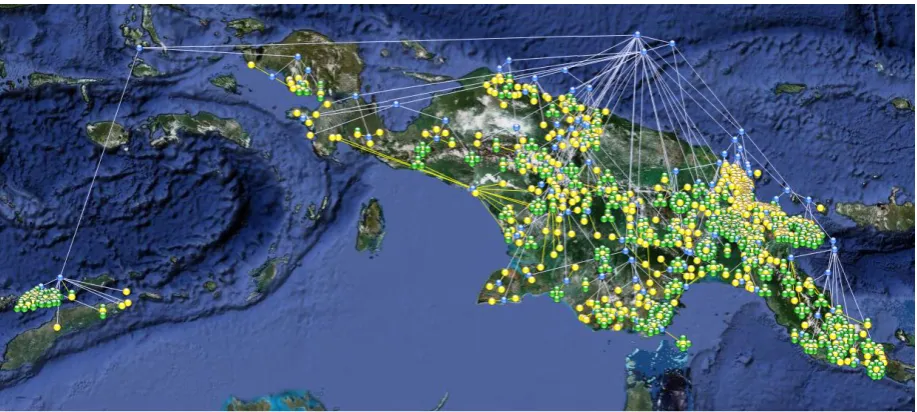
Figure 1 shows the result of a relatively simple warehouse query (using our unreleased explora-tory implementation): a geo-constrained phy-logenetic tree for Trans-New Guinea languages. Tree topology follows Ethnologue 16 (Lewis, 2009) as provided by the MultiTree project (Aristar and Ratliff, 2005); other analyses are
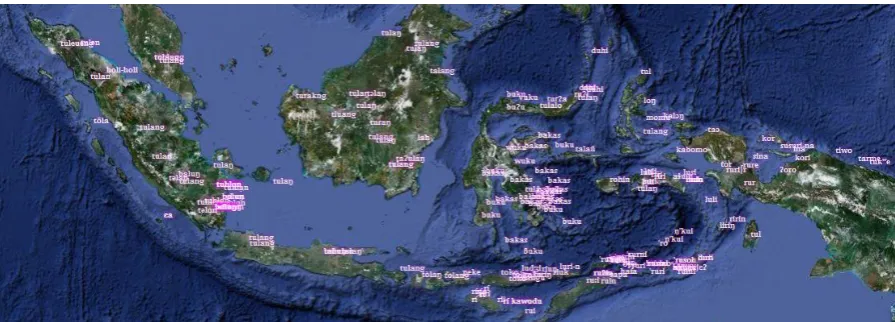
readily specified. In this example dialects (from the same sources) are arranged in a circular pat-tern around the ISO 639-3 hub language (and, again, other analyses could be used instead). The same filtering and visualization routines are used in a different manner in Figure 2, which shows words for “bone” in Austronesian languages as provided by ABVD (Greenhill et al, 2008).
5
Data comparability and reusability
We will finish the discussion of data warehouses
with a quick look at data comparability and
re-use. Comparability or equivalence of datasets
can be looked at in two ways
at the content level, e.g. to ensure that the same systems of transcription and glossing are used for all datasets, and
at the structural level, in identifying datasets of comparable complexity, structure, or available detail.
At the content level, normalization of forms and glosses is the critical transformation in the journey to gold-standard quality. We will briefly describe our systems for normalization, Meta-gloss and Metaphon, because they are ripe for computational assistance. The discussion ends with a quick introduction to Etyset, the frame-work we intend to use to describe and distribute structured datasets, such as those that incorporate subgroup and cognate detail.
5.1 Gloss, Metagloss, Etygloss
In most of our applications, a gloss is semantic annotation provided by the wordlist author in order to index phonological forms. Unfortu-nately, these may be elicitation terms rather than glosses (green? “grue.” blue? “grue”), or local
vernacular rather than common or scientific terms for flora and fauna. Phrasing varies wildly, and proper reading may depend on having the list context available (short/tall, short/long). Trans-lation may be lossy (strew or scatter as nouns) due to differences in grammaticalization or lexi-fication. All of these undermine comparability.
We have begun to define an intermediate,
standardized metagloss layer to express the
au-thor’s intent (if discernable). A third layer, the etygloss, will help account for semantic shift in labeling cognate groups; i.e. glossing empty placeholders for proto-language reconstructions. In the simple case all three layers are identical.
Metagloss provides a controlled vocabulary for re-annotating or translating existing lexicon glosses; it foregrounds the critical design link between glossing and searching. We map this to
WordNet senses, creating a low-overhead tool for word-sense disambiguation and facet generation.
The Metagloss controlled vocabulary can be extended; it uses attributes to specify predictable
relationships (sheep:male:castrated for wether)
and solve lexicalization problems that arise in
gloss translation (e.g. n@strew is the noun form
of strew). Additionally, it allows definition of
lightweight ontologies; relations between Meta-glosses that clarify semantic relations and im-prove search fallback performance.
5.2 Phon, Metaphon, Etyphon
[image:6.595.74.522.69.230.2]Phonological forms present similarly difficult search problems; these go beyond easily fixed notational convention. For example, absence of marked syllable boundaries can make phonologi-cal searches difficult when we are interested in the phoneme’s role (such as pre-nasalization) rather than its sign (/n/, /m/ etc.).
The same holds true for other context-sensitive symbols (e.g. “h” as /h/, /h/, or as a
pre-pended indicator of unvoiced phonemes). A greater problem arises from parsimonious nota-tions that rely on commentary to clarify unwrit-ten conunwrit-tent, e.g. predictable vowel insertion – these must be made explicit.
We define an intermediate layer of standard-ized notation called metaphon: a conventional notation that allows consistent search, while clearly documenting (and minimizing, in com-parison to wild-card searches) the scope of any unavoidable approximation. A third layer, the
etyphon, allows temporary specification of a (possibly sub-lexical) phonemic rendition prior to any formal reconstruction.
Metaphon, like metagloss, is intimately tied to search functionality. Normalized transcription enables consistent extraction of phonological and phonotactic data. It lets the search universe be restricted to languages (or items) that have par-ticular phonemes or features. This dynamic, data-driven process lets us weigh relative signifi-cance – frequency, salience, functional load – of features in sets that are themselves results drawn from a restricted search universe; e.g. to consider the functional load of tones in sesquisyllables.
5.3 Structural comparability: EtySet
The discussion thus far has focused on the form and quality of data items. We are equally con-cerned with what might be called structural com-parability of data sets, because this determine the approach we take to systematic description, dis-semination, and re-use of cognate sets, phyloge-netic trees, or sets of proto-form reconstructions.
This has nothing to do with tagging or inter-change standards, which can be handled with borrowed schemes designed for similar purposes, e.g. Newick notation (Felsenstein, 1986) or suc-cessors (Nakhleh, 2003). Rather, we require nomenclature that might be used to describe their contents, or to enable identification of sets of
comparable complexity, structure, or detail. We think such comparison is crucial to help research in quantitative historical linguistics move beyond its current state, which many lin-guists view as interesting but nevertheless ad hoc experimentation. In other words, we would like to see computational approaches to cognate iden-tification, subgrouping, and proto-language re-construction be developed and tested in envi-ronments for which the controlled variable is
linguistic typology, with as many other factors as possible held equal.
Similarly, we would like to be able to vary starting conditions. For example Bouchard-Côté et al (2013) report on a computational approach to reconstruction given (assumed) prior knowl-edge of subgrouping in Austronesian. However, any one or two variables from amongst cognate grouping, reconstruction, and phylogenetic sub-grouping may be used to test approaches to infer-ring or generating the third.
We refer to cognate sets, phylogenetic trees, and reconstructed proto-forms as etysets. The key terms of our working descriptive nomencla-ture are outlined in Table 2.
Etysets may be bare (links only), or supported by reconstructed forms or semantics; note that the phylogenetic analyses provided by Eth-nologue, Glottolog, or MultiTree may be repre-sent with bare etysets. An internal cognate etyset has depth (number of internal sets) and size (number of forms in each set). A regular cognate etyset has depth (the number of sets / implicit number of root proto-forms) and breadth (the number of lects represented in each cognate set).
For example a bare cognate etyset of
Bah-naric, breadth Eth:80% / depth MSEA:90% depth includes data from 32 (of 40. according to the Ethnologue analysis) Bahnaric languages, and at least 450 of the 500-odd terms in the MSEA (SIL 2002) elicitation list. Cognate groupings are provided, but not reconstructions or etyglosses.
breadth number of nodes or leaves at any level of a phylogenetic tree.
depth number of branch levels supplied.
degree branchy-ness – the number of branches / degree of diversity at a given node.
density a joint measure of breadth, depth, and degree.
size # of cited or reconstructed forms associated with a leaf or branch node.
coverage describes the extent of an etyset in terms of a fixed reference inventory.
phylogenetic etyset described in term of breadth, depth, degree, and size.
documented node includes metadata for approximate time depth and geographic location.
cognate etyset may be internal or regular, and contains internal or regular cognate sets.
6
Operations on lexicons
We end with a brief note about computational tasks for and by a data warehouse that is:
stocked primarily with lexical, phonological, and phylogenetic data and relevant metadata,
intended to support research in comparative and historical linguistics.
These fall under the general heading of opera-tions on lexicons. We do not draw a strict divid-ing line between software employed to prepare data for use in a warehouse, and software used by
the warehouse. We do exclude operations whose implementation is likely to be closely tied to a particular database implementation.
All would benefit from being implemented as plug-and-play functions, requiring some, but not excessive, programmer effort. This:
allows head-to-head comparison of alterna-tive algorithms, implementations, or inter-pretations of how measurements or actions should be carried out,
allows encapsulation and offloading of com-putationally expensive algorithms; this is an important issue for some quantitative or sta-tistical comparative methods, and
encourages re-use of code in building new, alternative platforms for linguistic research. We assume that all of these can be specified in terms of functionality, required data inputs, and expected data outputs, sticking to a Unix-like model in which data can be minimally formatted plain-text streams which, with the assistance of tabs, parentheses, and newlines, can be inter-preted as bags, lists, vectors, matrices, trees, and the like. Higher-level streams (JSON, XML, RDF, HTML) are also reasonable outputs.
For brevity’s sake, we limit examples to op-erations on phonological forms. We could easily list similar sets of operations – some straightfor-ward, some not – on morphology, semantics, alternatives for visualization, cognate identifica-tion, phylogenetic subgrouping, proto-form gen-eration, and the like.
Operations on phonological strings / lists
Conversion and markup of transcription
between standardized and/or special-purpose notations,
to novel notations, e.g. gestural scores,
unambiguous conversion of notation from historical (e.g. Americanist) to IPA,
potentially ambiguous normalization (e.g. interpretation of /h/),
phonetic to phonemic conversion,
marking of syllable boundaries,
marking of syllable-internal features (e.g. onset, nucleus, coda),
marking of morpheme boundaries.
Extraction / recognition of phonological features sonority sequence tagging.
extraction/recognition of phones, phonation, co-articulatory, suprasegmental features,
count/extraction of phone/feature n-grams,
extraction or identification of arbitrary collo-cational features (e.g. sesquisyllable+tone),
Calculation of distance/similarity measures be-tween strings, lists, and vectors
weighted and unweighted edit distances,
substring matching measures,
vector cosine distance,
phonologically based distance/similarity,
language-internal distance/similarity,
information content distance/similarity.
Clustering
subgrouping list contents,
“sounds like...” search (for very large sets).
Neighborhood measures
generation of phonological neighborhoods,
identification of neighbors,
calculation of neighborhood size, density, clustering coefficients.
Load measures
calculation of functional load of phonemes, features, collocations,
calculation of salience of phonemes, fea-tures, collocations,
use in pseudo-word generation.
7
Conclusion
We suggest that these same needs exist all down the line, encompassing low-resource lan-guages in general, documentation long-since completed, and analytical applications far re-moved from fieldwork settings. We propose that addressing them in downstream environments, such as data warehouses and STECs, may be an effective way to meet our common “preeminent grand challenge:” integration of linguistic theo-ries and analyses, relying on massive scaling up of datasets and new computational methods, as articulated by Bender and Good (2010).
References
Anthony Aristar and Martha Ratliff. 2005. MultiTree: A digital library of language relationships. Insti-tute for Language Information and Technology: Ypsilanti, MI. http://multitree.org.
Anja Belz and Adam Kilgarriff. 2006. Shared-task evaluations in HLT: Lessons for NLG. In Proceed-ings of INLG-2006.
Emily Bender and Jeff Good. 2010. A Grand Chal-lenge for Linguistics: Scaling Up and Integrating Models. White paper contributed to NSF SBE 2020 initiative. http://www.nsf.gov/sbe/sbe_2020/-2020_pdfs/Bender_Emily_81.pdf
Steven Bird and Gary Simons. 2003. Seven Dimen-sions of Portability for Language Documentation and Description. Language 79:2003, 557-5822. Alexandre Bouchard-Côté, David Hall, Thomas L.
Griffiths and Dan Klein. 2013. Automated recon-struction of ancient languages using probabilistic models of sound change. Proceedings of the Na-tional Academy of Sciences. http://-www.pnas.org/content/110/11/4224
Joseph Felsenstein. 1986. The newick tree format. http://evolution.genetics.washington.edu/phylip/ne wicktree.html
Simon Greenhill, Robert Blust, and Russell D.. Gray. 2008. The Austronesian Basic Vocabulary Data-base: From Bioinformatics to Lexomics. Evolu-tionary Bioinformatics, 4:271-283. http://-language.psy.auckland.ac.nz/austronesian
Erhard W. Hinrichs, Marie Hinrichs and Thomas Zas-trow. 2010. WebLicht: Web-Based LRT Services for German. In: Proceedings of the ACL 2010 Sys-tem Demonstrations. pages 25–29.
Lynette Hirschman. 1998. The evolution of evalua-tion: Lessons from the Message Understanding Conferences. Computer Speech and Language, 12:283–285.
Adam Kilgarriff. 1998. Gold Standard Datasets for Evaluating Word Sense Disambiguation Programs. Computer Speech and Language, 12 (3) Special
Is-sue on Evaluation of Speech and Language Tech-nology, edited by Robert Gaizauskas. 453-472. http://www.kilgarriff.co.uk/Publications/1998-K-CompSL.pdf For TREC see http://trec.nist.gov. The TIPSTER site has been preserved here: http://www.nist.gov/itl/div894/894.02/related_proj ects/tipster/
Peter Kleiweg. 2006. RuG/L04 Software for dialecto-metrics and cartography. Rijksuniversiteit Gronin-gen. Faculteit der Letteren. http://www.let.rug.nl-/kleiweg/L04/
M. Paul Lewis. 2009. Ethnologue: Languages of the World, Sixteenth Edition. SIL International, Dal-las, Texas.
Johann-Mattis List and Steven Moran. 2013. An Open-Source Toolkit for Quantitative Historical Linguistics. Proceedings of the 51st Annual Meet-ing of the Association for Computational LMeet-inguis- Linguis-tics, 13–18, Sofia, Bulgaria.
http://-www.zora.uzh.ch/84667/1/P13-4003.pdf
Luay Nakhleh, Daniel Miranker, and Francois Bar-bancon. 2003. Requirements of Phylogenetic Data-bases. In Third IEEE Symposium on BioInformat-ics and BioEngineering (BIBE’03). 141-148. IEEE Press. http://www.cs.rice.edu/~nakhleh/Papers/-bibe03_final.pdf
Heike Neuroth, Felix Lohmeier, Kathleen Marie Smith: TextGrid. Virtual Research Environment for the Humanities. In: The International Journal of Digital Curation. 6, Nr. 2, 2011, S. 222–231. Sebastian Nordhoff and Harald Hammarström. 2011.
Glottolog/Langdoc: Defining dialects, languages, and language families as collections of resources. 783 CEUR Workshop, Proceedings of the First In-ternational Workshop on Linked Science 2011 http://iswc2011.semanticweb.org/fileadmin/iswc/-Papers/Workshops/LISC/nordhoff.pdf
Erich R. Round. 2013. ‘Big data’ typology and lin-guistic phylogenetics: Design principles for valid datasets. Presented 25 May 2013 at 21st Manches-ter Phonology Meeting. Accessible via https://uq.academia.edu/ErichRound.
Erich R. Round. 2014. The performance of STRUC-TURE on linguistic datasets & ‘researcher degrees of freedom’. Presented 15 Jan 2014 at TaSil, Aar-hus, Denmark. Accessible via https://uq.academia.edu/ErichRound
SIL Mainland Southeast Asia Group. 2002. Southeast Asia 436 Word List revised November 2002. http://msea-ling.info/digidata/495/b11824.pdf Gary Simons and Steven Bird. 2000. The seven pillars