Proceedings of the 6th Linguistic Annotation Workshop, pages 118–123,
Simultaneous error detection
at two levels of syntactic annotation
Adam Przepiórkowski Institute of Computer Science
Polish Academy of Sciences ul. Jana Kazimierza 5 01-248 Warszawa, Poland [email protected]
Michał Lenart
Institute of Computer Science Polish Academy of Sciences
ul. Jana Kazimierza 5 01-248 Warszawa, Poland
Abstract
The paper describes a method for measuring compatibility between two levels of manual corpus annotation: shallow and deep. The pro-posed measures translate into a procedure for finding annotation errors at either level.
1 Introduction
Syntactic parsers are typically evaluated against manually or semi-automatically developed tree-banks. Although, in evaluation tasks, such hand-produced resources are treated as if they were error-free, it is well known that even the most carefully annotated corpora contain errors. Some attention has been given to this problem within the last decade, and statistical techniques have been proposed to loc-ate untypical – and, hence, possibly erroneous – an-notations.
In this paper we examine a related issue, namely, the possibility of finding annotation errors by com-paring two independently annotated levels of syn-tactic annotation: shallow (roughly: chunking) and deep (fully connected syntactic trees spanning the whole sentence).
2 Related Work
There are two strands of work relevant to the cur-rent enterprise. First, there is a line of work on dis-covering errors in manually annotated corpora (van Halteren 2000, Eskin 2000, Dickinson and Meurers 2003a), including treebanks (Dickinson and Meur-ers 2003b, Boyd et al. 2008, Dickinson and Lee 2008, Kato and Matsubara 2010). These methods
concentrate on finding inconsistencies in linguistic annotations: if similar (in some well-defined way) inputs receive different annotations, the less frequent of these annotations is suspected of being erroneous. Experiments (reported elsewhere) performed on a Polish treebank show that such methods reach reas-onable precision but lack in recall.
The second relevant line of research is concerned with the evaluation of syntactic parsers. The stand-ard measure is the so-called Parseval measure (Black et al. 1991), used in the eponymous series of com-petitions. It calculates precision and recall on the set of (perhaps labelled, Magerman 1995) spans of words, i.e., on brackets identified in parse results and in the gold standard. Unfortunately, this measure – regardless of the fact that it has been repeatedly criti-cised on various grounds (Briscoe and Carroll 1996, Sampson and Babarczy 2003, Rehbein and van Gen-abith 2007, Kübler et al. 2008) – is not applicable to the current problem, as spans of discovered constitu-ents are very differentby design.
A more promising measure, older than Parseval (cf. Sampson et al. 1989), but gaining prominence only recently, is Leaf-Ancestor (LA; Sampson 2000, Sampson and Babarczy 2003), which compares trees word-by-word. For each word, the similarity of the path from this word to the root of the tree in both trees is calculated as a number in h0,1i, and the mean of these similarities over all words in a sen-tence is the score for this sensen-tence.1While also not
1
The very lenient IOB (Ramshaw and Marcus 1995, Tjong Kim Sang and Veenstra 1999) accuracy measure, used some-times in chunking, can be considered as an extreme case of the LA measure.
directly applicable to the current scenario, this meas-ure is much more flexible, as path similarity may be defined in various ways. The method proposed in section 4 has been inspired by this measure. An-other general source of inspiration have been eval-uation measures used in dependency parsing, where the notion of head is of paramount importance.
3 Levels of Syntactic Annotation
Among the various levels of linguistic annotation in the National Corpus of Polish (http://nkjp. pl/; NKJP; Przepiórkowski et al. 2010), two are immediately relevant here: morphosyntax (roughly, parts of speech and values of grammatical cat-egories such as case or gender) and shallow syn-tactic groups. A 1-million-word subcorpus of NKJP was semi-automatically annotated at these levels: first relevant tools (morphological analyser, shallow grammar) were used to automatically add mark-up and then human annotators carefully (2 annotators per sentence plus a referee) selected the right inter-pretation, often correcting the automatic outcome.
In a related project (Woli´nski et al. 2011), the morphosyntactic level was used as a basis for con-structing the level of deep syntax. Again, sentences were run through a deep parser and human annotat-ors carefully selected the right parse.
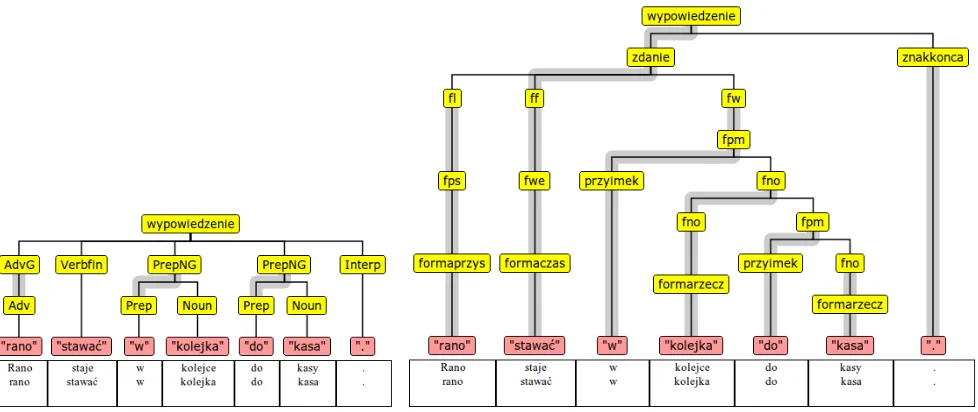
The two syntactic annotation layers, illustrated in Figure 1, are described in more detail below.
3.1 Shallow Syntax
By shallow syntactic annotation we understand here a little more than chunking (Abney 1991): various types of basic groups are found (nominal, prepos-itional, adverbial, sentential), each marked with a syntactic head and a semantic head, and some hier-archical structure is allowed to the extent that sen-tential groups may contain smaller groups (includ-ing sentential ones). On the other hand, the general chunking principle of not resolving attachment am-biguities is preserved, so, e.g., instead of the nes-ted structure[P [NP [P NP]PP]NP]PPforw kolejce do kasyin the right-hand tree in Fig. 1, two smaller
[P N]PPconstituents are marked at the shallow level (cf. the tree on the left).2
2Note that non-terminal labels used in the figure differ from the ones used in text, and that in particular the deep tree uses
3.2 Deep Syntax
Complete constituent trees are assigned to sentences at the deep syntactic level. Labels of pre-terminals reflect parts of speech (e.g.,przyimek‘preposition’ orformarzecz‘nominal form’), higher non-terminal labels mostly correspond to standard labels such as PP (fpm), NP (fno), VP (fwe, understood here rather as a verbal group) or S (zdanie), with an additional level containing information about argument (fw) or non-argument (fl) status of phrases. No further dependency-like information is provided, i.e., there is no special marking of subjects, direct objects, etc.
4 Comparing Annotation Levels
Let us first note that all measures mentioned above are symmetrical in the sense that the evaluation of treeT1against treeT2 gives the same results – per-haps after swapping precision and recall – as the evaluation of T2 against T1. In the current scen-ario, the two annotation schemata are rather differ-ent, with the shallow level containing – by design – fewer and smaller constituents. Hence, two different measures of precision are needed for the two levels (each measure having the dual role of measuring re-call of the other level).
Second, since both annotation schemata assume the existence of syntactic heads for all constituents (see the thick lines in Fig. 1), and – together with de-pendency grammarians, practitioners of HPSG (Pol-lard and Sag 1994), etc. – we take headedness to be a crucial property of constituents, the proposed meas-ures will build on this notion.
Let us first start with the types of shallow groups that cannot be nested, i.e., nominal, prepositional, etc., but not sentential. We define shallow precision, Ps, as the percentage of those segments contained in
such groups which are annotated consistently with deep syntax:
Ps=
|{w:∃G w∈yield(G)∧c(w, G)}| |{w:∃G w∈yield(G)}| , (1)
where w ranges over words, G ranges over (non-sentential) groups, andc(w, G)is the compatibility predicate, which is true if and only if the annotation
Figure 1: An example of shallow (on the left) and deep (on the right) syntactic annotation ofRano staje w kolejce do kasy.‘In the morning, (s)he queues to the cash desk.’, lit. ‘morning stands in queue to cash-desk’. In the shallow annotation, an artificial root (wypowiedzenie‘utterance’) is added to connect all words and groups.
ofwis compatible across the two levels. More pre-cisely,c(w, G) is true iff there exists a phraseF at the deep annotation of the same sentence such that w ∈ yield(F), and also G and F have the same lexical heads. These conditions imply thatwhas the same headedness status with respect toGandF, i.e., it is either the head of both or of neither.
A labelled version of Ps, marked as lPs,
addi-tionally requires that labels ofGandF are compat-ible, in the sense of a manually defined mapping that relates – to give examples based on Fig. 1 –PrepNG
tofpm,AdvGtofps, etc.
Applying this measure to Fig. 1 we note that there are 5 words belonging to some shallow group (Rano,
w,kolejce,do,kasy). All these words, together with their respective groups, satisfyc(w, G)and the con-dition on labels, so both Ps and lPs are 1.0. For
example, for w = kolejce, G is the PrepNG yield-ingw kolejce, whose head is the prepositionw. Con-sequently,F is thefpmyieldingw kolejce do kasy.
Deep precision,Pd, is defined in a similar way, but
we are only interested in wordswwhich aremore or less directlycontained in a phrase of a type corres-ponding to the types of groups considered here (i.e., nominal, prepositional, etc.). We say thatwismore or less directlycontained inF iff the path fromwto
F does not contain any sentential labels.3For every such wordwwe require that for one of itsmore or less directlydominating phrases,F, there is a corres-ponding shallow groupGwith the same head asF and also containingw; in case of labelled deep preci-sion,lPd, the labels ofF andGshould also match.
For the deep annotation in Fig. 1, both unlabelled and labelled precision is again 1.0. This means that the two trees in this figure match perfectly, given the differing annotation schemata.
Recall that above measures do not take into ac-count sentential constituents. This is due to the fact that finding clauses is not typically part of shallow parsing, and also in the current setup it is limited to complementiser clauses (CG) and embedded ques-tions (KG). Although, given these constraints, it is not clear how to measure recall in this task, we can measure precision by checking that for each con-stituent CG and KG there is a corresponding sen-tential node at deep syntax. However, aware of the criticisms directed at Parseval, we do not want to ex-cessively punish annotations for having slightly dif-ferent spans of clauses, so we define the proximity of a clause in shallow syntax to a sentential constituent
3
in the deep syntax as the F-measure over the words they contain.4The final clausal precision of the shal-low level is defined as the mean over all clauses.
5 Experiments and Evaluation
The measures defined above were applied to a 7600-sentence subcorpus annotated at both syntactic levels. For the whole corpus, the mean (micro-average) unlabelled precisions were: Ps = 98.7%
and Pd = 93.4%. This shows that, while the two
levels of annotation are largely compatible, there are differences in the extents of some constituents. Also, the fact thatPd< Psshows that it is more common
for the shallow level to miss (parts of) deep-level constituents, than the other way round.
We manually examined 50 sentences containing words on which the two annotations do not agree ac-cording to the unlabelled measures; there were 104 such word-level disagreements.
Discrepancies discovered this way may be di-vided into those 1. resulting from the insufficient subtlety of the measure, 2. reflecting controversial design decisions at the shallow level, 3. showing real differences, i.e., possible errors.
The biggest subset of class 1. results from the fact that not only syntactic groups are marked at the shallow level, but also some multi-token syntactic words, e.g., some adverbial groups resembling pre-positional constructions. If such a syntactic word is the head of a group, a mismatch with the correspond-ing deep phrase is over-zealously reported. Around 35% of all differences belong to this group. Addi-tionally, 16% of mismatches reflect differences in the treatment of adjectival participles. Hence, over 50% of reported differencies can be avoided by mak-ing the measures sensitive to such special cases.
Another 15% of differences, belonging to class 2., are caused by the controversial design decision to split larger coordinate structures at the shallow level into separate constituents, with only the final two conjuncts forming a coordinated group.
Finally, the remaining 1/3 of mismatches reflect real differences, often corresponding to errors at one of the levels. The most interesting subclass of these are discontinuities, currently handled only
4Obviously, for any shallow-level clause we select a deep-level sentential constituent that maximises this F-measure.
at the shallow level, e.g., cases of sentential con-junctions incorporated into NPs or discontinuous numeral phrases. Other differences include: some particles analysed as parts of NPs at one level, but not at the other, some adverbs or participles not ana-lysed as adverbial groups at the shallow level, incor-rect analysis of the highly ambiguoustoas a noun (instead of a particle) at the deep level, etc.
Labelled measures have significantly lower values than the the unlabelled equivalents: lPs = 95.1%
andlPd = 91.1%. This is somewhat surprising, as
at both levels constituents are marked for their lex-ical heads and it would seem that the morphosyn-tactic properties of the head should determine the label of the constituent. It turns out that the two main reasons for label mismatches are different proaches to some relative pronouns, and to some ap-parently prepositional constructions (analysed as ad-verbial at the shallow level).
Let us also note that the overall clausal precision of the shallow level is0.996. Out of 691 sentences containingCGandKGgroups, 670 match the deep level perfectly. In the remaining sentences, the usual problem is thatCGorKGextends too far to the right (in 1 case it is too short), although in some cases it is the deep phrase that is too long or that is wrongly analysed, and in other cases two different spans re-flect a genuine semantic ambiguity in the sentence.
6 Conclusion
References
Steven Abney. Parsing by chunks. In Robert Berwick, Steve Abney, and Carol Tenny, ed-itors, Principle-Based Parsing, pages 257–278. Kluwer, 1991.
Ezra Black, Steve Abney, Dan Flickinger, Claudia Gdaniec, Ralph Grishman, Phil Harrison, Don Hindle, Robert Ingria, Frederick Jelinek, Judith L. Klavans, Mark Liberman, Mitchell P. Marcus, Salim Roukos, Beatrice Santorini, and Tomek Strzałkowski. A procedure for quantitatively comparing the syntactic coverage of English grammars. InProceedings of the DARPA Speech and Natural Language Workshop, pages 306–311, Pacific Grove, 1991.
Adriane Boyd, Markus Dickinson, and Detmar Meurers. On detecting errors in dependency tree-banks. Research on Language and Computation,
6(2):113–137, 2008. URL http://jones.
ling.indiana.edu/~mdickinson/ papers/boyd-et-al-08.html.
Ted Briscoe and John Carroll. A probabilistic LR parser of part-of-speech and punctuation labels. In Jenny Thomas and Mick Short, editors,Using Corpora for Language Research, London, pages 135–150. Longman, London, 1996.
Markus Dickinson and Chong Min Lee. De-tecting errors in semantic annotation. In
LREC. URL {http://jones.ling.
indiana.edu/~mdickinson/papers/ dickinson-lee08.html}.
Markus Dickinson and W. Detmar Meurers. Detect-ing errors in part-of-speech annotation. In Pro-ceedings of the 10th Conference of the European Chapter of the Association for Computational Linguistics (EACL 2003), pages 107–114, Bud-apest, 2003a.
Markus Dickinson and W. Detmar Meurers. De-tecting inconsistencies in treebanks. In Joakim Nivre and Erhard Hinrichs, editors, Proceedings of the Second Workshop on Treebanks and Lin-guistic Theories (TLT 2003), pages 45–56, Växjö,
Norway, 2003b. URLhttp://jones.ling.
indiana.edu/~mdickinson/papers/ dickinson-meurers-tlt03.html. LREC. Proceedings of the Sixth International
Con-ference on Language Resources and Evaluation,
LREC 2008, Marrakech, 2008. ELRA.
Eleazar Eskin. Automatic corpus correction with anomaly detection. In Proceedings of the 1st Meeting of the North American Chapter of the Association for Computational Linguist-ics (NAACL 2000), pages 148–153, Seattle, WA, 2000.
Yoshihide Kato and Shigeki Matsubara. Correct-ing errors in a treebank based on synchronous tree substitution grammar. In Proceedings of the ACL 2010 Conference Short Papers, pages 74–79, Stroudsburg, PA, 2010. URL http://dl.acm.org/citation.cfm? id=1858842.1858856.
Sandra Kübler, Wolfgang Maier, Ines Rehbein, and Yannick Versley. How to compare treebanks. In LREC.
David M. Magerman. Statistical decision-tree mod-els for parsing. In Proceedings of the 33rd Annual Meeting of the Association for Com-putational Linguistics, pages 276–283, Cam-bridge, MA, 1995. doi: 10.3115/981658.
981695. URL http://www.aclweb.org/
anthology/P95-1037.
Carl Pollard and Ivan A. Sag. Head-driven Phrase Structure Grammar. Chicago University Press / CSLI Publications, Chicago, IL, 1994.
Adam Przepiórkowski, Rafał L. Górski, Marek Łazi´nski, and Piotr P˛ezik. Recent developments in the National Corpus of Polish. InProceedings of the Seventh International Conference on Lan-guage Resources and Evaluation, LREC 2010, Valletta, Malta, 2010. ELRA.
Lance A. Ramshaw and Mitchell P. Marcus. Text chunking using transformation-based learning. In
Proceedings of the Third Workshop on Very Large Corpora, pages 82–94, Cambridge, MA, 1995. ACL.
Ines Rehbein and Josef van Genabith. Treebank an-notation schemes and parser evaluation for Ger-man. In Proceedings of the 2007 Joint Confer-ence on Empirical Methods in Natural Language Processing and Computational Natural Lan-guage Learning (EMNLP-CoNLL), pages 630–
639, 2007. URL http://www.aclweb.
the measurement of parse accuracy. Interna-tional Journal of Corpus Linguistics, 5:53–68,
2000. URLhttp://www.grsampson.net/
APfi.html.
Geoffrey Sampson and Anna Babarczy. A test of the leaf-ancestor metric for parse accur-acy. Natural Language Engineering, 9:365–380,
2003. URLhttp://www.grsampson.net/
ATot.html.
Geoffrey Sampson, Robin Haigh, and Eric S. At-well. Natural language analysis by stochastic op-timization: a progress report on Project APRIL.
Journal of Experimental and Theoretical Artifi-cial Intelligence, 1:271–287, 1989.
Erik F. Tjong Kim Sang and Jorn Veenstra. Rep-resenting text chunks. In Proceedings of the 9th Conference of the European Chapter of the Association for Computational Linguistics (EACL 1999), pages 173–179, Bergen, 1999. Hans van Halteren. The detection of inconsistency
in manually tagged text. InProceedings of the 2nd Workshop on Linguistically Interpreted Corpora (LINC 2000), 2000.