Really? Well. Apparently Bootstrapping Improves the Performance of
Sarcasm and Nastiness Classifiers for Online Dialogue
Stephanie Lukin
Natural Language and Dialogue Systems University of California, Santa Cruz 1156 High Street, Santa Cruz, CA 95064
Marilyn Walker
Natural Language and Dialogue Systems University of California, Santa Cruz 1156 High Street, Santa Cruz, CA 95064
Abstract
More and more of the information on the web is dialogic, from Facebook newsfeeds, to fo-rum conversations, to comment threads on news articles. In contrast to traditional, mono-logic Natural Language Processing resources such as news, highly social dialogue is fre-quent in social media, making it a challenging context for NLP. This paper tests a bootstrap-ping method, originally proposed in a mono-logic domain, to train classifiers to identify two different types of subjective language in dialogue: sarcasm and nastiness. We explore two methods of developing linguistic indica-tors to be used in a first level classifier aimed at maximizing precision at the expense of re-call. The best performing classifier for the first phase achieves 54% precision and 38% recall for sarcastic utterances. We then use general syntactic patterns from previous work to cre-ate more general sarcasm indicators, improv-ing precision to 62% and recall to 52%. To further test the generality of the method, we then apply it to bootstrapping a classifier for nastiness dialogic acts. Our first phase, using crowdsourced nasty indicators, achieves 58% precision and 49% recall, which increases to 75% precision and 62% recall when we boot-strap over the first level with generalized syn-tactic patterns.
1 Introduction
More and more of the information on the web is dialogic, from Facebook newsfeeds, to forum con-versations, to comment threads on news articles. In contrast to traditional, monologic Natural Language Processing resources such as news, highly social di-alogue is very frequent in social media, as illustrated in the snippets in Fig. 1 from the publicly
avail-able Internet Argument Corpus (IAC) (Walker et al.,
QuoteQ, ResponseR Sarc Nasty Q1: I jsut voted. sorry if some people
actu-ally have, you know, LIVES and don’t sit around all day on debate forums to cater to some athe-ists posts that he thiks they should drop every-thing for. emoticon-rolleyes emoticon-rolleyes emoticon-rolleyes As to the rest of your post, well, from your attitude I can tell you are not Christian in the least. Therefore I am content in knowing where people that spew garbage like this will end up in the End.
R1: No, let me guess . . . er . . . McDonalds. No, Disneyland. Am I getting closer?
1 -3.6
Q2: The key issue is that once children are born they are not physically dependent on a particular individual.
R2Really? Well, when I have a kid, I’ll be sure to just leave it in the woods, since it can apparently care for itself.
1 -1
Q3: okay, well i think that you are just finding reasons to go against Him. I think that you had some bad experiances when you were younger or a while ago that made you turn on God. You are looking for reasons, not very good ones i might add, to convince people...either way, God loves you. :)
R3: Here come the Christians, thinking they can know everything by guessing, and commiting the genetic fallacy left and right.
0.8 -3.4
Figure 1: Sample Quote/Response Pairs from
4forums.com with Mechanical Turk annotations for Sarcasm and Nasty/Nice. Highly negative values of Nasty/Nice indicate strong nastiness and sarcasm is indicated by values near 1.
2012). Utterances are frequently sarcastic, e.g.,
Re-ally? Well, when I have a kid, I’ll be sure to just leave it in the woods, since it can apparently care for itself(R2 in Fig. 1 as well as Q1 and R1), and are
often nasty, e.g. Here come the Christians, thinking
they can know everything by guessing, and commit-ing the genetic fallacy left and right(R3 in Fig. 1). Note also the frequent use of dialogue specific
dis-course cues, e.g. the use ofNoin R1,Really? Well
in R2, and okay, well in Q3 in Fig. 1 (Fox Tree
and Schrock, 1999; Bryant and Fox Tree, 2002; Fox Tree, 2010).
The IAC comes with annotations of different types of social language categories including sarcas-tic vs not sarcassarcas-tic, nasty vs nice, rational vs emo-tional and respectful vs insulting. Using a conser-vative threshold of agreement amongst the annota-tors, an analysis of 10,003 Quote/Response pairs
(Q/R pairs) from the4forumsportion of IAC
sug-gests that social subjective language is fairly fre-quent: about 12% of posts are sarcastic, 23% are emotional, and 12% are insulting or nasty. We select sarcastic and nasty dialogic turns to test our method on more than one type of subjective language and explore issues of generalization; we do not claim any relationship between these types of social language in this work.
Despite their frequency, expanding this corpus of sarcastic or nasty utterances at scale is expensive: human annotation of 100% of the corpus would be needed to identify 12% more examples of sarcasm or nastiness. An explanation of how utterances are annotated in IAC is detailed in Sec. 2.
Our aim in this paper is to explore whether it is possible to extend a method for bootstrapping a clas-sifier for monologic, subjective sentences proposed by Riloff & Wiebe, henceforth R&W (Riloff and Wiebe, 2003; Thelen and Riloff, 2002), to automat-ically find sarcastic and nasty utterances in unanno-tated online dialogues. Sec. 3 provides an overview of R&W’s bootstrapping method. To apply boot-strapping, we:
1. Explore two different methods for identifying cue words and phrases in two types of subjec-tive language in dialogues: sarcasm and nasty (Sec. 4);
2. Use the learned indicators to train a sarcastic (nasty) dialogue act classifier that maximizes precision at the expense of recall (Sec. 5); 3. Use the classified utterances to learn general
syntactic extraction patterns from the sarcastic (nasty) utterances (Sec. 6);
4. Bootstrap this process on unannotated text to learn new extraction patterns to use for classifi-cation.
We show that the Extraction Pattern Learner im-proves the precision of our sarcasm classifier by 17% and the recall by 24%, and improves the pre-cision of the nastiness classifier by 14% and recall by 13%. We discuss previous work in Sec. 2 and compare to ours in Sec. 7 where we also summarize our results and discuss future work.
2 Previous Work
IAC provides labels for sarcasm and nastiness that were collected with Mechanical Turk on Q/R pairs such as those in Fig. 1. Seven Turkers per Q/R pair
answered abinaryannotation question for sarcasm
Is the respondent using sarcasm?(0,1) and ascalar
annotation question for nastiness Is the respondent
attempting to be nice or is their attitude fairly nasty?
(-5 nasty . . . 5 nice). We selected turns from IAC
Table 1 with sarcasm averages above 0.5, and nasty averages below -1 and nice above 1. Fig. 1 included example nastiness and sarcasm values.
Previous work on the automatic identification of sarcasm has focused on Twitter using the
#sarcasm (Gonz´alez-Ib´a˜nez et al., 2011) and
#irony(Reyes et al., 2012) tags and a combined variety of tags and smileys (Davidov et al., 2010). Another popular domain examines Amazon product reviews looking for irony (Reyes and Rosso, 2011), sarcasm (Tsur et al., 2010), and a corpus collec-tion for sarcasm (Filatova, 2012). (Carvalho et al., 2009) looks for irony in comments in online newpa-pers which can have a thread-like structure. This primary focus on monologic venues suggests that sarcasm and irony can be detected with a relatively high precision but have a different structure from di-alogues (Fox Tree and Schrock, 1999; Bryant and Fox Tree, 2002; Fox Tree, 2010), posing the ques-tion, can we generalize from monologic to dialogic structures? Each of these works use methods in-cluding LIWC unigrams, affect, polarity, punctua-tion and more, and achieve on average a precision of 75% or accuracy of between 45% and 85%.
Automatically identifying offensive utterances is also of interest. Previous work includes identifying flames in emails (Spertus, 1997) and other messag-ing interfaces (Razavi et al., 2010), identifymessag-ing in-sults in Twitter (Xiang et al., 2012), as well as com-ments from new sites (Sood et al., 2011). These approaches achieve an accuracy between 64% and 83% using a variety of approaches. The accuracies for nasty utterances has a much smaller spread and higher average than sarcasm accuracies. This sug-gests that nasty language may be easier to identify than sarcastic language.
3 Method Overview
Figure 2: Bootstrapping Flow for Classifying Subjective Dialogue Acts, shown for sarcasm, but identical for nas-tiness.
overall idea of the method is to find reliable cues and then generalize. The top of Fig. 2 specifies the input to the method as an unannotated corpus of opinion dialogues, to illustrate the long term aim of building a large corpus of the phenomenon of interest with-out human annotation. Although the bootstrapping
method assumes that the input isunannotated text,
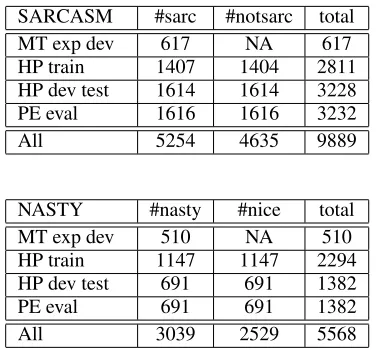
we first need utterances that are already labeled for sarcasm (nastiness) to train it. Table 1 specifies how we break down into datasets the annotations on the utterances in IAC for our various experiments.
The left circle of Fig. 2 reflects the assump-tion that there are Sarcasm or Nasty Cues that can identify the category of interest with high preci-sion (R&W call this the “Known Subjective Vocab-ulary”). The aim of first developing a high preci-sion classifier, at the expense of recall, is to select utterances that are reliably of the category of inter-est from unannotated text. This is needed to ensure that the generalization step of “Extraction Pattern Learner” does not introduce too much noise.
R&W did not need to develop a “Known Sub-jective Vocabulary” because previous work provided one (Wilson et al., 2005; Wiebe et al., 1999; Wiebe et al., 2003). Thus, our first question with applying R&W’s method to our data was whether or not it is possible to develop a reliable set of Sarcasm
(Nas-tiness) Cues (O1below). Two factors suggest that
it might not be. First, R&W’s method assumes that the cues are in the utterance to be classified, but it has been claimed that sarcasm (1) is context depen-dent, and (2) requires world knowledge to recognize,
SARCASM #sarc #notsarc total MT exp dev 617 NA 617 HP train 1407 1404 2811 HP dev test 1614 1614 3228 PE eval 1616 1616 3232
All 5254 4635 9889
NASTY #nasty #nice total MT exp dev 510 NA 510 HP train 1147 1147 2294 HP dev test 691 691 1382 PE eval 691 691 1382
All 3039 2529 5568
Table 1: How utterances annotated for sarcasm (top) and nastiness (bottom) in IAC were used. MT=Mechanical Turk experimental development set. HP train= utter-ances used to test whether combinations of cues could be used to develop a High precision classifier. HP dev test
=“Unannotated Text Collection” in Fig. 2. PE eval=
utterances used to train the Pattern Classifier.
at least in many cases. Second, sarcasm is exhibited by a wide range of different forms and with differ-ent dialogue strategies such as jocularity, understate-ment and hyberbole (Gibbs, 2000; Eisterhold et al., 2006; Bryant and Fox Tree, 2002; Filatova, 2012). In Sec. 4 we devise and test two different methods for acquiring a set of Sarcasm (Nastiness) Cues on particular development sets of dialogue turns called the “MT exp dev” in Table 1.
The boxes labeled “High Precision Sarcastic Post Classifier” and “High Precision Not Sarcastic Post Classifier” in Fig. 2 involves using the Sarcasm (Nastiness) Cues in simple combinations that
max-imize precision at the expense of recall. R&W
found cue combinations that yielded a High Preci-sion Classifier (HP Classifier) with 90% preciPreci-sion and 32% recall on their dataset. We discuss our test of these steps in Sec. 5 on the “HP train” develop-ment sets in Table 1 to estimate parameters for the High Precision classifier, and then test the HP classi-fier with these parameters on the test dataset labeled “HP dev test” in Table 1.
R&W’s Pattern Based classifier increased recall to 40% while losing very little precision. The open question with applying R&W’s method to our data, was whether the cues that we discovered, by what-ever method, would work at high enough precision
[image:3.612.76.303.53.230.2]describe how we use the “PE eval” development set (Table 1) to estimate parameters for the Extraction Pattern Learner, and then test the Pattern Based Sar-castic (Nasty) Post classifier on the newly classified utterances from the dataset labeled “HP dev test” (Table 1). Our final open question was whether the extraction patterns from R&W, which worked well
for news text, would work on social dialogue (O3
below). Thus our experiments address the following open questions as to whether R&W’s bootstrapping method improves classifiers for sarcasm and nasti-ness in online dialogues:
• (O1) Can we develop a “known sarcastic
(nasty) vocabulary”? The LH circle of Fig. 2 illustrates that we use two different methods to
identifySarcasm Cues. Because we have
ut-terances labeled as sarcastic, we compare a sta-tistical method that extracts important features automatically from utterances, with a method that has a human in the loop, asking annotators to select phrases that are good indicators of sar-casm (nastiness) (Sec. 5);
• (O2) If we can develop a reliable set of sarcasm
(nastiness) cues, is it then possible to develop an HP classifier? Will our precision be high enough? Is the fact that sarcasm is often con-text dependent an issue? (Sec. 5);
• (O3) Will the extraction patterns used in
R&W’s work allow us to generalize sarcasm cues from the HP Classifiers? Are R&W’s pat-terns general enough to work well for dialogue and social language? (Sec. 6).
4 Sarcasm and Nastiness Cues
Because there is no prior “Known Sarcastic Vocabu-lary” we pilot two different methods for discovering lexical cues to sarcasm and nastiness, and experi-ment with combinations of cues that could yield a high precision classifier (Gianfortoni et al., 2011).
The first method usesχ2to measure whether a word
or phrase is statistically indicative of sarcasm (nasti-ness) in the development sets labeled “MT exp dev” (Table 1). This method, a priori, seems reasonable because it is likely that if you have a large enough set of utterances labeled as sarcastic, you could be able to automatically learn a set of reliable cues for sarcasm.
The second method introduces a step of human
annotation. We ask Turkers to identify sarcastic
(nasty) indicators in utterances (the open question
unigram
χ2 MT IA FREQ
right ah .95 2
oh relevant .85 2
we amazing .80 2
same haha .75 2
all yea .73 3
them thanks .68 6
mean oh .56 56
bigram
χ2 MT IA FREQ
the same oh really .83 2 mean like oh yeah .79 2 trying to so sure .75 2
that you no way .72 3
oh yeah get real .70 2
I think oh no .66 4
we should you claim .65 2 trigram
χ2 MT IA FREQ
[image:4.612.328.528.52.381.2]you mean to I get it .97 3 mean to tell I’m so sure .65 2 have to worry then of course .65 2 sounds like a are you saying .60 2 to deal with well if you .55 2 I know I go for it .52 2 you mean to oh, sorry .50 2
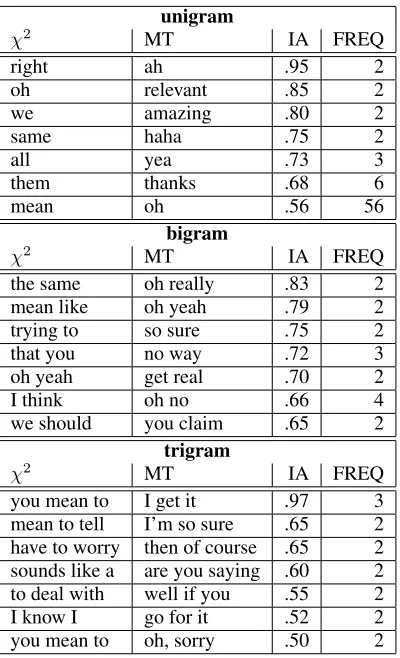
Table 2: Mechanical Turk (MT) and χ2 indicators for
Sarcasm
O1) from the development set “MT exp dev”
(Ta-ble 1). Turkers were presented with utterances pre-viously labeled sarcastic or nasty in IAC by 7 dif-ferent Turkers, and were told “In a previous study, these responses were identified as being sarcastic by 3 out of 4 Turkers. For each quote/response pair, we will ask you to identify sarcastic or potentially sarcastic phrases in the response”. The Turkers then selected words or phrases from the response they be-lieved could lead someone to believing the utterance was sarcastic or nasty. These utterances were not used again in further experiments. This crowdsourc-ing method is similar to (Filatova, 2012), but where their data is monologic, ours is dialogic.
4.1 Results from Indicator Cues
unigram
χ2 MT IA FREQ
like idiot .90 3
them unfounded .85 2
too babbling .80 2
oh lie .72 11
mean selfish .70 2
just nonsense .69 9
make hurt .67 3
bigram
χ2 MT IA FREQ
of the don’t expect .95 2 you mean get your .90 2
yes, you’re an .85 2
oh, what’s your .77 4
you are prove it .77 3
like a get real .75 2
I think what else .70 2 trigram
χ2 MT IA FREQ
[image:5.612.79.292.50.387.2]to tell me get your sick .75 2 would deny a your ignorance is .70 2 like that? make up your .70 2 mean to tell do you really .70 2 sounds like a do you actually .65 2 you mean to doesn’t make it .63 3 to deal with what’s your point .60 2
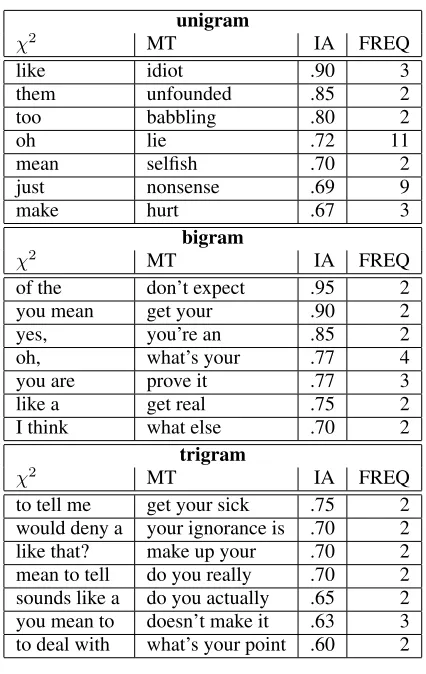
Table 3: Mechanical Turk (MT) and χ2 indicators for
Nasty
Figure 3: Interannotator Agreement for sarcasm trigrams
the development set “MT exp dev” to see if this was necessarily the case in our dialogues. (Snow et al., 2008) measures the quality of Mechanical Turk an-notations on common NLP tasks by comparing them to a gold standard. Pearson’s correlation coefficient shows that very few Mechanical Turk annotators were required to beat the gold standard data, often
less than 5. Because our sarcasm task does not have gold standard data, we ask 100 annotators to partic-ipate in the pilot. Fig. 3 plots the average interan-notator agreement (ITA) as a function of the number of annotators, computed using Pearson correlation counts, for 40 annotators and for trigrams which re-quire more data to converge. In all cases (unigrams, bigrams, trigrams) ITA plateaus at around 20 anno-tators and is about 90% with 10 annoanno-tators, showing that the Mechanical Turk tasks are well formed and there is high agreement. Thus we elicited only 10 annotations for the remainder of the sarcastic and all the nasty utterances from the development set “MT exp dev”.
We begin to form our “known sarcastic
vocab-ulary” from these indicators, (open question O1).
Each MT indicator has a FREQ (frequency): the
number of times each indicator appears in the
train-ing set; and anIA(interannotator agreement): how
many annotators agreed that each indicator was sar-castic or nasty. Table 2 shows the best unigrams,
bigrams, and trigrams from theχ2test and from the
sarcasm Mechanical Turk experiment and Table 3 shows the results from the nasty experiment. We
compare the MT indicators to the χ2 indicators as
part of investigating open questionO1.
As a pure statistical method, χ2 can pick out
things humans might not. For example, if it just hap-pened that the word ‘we’ only occurs in sarcastic
utterances in the development set, thenχ2 will
se-lect it as a strong sarcastic word (row 3 of Table 2). However, no human would recognize this word as
corresponding to sarcasm. χ2 could easily be
over-trained if the “MT exp dev” development set is not large enough to eliminate such general words from consideration, “MT exp dev” only has 617 sarcastic utterances and 510 nasty utterances (Table 1).
Words that the annotators select as indicators (columns labeled MT in Table 2 and Table 3) are much more easily identifiable although they do not
appear as often. For example, theIAof 0.95 for ‘ah’
in Table 2 means that of all the annotators who saw ‘ah’ in the utterance they annotated, 95% selected it
to be sarcastic. However theFREQof 2 means that
‘ah’ only appeared in 2 utterances in the “MT exp dev” development set.
We test whether any of the methods for select-ing indicators provide reliable cues that generalize to a larger dataset in Sec. 5. The parameters that we estimate on the development sets are exactly how
[image:5.612.81.290.432.575.2](com-pared to aθ2) a cue has to be to be useful in R&W’s bootstrapping method.
5 High-Precision Classifiers
R&W use their “known subjective vocabulary” to train a High Precision classifier. R&W’s HP classi-fier searches for exact surface matches of the jective indicators and classifies utterances as sub-jective if two subsub-jective indicators are present. We follow similar guidelines to train HP Sarcasm and
Nasty Classifiers. To test open question O1, we
use a development set called “HP train” (Table 1) to test three methods for measuring the “goodness” of an indicator that could serve as a high precision cue: (1) interannotator agreement based on anno-tators consensus from Mechanical Turk, on the as-sumption that the number of annotators that select
a cue indicates its strength and reliability (IA
fea-tures); (2) percent sarcastic (nasty) and frequency
statistics in the HP train dataset as R&W do (percent
features); and (3) the χ2 percent sarcastic (nasty)
and frequency statistics (χ2features).
TheIA featuresuse the MT indicators and theIA
and FREQ calculations introduced in Sec. 4 (see
Tables 2 and 3). First, we select indicators such
that θ1 <= FREQ where θ1 is a set of possible
thresholds. Then we introduce two new parameters
α andβ to divide the indicators into three
“good-ness” groups that reflect interannotator agreement.
indicatorstrength=
weak if0≤IA< α medium if α≤IA< β strong if β≤IA<1
For IA features, an utterance is classified as
sar-castic if it contains at least onestrongor twomedium
indicators. Other conditions were piloted. We first hypothesized that weak cues might be a way of classifying “not sarcastic” utterances. But HP train showed that both sarcastic and not sarcastic utter-ances contain weak indicators yielding no informa-tion gain. The same is true for Nasty’s counter-class Nice. Thus we specify that counter-counter-class
utter-ances must have nostrongindicators or at most one
mediumindicator. In contrast, R&W’s counter-class classifier looks for a maximum of one subjective in-dicator.
The percent features also rely on the FREQ of
each MT indicator, subject to a θ1 threshold, as
well as the percentage of the time they occur in
a sarcastic utterance (%SARC) or nasty utterance
(%NASTY). We select indicators with various
pa-rameters forθ1andθ2 ≤%SARC. At least two
in-dicators must be present and above the thresholds to be classified and we exhaust all combinations. Less than two indicators are needed to be classified as the counter-class, as in R&W.
Finally, the χ2 features use the same method as
percent featuresonly using theχ2indicators instead of the MT indicators.
After determining which parameter settings per-forms the best for each feature set, we ran the HP classifiers, using each feature set and the best param-eters, on the test set labeled “HP dev test”. The HP Classifiers classify the utterances that it is confident on, and leave others unlabeled.
5.1 Results from High Precision Classifiers
The HP Sarcasm and Nasty Classifiers were trained on the three feature sets with the following
parame-ters:IA featureswe exhaust all combinations ofβ=
[.70, .75, .80, .85, .90, .95, 1.00],α =[.35, .40, .45,
.50, .55, .60, .65, .7], andθ1=[2, 4, 6, 8, 10]; for the
percent featuresandχ2featureswe again exhaustθ1
=[2, 4, 6, 8, 10] andθ2=[.55, .60, .65, .70, .75, .80,
.85, .90, .95, 1.00].
Tables 4 and 5 show a subset of the experiments with each feature set. We want to select parame-ters that maximize precision without sacrificing too much recall. Of course, the parameters that yield the highest precision also have the lowest recall, e.g.
Sarcasm percent features, parameters θ1 = 4 and
θ2 = 0.75 achieve 92% precision but the recall is
1% (Table 4), and Nasty percent features with
pa-rametersθ1 = 8andθ2 = 0.8achieves 98%
preci-sion but a recall of 3% (Table 5). On the other end of the spectrum, the parameters that achieve the highest recall yield a precision equivalent to random chance. Examining the parameter combinations in
Ta-bles 4 and 5 shows thatpercent features do better
than IA features in all cases in terms of precision. Compare the block of results labeled % in Tables 4
and 5 with the IA andχ2blocks for column P. Nasty
appears to be easier to identify than Sarcasm,
espe-cially using thepercent features. The performance
of the χ2 featuresis comparable to that of percent
featuresfor sarcasm, but lower thanpercent features for Nasty.
The best parameters selected from each feature
set are shown in the PARAMS column of Table 6.
SARC PARAMS P R N (tp) % θ1=4,θ2=.55 62% 55% 768
4, .6 72% 32% 458 4, .65 84% 12% 170 4, .75 92% 1% 23 IA θ1=2,β=.90,α=.35 51% 73% 1,026
2, .95, .55 62% 13% 189 2, .9, .55 54% 34% 472 4, .75, .5 64% 7% 102 4, .75, .6 78% 1% 22
χ2 θ
1=8,θ2=.55 59% 64% 893
[image:7.612.79.295.53.193.2]8, .6 67% 31% 434 8, .65 70% 12% 170 8, .75 93% 1% 14
Table 4: Sarcasm Train results; P: precision, R: recall, tp: true positive classifications
NASTY PARAMS P R N (tp)
% θ1=2,θ2=.55 65% 69% 798
4, .65 80% 44% 509 8, .75 95% 11% 125 8, .8 98% 3% 45 IA θ1=2,β=.95,α=.35 50% 96% 1,126
2, .95, .45 60% 59% 693 4, .75, .45 60% 50% 580 2, .7, .55 73% 12% 149 2, .9, .65 85% 1% 17
χ2 θ
1=2,θ2=.55 73% 15% 187
[image:7.612.78.296.253.382.2]2, .65 78% 8% 104 2, .7 86% 3% 32
Table 5: Nasty Train results; P: precision, R: recall, tp: true positive classifications
dev test” (Table 1). The performance on test set “HP dev test” (Table 6) is worse than on the training set
(Tables 4 and 5). However we conclude thatboth
the % andχ2 featuresprovide candidates for sar-casm (nastiness) cues that are high enough precision
(open questionO2) to be used in the Extraction
Pat-tern Learner (Sec. 6), even if Sarcasm is more con-text dependent than Nastiness.
PARAMS P R F
Sarc % θ1=4,θ2=.55 54% 38% 0.46
Sarc IA θ1=2,β=.95,α=.55 56% 11% 0.34
Sarcχ2 θ
1=8,θ2=.60 60% 19% 0.40
Nasty % θ1=2,θ2=.55 58% 49% 0.54
Nasty IA θ1=2,β=.95,α=.45 53% 35% 0.44
Nastyχ2 θ1=2,θ2=.55 74% 14% 0.44
Table 6: HP Dev test results; PARAMS: the best pa-rameters for each feature set P: precision, R: recall, F: f-measure
6 Extraction Patterns
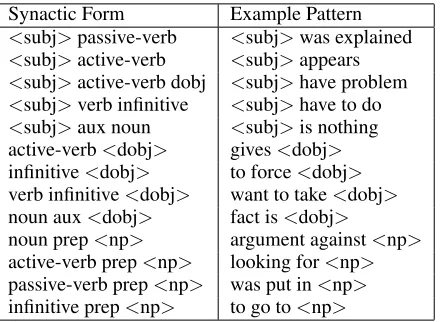
R&W’s Pattern Extractor searches for instances of the 13 templates in the first column of Table 7 in ut-terances classified by the HP Classifier. We reim-plement this; an example of each pattern as in-stantiated in test set “HP dev test” for our data is shown in the second column of Table 7. The
tem-plate<subj> active-verb <dobj>matches
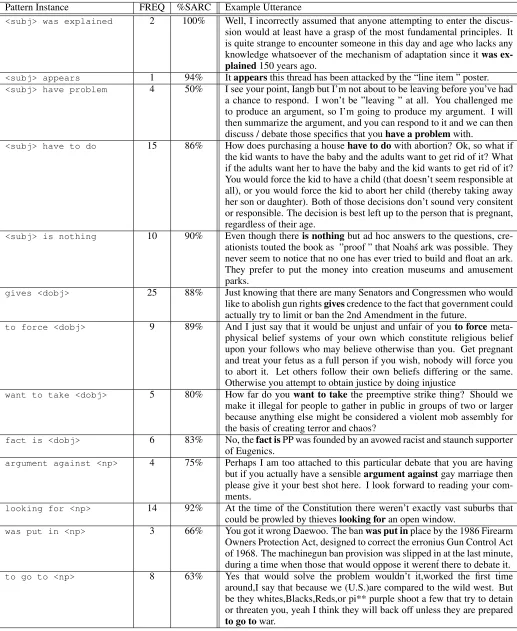
ut-terances where a subject is followed by an active verb and a direct object. However, these matches are not limited to exact surface matches as the HP Classifiers required, e.g. this pattern would match the phrase “have a problem”. Table 10 in the Ap-pendix provides example utterances from IAC that match the instantiated template patterns. For exam-ple, the excerpt from the first row in Table 10 “It is quite strange to encounter someone in this day and age who lacks any knowledge whatsoever of the
mechanism of adaptation since itwas explained150
years ago” matches the <subj> passive-verb
pattern. It appears 2 times (FREQ) in the test set
and is sarcastic both times (%SARCis 100%). Row
11 in Table 10 shows an utterance matching the active-verb prep <np>pattern with the phrase “At the time of the Constitution there weren’t ex-actly vast suburbs that could be prowled by thieves
looking foran open window”. This phrase appears
14 times (FREQ) in the test set and is sarcastic
(%SARC) 92% of the time it appears.
Synactic Form Example Pattern
<subj>passive-verb <subj>was explained
<subj>active-verb <subj>appears
<subj>active-verb dobj <subj>have problem
<subj>verb infinitive <subj>have to do
<subj>aux noun <subj>is nothing active-verb<dobj> gives<dobj>
infinitive<dobj> to force<dobj>
verb infinitive<dobj> want to take<dobj>
noun aux<dobj> fact is<dobj>
noun prep<np> argument against<np>
active-verb prep<np> looking for<np>
passive-verb prep<np> was put in<np>
infinitive prep<np> to go to<np>
Table 7: Syntactic Templates and Examples of Patterns that were Learned for Sarcasm. Table. 10 in the Appendix provides example posts that instantiate these patterns.
[image:7.612.319.539.446.607.2] [image:7.612.80.292.586.659.2]Figure 4: Recall vs. Precision for Sarcasm PE eval
in any further experiments. Patterns are extracted
from the dataset and we again computeFREQ and
%SARCand%NASTYfor each pattern subject to θ1 ≤ FREQ and θ2 ≤ %SARC or % NASTY. Classifications are made if at least two patterns are
present and both are above the specifiedθ1 andθ2,
as in R&W. Also following R&W, we do not learn “not sarcastic” or “nice” patterns.
To test the Pattern Based Classifiers, we use as in-put the classifications made by the HP Classifiers. Using the predicted labels from the classifiers as the true labels, the patterns from test set “HP test dev” are extracted and compared to those patterns found in development set “PE eval”. We have two feature sets for both sarcasm and nastiness: one using the predictions from the MT indicators in the HP
clas-sifier (percent features) and another using those
in-stances from theχ2features.
6.1 Results from Pattern Classifier
The Pattern Classifiers classify an utterance as Sar-castic (Nasty) if at least two patterns are present and
above the thresholdsθ1 andθ2, exhausting all
com-binations ofθ1 =[2, 4, 6, 8, 10] andθ2=[.55, .60,
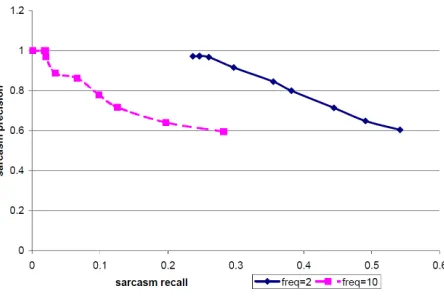
.65, .70, .75, .80, .85, .90, .95, 1.00]. The counter-classes are predicted when the utterance contains less than two patterns. The exhaustive classifica-tions are first made using the utterances in the de-velopment set labeled “PE eval”. Fig. 4 shows the
precision and recall trade-off forθ1=[2, 10] and all
θ2values on sarcasm development set“PE eval”. As
recall increases, precision drops. By including pat-terns that only appear 2 times, we get better recall.
Limiting θ1 to 10 yields fewer patterns and lower
recall.
Table 8 shows the results for various parameters. The PE dev dataset learned a total of 1,896 sarcas-tic extraction patterns above a minimum threshold of
θ1 <2andθ2 < 0.55, and similarly 847 nasty
ex-traction patterns. Training on development set “PE dev” yields high precision and good recall. To se-lect the best parameters, we again look for a balance between precision and recall. Both Classifiers have very high precision. In the end, we select ters that have a better recall than the best
parame-ter from the HP Classifiers which isrecall = 38%
for sarcasm andrecall = 49% for nastiness. The
best parameters and their test results are shown in Table 9.
PARAMS P R F N (tp)
SARC θ1=2,θ2=.60 65% 49% 0.57 792
2, .65 71% 44% 0.58 717 2, .70 80% 38% 0.59 616 2, 1.0 97% 24% 0.60 382
NASTY θ1=2,θ2=.65 71% 49% 0.60 335
2, .75 83% 42% 0.62 289 2, .90 96% 30% 0.63 209
Table 8: Pattern Classification Training; P: precision, R: recall, F: F-measure, tp: true positive classifications
The Pattern Classifiers are tested on “HP dev test” with the labels predicted by our HP Classifiers, thus we have two different sets of classifications for both
Sarcasm and Nastiness:percent featuresandχ2
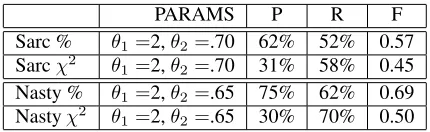
fea-tures. Overall, the Pattern Classification performs
better on Nasty than Sarcasm. Also, thepercent
fea-tures yield better results thanχ2 features, possibly
because the precision for χ2 is high from the HP
Classifiers, but the recall is very low. We believe
thatχ2selects statistically predictive indicators that
are tuned to the dataset, rather than general. Having
a human in the loop guarantees more general fea-turesfrom a smaller dataset. Whether this remains true on the size as the dataset increases to 1000 or more is unknown. We conclude that R&W’s patterns generalize well on our Sarcasm and Nasty datasets
(open questionO3), but suspect that there may be
better syntactic patterns for bootstrapping sarcasm and nastiness, e.g. involving cue words or semantic categories of words rather than syntactic categories, as we discuss in Sec. 7.
[image:8.612.317.537.244.334.2]PARAMS P R F Sarc % θ1=2,θ2=.70 62% 52% 0.57
Sarcχ2 θ1=2,θ2=.70 31% 58% 0.45
Nasty % θ1=2,θ2=.65 75% 62% 0.69
Nastyχ2 θ
[image:9.612.78.293.53.119.2]1=2,θ2=.65 30% 70% 0.50
Table 9: The results for Pattern Classification on HP dev test dataset ; PARAMS: the best parameters for each fea-ture set P: precision, R: recall, F: f-measure
can be repeated for multiple iterations. We leave this for future work.
7 Discussion and Future Work
In this work, we apply a bootstrapping method to train classifiers to identify particular types of subjec-tive utterances in online dialogues. First we create a suite of linguistic indicators for sarcasm and nas-tiness using crowdsourcing techniques. Our crowd-sourcing method is similar to (Filatova, 2012). From these new linguistic indicators we construct a classi-fier following previous work on bootstrapping sub-jectivity classifiers (Riloff and Wiebe, 2003; Thelen and Riloff, 2002). We compare the performance of the High Precision Classifier that was trained based on statistical measures against one that keeps human annotators in the loop, and find that Classifiers us-ing statistically selected indicators appear to be over-trained on the development set because they do not generalize well. This first phase achieves 54% preci-sion and 38% recall for sarcastic utterances using the human selected indicators. If we bootstrap by using syntactic patterns to create more general sarcasm in-dicators from the utterances identified as sarcastic in the first phase, we achieve a higher precision of 62% and recall of 52%.
We apply the same method to bootstrapping a classifier for nastiness dialogic acts. Our first phase, using crowdsourced nasty indicators, achieves 58% precision and 49% recall, which increases to 75% precision and 62% recall when we bootstrap with syntactic patterns, possibly suggesting that nastiness (insults) are less nuanced and easier to detect than sarcasm.
Previous work claims that recognition of sarcasm (1) depends on knowledge of the speaker, (2) world knowledge, or (3) use of context (Gibbs, 2000; Eis-terhold et al., 2006; Bryant and Fox Tree, 2002; Carvalho et al., 2009). While we also believe that certain types of subjective language cannot be
de-termined from cue words alone, our Pattern Based Classifiers, based on syntactic patterns, still achieves high precision and recall. In comparison to previous monologic works whose sarcasm precision is about 75%, ours is not quite as good with 62%. While the nasty works do not report precision, we believe that they are comparable to the 64% - 83% accuracy with our precision of 75%.
Open question O3was whether R&W’s patterns
are fine tuned to subjective utterances in news. How-ever R&W’s patterns improve both precision and re-call of our Sarcastic and Nasty classifiers. In fu-ture work however, we would like to test whether semantic categories of words rather than syntactic categories would perform even better for our prob-lem, e.g. Linguistic Inquiry and Word Count cat-egories. Looking again at row 1 in Table 10, “It is quite strange to encounter someone in this day and age who lacks any knowledge whatsoever of the mechanism of adaptation since it was explained 150 years ago”, the word ‘quite’ matches the ‘cogmech’ and ‘tentative’ categories, which might be interest-ing to generalize to sarcasm. In row 11 “At the time of the Constitution there weren’t exactly vast sub-urbs that could be prowled by thieves looking for an open window”, the phrase “weren’t exactly” could also match the LIWC categories ‘cogmech’ and ‘cer-tain’ or, more specifically, certainty negated.
We also plan to extend this work to other cate-gories of subjective dialogue acts, e.g. emotional and respectful as mentioned in the Introduction, and to expand our corpus of subjective dialogue acts. We will experiment with performing more than one iter-ation of the bootstrapping process (R&W complete two iterations) as well as create a Hybrid Classifier combining the subjective cues and patterns into a single Classifier that itself can be bootstrapped.
Finally, we would like to extend our method to different dialogue domains to see if the classifiers trained on our sarcastic and nasty indicators would achieve similar results or if different social media sites have their own style of displaying sarcasm or nastiness not comparable to those in forum debates.
References
G.A. Bryant and J.E. Fox Tree. 2002. Recognizing ver-bal irony in spontaneous speech. Metaphor and sym-bol, 17(2):99–119.
con-tents: oh...!! it’s so easy;-). InProc. of the 1st inter-national CIKM workshop on Topic-sentiment analysis for mass opinion, p. 53–56. ACM.
D. Davidov, O. Tsur, and A. Rappoport. 2010. Semi-supervised recognition of sarcastic sentences in twitter and amazon. InProc. of the Fourteenth Conference on Computational Natural Language Learning, p. 107– 116. Association for Computational Linguistics. J. Eisterhold, S. Attardo, and D. Boxer. 2006. Reactions
to irony in discourse: Evidence for the least disruption principle. Journal of Pragmatics, 38(8):1239–1256. E. Filatova. 2012. Irony and sarcasm: Corpus
genera-tion and analysis using crowdsourcing. In Language Resources and Evaluation Conference, LREC2012. J.E. Fox Tree and J.C. Schrock. 1999. Discourse
Mark-ers in Spontaneous Speech: Oh What a Difference an Oh Makes. Journal of Memory and Language, 40(2):280–295.
J. E. Fox Tree. 2010. Discourse markers across speak-ers and settings. Language and Linguistics Compass, 3(1):1–13.
P. Gianfortoni, D. Adamson, and C.P. Ros´e. 2011. Mod-eling of stylistic variation in social media with stretchy patterns. In Proc. of the First Workshop on Algo-rithms and Resources for Modelling of Dialects and Language Varieties, p. 49–59. ACL.
R.W. Gibbs. 2000. Irony in talk among friends. Metaphor and Symbol, 15(1):5–27.
R. Gonz´alez-Ib´a˜nez, S. Muresan, and N. Wacholder. 2011. Identifying sarcasm in twitter: a closer look. InProc. of the 49th Annual Meeting of the ACL: Hu-man Language Technologies: short papers, volume 2, p. 581–586.
A. Razavi, D. Inkpen, S. Uritsky, and S. Matwin. 2010. Offensive language detection using multi-level classi-fication.Advances in Artificial Intelligence, p. 16–27. A. Reyes and P. Rosso. 2011. Mining subjective knowl-edge from customer reviews: a specific case of irony detection. InProc. of the 2nd Workshop on Computa-tional Approaches to Subjectivity and Sentiment Anal-ysis (WASSA 2.011), ACL, p. 118–124.
A. Reyes, P. Rosso, and D. Buscaldi. 2012. From humor recognition to irony detection: The figurative language of social media. Data & Knowledge Engineering. E. Riloff and J. Wiebe. 2003. Learning extraction
pat-terns for subjective expressions. InProc. of the 2003 conference on Empirical methods in Natural Lan-guage Processing-V. 10, p. 105–112. ACL.
R. Snow, B. O’Conner, D. Jurafsky, and A.Y. Ng. 2008. Cheap and fast—but is it good?: evaluating non-expert annotations for natural language tasks In Proc. of the Conference on Empirical Methods in Natural Lan-guage Processing, p. 254–263. ACM.
S.O. Sood, E.F. Churchill, and J. Antin. 2011. Auto-matic identification of personal insults on social news sites. Journal of the American Society for Information Science and Technology.
Dan Sperber and Deidre Wilson. 1981. Irony and the use-mention distinction. In Peter Cole, editor,Radical Pragmatics, p. 295–318. Academic Press, N.Y. E. Spertus. 1997. Smokey: Automatic recognition of
hostile messages. InProc. of the National Conference on Artificial Intelligence, p. 1058–1065.
M. Thelen and E. Riloff. 2002. A bootstrapping method for learning semantic lexicons using extraction pattern contexts. InProc. of the ACL-02 conference on Empir-ical methods in natural language processing-Volume 10, p. 214–221. ACL.
O. Tsur, D. Davidov, and A. Rappoport. 2010. Icwsm– a great catchy name: Semi-supervised recognition of sarcastic sentences in online product reviews. InProc. of the fourth international AAAI conference on we-blogs and social media, p. 162–169.
Marilyn Walker, Pranav Anand, , Robert Abbott, and Jean E. Fox Tree. 2012. A corpus for research on deliberation and debate. InLanguage Resources and Evaluation Conference, LREC2012.
J.M. Wiebe, R.F. Bruce, and T.P. O’Hara. 1999. Devel-opment and use of a gold-standard data set for subjec-tivity classifications. InProc. of the 37th annual meet-ing of the Association for Computational Lmeet-inguistics, p. 246–253. ACL.
J. Wiebe, E. Breck, C. Buckley, C. Cardie, P. Davis, B. Fraser, D. Litman, D. Pierce, E. Riloff, T. Wilson, et al. 2003. Recognizing and organizing opinions ex-pressed in the world press. InWorking Notes-New Di-rections in Question Answering (AAAI Spring Sympo-sium Series).
T. Wilson, P. Hoffmann, S. Somasundaran, J. Kessler, J. Wiebe, Y. Choi, C. Cardie, E. Riloff, and S. Pat-wardhan. 2005. Opinionfinder: A system for subjec-tivity analysis. InProc. of HLT/EMNLP on Interactive Demonstrations, p. 34–35. ACL.
G. Xiang, B. Fan, L. Wang, J. Hong, and C. Rose. 2012. Detecting offensive tweets via topical feature discov-ery over a large scale twitter corpus. In Proc. of the 21st ACM international conference on Information and knowledge management, p. 1980–1984. ACM.
Pattern Instance FREQ %SARC Example Utterance
<subj> was explained 2 100% Well, I incorrectly assumed that anyone attempting to enter the discus-sion would at least have a grasp of the most fundamental principles. It is quite strange to encounter someone in this day and age who lacks any knowledge whatsoever of the mechanism of adaptation since itwas ex-plained150 years ago.
<subj> appears 1 94% Itappearsthis thread has been attacked by the “line item ” poster.
<subj> have problem 4 50% I see your point, Iangb but I’m not about to be leaving before you’ve had a chance to respond. I won’t be ”leaving ” at all. You challenged me to produce an argument, so I’m going to produce my argument. I will then summarize the argument, and you can respond to it and we can then discuss / debate those specifics that youhave a problemwith.
<subj> have to do 15 86% How does purchasing a househave to dowith abortion? Ok, so what if the kid wants to have the baby and the adults want to get rid of it? What if the adults want her to have the baby and the kid wants to get rid of it? You would force the kid to have a child (that doesn’t seem responsible at all), or you would force the kid to abort her child (thereby taking away her son or daughter). Both of those decisions don’t sound very consitent or responsible. The decision is best left up to the person that is pregnant, regardless of their age.
<subj> is nothing 10 90% Even though thereis nothingbut ad hoc answers to the questions, cre-ationists touted the book as ”proof ” that Noah´s ark was possible. They never seem to notice that no one has ever tried to build and float an ark. They prefer to put the money into creation museums and amusement parks.
gives <dobj> 25 88% Just knowing that there are many Senators and Congressmen who would
like to abolish gun rightsgivescredence to the fact that government could actually try to limit or ban the 2nd Amendment in the future.
to force <dobj> 9 89% And I just say that it would be unjust and unfair of youto force meta-physical belief systems of your own which constitute religious belief upon your follows who may believe otherwise than you. Get pregnant and treat your fetus as a full person if you wish, nobody will force you to abort it. Let others follow their own beliefs differing or the same. Otherwise you attempt to obtain justice by doing injustice
want to take <dobj> 5 80% How far do youwant to take the preemptive strike thing? Should we
make it illegal for people to gather in public in groups of two or larger because anything else might be considered a violent mob assembly for the basis of creating terror and chaos?
fact is <dobj> 6 83% No, thefact isPP was founded by an avowed racist and staunch supporter of Eugenics.
argument against <np> 4 75% Perhaps I am too attached to this particular debate that you are having but if you actually have a sensibleargument againstgay marriage then please give it your best shot here. I look forward to reading your com-ments.
looking for <np> 14 92% At the time of the Constitution there weren’t exactly vast suburbs that could be prowled by thieveslooking foran open window.
was put in <np> 3 66% You got it wrong Daewoo. The banwas put inplace by the 1986 Firearm
Owners Protection Act, designed to correct the erronius Gun Control Act of 1968. The machinegun ban provision was slipped in at the last minute, during a time when those that would oppose it weren´t there to debate it.
to go to <np> 8 63% Yes that would solve the problem wouldn’t it,worked the first time
[image:11.612.73.590.54.685.2]around,I say that because we (U.S.)are compared to the wild west. But be they whites,Blacks,Reds,or pi** purple shoot a few that try to detain or threaten you, yeah I think they will back off unless they are prepared to go towar.