Semantic-‐based Service
Analysis and Optimization
A thesis submitted to the
University of Dublin, Trinity College,
for the degree of
Doctor of Philosophy
Liam Fallon
Knowledge and Data Engineering Group,
Department of Computer Science,
Trinity College, University of Dublin,
Ireland
2013
~ i ~
Declaration
I, the undersigned, declare that this work has not previously been submitted as an exercise for a degree at this or any other University, and that, unless otherwise stated, it is entirely my own work.Liam Fallon
Permission to Lend or Copy
I, the undersigned, agree that the Trinity College Library may lend or copy this thesis upon request.Liam Fallon
~ iii ~
Acknowledgements
Firstly, I would like to thank my supervisor, Prof. Declan O’Sullivan, for his guidance, encouragement, and support over the course of the last number of years. His advice has always been insightful and has been invaluable for keeping my focus on the core of the research. I would also like to thank Dr. John Kenney, Dr. Sidath Handurukande, and Dr. Sven van der Meer at the Network Management Lab in Ericsson Ireland for their advice and suggestions during the course of this research, and also David Cleary for encouraging me to undertake it. I would also like to thank all the members of the KDEG group at TCD for their advice and help, and for always making me feel welcome.I would like to thank my colleagues in Ericsson Ireland for their support and understanding during the course of this research. I would particularly like to thank my managers Jimmy O’Meara and Gabriel Hogan, who always supported and encouraged me, and aided me in balancing the work for this this research with my other activities. I would also like to thank the staff of the Prototyping and Customer Trials group at Ericsson Ireland for their support and understanding, particularly Sajeevan Achuthan, Damien Brennan and Mark McFadden.
I would like to thank Ericsson Ireland for funding this research through its excellent Scholar programme, and Michael Gallagher, Tony Devlin, and Matt Hamilton for their continued support for the duration of this research.
I would like to thank my family, particularly Aoife, Eoghan, Kenae, and Elias for their love and understanding, and for putting up with my many physical and virtual absences over this period. I would also like to thank my parents for instilling the value of learning in me and for their continuing encouragement.
Finally, I would like to dedicate this thesis to Anne, without whose love, support, advice, patience, and serenity I could never have undertaken this research.
Abstract
The need to autonomically optimize end user service experience in near real time has been identified in the literature in recent years. Service management systems that monitor end user service session context are deployed but approaches that estimate end user service experience from session context do not analyse the compliance of that experience with user expectations. Approaches that plan and execute actions to optimize end user service session delivery are not applicable to arbitrary service sessions; they work with specific service types and delivery mechanisms or do not consider end user service experience when making optimization decisions. Another barrier to autonomic end user service management optimization is the lack of a holistic model for the domain.This thesis proposes the Aesop approach, an approach that addresses semantic-‐
based autonomic optimization of end user service delivery. This approach has a
knowledge base at its core and proposes the EUSAO ontology. This ontology,
designed to semantically model the end user service management domain, enables partitioning of knowledge that varies over time for efficient access. The Aesop Engine is designed to execute an iteration of an autonomic loop (Monitor, Analyse, Plan, Execute) in near real time. It runs semantic algorithms designed to use queries and rules on subsets of the partitioned EUSAO-‐based knowledge in order to monitor end user sessions, to analyse their compliance with expectations, to plan optimizations, and to execute those optimizations as throttling actions on the service delivery network. The semantic-‐based algorithms that are proposed are efficient because they operate on small partitioned subsets of the knowledge base. The Aesop approach allows arbitrary end user service types and network domains to be added by specializing the EUSAO ontology for that domain and adding domain specific semantic mappings, queries and rules. A case study has demonstrated that the approach is applicable in the Mobile Broadband access domain.
A prototype implementation of the complete Aesop approach was evaluated on a full purpose built Home Area Network test bed, on which execution of end user service sessions was automated and controlled. In the evaluation, when the measured compliance of a set of end user service sessions with expectations when Aesop optimization was active was compared with the compliance of an identical set of sessions when Aesop optimization was inactive, a significant improvement was observed on the compliance levels of high priority sessions in all experimental scenarios, with compliance levels more than doubled in some cases.
~ v ~
Table of Contents
Declaration ... i
Permission to Lend or Copy ... ii
Acknowledgements ... iii
Abstract ... iv
Table of Contents ... v
Table of Figures ... viii
Table of Tables ... x
Abbreviations ... xii
Chapter 1 Introduction ... 1
1.1 Motivation ... 1
1.2 Research Question and Objectives ... 2
1.3 Research Process and Approach ... 4
1.3.1 Research Artefacts ... 6
1.3.2 The Research Phases ... 6
1.3.3 Evaluation ... 8
1.4 Contributions ... 10
1.5 Thesis Overview ... 13
Chapter 2 Background and Related Work ... 15
2.1 Introduction ... 15
2.2 Background ... 15
2.3 Related Work ... 19
2.3.1 End User Service Delivery Monitoring, Analysis, and Optimization ... 19
2.3.2 Related Models, Vocabularies, and Ontologies ... 29
2.3.3 Semantic Techniques Applicable to End User Service Management ... 34
2.3.4 Semantics in Autonomic Network Management ... 37
2.4 Summary ... 39
Chapter 3 The EUSAO Ontology ... 42
3.1 Introduction ... 42
3.2 Requirements ... 42
3.3 Design ... 43
3.4 Implementation ... 52
3.5 Using the Ontology ... 54
3.6 Summary ... 56
Chapter 4 Aesop ... 57
4.1 Introduction ... 57
4.2 Requirements ... 58
4.3 Design ... 59
4.3.1 Semantic Components ... 61
4.3.2 The Knowledge Base ... 62
4.3.3 The Knowledge Bus ... 64
4.3.4 The Aesop Engine ... 66
4.4 Implementation ... 76
4.4.1 Semantic Components ... 77
4.4.2 The Knowledge Base ... 78
4.4.3 The Knowledge Bus ... 79
4.4.4 The Aesop Engine ... 79
4.5 Summary ... 86
Chapter 5 The SECCO Framework ... 88
5.1 Introduction ... 88
5.2 Requirements ... 89
5.3 Design ... 90
5.3.1 The SECCOReporter ... 91
5.3.2 The SECCOClient ... 93
5.4 Implementation ... 95
5.4.2 The SECCOClient ... 98
5.5 Summary ... 101
Chapter 6 Experimentation ... 102
6.1 Introduction ... 102
6.2 The Experimental Framework ... 104
6.2.1 Domain ... 105
6.2.2 End User Services ... 106
6.2.3 Scenarios ... 107
6.2.4 Simulation Environment ... 111
6.2.5 Test Bed Environment ... 113
6.2.6 Experimental Timings and Runs ... 115
6.2.7 Experimental Methodology ... 116
6.3 Experiment 1: Semantic Monitoring of Terminal Reports ... 119
6.3.1 Hypothesis ... 119
6.3.2 Experimental Setup and Execution ... 119
6.3.3 Experimental Results ... 120
6.3.4 Analysis of Results ... 121
6.3.5 Summary ... 126
6.4 Experiment 2: Semantic Analysis of Service Experience ... 128
6.4.1 Hypothesis ... 128
6.4.2 Experimental Setup and Execution ... 129
6.4.3 Experimental Results ... 129
6.4.4 Analysis of Results ... 131
6.4.5 Summary ... 140
6.5 Experiment 3: Semantic Optimization of Services towards Expectations ... 141
6.5.1 Hypothesis ... 142
6.5.2 Experimental Setup and Execution ... 143
6.5.3 Experimental Results ... 143
6.5.4 Analysis of Results ... 145
6.5.5 Summary ... 163
6.6 Experience with Semantic Technologies Used ... 166
6.6.1 Protégé ... 166
6.6.2 Jena ... 167
6.6.3 The Pellet Reasoner ... 167
6.6.4 SPARQL ... 168
6.6.5 SWRL Rules ... 168
6.7 Conclusions from Experimentation ... 168
Chapter 7 Mobile Broadband Case Study ... 170
7.1 Introduction ... 170
7.2 Background ... 171
7.3 Scenario ... 173
7.4 Suggested Placement of Aesop in the 3GPP Network Architecture ... 173
7.5 Assessment of Applicability of Aesop Architecture and Structure ... 175
7.5.1 Applying the EUSAO Ontology and the Knowledge Base ... 176
7.5.2 Applying Semantic Knowledge Monitoring ... 177
7.5.3 Applying Semantic Analysis ... 178
7.5.4 Applying Semantic Optimization Planning and Execution ... 178
7.5.5 Deploying Aesop in a Full Network ... 179
7.5.6 Optimizing End User Service Delivery in a Full Network ... 180
7.5.7 Synopsis of Enhancements and Extensions to Aesop ... 182
7.6 Summary ... 183
Chapter 8 Conclusions and Future Work ... 185
8.1 Overview ... 185
8.2 Research Question and Objectives ... 185
8.3 Contributions ... 192
8.4 Future Work ... 194
8.5 Final Remarks ... 195
~ vii ~
Table of Figures
Figure 1-‐1: Research Phases ... 5
Figure 1-‐2: Organization of Research ... 6
Figure 3-‐1: Core Concepts in the EUSAO Ontology ... 46
Figure 3-‐2: Core Global Concepts in the EUSAO Ontology ... 48
Figure 3-‐3: Snapshot Concepts and Referenced Core Global Concepts in the EUSAO Ontology ... 50
Figure 3-‐4: Sub-‐Concepts Representing Service Type Concepts ... 51
Figure 3-‐5: The SSM_Terminal Concept Specification in Protégé ... 53
Figure 3-‐6: The ssm_communicatesUsing Reference in Protégé ... 54
Figure 3-‐7: The ssm_terminalModel Attribute in Protégé ... 54
Figure 4-‐1: The Aesop System ... 60
Figure 4-‐2: UML Class Diagram of Aesop Software Components ... 61
Figure 4-‐3: Knowledge Monitoring ... 67
Figure 4-‐4: The Aesop Knowledge Loading Algorithm UML Activity Diagram ... 69
Figure 4-‐5: The Aesop Semantic Analysis Algorithm UML Activity Diagram ... 71
Figure 4-‐6: The Aesop Optimization Planning and Execution Algorithm UML Activity Diagram ... 73
Figure 4-‐7: UML Class Diagram of a Prototype Implementation of Aesop ... 76
Figure 4-‐8: Semantic Analysis Implementation ... 82
Figure 5-‐1: Conceptual Overview of SECCO ... 91
Figure 5-‐2: SECCO UML Deployment Diagram ... 91
Figure 5-‐3: SECCOReporter UML Class Diagram ... 92
Figure 5-‐4: connection Package UML Class Diagram ... 92
Figure 5-‐5: service Package UML Class Diagram ... 93
Figure 5-‐6: SECCOClient Class Diagram ... 94
Figure 5-‐7: SECCO Instance UML Deployment Diagram ... 96
Figure 5-‐8: Firefox Deployment for Web Browsing end User Session Recording ... 101
Figure 6-‐1: Facets of the Experimental Framework ... 104
Figure 6-‐2: Timeline of Scenario 1 ... 109
Figure 6-‐3: Timeline of Scenario 2 ... 110
Figure 6-‐4: Timeline of Scenario 3 ... 111
Figure 6-‐5: Approximated Relationship between Packet Loss and MOS ... 112
Figure 6-‐6: Simulation Environment ... 113
Figure 6-‐7: Test Bed for Experimentation ... 113
Figure 6-‐8: Logical View of Test Bed with Running Sessions and Terminal Reporting ... 114
Figure 6-‐9: Relationship between Time Parameters in Experiment 1 ... 120
Figure 6-‐10: Statistical Analysis of Results, 6 Terminals Reporting ... 121
Figure 6-‐11: Elapsed time per Run, 10 Runs ... 122
Figure 6-‐12: Average Generate to Store Time: 10 Runs ... 123
Figure 6-‐13: Average Processing Time, 10 Runs ... 123
Figure 6-‐14: Average Intercept Time, 10 Runs ... 124
Figure 6-‐15: Spread of Processing Time Data, All Runs ... 125
Figure 6-‐16: Spread of Intercept Time Data, All Runs ... 126
Figure 6-‐17: Processing Time Data Points (300 Terminals Reporting), All Runs ... 127
Figure 6-‐18: Intercept Time Data Points (300 Terminals Reporting), All Runs ... 127
Figure 6-‐19: Monitoring Times Average and Standard Deviation ... 133
Figure 6-‐20: Analysis Times Average and Standard Deviation ... 134
Figure 6-‐21: CPU Usage Average and Standard Deviation ... 135
Figure 6-‐22: Memory Usage Average and Standard Deviation ... 136
Figure 6-‐23 Average Session Compliance, Scenario 2 ... 137
Figure 6-‐24: Average Session Compliance, Scenario 3 ... 139
Figure 6-‐25: Effectiveness of Aesop Optimization, Scenarios 2 and 3 ... 147
Figure 6-‐26: Average Session Compliance before and after Optimization, Scenario 2 ... 148
Figure 6-‐27: Average Session Compliance before and after Optimization, Scenario 3 ... 150
Figure 6-‐28: Throttling on Scenario 2 Sessions ... 152
~ ix ~
Figure 6-‐30: Optimization Times Average and Standard Deviation ... 157
Figure 6-‐31: Monitoring Times Average and Standard Deviation ... 159
Figure 6-‐32: Analysis Times Average and Standard Deviation ... 160
Figure 6-‐33: Average Times for Experiment 3 Runs ... 161
Figure 6-‐34: CPU Usage Average and Standard Deviation ... 162
Figure 6-‐35: Memory Usage Average and Standard Deviation ... 163
Figure 7-‐1: Base Stations and Possible Cells in Athlone, Ireland ... 172
Figure 7-‐2: Aesop End User Service Delivery Optimization for Mobile Broadband ... 174
Figure 7-‐3: An Aesop Instance Managing Multiple Cell Wireless Networks ... 176
Figure 7-‐4: TM Forum SID NetworkComposite and SubNetwork Concepts in UML ... 177
Figure 7-‐5: Aesop Instance Managing Regions of a Mobile Broadband Access Network ... 179
Figure A-‐1: Comparison of Fixed and Mobile Broadband Performance, from [OFCOM, 2011] ... A-‐9 Figure A-‐2: Comparison of Download Speeds as Signal Strength Varies, from [OFCOM, 2011] ... A-‐10 Figure A-‐3: Comparison of Download Speeds for Case Studies, from [OFCOM, 2011] ... A-‐11 Figure B-‐1: The EUSAO Ontology ... B-‐1 Figure B-‐2: The EUSAO Ontology in Protégé showing Concepts as Classes ... B-‐2 Figure B-‐3: The EUSAO Ontology in Protégé showing References as Object Properties ... B-‐2 Figure B-‐4: The EUSAO Ontology in Protégé showing Attributes as Data Properties ... B-‐3 Figure D-‐1: Service Expectation and Service Priority Configuration ... D-‐2 Figure F-‐1: The Experimental Test Bed ... F-‐1 Figure F-‐2: The Server, Traffic Shaper, and Home Gateway ... F-‐1 Figure F-‐3: Home Gateway Monitor ... F-‐2 Figure F-‐4: Close up of Home Gateway Monitor ... F-‐2 Figure F-‐5: Laptops and HAN Ethernet Switch ... F-‐3 Figure F-‐6: Laptop 1 running a Workplace Web Session ... F-‐3 Figure F-‐7: Laptop 2 running a File Transfer Session ... F-‐4 Figure F-‐8: Laptop 3 running a Social Networking Web Session ... F-‐4 Figure F-‐9: Laptop 4 running a Video on Demand Session ... F-‐5 Figure F-‐10: Close Up of Degraded Video Session running on Laptop 4 ... F-‐5 Figure H-‐1: Normal Quantile Plots for Experimental Metrics ... H-‐1 Figure K-‐1: Screenshot of the Aesop client at the end of Experiment 3 Scenario 3 Run 2 ... K-‐6
Table of Tables
Table 1-‐1: Aesop Evaluation Properties Assessed during Experimentation ... 9
Table 2-‐1: Summary of Service Expectation Metrics ... 23
Table 3-‐1: The Dynamicity and Temporality Properties of Concepts in the EUSAO ontology ... 44
Table 3-‐2: Concept Categories as used by Concepts in the EUSAO Ontology ... 45
Table 3-‐3: Ontologies, Vocabularies, and Models Used and Referenced ... 47
Table 3-‐4: Snapshots Recording Knowledge with a Time Dimension ... 49
Table 4-‐1: Static Global Knowledge Configured in Aesop ... 65
Table 4-‐2: An Annotated Element Lookup Reference (AELR) entry ... 81
Table 6-‐1: Synopsis of Experimentation ... 103
Table 6-‐2: Emulated Connection Characteristics, Congestion Experiments ... 105
Table 6-‐3: Emulated Connection Characteristics, Network Impairment Experiments ... 106
Table 6-‐4: Service Expectation Parameters per Service ... 107
Table 6-‐5: Service Priorities and Throttling for User Service Sessions ... 108
Table 6-‐6: Metrics Examined using Statistical Analysis ... 116
Table 6-‐7: Lowest and Highest Processing Times ... 125
Table 6-‐8: Aesop Monitoring Accuracy ... 131
Table 6-‐9: Aesop Analysis Accuracy ... 132
Table 6-‐10: Aesop Optimization Average Effectiveness ... 146
Table 6-‐11: Throttling Spreads for Scenario 2 ... 153
Table 6-‐12: Throttling Spreads for Scenario 3 ... 153
Table 6-‐13: Aesop Monitoring Accuracy ... 154
Table 6-‐14: Aesop Analysis Accuracy ... 155
Table 6-‐15: Aesop Optimization Accuracy ... 156
Table 7-‐1: Aesop Deployment in a Mobile Broadband Access Network with 50,000 Cells ... 180
~ xi ~
Table N-‐10: Statistical Analysis of Scenario 2 Memory Usage ... N-‐8 Table N-‐11: Statistical Analysis of Scenario 3 Monitoring Times ... N-‐9 Table N-‐12: Statistical Analysis of Scenario 3 Analysis Times ... N-‐10 Table N-‐13: Statistical Analysis of Scenario 3 CPU Usage ... N-‐11 Table N-‐14: Statistical Analysis of Scenario 3 Memory Usage ... N-‐12 Table N-‐15: Statistical Analysis of Scenario 2 File Transfer Session Metrics ... N-‐13 Table N-‐16: Statistical Analysis of Scenario 2 Video on Demand Session Metrics ... N-‐14 Table N-‐17: Statistical Analysis of Scenario 2 Social Networking Web Session Metrics ... N-‐15 Table N-‐18: Statistical Analysis of Scenario 2 Work Web Session Metrics ... N-‐16 Table N-‐19: Statistical Analysis of Scenario 3 Sam Video on Demand Session Metrics ... N-‐17 Table N-‐20: Statistical Analysis of Scenario 3 Cathy Video on Demand Session Metrics ... N-‐18 Table N-‐21: Statistical Analysis of Scenario 3 Social Networking Web Session Metrics ... N-‐19 Table N-‐22: Statistical Analysis of Scenario 3 Work Web Session Metrics ... N-‐20 Table N-‐23: Optimization Effectiveness, Scenario 2 ... N-‐21 Table N-‐24: Optimization Effectiveness, Scenario 3 ... N-‐22 Table N-‐25: Statistical Analysis of Scenario 2 File Transfer Session Metrics ... N-‐23 Table N-‐26: Statistical Analysis of Scenario 2 Video on Demand Session Metrics ... N-‐24 Table N-‐27: Statistical Analysis of Scenario 2 Social Networking Web Session Metrics ... N-‐25 Table N-‐28: Statistical Analysis of Scenario 2 Work Web Session Metrics ... N-‐26 Table N-‐29: Statistical Analysis of Scenario 3 Priority 2 Video on Demand Session Metrics ... N-‐27 Table N-‐30: Statistical Analysis of Scenario 3 Priority 5 Video on Demand Session Metrics ... N-‐28 Table N-‐31: Statistical Analysis of Scenario 3 Social Networking Web Session Metrics ... N-‐29 Table N-‐32: Statistical Analysis of Scenario 3 Work Web Session Metrics ... N-‐30 Table N-‐33: Throttling in Scenario 2 Sessions ... N-‐31 Table N-‐34: Throttling in Scenario 3 Sessions ... N-‐33 Table N-‐35: Throttling Spreads during Scenario 2 Session Starts, Minute 0-‐22 ... N-‐35 Table N-‐36: Throttling Spreads during Scenario 2 Session Terminations, Minute 44-‐60 ... N-‐35 Table N-‐37: Throttling Spreads during Scenario 3 Impairment Increase, Minute 12-‐30 ... N-‐35 Table N-‐38: Throttling Spreads during Scenario 3 Impairment Decrease, Minute 30-‐60 ... N-‐35 Table N-‐39: Scenario 2 Sessions ... N-‐36 Table N-‐40: Scenario 3 Sessions ... N-‐36 Table N-‐41: Aesop Monitoring Accuracy ... N-‐37 Table N-‐42: Aesop Analysis Accuracy ... N-‐37 Table N-‐43: Aesop Optimization Accuracy ... N-‐38 Table N-‐44: Statistical Analysis of Scenario 2 Monitoring Times ... N-‐39 Table N-‐45: Statistical Analysis of Scenario 2 Analysis Times ... N-‐40 Table N-‐46: Statistical Analysis of Scenario 2 Optimization Times ... N-‐41 Table N-‐47: Statistical Analysis of Scenario 2 CPU Usage ... N-‐42 Table N-‐48: Statistical Analysis of Scenario 2 Memory Usage ... N-‐43 Table N-‐49: Statistical Analysis of Scenario 3 Monitoring Times ... N-‐44 Table N-‐50: Statistical Analysis of Scenario 3 Analysis Times ... N-‐45 Table N-‐51: Statistical Analysis of Scenario 2 Optimization Times ... N-‐46 Table N-‐52: Statistical Analysis of Scenario 3 CPU Usage ... N-‐47 Table N-‐53: Statistical Analysis of Scenario 3 Memory Usage ... N-‐48
Abbreviations
ACS ... Auto Configuration ServerAesop ... An approach for optimization of end user service delivery API ... Application Programming Interface
CIM ... Common Information Model CLI ... Command Line Interface
DEN-‐ng ... Directory Enabled Networking, next generation DMTF ... Distributed Management Task Force
DSL ... Digital Subscriber Line
EUSAO ... End User Service Analysis and Optimization ontology FOAF ... Friend Of A Friend
FOCALE ... The Foundation Observation Comparison Action Learn rEason architecture
GPRS ... General Packet Radio Service GPS ... Global Positioning System
GSQR ... Generic Service Quality Reporting HAN ... Home Area Network
IMEI ... International Mobile Station Equipment Identity IP ... Internet Protocol
IPTV ... Internet Protocol TeleVision IQR ... Interquartile Range
IRP ... Integration Reference Point ISP ... Internet Service Provider JSON ... JavaScript Object Notation JVM ... Java Virtual Machine KPI ... Key Performance Indicator KQI ... Key Quality Indicator LTE ... Long term Evolution MANET ... Mobile Ad-‐hoc NETwork
MAPE ... Monitor, Analyse, Plan, Execute MIB ... Management Information Base NETCONF ... NETwork CONFiguration protocol NGMN ... Next Generation Mobile Networks NGN ... Next Generation Networks
NIC ... Network Interface Card NTP ... Network Time Protocol
OSI ... Open Systems Interconnection PCRF ... Policy and Charging Rules Function QoE ... Quality of Experience
QoS ... Quality of Service
RDF ... Resource Description Framework RMI ... Remote Method Invocation RTSP ... Real Time Streaming Protocol RUP ... Rational Unified Process
SAWSDL ... Semantic Annotations for WSDL
~ xiii ~
SECCO ... Service Experience and Context Collection framework SGSN ... Serving GPRS Support Node
SLA ... Service Level Agreement SLS ... Service Level Specification
SMI ... Structure and Identification of Management Information SNMP ... Simple Network Management Protocol
SPARQL ... SPARQL Protocol and RDF Query Language SQL ... Structured Query Language
SWRL ... Semantic Web Rule Language UE ... User Equipment
UI ... User Interface
UML ... Unified Modelling Language
UMTS ... Universal Mobile Telecommunications System URI ... Universal Resource Identifier
URL ... Universal Resource Locator VLC ... The Videolan media player
WSDL ... Web ServicesDiscription Language WSMO ... Web Service Modelling Ontology XML ... Extensible Markup Language
XMPP ... Extensible Messaging and Presence Protocol XPath ... XML Path language
Chapter 1
Introduction
1.1
Motivation
The NGMN [NGMN, 2007a] and the TM-‐Forum [TMF, 2009] have identified
automated optimization of end user service delivery as an important feature in telecommunication networks [Aliu et al., 2013]. Automated optimization of end user
service delivery presents three challenges [NGMN, 2007a]. Firstly, the service
expectations for a set of services at the service consumption point must be set, agreed and actively managed. Secondly, once those expectations have been agreed, the actual service experience of service users must be monitored and analysed. Thirdly, changes to the service delivery context must be planned and executed to optimize service delivery. Any system that addresses these challenges must be adaptable, highly flexible, and operate with minimal human intervention [TMF, 2009], and operate in near real time, defined by the NGMN (2007b) as being a very small number of minutes.
Autonomic Management [Mortier & Kiciman, 2006] is the application of the autonomic computing [Kephart & Chess, 2003] reference architecture to automation of applications in management systems. An autonomic management system for optimization of end user service delivery must continuously execute a MAPE (Monitor, Analyse, Plan, and Execute) loop in near real time. Monitoring of service experience and context is often automated in current systems using mechanisms such as 3GPP Performance Management [3GPP, 2012e], SNMP [IETF, 2002] and terminal reporting [IETF, 2003a][3GPP, 2010b]. Execution of optimization for end user service delivery may be deployed using approaches such as NETCONF [IETF, 2006b] or 3GPP
configuration management [3GPP, 2011a]. Analysis and Planning of end user service
and services [Oyman & Singh, 2012][Latre et al., 2009] but an approach applicable to arbitrary network types and services has not yet been proposed.
A system for autonomic optimization of end user service delivery must have a holistic view of service expectations, experience, and context [Toutain et al., 2011]; using a model that is aware of the complex and dynamic relationships [Stankiewicz et al., 2011] between concepts. While there are many models for telecommunication networks [IETF, 2002][IETF, 2006b][3GPP, 2009c], services [TMF, 2011][Leijon et al., 2008] and service expectations [TMF, 2011][Lamanna et al., 2003], each model is disjoint, describing the structure and syntax of its own domain in isolation.
Semantic modelling shows promise in providing the holistic view necessary for a system for autonomic optimization of end user service delivery. Semantic modelling allows the structure, meaning, and references of models to be captured using ontologies [Vitvar et al., 2007b], and has already been successfully applied for modelling in health care [Feigenbaum et al., 2007] and web searching [Singhal, 2012]. The use of semantic approaches in solving modelling problems in the telecommunication domain has been proposed [Strassner et al., 2007][Lopez de Vergara et al., 2009] and has been applied to some problems in the telecommunication domain [Rana & Jennings, 2012][Seo et al., 2011]. Indeed, Toutain et al. (2011) suggest using semantics to model end user services. However, concerns have been expressed on the difficulty of designing comprehensive working ontologies for problem domains [Lopez de Vergara et al., 2009], the challenges of building a full working semantic system [Heitmann et al., 2009][Strassner et al., 2007], and the time performance of semantic technologies [Keeney et al., 2011].
1.2
Research Question and Objectives
This thesis addresses the following research question:
“To what extent can a semantic model of end user service expectations, experience, and context be used to autonomically optimize end user service session delivery in near real time?”
ontology-‐based approach was chosen because ontologies have the expressive power to capture the complex relationships in the end user service management domain. In particular, an ontology for End User Service Analysis and Optimization (EUSAO) was designed. Autonomic [Kephart & Chess, 2003] optimization in near real time is defined in this thesis as execution of an iteration of the MAPE loop in less than five minutes [NGMN, 2007b].
Four specific research objectives have been derived in order to support answering the research question above. They are:
Objective 1: Identify approaches that are used to manage end user services and technologies that are applicable to autonomic semantic-‐based optimization of end user service session delivery.
Objective 2: Establish the EUSAO ontology, a semantic model of end user service expectations, experience, and context.
Objective 3: Design a framework that uses semantic lifting1, querying, rules, and reasoning upon the EUSAO ontology, to produce an analysis of the service experience and context reported by service users in near real time.
Objective 4: Develop semantic mechanisms using the EUSAO ontology that can be used to optimize service delivery in near real time by re-‐allocating network resources to high priority services when the available network resources are insufficient to optimally deliver all running service sessions.
Objective 1 addresses examining the background and related work for the scope of the research question. End-‐user service management research and practice was surveyed to confirm that research into autonomic analysis and optimization is required. A survey of end-‐user service modelling was conducted to provide a foundation for the research towards Objective 2, Objectives 3 and 4 were underpinned by a further survey on the application of semantic techniques to network management. In addition to those surveys, a study was conducted to establish what the most common end user services are, and what levels of
1 Semantic lifting is an approach used to translate information into knowledge in a semantic form. For
expectations are realistic for those services. That study goes on to examine how those services are affected by network impairments and how they are likely to perform in two of the most common networking domains that terminals operate in; DSL connected Home Area Networks and Mobile Broadband Connected terminals [OECD, 2011a].
Objective 2 addresses the “semantic model of end user service expectations,
experience, and context” aspect of the research question. The EUSAO ontology meets the requirement of modelling the domain of end user service management by building new concepts and relationships for that domain that are linked heavily to concepts and relationships of existing models identified in the survey carried out to meet Objective 1.
Objective 3 addresses the entire research question with the initial autonomic scope of monitoring and analysis. This objective was achieved by developing the
Aesop autonomic end user service management system, a semantic-‐based system that uses the EUSAO model to structure its knowledge base. Aesop uses semantic lifting to capture service experience and context from terminal reports and stores that knowledge into the knowledge base. Aesop then uses semantic queries and rules to analyse the compliance of service experience with service expectations.
The entire research question with full autonomic scope is the subject of Objective 4. To meet this objective, an optimization planning and execution mechanism was added to the Aesop engine. That mechanism plans optimizations by examining the compliance of running service sessions to determine if the expectations of high priority sessions are being met and executes actions to the service delivery network to prioritize delivery of those sessions if their expectations are not being met.
1.3
Research Process and Approach
approaches being used in ongoing semantic research in network management in general and autonomic management in particular were examined.
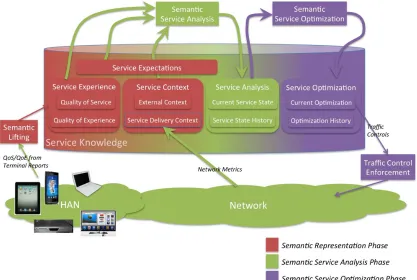
Following the state of the art study, the research work was structured into three further phases, as shown in Figure 1-‐1. The Semantic Representation Phase developed the EUSAO ontology and explored monitoring by lifting knowledge into that ontology. The Semantic Service Analysis Phase focused on building the Aesop framework and on building the algorithms for semantic service analysis. The Semantic Service Optimization phase developed the optimization planning algorithms and the mechanisms for executing traffic controls on the network.
Figure 1-‐1: Research Phases
In order to conduct realistic experimentation, a test framework for running end
user sessions was required. The Service Experience and Context COllection
(SECCO) framework was developed to fulfil three roles. Firstly, it allows end-‐user service sessions to be run in a controlled manner. Secondly, it records end user service experience and context for running sessions. Thirdly, it compiles terminal reports for end user sessions and forwards them to Aesop for processing.
[image:19.595.100.517.258.538.2]
Figure 1-‐2: Organization of Research
1.3.1
Research Artefacts
The research produced the following five main research artefacts:
1. The State of Art Report. This report fulfils Objective 1 and appears as Chapter 2 in this thesis.
2. The EUSAO ontology. This ontology is the model produced to meet
Objective 2. The design is described in detail in Chapter 3 of this thesis.
3. The Aesop autonomic end user service management system. Aesop is the
software entity that delivers the system that fulfils Objective 3 and Objective 4, and is described in detail in Chapter 4 of this thesis.
4. The SECCO Service Experience and Context COllection framework. This
framework is used in experimentation to evaluate Objectives 3 and 4 and is described in Chapter 5 of this thesis.
5. The Mobile Broadband Case Study. This case study evaluates Objectives 2,
3 and 4, demonstrating the applicability of this research in the Mobile Broadband domain and it is presented in Chapter 7.
1.3.2
The Research Phases
This sub-‐section explains the research carried out in each research phase.
1.3.2.1 The Semantic Representation Phase
The core of the EUSAO ontology was built to represent the main concepts required for end user service management and the relationships between them; specifically the concepts of service expectation, service experience, and service context. Those concepts reference existing ontologies for some contextual aspects, specifically FOAF [FOAF, 2010] for user context and WGS84 [W3C, 2006b] for positional context. The concepts of a snapshot and a snapshot bucket were introduced in the EUSAO ontology, and are fundamental for enabling efficient access to the knowledge base. These concepts enable partitioning of the knowledge base into separate models at run time. Each individual set of user session metrics is a snapshot and all metrics reported in a time period are collected into a snapshot bucket. Each snapshot bucket is held as a separate model in the knowledge base.
Based on insights gained during the state of the art study, SAWSDL [W3C, 2007] was selected to extract and encode semantic knowledge from terminal reports. Existing SAWSDL implementations do not support non-‐WSDL [W3C, 2001] XML schemas, so a SAWSDL framework for extracting and encoding semantic knowledge from streams of XML terminal reports was developed. Mappings were developed to translate data from XML elements into EUSAO service experience and context concept instances in RDF [W3C, 2004a] format for storage in the knowledge base.
1.3.2.2 The Semantic Service Analysis Phase
In this phase, the focus of the research was on developing the structure of the Aesop knowledge base and components, as well as the algorithms for Semantic Analysis of end user services. In addition, the session control and terminal reporting features of the SECCO framework were developed.
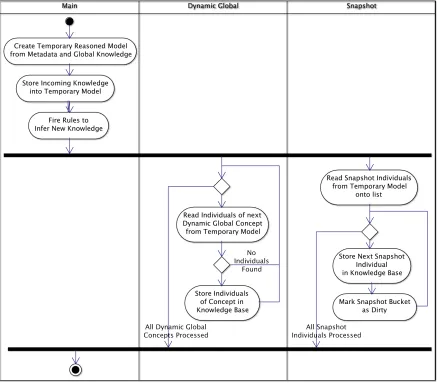
The Aesop knowledge base is structured as a series of semantic models, with a separate model being used for each snapshot bucket. The Aesop components monitor and store knowledge into the knowledge base and that execute optimization analysis, planning, and execution operations periodically on the knowledge base.
The main body of the SECCO framework was developed in this phase. A SECCO collection entity runs on each terminal and collects service experience from each session running on a terminal. The service experience for each session is collated with the service context information from the terminal into a terminal report, which is forwarded to Aesop for lifting as knowledge into its knowledge base.
1.3.2.3 The Semantic Service Optimization Phase
The research in this phase developed the algorithms for planning optimization of end user service quality, implemented those algorithms in Aesop, and implemented execution of optimization traffic controls in Aesop.
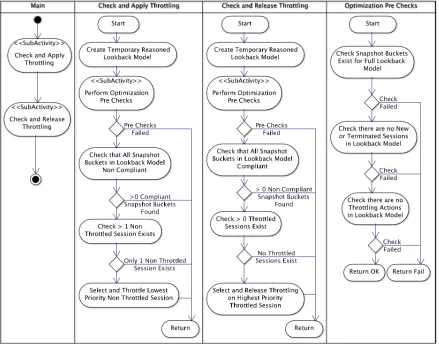
The Semantic Service Optimization planning algorithms act on service sessions identified by Semantic Service Analysis as not complying with service expectations. Semantic reasoning is applied to prioritize service sessions and to determine which of those sessions should get priority for access to network resources. Optimizations are executed on service sessions determined as being low priority using throttling. Deployed optimizations are represented semantically, and the effectiveness of those optimizations is tracked over time.
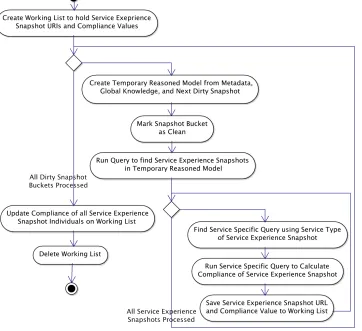
Aesop was extended with components to run semantic optimization planning and execution in this phase. Aesop runs semantic optimization planning as a series of queries that are executed on a reasoned model made up of the most recent sequence of snapshot buckets. The Aesop feature to execute application or release of throttling actions was also developed in this phase.
1.3.3
Evaluation
The evaluation was carried out as a series of three experiments and a case study. The goal of the experimentation was to evaluate the proposed Aesop approach in the experimental domain, specifically addressing the “to what extent…” and “…in near real time” facets of the research question. The goal of the case study, which examines the applicability of the approach in the mobile broadband access domain, was undertaken to show that the proposed approach was applicable in a second networking domain.
Semantic Service Analysis system carrying out monitoring and analysis. Experiment 3 evaluated Aesop-‐MAPE, with Aesop running as a Semantic Service Analysis and Optimization system, carrying out monitoring, analysis, planning, and execution.
Four properties (shown in Table 1-‐1) of the Aesop approach were evaluated in order to perform a quantitative assessment of Aesop.
Table 1-‐1: Aesop Evaluation Properties Assessed during Experimentation
Property Description Scope Experiments
Effectiveness A measure of how much the system improves the compliance of running service sessions with expectations
Full
System Experiment 3
Consistency A measure of how similar optimization
actions taken in different experimental runs of the same scenario were
Full
System Experiment 3
Accuracy A measure of how well an autonomic
function is performed; such as how many sessions did analysis calculate compliance for correctly.
Each of the MAPE functions
Experiment 2 Experiment 3
Performance A measure of how much time taken to
perform an autonomic function and how much system resources were used
Each of the MAPE functions
Experiment 1 Experiment 2 Experiment 3
The properties above were selected to evaluate the Aesop approach from the “to
what extent” and “in near real time” aspects of the research question. Effectiveness and consistency are measured on the entire system and measure to what extent the
system as a whole optimizes end user service session delivery. Accuracy and
performance are measured separately on each of the MAPE functions, assessing how well each function works and the amount of time taken for each function to execute.
Experiment 1 was executed in a simulated environment because, in addition to its primary goal of evaluating the performance of semantic monitoring using the Aesop approach, it was used to gauge the effectiveness of the first part of the approach before a commitment was made to carry out further research and build experimental frameworks and test beds. Experiments 2 and 3 were executed in a full test HAN test bed, with SECCO being used to control end user sessions, for collection of end user service experience and context and for terminal reporting.
understood [OFCOM, 2012] [Sundaresan et al., 2011] [Dobrian et al., 2011], and because it is feasible and inexpensive to set up a realistic HAN test bed.
Three scenarios were explored in experimentation, a degradation scenario where a session deteriorates from a perfect to an unusable level, a congestion scenario where the connection from the HAN to the Internet becomes congested due to over use by end user services, and an impairment scenario where a temporary impairment occurs on connection between the HAN and the Internet causing end user services to degrade. Web Browsing, Video on Demand and File Transfer were chosen as end user services because they are amongst the most common end user services used on the Internet today [Maier et al., 2009][Sandvine, 2012].
The case study on the application of the approach in the domain of Mobile Broadband Access networks demonstrated that the structure of the EUSAO ontology, architecture and structure of the Aesop approach could be applied unchanged to optimize end user service session delivery in that domain. The object and data properties of some concepts would be amended to represent Mobile Broadband Access knowledge. Extensions to the Aesop implementation are suggested in the case study to allow a deployment that could scale to manage a full Mobile Broadband Access Network. The case study, in describing Aesop’s application in a second network type, provides strong evidence of Aesop’s applicability in arbitrary network types.
1.4
Contributions
The contributions of this research are:
Major Contribution: The Semantic Service Analysis and Optimization (Aesop) approach. The approach uses the EUSAO ontology to model end user service management, and the Aesop autonomic end user service management system that uses an entirely semantic processing approach to analyse and optimize end user services.
Minor Contribution: The development of the SECCO framework. SECCO allows controlled execution of end user service sessions, collection and forwarding of terminal reports from those sessions, and implements throttling of those sessions.
system built entirely using semantic approaches. The research has shown that semantic techniques are applicable to analyse and optimize end user service delivery in near real time as service expectations and service delivery context changes. This approach is end user-‐centric, it enables automation of end user service management from a Quality of Experience (QoE) point of view, a major step forward compared to the manual and static Quality of Service (QoS)-‐centric approaches being used and proposed in research to date.
The EUSAO ontology is an end user service management model that can be used to manage any end user service set in a networking domain. The ontology captures the concepts, relationships, constraints, and complexity of end user service management. Its novel snapshot and snapshot bucket structure for metrics is designed to be transparent to the services and networking domains being managed whilst enabling efficient knowledge storage and retrieval. The model uses references to the TM Forum SID [TMF, 2011] for networking domain, user, and service provider concepts thus allowing it to be applied to any networking domain.
The domain specific logic in the Aesop approach is implemented using semantic techniques, without any domain specific source code. Monitoring mappings can be written to lift any arbitrary textual data source of service experience or context into the knowledge base. The analysis and optimization planning algorithms can be modified to consider new concepts and relationships by just changing semantic queries and rules. The throttling parameters used in optimization execution are configured in the EUSAO ontology. An Aesop engine would be aware of just the concepts of service, service session, and compliance. How the compliance of a service session is calculated and what service sessions are selected for throttling actions are matters for the optimization analysis and planning queries and rules that are invoked and fired by an Aesop engine. Because the complexity of the domain is captured in the ontology, the mappings, rules, and queries are relatively straightforward to implement.
scoped to use only the semantic models that cover the time period over which analysis and optimization is being carried out.
Aesop has been developed and implemented on commodity hardware using readily available semantic frameworks, libraries, and toolsets (Jena, Protégé, Pellet reasoner). This work shows the practicability and limitations of developing a semantic management system using the currently available semantic ecosystem and is a benchmark that can be used by further research efforts in the field.
The SECCO framework is a minor contribution of this work. SECCO makes it easy
for users to set up, run, and monitor end user service sessions. To a user of SECCO, specification, execution, and monitoring of different types of end user services is carried out in a uniform manner. The motivation for SECCO is that it shields the user from the intricacies of mechanisms and interfaces provided by different end user service delivery clients such as web browsers and media players. All end user service sessions are handled by SECCO, without the need for writing complex scripts to launch clients and extract measurements from them.
SECCO is designed to be a highly customizable framework, so that addition of support for new service delivery clients is straightforward. It provides a customizable mechanism that allows end-‐user service sessions to be run in a consistent and controlled manner. Secondly it provides support for recording end user service delivery and context at the service delivery client. Thirdly it collects measurements and compiles terminal reports for all end user sessions on a host and forwards them to Aesop for processing.
A patent proposal on the Aesop approach that specifically addresses the partitioning structure of the knowledge base, the components of Aesop, and the semantic monitoring and analysis algorithms has been accepted for filing under the Intellectual Property review process of Ericsson and has been provisionally filed.
A further patent proposal that addresses the Aesop optimization algorithm and the application of the Aesop approach for optimization of end user service delivery in mobile broadband access networks has been submitted to the Intellectual Property review process of Ericsson and is currently under consideration.
L. Fallon and D. O’Sullivan. “Aesop: A semantic system for autonomic management of end-‐user service quality”. In Integrated Network Management, 2013. IM ’13. IFIP/IEEE International Symposium on, to Appear. IM 2013, May 2013.
This paper describes the Aesop approach, the partitioning structure of the knowledge base, and the components of Aesop. The paper describes the end user service analysis algorithm and presents an evaluation of the performance of Aesop.
L. Fallon and D. O’Sullivan. “Using a semantic knowledge base for communication service quality management in home area networks”. In Network Operations and Management Symposium, 2012. NOMS 2012. 13th IEEE/IFIP. NOMS 2012, April 2012.
This paper describes the EUSAO ontology and its structure for holding end user service knowledge. The paper also describes the Aesop lifting mechanism and presents an evaluation of the performance of that mechanism.
L. Fallon, Y. Huang, and D. O’Sullivan. “Towards automated analysis and optimization of multimedia streaming services using clustering and semantic techniques”. In R. Brennan, J. Fleck, and S. van der Meer, editors, Modelling Autonomic Communication Environments, volume 6473 of Lecture Notes in Computer Science, pages 12–23. Springer, October 2010.
This paper presents a high-‐level summary of the approach being proposed in this research. An autonomic approach to end user service management is proposed, with methods being presented for service session analysis and optimization.
A further paper describing the SECCO framework is planned for submission to the Experience Sessions of the IEEE/IFIP Network Operations and Management Symposium (NOMS 2014).
A journal article based on this thesis is planned for submission to the Journal of Network and Service Management (JNSM).
1.5
Thesis Overview
This thesis is structured as follows:
Chapter 1 introduces the thesis.