1
Human Rights-Based Approach to Applied Psychology
Abstract
2
Human Rights-Based Approach to Applied Psychology
Nimisha Patel
Human rights and applied psychology share one key focus, amongst others: health and well-being. In this article a human rights-based approach (HRBA) to psychology is explored, by outlining the key features, principles, limitations and the value of international human rights; and by considering its relevance to psychological practice, research, advocacy and pedagogy.
What are human rights?
Human rights are international legal standards, conceived and constructed following World Wars I and II, first with the establishment of the United Nations, an inter-governmental organisation, then by the development and adoption of the Universal Declaration of Human Rights in 1948 (UDHR). The UDHR, together with the International Covenant on Civil and Political Rights (1966) with its two Optional Protocols and the International Covenant on Economic, Social and Cultural Rights (1966) form the International Bill of Rights. The UDHR is the origin of the other nine international legal treaties, which together with various regional conventions, declarations, principles of law, agreements and judicial decisions, form international human rights law. Whilst the doctrine of human rights, as derived from
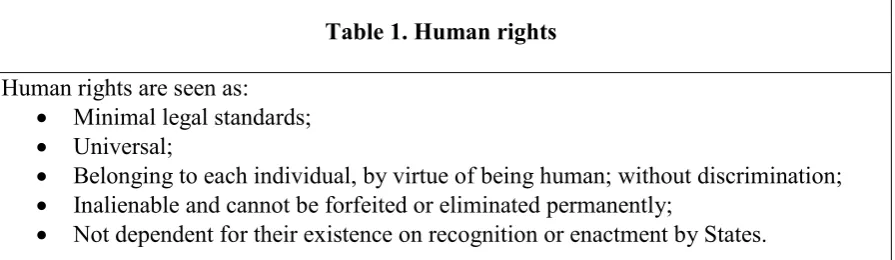
[image:2.595.77.525.501.631.2]international human rights law, promotes human rights as norms which share key features (Box 1), they are perhaps more accurately to be understood as minimal moral claims, encoded and established in legal language. They are the outcome of a political enterprise of international consensus-building on morality, on what governments should and should not do to those under their jurisdiction. This political process has included the establishment of human rights machinery, regional and international systems and peer review structures to ensure accountability between States within the international community.
Table 1. Human rights
Human rights are seen as: • Minimal legal standards; • Universal;
• Belonging to each individual, by virtue of being human; without discrimination; • Inalienable and cannot be forfeited or eliminated permanently;
• Not dependent for their existence on recognition or enactment by States.
Why do we need human rights?
3
practice. Yet, in psychology, human rights have often been ignored as peripheral: inequalities and injustices which happen ‘out there’, in ‘other’ countriesor by the ‘other’, rather than by us, and within our psychological practices and institutions. When human rights are
acknowledged in applied psychology, the focus is on the adverse psychological consequences resulting from grave human rights abuses, but not on the root causes. Violations such as racial violence, slavery and egregious crimes of torture, are psychologised (Patel, 2011) and the causes and the structural, political and economic conditions which give rise to those violations are airbrushed away. Further, the survivor is objectified as the psychological impact (specifically, symptoms and diagnoses) become the main focus for forensic scrutiny by psychologists, as if the impact is best understood when stripped of its causes and context, thereby diminishing survivors’ own cultured, gendered and politicised understandings of their suffering. Similarly, when human rights violations (e.g. breach of the right to liberty) are highlighted in the mental health field, psychologists are quick to step aside and point the finger at psychiatrists, without proper and equal scrutiny of how psychologists collude, and also may breach human rights. Unfortunately, what psychologists may easily forfeit are the low-hanging fruits - proactive and preventive activities within psychological practice which respect, promote and defend human rights.
What is the human rights framework relevant to psychology?
The term human rights framework refers broadly to human rights responsibilities, commitments and principles, which are based in international human rights law.
Human rights responsibilities
Human rights responsibilities rest with the State which is obliged to protect the rights of its citizens. The responsibilities, relevant to healthcare and psychologists, include:
1. The recognition that that every individual, by virtue of being human, has human rights. This includes people who use psychological/health services, their carers and family members who are rights-bearers; and staff working in State institutions or State-commissioned services are both rights-bearers and duty-bearers.
2. The State and public authorities, as duty-bearers, have a responsibility to respect, protect and fulfil human rights of each individual. Duty-bearers include the State, policy-makers, hospital managers and health professionals (including psychologists) who work within State institutions, inspectors, regulatory bodies and others. The term public authority covers private organisations, including non-governmental or private organisations, which are commissioned to carry out a public function on behalf of the State.
3. Accountability for human rights: This requires duty-bearers to provide mechanisms to ensure the social determinants of health are known, understood and addressed; to monitor discrimination and disparities in access to healthcare and support; and to identify the most vulnerable and marginalised. It enables duty-bearers to explain their practices and to make necessary changes. It also allows rights-bearers, including those who use services and their carers, to understand how service providers have fulfilled their duties; and to claim redress where rights are violated.
4
organisational culture, clinical practices and in all monitoring and evaluation activities of health services.
Human rights commitments
Of the thirty basic human rights based on the UDHR, all may have implications for health and to psychological practice. Regional laws, such as the European Convention on Human Rights and the Charter of Fundamental Rights, also have implications for healthcare. Additionally, domestic laws contain rights relevant to healthcare (e.g. laws safeguarding children, mental health, criminal justice and anti-discrimination laws), and human rights have to be seen together with other statutory and ethical obligations of psychologists.
The right to health, first established in the United Nations International Covenant on Economic, Social and Cultural Rights (ICESCR, article 12) is important for all health professionals. This is not a right to be healthy, but the right to access healthcare providing equality of opportunity for everyone to enjoy the highest attainable level of physical and mental health. Importantly, the right to health includes: (a) Equal and timely access to basic health services, the provision of health-related education and information and services which are available, accessible, acceptable and of good quality; (b) obligations for States to address the underlying determinants of health, which include adequate nutrition and housing, healthy working and environmental conditions, gender equality and health-related education and information; and (c) freedoms, such as the freedom from torture or other cruel, inhuman or degrading treatment or punishment and freedom from non-consensual medical treatment and experimentation.
To understand how rights work in practice it is essential to understand that different types of rights set out in the European Convention on Human Rights allow for different types of lawful interference with them, under certain circumstances. Absolute rights, such as the right to not be tortured or treated in a cruel, inhuman or degrading way, addresses any treatment which causes severe pain or suffering, physical and/or mental. The consideration of whether treatment amounts to torture or to cruel, inhuman or degrading treatment depends on the particular circumstances of each case. As an absolute right it cannot be limited or restricted in any way or derogated from under any circumstance or situation – whether during war,
emergency, healthcare etc. An absolute right cannot be balanced against the needs of another individual or public interests, except where two absolute rights need to be balanced.
Limited rights, such as the right to liberty and security of person protects against the deprivation of liberty through arrest and detention, being locked in a room, or in detention setting, or to have movement restricted in any other extreme way. The right to a fair trial and to not receive punishment without law is also a limited right; and it applies to both civil and criminal matters, detention under mental health legislation, employment matters and
dismissal from employment and expulsion from a profession or withdrawal of license to practice a profession. Both rights can be limited in certain circumstances although any restriction has to be explicit, lawful, carefully justified by those responsible and finite. Qualified rights are those which may need to be balanced against the rights of others and in the interests of the wider community, or public good, to achieve a fair outcome (as decided by courts). For example, the right to respect for private and family life, home and
5
information, including medical, financial and other personal records, including the storing, sharing and dissemination of such information; and the right to access one’s own personal information (such as health records). It includes protection of personal autonomy and
physical and psychological integrity (no one can interfere with an individual’s body, without consent); protection against domestic or sexual abuse; respecting one’s established family life, including close family ties (e.g. carers or family members of clients); being able to maintain and establish relationships with others (including family relationships and
relationships between unmarried and married partners); being able to live with one’s family and where this is not possible, to have regular contact; respecting the right of each individual to influence decisions about their care and contact with family; right to not have one’s home life interfered with (e.g. by unlawful surveillance, unlawful entry, arbitrary evictions); and the right to confidential, uninterrupted and uncensored communication with others (e.g. no surveillance of phone calls or email, not reading personal letters – including when in hospital or a mental health setting). Qualified rights can be restricted, either partly or completely, but with due consideration of the consequences for the individuals concerned. Where restrictions are made on qualified rights, they must have a legitimate aim (as set out in the relevant article, e.g. national security, public safety, prevention of crime); be necessary (no other actions or methods could achieve the same end); and proportionate (not excessive).
Human rights principles
Many of the principles underpinning human rights are similar to those embedded in ethical codes for psychologists (e.g. Meta-Code of Ethics of the European Federation of
Psychologists’ Associations, EFPA, 2005; Universal Declaration of Ethical Principles for Psychologists), which are also provided as a universally applicable framework (Gauthier et al., 2010)). Of the numerous human rights principles embedded in many international treaties and articles, twelve principles are summarised to illustrate their relevance to psychological practice and all healthcare (Table 2).
The interdependence, indivisibility and inter-relatedness of rights, together are an overarching human rights principle (Vienna Declaration and Programme of Action, 1993), emphasising the need to consider rights together, since the violation of one right can impair other rights. For example, the violation of the right to access to quality healthcare can impair a person’s ability to engage in education or employment, leading to poverty and social conditions which further impair their health; and the deprivation of liberty can also impinge on the right to private and family life – for the person with mental health difficulties and their
families/carers.
Another cross-cutting human rights principle is the need for gender and
culture-appropriateness. In the context of patients’ rights, the WHO states that “everyone has the right to have his or her moral and cultural values and religious and philosophical convictions respected” (WHO, 1994, article 1.5). The right to health also requires health facilities, goods and services to be “culturally appropriate, i.e. respectful of the culture of individuals,
6
Similarly, equality and non-discrimination are important human rights principles, relevant to
all healthcare (UN, 2009a). States have an obligation to prohibit discrimination and a positive obligation to ensure equality of opportunity for the enjoyment of the right to health by
persons with mental health problems (ICESCR, article 2(2)); UN, 2009a,b). States are also obliged to prohibit and eliminate discrimination on all grounds in access to health services and to address underlying social determinants and to prohibit and to eliminate racial discrimination and guarantee the right of everyone to public healthcare (International Covenant on the Elimination of all forms of Racial Discrimination (ICERD), article 5). The principle of non-discrimination extends to those with mental health difficulties (UN 2017a) and requires States parties to “recognize that persons with disabilities [physical or mental] have the right to the enjoyment of the highest attainable standard of health without
discrimination on the basis of disability” (CRPD, article 25).
States must also recognise and address the needs of specific groups which face particular health challenges and which can be considered vulnerable, particularly because vulnerable and marginalized people are often less likely to enjoy the right to health (WHO, 2015). Vulnerable groups include, for example, those who have suffered from social inequalities, discrimination and stigma, and who face challenges in relation to the right to health, including those who have been continuously discriminated against by State practices (UN, 2009b). The reliance on the person’s ability to pay can be seen as discrimination against those without the adequate financial means to access equal quality of psychological healthcare. Yet, there are different quality of psychological care provided to different social groups and to those from socially disadvantaged groups (e.g. low-income families, ethnic minority people or refugee people); and differential access to psychological therapies, dependant on the national health structures and health-financing systems.
Table 2. Examples of human rights principles and their relevance to applied psychology and healthcare
Principle 1
Safety, security and physical and mental integrity of person
The safety, security and physical and mental integrity of every individual person using services, carer/family member and staff member is protected.
Services should do no harm: people who use services should be able to live as freely as possible and safe from harm, including from any form of neglect, abuse, violence or exploitation.
Challenges:
• How can we ensure that people who use services are not harmed in any way by services, by staff or by other people who use services; or that their health and safety is not threatened by staff practices or by the environment and conditions in which they are provided services? • What are alternatives to compulsory treatment and restraint practices? • Which working conditions give rise to threats to staff health and safety?
Principle 2 Fairness
7
and access to fair processes and procedures to provide feedback or make complaints about their healthcare and treatment.
Decision-making processes to be based on the application of explicit criteria accessible to people who use services, carers and staff.
Staff access to fair processes and procedures to provide feedback or make complaints about employment conditions and practices.
Challenges:
• How can we ensure that all people who use services and their carers are informed of, and can readily access, user-friendly complaints and feedback mechanisms?
• How can we monitor clinical decision-making to ensure service criteria are fairly applied when accepting, rejecting or sign-posting referrals; and that this decision-making is made transparent to those referred to our services?
Principle 3 Respect
People who use services are valued and respected as individuals and are listened to; decisions about their care are respectfully effectively communicated to them; and what is important to them is viewed as important by the service.
Staff are valued and respected as individuals and what is important to them is viewed as important by their employer.
Challenges:
• How can we seek and meaningfully integrate the views of people who use our services in our psychological formulations and care?
• How can we respectfully inform a person why they cannot be offered a service?
Principle 4 Dignity
People who use services are always treated in a humane way –with compassion and in a way that values them as human beings and supports their self-respect, even if their wishes are not known at the time. Dignity is interlinked with the principles of respect and autonomy and includes the right to bodily integrity and to control one’s body and health, as well as the right to informed consent in the context of healthcare.
Respect relies on gaining and acting on the views of the person; but all persons should be treated with dignity regardless of whether their views are known, whether unconscious, lacking mental or physical capacity, having committed a crime, caused harm to another etc.
Staff are treated in a humanitarian and compassionate way which values them as human beings and supports their self-respect.
Challenges:
8
• How can we prevent practices and healthcare conditions which could be considered degrading?
• How can we ensure minimal and only lawful surveillance (e.g. cameras) when people are in hospital, care homes etc.?
Principle 5 Autonomy
People who use services can exercise the maximum amount of choice and control possible – in their individual healthcare; in service development; in their relationships with others; and as citizens beyond the health and social care services that they are using.
This includes the right to informed consent, ensuring information, encouragement and support to people who use services and their carers to evaluate the possible benefits and harms of any choice or decision; and to be able to contribute to decisions.
Challenges:
• How can we best support people to freely choose or refuse a particular service or therapy on offer?
• How can we respect the religious or other deeply-held beliefs (e.g. pacifism) of people who use services and of carers?
Principle 6 Participation and inclusion
Everyone has the right to participate in decisions and in the development of policy and practices which affect them. Participation must be active, free, and meaningful.
A participatory approach seeks to uphold human dignity of every person by ensuring that each individual using a service, and their family members/carers:
(a) are informed of and given opportunities to meaningfully participate in decisions that affect them.
(b) have equal opportunity to have their voice heard, including those who are already marginalised, excluded or have limited influence in decision-making processes which affect them.
(c) are meaningfully involved in decision-making processes which affect them, and their needs and views are properly considered.
(d) are given adequate, relevant and accessible information (considering age, gender, language, cultural and religious background); support and the means to making and having their views and complaints heard and addressed.
(e) are entitled to meaningful participation in the design, implementation and monitoring of interventions provided in services.
(f) are given opportunities to meaningfully participate in decision-making at all levels of the organisation e.g. in the management board, service planning and development.
(g) have freedom of association to meet with others in order to be able to participate in the above.
9
• How can we ensure that service user-involvement mechanisms are not tokenistic and that they do not deter or exclude those who are from marginalised backgrounds or others (e.g. women, young people)?
Principle 7 Indivisibility of rights
Human rights are inter-related, indivisible and interdependent and need to be considered together, not in isolation. Violating one right can impair the enjoyment of other rights.
Challenges:
• How can practitioners and teams keep in mind during decision-making that interfering with one right can affect other rights of the individual, or others? For example, restricting the right to exchange information to say or write what they like, may also interfere with the person’s right to private life; or placing someone in seclusion in mental health setting restricts the right to liberty, but if it also prevents family visits, it can interfere with the right to family life for the person and their family members.
Principle 8
Balancing of rights
Each situation has its own unique context in which there should be a careful consideration of the rights of each individual.
There may be competing rights in some cases, and sometimes the rights of the person using the service may need to be considered alongside the rights of their carer, or the interests of the wider community. In these situations, there needs to be a balancing in reaching decisions.
The classification and nature of the relevant human rights are considered in such balancing. Absolute rights (e.g. freedom from torture or other cruel, inhumane or degrading treatment) would take precedence over limited rights (e.g. right to liberty). Absolute rights can never be balanced with qualified rights.
Challenge:
• How are the views and the rights of children respected, whilst also considering the views and rights of their parents/caregivers?
• How can the safety of an individual, and the possible risk of harm to their family or the wider community, be considered together?
Principle 9 Proportionality
Restrictions placed on rights should be to the end that needs to be achieved; they should be lawful, legitimate and proportionate; and they should ensure a proper balance between the needs and rights of other people who use services, carers/family members and staff.
In other words, a proportionate action is one that is:
(a) Appropriate to the situation, for a legitimate reason and not arbitrary or unfair.
10
(c) Not excessive (not ‘using a sledge hammer to crack a nut’ when other means would suffice).
(d) The infringement of a person’s human rights is kept to a minimum and reviewed regularly.
Challenges:
• How services ensure that any actions and service policies (e.g. blanket bans on access to mobile phones when detained on mental health grounds); and restrictions to an individual’s rights (e.g. preventing contact with family members, or seclusion practices), are not excessive, and not primarily for the convenience of staff?
Principle 10 Equality, non-discrimination and attention to vulnerable groups
People who use or provide health services, and carers, do not experience discrimination on any prohibited grounds.
All forms of discrimination must be prohibited, prevented and eliminated and those who are in situations where they can be considered vulnerable and less able to access their rights should be prioritised.
Challenges:
• How can we prevent discrimination (based on sex, sexuality, race/ethnicity, disability, etc.) in our care/intervention plans and in services?
• How can we prevent discrimination against those who do not speak fluently, read or write in the main national language?
Principle 11 Gender and cultural
appropriateness
Decisions and practices towards people who use services, carers and staff should adhere to the human rights principles of ensuring gender and cultural appropriateness, on a service-wide level and for each individual person’s unique context.
Challenges:
• How can we systematically scrutinise our practices and services for gender- and cultural-appropriateness and relevance; and promote good practice?
Principle 12 Monitoring by disaggregation
Compliance with human rights obligations and potentially unfair disparities and discrimination in treatment and healthcare practice should be monitored.
This includes monitoring of organisational practices related to staff, persons who use services and their families/carers (including disparities in access to services, types of services and practices). Such monitoring should be disaggregated (e.g. by sex, gender, age, ethnicity, disability, sexuality) to assess organisational practices for non-discrimination, equality and fairness.
Monitoring by disaggregation should be used to inform national, organisational and service policies, service design, service development and practices within services.
11
• How can services develop and implement appropriate mechanisms to routinely monitor their practices (e.g. according to sex, race/ethnicity, disability)?
• How can the results of such monitoring be used to improve psychological practices and services?
The limitations and value of human rights
There are many obstacles to the implementation of human rights globally, including geopolitical and economic national interests, lack of political will, weak or absent civil society, corruption, lack of an independent judiciary, harassment and intimidation of human rights defenders, lack of awareness and understanding of human rights, fear of threats, marginalisation, persecution, detention, torture and ill-treatment. The reasons are multiple, complex and variable, differing from country to country.
At the theoretical and philosophical levels, human rights remain deeply contested (for example, Ignatieff, 2001, An-Nai’im, 2016, Panniker, 1982, Shachar, 2001). Human rights are arguably a substitute to traditional, institutionalised morality. They are the legal
codification of a certain set of moral principles, emerged from a process of consensus-building on norms and values, and fashioned by political interest, patriarchal, White and economic privilege as well as by national, regional and global power struggles, within the specific conditions and context of post-World War II. As such, human rights continue to draw criticisms from some States as being a neocolonialist enterprise of the West. It is the nature of those moral principles, also the bedrocks of applied Western psychologies, that betrays the Eurocentricity and individualism derivative of Western moral philosophies and culturally-mediated understandings of what it is to be ‘human’. For example, the principle of autonomy, also rooted in liberal political philosophy, constructs the human in human rights as an
individual, an autonomous agent, whose entitlement to autonomy to exercise choice and control requires certain conditions and safeguards. Such a construction of rights diminishes collective suffering and rights of those subjected to marginalisation, persecution and harm, as a group, for example, because of their ethnicity or beliefs. Similarly, the classification of some rights as absolute, and hence as conclusively valid, always, is also contested (Gewirth, 1981). Hence, whilst human rights are posited as minimum moral guarantees encompassing fundamental principles of humanity, their context-boundedness undermines claims to universality across contexts, cultures, ethnicities, religions, political and philosophical backgrounds and history.
12
akin to ‘relative universality’ (e.g. Donnelly, 2007). However, cultural rights arguments can also be problematic in their propensity to reproduce patriarchal domination (e.g. Shachar, 2001), both in the construction and application of human rights, such that girls and women continue to be most at risk of harm and rights violations.
Notwithstanding the pervasive impresses and struggles of power and ideologies in the codification and implementation of human rights, they have been utilised in social movements and civil rights struggles in many contexts, by those who are marginalised, discriminated against, oppressed and subjected to persecution, violence, torture, genocide etc. Ignatieff (2001) suggests, what is important is what human rights can do for people, an approach which assumes that no one would want to contest the view that all human beings deserve to be free of violence, poverty, insecurity and that each of us should be allowed to pursue a ‘good life’ (however that is constructed) with peace, freedom and safety.
The recognition that every individual is worthy of respect and protection as a human being, and even more so when a person is vulnerable to marginalisation, exploitation or harm, is one of the core values central to both human rights and psychology. A pragmatic epistemological stance to human rights does not evade the shortcomings of human rights, including the Eurocentric, gendered, ideological, ethical, political and constructed nature of human rights. It would mean recognising that a human rights framework, despite its limitations, offers psychologists a compass, and important tools, in the service of change, to improve the lives of all human beings.
This does not resolve the dilemmas of using potentially oppressive discourses and tools; or the incompatibility of some values and cultural norms or competing claims for human rights (e.g. rights of the person and those of their carer). Pragmatism however, does not advocate that ‘anything goes’, nor is it a crude form of utilitarianism, with fluid principles and applications as situations and individual or institutional opinions and priorities dictate. Instead, pragmatism can enable ethical decision-making in psychological practice, which draws on human rights to achieve particular ends, for example, the prevention of harm towards, and the protection and improvement of the health and well-being of, individuals, families and communities. A pragmatic and critical realist stance acknowledges the values and moral arguments psychologists use in support of moral positions on well-being, justice, humanity and human rights (Patel, 2011); and accepts that human rights are not fixed, complete, objective and definitive truths, simply in need of implementation. It is a stance which recognises, as argued by Mutua (2002), that the human rights movement is young and hence provides scope for experimental development and critique.
What is a Human Rights-Based Approach to healthcare?
13
disadvantaged populations; and human rights are being increasingly integrated into health policies and programs in different countries (Hunt et al., 2015).
In mental health, a HRBA is advocated by UN bodies. The UN’s High Commissioner for Human Rights, noting that stigma, discrimination, violations of human rights and the denial of autonomy and legal capacity are some of the challenges faced by those who use mental health services, recommended policy shifts to include systematic inclusion of human rights and the recognition of the individual’s autonomy, agency and dignity and attention to the underlying social determinants; elimination of stigma and non-discrimination, as well as the application of the principles of participation, data collection/monitoring for accountability and free and informed consent for treatment (UN, 2017b). Both, this report and that of the Special Rapporteur on Health (UN, 2017c), support a HRBA to improve mental health service delivery and recommend an end to involuntary treatment, arbitrary deprivation of liberty and institutionalisation; and the unconditional application of the principle of non-discrimination associated with the mental health “impairment”; and an adoption and integration of such a HRBA in mental health policy (UN, 2017b). However, not all UN bodies support an absolute ban on involuntary detention and treatment (e.g. the Human Rights Committee and the Subcommittee on the Prevention of Torture and other Cruel, Inhuman or Degrading Treatment).
The implications of HRBA for practitioners has been largely neglected, partly due to the lack of agreed definitions of a HRBA. In the UK, the FREDA principles of human rights (fairness, respect, equality, dignity and autonomy) (Curtice and Exworthy, 2010); and the PANEL principles (people’s right to participate in decisions that affect their lives; accountability of duty-bearers; non-discrimination and prioritization of vulnerable groups; empowerment of rights-holders; and legality) (Dyer, 2015), are put forward as part of a HRBA to health services. A HRBA to applied psychology and mental health can be described as the adoption of human rights as a conceptual framework for all aspects of healthcare, from policy, research, practice and monitoring; an approach which places physical, psychological and social health firmly within the context of security, social justice, equality and non-discrimination. Hence, a HRBA frames health not just as needs but as rights to safety, various protections and freedoms, whereby every individual and community can enjoy health and well-being. In practice, it requires also a scrutiny of traditional notions of empowerment – for example, where is privilege and power and how does operate – who has the authority, means and legitimacy to empower and protect who, why, in whose interests? For all psychologists and mental health professionals, the structural reality and operations of power cannot be denied; power is embedded in our professional knowledge-production, methods, practices and professional, academic and regulatory institutions. The dynamics of power between psychologists and those we seek to support are also inevitable. In some cases, the site of psychological assessment, formulation, therapy or other research or other psychological activities are the very source of disempowerment, subjugation and discrimination, raising human rights issues.
14
models, practices and institutions on each individual, their family/carers, and communities. A HRBA also requires identification of the social determinants of health, social inequalities, patterns of discrimination and human rights violations which happen ‘out there’ and within health services and practices. It requires an honest examination and acknowledgement of how and when our practices and services lead to adverse consequences; collude with, condone and perpetuate (directly or indirectly) human rights violations and social injustices; and how they ignore or deny the right to redress for those harmed by our practices, research activities and services. A HRBA has implications for psychological practice, research, advocacy and pedagogy.
HRBA and psychological practice
A HRBA implies that psychologists can promote human rights principles and awareness in everyday professional practice with individuals, groups and communities, in different settings and services(Table 3).
Table 3. Human rights in psychological practice
A human-rights-based approach includes:
1. Raising awareness of human rights and promoting a shared understanding of how human rights principles and legal standards may be at risk in a particular service (e.g. services for children and young people, older adults, refugees, those with learning difficulties), and which practices help defend human rights, minimise the risk, or prevent human rights breaches.
2. Respecting human rights principles, alongside ethical obligations, in all aspects of psychological practice, services, clinical supervision and team discussions.
3. Recognising and acknowledging the social, economic and political causes of suffering and pain, including social injustices and experiences of discrimination, inadequate housing, poverty, sexual exploitation, abuse and violence, torture, human trafficking and other human rights violations.
4. Adopting a stance of non-neutrality against human rights violations.
5. Recognising and acknowledging the potential for, or actual discrimination, coercion, exploitation, harm or other human rights breaches within (a)
15
6. Recognising and acknowledging ethical and human rights breaches when they occur within clinical practice and services; and addressing this to ensure accountability and redress for clients.
HRBA and psychological research
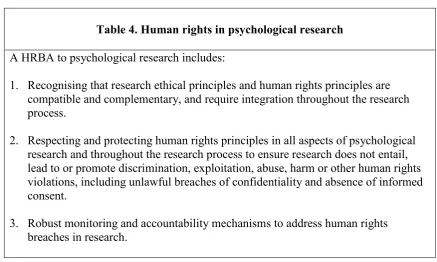
[image:15.595.82.520.308.570.2]With respect to HRBA to psychological research (Table 4), most research ethics governance structures and processes, where available, help ensure ethical risks are minimised and breaches reported and addressed. Yet, often research ethics governance fails to adequately address human rights principles explicitly and inadequate monitoring and accountability processes can render such governance toothless, where potential or actual breaches of human rights in research pass unnoticed.
Table 4. Human rights in psychological research
A HRBA to psychological research includes:
1. Recognising that research ethical principles and human rights principles are compatible and complementary, and require integration throughout the research process.
2. Respecting and protecting human rights principles in all aspects of psychological research and throughout the research process to ensure research does not entail, lead to or promote discrimination, exploitation, abuse, harm or other human rights violations, including unlawful breaches of confidentiality and absence of informed consent.
3. Robust monitoring and accountability mechanisms to address human rights breaches in research.
HRBA and advocacy
A HRBA to psychology includes two levels of advocacy (table 5), individual-level (specific to an individual case - individual or family); and policy-level advocacy, both consistent with the role of psychologists as human rights defenders.
Box 5. Human rights-based approach to advocacy by psychologists
16
Individual-level advocacy (working with individual cases – individual/family): 1. Acknowledges the social, economic and political threats, abuses and human rights
violations (e.g. poverty, inadequate housing, religious persecution, sexual violence, torture) which cause psychological suffering and pain.
2. Develops and implements psychological activities and interdisciplinary interventions, with others, which seek to protect and defend the person’s/family’s social, economic and cultural rights and basic needs for safety, security, adequate housing, food and clothing.
3. Develops and implements psychological activities and interventions which aim to protect the person/family from discriminatory abuse, violence or other physical, emotional or sexual abuse or other forms of harm and exploitation, including economic and sexual exploitation and other human rights violations, in the wider society, public institutions and within psychological, health or social care services.
Policy-level advocacy:
1. Acknowledges and identifies the relationship between certain policies (service, local, national or international), which may lead to human rights breaches; and their adverse psychological impacts.
2. Raises awareness of human rights issues and the adverse psychological impacts of certain policies and practices of public institutions (e.g. impact of national health policy, whistleblowing within institutions, defending human rights of people using services and of staff).
3. Develops and supports the implementation of interventions to influence, change or help develop new policies (e.g. for gambling-regulation, refugees and immigration, social welfare, housing) which can better protect human rights and promote
psychological health.
4. Ensures that professional bodies, their regulatory institutions and ethics committees, integrate a HRBA in their ethical codes and monitoring and accountability
mechanisms.
HRBA and applied psychology training and pedagogy
pre-17
qualification; and post-qualification, it should be valued as a continuous process of learning and professional development.
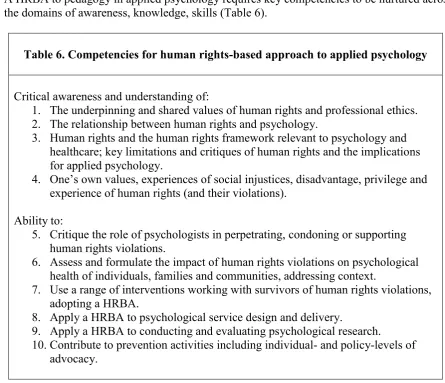
[image:17.595.68.514.144.527.2]A HRBA to pedagogy in applied psychology requires key competencies to be nurtured across the domains of awareness, knowledge, skills (Table 6).
Table 6. Competencies for human rights-based approach to applied psychology
Critical awareness and understanding of:
1. The underpinning and shared values of human rights and professional ethics. 2. The relationship between human rights and psychology.
3. Human rights and the human rights framework relevant to psychology and healthcare; key limitations and critiques of human rights and the implications for applied psychology.
4. One’s own values, experiences of social injustices, disadvantage, privilege and experience of human rights (and their violations).
Ability to:
5. Critique the role of psychologists in perpetrating, condoning or supporting human rights violations.
6. Assess and formulate the impact of human rights violations on psychological health of individuals, families and communities, addressing context.
7. Use a range of interventions working with survivors of human rights violations, adopting a HRBA.
8. Apply a HRBA to psychological service design and delivery.
9. Apply a HRBA to conducting and evaluating psychological research.
10. Contribute to prevention activities including individual- and policy-levels of advocacy.
Applied psychologists as practitioner-activists
In adopting a critical human rights-based approach to psychology, the role of applied psychologists can be conceptualised as practitioner-activists. The label of activism directly challenges traditional psychological approaches which focus primarily on the psychological manifestations and consequences of social adversity and rights violations. In adopting a HRBA, it is important to recognise that every aspect of psychological practice which is aimed at change processes, whether individual, interpersonal, familial, community, organisational or societal, is activism - since such practices seek change to the status quo, and the
circumstances, factors and conditions which impact adversely on psychological health and the well-being of individuals, families and communities.
The practitioner-activist seeks to uphold and promote the rights of all people to be treated as human beings with dignity. It is a stance which is value-laden, against human rights
18
views, experiences and participation of survivors of human rights violations. As practitioner-activists, psychologists acknowledge and seek to understand and theorise the relationship between social context, social injustices and human rights violations and health; they commit to a HRBA in psychological practice, research, service design and delivery. This in turn demands that practitioner-activists name, expose and seek to understand the dynamics of power as well as to address the root causes of suffering and the impact. A practitioner-activist works in collaboration with others, such as legal and advocacy practitioners, to engage in advocacy-related activities which seek to promote and defend human rights and to help prevent human rights violations, enabling access to justice, redress and healthcare. This requires more than human rights education, it demands changes in our theories, methods of knowledge-production, our professional training, regulatory bodies and in our practice so that human rights-based practice is a core, foundational competency.
Conclusion
Human rights set high international standards, yet the numerous political, economic, cultural and other obstacles to the realisation of human rights may mean that for the foreseeable future, human rights remain partially achievable and aspirational. For applied psychologists, often working with those who are particularly vulnerable and disadvantaged, a HRBA provides a framework and resources which complement our professional and ethical obligations. At best, a HRBA enables psychologists to use their knowledge and skills, as practitioner-activists, to help respect, promote and defend human rights.
References
An-Nai’im, A. (2016). The spirit of laws is not universal: Alternatives to the enforcement paradigm for human rights. Tilburg Law Review, 21, 255-274. DOI:10.1163/22112596-02102008
Cerna, C. (1994). Universality of human rights and cultural diversity: Implementation of human rights in different social-cultural contexts. Human Rights Quarterly, 16, 751-752.
DOI: 10.2307/762567
Curtice, M. and Exworthy, T. (2010). FREDA: A human rights-based approach to healthcare. The Psychiatrist, 34, 150-156. DOI: 10.1192/pb.bp.108.024083
Donnelly, J. (2007). The relative universality of human rights. Human Rights Quarterly, 29(2), 281-306. DOI: 10.1353/hrq.2007.0016
Dyer, L. (2015). A Review of the Impact of the Human Rights in Healthcare Programme in England and Wales. Health and Human Rights Journal, 17(2), 111-122. PMID:26766853
19
Gauthier, J., Pettifor, J. and Ferrero, A. (2010). The Universal Declaration of ethical principles for psychologists: a culture-sensitive model for creating and reviewing a code of ethics. Ethics & Behaviour, 20(3-4),179-196. DOI: 10.1080/10508421003798885
Gewirth, A. (1981). Are there any absolute rights? The Philosophical Quarterly, 31(122), 1-16. DOI: 10.2307/2218674
Hunt, P., Ely Yamin, A. and Bustreo, F. (2015). Editorial. Making the Case: What Is the Evidence of Impact of Applying Human Rights-Based Approaches to Health? Health and
Human Rights Journal, 17(2), 1-9.
Ignatieff, M. (2001). Human Rights as Politics and Idolatry. Princeton: Princeton University Press.
Maslow, A. (1943). A Theory of Human Motivation. Psychological Review, 50(4), 370- 96. DOI: 10.1073/h0054346
Mutua, M. (2002). Human rights: A political and cultural critique. Philadelphia: Pennsylvania University Press.
Nickel, J. (2004). Making Sense of Human Rights. Revised Edition. Washington, D.C.: Georgetown University Press.
Panniker, R. (1982). Is the notion of human rights a western concept?” Diogenes, 120, 75-102. DOI: 10.1177/039219218203012005
Parekh, B. (1999). Non-ethnocentric universalism. In T. Dunne and N.J. Wheeler (eds.).
Human rights in Global Politics (128-159). Cambridge: Cambridge University Press.
Patel, N. (2011). The psychologisation of torture. In M. Rapley, J. Moncrieff & J. Dillon (eds.)
De-Medicalising Misery: Psychiatry, psychology and the human condition (239-255). London: Palgrave Macmillan.
Shachar, A. (2001). Multicultural jurisdictions: Cultural differences and women’s rights. Cambridge: Cambridge University Press.
Tibi, B. (1994). Islamic/Shari’a law, Human rights, universal morality and international relations. Human Rights Quarterly, 16(2), 277-299. DOI: 10.2307/762448
United Nations (2009a). General Comment no. 20: Non-discrimination in economic, social and cultural rights, E/C.12/GC/20. Available at:
https://tbinternet.ohchr.org/_layouts/treatybodyexternal/Download.aspx?symbolno=E%2FC.1 2%2FGC%2F20&Lang=en
United Nations (2009b). Report of Special Rapporteur on right to health. A/64/272. Available
20
United Nations (2000). General Comment no.14: The right to the highest attainable standard of health, E/C.12/2000/4, reprinted HRI/GEN/1/Rev.6 at 85 (2003). Available at:
http://docstore.ohchr.org/SelfServices/FilesHandler.ashx?enc=4slQ6QSmlBEDzFEovLCuW 1AVC1NkPsgUedPlF1vfPMJ2c7ey6PAz2qaojTzDJmC0y%2B9t%2BsAtGDNzdEqA6SuP2r 0w%2F6sVBGTpvTSCbiOr4XVFTqhQY65auTFbQRPWNDxL
United Nations (2017a). Human Rights Council Resolution on Mental Health and Human Rights, A/HRC/36/L.25. Available at:
https://www.ohchr.org/EN/HRBodies/HRC/RegularSessions/Session36/Pages/ResDecStat.as px
United Nations (2017b). Mental health and human rights. Report of the United Nations High Commissioner for Human Rights, Human Rights Council, A/HRC/34/32. Available at:
https://digitallibrary.un.org/record/861008
United Nations (2017c). Report of the Special Rapporteur on the right of everyone to the enjoyment of the highest attainable standard of physical and mental health, A/HRC/35/21. Available at: https://www.ohchr.org/en/issues/health/pages/annualreports.aspx
Vienna Declaration and Programme of Action (1993). Adopted by the World Conference on Human Rights, A/CONF.157/23. Available at: http://www.un-documents.net/ac157-23.htm
World Health Organisation (2015). Health and Human Rights, Factsheet no. 323. Geneva: WHO. Available at: https://www.who.int/news-room/fact-sheets/detail/human-rights-and-health
World Health Organisation (1994). Declaration on the Promotion of Patients’ Rights in Europe. Geneva: WHO. Available at: