Modulation Equations for Roll Waves on Vertically Falling
Films of a Power-Law Fluid
Abdelaziz Boudlal1, Valery Liapidevskii2
1Laboratoire de Mecanique de Lille, Villeneuve d’Ascq, France
2Lavrentyev Institute of Hydrodynamics, Novosibirsk State University, Novosibirsk, Russia Email: [email protected], [email protected]
Received November 20,2011; revised December 20, 2011; accepted December 30, 2011
ABSTRACT
Waves of finite amplitude on a thin layer of non-Newtonian fluid modelled as a power-law fluid are considered. In the long wave approximation, the system of equations taking into account the viscous and nonlinear effects has the hyper- bolic type. For the two-parameter family of periodic waves in the film flow on a vertical wall the modulation equations for nonlinear wave trains are derived and investigated. The stability criterium for roll waves based on the hyperbolicity of the modulation equations is suggested. It is shown that the evolution of stable roll waves can be described by self-similar solutions of the modulation equations.
Keywords: Power-Law Fluid; Thin Film Flow; Vertical Wall; Modulation Equations; Nonlinear Stability; Roll Wave
1. Introduction
Mud flows are frequently encountered in mountainous regions, especially after torrential rains, and often exhibit a series of breaking waves (roll waves). These type of waves can also be observed as an event following vol- cano eruptions. A report on roll waves can be found in extensive references quoted by Ng & Mei [1]. The roll waves which occur in inclined open channels are impor- tant in drainage problems and have received an extensive treatement in turbulent regime by Jefffreys [2], Dressler [3], Boudlal & Liapidevskii [4], among others, and for a laminar sheet flow by considering the flow with quad- ratic distribution of velocity profile (Alekseenko & Na- koryakov [5]; Buchin & Shaposhnikova [6]; Julien & Hartley [7]; Boudlal & Liapidevski [8]).
The discontinuous waves play an important role in en- gineering and geophysical processes. Roll waves consist of a periodic pattern of bores separated by continuous profiles of free boundary. The transition from uniform flow to intermittent flow regime is usually tackled by resorting to stability theory. When it is perturbed, a steady flow becomes unstable, if certain criteria are satis- fied, and evolves towards wave breaking. Dressler has been the first, who gave the analytical solution for such waves in open channel flows. Based on long wave ap- proximation, Dressler’s theory of roll waves was ex- tended in [1] to a shallow layer of fluid mud, which has been modelled as a power law fluid. It has been shown, particularly, that if the fluid is highly non-Newtonian,
very long waves may still exist even if the corresponding uniform flow is stable to infinitesimal perturbations.
The aim of the paper is to give a nonlinear study on stability of permanent roll waves on a shear thinning fluid in the frame of one-dimensional, unsteady, gradu- ally varied, laminar mud flow with the shear stress being evaluated in a conventional manner. Starting from long waves equations averaged over the normal to the bed [1], the standard procedure of roll wave construction is used by matching continuous solutions of shallow water equa- tions through stable hydraulic jumps. As the amplitude and the phase velocity of waves are slowly varying dur- ing their propagation and as these variations give rise to instability, the problem of stability is solved by deriving modulation equations for wave series. The stability crite- rion is formulated in terms of hyperbolicity of modula- tion equations that need the calculation of averaged quantities.
All results presented herein can be regarded as a gen- eralization to a power law mud fluid in laminar flow re- gime of non linear stability method alredy applied to Newtonian turbulent flows in open channels (Boudlal & Liapidevskii [9]).
2. Governing Equations
Consider two-dimensional film flows of a non-Newtonian liquid on a vertical wall. The coordinate system
x x1, 2
Note that Equation (2.5) are hyperbolic with the char-acteristics
the liquid layer. The longitudinal velocity component is denoted by 1 2 The boundary layer approxi- mation is assumed to be valid, with a power-law shear stress relation for laminar flows taken in the form
( , , ). u t x x
d 1 d xk k k
t
u. (2.7)
2 n u n x
It is shown by linear analysis in [1] that any steady-state solution of (2.5)
(2.1)
1
,
n n
s s s
u h h const
Here n is the viscosity coefficient of dimension
1 n
ML T
2 and is the flow index n
0 n 1
. Theis unstable. The instability of the uniform steady-state flow also can be easily checked by the Whitham method [9]. The flow is unstable if the velocity of the kinematic wave c exceeds the velocity of long waves in (2.5), i.e.
case n = 1 corresponds to the Newtonian fluid and 1 is the ordinary dynamic viscosity [1]. By assuming the fol-lowing form of the velocity profile in the film flow
1 1 2 1 1 1 n n n u x n h
c 2 1 s s, (
1)
n
u u k k
n
k
. (2.8)
1n n
n gh
, (2.2)
the governing equations, which consist of the mass and momentum conservation equations averaged in the ordi-nate direction, are reduced to the system [1].
1
1
2
0, b.
t x t x
h hu hu khu gh
(2.3)
Here h is the layer thickness, u is the depth-averaged velocity,
1 2
n
b n
n u
nh
is the bottom stress, g is
the gravity acceleration, 2 2
1
3 2 n k n is the
momen-tum flux factor. For a shear-thinning fluid, which will be considered bellow, we have 0 n 1 and, consequently,
. 1 k 1.2
In dimensionless variables introduced in [1]; namely,
It is clear that (2.8) is satisfied for
1 0 n n s s u h
, since 0 n 1 and 1 k 1.2.
3. Roll Waves
Analogously to unstable flow regimes in open channel flows, the roll waves or periodic discontinuous solutions, have been constructed for (2.5) [1]. In this section we give the short description of roll waves in the form suitable for the purposes of the paper.
Consider the travelling waves propagating with a con-stant velocity D D
0
. Introducing the variablex Dt
and assuming the flow being steady in the coordinate system moving with the velocity , Equation (2.5) are reduced to the ODE
D
d (
d (
h F h h
)
), (3.1)
* * * *
0
1 0 0 0
0
0
0 * 2 0
0 0 0 , , , 1 2 , , n
b b b b n
t t x x u u u h h h
u n u u g nh (2.4)
where hh
, uu
and
2 2 2 2 2 2 , ,1 1 2
1 .
n
Dh m
h D u m F h h
h
m
G h k k D h k Dm
h
km
h G h k D
h
, (3.2) Equation (2.3) take the form (asterisks are omitted)
0,
2
n
t x t x
h hu hu khu h u
h
(2.5)
Let y and be the critical depth and the critical ve-locity with c
u
y 0. It follows from (3.1) that the nec-essary condition of roll wave existence is
Here the reference depth 0 and the reference velocity 0 are expressed through the given flow rate and the viscosity
h
u Q0
n
as follows:
0F y (3.3)
1 1 2 1 2 1 2 0 1 1 0 0 0 0 1 2 , . 1 2 n n n n n n n n n n
h n Q
n g
Q n g
u h h n 0
(2.6) In view of (3.2) we have
1 1 2 1
, , 1
n n n
n n n
c
u y D y m y
. (3.4)
2 3 2 0,1 2 0
km y
y
F y n
,
(3.5)
and, consequently, d dh 0 at the critical depth. Let y0 be fixed and sh y. Equations (3.1)-(3.2) take the form
2 1 2 2 2 2
2 1
d ( ), ( ) ( 1) (
d (
n n
n
n
k s s
y A s A s
h s s
1)
1 1)n . (3.6)
To find the function A s( )in (3.6), the following iden-tity is used:
1
2
1
2 k k .Furthermore, the function A s( ) can be represented as follows
1
2
1
2 ,n
m
k s s
A s
s z s
2 (3.7)
where zmhm y
, and is a root of the equation at the interval m . The continuous function
h
0, y
0F h
2
1
1 1
1 n n m s s ss s z
is positive for s0. It means that the function F h
y
vanishes only at two points and m for [1]. Therefore,
hy hh 0
h d d h0 for szm and
0
( )
m
hlimz h
.
Now we can construct the two-parameter family of roll waves as follows: for given y0 and yhyzm we put zh y, w1 z, hyw. Note that h and h are the conjugate depths, since the Rankine-Hugoniot conditions for discontinuous solutions of (2.5), which are reduced to the relation
G h G h or w1z
, (3.8) are fulfilled. The stability condition for shocks satisfying (3.8) takes the form (Rozhdestvenskii and Janenko [10])
hh or zw (3.9) Thus the admissible values of the governing parameters
y z,
, for which a roll wave exists, belong to the domain
( , ) : 0,
.a y z y zzm
For , a roll wave consists of the smooth part defined by the monotonous solution
, ay z
hh of (3.6) at the interval and of the jump with the conjugate depths
, andz w hyz
. hyw
4. Modulation Equations
It is shown in the previous section that analogously to the roll waves in open channel flows governed by the classic
shallow water theory (Whitham [10]), the periodic trav-elling waves (roll waves) in film flow of a non-Newto- nian fluid can be represented by the two-parameter fam-ily of discontinuous solutions of (2.5). We chose and
as such parameters. The problem on nonlinear stability of periodic wave trains with slowly varying values and can be solved by analysis of hyperbolicity of the modulation equations for roll waves (Boudlal and Liapidevskii, [11]). After averaging (2.5) over the fixed length scale, which is large enough compared with the length of roll waves, we have the following modulation equations: y z y z
20, 0. t x t x h hu hu khu
(4.1)
All averaged quantities can be expressed as functions of y and as follows : z
2 2 1/
0
1/
3 2 2 2
1/
d , d
1
, d ,
, 2 ,
1 ( )d , 1 .
n L z n z z z n n z z
L y z z A s s
h yz z z sA s s
hu Dh m hu D h mD y z
A s
z s z z
s ,
(4.2)Here we have used (3.1)-(3.2), (3.8) for periodic roll waves defined by parameters y and . z
In view of (4.2) and (3.4) the modulation equations take the form
2 12 1 3 2
0, 0, n n t x n n n n t x yz y y y (4.3) where
2 2
1 ( ) 2 1 1
k z z
z , (4.4)
The nonstationary evolution of the governing parame-ters
y z,
for a periodic wave train is described by Equation (4.3). We say the roll waves are stable if the modulation Equation (4.3) for corresponding values
y z,
are hyperbolic. Considering and y z
z as new dependent variables instead of and , we can find the characteristics of (4.3) from the quadratic equationy z
1
2
d ( ), 0
d n
n
x
y z a b c
t
where
2 2
2 1 3
, ,
2 1 (3 2)
,
( ) 1 .
n n
a z b z
n n
n n
c
n
z k z
2 (4.6)
Here “·” denotes the differentiation on z and
z
z . Equation (4.3)
z
means t vari
are hyperbolic for . It hat the hyperbolicity domain depends only n the
1
2 4 0
b ac o able z z
m z
or z z
m z 1 .
Note that
,m
zz z for zzm. It can be shown by numerical calculations that the hyperbolicity interval is rather na s in v ity of zm. For n = 1
the values of z corresponding to the hyper-bolicity domain belong to the interval
zm,z1
with1
0, 4695,z 0, 4697.
Therefore, the boundary of the hyperbolicity domain can be found effectively by the following approximation of the function for long waves
rrow and it lie icin
k1, 2
m
z
z
zzmzm
1/zm )d
1 1 * 1/ ( , ( )d m m m m z
m m m m m z
m z
s z s s
z z
a
s
z z z
s z a s s
(4.7)Approximate values of characteristics are given by (4.5)-(4.6) with
*
instead of and m instead of
. In this case the modulation equations simplify con-siderably since the functions
z and
z are linear on z:
1 , ,
z z z z
1 2 2 1 1 2 2 21 2 1 ,
1 .
m m m
m z z (4.8)
The dependence
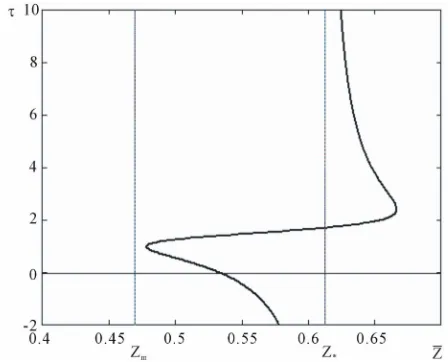
z for Equations .8) with n = 1 is shown in Figure 1 for real roots of (4.5)(4.3), (4 (z*1.5
1
). Note that the corresponding graphsfor (4.3), (4.4) and the approximate system (4.3), (4.8) practically concide, so we can use the latter system for the analysis of nonlinear stability of roll waves in the flows governed by (2.5). It follows from Figure 1 that the hyperbolicity interval
z,z
for (4.3), (4.8) lies inside of the admissible interval of roll wave existence
zm z z 1
. It means that short roll waves
1z1
and very long roll waves
zzmzm
are unstaple centered waves, i.e. the self-similar solu-tions of (4.3) depending on the variab
ble. The sim
le x t, ca cally. Equations (4.3), (4.8) for simple
n be found analyti
[image:4.595.314.538.84.265.2]
zFigure 1. Dependence for (4.3), (4.8). waves take the form
3 5 3 0, 0. y yz y y (4.9)
A solution of (4.9) can be represented in the form
0 0 z (42 , exp d ,
. 3
z
y z y y s s
z z z z
.10)Here
z is a solution of (4.3) for the coing family of characteristics. The solution (4.10) can be applied to explain some specific features of roll wave dy s con
the numerical calculations Meza and Balako- ling films of Newtonian
rrespond-namic sidered below.
5. Roll Wave Dynamics
In this section we compare performed for the model derived by taiah (2008) for vertically fal
fluid with numerical solutions of (2.3) for n = 1. Both models are derived for moderate Reynolds numbers of flow, but in contrast to the former model, the surface tension in Equation (2.3) is ignored. Let us rescale (2.3) slightly according to (Meza and Balakotaiah, 2008). For that we introduce the Reynolds number Re and the Weber number We as follows
0 1 4
Re Q , We .
u Q
0 0 Here
flows ith
is the surface tension. Consider two models of film on a vertical wall dependin on and
explicitly. The first one is the Shkadov model [12],
g Re
We
takes the form
2
2 0
12
t x
t
h q
q h qq
q
q h
2 6 12
Re 5 5
x x
xxx
Wehh
h h
h
(5.1)
It is clear that for and Equatio are equivalent to (5.1) and the systems can be trans-formed to each other by dilatation of independent
vari-ab m equation derive
periodic wave trains generated by monochromatic initial perturbations is very alike for both models. Note that Equations (5.1) and (5.2) are written in dimensionless variables. The characteristics of (5.1) with We0 co-incide with (2.7) and are positive. Therefore, to find a solution of (5.1) in the domain
, :0 , 0
T x t x L t T , we must put the values
of
h q, 0,0, 0
at the boundaries t 0 x L and
x t T . The corresponding data are taken from (Meza and Balakotaiah, 2008) for the cases considered in their paper, namely:
0
We n1. ns (2.5)
les. The momentu d by Meza and Balakotaiah [13] gives the more accurate dispersion rela-tions comparing with the Shkadov model as it has
re-ported in their paper:
1 3,0 ,0 1,
0, 1 0.1sin 2π ,
0, 0, .
h x q x
q t ft
h t q t
(5.3) 2
2 2
0
2 18 34
Re 4 4
t x
t
h q
q h qq
q
q h
2
2 2
2
Re Re
5 35 35
339 9 373 41
70 7 70 84
2837 449 1Re
420 70 3
xx
xx
xxx
x x
x x x
x
xx
h
h h
h q qh
hh h h
h h
qh
q Wehh
h
(5.2)
We will compare below numerical solutions of the model (5.2) presented in [13] with the corresponding numerical solutions of the hyperbolic model (5.1) with
We restrict our attention to the case 1 in [13] with Re 3.848 . The Weber number for (5.2) is finite (We10) and it vanishes for (5.1). The values of the dimensionless frequency f are varied to demonstrate its influence on roll wave dynamics.
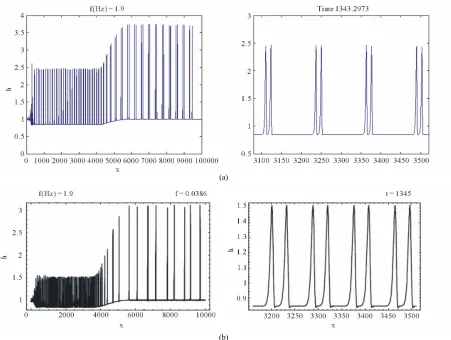
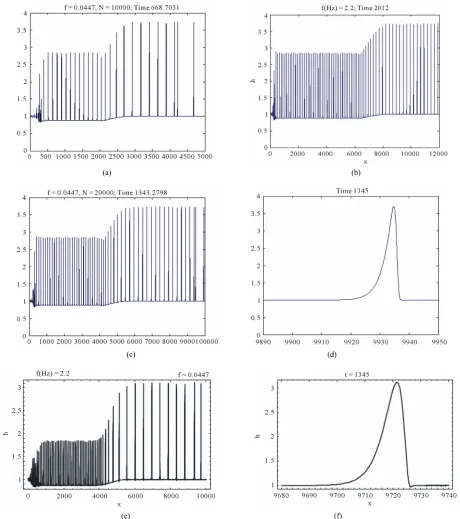
Numerical calculations using a variant of the Godunov standard scheme illustrate the development of roll waves on the free surface of a thin film flowing on a vertical wall in the frame of the hyperbolic model (5.1). In Fig-ures 2-4 the perturbations of free surface of the liquid layer calculated by (5.1) are comparing with correspond-0
e . It will be shown that despite of the difference in the shape of individual roll waves for the models with and without surface tension, the evolution of nonlinear W
(a)
[image:5.595.114.483.425.704.2](b)
(a)
[image:6.595.74.525.83.423.2](b)
Figure 3. Wave profile in the forced film flow of the Newtonian fluid (n1 Re 3 85, = . , f 0 0386. ,t1325): (a) Equation (5.1), We = 0; (b) Equation (5.2), We = 10.
do not exceed a ow, ing calculations from [13], at given time. In both cases small perturbations, which amplitudes
small fraction of the depth of the initial steady-state fl are developing into roll waves of finite amplitude. Note that the waves stop to grow after they reach some critical value of amplitude. The interesting feature of roll wave evolution is the transition from “saturated” waves to very long waves (“tsunami” waves according [11]). Such transition is most pronounced in Figure4. It is seen from Figures 4(a)-(c) that the length of the transition zone is increasing with time linearly. The analysis of the nonsta-tionary evolution of roll wave packets is the subject of future investigations. Here we just give an idea how the self-similar solutions (4.10) can be applied to describe the transition “0” - “1” shown in Figures 4(a)-(c). First of all, for given frequency f0 of the monochromatic wave packet “0”, the governing parameters
y z, 0
areuniquelly determined by (3.4), (4.2), (4.7). Furthermore, in virtue of (4.10) the left bo ndary u 2
0 y0 z0
of the centered simple wave is known. The righ dary of the simple wave is calculated using (4.10) and the ad-ditional condition for “tsunami” waves:
This al alues for the
t boun
1 1 1 1
hy z .
tion. Therefore, the transition “0” - “1” a)- (c) can be described by the centered simple wave of (4.9) moving on the left
gorithm gives the reasonable v
boundaries of the states “0” and “1” in numerical calcu-lations of the nonstationary problem of roll wave
in Figures 4(
and the roll waves shown in Figure 4 are stable, since the governed parameters
y z,
in a simple wave always belong to the hyper-bolicity domain of the modulation equations6. Conclusion
We have investigated the roll wave generation on verti-cally falling films b onlinear hyperbolic model (2.3), in which the viscous effects are taken into account
suming that the velocity profile of an exact steady-state solution of the two-dimensional p
y the n by as
roblem can he one-dimensional wavy flows. The
the first order long-wave approxima-be used also in t
model is based on
(a) (b)
(c) (d)
[image:7.595.66.526.86.605.2]
(e) (f)
Figure 4. Wave profile in the forced film flow of the Newtonian fluid (n1 Re 3 85, = . , f 0 0447. ): (a)-(d) Equation (5.1), We = 0; (e)-(f) Equation (5.2), We = 10; (a)t669; (b)t2012; (c)-(f)t1345 .
the periodic discontinuous solut
ressed in the terms of the hyperbolicity of modulation
and without surface tension reveal that in spite of the
shapes the behav
ery alik for the models. In particular, the transition from “saturated” to “tsunami” waves described in [13] ions of (2.3) (roll waves) lution for the models with
can be described by two parameters analogously to the roll waves in open channel flows. Moreover, the nonlin-ear stability of finite amplitude roll waves can be
ex-effects difference in the indi-vidual wave ior of roll wave packets is
v e
p
Equations (4.3) for the governing parameters of roll waves. Comparison of numerical calculations of roll wave
7. Acknowledgements
The work was supported by the Russian Foundation for Basic Research (Grant No. 10-01-00338) and by the Pro- gram for support of leading scientific schools of the Rus-sian Federation (Grant No. NSh-6706.2012.1).
REFERENCES
[1] C. O. Ng and C. C. Mei, “Roll Waves on Shallow Layer of Mud Modelled as a Power-Law Fluid,” Journal of
, 1994, pp. 151-1834.
Water in Inclined Channel of
2, No. 2-3, 1949, pp. 149-194. doi:10.1002/cpa.3160020203
Fluid Mechanics, Vol. 263 [2] T. Jeffreys, “The Flow of
Rectangular Section,” Philosophical Magazine, Vol. 49, No. 6, 1925, pp. 793-807.
[3] F. Dressler, “Mathematical Solution of the Problem of Roll Waves in Inclined Open Channels,” Communica-tions on Pure and Applied Mathematics, Vol.
[4] A. Boudlal and V. Yu. Liapidevskii “Stability of Roll Waves in Open Channels,” Comptes Rendus Mécanique, Vol. 330, No. 4, 2002, pp. 209-295.
doi:10.1016/S1631-0721(02)01461-4
[5] S. V. Alekseenko, V. E. Nakoryakov and B. G. Pokusaev, “Wave Flow in Liquid Films,” Begell House, New York, 1994.
[6] V. A. Buchin and G. A. Shaposhnikova, “Flow of Shal-low Water with a Periodic System of Jumps over a
Verti-cal Surface,” Doklady Physics, Vol. 54, No. 5, 2009, pp. 248-251. doi:10.1134/S1028335809050073
[7] P. Y. Julien and D. M. Hartley, “Formation of Roll Waves in Laminar Sheet Flow,” Journal of Hydraulic Research, Vol. 24, No. 1, 1986, pp. 5-17.
doi:10.1080/00221688609499329
[8] A. Boudlal and V. Yu. Liapidevskii, “Stability of Roll
i, “Stability of Regular
Their Application to Gaz
Dy-inear and NonlDy-inear Waves,” John
aza, Vol. 2, 1968, pp. 20-25. Waves on Vertically Waves on a Vertical Wall,” International Conference “Fluxes and Structures in Fluids: Physics of Geospheres”, Moscow, 2010, pp. 48-53.
[9] A. Boudlal and V. Yu. Liapidevski
Roll Waves,” Computation Technologies, Vol. 10, No. 2, 2004, pp. 3-14.
[10] B. L. Rozhdestvenskii and N. N. Janenko, “Systems of Quasilinear Equations and
namics,” American Mathematical Society Translations: Series 2, Vol. 55, 1983.
[11] G. B. Whitham, “L
Wiley and Sons, New York, 1974.
[12] V. Ya. Shkadov, “Theory of Wave Flows of a Thin Layer of a Viscous Liquid,” Izvestiya Akademii Nauk SSSR Mekhanika Zhidkosti I G
[13] C. E. Mesa and V. Balakotaiah, “Modelling and Experi- mental Studies of Large Amplitude
Falling Films,” Chemical Engineering Science, Vol. 63, No. 19, 2008, pp. 4704-4734.