Background
The number of indicators aiming to provide a clear picture of healthcare needs and the quality and efficiency of healthcare systems and services has proliferated in recent years.
To improve the health of populations and increase opportunities for comparability, more valid, comprehensive, transparent, and standardized ways of measuring and reporting the population’s health are needed.
Knowing the important sources of data and information is useful for all health care system stakeholders including decision and policy makers. In particular policy makers need to determine the effects of policy changes on health status and health care services provided to the population. It needs to sort the wheat from the chaff in the information overload world in which
we now live [1].
Health reporting has the task to contribute to “evidence-based health policy” [2].
There are a lot of frameworks and relative indicators concerning the relationship between different elements of population health: World Health Organization [3], European Community Health Indicators [4], Canadian Institute for Advanced Research’s (CIAR) Population Health Program [5], Organisation for Economic and Cooperation Development (OECD) [6], etc..
The ideas that health should be measured in multiple ways, at the population level, and that multiple non medical factors influence health are to remain in time: data sources for constructing indicators have steadily improved over time [7].
Today and every day, the lives of vast numbers of people lie in the hands of health systems. From
The Observatory Health Report
Laura Murianni
1, Silvia Longhi
1, Walter Ricciardi
21National Observatory on Health Status in the Italian Regions, Rome; 2Institute of Hygiene, Catholic
University of Sacred Heart, Rome
Correspondence to: Laura Murianni, Largo Francesco Vito 1, Rome, 00168, Italy. Email: [email protected]
Abstract
Background:The number of indicators aiming to provide a clear picture of healthcare needs and the quality and efficiency of healthcare systems and services has proliferated in recent years. The activity of the National Observatory on Health Status in the Italian Regions is multidisciplinary, involving around 280 public health care experts, clinicians, demographers, epidemiologists, mathematicians, statisticians and economists who with their different competencies, and scientific interests aim to improve the collective health of individuals and their conditions through the use of “core indicators”. The main outcome of the National Observatory on Health Status in the Italian Regions is the “OsservasaluteReport – a report on health status and the quality of healthcare assistance in the Italian Regions”.
Methods:The Report adopts a comparative analysis, methodology and internationally validated indicators. Results:The results of Observatory Report show it is necessary:
• to improve the monitoring of primary health care services (where the chronic disease could be cared) through implementation of clinical path;
• to improve in certain areas of hospital care such as caesarean deliveries, as well as the average length of stay in the pre-intervention phase, etc.;
• to try to be more focused on the patients/citizens in our health care services;
• to practice more geographical interventions to reduce the North-South divide as well as reduce gender inequity. Conclusions: The health status of Italian people is good with positive results and outcomes, but in the meantime some further efforts should be done especially in the South that still has to improve the quality and the organization of health care services. There are huge differences in accuracy and therefore usefulness of the reported data, both between diseases and between Regions.
the safe delivery of a healthy baby to the care, with dignity, of the frail elderly, health systems have a vital and continuing responsibility to people throughout their lifespan. They are crucial to the healthy development of individuals, families and societies everywhere [3].
The activity of the National Observatory on Health Status in the Italian Regions is multidisciplinary, involving around 280 public health care experts.
They come from Universities, the Ministry of Health, the National Institute of Statistics, Health Institutes, National Healthcare Agencies, Regional Healthcare Agencies, Healthcare Organisations,
and Local Health Trusts.
One of the objectives of the Health Observatory Report is to analyse and to develop comparable information on the health status and health care services throughout the Italian Regions.
This information covers:
• health-related behaviours of the population and their subdivisions. (e.g. data on lifestyles and other health determinants, data on prevention, injuries, etc..);
• diseases and their subdivisions (e.g. incidence and ways to monitor chronic and infective diseases);
• some groups of vulnerable populations and their subdivisions (disables, women, migrants, child..);
• regional health systems and their subdivisions (e.g. indicators on access to care, on quality in the care provided, on human resources, and on financial viability of health care systems, on hospital, primary and pharmaceutics care). The development of this information is based on European health indicators (ECHI-1, ECHI-2 , ECHIM - projects under the Health Monitoring Programme) and on available-official data sets with agreed definitions, methodologies for data collection and which are used by a group of experts on health indicators.
Attention is also given to the development of a reduced set “a core group” of health indicators at the regional level.
The main outcome of the activity of the National Observatory on Health Status is the Observatory Health Report.
This report has been published each year since 2003 and looks at the Italian health status through a number of indicators intended to measure the outcomes achieved by the different Regional Health Systems in providing health services to the Italian population.
The necessity for an instrument that was able to describe the Italian health situation adopting a
comparable methodology can be explained by taking into consideration the health reforms that have been put in place in recent years, these are centred on cost containment and decentralization of financial responsibility to the Regions.
From this perspective the main purpose of the Observatory Health Report is to study and verify the impact of the different regional organizational and institutional arrangements on the quality of the health services provided by stressing the underlying weaknesses and strengthens.
Through this instrument it is possible every year to provide an overview of the Italian Health System, which is helpful for those who are responsible for taking important political decisions regarding the way in which health services are organized.
The need to improve health reporting with respect to its relevance for policy formulation and decision making is still a subject of discussion amongst health professionals all over Europe [8].
Methods
The National Observatory on Health Status in the Italian Regions is composed by 21 regional and autonomous provincial sections with the aim: 1.to collect comparable regional data coming
from different sources;
2.to monitor the health status in the Italian Regions through specific indicators characterized by scientific strictness and cognitive simplicity;
3.to disseminate public health care control tools via: annual reports; web pages; press conferences; events aimed at the regional level; as well as events aimed at specific problems. The activity has two main perspectives: developing comparison during the time and with other surveys concerning the topic of interest and to adopt an European approach to build a benchmarking activity for the health status and health care assistance in the European Regions.
In fact quite a few indicators are derived from WHO-Euro (HFA database), from OECD (OECD health data) or Eurostat (Variable in New Cronos). Many indicators are included as recommendations of projects run under the Health Monitoring Programme (HMP).
Our criteria for selection of indicators are: 1.Meaning: Precise definitions of meanings, such
as its purpose, measurable objectives, numerators and denominators, validity, limits and benchmarks.
2.Feasibility and Quality: Data required for the indicator are readily available for the areas and time periods indicated, there should be no unreasonable obstacles or constraints on access to the information collected, nor restrictions on its use. Evidence based.
3.Comparability: Feasibility of obtaining regional comparable data for the measure (e.g. standardization).
4.Reliability: The indicator produces consistent results in repeated measurements of the same condition or event.
For each indicator the format presents information about meaning, pattern, validity and limits, data (tables, graphics and cartograms), description or analysis of data, finally the Observatory’s recommendations for decision makers.
Results
In recent years the health status of Italians has improved and compares favourably with those in other European countries, although regional and sex disparities persist.
The analysis of population data shows a decrease during the year 2005-2006 in particular in some Regions like Molise, Basilicata and Calabria, while it has been noticed an internal movement from South Regions to Centre and North Regions.
Regarding the fertility rate there has been a light increase in the Centre and North Regions, but not in the rest of the country where the situation seems to be stable.
In the meantime the Italian population keeps aging without any considerable difference between each Region.
During the last year life expectancy at birth, at age 65 and 75 has registered an overall resumption.
Taking into consideration the trend between 2002 and 2006 life expectancy has increased of 1.1 years for men and 1 year for women (Graphic 1).
The difference between men and women is always more stressed, but even though women have a longer life they face worse disability
conditions.
In fact, while the disability free life expectancy has improved, this change is more evident for men than for women.
Referring to causes of mortality distribution the situation hasn’t changed compared to last year while it is possible to remark an important difference between men and women; 40 % of men deaths are due to cardiovascular diseases and 24% to tumours, while the women percentage are 60% and 11%.
To sum up, survival and mortality data confirm that Italy has registered a positive trend in the last years, while instead there are many concerns about those factors that should be related to them. In fact, the analysis of risk factors and lifestyles shows that even though the programs set to develop a prevention activity has begin to achieved first results, there is still the necessity for reducing inappropriate habits regarding alcohol, smoke and food.
Data regarding drinking and purified water as well as the production of garbage shows that many efforts still need to be undertaken, while the evaluation of air quality requires an information system capable of gathering more information regarding ozone and benzene pollution, especially in Southern Regions.
Cancers mortality has decreased constantly over the last few years for both women and men in Centre and North Regions, while in the South the decrease has been less remarkable.
This result reflects on the one hand, the incidence rate trend and on the other, the diagnostic and therapeutic progress achieved for many oncological pathologies.
The incidence rate of South Regions, historically lower than the rest of Italy, is approaching that of the North; even if the incidence rate differences between South and North still exists, it has decreased compared with the past.
It is noted that in the North, during the last decade, the incidence rate has decreased for men, while it has increased in some South Regions like Basilicata and Calabria.
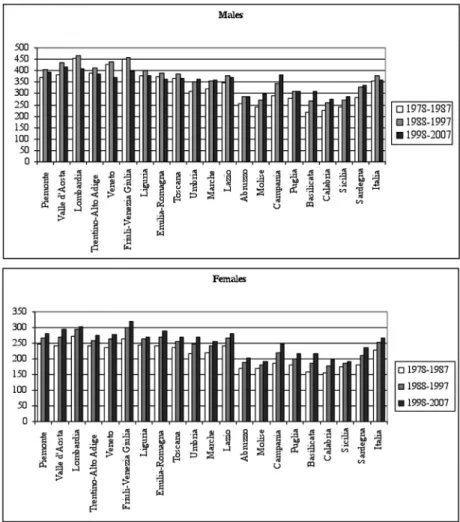
The incidence rate for females instead is estimated to increase in each Region, in a more consistent manner for some South Regions (Campania, Puglia, Basilicata, Sardegna) (Graphic 2). The caesarean section has been studied with regard to maternal age, showing a decrease for each age class but with strong variability between Regions; South Regions still have the higher caesarean rates.
increasing especially among Eastern Europe and China population. Rumanians are the first community with regard to permissions to stay.
Taking into consideration their labour market insertion it is noticed that they have an activity and occupancy rate higher than Italians; occupancy sectors are, in general, building and services to family. In view of the rapid changes occurring in the health care systems at national level over the last years concepts like cost containment have become a strategic matter and many efforts have been made in order to identify interventions and factors with the potential to reduce health care costs.
From this perspective medicines consumption is considered one of the main factor that contributes to the national health expenditure and for this reason much attention is given in studying its distribution.
There is a strong variability in medicines use and consumption within Regions; e.g., while Molise and Trento has registered an increase of consumption respectively of 16% and 11% between 2005 and 2006, Bolzano has decreased the consumption of 4%.
In general pharmaceutical expenditure covered
by the National Health System has shown some improvement, but in the South it still remains too high.
Moreover, the Observatory Health Report each year analyzes through a consistent number of indicators the hospital health care that still absorbs the majority of health care activity, in terms of human and monetary resources.
In the last decade the hospital health care has passed
through a process of
reorganization intended to improve the outputs and outcomes.
This reorganization requires the necessity for achieving aims fixed by the strategic planning of the National Health System and of each regional system.
The most important aims are:
• 4.5 bed places per 1,000
inhabitants;
• 180 hospital discharge
rate per 1,000 inhabitants. In the meantime national disposals encourage the use of different typology of health care like Day Hospital, Day Surgery, long term rehabilitation, home care, etc.
The Observatory Health Report tries to monitor constantly these ongoing changes: hospital discharge rates are decreasing while long term and rehabilitation discharges are increasing.
These positive results mean that there is a major use of territorial care.
At last positive results are achieved in regard with organ transplants; Italy has the leadership in the European scenario in donors, interventions quality and performances security.
Conclusions
The overview of the Italian Health system, described by the data of the Observatory Health Report, shows that the health status of Italian people is good with positive results and outcomes, but in the meantime some further efforts should be done especially in the South that still has to improve the quality and the organization of health care services.
The Observatory Report each year describes the health status of Italian population and monitor the
Graphic 1. Life expectancy at birth, males and females, per Italian region. Years 2002-2006.
*Provisional data
possible changes.
The principal aim is to provide objective and reliable data useful in taking important decisions regarding consistent, reasonable and timely actions.
This year it recognizes the following priorities: 1) To take into consideration the patient perspective, in terms of perceived efficacy and quality of services. The research on patient satisfaction shows that the 43.4% of the investigated Italian population expressed a hardly sufficient satisfaction with the Public Health Service, while 34% were satisfied.
In order to change their perspective it is
necessary to develop a widespread
communication system and to focus on the organizational and management results as a decisive step towards meeting the population needs.
2) In terms of primary care: to improve the
monitoring of primary health care services (where the chronic disease could be
cared) through the
implementation of clinical pathways.
3) To improve specific areas such as caesarean deliveries (the average rate of caesarean sections in Italy is 38% which is higher than the OMS (WHO) standard of 15%), as well as the average length of stay in the pre-intervention phase.
In conclusion, there are huge differences in accuracy and therefore usefulness of the reported data, both between diseases and between Regions. This is one of the main challenges for the National Observatory to address.
This report sheds new light on what makes health systems behave in certain ways, and offers them better directions to pursue their goals.
References
1) Crump B. Foreword. In: Pencheon D.
The Good Indicators Guide:
Understanding how to use and choose
indicators. NHS, Institute for
Innovation and Improvement, APHO, 2008:2.
2) Stein, H. Do Health Reports Meet the Information Needs of their Users? In: The German Health Reporting System and Current Approaches in Europe. Proceedings of the International Conference, Robert Koch Institut, Berlin, 2001:29-31.
3) WHO. The World Health Report 2000. Health systems: improving performance, 2000.
4) ECHI. Public health indicators for Europe: context, selection, definition final report by the ECHI project, 2005.
5) Canadian Institute for Advanced Research’s (CIAR). Population Health Program, 2001.
6) Health at a glance 2007: OECD indicators, 2007
7) Bynam, WF, Porter R. (eds.) Companion Encyclopaedia of the history of medicine. London: Routledge, 1994.
8) Aromaa A. Health Observation and Health Reporting in Europe. Revue Épidém. et Santé Publ 1998;46:481-90.
Source: The Observatory Health Report, 2007