z
REVIEW ARTICLE
EFFECT OF MULCHING AND NUTRIENT MANAGEMENT PRACTICES ON GROWTH, YIELD,
NUTRIENT UPTAKE OF INDIAN MUSTARD (BRASSICA JUNCEA
L.)
AND SOIL MOISTURE CONTENT
*
Tiryak Kumar Samant
Krishi Vigyan Kendra (Orissa University of Agriculture and Technology), Angul-759132, Odisha, India
ARTICLE INFO ABSTRACT
Field experiment was carried out in Instructional farm, Krishi Vigyan Kendra, Angul of Odisha during rabi seasons of 2010-11 and 2011-12 to study effect of mulching and nutrient management practices on growth, yield, nutrient uptake of Indian mustard and soil moisture content. The experiment comprised of three main plot treatments viz. no mulching, soil mulching, straw mulching and four subplots viz RDF, RDF+Sulphur, 75% RDF+FYM, 75% RDF+vermicompost in split plot design with three replications. The results revealed that application of straw mulching@ 5t ha-1 recorded significantly higher dry matter accumulation plant-1(28.43 g) , no of siliquae plant-1(171.58), grain yield(14.17 q ha-1), stover yield (47.75 q ha-1), harvest index (22.93 %), soil moisture content at harvest( 14.8 %) with maximum uptake of N, P, K and S by both seeds and stovers than no mulching. Among the nutrient management practices, application of 75% RDF+ vermicompost 2 t ha -1 recorded maximum dry matter accumulation plant-1 (30.85 g), grain yield(18.83 q ha-1) with
moisture content at harvest(13.67 %). Thus, application of straw mulching @ 5t ha-1and 75% RDF+ vermicompost 2 t ha-1can be practiced for maximizing yield, improvement of growth, nutrient uptake of Indian mustard and soil moisture content.
Copyright © 2015 Tiryak Kumar Samant. This is an open access article distributed under the Creative Commons Attribution License, which permits unrestricted use, distribution, and reproduction in any medium, provided the original work is properly cited.
INTRODUCTION
Indian mustard (Brassica juncea L.) is the second important oilseed crop cultivating for its premier oil for manifold uses. India is the fourth largest oilseed economy in the world. Among the seven edible oilseeds cultivated in India, rapeseed-mustard contributes 28.6% in the total oilseeds production and
ranks second after groundnut sharing 27.8% in the India’s
oilseed economy. The mustard growing areas in India are experiencing the vast diversity in the agro climatic conditions and different species of rapeseed-mustard are grown in some or other part of the country (Shekhawat et al., 2012). In Odisha state, it is grown in an area of 0.24 lakh hectare with a production of 0.28 lakh tonnes and a productivity of 11.81 q ha-1(Anonymous, 2012). Its productivity is much lower than the national average. One of the major problems in low productivity is due to moisture stress faced by the crop during latter part of the crop growth. So soil mousture conservation through mulching plays an important role for enhancing the productivity (Mandal and Ghosh, 1984). Because of deep tap root system and inherent tolerance to soil moisture stress, Indian mustard is generally grown under rainfed condition. Also sulphur free inorganic fertiliser have limited the crop yield. To build up soil fertility through INM was suggested as
*Corresponding author: Tiryak Kumar Samant
Krishi Vigyan Kendra (Orissa University of Agriculture and Technology), Angul-759132, Odisha, India
potential means to increase the soil fertility especially in dry lands (Subha Reddy, et al., 1991). The uptake of the nutrients by mustard increased due to gypsum application and deep ploughing. A profuse vegetative growth and higher yield due to deep tillage and sulphur application through gypsum might have increased the uptake of these nutrients by the crop(Pal and Phogat, 2005) Indian farmers are mostly marginal and small, donot apply the recommended doses of nutrients to these energy rich crops. Indigenously available organic sources of nutrients have been recorded to enhance the efficiency and reduce the requirements of chemical fertilisers. The functions of sulphur within the plant are closely related to those of nitrogen and the two nutrients are synergistics. There is a negative balance of sulphur in our soils as its addition through varios sources is much lower than the removal (Mohd et al., 2007). Keeping in view the importances of mulching and nutrient management in Indian mustard , an experiment was carried out to study the effect of mulching and nutrient management practices on growth, yield, nutrient uptake of Indian mustard and soil moisture content.
MATERIALS AND METHODS
A field experiment was carried out in Instructional farm, Krishi Vigyan Kendra, Angul district in mid central table land zone of Odisha during rabi seasons of 2010-11 and 2011-12 to study effect of mulching and nutrient management practices on
ISSN: 0975-833X
Available online at http://www.journalcra.com
International Journal of Current Research
Vol. 7, Issue, 04, pp.14329-14333, April, 2015
INTERNATIONAL JOURNAL OF CURRENT RESEARCH
Article History: Received 07thJanuary, 2015 Received in revised form 19thFebruary, 2015
Accepted 07thMarch, 2015
Published online 28thApril, 2015
Key words:
Mulching,
Nutrient management, Nutrient uptake , Indian mustard, Soil moisture content.
z
REVIEW ARTICLE
EFFECT OF MULCHING AND NUTRIENT MANAGEMENT PRACTICES ON GROWTH, YIELD,
NUTRIENT UPTAKE OF INDIAN MUSTARD (BRASSICA JUNCEA
L.)
AND SOIL MOISTURE CONTENT
*
Tiryak Kumar Samant
Krishi Vigyan Kendra (Orissa University of Agriculture and Technology), Angul-759132, Odisha, India
ARTICLE INFO ABSTRACT
Field experiment was carried out in Instructional farm, Krishi Vigyan Kendra, Angul of Odisha during rabi seasons of 2010-11 and 2011-12 to study effect of mulching and nutrient management practices on growth, yield, nutrient uptake of Indian mustard and soil moisture content. The experiment comprised of three main plot treatments viz. no mulching, soil mulching, straw mulching and four subplots viz RDF, RDF+Sulphur, 75% RDF+FYM, 75% RDF+vermicompost in split plot design with three replications. The results revealed that application of straw mulching@ 5t ha-1 recorded significantly higher dry matter accumulation plant-1(28.43 g) , no of siliquae plant-1(171.58), grain yield(14.17 q ha-1), stover yield (47.75 q ha-1), harvest index (22.93 %), soil moisture content at harvest( 14.8 %) with maximum uptake of N, P, K and S by both seeds and stovers than no mulching. Among the nutrient management practices, application of 75% RDF+ vermicompost 2 t ha -1 recorded maximum dry matter accumulation plant-1 (30.85 g), grain yield(18.83 q ha-1) with
moisture content at harvest(13.67 %). Thus, application of straw mulching @ 5t ha-1and 75% RDF+ vermicompost 2 t ha-1can be practiced for maximizing yield, improvement of growth, nutrient uptake of Indian mustard and soil moisture content.
Copyright © 2015 Tiryak Kumar Samant. This is an open access article distributed under the Creative Commons Attribution License, which permits unrestricted use, distribution, and reproduction in any medium, provided the original work is properly cited.
INTRODUCTION
Indian mustard (Brassica juncea L.) is the second important oilseed crop cultivating for its premier oil for manifold uses. India is the fourth largest oilseed economy in the world. Among the seven edible oilseeds cultivated in India, rapeseed-mustard contributes 28.6% in the total oilseeds production and
ranks second after groundnut sharing 27.8% in the India’s
oilseed economy. The mustard growing areas in India are experiencing the vast diversity in the agro climatic conditions and different species of rapeseed-mustard are grown in some or other part of the country (Shekhawat et al., 2012). In Odisha state, it is grown in an area of 0.24 lakh hectare with a production of 0.28 lakh tonnes and a productivity of 11.81 q ha-1(Anonymous, 2012). Its productivity is much lower than the national average. One of the major problems in low productivity is due to moisture stress faced by the crop during latter part of the crop growth. So soil mousture conservation through mulching plays an important role for enhancing the productivity (Mandal and Ghosh, 1984). Because of deep tap root system and inherent tolerance to soil moisture stress, Indian mustard is generally grown under rainfed condition. Also sulphur free inorganic fertiliser have limited the crop yield. To build up soil fertility through INM was suggested as
*Corresponding author: Tiryak Kumar Samant
Krishi Vigyan Kendra (Orissa University of Agriculture and Technology), Angul-759132, Odisha, India
potential means to increase the soil fertility especially in dry lands (Subha Reddy, et al., 1991). The uptake of the nutrients by mustard increased due to gypsum application and deep ploughing. A profuse vegetative growth and higher yield due to deep tillage and sulphur application through gypsum might have increased the uptake of these nutrients by the crop(Pal and Phogat, 2005) Indian farmers are mostly marginal and small, donot apply the recommended doses of nutrients to these energy rich crops. Indigenously available organic sources of nutrients have been recorded to enhance the efficiency and reduce the requirements of chemical fertilisers. The functions of sulphur within the plant are closely related to those of nitrogen and the two nutrients are synergistics. There is a negative balance of sulphur in our soils as its addition through varios sources is much lower than the removal (Mohd et al., 2007). Keeping in view the importances of mulching and nutrient management in Indian mustard , an experiment was carried out to study the effect of mulching and nutrient management practices on growth, yield, nutrient uptake of Indian mustard and soil moisture content.
MATERIALS AND METHODS
A field experiment was carried out in Instructional farm, Krishi Vigyan Kendra, Angul district in mid central table land zone of Odisha during rabi seasons of 2010-11 and 2011-12 to study effect of mulching and nutrient management practices on
ISSN: 0975-833X
Available online at http://www.journalcra.com
International Journal of Current Research
Vol. 7, Issue, 04, pp.14329-14333, April, 2015
INTERNATIONAL JOURNAL OF CURRENT RESEARCH
Article History: Received 07thJanuary, 2015 Received in revised form 19thFebruary, 2015
Accepted 07thMarch, 2015
Published online 28thApril, 2015
Key words:
Mulching,
Nutrient management, Nutrient uptake , Indian mustard, Soil moisture content.
z
REVIEW ARTICLE
EFFECT OF MULCHING AND NUTRIENT MANAGEMENT PRACTICES ON GROWTH, YIELD,
NUTRIENT UPTAKE OF INDIAN MUSTARD (BRASSICA JUNCEA
L.)
AND SOIL MOISTURE CONTENT
*
Tiryak Kumar Samant
Krishi Vigyan Kendra (Orissa University of Agriculture and Technology), Angul-759132, Odisha, India
ARTICLE INFO ABSTRACT
Field experiment was carried out in Instructional farm, Krishi Vigyan Kendra, Angul of Odisha during rabi seasons of 2010-11 and 2011-12 to study effect of mulching and nutrient management practices on growth, yield, nutrient uptake of Indian mustard and soil moisture content. The experiment comprised of three main plot treatments viz. no mulching, soil mulching, straw mulching and four subplots viz RDF, RDF+Sulphur, 75% RDF+FYM, 75% RDF+vermicompost in split plot design with three replications. The results revealed that application of straw mulching@ 5t ha-1 recorded significantly higher dry matter accumulation plant-1(28.43 g) , no of siliquae plant-1(171.58), grain yield(14.17 q ha-1), stover yield (47.75 q ha-1), harvest index (22.93 %), soil moisture content at harvest( 14.8 %) with maximum uptake of N, P, K and S by both seeds and stovers than no mulching. Among the nutrient management practices, application of 75% RDF+ vermicompost 2 t ha -1 recorded maximum dry matter accumulation plant-1 (30.85 g), grain yield(18.83 q ha-1) with
moisture content at harvest(13.67 %). Thus, application of straw mulching @ 5t ha-1and 75% RDF+ vermicompost 2 t ha-1can be practiced for maximizing yield, improvement of growth, nutrient uptake of Indian mustard and soil moisture content.
Copyright © 2015 Tiryak Kumar Samant. This is an open access article distributed under the Creative Commons Attribution License, which permits unrestricted use, distribution, and reproduction in any medium, provided the original work is properly cited.
INTRODUCTION
Indian mustard (Brassica juncea L.) is the second important oilseed crop cultivating for its premier oil for manifold uses. India is the fourth largest oilseed economy in the world. Among the seven edible oilseeds cultivated in India, rapeseed-mustard contributes 28.6% in the total oilseeds production and
ranks second after groundnut sharing 27.8% in the India’s
oilseed economy. The mustard growing areas in India are experiencing the vast diversity in the agro climatic conditions and different species of rapeseed-mustard are grown in some or other part of the country (Shekhawat et al., 2012). In Odisha state, it is grown in an area of 0.24 lakh hectare with a production of 0.28 lakh tonnes and a productivity of 11.81 q ha-1(Anonymous, 2012). Its productivity is much lower than the national average. One of the major problems in low productivity is due to moisture stress faced by the crop during latter part of the crop growth. So soil mousture conservation through mulching plays an important role for enhancing the productivity (Mandal and Ghosh, 1984). Because of deep tap root system and inherent tolerance to soil moisture stress, Indian mustard is generally grown under rainfed condition. Also sulphur free inorganic fertiliser have limited the crop yield. To build up soil fertility through INM was suggested as
*Corresponding author: Tiryak Kumar Samant
Krishi Vigyan Kendra (Orissa University of Agriculture and Technology), Angul-759132, Odisha, India
potential means to increase the soil fertility especially in dry lands (Subha Reddy, et al., 1991). The uptake of the nutrients by mustard increased due to gypsum application and deep ploughing. A profuse vegetative growth and higher yield due to deep tillage and sulphur application through gypsum might have increased the uptake of these nutrients by the crop(Pal and Phogat, 2005) Indian farmers are mostly marginal and small, donot apply the recommended doses of nutrients to these energy rich crops. Indigenously available organic sources of nutrients have been recorded to enhance the efficiency and reduce the requirements of chemical fertilisers. The functions of sulphur within the plant are closely related to those of nitrogen and the two nutrients are synergistics. There is a negative balance of sulphur in our soils as its addition through varios sources is much lower than the removal (Mohd et al., 2007). Keeping in view the importances of mulching and nutrient management in Indian mustard , an experiment was carried out to study the effect of mulching and nutrient management practices on growth, yield, nutrient uptake of Indian mustard and soil moisture content.
MATERIALS AND METHODS
A field experiment was carried out in Instructional farm, Krishi Vigyan Kendra, Angul district in mid central table land zone of Odisha during rabi seasons of 2010-11 and 2011-12 to study effect of mulching and nutrient management practices on
ISSN: 0975-833X
Available online at http://www.journalcra.com
International Journal of Current Research
Vol. 7, Issue, 04, pp.14329-14333, April, 2015
INTERNATIONAL JOURNAL OF CURRENT RESEARCH
Article History: Received 07thJanuary, 2015 Received in revised form 19thFebruary, 2015
Accepted 07thMarch, 2015
Published online 28thApril, 2015
Key words:
Mulching,
growth, yield, nutrient uptake of Indian mustard and soil moisture content. The geographical location of the area has 840 16΄to 850 23΄ E longitude and 200 31΄ to 210 41΄ N latitude and average elevation of 300 m above mean sea level. The average rainfall in both the year during the study period from October to February was 124.5 mm. The mean maximum and mean minimum temperature registered in both the year was 32.80 C and 14.50 C respectively. The soil of the experimental site was slightly acidic in reaction (pH-5.52), sandy loam in texture with medium in organic carbon (0.45 %), available nitrogen (212.6 kg ha-1), phosphorus (15.27 kg ha-1) and potash (234.85 kg ha-1) contents (Jackson, 1973). The experiment involved three main plot treatments comprising different mulching viz.T1- No mulching, T2-Soil mulching, T3 -Straw mulching @5t ha-1 and four subplots viz N1 -RDF(60:30:30 kg NPK ha-1), N2-RDF+S(40kg ha-1), N3- 75% RDF+FYM 5 t ha-1, N4- 75% RDF+Vermicompost 2 t ha-1. Experiment was conducted in split plot design with three replications in a fixed layout. Recommended package of practices were followed for growing Indian mustard cv.Pusa
Bold during both the year. The crop was sown during 2nd
week of October with 30X10 cm spacing and harvested during 1st week of February. The recommended fertilizer dose were N:P:K 60:30:30 kg ha-1 respectively. Full dose of P and K as basal and N in 2 splits i.e 50% as basal and 50% at 30 DAS. All the moisture conservation practices were applied at 25 DAS. The straw mulch @5 t ha-1was applied. Sulphur 40 kg ha-1through gypsum was drilled in rows of mustard at time of sowing. Three numbers of irrigations were given during seeding, flower initiation and siliquae development. Soil samples were collected at 30 cm depth at 60 DAS and harvest to esimate soil moisture.
Seed and stover samples taken after crop harvest were washed throughly, dried at 700C, pulverized and were digested in a diacid mixture of concentrated HNO3 and HCLO4 (9.1) and sulphur in the extract was estimated by turbidimetric method (Chesnin and Yien, 1951). The datas were statistically analyzed applying the techniques of analysis of variance and the significance of different sources of variations were tested
by error mean square of Fisher Snedecor’s ‘F’ test at
probability level 0.05 (Cochran and Cox, 1977). The datas were statistically analyzed applying the techniques of analysis of variance and the significance of different sources of variations were tested by error mean square of Fisher
Snedecor’s ‘F’ test at probability level 0.05 (Cochran and Cox
1977).
RESULTS AND DISCUSSION
Growth parameters
Growth parameters like plant height, no of primary branches plant-1 and dry matter accumulation plant-1were significantly increased by 2.79, 7.16 and 13.5 % respectively with application of straw mulching@ 5t ha-1 as compared to no mulching (Table 1). Application of RDF+ Sulphur 40 kg ha-1 produced the tallest plant(157.2 cm), maximum number of primary branches plant-1(5.16) as compared to other nutrient management treatments attributed to increased cell division and cell elongation. These results are consistent with Rawat
et al. (2000) and Sharma, (1994). Maximum dry matter
[image:2.595.71.521.455.589.2]accumulation plant-1 (30.85 g) was recorded with application of 75% RDF+Vermicompost 2 t ha-1.
Table 1. Effect of mulching and nutrient management practices on growth parameters of Indian mustard
Treatment Plant height (cm) No of primary branches plant-1 Dry matter accumulation plant-1(g)
Mulching practices
T1- No mulching 146.03 4.61 25.05
T2-Soil mulching 149.3 4.85 27.85
T3-Straw mulching @5t ha-1 150.1 4.94 28.43
SEm+ 0.044 0.004 0.055
C.D at 5 % 0.173 0.017 0.217
Nutrient management practices
N1-RDF (60:30:30 kg NPK ha-1) 137.4 4.32 21.73
N2-RDF+S (40kg ha-1) 157.2 5.16 29.52
N3- 75% RDF+FYM 5 t ha-1 145.7 4.67 26.34
N4- 75% RDF+Vermicompost 2 t ha-1 153.6 5.04 30.85
SEm+ 0.092 0.005 0.063
C.D at 5 % 0.274 0.015 0.187
*RDF:Recommended Dose of Fertiliser; S: Sulphur; SEm:Standard Error of Mean; CD:Critical Difference
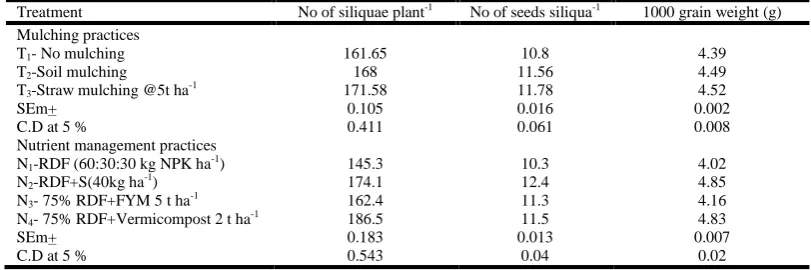
Table 2. Effect of mulching and nutrient management practices on yield attributing characters of Indian mustard
Treatment No of siliquae plant-1 No of seeds siliqua-1 1000 grain weight (g)
Mulching practices
T1- No mulching 161.65 10.8 4.39
T2-Soil mulching 168 11.56 4.49
T3-Straw mulching @5t ha-1 171.58 11.78 4.52
SEm+ 0.105 0.016 0.002
C.D at 5 % 0.411 0.061 0.008
Nutrient management practices
N1-RDF (60:30:30 kg NPK ha-1) 145.3 10.3 4.02
N2-RDF+S(40kg ha-1) 174.1 12.4 4.85
N3- 75% RDF+FYM 5 t ha-1 162.4 11.3 4.16
N4- 75% RDF+Vermicompost 2 t ha-1 186.5 11.5 4.83
SEm+ 0.183 0.013 0.007
C.D at 5 % 0.543 0.04 0.02
[image:2.595.94.500.629.764.2]Yield attributing characters
Application of straw mulching@ 5t ha-1recorded (Table 2) the maximum yield attributing characters like no of siliqua plant -1
(171.58), no of seeds siliqua-1(11.78), 1000 grain weight (4.52 g) which is 6.1, 9.1 and 3.0 %, respectively, higher than no mulching. Application of 75% RDF+Vermicompost 2 t ha-1 produced siliqua plant-1(186.5) which is 28.4 % higher than sole 100% RDF. Maximum seeds siliqua-1(12.4) was produced in RDF+ Sulphur 40 kg ha-1 followed by 75% RDF+Vermicompost 2 t ha-175% and RDF+FYM 5 t ha-1 which were at par . Application of RDF+ Sulphur 40 kg ha-1 showed a significant increase in 1000 grain weight (20.6 %) as compared to sole 100% RDF and was at par with application of 75% RDF+Vermicompost 2 t ha-1owing to better nitrogen and carbohydrate metabolism of plants that facilitates synthesis of nuclic acids and hormones which had encouraged the better filling of seeds (Yadav et al, 1999).
Yield
[image:3.595.106.487.284.420.2]Application of mulching practices recorded significantly higher grain yield than no mulching treatment. (Table 3). Application of Straw mulching @ 5t ha-1 resulted maximum grain yield 14.17 q ha-1 followed by soil mulching (12.79 q ha-1) which were 24.2 and 12.1% higher than no mulching respectively. Among the mulching practices, maximum stover yield (47.75 q ha-1) and harvest index (22.93%) was observed in straw mulching @ 5t ha-1. It may be due to sustained supply of nutrient and water to the crop. This is in line with the results reported by Dubey et al. (1993). Among the nutrient management practices, application of 75% RDF+ vermicompost 2 t ha-1 was found to be superior over other nutrient management practices and recorded the maximum grain yield (18.83 q ha-1) with harvest index (22.75 %).
Table 3. Effect of mulching and nutrient management practices on yield of Indian mustard
Treatment Grain yield (q ha-1) Stover yield (q ha-1) Harvest index (%)
Mulching practices
T1- No mulching 11.41 45.13 20.22
T2-Soil mulching 12.79 47.1 21.28
T3-Straw mulching @5t ha-1 14.17 47.75 22.93
SEm+ 0.035 0.043 0.039
C.D at 5 % 0.136 0.171 0.152
Nutrientmanagement practices
N1-RDF (60:30:30 kg NPK ha-1) 11.53 41.90 21.56
N2-RDF+S(40kg ha-1) 13.64 52.30 20.66
N3- 75% RDF+FYM 5 t ha-1 12.15 45.83 20.94
N4- 75% RDF+Vermicompost 2 t ha-1 18.83 47.0 22.75
SEm+ 0.015 0.066 0.014
[image:3.595.108.490.445.580.2]C.D at 5 % 0.043 0.196 0.04
Table 4. Effect of mulching and nutrient management practices on soil moisture content
Treatment Moisture content (%) at 60 DAS Moisture content (%) at harvest Mulching practices
T1- No mulching 18.7 11.5
T2-Soil mulching 20.5 13.6
T3-Straw mulching @5t ha-1 21.3 14.8
SEm+ 0.028 0.042
C.D at 5 % 0.109 0.165
Nutrientmanagement practices
N1-RDF (60:30:30 kg NPK ha-1) 19.57 12.83
N2-RDF+S(40kg ha-1) 20.17 13.3
N3- 75% RDF+FYM 5 t ha-1 20.37 13.4
N4- 75% RDF+Vermicompost 2 t ha-1 20.57 13.67
SEm+ 0.004 0.042
C.D at 5 % 0.013 0.013
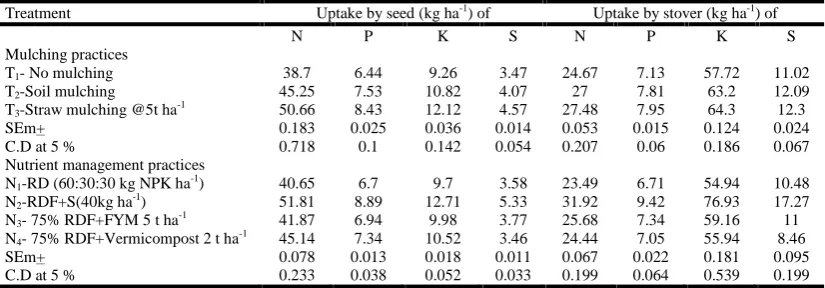
Table 5. Effect of mulching and nutrient management practices on nutrients uptake
Treatment Uptake by seed (kg ha-1) of Uptake by stover (kg ha-1) of
N P K S N P K S
Mulching practices
T1- No mulching 38.7 6.44 9.26 3.47 24.67 7.13 57.72 11.02
T2-Soil mulching 45.25 7.53 10.82 4.07 27 7.81 63.2 12.09
T3-Straw mulching @5t ha-1 50.66 8.43 12.12 4.57 27.48 7.95 64.3 12.3
SEm+ 0.183 0.025 0.036 0.014 0.053 0.015 0.124 0.024 C.D at 5 % 0.718 0.1 0.142 0.054 0.207 0.06 0.186 0.067 Nutrient management practices
N1-RD (60:30:30 kg NPK ha-1) 40.65 6.7 9.7 3.58 23.49 6.71 54.94 10.48
N2-RDF+S(40kg ha-1) 51.81 8.89 12.71 5.33 31.92 9.42 76.93 17.27
N3- 75% RDF+FYM 5 t ha-1 41.87 6.94 9.98 3.77 25.68 7.34 59.16 11
N4- 75% RDF+Vermicompost 2 t ha-1 45.14 7.34 10.52 3.46 24.44 7.05 55.94 8.46
[image:3.595.93.506.610.754.2]This may be due to its high nutritinal composition. Application of RDF+ Sulphur 40 kg ha-1 produced 18.3% higher grain yield as compared to sole 100% RDF alone may be due to better availability of nutrients and their translocation. Simillarly application of 75% RDF+FYM 5 t ha-1recorded 5.4 % higher grain yield than sole 100% RDF attributed to increase in soil organic carbon, secondary and micro-nutrient availability coupled with better physico-chemical and biological properties of soil. These results are in conformity with findings of Patel and Shelke (1998) and Jain and Sharma (2000).
Soil moisture content
Mulching treatments recorded higher soil moisture content than no mulch treatment both at 60 DAS and harvest. Straw mulching @5t ha-1 conserved more moisture (21.3% at 60 DAS and 14.8 % harvest) as compared to other mulching treatments (Table 4) owing to reduced crop weed competition for moisture and reduced evaration loss resulting more moisture conservation. These results are also in agrrement with results of Nikam et al. (2009). Soil mulching resulted moisture content (20.5 and 13.6 % at 60 DAS and harvest respectively). No mulching resulted minimum moisture content 18.7 and 11.5 % at 60 DAS and harvest respectively. The higher soil moisture content below the mulches might be due to reduction in soil surface evaporation and weed intensity (Shiurgure et al., 2003). These results are in agrrement with Kumar et al., (2001). Among the nutrient management practices, application of 75% RDF+Vermicompost 2 t ha-1 recorded maximum moisture content 20.57 and 13.67 % at 60 DAS and harvest respectively. Similar results were obtained by Banik et al. (2008).
Nutrient uptake
Perusal of the results presented in (Table 5) clearly reveals that all the mulching practices brought about significant differences in the uptake of nutrients over no mulching. Maximum uptake of N, P, K and S was obtained in straw mulching @5t ha-1 which were (11.96, 1.99, 2.86 and 1.1 kg ha-1 respectively) higher by seed and (2.81, 0.82, 6.58 and 1.28 kg ha-1 respectively) higher by stover than no mulching. Application of RDF+ Sulphur 40 kg ha-1 recorded the maximum uptake of N, P, K and S by seed (51.81, 8.89, 12.71 and 5.33 kg ha-1, respectively) and by stover (31.92, 9.42, 76.93 and 17.27 kg ha-1, respectively) followed by 75% RDF+Vermicompost 2 t ha-1; 75% RDF+FYM 5 t ha-1and RDF(60:30:30 kg NPK ha-1) which were statistically significant in case of both seed and stover. Higher accumulation and uptake of nutrients under these treatments could be ascribed to better availability and synergistic effect of applied nutrients. These results are in agreement with Kumaran and Solaimalai (2000).
Conclusion
Thus, application of Straw mulching @ 5t ha-1 and 75% RDF+Vermicompost 2 t ha-1 was found to be beneficial and can be practiced for maximizing the yield of Indian mustard, improvement of quality, conserving soil moisture.
REFERENCES
Anonymous, 2012. Odisha Agriculture Statistics 2011-12, Directorate of Agriculture, pp.5.
Banik, P. and Sharma, R. C. 2008. Effects of integrated nutrient management with mulching on rice (Oryza sativa)-based cropping systems in rainfed eastern plateau area.
Indian Journal of Agricultural Sciences, 78(3):240-243.
Chesnin, L. and Yien, C. H.1951. Turbidimetric determination of sulphur. Soil Science Society of America Proceedings, 15:149-150.
Cochran, W. G. and Cox, G. M. 1977. Experimental Designs. Asia Publishing House. Kolkata, pp. 95-132 & 142-181. Dubey, M. P., Mishra, P. C. and Purohit, J. P. 1993. Influence
of mulching on double cropping of early soyabean and leanseed under rainfed condition. Indian Journal of
Agronomy, 38(3):361-364.
Jackson, M. L.1973. Soil Chemical Analysis, Prentice Hall of India Private Limited, New Delhi.
Jain, N. K and Sharma, P. P. 2000. Integrated nutrient management in mustard. Jounal of Oilseeds Research, 17(1):127-129.
Kumar, S., Singh, B. and Rajput, A. L. 2001. Response of Indian mustard(Brassica juncea) to source and level of sulphur. Indian Journal of Agronomy, 46:528-532.
Kumaran, S. and Solaimalai, A. 2000. Effect of organic manure and inorganic fertilisers on yield and nutrient uptake of irrigated groundnut. Crop Research.20:35-38. Mandal, B. K. and Ghosh, T. K.1984.Effect of mulches on the
growth and yield of sesamum. Indian Journal of Agronomy, 29(4):549-552.
Mohd. A. B, Singh, R. and Kohli, A. 2007.Effect of Integrated use of farm yard manure and fertiliser nitrogen with and without sulphur on yield and quality of Indian mustard.
Journal of the Indian Society of Soil Sciences,
55(2):224-226.
Nikam, R. R., Ghorpade, P. B., Gohokar, R.T., Manapure, P.R. and Patil, P. V.2009. Studies on moisture consrvation practices for linseed grown under rainfed situation. Journal
of Oil seeds Research, 26(Special Issue):389-390.
Pal, D and Phogat, V. K. 2005. Effect of deep tillage and gypsum on yield and N,P,K and S uptake by Mustard.
Journal of the Indian Society of Soil Sciences,
53(1):134-136.
Patel, J. R. and Shelke, V. B.1998. Effect of FYM, phosphorus and sulphur on growth, yield and quality of Indian mustard(Brassica juncea). Indian Journal of Agronomy, 43:713-717.
Rawat, R. F., Abdul Hamid, Hadole, S. S. and Jeughale, G.S.2000. Effect of irrigation and sulphur on concentration, uptake and availability of sulphur, nitrogen and phophorus in mustard(Brassica juncea). Journal of Soils and Crops, 10:145-148.
Sharma, J. P. 1994. Response of Indian mustard(Brassica
juncea) to different irrigation schedules and nitrogen and
sulphur levels. Indian Journal of Agronomy, 39(3):421-425.
Shekhawat, K., Rathore, S. S., Premi, O. P, Kandpal, B.K. and J. S. Chauhan.2012. Advances in Agronomic Management of Indian Mustard (Brassica juncea (L.) Czernj. Cosson).
International Journal of Agronomy, 2012:1-14.
Shirgure, P. S., Sonkar, R. K., Singh, Shyam and Panigrahi, P. 2003. Effect of different mulches on soil moisture conservation, weed reduction, growth and yield of drip irrigated mandarin (Citrus reticulata). Ind. J. Agric
Sci., 73(3):148-152.
Subba Reddy, G., Venkataswaralu and Shankara, G. R. M. 1991. Green leaf mannuring as an alternative nitrogen source for castor bean on marginal soils of India. American
Journal of Alternative Agriculture, 6:132-138.
Yadav, M. S., Singh, R. N. and Meheta, D. 1999. Boron requirement of crops. Indian Farming, 48(12):4-5.