http://dx.doi.org/10.4236/jwarp.2012.42011 Published Online February 2012 (http://www.SciRP.org/journal/jwarp)
Adsorption of Dye Eosin from an Aqueous Solution on
Two Different Samples of Activated Carbon by
Static Batch Method
Rita Kant
Institute of Fashion Technology, Panjab University, Chandigarh, India Email: [email protected]
Received December 16, 2011; revised January 11, 2012; accepted February 5, 2012
ABSTRACT
Removal of dye Eosin on two different samples of activated carbon by static batch method was studied. Experimental data on optical density of blank solutions of different concentrations ranging from 10 to 100 mg/L and optical density of solutions after adsorption on activated carbon samples were taken and analyzed. Calibration curves were plotted and the amount of dye adsorbed was calculated. The data was fitted to Langmuir and Freundlich isotherms for two different carbon samples and different concentration values. Constants were calculated from the slope and intercept values of the isotherms. Coefficient of correlation R2 and Standard Deviation SD were also noted. The data fitted well to the iso- therms. It was observed that adsorption decreased with increase in ppm concentrations. Carbon sample C2 showed
higher potential to adsorb the dye Eosin as compared to carbon sample C1. Further Carbon sample C2 showed better
adsorption in acidic pH as compared to in alkaline pH. From the analysis of the data it is shown that C2 sample has a
good capacity to remove the textile dye from the residue water.
Keywords: Adsorption; Eosin; Activated Carbon; Textile Industry Effluent
1. Introduction
Dyestuffs are being used by a large number of industries to color their products and make their appearance more attractive. Textile dyeing industry uses a lot of synthetic dyes due to their superior dyeing properties, especially in terms of fastness. This industry emits significant amounts of synthetic textile organic dye wastes amongst all Indus- trial waste waters. 10.000 different types of dyes and pigments and dyes are being manufactured worldwide annually. Approximately it is estimated that 10% to 15% of the dye is lost in the effluent during the dyeing proc- ess , Young et al., 1997; Danis et al., 1998 [1]. The waste water after the dyeing process carries the residual and unspent dye substances which are usually discharged into the environment as such without being treated. This dis- charged effluent is toxic in nature, imparts color to the receiving water or soil and interferes with both land and aquatic plant and animal life, Kadirvelu et al., 2003 [2]. Considering the effect the textile dye effluent is having on all forms of life increasingly strict laws related to de- contamination of wastewater are being passed by various nations. Use of activated carbon has been proposed the for the purpose of decontaminating the colored water. More so because carbons can be re activated and regen- erated for repeated use. It has been seen that a lot of in-
dustrial or agricultural by-products can be used for the production of carbon-based adsorbents. This helps in conserving the nonrenewable natural resources and cre- ating a useful product that has a potential use in pollution control.
Sajjla Sreedhar Reddy, Bijjam Kotaiah, Nanaga Siva Prasad Reddy, Murthukumara Velu [1] studied the re- moval of composite reactive dye from dyeing unit efflux- ent using sewage sludge derived Activated Carbon which was prepared from dried municipal sewage sludge. Batch mode adsorption experiments were conducted to study its potential to remove composite reactive dye from dyeing unit effluent. Adsorption parameters for the Langmuir and Freundlich isotherms were determined and the ef- fects of effluent pH, adsorbent dosage, contact time and initial dye concentration were observed.
treated activated carbon was an attractive candidate for removing organic dye of methylene blue which shows great reduction of colour while reducing the time contact to achieve equilibrium.
Ying Li, Qin-Yan Yue, Bao-Yu Gao, Jing Yang, Yan Zheng [4] studied theadsorption capability of activated carbon fiber (ACF) to four reactive dyes (reactive bril-liant red K-2BP, reactive turquoise blue KN-G, reactive golden yellow K-3RP, reactive black KN-B) in aqueous solution. The results showed that the equilibrium ad-sorbing capacity qe of each dye increases with the
addi-tion to initial concentraaddi-tion or temperature. On the same condition, the order of qe is: reactive brilliant red >
reac-tive golden yellow > reacreac-tive black > reacreac-tive turquoise blue.
Soheila Izadyar, Maryam Rahimi [5] studied the use of beech wood sawdust, an industrial waste, for adsorption of textile dyes. Adsorption of Direct Orange 26, Acid Orange 7, Acid Green 20 dyes was investigated. Lang-muir and Freundlich isotherm models were used for data analysis. This study showed that the beech wood sawdust could be employed as low-cost and effective sorbent for the removal of dyes from aqueous solution
M. Husseien, A. A. Amer, Azza, El-Maghraby, Nahla. A. Tahaused [6] used barley straw as a raw material to produce activated carbon and utilized it as a source for removal of Methylene Blue from simulated aqueous so-ltion. The adsorption capacity was demonstrated by the isotherms. The effects of different system variables, ad- sorbent dosage, initial dye concentration, pH and contact time were studied. The results showed that as the amount of the adsorbent was increased, the percentage of dye removal increased accordingly. Higher adsorption per- centages were observed at lower concentrations of Me- thylene blue. Optimum pH value for dye adsorption was determined as 7. Maximum dye was adsorbed within 90 minutes of beginning time for every experiment.
Sreedhar Reddy, B. Kotaiah [7] studied the sorption of dyes from aqueous solutions on to sludge-based activated carbon and compared it with commercial activated car-bon. Adsorption parameters for the Langmuir and Freund- lich isotherms were determined and the effects of effluent pH, adsorbent dosage, contact time and initial dye con- centration were studied.
Nagarethinam Kannan and Soundrapandian Muru-gavel [8] conducted studies on the removal of Rhoda-mine-B (RB), Congo Red (CR) and Acid Violet (AV) by column method on Iron Chromium Oxide (ICO) and Lignite Coal (LC). The experiment was carried out at 30˚C ± 1˚C. Effect of various experimental parameters were investigated to get the information on treating ef-fluents from the textile industries. The percentage re-moval of dyes (RB, CR and AV) increased with decrease in the initial concentration of dyes and increased with the
increase in the contact time and the dose of adsorbent (in terms of column height). The percentage removal of CR and AV increased with decrease in the initial pH, but decreased for RB due to the nature of the dyes. Adsorp- tion data were modeled with Langmuir adsorption iso- therms. The adsorption capacities of ICO and LC were compared with that of commercial activated carbon (CAC). The results indicate that the materials like ICO and LC could be employed as low cost adsorbents as alternative to CAC in wastewater treatment for the re- moval of dyes.
Rita Kant and V. K. Rattan [9] studied the removal of dye Green B. by adsorption on activated carbon through static batch method and continuous process. The data was fitted to Langmuir and Freundlich isotherms. It was found that adsorption was better in batch process as compared to continuous flow method. The carbon sam- ples exhibited a good capacity to remove the dye Green B. from the textile industry effluent.
2. Experimental
Samples of Granular Activated Carbon C1 and C2 used
were obtained from Brillex Chemical Ltd. Punjab and Industrial Carbon Pvt. Ltd., Gujarat respectively.
A stock solution of the dye with a concentration of 1000 ppm was prepared and dilutions were made with distilled water to make different concentrations. Optical density of all the solutions was measured on a spectro- photometer (ELICO make, wavelength range 200 - 900 nm). One gram of activated carbon was placed in each 50 mL solution of 10 to 100 ppm. The solutions were sha- ken and kept in a thermostat for 24 hr. The samples were then filtered and analyzed spectrophotometrically.
3. Results and Discussion
Table 1 shows the amount qe of dye Eosin adsorbed by C1 and C2 samples of Granulated Activated Carbon at
various pH values and ppm concentrations.
3.1. Adsorption on Different GAC Samples
Adsorption of dye Eosin was studied on two samples of granulated activated carbon. Table 1 shows the amount of Eosin adsorbed on the two GAC samples in same pH environment. It can be seen that at a constant dose of the adsorbent of 1 gm/50 ml of dye solution carbon samples C1 and C2 exhibited almost similar adsorption capacity at
the same pH value of 6.22.
3.2. Effect of Initial Dye Concentration.
Table 1 again shows the amount qe of dye Eosin ad-
sorbed by C1 and C2 samples of granulated activated car-
3.4. Data Fit to Polynomial Isotherm
on GAC C1 and C2 was higher at lower ppm concentra-
[image:3.595.310.539.173.315.2]tion as compared to the adsorption at higher ppm con- centration with the adsorbent dose being kept constant. At lower ppm concentration a substantial amount of dye got adsorbed leaving behind a good number of free ad- sorption sites on the adsorbent. At higher ppm concentra- tions the adsorbent was used to its greater capacity and lesser number of active sites remained available on GAC surface for further adsorption to take place.
Table 2 shows the values of the constants A, B1, B2
along with values of coefficient of correlation R2 and standard deviation SD.
The experimental data was fitted to the polynomial equation:
3.3. Effect of PH
Adsorption of dye Eosin on carbon sample C2 was
greatly effected by change in pH of the aqueous solution as can be seen from Table 1 and Figure 1. Amount of dye adsorbed qe on C2 in acidic pH was higher at all ppm
concentrations as compared to adsorption in a lesser acidic and an alkaline and environment. At initial dye concentration of 10 mg·dye/L the adsorption is 7.5 mg/g on GAC C2 in acidic environment. At the same ppm
con-centration in alkaline pH it is 5.09 mg/g and 5.2 mg/g at a mildly acidic pH.
Figure 1. Polynomial Isotherm for dye Eosin on C1 & C2 at
[image:3.595.100.496.372.564.2]different pH values.
Table 1. Concentration of dyes (Ce) and amount of dye adsorbed per gram of the adsorbent (qe) on C1 & C2 at different pH.
Dye Name Eosin pH
C1 6.22 C2 6.22 C2 4.12 C2 8.30
Ce (mg/L) qe qe qe qe
10 5.300 5.290 7.500 5.090
20 8.050 8.670 12.700 8.630
30 12.400 13.470 18.300 12.130
40 16.430 17.200 23.500 16.630
50 20.960 20.710 28.300 20.640
60 24.840 25.290 32.600 25.000
70 27.390 30.430 37.600 30.000
80 29.300 35.600 43.400 34.630
90 31.910 38.700 47.800 38.000
[image:3.595.101.498.591.737.2]100 34.000 40.200 48.800 38.640
Table 2. Constants for Polynomial Isotherm at various pH values.
Dye Name Eosin pH
C1 6.22 C2 6.22 C2 4.12 C2 8.30
A 1.22633 3.45267 3.31667 3.93067
B1 0.34322 0.15967 0.41935 0.0803
B2 0.00187 0.0059 0.00285 0.0077
B3 –2.07E–05 –3.77E–05 –2.41E–05 –4.98E–05
R2 0.99743 0.99727 0.9976 0.99834
2 e B C1 0B C2 0
Q = A (1)
where C0 is the initial concentration of the dye.
Figure 1 shows the adsorption (qe) at all three pH val-
ues at lower concentrations of Eosin. It can be seen that adsorption increases linearly and gets stable at higher concentration. It shows a better adsorption at an acidic pH of 4.12 as compared to adsorption at slightly acidic pH of 6.22 and alkaline pH of 8.30. It can thus be drawn that acidic pH is best suited for adsorption dye Eosin and that it exhibits a linear behavior.
3.5. Data Fit to Langmuir Isotherms at Various PH
Linear forms of Langmuir isotherms were plotted. The experimental data was fitted to Langmuir isotherm of the type:
e +1 bQ +1 Ce
1 q =1 Q (2)
qe indicates theamount of dye adsorbed per unit weight
of adsorbent (mg/g). Ce is the equilibrium concentration
of dye in mg/L. Q and b are the Langmuir constants where Q indicates the adsorption capacity in mg/g and b relates to the energy of adsorption (L/mg) in different
[image:4.595.159.446.383.554.2]experimental conditions. These were calculated from the straight line slope and intercept of linear plot between 1/qe and 1/Ce.
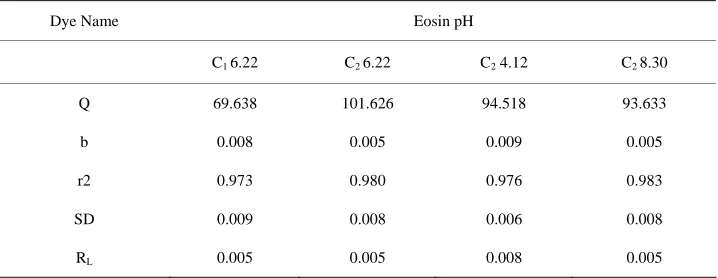
Table 3 gives the values of Langmuir constants Q and b along with the values of r2, RL and SD for all pH values
and for the two samples of GAC, C1 and C2. RL values
indicate the shape of the isotherm. Value of RL between 0
and one indicate a favorable adsorption [10]. RL > 1 is
unfavorable. RL = 1 is linear. 0 > RL < 1 is favorable .RL
= 0 is irreversible.
Value of Q in Table 3 signifies good adsorption of Eosin on C2 as compared to C1 at initial pH. As the val-
ues of RL are seen to lie between 0 and 1 the system can
be said to have shown a favorable adsorption
The linear plots of 1/qe and 1/Ce for Langmuir iso-
therm are shown in Figure 2.
3.6. Data Fit to Freundlich Isotherm at Various pH
Linear forms of Freundlich isotherms were plotted for all the pH values and for the two samples of GAC .
e F e
log q log K 1 n log C (3)
[image:4.595.119.478.598.737.2]Figure 2. Langmuir Isotherm for dye Eosin on C1 & C2 at different pH values.
Table 3. Constants for Langmuir Isotherm at various pH values.
Dye Name Eosin pH
C1 6.22 C2 6.22 C2 4.12 C2 8.30
Q 69.638 101.626 94.518 93.633
b 0.008 0.005 0.009 0.005
r2 0.973 0.980 0.976 0.983
SD 0.009 0.008 0.006 0.008
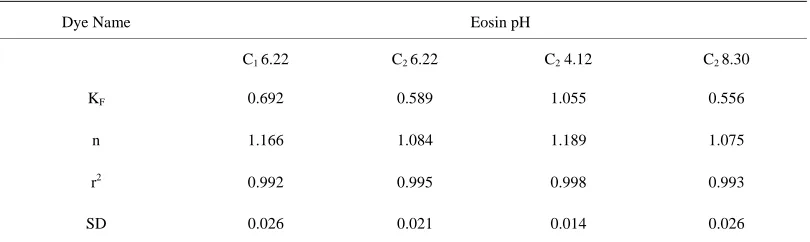
Freundlich constants KF and n calculated from the
slope and intercept of log qe and log Ce along with R2 and
SD as given in Table 4. KF (parameter relative to adsorp-
tion capacity) and n (process intensity) were calculated. Values of constant KF indicate higher adsorption capacity
on Carbon sample C2 at acidic pH.
The linear plots of log qe and log Ce for Freundlich
isotherm are shown in Figure 3.
4. Adsorption Mechanism
At acidic pH the adsorbent tends to form an aqua com- plex to yield a positively charged surface. The ionic dye releases colored dye anions/cations in solution, which in turn is influenced by the solution pH agents [11]. At acidic PH there is an increase in H+ ions in dye solution. The OH– ions on the adsorbent surface tend to be neu- tralized by protonation which facilitates the diffusion of dye molecules in the vicinity of the adsorbent. The posi-tively charged surface sites on the adsorbent and the so-lution thus play a significant role in influencing the ca-pacity of the adsorbent towards dye ions due to elec- trostatic attraction. Having an excess positive charge on their surface activated carbon shows a greater capacity to adsorb the dye when the solution is made acidic. As the
pH of the system decreases number of negatively ch- arged surface sites increases. Lower adsorption at al- kaline pH may thus have been due to the presence of OH– ions competing with the dye ions for adsorption sites.
5. Conclusions
[image:5.595.150.448.392.567.2]Both samples of activated carbon proved to be reasona- bly good adsorbents for removing the residual dye Eosin from waste water. From the results it may be observed that the percentage of adsorption of dye on both samples of GAC increased with the increase in initial concentra- tion from 10 to 100 mg/L. It was also seen that adsorp- tion was high at Acidic pH as compared to adsorption in Alkaline the values of SD and r2 indicate that both ad- sorption models fitted satisfactorily and suggested monola- yer adsorption coverage on the outer surface of the ad- sorbent. Adsorption followed both Langmuir and Freund- lich isotherms but as observed from the values of r2 Langmuir isotherm gave a better fit. On the whole both carbon samples showed favorable adsorption. Acidic pH environment was found to be more conducive to the ad- sorption process.
Figure 3. Freundlich Isotherm for dye Eosin on C1 & C2 at different pH values.
Table 4. Constants for Freundlich Isotherm at various pH values.
Dye Name Eosin pH
C1 6.22 C2 6.22 C2 4.12 C2 8.30
KF 0.692 0.589 1.055 0.556
n 1.166 1.084 1.189 1.075
r2 0.992 0.995 0.998 0.993
[image:5.595.96.501.615.736.2]
This study can be the basis of the amount and brand of carbon to be used and time of contact with carbon to be given for this technological process. When the break- through point has been reached and the adsorption effi- ciency of the carbon has decreased the spent carbon can be replaced or reactivated for reuse. Being inexpensive and easily available granular activated carbon can be used effectively in a commercial system.
REFERENCES
[1] S. S. Reddy, et al., “Removal of Composite Reactive Dye from Dyeing Unit Effluent Using Sewage Sludge Derived Activated Carbon,” Turkish Journal of Engineering and Environmental Sciences, Vol. 30, 2006, pp. 367-373.
[2] Kadirvelu, et al., “Utilization of Various Agricultural Wastes for Activated Carbon Preparation and Application for the Removal of Dyes and Metal Ions from Aqueous Solutions,” Department of Environmental Science, PSG College of Arts and Science Coimbatore, Tamil Nadu, Bioresource Technology, Vol. 87, No. 1, 2003, pp. 129- 132. doi:10.1016/S0960-8524(02)00201-8
[3] Y. Yasin, M. Z. Hussein and F. Hj Ahmad, “Adsorption of Methylene Blue onto Treated Activated Carbon,” The Malaysian Journal of Analytical Sciences, Vol. 11, No. 11, 2007, pp. 400-406
[4] Y. Li, Q.-Y. Yue, B.-Y. Gao, J. Yang and Y. Zheng, “Adsorption Kinetics of Reactive Dyes on Activated Car- bon Fiber,” Chinese Journal of Environmental Science, Vol. 28, No. 11, 2007, pp. 2637-2641.
[5] S. Izadyar and M. Rahimi, “Use of Beech Wood Sawdust
for Adsorption of Textile Dyes,” Pakistan Journal of Biological Sciences, Vol. 10, No. 2, 2007, pp. 287-293. doi:10.3923/pjbs.2007.287.293
[6] M. Husseien, A. A. Amer, A. El-Maghraby and N. A. Tahaused, “Utilization of Barley Straw as a Source of Activated Carbon for Removal of Methylene Blue from Aqueous Solution,” Journal of Applied Sciences Research, Vol. 3, No. 11, 2007, pp. 1352-1358.
[7] S. Reddy and B. Kotaiah, “Comparative Evaluation of Commercial and Sewage Sludge Based Activated Carbon for Removal of Textile Dyes from Aqueous Solutions,” Iranian Journal of Environmental Health Science & En-gineering, Vol. 3, No. 4, 2006, pp. 239-246
[8] N. Kannan and S. Murugavel, “Column Studies on the Removal of Dyes Rhodamine-B, Congo Red and Acid Violet by Adsorption on Various Adsorbents,” EJEAF-Che, Vol. 6, No. 3, 2007, pp. 1860-1868.
[9] R. Kant and V. K. Rattan, “Adsorption of Dye Green B from a Textile Industry Effluent Using Two Different Samples of Activated Carbon by Static Batch Method and Continuous Process,” Indian Journal of Chemical Tech-nology, Vol. 16, 2009, pp. 240-244.
[10] Z. Aksu and S. Tezer, “Equilibrium and Kinetics Medeling of Biosorption of Remozol Black B by Rhizopodus Ar- rhizus in a Batch System: Effect of Temperature,” Proc-ess Biochemistry, Vol. 36, No. 5, 2000, pp. 432-439. doi:10.1016/S0032-9592(00)00233-8
[11] K. R. Ramakrishna and T. Viraraghawan, “Dye Removal Using Low Cost Adsorbents,” Water Science and Tech-nology, Vol. 36, No. 2-3, 1997, pp. 189-196.