Proceedings of the 2019 Conference on Empirical Methods in Natural Language Processing and the 9th International Joint Conference on Natural Language Processing, pages 3195–3205,
3195
Keeping Consistency of Sentence Generation and Document Classification
with Multi-Task Learning
Toru Nishino
Tomoki Taniguchi Shotaro MisawaYasuhide Miura
Fuji Xerox Co., Ltd.
{nishino.toru, misawa.shotaro, kano.ryuji,
taniguchi.tomoki, yasuhide.miura, ohkuma.tomoko}
@fujixerox.co.jp
Ryuji Kano Tomoko Ohkuma
Abstract
The automated generation of information in-dicating the characteristics of articles such as headlines, key phrases, summaries and categories helps writers to alleviate their work-load. Previous research has tackled these tasks using neural abstractive summarization and classification methods. However, the outputs may be inconsistent if they are generated individually. The purpose of our study is to generate multiple outputs consistently. We introduce a multi-task learning model with a shared encoder and multiple decoders for each task. We propose a novel loss function calledhierarchical consistency loss to main-tain consistency among the attention weights of the decoders. To evaluate the consistency, we employ a human evaluation. The results show that our model generates more consistent headlines, key phrases and categories. In addition, our model outperforms the baseline model on the ROUGE scores, and generates more adequate and fluent headlines.
1 Introduction
Headlines and other information such as key phrases, summaries and categories about articles are crucial for readers to search articles on demand. To attract more readers, writers manually create headlines and summaries by summarizing the articles, extract key phrases and classify
articles into categories. Figure 1 shows an
example of job advertisement articles. In addition to the job description text, the headline, key phrase and category are labeled for each article. Thus job seekers can easily retrieve the job advertisements they desire by reading them. However, it is a burden for writers to create these headlines, key phrases and categories manually for extremely large numbers of articles. Hence, an automatic generation system is highly demanded.
Headline:We Want Android1Engineer to Develop our New Service “Wantedly People2”!
Key Phrase:Android Engineer
Category:Engineer
Description Text (Truncated):
We released a new service ”Wantedly People” in November 2016, and released new features in July 2017! Our “People team”, developing rapidly growing “Wantedly People” service, is recruiting an Android Engineer! If you love to work on new services, or if you want to try to develop new apps as your representative work, we are looking forward to your application!
Figure 1: An example job advertisement article with consistency. Each article contains a headline, key phrase and category. The underlined topic “Engineer” is consistently noted in the headline, key phrase and category. A Japanese-English translation is applied.
For automated generation of multiple outputs, consistency among outputs is crucial. A lack of consistency among outputs causes incorrect infor-mation in the outputs. In Figure 1, for example, the “Engineer” position is consistently noted in the headline, key phrase and category. An occupation is consistent and salient information for headlines, key phrases and categories. If the article was to be misclassified as a “Designer” category or the key phrase wrongly noted as “Robotics Engineer,” an inconsistency among the headline, key phrase and category would occur. Thus, readers would be confused by these inconsistencies. We must force generators to predict multiple outputs consistently. This leads to the correctness of the occupation in the outputs, and thus the quality of the generated outputs also improves.
In previous research, neural networks have achieved significant improvements in individual tasks, such as abstractive summarization (Rush et al., 2015; See et al., 2017; Shi et al., 2018),
1Android is a trademark of Google LLC.
headline generation (Takase et al., 2016), key phrase generation (Meng et al., 2017) and text classification (Zhang et al.,2015) tasks. However, consistency among multiple outputs is not consid-ered in the strategy to predict multiple outputs with separate models.
The purpose of our study is to maintain consis-tency among automatic generated sentences and classified categories. We adopt multi-task learning (Caruana, 1997) to predict the headlines, key phrases and categories of articles in one unified model. We handle the key phrase generation and classification tasks not as auxiliary tasks, but as the desired outputs of our system. Multi-task learning enables the encoder to focus on the common and salient features in the input text.
We propose a novel hierarchical consistency loss to maintain consistency among the multiple outputs. A hierarchical consistency loss forces the attention weights of the decoders to focus on the same words in the input text, considering the hierarchical relation among tasks. There is a hierarchical relation among the tasks; the headline generator generally focuses on the wider range of words including the key phrase generator focus upon. In addition, this loss has a flexibility that alleviate the influences of errors propagated from other tasks, similar to soft-parameter sharing methods (Guo et al.,2018).
We design human evaluations using crowd-sourcing to score the following three metrics: fluency, adequacy and consistency among the outputs. We implement human evaluations of the job advertisement dataset, and the results indicate that our model improves not only the consistency score but also the fluency and adequacy scores.
In addition, we conduct automatic evaluations of the job advertisement dataset and the modified
CNN-DailyMail (CNN-DM) dataset (Nallapati
et al.,2016). The automatic evaluations show that our method improves the ROUGE metric scores on both datasets, which has multiple outputs.
Overall, our contributions are as follows:
• We propose a multi-task sentence generation and document classification model.
• A novel hierarchical consistency loss is
introduced to train the weights of attention to focus more on the same part of the input text among the task-specific decoders.
Our designed human evaluations show that our
model generates more consistent outputs. Our pro-posed model generates more adequate and fluent outputs on a human evaluation, and achieves the best ROUGE score on an automatic evaluation.
2 Related Work
Abstractive summarization. Abstractive sum-marization is a task to generate a short summary that captures the core meaning of the original text. Rush et al. (2015) used a neural attention model, andSee et al.(2017) introduced a pointer-generator network to copy out-of-vocabulary (OOV) words from the input text.Hsu et al.(2018) combined abstractive and extractive summariza-tion with an inconsistency loss to encourage con-sistency between word-level attention weights of the abstracter and sentence-level attention weights
of the extractor. Abstractive summarization
techniques are generally applied to a headline generation because this is a similar task (Shen et al.,2017;Tan et al.,2017).
Multi-task learning. Multi-task learning, which trains different tasks in one unified model, has achieved success in many natural language processing tasks (Luong et al., 2016;Hashimoto et al.,2017;Liu et al., 2019). Typical multi-task learning models have a structure with a shared encoder to encode the input text and multiple decoders to generate outputs of each task. Multi-task learning has a benefit in that the shared encoder captures common features among tasks; in addition, the encoder focuses more on relevant and beneficial features, and disregards irrelevant and noisy features (Ruder,2017).
Although a multi-task learning model is ben-eficial in training a shared encoder, it is still difficult to share information among task-specific
decoders. Some studies have constructed a
multi-task learning model using techniques that encourages information sharing among decoders.
the second tasks. They consider the hierarchy among tasks, but these models suffer from the errors of the previous tasks.
Guo et al. (2018) proposed a decoder shar-ing method with soft-parameter sharshar-ing to train the summarization and entailment tasks. Soft-parameter sharing has a benefit in that it provides more flexibility between the layer of summariza-tion and entailment tasks; however, this method does not consider the hierarchy among tasks.
Our study extends the method in Hsu et al.
(2018) to a multi-task learning model in which the models need to generate multiple outputs with consistency. Hierarchical consistency loss combines two advantages. This loss considers the hierarchy among tasks, and has flexibility among tasks, similar to soft-parameter sharing methods. We assess the advantages of this loss in Section
4.2.
3 Method
3.1 Problem Definition
We define the tasks of our study and describe the overview of the datasets.
Letx = {x1, x2, ...xS}be a sequence of input text. The target of our multi-task model is to generate two types of sentences and to predict the category of the input article. Our model predicts the exactly one category tag y1 for each
input sentence. Our model also predicts y2 = {y12, y22, ...y2T2} andy3 = {y31, y32, ...yT33}, which are the sequence of sentences.
For the job advertisement dataset, the targets of our model are to classify articles into occupation categories y1 (task 1), generate key phrases regarding the occupationy2 (task 2) and generate headlinesy3 (task 3). For the CNN-DM dataset,
the targets are to predict the article categories y1 (task 1), headlinesy2 (task 2) and multi-sentence summariesy3(task 3).
Here,S is the length of the input texts, andT2 and T3 are the lengths of the output sequences,
respectively. T2 is generally smaller than T3 in both datasets. Hence, task 3 is generally more difficult than task 2, and more information is needed to generatey3 thany2.
3.2 Encoder-Decoder model
Encoder-decoder model with attention mecha-nism. Our model is based on an encoder-decoder
model (Cho et al., 2014). The encoder RNN
transforms the input text into hidden vectors he ={he1, he2, ..., heS}, and the decoder RNN then predicts the generation probability of each word
Pvocab,t:
het = RNNenc(xt, het 1) (1)
hdt = RNNdec(yt 1, hdt 1, heS) (2)
Pvocab,t = softmax(Wd2vhdt +bd2v) (3)
where the weight matricesWd2v and bias vector bd2vare trainable parameters.
Rush et al.(2015) used an attention mechanism to handle long input sentences. The attention mechanism obtains the hidden vector of attention
¯ hd
t from the hidden vector and context vector cet, which is defined as the weighted sum of the hidden vectors of the encoder:
eetj = vTtanh(Wehje+Wdhdt +battn) (4)
↵etj = softmax(eetj) (5)
cet = X
j
↵etjhej (6)
¯ hd
t = Wc[hdt, cet] +bc (7)
Note that [hdt, cet] indicates the concatenation of
vectorshd
t and cet. Weight matrices We, Wd and Wc and the bias vectors battnandbc are trainable parameters.
Pointer-generator network. We adopt a pointer-generator network (See et al., 2017) for the decoders to handle OOV words. The decoder generates words under the probability of pgen,yt
and copies words from the input sentence under the probability of1 pgen,yt.
Coverage mechanism. See et al. (2017) also introduced a coverage mechanism to alleviate the repetition problem. The coverage loss Lcov is added to the loss function to penalize the attention mechanism to avoid focusing on the same input words.
3.3 Multi-Task Learning for Generation and Classification
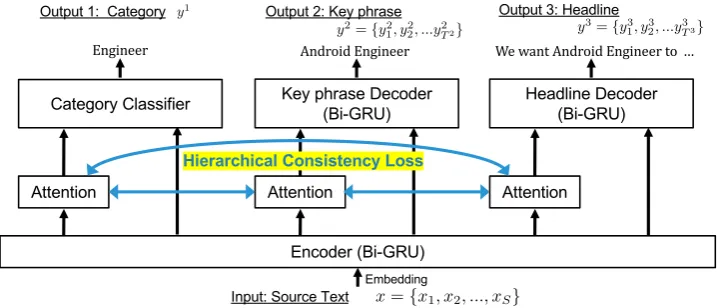
We introduce task learning to predict multi-ple outputs simultaneously in one unified model. Figure2 describes an overview of our multi-task
learning model. A multi-task learning model
comprises one shared layer, two task-specific decoders for generation tasks, and one classifier.
!"#$%&'()$*+,'-,.%
/"+)0,*'12345678
9%%,"%3)"
:,;0<3",'=,+)0,* 12345678
>$%#$%'?&':,;0<3",
9%%,"%3)"
@,A'#B*;C,'=,+)0,* 12345678
>$%#$%'D&'@,A'#B*;C,
9%%,"%3)"
E;%,F)*A'E<;CC3G3,*
>$%#$%'H&''E;%,F)*A
We released a new service ”Wantedly People” in November 2016, and released new features in July 2017! …
!"#$"%%& '"(&)$( !"#$"%%& *% +,"- '"(&)$( !"#$"%%& -) .
[image:4.595.124.483.61.215.2]
!"#$%$&'"&%()*+,-"-.#,&/)0+--/IJ,003"F
Figure 2: An overview of our multi-task learning model. The shared embedding layer and encoder first transform the input text into a shared hidden vector, and the task-specific layers then predict the outputs of each task. Hierarchical consistency loss penalizes the inconsistency between the attention weights of the pairs of decoders.
vector he
t. We use a 2-layer bi-directional GRU (Cho et al.,2014) for the encoder.
Classifier. The classifier transforms a shared hidden vector into the category probability Pcat. We implement the classifier as 2-layer perceptron with an attention mechanism:
oc = ReLU(W1c([hSe, cet] +bc1)) (8) Pcat = softmax(W2coc+bc2) (9)
where the weight matricesW1c andW2c, and bias vectorsbc
1andbc2are trainable parameters.
Decoders. The hidden vector of encoder heS is first transformed into hˆd
0 in the bridge layer, and
the decoders RN Ndec of each task then generate output sequences y2 and y3 from hˆd0. A bridge is an additional fully connected layer used to fit the hidden vector into each task. We expect that multi-task learning will enable the shared encoder to capture more common and salient parts of an article, that is, the parts of the text that mention the occupation.
3.4 Hierarchical Consistency Loss
The main objective of our method is to maintain
consistency among multiple outputs. If each
decoder focuses on the same word in the input text, the model can generate a more consistent output. Hence, consistency between attention weights leads to consistency between multiple outputs. For example, in Figure3, inconsistency regarding the occupation occurs because the word “engineer” is inconsistently focused on the attention weights of the key phrase generator. From this, the key phrase generator predicts an incorrect key phrase. By
penalizing such inconsistencies, the model enables the generation of more consistent outputs.
However, perfect consistency between attention weights occasionally disturbs the model to gen-erate proper outputs. Because headlines contain more information than key phrases, the headline generator must focus on a wider range of words in the input text than the key phrase generator. For example, in Figure3, the headline generator focuses on the words “user interface.” In contrast, the key phrase generator does not focus on these words. Therefore, the attention weights among tasks generally maintain a hierarchical relation. That is, the higher tasks (headline generation and summarization) need to focus on a wider range of words, and the lower tasks (classification) focus on the range on which the higher tasks focused.
We introduce a novel “hierarchical consistency loss” to penalize inconsistency among multiple outputs. We define hierarchical consistency loss between tasksand tasktas follows:
Lsthcl= hcl S
S
X
i=1
|max
j e
ds
ij max
j e
dt
ij|+ (10)
whereedijs is the non-normalized attention weight of the output wordjtoward the input wordi. Note that a ramp function|x|+is used to compare two
attention weights. Tasktis a task that needed to focus on a wider range of words than the input task s. For example, in Figure3, tasksis a key phrase generation, and tasktis a headline generation.
!"#####$%&'######%&###(")*+&",## '-###("."/-0##1)",##*&'",2%3"#$*'4##"&+*&"",)#5 !"#####$%&'######%&###(")*+&",## '-##("."/-0##1)",##*&'",2%3"##$*'4##"&+*&"",)#5
!" $%&'
67
(")*+&",
("."/-0
5
("."/-08"&'
"&+*&"", )-2'$%," 9''"&'*-&#$"*+4')#-&#
4"%(/*&"#+"&",%'-,
9''"&'*-&#$"*+4')#-&# :";#04,%)"#+"&",%'-,
<=',%3'#8-)'#)%/*"&'# %''"&'*-&#$"*+4')# 2-,#"%34#*&01'#$-,()
<=',%3'#8-)'#)%/*"&'# %''"&'*-&#$"*+4') 2-,#"%34#*&01'#$-,()
'->-80%,*)-&#
?,%80#21&3'*-&@ 7&3-&)*)'"&3;#-&# %''"&'*-&#$"*+4') 7&01'#'"=' 7&01'#'"='
A"
&"
,%
'"
(#
B
";
#C4
,%
)"
A"
&"
,%
'"
(#
D
"%
(/
*&
[image:5.595.77.520.62.233.2]"
Figure 3: An overview illustration of our hierarchical consistency loss. This loss penalizes a case in which inconsistency occurs between two outputs. The decoder of the key phrase generator focuses on the word “engineers.” However, the headline generation decoder does not focus on this word. Hierarchical consistency loss treats this difference as an inconsistency.
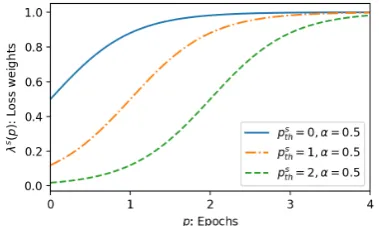
Figure 4: An illustration of our training scheduling strategy. The loss weights s(p)gradually increase as the training proceeds.
“engineers” to a higher weight because the word “engineers” is crucial to generate consistent and adequate outputs. Figure 3 shows the process of the loss. The most salient attention weights for each input word are extracted, and the extracted attention weights between two tasks are then compared. A ramp function enables this loss to consider the hierarchical relation between two tasks.
3.5 Learning Scheduling for Multi-Task Learning
We also introduce a new multi-task learning scheduling strategy to effectively train several tasks with different levels of difficulty. Kiper-wasser and Ballesteros (2018) introduced a strat-egy that gradually changes the probability that the training examples will be picked from each
dataset as the training proceeds. We modify
this idea to a situation in which the input text
is in common among multiple tasks, adjusting the hyperparameters of the weighted sum of loss functions. This strategy enables us to train our model in such a way that our model focuses on learning easy tasks at the beginning, and then gradually focuses more on learning difficult tasks. We determine the weights of the loss function s(p)for task s with a sigmoid function:
s(p) = s
const
1 1 + exp((ps
th p)/↵)
(11)
where s
const and psth are hyperparameters for
each task. Parameter p describes the number of epochs trained thus far. We set hyperparameter↵
to 0.5 for all tasks. As illustrated in Figure4, s(p) becomes larger as the training proceeds.
3.6 Overall Loss Function
The overall loss function of the proposed model is calculated as the weight sum of losses from three tasks, coverage losses and hierarchical consistency loss:
Lall = 1(p)L1+ 2(p)L2+ 3(p)L3
+ 2covL2cov+ 3covL3cov
+ allhclLallhcl (12)
where 1(p), 2(p), 3(p), 2
cov, 3covand allhclare
hyperparameters. In addition, 1(p), 2(p), and 3(p)are calculated using Eqn.11. Moreover,L
1,
L2andL3signify the loss of the classification, key
phrase generation and headline generation tasks, respectively.L2
[image:5.595.86.276.307.420.2]of two generators, and Lall
hcl is the sum of the hierarchical consistency losses:
Lallhcl=L12hcl+L13hcl+L23hcl (13)
whereLst
hcl indicates the hierarchical consistency loss between tasksandt.
4 Experiments and Results
4.1 Experimental Settings
We use two datasets, namely, a job advertise-ment dataset and the CNN-DailyMail (CNN-DM) dataset. We evaluate the headline generation, key phrase generation and classification tasks in these datasets. As an example, Figure 1 shows the headlines, key phrases and categories, which generally include common features, that is, the words mentioning occupations.
We also use the CNN-DM dataset (See et al.,
2017) in an automatic evaluation under different task settings. We evaluate the multi-sentence summarization, headline generation and classifi-cation tasks in this dataset. Note that we train and evaluate the CNN and DailyMail datasets separately because they have different taxonomies. The original CNN-DM dataset does not con-tains headlines or categories, and thus we extract the headlines and categories from the raw HTMLs. The Supplementary section describes the details and modification of the CNN-DM dataset.
We employ pointer-generator models without multi-task learning as baselines of the sentence generators, and a 2-layer GRU with attention as the baseline of the classifier. We chose all hyperparameters based on the learning curve and the scores of the validation set. Details of our model, such as the hyperparameters of the RNNs, the weights of the loss function and the optimizers, are described in the Supplementary section for reproducibility.
4.2 Results
Human evaluation of job advertisement dataset. We conduct a human evaluation of the job advertisement dataset to measure the quality of the generated outputs. Ten crowd-sourcing workers measure 250 randomly selected samples. We defined the following four metrics:
• Consistency: Measure whether the outputs
include the same occupation. We choose a pair of outputs, and if both outputs mention
HG-KG HG-CC KG-CC 3 Outputs
Baseline 56.8% 37.6% 37.6% 30.0%
Proposed 58.8% 39.6% 39.2% 32.4%
Gold 65.2% 44.4% 48.8% 35.2%
Table 1: Comparison of human evaluation results with their consistency. HG-KG, HG-CC and KG-CC indicate the consistency scores between the headline generation and key phrase generation, headline gen-eration and category classification and key phrase generation and category classification, respectively.
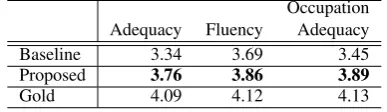
Adequacy Fluency OccupationAdequacy
Baseline 3.34 3.69 3.45
Proposed 3.76 3.86 3.89
Gold 4.09 4.12 4.13
Table 2: Comparison of human evaluation results for headlines. Scores are an average of ten crowd-sourcing workers with five scale rating.
the same type of occupation, we regard this pair as consistent.
• Adequacy: Measure how well the headline
describes the correct information.
• Fluency: Measure how natural the generated headline is.
• Occupation Adequacy: Measure how well
the headline mentions the correct occupation. For example, in Figure 1, if the generated headline implies that the occupation “engi-neer” is recruited, we regard this headline as adequate regarding the occupation. We assume that consistency of the occupation improves the score of the occupation ade-quacy.
First, we conduct a human evaluation to measure the consistency among three outputs. Table 1 shows the evaluation results with their consistency. The scores are the percentage of articles evaluated as consistent by a majority of workers. We consider all three outputs as consistent if all pairs of outputs are consistent. The results indicate that the proposed method improves the consistency of the three generated outputs1.
[image:6.595.319.513.197.253.2]Headline generation Key phrase generation Classification
R-1 R-2 R-L R-1 R-2 R-L Accuracy
Baseline (Pointer-Generator Network) 25.1 5.3 21.1 30.9 10.6 28.7 62.8
Multi-Task Learning (MTL) 26.2 5.8 21.6 32.3 10.9 30.0 64.1
MTL + Scheduling (SD) 26.3 6.0 21.8 32.3 10.4 29.9 63.9
Proposed (MTL + SD +
Hierarchical Consistency Loss (HCL)) ⇤26.9 ⇤6.1 ⇤22.4 ⇤32.8 ⇤11.2 ⇤30.5 64.4
Lead-1 19.0 4.3 13.5 - - -
-Table 3: Automatic evaluation results based on the ROUGE metrics and accuracy (%) of classification of job advertisement dataset. R-1, R-2 and R-L indicate the F1 scores of ROUGE-1, ROUGE-2 and ROUGE-L,
respectively. The proposed method (MTL + SD + HCL) achieved the best scores (bold) for all tasks, and the ROUGE scores are statistically significant from the baseline model (p <0.05) in both the headline and key phrase (indicated as⇤). Lead-1 is the baseline score, which uses the first sentence of the input article as a predicted headline.
Summarization Headline Generation Classification
R-1 R-2 R-L R-1 R-2 R-L Accuracy
CNN Proposed (MTL + SD + HCL)Baseline ⇤30.731.0 ⇤10.610.9 ⇤27.327.8 19.519.6 5.05.0 17.017.1 43.843.9
Lead 33.4 12.2 26.1 17.2 5.0 11.1
-DailyMail BaselineProposed (MTL + SD + HCL) ⇤38.938.4 ⇤16.315.8 ⇤35.435.0 ⇤43.743.1 25.325.5 ⇤40.139.6 89.089.8
Lead 43.8 19.2 37.3 27.7 10.9 21.7
-Table 4: Automatic evaluation results based on the ROUGE metrics and accuracy (%) of classification of the CNN and DailyMail datasets. The metrics are the same as in Table3. The proposed method (MTL + SD + HCL) improved the scores for all tasks. The scores with⇤indicate that the scores are statistically significant from the baseline model (p <0.05). The lead is the score that uses the first three sentences of the input article as a predicted summary, and the first sentence of the input article as a predicted headline.
adequacy by0.42ptand the occupation adequacy by 0.44pt. Proposed method can generate more adequate outputs, particularly for the occupation.
Automatic evaluation of job advertisement cor-pus.We implement an automatic evaluation using the ROUGE metrics (Lin,2004) and accuracy. We conduct the experiment ten times, and calculate
the average score. Table 3 shows the effect
of the proposed methods: multi-task learning (MTL), scheduling strategy (SD) and hierarchical consistency loss (HCL). From this result, the proposed method (MTL + SD + HCL) achieves the best score on all three tasks. MTL and HCL improve for all three tasks, and SD improves the score of the headline generation.
Automatic evaluation of the CNN-DM dataset.
Table4shows the results of the CNN and Daily-Mail datasets, respectively. For both datasets, the proposed method improves the ROUGE scores of the summarization and headline generation.
From Table 5, headlines and key phrases of the job advertisement dataset have more overlap than the summaries and headlines of the CNN-DM
dataset. Therefore, tasks of the job
adver-tisement dataset benefit more from maintaining
ROUGE-1 ROUGE-2 ROUGE-L
Job Ads 48.4 15.9 47.9
CNN 42.8 13.7 38.8
[image:7.595.97.503.62.151.2]DailyMail 37.9 12.6 34.0
Table 5: ROUGE recall scores of task 2 (key phrases for the Job Ads, headlines for CNN-DM) gold sen-tences against task 3 (headlines for Job Ads, summaries for CNN-DM) gold sentences in the validation set. Higher scores indicate that words appearing in the sentence of task 2 are overlapped by the sentence of task 3.
the consistency. For this reason, the scores
of the job advertisement dataset achieve greater improvement than the CNN-DM dataset.
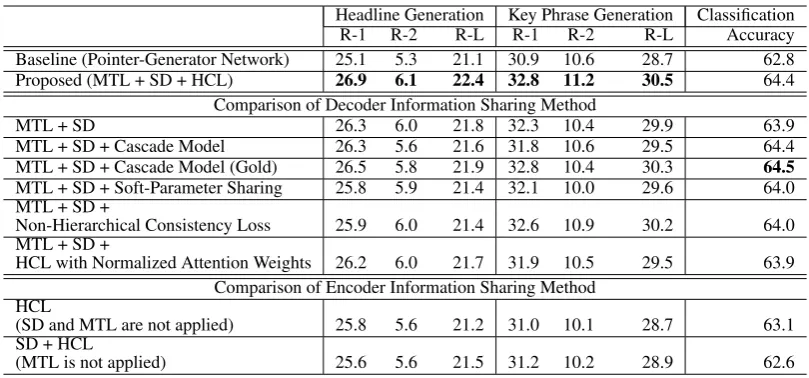
Comparison of the decoder information shar-ing methods. To validate the advantages of our hierarchical consistency loss, we compare five decoder information sharing methods: a cascade model, soft-parameter sharing, non-hierarchical consistency loss, hierarchical consistency loss with normalized attention weights and our hi-erarchical consistency loss. Table 6 presents the comparison of the five methods for the job advertisement dataset.
[image:7.595.90.513.242.327.2] [image:7.595.318.516.417.462.2]Headline Generation Key Phrase Generation Classification
R-1 R-2 R-L R-1 R-2 R-L Accuracy
Baseline (Pointer-Generator Network) 25.1 5.3 21.1 30.9 10.6 28.7 62.8
Proposed (MTL + SD + HCL) 26.9 6.1 22.4 32.8 11.2 30.5 64.4
Comparison of Decoder Information Sharing Method
MTL + SD 26.3 6.0 21.8 32.3 10.4 29.9 63.9
MTL + SD + Cascade Model 26.3 5.6 21.6 31.8 10.6 29.5 64.4
MTL + SD + Cascade Model (Gold) 26.5 5.8 21.9 32.8 10.4 30.3 64.5
MTL + SD + Soft-Parameter Sharing 25.8 5.9 21.4 32.1 10.0 29.6 64.0 MTL + SD +
Non-Hierarchical Consistency Loss 25.9 6.0 21.4 32.6 10.9 30.2 64.0 MTL + SD +
HCL with Normalized Attention Weights 26.2 6.0 21.7 31.9 10.5 29.5 63.9 Comparison of Encoder Information Sharing Method
HCL
(SD and MTL are not applied) 25.8 5.6 21.2 31.0 10.1 28.7 63.1
SD + HCL
[image:8.595.96.501.60.249.2](MTL is not applied) 25.6 5.6 21.5 31.2 10.2 28.9 62.6
Table 6: Comparison of the decoder information sharing methods and encoder sharing methods for the job advertisement dataset. The metrics are the same as in Table3. The proposed method (adopting HCL) achieved the best scores (bold) compared to the other sharing methods.
(2017); Anastasopoulos and Chiang(2018), uses the output of the classifier as an additional input of the headline and key phrase generators. Meanwhile, the cascade model (gold) uses the gold classification category as the additional input of the generators during training and inference.
It can be observed from Table6that the cascade model achieves a lower score than MTL + SD. However, the cascade model (gold) improves the ROUGE-L score. This result indicates that the classification error propagates to the generators when the cascade model is applied. Our proposed HCL has an advantage in that it does not suffer from an error of the classifier, and thus this method achieves the best score.
Furthermore, we compare our proposed HCL
model with other settings. A soft-parameter
sharing method (Guo et al., 2018) penalizes the difference between parameters in pairs of decoders. The non-hierarchical consistency loss is almost the same as the hierarchical consistency
loss (Eqn. 10). We replace a ramp function
in Eqn. 10 with an absolute value function.
Neither the soft-parameter sharing method nor the non-hierarchical consistency loss has the ability to consider the hierarchy among tasks.
It can be observed from Table6that both meth-ods achieved a lower score than the hierarchical consistency loss. This is because our hierarchical consistency loss enables the model to penalize a multi-task model with hierarchy among the tasks.
Although the HCL with normalized-attention weights adopts the hierarchical consistency loss
model indicated in Eqn. 10, however, we
substitute the normalized attention weights↵dijsfor
non-normalized attention weightsedijs.
HCL with normalized attention weights is not as effective as HCL with non-normalized attention weights. Our HCL is based on the assumption that if one specific input word is important for both the shorter and longer text generation tasks, the attention weights of the words for the shorter text generation task would be smaller than the attention weights for the longer text generation task. However, the distributions of the normalized attention weights converge to a few words for the shorter text generation task; thus the normalized attention weights does not satisfy the assumption. As a result, our proposed HCL with non-normalized attention weights can accurately compute this inconsistency, contrary to the HCL with normalized attention weights.
Comparison of encoder information sharing methods. To determine the dependence of HCL on MTL, we conduct two experiments. HCL applies the hierarchical consistency loss without MTL and SD, while SD + HCL applies the scheduling sampling and hierarchical consistency loss; however, multi-task learning is not applied. Table6presents the results of two methods for the job advertisement dataset.
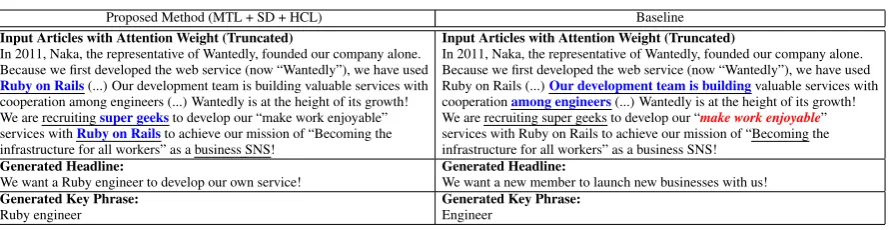
infor-Proposed Method (MTL + SD + HCL) Baseline Input Articles with Attention Weight (Truncated)
In 2011, Naka, the representative of Wantedly, founded our company alone. Because we first developed the web service (now “Wantedly”), we have used
Ruby on Rails(...) Our development team is building valuable services with cooperation among engineers (...) Wantedly is at the height of its growth!
We are recruitingsuper geeksto develop our “make work enjoyable”
services withRuby on Railsto achieve our mission of “Becoming the
infrastructure for all workers” as a business SNS!
Input Articles with Attention Weight (Truncated)
In 2011, Naka, the representative of Wantedly, founded our company alone. Because we first developed the web service (now “Wantedly”), we have used
Ruby on Rails (...)Our development team is buildingvaluable services with
cooperationamong engineers(...) Wantedly is at the height of its growth!
We are recruiting super geeks to develop our “make work enjoyable”
services with Ruby on Rails to achieve our mission of “Becoming the infrastructure for all workers” as a business SNS!
Generated Headline:
We want a Ruby engineer to develop our own service! Generated Headline:We want a new member to launch new businesses with us!
Generated Key Phrase:
[image:9.595.79.524.58.173.2]Ruby engineer Generated Key Phrase:Engineer
Figure 5: An example of an input article, generated headlines and key phrases. Underlined words indicate that the attention weights of the headline generator between these words and the output words are high.Blue colored words indicate that the attention weights of these words are consistently high between the two decoders. In contrast, red colored italic wordsindicate that the attention weights of these words are high in the key phrase generator, but low in the headline generator, that is, inconsistency occurs between the two decoders. A Japanese-English translation is applied.
ROUGE-1 ROUGE-2 ROUGE-L
Baseline 29.1 5.5 29.0
Proposed 53.7 19.2 53.4
Table 7: Comparison of ROUGE recall scores of generated key phrases against generated headlines for the job advertisement dataset. The proposed method significantly increases the word overlap between gen-erated sentences.
mation sharing method is beneficial only for the generation task. This can be attributed to the asymmetry in the task settings. Generally, the generation task need to focus on a wider range of input words than the classification tasks. For the generation task, it is important that which words are focused on in the classification task. However, this is not always the case that the words focused on in the generation task are important for the classification task.
Analysis of word overlap between output sen-tences. To estimate the consistency between output sentences, we evaluate the word overlap between generated headlines and key phrases. Table7 presents the ROUGE recall scores of the generated key phrases computed against generated headlines for the job advertisement dataset. There-fore, our proposed method generates significantly similar word outputs, resulting in improvement in the consistency between two sentences.
4.3 Example of Predicted Outputs
We visualize the attention weights of the decoders to assess the performance of the proposed method. The upper part of Figure 5 indicates an example of the attention weights of the headline and key phrase generators. The proposed method increases
the consistency and decreases the inconsistency between the attention weights of the two decoders. With the proposed method, both decoders com-monly focus on the word “Ruby on Rails,” and thus both outputs consistently contain the word “Ruby.” From this result, the proposed method, which avoids inconsistency, improves the quality of the outputs.
5 Conclusion
We introduced a novel multi-task learning method to maintain consistency among outputs. Hierar-chical consistency loss was introduced to penalize inconsistency between two attention weights of decoders. We implemented a manual evaluation using crowd-sourcing, and the results indicates that our method generates more consistent outputs. An automatic evaluation showed that proposed method achieves the best ROUGE scores on both
datasets. As a future work, we would like
to explore whether our method is applicable to other tasks such as multi-task learning for object detection and image caption generation.
References
Antonios Anastasopoulos and David Chiang. 2018. Tied multitask learning for neural speech translation. InProceedings of the 2018 Conference of the North American Chapter of the Association for Computa-tional Linguistics: Human Language Technologies, Volume 1 (Long Papers), pages 82–91.
[image:9.595.80.280.271.307.2]Rich Caruana. 1997. Multitask learning. Machine learning, 28(1):41–75.
Jianpeng Cheng and Mirella Lapata. 2016. Neural summarization by extracting sentences and words. In Proceedings of the 54th Annual Meeting of the Association for Computational Linguistics (Volume 1: Long Papers), volume 1, pages 484–494.
Kyunghyun Cho, Bart van Merrienboer, Caglar Gul-cehre, Dzmitry Bahdanau, Fethi Bougares, Holger Schwenk, and Yoshua Bengio. 2014. Learn-ing phrase representations usLearn-ing RNN Encoder– Decoder for statistical machine translation. In
Proceedings of the 2014 Conference on Empirical Methods in Natural Language Processing, pages 1724–1734.
John Duchi, Elad Hazan, and Yoram Singer. 2011. Adaptive subgradient methods for online learning and stochastic optimization. Journal of Machine Learning Research, 12(Jul):2121–2159.
Han Guo, Ramakanth Pasunuru, and Mohit Bansal. 2018. Soft layer-specific multi-task summarization with entailment and question generation. In
Proceedings of the 56th Annual Meeting of the Association for Computational Linguistics, (Volume 1: Long Papers), pages 687–697.
Kazuma Hashimoto, Yoshimasa Tsuruoka, Richard Socher, et al. 2017. A joint many-task model: Growing a neural network for multiple NLP tasks. InProceedings of the 2017 Conference on Empirical Methods in Natural Language Processing, pages 1923–1933.
Karl Moritz Hermann, Tomas Kocisky, Edward Grefenstette, Lasse Espeholt, Will Kay, Mustafa Suleyman, and Phil Blunsom. 2015. Teaching machines to read and comprehend. InAdvances in Neural Information Processing Systems 28, pages 1693–1701.
Wan-Ting Hsu, Chieh-Kai Lin, Ming-Ying Lee, Kerui Min, Jing Tang, and Min Sun. 2018. A unified model for extractive and abstractive summarization using inconsistency loss. InProceedings of the 56th Annual Meeting of the Association for Computa-tional Linguistics (Volume 1: Long Papers), pages 132–141.
Masaru Isonuma, Toru Fujino, Junichiro Mori, Yutaka Matsuo, and Ichiro Sakata. 2017. Extractive sum-marization using multi-task learning with document classification. InProceedings of the 2017 Confer-ence on Empirical Methods in Natural Language Processing, pages 2101–2110.
Diederik P. Kingma and Jimmy Ba. 2015. Adam: A method for stochastic optimization. InProceedings of the 3rd International Conference on Learning Representations.
Eliyahu Kiperwasser and Miguel Ballesteros. 2018. Scheduled multi-task learning: From syntax to translation. Transactions of the Association of Computational Linguistics, 6:225–240.
Chin-Yew Lin. 2004. ROUGE: A package for automatic evaluation of summaries. InProceedings of Workshop on Text Summarization Branches Out.
Xiaodong Liu, Pengcheng He, Weizhu Chen, and Jian-feng Gao. 2019. Multi-task deep neural networks for natural language understanding. arXiv preprint arXiv:1901.11504.
Minh-Thang Luong, Quoc V Le, Ilya Sutskever, Oriol Vinyals, and Lukasz Kaiser. 2016. Multi-task sequence to sequence learning. In Proceedings of 4th the International Conference on Learning Representation.
Christopher Manning, Mihai Surdeanu, John Bauer, Jenny Finkel, Steven Bethard, and David McClosky. 2014. The Stanford CoreNLP natural language processing toolkit. InProceedings of 52nd Annual Meeting of the Association for Computational Lin-guistics: System Demonstrations, pages 55–60.
Rui Meng, Sanqiang Zhao, Shuguang Han, Daqing He, Peter Brusilovsky, and Yu Chi. 2017. Deep keyphrase generation. In Proceedings of the 55th Annual Meeting of the Association for Computa-tional Linguistics (Volume 1: Long Papers), pages 582–592.
Ramesh Nallapati, Bowen Zhou, Cicero dos Santos, Caglar Gulcehre, and Bing Xiang. 2016. Abstrac-tive text summarization using sequence-to-sequence rnns and beyond. In Proceedings of The 20th SIGNLL Conference on Computational Natural Language Learning, pages 280–290.
Eric W Noreen. 1989. Computer-intensive methods for testing hypotheses. A Wiley-Interscience Publica-tion, New York: Wiley, 1989.
Sebastian Ruder. 2017. An overview of multi-task learning in deep neural networks. arXiv preprint arXiv:1706.05098.
Alexander M Rush, Sumit Chopra, and Jason Weston. 2015. A neural attention model for abstractive sentence summarization. In Proceedings of the 2015 Conference on Empirical Methods in Natural Language Processing, pages 379–389.
Toshinori Sato, Taiichi Hashimoto, and Manabu Oku-mura. 2017. Implementation of a word segmen-tation dictionary called mecab-ipadic-NEologd and study on how to use it effectively for information retrieval. InProceedings of the 23th Annual Meeting of the Association for Natural Language Processing.
55th Annual Meeting of the Association for Compu-tational Linguistics (Volume 1: Long Papers), pages 1073–1083.
Shi-Qi Shen, Yan-Kai Lin, Cun-Chao Tu, Yu Zhao, Zhi-Yuan Liu, Mao-Song Sun, et al. 2017. Recent advances on neural headline generation. Journal of Computer Science and Technology, 32(4):768–784.
Tian Shi, Yaser Keneshloo, Naren Ramakrishnan, and Chandan K Reddy. 2018. Neural abstractive text summarization with sequence-to-sequence models.
arXiv preprint arXiv:1812.02303.
Sho Takase, Jun Suzuki, Naoaki Okazaki, Tsutomu Hirao, and Masaaki Nagata. 2016. Neural headline generation on abstract meaning representation. In
Proceedings of the 2016 Conference on Empirical Methods in Natural Language Processing, pages 1054–1059.
Jiwei Tan, Xiaojun Wan, and Jianguo Xiao. 2017. From neural sentence summarization to headline generation: a coarse-to-fine approach. In Proceed-ings of the 26th International Joint Conference on Artificial Intelligence, pages 4109–4115.