warwick.ac.uk/lib-publications
Manuscript version: Author’s Accepted Manuscript
The version presented in WRAP is the author’s accepted manuscript and may differ from the
published version or Version of Record.
Persistent WRAP URL:
http://wrap.warwick.ac.uk/139525
How to cite:
Please refer to published version for the most recent bibliographic citation information.
If a published version is known of, the repository item page linked to above, will contain
details on accessing it.
Copyright and reuse:
The Warwick Research Archive Portal (WRAP) makes this work by researchers of the
University of Warwick available open access under the following conditions.
Copyright © and all moral rights to the version of the paper presented here belong to the
individual author(s) and/or other copyright owners. To the extent reasonable and
practicable the material made available in WRAP has been checked for eligibility before
being made available.
Copies of full items can be used for personal research or study, educational, or not-for-profit
purposes without prior permission or charge. Provided that the authors, title and full
bibliographic details are credited, a hyperlink and/or URL is given for the original metadata
page and the content is not changed in any way.
Publisher’s statement:
Please refer to the repository item page, publisher’s statement section, for further
information.
Multi-Task Mutual Learning for Joint Sentiment
Classification and Topic Detection
Lin Gui, Jia Leng, Jiyun Zhou, Ruifeng Xu, Yulan He
Abstract—Recently, advances in neural network approaches have achieved many successes in both sentiment classification and probabilistic topic modeling. On the one hand, latent topics derived from the global context of documents could be helpful in capturing more accurate word semantics and hence could potentially improve the sentiment classification accuracy. On the other hand, the word-level attention vectors obtained during the learning of sentiment classifiers could carry word-level polarity information and can be used to guide the discovery of topics in topic modeling. This paper proposes a multi-task learning framework which jointly learns a sentiment classifier and a topic model by making the word-level latent topic distributions in the topic model to be similar to the
word-level attention vectors in sentiment classifiers through mutual learning. Experimental results on the Yelp and IMDB datasets verify the superior performance of the proposed framework over strong baselines on both sentiment classification and topic modeling. The proposed framework also extracts more interpretable topics compared to other conventional topic models and neural topic models. Index Terms—Multi-Task Learning, Sentiment Analysis, Neural Topic Models.
F
1
INTRODUCTION
I
N recent years, advances in neural networks (NNs) have achieved many successes in both text classification and probabilistic topic modeling. In NN-based text classifiers, the inputs to the NN architecture are usually the distributed representations of words which are typically learned based on the local context that they occurred. However, the prob-lem with this setup is that each word is only mapped to a single vector representation without considering the actual topic that it is associated with. For example, for the sentence, ‘I like java.’, if it appeared in reviews relating to food, then ‘java’ most likely refers to ‘coffee’. However, if the sentence is found in reviews about programming languages, then ‘Java’ is likely a programming language. This shows that incor-porating the latent topic information could better capture word semantics and hence feeding the topic information into NN-based text classifier learning would likely produce more accurate classification results.For the NN-based generative topic models, the latent topics are learned based on the global context of words (word co-occurrence patterns in a document), as opposed to the local context windows used in word embedding learning. As such, they have a difficulty in capturing the local contextual information such as negations in review documents. Moreover, typically NN-based topic models take a document representation as an input and then pass it through a number of hidden layers before re-constructing the original document representation. One of the hidden layers is usually assumed to capture the latent topic in-formation of the document. In such a setup, however, it is difficult to incorporate word prior sentiment
infor-Corresponding Author: [email protected]
• L. Gui and Y. He are with the Department of Computer Science, University of Warwick, UK.
• L. Jia, J. Zhou and R. Xu are with School of Computer Science, Harbin Institute of Technology, China.
Manuscript received xx, 2019; revised xx, 2019.
mation (e.g., ‘excellent’ carries a positive sentiment) into the NN architecture. Nevertheless, as shown in Figure 1, the attention signals produced during sentiment classifier training sometimes reveal word-polarity information, e.g., ‘hackneyed’ in Figure 1 carries a strong negative polarity. Hence, the incorporation of attention signals for the learning of neural topic models could help extracting semantically more coherent topics.
Since jointly learning a neural topic model and a senti-ment classifier could bring benefits to both tasks, we could explore multi-task learning (MTL). In a typical MTL frame-work, as shown in Figure 2(a), the lower layers capture the shared representation across tasks, and the task-specific up-per layers are stacked to learn task-relevant representations. However, such a framework is not applicable here since the learned latent topic representations in topic models can not be shared directly with word or sentence representations learned in classifiers, due to their different inherent mean-ings.
We instead propose a new MTL framework based on mutual learning to jointly learn a topic model and a classifier as shown in Figure 2(b). Recall that in a NN-based topic model, the goal is to use the learned topic representations to reconstruct documents. Hence, the weights connecting the latent topic layer and the reconstruction layer essentially represent the topic probabilities for words. That is, each word is associated with a topic distribution. On the other hand, in a NN-based text classifier, we can have an attention layer calculating the contribution of each word (or attention weight) towards the final document representation before feeding it to a softmax layer for classification. As such, each word is associated with an attention vector which somehow indicates the word-level polarity (as shown in Figure 1). The key idea in our proposed MTL framework is to design a mutual learning strategy to maximise the similarity between the latent topic distribution of a word in the NN-based topic model and the attention vector of the corresponding word
Fig. 1. Attention signals in sentiment classification. Darker blue colour denotes higher attention weights for the negative sentiment while darker red colour denotes higher attention weights for the positive sentiment.
Fig. 2. Two Multi-Task Learning (MTL) architectures: (a) MTL with a shared layer; (b) MTL with mutual learning between weights and units. Here, Task A represents the topic modeling task and Task B represents the sentiment classification task. The red box enclosing the weight links in Task A denotes the topic-word distributions while the red box enclosing the neural network nodes in Task B denotes the word-level attention vectors.
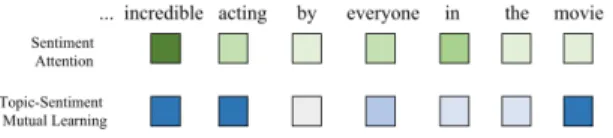
in the NN-based text classifier as illustrated in Figure 2(b). In order to explain our key idea better, we give an example in Figure 3 to illustrate the word-level attention weights generated from a traditional sentiment classification model and our proposed topic-sentiment mutual learning. We can observe that the traditional sentiment classification model puts a higher attention weight on the polarity word ‘incredible’. But with topic-sentiment mutual learning, higher attention weights are not only put on the polarity word ‘incredible’, but also on the associated topic indicated by the words ‘acting’ and ‘movie’. We argue that mutual learning would benefit sentiment classification since it enriches the information required for the training of the sentiment clas-sifier (e.g., when the word ‘incredible’ is used to describe ‘acting’ or ‘movie’, the polarity should be positive). At the same time, mutual learning could also benefit topic model learning since it encourages the clustering of words which are not only relevant under a similar topic but are also linked with a similar polarity.
Fig. 3. Different attention weights generate from traditional sentiment classification and our proposed mutual learning. Darker color indicates higher attention weights.
We summmarise the main contributions below1: • we propose a multi-task mutual learning framework
for jointly learning a neural generative topic model 1. We release our source code at OpenAIRE, https://zenodo.org/ record/3731361
and a NN-based text classifier;
• We propose a novel mutual learning method to max-imise the similarity between the topic distribution of a word in the NN-based topic model and the attention vector of the corresponding word in the NN-based text classifier;
• We evaluate our model on subsets of the Yelp and IMDB datasets and show that our model achieves superior performance compared with several strong baselines on both sentiment classification and topic extraction. On the original full datasets, our pro-posed method still beats the baselines most of the time on sentiment classification even though our topic modeling component can only be trained with a reduced vocabulary.
• The proposed framework also extracts more seman-tically coherent and interpretable topics compared to other conventional topic models and neural topic models.
The rest of the paper is organised as follows. Section 2 provides a review of related works on topic modeling, sentiment classification and multi-task learning for NLP. Section 3 presents our proposed multi-task mutual learn-ing framework. Section 4 discusses experimental setup and evaluation results. Finally, Section 5 concludes the paper and outlines the future directions.
2
RELATED
WORK
Our work is related to three lines of research: topic model-ing, text classification, and multi-task learning for NLP.
2.1 Topic modeling
Probabilistic topic models have been used widely in NLP. Typically, words are assumed to be generated from latent
topics which can be inferred from data based on word co-occurrence patterns. Topic models are often learned using the Markov chain Monte Carlo method [1], [2] in which model training and inference are approximated using sam-pling. Many variants of topic models have been proposed to take into account of sentiment [3], [4], [5], author informa-tion [6], contextual informainforma-tion [7] and word embeddings [8], [9], [10].
In recent years, the neural network based topic models have been proposed for many NLP tasks, such as infor-mation retrieval [11], aspect extraction [12] and sentiment classification [13]. The basic idea is to construct a neural network which aims to approximate the topic-word distri-bution in probabilistic topic models. Additional constraints, such as incorporating prior distribution [14], enforcing di-versity among topics [15] or encouraging topic sparsity [16], have been explored for neural topic model learning and proved effective. However, most of these algorithms take the auto-encoder as the basis learner to fit the distribution function. Due to the drawback in integrals, the generaliza-tion ability of the auto-encoder is limited.
More recently, the Variational Auto-Encoder (VAE) [17] has been proved more effective and efficient to approximat-ing deep, complex and underestimated variance in integrals [18], [19]. However, these VAE-based topic models [17], [20], [21], [22] focus on the construction of deep neural networks to approximate the intractable distribution be-tween observed words and latent topics. Intuitively, training the VAE-based supervised neural topic models with class labels [23], [24] may generate better features for classifi-cation. However, existing supervised neural topic models treat the class labels as weights which are distributed across words during training. It thus ignores the rich contextual information such as dependencies among words/phrases in a sentence and the ordering of sentences in a document, which is important for many downstream NLP tasks includ-ing sentiment analysis and opinion mininclud-ing.
2.2 Sentiment Classification
Sentiment classification can be solved by supervised sta-tistical learning models [25], [26], [27]. Traditional feature-engineering based sentiment classification models usually focus on extracting efficient features including lexical tures [26], topic-based features [3] and ontology-based fea-tures [28]. With the rapid development of deep learning, NN based models have shown promising performance on senti-ment classification. Various architectures of neural networks including Convolution Neural Network (CNN) [29] and Recurrent Neural Network (RNN) [30] have been proposed for sentiment classification. In document-level sentiment classification, the hierarchical semantic composition of a document can be modeled by hierarchical models such as the Gated Recurrent Neural Network [31] and the Hierarchi-cal Attention Network [32]. More recently, training neural networks with large-scale pre-trained word embeddings gives significantly improvements in text classification [33], [34].
In recent years, neural attention models have been com-monly applied to NLP tasks, including neural machine translation [35], text summarisation [36] and textual in-ference [37], and have also achieved encouraging result
in sentiment analysis [38]. Therefore, the most commonly seen sentiment classification models now focus on incor-porating the attention mechanism into the NN-based text classification models. Chen et al. [39] used the author and product information to obtain the attention signals with a hierarchical neural network for sentiment classification on product reviews. Tang et al. [40] deployed the memory network with attention for aspect-level sentiment classifi-cation. He et al. [13] stacked an auto-encoder layer in the memory network to obtain the aspect-specific attentions to improve the aspect-level sentiment classification. Besides the aforementioned methods, complicated neural module in networks [41], [42], prior knowledge obtained from a sentiment lexicon [43], and author profiles [44] have also been considered in sentiment classification. However, ex-isting neural attention models largely derive the attention weights or signals based on lexical matching between the hidden state representation of the current lexical unit (word or sentence) and a common context vector shared across sentences or documents. They mostly ignore the latent topic information which captures the semantic information in the global context.
2.3 Multi-Task Learning
Multi-task learning (MTL) is an important machine learning mechanism that improves the generalisation performance by learning a task together with other related tasks. It usually has a common layers which learns a shared rep-resentation across tasks, then stacks several task-specific upper layers to learn task-relevant representations. MTL has been successfully applied in many NLP tasks including classification [45], [46] and sequence tagging [47], [48], [49], [50]. However, most MTL research focuses on supervised learning [51]. To the best of our knowledge, there is no MTL framework for jointly learning an unsupervised model such as a generative topic model and a supervised model such as a text classifier.
Another challenging is that, most MTL research focuses on relevant tasks. For example, Liu et al. [52] proposed a RNN with shared layers for four tasks, which are all supervised text classification tasks. For sequence tagging [47], MTL is used for chucking, named entity recognition and part-of-speech tagging, which are all related. In this paper, the goal of our research is to build a framework which benefits both the unsupervised neural topic model and the supervised sentiment classifier. To the best of our knowledge, there is no MTL framework for jointly learning an unsupervised model and a supervised model simultane-ously in NLP.
3
PROPOSED
METHOD
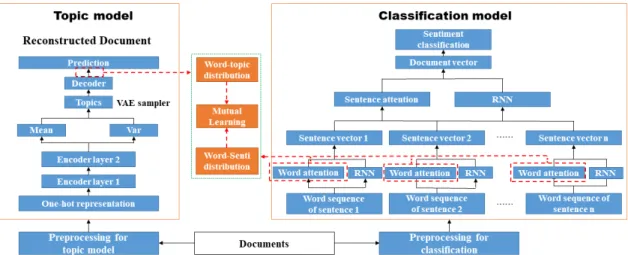
In this section, we will introduce our proposed MTL frame-work with mutual learning for topic detection and senti-ment classification. The overall architecture is illustrated in Figure 4. We propose a novel MTL framework based on the following observation. The weights of the decoder in a neural topic model indicate the association probabilities between words and topics, while the attention signals in
an attention-based classification model captures the impor-tance of words/sentences contributing to the overall senti-ment classification. Thus, if we could make these two distri-butions as similar as possible, we can potentially generate polarity-bearing topics and at the same time achieve higher sentiment classification results with the topical information incorporated. In the following, we will first briefly introduce the basic neural topic model and the classification model, then present our proposed mutual learning mechanism and the training strategy for MTL.
3.1 Neural Topic Model
Inspired by [18], [19], we assume the document-level topic distribution can be approximated by an Multi-Layer Per-ceptron (MLP) taking as input a multivariate Gaussian distribution. Then we can build our neural topic model based on VAE, which consists of two main components, the Inference Network and the Generation Network. For the In-ference Network, we use VAE to approximate the posterior distribution over topics for all the training instances. In the Generation Network, the words are generated via Gaussian softmax construction from the topic distribution generated by the Inference Network. The architecture of the neural topic model is shown in the left part of Figure 4 and we describe the model in more details below.
Inference Network. Following the idea of VAE which com-putes a variational approximation to an intractable posterior using MLPs, we define two MLPsfµθ andfΣθ which takes
as input the word counts in a document, µθ = fµθ(wd),
Σθ = diag(fΣθ(wd)), and outputs mean and variance of a
Gaussian distribution, both being vectors inRK. Here, ‘diag’
converts a column vector to a diagonal matrix. For a docu-ment wd, its variational distribution is q(θ) ' N(µθ,Σθ).
With such a formulation, we can generate samples from
q(θ) by first sampling ∼ N(0, I2) and then computing
ˆ
θ=σ(µθ+ Σθ1/2).
Generation Network. We feed the sampledθˆto two MLPs to generate zd. Here, zd is a K-dimensional latent topic
representation of documentd. The probability of wordwd,n
can be parameterised by another network,
p(wd,n|w, zd)∝exp(md+Wt·zd), (1)
wheremd is theV-dimensional background log-frequency
word distribution,Wt∈RV×K.
With the sampled θˆ , for each document wd, we can
estimate the Evidence Lower Bound with a Monte Carlo approximation usingLindependent samples:
Lt(wd)≈ 1 L L X l=1 Nd X n=1 logp(wd,n|θˆ(l))−KL(q(zd|wd)||p(zd)), (2) where the first term is given by Eq. (1), and the second term is: −KL(q(zd|wd)||p(zd)) =1 2 K X k=1 (1 + log((σθ,k)2)−(µθ,k)2−(σθ,k)2), (3)
whereKis the number of topics.
At the reconstruction layer, we stack a single-layer net-work to capture the sampling weights between each words and the latent topics.
3.2 Neural Text Classification Model
For the text classification model, we use a hierarchical RNN to model a document. Assuming that a document wd contains Md sentences,wd = {s1, s2, ...sMd}, and the
word embedding ofj-th word ini-th sentence iswji. Then, the representation of sentence si can be obtained by the
following steps: xji =W ·wji, − → hji =−−−→GRU(xji), ←− hji =←−−−GRU(xji), hji = − → hji⊕←h−ji, uji = tanh(Ww·h j i+bw), (4) αji = exp(u T ·uj i) P texp(uT ·u t i) , si= n X j=1 αji ·hji,
where −−−→GRU and ←−−−GRU are bi-directional gated recurrent neural units for RNN,W,Ww,bw are learned parameters
in the classification model, anduji is the attention vector of
j-th word ini-th sentence,αji is the attention signal captured byuji,si is the learned representation for thei-th sentence
in document wd. Then, we can learn the representation
of document wd with the similar architecture taking the
input as a sequence of sentence representations. Finally, a softmax layer is stacked at the top to predict the class labels of documents by cross entropy loss between the predicted labels and the true labels.
Lc(wd) =−
X
p·log[softmax(Wd·wd+bd)], (5)
where the output ofsoftmax(Wd·wd+bd)is the distribution
of predicted labels andpis the distribution of true labels.
3.3 Two Strategies for Multi-Task Learning
Before presenting our proposed mutual learning strategy for MTL, we first describe a simple setup, termed as ‘Hard At-tentions’, by forcing the topic distribution and the attention vector of a word to be the same by taking the mean value of these two vectors.
3.3.1 Multi-Task Learning with Hard Attentions
In the hard attention mechanism, we build a lookup table for each word in the vocabulary. The vector which is associated with a word is the mean value of its word attention vector obtained from sentiment classifier training and the decoder weights for topic generation obtained from the neural topic model.
Formally, for Wt ∈ RV×K in Eq. (1), let wij2 be an
entry in Wt, which stands for the generative
probabil-ity of the i-th word from the j-th topic, then the latent topic distribution for the i-th word can be represented as
w0i = {wi1, wi2, ..., wiK}, where K is the total number of
topics. We can also obtain the attention vectoru0ifor thei -th word from Eq. (4), u0
i = tanh(Ww·hi +bw). Here,hi 2. Note that we abuse the notation ofwijhere. Its meaning should
Fig. 4. Our proposed MTL with mutual learning for sentiment classification and topic detection.
Algorithm 1Multi-task Learning with Hard Attention
Require: Documents with labels{wd, yd},d={1,2, ..., D},
pre-trained word embeddings, the maximum training iterationsT.
Ensure: Trained topic model and sentiment classifier 1: Initialise model parameters
2: forj= 1toT or until convergencedo
3: Minimise the loss functionLf inalin Eq.(7) 4: Update the lookup table by Eq. (6) for each word 5: Update the weights in the topic decoder and the
attention vectors according to the lookup table 6: end for
7: Fine tune the model by minimising the task specific loss function for each task
is the hidden representation of the i-th word learned by GRU. In order to reshape the attention vector and topic distribution to the same size, we fix the dimension of the attention vectors asK. For thei-th word in the lookup table, the vector is:
Vi =
u0i+w0i
2 (6)
During training, we take topic modeling as task A and sentiment classification as task B. Then, the loss function is:
Lf inal=
X
d
α·Lt(wd) +β·Lc(wd) (7)
The lookup table is updated after each epoch of training. Then the weights of the topic decoder and the attention vec-tors are updated according to the lookup table. The pseudo-code of the training procedure is shown in Algorithm 1.
3.3.2 Multi-Task Mutual Learning
In the hard attention model, the neural topic model and the sentiment classifier are essentially trained separately except that the weights of the topic decoder and the attention vectors are forced to be the same by taking the average of their corresponding word-level distributions at the end of each training iteration. Such an ad-hoc update does not take into account the objective function during the decoder weight or attention signal update.
In this subsection, we instead propose a training strategy based on mutual learning. The key idea is to use latent topic distribution of each word obtained from the neural topic model to guide the calculation of word-level attention signals in the text classification model, which essentially in-corporates the topic information into the classifier training. On the other hand, the word-level attention vector which potentially carries the word-level polarity information could be used to guide the learning of latent topic distributions in the neural topic model.
The latent topic distribution for each word can be ob-tained by using the weights connecting the penultimate layer and the reconstruction layer in the neural topic model (as shown in the left part of Figure 4). The attention vector for each word in RNN is stored inuji as in Eq. (4). Mutual learning is used to make the latent topic distribution of a word to be similar to the attention vector of the same word from RNN. The benefits of using such a strategy are: 1) learning latent topics with word-level polarity information derived from classifier training without the need of using any external sentiment lexicons; 2) incorporating the latent topic information into classifier training to improve the classification performance.
Using the same notation introduced in Section 3.3.1 that the latent topic distribution for thei-th word is represented as w0i = {wi1, wi2, ..., wiK}, whereK is the total number
of topics, and the attention vector u0i for the i-th word is
obtained from Eq. (4). We measure and maximise the simi-larity between the latent topic distribution of theith word,
w0
i, and its attention vector,u0i, during the training. Here, we
explore four different similarity measurement metrics:
O1= X i |wi0·u0i| kw0ik2· ku0ik2 O2= X i |w0i·u0i| − kw0ik2− ku0ik2 O3= X i 2 2 +DKL(wi0|u0i) +DKL(u0i|wi0) O4= X i 1 1 + 1 1 DKL(w0i|u0i)+ 1 DKL(u0i|w0i) (8)
Algorithm 2Multi-task Mutual Learning
Require: Documents with labels{wd, yd},d={1,2, ..., D},
pre-trained word embeddings, candidate word vocab-ulary V = {w10, w20, ...w0kVk}, the maximum training iterationsT.
Ensure: Trained topic model and classifier 1: Initialise model parameters
2: forj= 1toT or until convergencedo
3: foreach mini batch of training instancesdo
4: Minimise the loss functionLf inalin Eq. (7) 5: end for
6: fort= 1tokVkdo
7: Optimise the object functionOin Eq. (8) for eachw0t
8: end for
9: end for
10: Fine tune the model by minimising the task specific loss function for each task
Here,O1is based on cosine similarity measurement,O2is an
inner product with a regularisation term,O3andO4are two
similarity functions introduced by arithmetic and harmonic mean of KL-divergence, respectively. In order to makew0i
and u0i comparable, we set the dimension of the attention vector ofu0
i to be the same as the number of latent topics.
With the similarity function define above, we introduce an additional objective function based solely on the similarity function. The optimal object now is to minimise the loss function defined in Eq.(9):
arg min θ,w0 i,u0i∈V X d (α·Lt(wd) +β·Lc(wd))− X V (Om(w0i, u 0 i))) (9) whereθ is the set of parameters in the neural topic model and the neural text classification model, 1 ≤ m ≤ 4, which stands for four different similarity measurements, respectively.
Note that it is highly ineffective to optimise the loss function defined in Eq. (9) directly. Because in topic model learning, usually text pre-processing is required to remove stop words, rare words and some high frequency words in order to alleviate the data sparsity issue. As such, the vocabulary size would be dramatically reduced. However, in RNN-based classification model learning, the original full vocabulary is usually kept since RNN needs to capture the word sequence information. Hence, for the u0i in the object function, we only consider the words which occur in the filtered vocabulary for topic modeling to ensure the symmetrical measure in the vector space constructed by our neural networks. In our actual implementation, we optimise the parameter in Eq. (7) and Eq. (8) separately. In each training epoch, we optimise the parameter in Eq. (7) iteratively for each minibatch of training instances to obtain topic and sentiment representations. Then, we updateOm
defined in Eq. (8) at the end of the current training epoch. That is, Eq. (7) is optimised more frequently compared to Eq. (8). The pseudo-code of the training procedure is shown in Algorithm 2.
For those words kept in the vocabulary for topic mod-eling, we can fine-tune the two distributions by making them similar (using the hard attention or mutual learning as
proposed in our work). In this way, we can adjust the word representations in both embedding spaces in order to incor-porate the sentiment information induced by the classifier and the topic information generated by the topic model. The isometrically embedding learning during classifier training can also ensure the influence of topic distributions to be spread to words which are filtered in topic modeling.
4
EXPERIMENTS
We evaluated our proposed framework on the IMDB and the Yelp datasets3 . Due to the computational constraints of training topic models, we sample part of the data to ensure balanced class distributions and a suitable size for topic model. Nevertheless, in order to compare with other sentiment classification baselines, we also evaluate our pro-posed method on the full dataset. The details of the sampled datasets and original dataset are shown in Table 1.
Data #Class #docs Vocab. Size
IMDB 10 348,415 115,831 Yelp2013 5 335,018 211,245 Yelp2014 5 1,125,457 476,191 Yelp2015 5 1,569,264 612,636 Sampled IMDB 10 15,000 55,819 Sampled Yelp 5 39,923 53,823 TABLE 1 Statistics of full datasets.
4.1 Experimental setup
For pre-processing, we performed stop word removal using the mallet toolkit4 and filtered the most frequent words falling into the upper quantile of 0.025 in the vocabulary. We then selected the most frequent 2,000, 3,000 and 5,000 words to form our vocabulary for the neural topic model.
For classifier training, we keep the full vocabulary since our classifier is built on the hierarchical RNNs. When max-imising the similarity function in Eq. (8), we only consider the attention vectors for words which can be found in the vocabulary of the topic model. We set aside 10% training samples as the validation set for parameter tuning.
During training, we use Adam to optimise the param-eters in the neural networks. The learning rate is 0.0001, the number of latent topics is set to [30,50,80], the mini-batch size is 20, α is 0.1, β is 0.9, and the pre-trained word embeddings for text classification are obtained from word2vec5 [53] trained from the Google news corpus and the dimension of word vector is 300.
4.2 Sentiment classification
For sentiment classification, we compare our approach with the following baselines.6
3. http://ir.hit.edu.cn/∼dytang/paper/emnlp2015/
emnlp-2015-data.7z
4. http://mallet.cs.umass.edu/import-stoplist.php 5. https://code.google.com/archive/p/word2vec/
6. Whenever the original implementation is available, the link to the source code is given in the footnote. For those methods which were re-implemented by us, they were marked with†.
Method Yelp Accuracy IMDB LightGBM 0.544 0.177 NGTMl 0.248 0.118 JST 0.411 0.243 NTSM 0.392 0.198 CNN 0.572 0.196 CNN+ 0.580 0.195 RNN 0.577 0.196 RCNN 0.594 0.196 NSC 0.616 0.355 MTL-RNN 0.610 0.327 V = 2,000 K= 30 K= 50 K= 80 K= 30 K= 50 K= 80 MTL-HA 0.608 0.611 0.599 0.381 0.371 0.378 MTL-ML1 0.610 0.618 0.608 0.407* 0.407* 0.396 MTL-ML2 0.610 0.614 0.610 0.406 0.400 0.398 MTL-ML3 0.621* 0.628* 0.621* 0.394 0.399 0.358 MTL-ML4 0.619 0.627 0.619 0.406 0.401 0.403* V = 3,000 K= 30 K= 50 K= 80 K= 30 K= 50 K= 80 MTL-HA 0.601 0.603 0.596 0.366 0.374 0.387 MTL-ML1 0.611 0.605 0.619 0.408* 0.402 0.402* MTL-ML2 0.612 0.611 0.612 0.396 0.403* 0.394 MTL-ML3 0.623* 0.622* 0.627* 0.367 0.399 0.376 MTL-ML4 0.620 0.617 0.619 0.399 0.401 0.397 V = 5,000 K= 30 K= 50 K= 80 K= 30 K= 50 K= 80 MTL-HA 0.601 0.597 0.583 0.377 0.362 0.381 MTL-ML1 0.616 0.608 0.618 0.402 0.402 0.395 MTL-ML2 0.597 0.617 0.605 0.371 0.396 0.396 MTL-ML3 0.621* 0.617 0.628* 0.395 0.411* 0.385 MTL-ML4 0.619 0.618* 0.621 0.406* 0.398 0.408* TABLE 2
Sentiment classification accuracy on sampled dataset. (* denotes proposed best method vs. the best in reference methods usingt-test with
p <0.01,V is the size of vocabulary andKis the number of topics.)
• LightGBM7: The Gradient Boosting Model (GBM) [54] withn-gram features. Here, then-gram features include the universal set of uni-grams, the top 500 most frequent bi-grams and tri-grams;
• NGTMl8: Neural Generative Topic Model (NGTM)
with sentiment labels [19]. Here, the basic classifier we choos is the Gradient Boosting Model (GBM) [54]; • JST9: Joint Sentiment-Topic Model [3], [4], a Bayesian modeling approach which jointly models sentiments and topics. The model is initialised with the word prior polarity derived from the MPQA sentiment lexicon [55]. The number of latent topics is 100 and the size of vocabulary is 5,000;
• NTSM: A Neural Sentiment Topic Model [23] with separate topic and sentiment representation. The prior knowledge of sentiment is from the MPQA sentiment lexicon [55] and the sentiment label of documents. The number of latent topics is 100 and the size of vocabulary is 5,000;
• CNN10: Convolutional neural network [29], which is a strong baseline and widely used in sentiment classification [56]. The kernel sizes are{2,3,4}, and the number of kernels of each size is 50;
• CNN+†: Incorporatingn-gram features into the pool-ing layer in CNN for sentiment classification; • RNN†: Recurrent neural network for sentiment
clas-sification [30]. The size of hidden states is 150;
7. https://scikit-learn.org/
8. https://github.com/ysmiao/nvdm 9. https://github.com/linron84/JST
10. https://github.com/yoonkim/CNNsentence
• RCNN11: A hierarchical neural network stacked with CNN and RNN layers for sentiment classification [31]. The convolutional kernel sizes are{2,3,4}, the number of kernels of each size is 50, and the size of hidden states in RNN is 150;
• NSC: A neural sentiment classification method [39] with hierarchical RNNs and an attention mechanism [32]. We use the re-implementation from [39]12with the default parameter settings.
For our proposed framework, we consider the following variants:
• MTL-RNN: Using RNN to reconstruct document in-stead of VAE in our proposed MTL framework. • MTL-HA: Our MTL framework without mutual
learning. Instead, it simply uses the average of word attentions and topic weights as the ‘hard-attention’ to allow the sharing of the information between the two networks.
• MTL-ML: Our proposed MTL with mutual learning with four different similarity measures, each one marked as MTL-MLm,m= 1,2,3,4.
The results of sentiment classification are shown in Ta-ble 2. LightGBM is a decision tree based classification model. We train it withn-gram or topic features. Its performance is the worst compared to NN-based classification methods. RCNN and NSC are based on the hierarchical learning architecture. The improvements of these two methods over
11. http://ir.hit.edu.cn/ dytang/paper/emnlp2015/codes.zip 12. https://github.com/thunlp/NSC
Method PPL C Yelp IMDB v PPL Cv PPL Cv PPL Cv PPL Cv PPL Cv V = 2,000 K= 30 K= 50 K= 80 K= 30 K= 50 K= 80 JST 1375.5 0.498 1438.8 0.498 1312.5 0.491 2573.8 0.517 2900.8 0.493 2348.3 0.502 NVDM 1980.1 0.492 1976.0 0.480 1985.9 0.536 1990.3 0.513 1872.3 0.517 1980.8 0.524 NGTM 1843.1 0.505 1851.9 0.511 1991.5 0.522 2064.2 0.493 2083.1 0.565 2038.2 0.505 NGTMl 1901.4 0.506 1733.9 0.514 2095.9 0.480 1887.8 0.485 2083.7 0.497 2719.3 0.535 NTSM 1729.8 0.505 1918.5 0.495 1807.6 0.507 1796.1 0.512 1829.5 0.531 2131.4 0.527 MTL-HA 1218.7 0.499 1243.7 0.501 1258.7 0.489 861.4 0.523 880.3 0.521 881.6 0.519 MTL-ML1 1299.4 0.481 1235.1 0.524* 1236.5 0.541 917.1 0.492 863.3 0.565 862.7 0.556 MTL-ML2 1301.9 0.483 1234.5 0.506 1234.5 0.553* 914.6 0.501 863.0 0.555 859.6 0.598* MTL-ML3 1219.5 0.516 1219.9 0.473 1233.7 0.491 857.7* 0.537* 864.7 0.473 862.1 0.496 MTL-ML4 1216.6* 0.521* 1183.9* 0.504 1190.9* 0.497 860.9 0.531 841.6* 0.571* 839.5* 0.492 V = 3,000 K= 30 K= 50 K= 80 K= 30 K= 50 K= 80 JST 2178.9 0.561 2144.7 0.522 2298.5 0.542 2988.1 0.528 3137.7 0.579 2897.1 0.533 NVDM 2558.8 0.543 2877.8 0.500 2675.9 0.514 2256.9 0.521 2936.6 0.551 2471.7 0.520 NGTM 2619.2 0.511 2840.1 0.488 2927.7 0.525 2300.1 0.531 2772.9 0.586 2454.6 0.508 NGTMl 3253.2 0.480 2650.7 0.488 4329.5 0.519 3599.4 0.533 3321.6 0.586 5080.5 0.521 NTSM 2510.9 0.497 2571.3 0.484 2999.0 0.484 2381.6 0.580 2698.8 0.521 3046.4 0.540 MTL-HA 1801.1 0.551 1788.4 0.521 1787.6 0.544 1289.1 0.561 1261.4 0.537 1211.7 0.559 MTL-ML1 1755.1 0.554 1764.9 0.538 1754.9 0.578 1201.8 0.532 1203.1 0.588 1200.5 0.578 MTL-ML2 1755.0 0.549 1762.1 0.480 1753.8 0.505 1199.6 0.556 1206.1 0.604* 1197.3 0.467 MTL-ML3 1751.5 0.579 1749.3 0.464 1752.0 0.500 1198.3 0.543 1133.4 0.488 1199.3 0.550 MTL-ML4 1750.5* 0.582* 1706.9* 0.595* 1749.4* 0.584* 1194.8* 0.598* 1131.3* 0.489 1191.9* 0.602* V = 5,000 K= 30 K= 50 K= 80 K= 30 K= 50 K= 80 JST 2171.4 0.546 3451.1 0.501 3133.4 0.551 3298.0 0.521 3361.7 0.516 3470.9 0.535 NVDM 2558.8 0.540 4576.9 0.523 4369.5 0.501 3479.0 0.581 4833.6 0.516 3751.7 0.533 NGTM 2619.3 0.522 4072.1 0.526 5112.8 0.525 3463.0 0.627 4593.3 0.564 3805.1 0.549 NGTMl 3253.2 0.515 4500.6 0.513 7636.2 0.498 5929.6 0.627 5539.6 0.516 7798.5 0.549 NTSM 2510.9 0.519 3972.4 0.517 4181.6 0.496 4442.1 0.566 4045.8 0.522 4521.5 0.522 MTL-HA 2688.1 0.551 2651.7 0.509 2541.7 0.513 1801.9 0.519 1847.7 0.523 1801.4 0.499 MTL-ML1 2664.8 0.536 2620.8 0.541 2665.1 0.562 1799.9 0.541 1809.8 0.587 1797.0 0.419 MTL-ML2 2664.0 0.476 2614.9 0.462 2663.3 0.434 1796.7 0.520 1816.5 0.599* 1793.1 0.485 MTL-ML3 2662.5 0.491 2537.6* 0.479 2656.3 0.500 1791.2 0.574 1660.8* 0.480 1791.8 0.499 MTL-ML4 2652.8* 0.607* 2540.8 0.543* 2654.1* 0.588* 1788.6* 0.574 1699.7 0.531 1775.7* 0.574* TABLE 3
Perplexity and topic coherence results on sampled dataset.(* denotes proposed best method VS. the best in reference methods using Mc- Nemars testp <0.01,V is the size of vocabulary andKis the number of topics.)
other baselines show the effectiveness of hierarchical learn-ing. With the attention mechanism, NSC shows further improvements over RCNN.
In our proposed framework, the sentiment classifier shares attention weights with topic-word distribution ob-tained from the neural topic model. We would like to find out if the vocabulary size affects the performance of sentiment classification. In another set of experiments, we evaluate the impact of different vocabulary size{2k, 3k and 5k}on the sentiment classification results.
Among our proposed variants, MTL-HA simply used the ‘hard-attention’ to ensure the sharing between the la-tent topic distributions and the word-level atla-tention vec-tors without mutual learning. Interestingly, MTL-HA out-performs most baselines. Nevertheless, it out-performs worse compared to MTL-MLm (m = 1,2,3,4), which are based
on mutual learning. MTL-ML3 and MTL-ML4, which are
based on KL-divergence, achieve better performance than MTL-ML1 and MTL-ML2 on the Yelp dataset. MTL-ML1
and MTL-ML2, which use cosine similarity based measures,
slightly outperform MTL-ML3and MTL-ML4on the IMDB
dataset when the vocabulary size is 2k and 3k. For the vocabulary size of 5k, MTL-ML3 and MTL-ML4 give the
best results on both datasets.
By cross comparing the results with different vocabulary sizes, we notice that the best result is achieved by MTL-ML3
when the vocabulary size is set to 2k on the Yelp dataset. Increasing the vocabulary size results in slightly decreased
classification accuracy. For the IMDB dataset, the sentiment classification performance is less sensitive to the vocabulary size. Overall, varying the vocabulary size does not impact the sentiment classification performance much.
We also use RNN instead of VAE to reconstruct the documents in MTL (denoted as MTL-RNN in Table 2). However, the performance is slightly lower than NSC. One possible reason is that using RNN to reconstruct documents is essentially the same as training a language model on the training set. Since we use word embeddings pre-trained on a large-scale data as input to MTL-RNN, it did not gain much on the current training set.
In conclusion, compared with the best baseline model, NSC, our proposed models give the improvement in accu-racy ranging between 1.2% and 5.6%.
4.3 Topic modeling
For topic extraction, we compare our approach with the following baselines:
• JST13: Joint Sentiment-Topic Model [3], [4], a Bayesian modeling approach which jointly models sentiments and topics. The model is initialised with the word prior polarity derived from the MPQA sentiment lexicon [55];
• NVDM14: Neural Variational Document model [18] which is based on VAE for topic extraction from text; • NGTM†: Neural Generative Topic model [19], also based on VAE, but additionally incorporating the log background frequency of words to better deal with sparsity;
• NGTMl: NGTM trained with document-level
senti-ment labels.
• NTSM†: A Neural Sentiment Topic Model [23] with separate topic and sentiment representation. The prior knowledge of sentiment is from the MPQA sentiment lexicon [55] and the sentiment label of documents.
The models are evaluated based on perplexity (PPL, lower is better) and topic coherence (Cv measures) [57]
(higher is better). The results are shown in Table 3. JST is a conventional Bayesian model with parameters estimated by Gibbs sampling, while NVDM and NGTM are neural topic models. JST and NTSM utilizes the MPQA lexicon to obtain the word-level prior sentiment information and NGTMl is
trained with the document-level sentiment class labels. It can be observed that among the baselines, the conven-tional topic model JST outperforms the others on perplexity measures on the Yelp dataset. But on the IMDB dataset, the results are mixed. Neural topic models such as NVDM, NGTM, and NTSM perform better than the others with 2k or 3k vocabulary size, but perform worse than JST with 5k vocabulary size. In terms of topic coherence, NGTM gives the best overall results compared to other baselines. Incor-porating supervised sentiment label information (NGTMl,
NTSM) does not boost the topic coherence measures. Among our proposed MTL variants, MTL-ML3 and
MTL-ML4give lower perplexity across different vocabulary
sizes on both the Yelp and IMBD datasets. It shows that using similarity measures based on the KL divergence is more effective compared to those based on cosine similarity measures on perplexity. For the coherence scores, MTL-ML4
perform better on the Yelp dataset in most cases when the vocabulary size grows. The MTL-ML2works well when the
topic number is 50.
When compared with the baselines, we can observe that our proposed MTL frameworks give superior performance by a large margin in perplexity on both the Yelp and IMBD datasets. For topic coherence, both MTL-ML3 and
MTL-ML4 outperform all the baselines on both datasets with 2k
vocabulary size. Increasing the vocabulary size, MTL-ML4
gives the best results on the Yelp dataset, while MTL-ML2
beats all the other models on the IMDB dataset when the topic number is 50.
We also compare the models with the varying topic number and observed generally improved perplexity results with the increasing number of topics. However, the topic coherence values fluctuate across topic numbers. Overall, we can conclude that the best perplexity results on both datasets are obtained by MTL-ML4with the vocabulary size
of 2k and topic number 30. The best topic coherence results are achieved using MTL-ML4 on Yelp and MTL-ML2 on
IMDB.
14. https://github.com/ysmiao/nvdm
Topic Top Words from NGTM in IMDB
1 hitler 1940 holden lands lethal morricone repulsive deserving
2 chainsaw offended undead marc ghost-busters deniro smilingrealistically
3 witches shake scariest rats patch psychi-atric kong cartoons
4 dumbest boring hopelessly insipid hack dismal disastrous nonsensical
5 razzie executives marilyn massesrousing
abysmalrecords glance
Topic Top Words from MTL-ML4in IMDB
1 horrendous messysolelyholy inexplicably avoided ambiguous inferior
2 amazed expert greeting saluted grace model drunken beauty
3 humbert pleasantville joanna caesar damien wolverine mick boogeyman 4 witnesses careers apocalypse teams
re-sponsibility viewings panic freak 5 ship flame sorbet delighted moms suns
mellowhalibut
Topic Top Words from NGTM in Yelp
1 ricotta sweets romaine aioli masala tikka nutella gras provolone
2 paste connoisseur hashbrowns croissant thicker garnish powder tastier
3 disgusted questioned ignoring flagged
false lied insult
4 unhelpful lied scam ringing false reply
argued loudly
5 pics ad tex aunt walnuts oddly responsive mash
Topic Top Words from MTL-ML4in Yelp
1 letdown miserably mediocrity frustrating horrendous sadness disastrous sloppy
2 exceptionally unbelievably superblysolely
blatant amazed unintentional astonishing
3 hockey player button jersey hipsters ques-tionable incorrectlybrew league
4 amc pics elevator buzz lane spotted bat-tered colombian patience
5 crusty barbecue diced kungpao quesadil-las chunky pastas hashbrowns
TABLE 4
Example topic words from NGTM and MTL-ML2(Vocabulary size = 2,000, topic = 50, the sentiment words are highlighted with color, red for
negative and green for positive).
We show example topics extracted from IMDB and Yelp by NGTM and MTL-ML4 in Table 4 when the vocabulary
size is set to 2k and topic number is 50. In IMDB, the topics extracted by NGTM are more relating to different categories of movies. For example, Topic 1 is about World War II, Topic 2 is about a thriller and Topic 3 contains words relating to cartoons. There are also some opinion words, which can be found in topic 4 and 5. In topic 5, the NGTM mixes positive and negative sentiment words into a same topic. It shows that the topic model lacks the capability to identify sentiment polarity.
The topic results produced by MTL-ML4 contain
se-mantic information from the embedding space. For ex-ample, Topic 1 contains largely negative adjective words and topic 2 contains many positive words. Interestingly, Topic 3 contains names of actors or movie characters. One possible reason is that people names might share some contextual patterns. As such, their hidden states in RNN tend to be mapped to similar attention vectors. Due to
mutual learning, the attention vectors will influence the topic distributions so as to form a topic of names. Similar to NGTM, there are also some topics about the themes of movies, such as Topic 4 which is likely about a disaster or a catastrophe, and Topic 5 is about holiday and vocations.
On the Yelp dataset, since most reviews are about restau-rants, the topics extracted by NGTM are largely relating to cuisines such as Topic 1 and Topic 2, or complaints about services such as Topic 3 and Topic 4. We also notice that most opinion words extracted by NGTM are negative. Topic 5 seems mixing the words about food and service.
On the contrary, our proposed MTL-ML4 can capture
not only the negative, but also the positive opinion words, as shown in Topic 1 and Topic 2, respectively, because of the joint learning of topics and sentiment attentions. Another advantage of mutual learning is that the semantic information encoded in the RNN enhances the capability of the neural topic model in capturing the low frequent words. Even the Yelp dataset contains mostly the restaurant reviews, MTL-ML4 extracts topics relating to spot bar or
cinema, as shown in Topic 3 and Topic 4, respectively. One possible reason is that the low frequent words are embedded by RNN according to the context, and the embedding space will lead the topic model to generate those words based on the similarity measure during mutual learning.
4.4 Parameter analysis
Fig. 5. The output of loss function in topic generation and sentiment classification during the model training.
In our proposed MTL-ML methods, most parameters can be fine-tuned by the validation set. The only parameter requires manual setup is α and β in Eq.(7), which stands for the weights of the two loss functions corresponding to two tasks in multi-task learning. Intuitively, the weights of the two loss functions should be balanced to ensure their equal contributions to the final loss functions. In neural topic model learning, the loss function of topic generation is based on ELBO, which is usually a large number, while for
sentiment classifier training, the loss function is based on cross entropy, which is between 0 and 1. To illustrate this, we show in Figure 5 the loss values of two tasks during the model training on the Yelp dataset.
It can be observed that the loss values of the sentiment classifier only fluctuate within a small range while the loss values of topic models have a larger scale. The reason is that although the ELBO can approximate the generative loss theoretically, the generative loss is in fact unbounded [58]. To address this issue, we assign a small value toα, and take
β= 1−α.
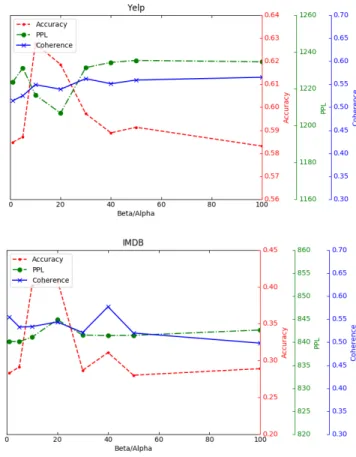
Fig. 6. The performance of sentiment classification and topic generation by proposedMTL-ML4with differentα&βvalues.
The performances of sentiment classification and topic generation with different ratio ofβ/αare shown in Figure 6. In this set of experiments, the vocabulary size is 2,000 and the topic number is 50. We can observe that the performance of topic generation (perplexity and topic coherence) is less sensitive to the setting ofβ/α, while the sentiment classifica-tion accuracy is impacted heavily by different values ofβ/α. In Fig. 6,α={0.05,0.1}gives the best results on sentiment classification without much degradation of topic PPL and coherence. Hence, we setαto 0.1 in our experiments. 4.5 Sentiment Classification on the Full Dataset In this section, we explore the performance of sentiment classification on the full dataset. Here, we follow the ex-perimental setup in [32] and report the results in Table 5. For our proposed method, the number of topics is 300 and the vocabulary size for the topic model is 5,000. The results of referenced methods are similar to those reported on the
Model Yelp 2013 Yelp 2014 Yelp 2015 IMDB LightGBM 56.8 57.5 58.2 31.6 CNN+ 63.7 61.2 64.7 41.3 RNN 62.1 62.5 63.1 41.1 CRNN 63.7 65.5 66.0 42.5 NSC 67.3 69.5 69.8 49.0 MTL-RNN 67.2 69.2 69.7 48.3 MTL-HA 65.7 63.2 66.7 46.3 MTL-ML1 67.1 68.9 68.8 48.2 MTL-ML2 66.9 69.4 68.6 48.4 MTL-ML3 67.4 70.2 69.6 49.3 MTL-ML4 68.6 70.1 69.4 49.7 TABLE 5
Sentiment classification accuracy of our proposed against baselines on full dataset15.
sampled dataset shown in Table 2. Among the baselines, NSC beats other models by a large margin. Among our proposed approaches, we notice that using hard attention (MTL-HA) performs worse since the topic distribution is not well trained and simply using mean pooling introduces noises into the sentiment classifier. The performance of mutual learning based methods is similar to that on the sampled data. MTL-ML3and MTL-ML4beat MTL-ML1and
MTL-ML2by a small margin.
When comparing our proposed approaches with NSC, we can see that MTL-ML4 outperforms NSC on the Yelp
2013 and IMDB datasets while MTL-ML3 gives slightly
better results on the Yelp 2014 dataset. We observe that in the largest dataset, Yelp 2015, using mutual learning performs slightly worse than NSC by 0.7%. This is due to the training constraint imposed on topic modeling that only limited vocabulary can be used since the input to the neural topic model is the bag-of-words representation. In future work, we will explore other ways in formulating neural topic models such as based on Bayesian formulation of the skip-gram model in order to deal with large-scale training data.
5
CONCLUSION
In this paper, we have presented a new Multi-Task Learn-ing framework with mutual learnLearn-ing for both sentiment classification and topic extraction. We evaluate our model on subsets of the Yelp and IMDB datasets and show that our model achieves superior performance compared with several strong baselines on sentiment classification. On the original full datasets, our proposed method still beats the baselines most of the time even though the topic modeling component can only be trained with a reduced vocabulary. The proposed framework also extracts more semantically coherent topics. In future work, we will explore extending this model for sentiment/topic dynamics analysis.
ACKNOWLEDGMENTS
This work was supported by EU-H2020 (grant no. 794196), EPSRC (grant no. EP/T017112/1), Innovate UK (grant no. 103652), National Natural Science Foundation of China 61876053, 61632011, Shenzhen Foundational Research Fund-ing JCYJ20180507183527919.
REFERENCES
[1] R. M. Neal, “Probabilistic inference using markov chain monte carlo methods,” 1993.
[2] C. Andrieu, N. de Freitas, A. Doucet, and M. I. Jordan, “An introduction to MCMC for machine learning,”Machine Learning, vol. 50, no. 1-2, pp. 5–43, 2003.
[3] C. Lin and Y. He, “Joint sentiment/topic model for sentiment analysis,” in The ACM Conference on Information and Knowledge Management, 2009, pp. 375–384.
[4] C. Lin, Y. He, R. Everson, and S. Ruger, “Weakly supervised joint sentiment-topic detection from text,” IEEE Transactions on Knowledge and Data engineering, vol. 24, no. 6, pp. 1134–1145, 2012. [5] C. Ma, M. Wang, and X. Chen, “Topic and sentiment unification maximum entropy model for online review analysis,” in Proceed-ings of the 24th International Conference on World Wide Web. ACM, 2015, pp. 649–654.
[6] J. Li, M. Liao, W. Gao, Y. He, and K.-F. Wong, “Topic extraction from microblog posts using conversation structures,” in Proceed-ings of the 54th Annual Meeting of the Association for Computational Linguistics (Volume 1: Long Papers). Association for Computational Linguistics, 2016, pp. 2114–2123.
[7] V. Rakesh, W. Ding, A. Ahuja, N. Rao, Y. Sun, and C. K. Reddy, “A sparse topic model for extracting aspect-specific summaries from online reviews,” inProceedings of the 2018 World Wide Web Conference on World Wide Web. International World Wide Web Conferences Steering Committee, 2018, pp. 1573–1582.
[8] X. Li, J. Chi, C. Li, J. Ouyang, and B. Fu, “Integrating topic mod-eling with word embeddings by mixtures of vmfs,” inProceedings of COLING 2016, the 26th International Conference on Computational Linguistics: Technical Papers, 2016, pp. 151–160.
[9] K. Batmanghelich, A. Saeedi, K. Narasimhan, and S. Gershman, “Nonparametric spherical topic modeling with word embed-dings,”arXiv preprint arXiv:1604.00126, 2016.
[10] R. Das, M. Zaheer, and C. Dyer, “Gaussian lda for topic models with word embeddings,” inProceedings of the 53rd Annual Meeting of the Association for Computational Linguistics and the 7th Interna-tional Joint Conference on Natural Language Processing (Volume 1: Long Papers), vol. 1, 2015, pp. 795–804.
[11] P. Xie, Y. Deng, and E. P. Xing, “Diversifying restricted boltzmann machine for document modeling,” inProceedings of the 21th ACM SIGKDD International Conference on Knowledge Discovery and Data Mining, Sydney, NSW, Australia, August 10-13, 2015, 2015, pp. 1315– 1324.
[12] R. He, “An unsupervised neural attention model for aspect extrac-tion,” inProceedings of the 55th Annual Meeting of the Association for Computational Linguistics, ACL 2017, Vancouver, Canada, July 30 -August 4, Volume 1: Long Papers, 2017, pp. 388–397.
[13] R. He, W. S. Lee, H. T. Ng, and D. Dahlmeier, “Effective attention modeling for aspect-level sentiment classification,” inProceedings of the 27th International Conference on Computational Linguistics, COLING, 2018, pp. 1121–1131.
[14] R. Das, M. Zaheer, and C. Dyer, “Gaussian LDA for topic models with word embeddings,” inProceedings of the 53rd Annual Meeting of the Association for Computational Linguistics and the 7th Interna-tional Joint Conference on Natural Language Processing of the Asian Federation of Natural Language Processing, ACL 2015, July 26-31, 2015, Beijing, China, Volume 1: Long Papers, 2015, pp. 795–804. [15] P. Xie, J. Zhu, and E. P. Xing, “Diversity-promoting bayesian
learning of latent variable models,” in Proceedings of the 33nd International Conference on Machine Learning, ICML 2016, New York City, NY, USA, June 19-24, 2016, 2016, pp. 59–68.
[16] M. Peng, Q. Xie, H. Wang, Y. Zhang, X. Zhang, J. Huang, and G. Tian, “Neural sparse topical coding,” inProceedings of the 56th Annual Meeting of the Association for Computational Linguistics, ACL 2018, Melbourne, Australia, July 15-20, 2018, Volume 1: Long Papers, 2018, pp. 2332–2340.
[17] D. P. Kingma and M. Welling, “Auto-encoding variational bayes,” CoRR, vol. abs/1312.6114, 2013. [Online]. Available: http://arxiv.org/abs/1312.6114
[18] Y. Miao, L. Yu, and P. Blunsom, “Neural variational inference for text processing,” in The International Conference on Machine Learning, 2016, pp. 1727–1736.
[19] D. Card, C. Tan, and N. A. Smith, “A neural framework for generalized topic models,”arXiv preprint arXiv:1705.09296, 2017. [20] A. Srivastava and C. Sutton, “Autoencoding variational inference
for topic models,” inInternational Conference on Learning Represen-tations, 2017.
[21] C. K. Sønderby, T. Raiko, L. Maaløe, S. K. Sønderby, and O. Winther, “Ladder variational autoencoders,” in The Annual Conference on Neural Information Processing Systems, 2016, pp. 3738– 3746.
[22] D. Bouchacourt, R. Tomioka, and S. Nowozin, “Multi-level vari-ational autoencoder: Learning disentangled representations from grouped observations,” inAAAI Conference on Artificial Intelligence, 2018.
[23] S. Chaidaroon and Y. Fang, “Variational deep semantic hashing for text documents,” inProceedings of the 40th International ACM SIGIR Conference on Research and Development in Information Retrieval, Shinjuku, Tokyo, Japan, August 7-11, 2017, 2017, pp. 75–84. [24] M. Huang, Y. Rao, Y. Liu, H. Xie, and F. L. Wang, “Siamese
network-based supervised topic modeling,” inProceedings of the 2018 Conference on Empirical Methods in Natural Language Processing, 2018, pp. 4652–4662.
[25] B. Pang, L. Lee, and S. Vaithyanathan, “Thumbs up?: sentiment classification using machine learning techniques,” in The 2002 Conference on Empirical Methods on Natural Language Processing, 2002, pp. 79–86.
[26] S. Wang and C. D. Manning, “Baselines and bigrams: Simple, good sentiment and topic classification,” inProceedings of the 50nd Annual Meeting of the Association for Computational Linguistics, 2012, pp. 90–94.
[27] E. Cambria, S. Poria, A. Gelbukh, and M. Thelwall, “Sentiment analysis is a big suitcase,”IEEE Intelligent Systems, vol. 32, no. 6, pp. 74–80, 2017.
[28] Y. Dang, Y. Zhang, and H. Chen, “A lexicon-enhanced method for sentiment classification: An experiment on online product reviews,”IEEE Intelligent Systems, vol. 25, no. 4, pp. 46–53, 2010. [29] Y. Kim, “Convolutional neural networks for sentence
classifica-tion,” in The 2014 Conference on Empirical Methods on Natural Language Processing. Association for Computational Linguistics, 2014, pp. 1746–1751.
[30] A. Graves, “Generating sequences with recurrent neural net-works,”arXiv preprint arXiv:1308.0850, 2013.
[31] D. Tang, B. Qin, and T. Liu, “Document modeling with gated recurrent neural network for sentiment classification,” inThe 2015 Conference on Empirical Methods on Natural Language Processing., 2015, pp. 1422–1432.
[32] Z. Yang, D. Yang, C. Dyer, X. He, A. J. Smola, and E. H. Hovy, “Hierarchical attention networks for document classification.” in Proceedings of the 2016 Conference of the North American Chapter of the Association for Computational Linguistics: Human Language Technologies, 2016, pp. 1480–1489.
[33] M. Peters, M. Neumann, M. Iyyer, M. Gardner, C. Clark, K. Lee, and L. Zettlemoyer, “Deep contextualized word representations,” inProceedings of the 2018 Conference of the North American Chapter of the Association for Computational Linguistics: Human Language Technologies, Volume 1 (Long Papers), vol. 1, 2018, pp. 2227–2237. [34] J. Devlin, M.-W. Chang, K. Lee, and K. Toutanova, “Bert:
Pre-training of deep bidirectional transformers for language under-standing,”arXiv preprint arXiv:1810.04805, 2018.
[35] D. Bahdanau, K. Cho, and Y. Bengio, “Neural machine trans-lation by jointly learning to align and translate,” arXiv preprint arXiv:1409.0473, 2014.
[36] A. M. Rush, S. Chopra, and J. Weston, “A neural attention model for abstractive sentence summarization,” arXiv preprint arXiv:1509.00685, 2015.
[37] B. Dhingra, H. Liu, Z. Yang, W. Cohen, and R. Salakhutdinov, “Gated-attention readers for text comprehension,” inProceedings of the 55nd Annual Meeting of the Association for Computational Linguistics (Volume 1: Long Papers), vol. 1, 2017, pp. 1832–1846. [38] S. Wang, S. Mazumder, B. Liu, M. Zhou, and Y. Chang,
“Target-sensitive memory networks for aspect sentiment classification,” in Proceedings of the 56th Annual Meeting of the Association for Computational Linguistics, 2018, pp. 957–967.
[39] H. Chen, M. Sun, C. Tu, Y. Lin, and Z. Liu, “Neural sentiment classification with user and product attention,” inProceedings of the 2016 Conference on Empirical Methods in Natural Language Processing. Association for Computational Linguistics, 2016, pp. 1650–1659. [40] D. Tang, B. Qin, and T. Liu, “Aspect level sentiment classification
with deep memory network,” inProceedings of the 2016 Conference on Empirical Methods in Natural Language Processing. Association for Computational Linguistics, 2016, pp. 214–224.
[41] C. Fan, Q. Gao, J. Du, L. Gui, R. Xu, and K. Wong, “Convolution-based memory network for aspect-“Convolution-based sentiment analysis,” in
The 41st International ACM SIGIR Conference on Research & Develop-ment in Information Retrieval, SIGIR 2018, Ann Arbor, MI, USA, July 08-12, 2018, 2018, pp. 1161–1164.
[42] P. Chen, Z. Sun, L. Bing, and W. Yang, “Recurrent attention network on memory for aspect sentiment analysis,” inProceedings of the 2017 Conference on Empirical Methods in Natural Language Processing, EMNLP 2017, Copenhagen, Denmark, September 9-11, 2017, 2017, pp. 452–461.
[43] Y. Zou, T. Gui, Q. Zhang, and X. Huang, “A lexicon-based super-vised attention model for neural sentiment analysis,” in Proceed-ings of the 27th International Conference on Computational Linguistics, COLING 2018, Santa Fe, New Mexico, USA, August 20-26, 2018, 2018, pp. 868–877.
[44] J. Li, H. Yang, and C. Zong, “Document-level multi-aspect senti-ment classification by jointly modeling users, aspects, and overall ratings,” inProceedings of the 27th International Conference on Com-putational Linguistics, COLING 2018, Santa Fe, New Mexico, USA, August 20-26, 2018, 2018, pp. 925–936.
[45] P. Liu, X. Qiu, and X. Huang, “Adversarial multi-task learning for text classification,” inProceedings of the 55th Annual Meeting of the Association for Computational Linguistics, 2017.
[46] M. Isonuma, T. Fujino, J. Mori, Y. Matsuo, and I. Sakata, “Ex-tractive summarization using multi-task learning with document classification,” in The 2017 Conference on Empirical Methods on Natural Language Processing, 2017, pp. 2101–2110.
[47] R. Collobert, J. Weston, L. Bottou, M. Karlen, K. Kavukcuoglu, and P. P. Kuksa, “Natural language processing (almost) from scratch,” Journal of Machine Learning Research, vol. 12, pp. 2493–2537, 2011. [48] A. Søgaard and Y. Goldberg, “Deep multi-task learning with
low level tasks supervised at lower layers,” inProceedings of the 54nd Annual Meeting of the Association for Computational Linguistics (Volume 2: Short Papers), 2016, pp. 231–235.
[49] H. M. Alonso and B. Plank, “When is multitask learning effective? semantic sequence prediction under varying data conditions,” pp. 44–53, 2017.
[50] K. Singla, D. Can, and S. Narayanan, “A multi-task approach to learning multilingual representations,” in Proceedings of the 56nd Annual Meeting of the Association for Computational Linguistics (Volume 2: Short Papers), 2018, pp. 214–220.
[51] Y. Zhang and Q. Yang, “A survey on multi-task learning,”arXiv preprint arXiv:1707.08114, 2017.
[52] P. Liu, X. Qiu, and X. Huang, “Recurrent neural network for text classification with multi-task learning,” inProceedings of the Twenty-Fifth International Joint Conference on Artificial Intelligence, IJCAI 2016, New York, NY, USA, 9-15 July 2016, 2016, pp. 2873– 2879.
[53] T. Mikolov, I. Sutskever, K. Chen, G. S. Corrado, and J. Dean, “Distributed representations of words and phrases and their com-positionality,” inAdvances in neural information processing systems, 2013, pp. 3111–3119.
[54] G. Ke, Q. Meng, T. Finley, T. Wang, W. Chen, W. Ma, Q. Ye, and T.-Y. Liu, “Lightgbm: A highly efficient gradient boosting decision tree,” in The Annual Conference on Neural Information Processing Systems, 2017, pp. 3146–3154.
[55] T. Wilson, J. Wiebe, and P. Hoffmann, “Recognizing contextual polarity in phrase-level sentiment analysis,” inHLT/EMNLP 2005, Human Language Technology Conference and Conference on Empirical Methods in Natural Language Processing, Proceedings of the Conference, 6-8 October 2005, Vancouver, British Columbia, Canada, 2005, pp. 347– 354.
[56] L. Gui, R. Xu, Y. He, Q. Lu, and Z. Wei, “Intersubjectivity and sentiment: From language to knowledge,” in Proceedings of the Twenty-Fifth International Joint Conference on Artificial Intelligence, IJCAI 2016, New York, NY, USA, 9-15 July 2016, 2016, pp. 2789– 2795.
[57] M. R ¨oder, A. Both, and A. Hinneburg, “Exploring the space of topic coherence measures,” inThe 8th ACM International Conference on Web Search and Data Mining, 2015, pp. 399–408.
[58] P. Mattei and J. Frellsen, “Leveraging the exact likelihood of deep latent variable models,” inAdvances in Neural Information Process-ing Systems 31: Annual Conference on Neural Information ProcessProcess-ing Systems 2018, NeurIPS 2018, 3-8 December 2018, Montr´eal, Canada., 2018, pp. 3859–3870.
Lin Guiis a Marie Curie Research Fellow in the Department of Computer Science, University of Warwick, UK. He has published over 20 papers in top conferences and high-impact journals. His research interests include natural language pro-cessing, machine learning, text and data mining, sentiment analysis, and social media analysis. Lin obtained his PhD degree from Harbin Insti-tute of Technology, China.
Jia Lengis a Research and Development Engi-neer in Meituan. Her research interests include natural language processing, sentiment analysis and topic modeling. She obtained her MEng de-gree from Harbin Institute of Technology.
Jiyun Zhouis now a postdoc in Department of Psychiatry and Behavioral Sciences, the Johns Hopkins University. His main research interests are bioinformatics, natural language processing and machine learning. He obtained his PhD de-gree from Hong Kong Polytechnic University.
Ruifeng Xuis a Professor in the School of Com-puter Science and Technology, Harbin Institute of Technology (Shenzhen), China. His research interests are natural language processing, emo-tion computing and text mining. He obtained his BEng degree from Harbin Institute of Technol-ogy, China, and MPhil and PhD degrees from Hong Kong Polytechnic University.
Yulan He is a Professor in the Department of Computer Science, University of Warwick, UK. She has published more than 160 papers with most appeared in high-impact journals and top conferences. Her research interests include nat-ural language processing, statistical modeling, text and data mining. Yulan received her PhD degree in spoken language understanding from the University of Cambridge, UK.