Efficient Algorithm for the Paired-Domination Problem in
Convex Bipartite Graphs
Ruo-Wei Hung
∗†, Chi-Hyi Laio, and Chun-Kai Wang
Abstract—Let G = (V, E) be a graph without iso-lated vertices. A matching in G is a set of indepen-dent edges in G. A perfect matching M in G is a matching such that every vertex of G is incident to an edge of M. A setS⊆V is a paired-dominating set
of G if every vertex not in S is adjacent to a vertex in S, and if the subgraph induced by S contains a perfect matching. The paired-domination problem is to find a paired-dominating set of G with minimum cardinality. The paired-domination problem on bi-partite graphs has been shown to be NP-complete. A bipartite graph G= (U, W, E) isconvex if there exists an ordering of the vertices of W such that, for each u ∈ U, the neighbors of u are consecutive in W. In this paper, we present anO(|U|log|U|)-time algorithm to solve the paired-domination problem in convex bi-partite graphs.
Keywords: graph algorithms, paired-domination, con-vex bipartite graphs
1
Introduction
The problem of placing monitoring devices in a system such that every site in the system (including the moni-toring devices themselves) is adjacent to a monitor and every monitor is paired with a backup monitor, can be modeled by paired-domination in graphs. In this paper, we consider the paired-domination problem in convex bi-partite graphs.
A setSof vertices of a graphG= (V, E) is adominating set ofGif every vertex not inSis adjacent to a vertex in S. The domination problem is to find a dominating set of Gwith minimum cardinality. Variations of the dom-ination problem seek to find a minimum dominating set with some additional properties, e.g., to be independent or to induce a connected graph. These problems arise in a number of distributed network applications, where the problem is to locate the smallest number of centers in networks such that every vertex is nearby at least one cen-ter. Domination and its variations in graphs have been thoroughly studied, and the literature on this subject has been surveyed and detailed in two books [8, 9].
∗Department of Computer Science and Information
Engineer-ing, Chaoyang University of Technology, Wufong, Taichung 413, Taiwan.
†Corresponding author’s e-mail: [email protected]
v1 v2
v4 v3
v6 v7
[image:1.595.381.474.192.288.2]v5 v8
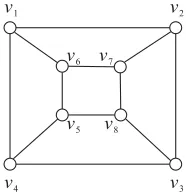
Fig. 1: The tree-cube graphQ3.
Amatching in a graphGis a set of independent edges in G. A perfect matching M in Gis a matching in Gsuch that every vertex of G is incident to an edge of M. A
paired-dominating set of a graphGis a dominating setS ofGsuch that the subgraphG[S] induced byS contains a perfect matching M. Two vertices joined by an edge ofM are said to bepaired. Every graph without isolated vertices has a paired-dominating set, since the vertices incident to edges of any maximal matching form such a set [10]. The paired-domination number of a graphG, denoted byγp(G), is the minimum cardinality of a paired-dominating set ofG. Thepaired-domination problemis to find a paired-dominating set ofGwith cardinalityγp(G). For example, for the three-cube graphQ3 shown in Fig. 1, S = {v1, v2, v3, v4} is a paired-dominating set of Q3 sinceS is a dominating set and the subgraph induced by S contains a perfect matching M = {(v1, v4),(v2, v3)}, andγp(Q3) = 4.
1 2 3 4 5 6 7 8 9 10 11 12
W
1 2 3 4 5 6 7 8
U
U beginend 1 2 13 36 3 4 31 45 5 6 24 84 7 8 7 107 12
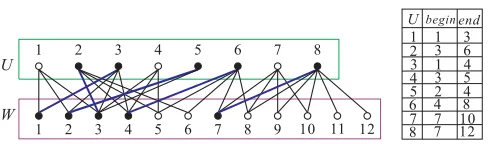
Fig. 2: Compact representation of a convex bipartite graph and a paired-domination set (filled circles incident to bold edges).
graphs, and interval graphs [3].
Let G = (U, W, E) represent an undirected, bipartite graph, whereU andW is a partition of the vertices and E is the edge set in which each edge (u, w) is such that u ∈ U and w ∈ W. The paired-domination problem on bipartite graphs has been shown to be NP-complete [3]. In this paper, we will investigate the time complex-ity of the paired-domination problem on convex bipartite graphs which form a subclass of bipartite graphs.
Convex bipartite graphs were introduced by Glover [7], motivated by some industrial applications. Since then several algorithms have been developed for problems in this kind of graph [2, 6, 11, 13, 14]. Let G= (U, W, E) be a bipartite graph. The graph G is called convex if the vertices in W can be ordered in such a way that, for each u ∈ U, the neighbors of u are consecutive in W. For convenience, we consider that U = {1,2,· · ·,|U|} andW ={1,2,· · ·,|W|}, and that the vertices inW are given according to the ordering mentioned above. This ordering can be obtained in a preprocessing step by a linear time algorithm [1]. That is, the vertices of W are represented by integers from 1 to|W|, and they are given according to their representing integers in an increasing manner. We say that a vertex u∈W is smaller (larger) than a vertexv∈W if the integer number ofuis smaller (larger) than that of v. A convex bipartite graph has a
compact representation by a set of|U|triples of the form (i, begin(i), end(i)), whereiis a vertex inU,begin(i) and end(i) are the smallest and largest vertices, respectively, in the consecutive vertices of W connected to i. Fig. 2 shows a convex bipartite graph in its compact representa-tion and a paired-dominating set on it. In this paper, we will present anO(|U|log|U|)-time algorithm to solve the paired-domination problem in convex bipartite graphs.
2
Terminologies
We begin with an elementary observation about paired-dominating sets of a graph. Let G be a graph without isolated vertices. Haynes and Slater [10] observed that a paired-dominating set of G does exist and its paired-domination numberγp(G) is even.
Lemma 2.1. [10] LetGbe a graph without isolated
ver-tices. Then, there exists a paired-dominating set in G
andγp(G)is even.
Hereafter, let G = (U, W, E) be a convex bipartite graph. We denote by [i, j] the set of consecutive integers
{i, i+ 1,· · · , j}. Thus,U = [1,|U|] andW = [1,|W|]. We call [i, j] an integer interval starting fromiand ending at j. For simplicity, an integer interval is also called an in-terval. Further, we also letU denote an array represent-ingG in a compact representation. Each element of the array U[1..|U|] has the fields begin and end. The triple (i, begin(i), end(i)) of the compact representation ofGis represented here by (i, U[i].begin, U[i].end). For simplic-ity, we will usei.begin and i.endto represent U[i].begin and U[i].end, respectively. We may assume that the in-put convex bipartite graph has no isolated vertices since isolated vertices can be easily detected. By definition of a convex bipartite graph, the neighbor of a vertexuinU can be represented as an interval Iu = [u.begin, u.end]. Then, the neighbors of vertices ofU can be represented by a set of intervals which is called the interval represen-tationI(U) ofU. For an intervalIu∈I(U), the smallest integer and largest integer inIuare called theleftmost in-teger and rightmost integer of Iu, respectively. Further, intervalIu= [u.begin, u.end] is said to bedominated by integer ifu.beginu.end.
We first partitionUintokdisjoint clustersU1, U2,· · ·, Uk such that u.begin =v.begin ifu and v are in the same cluster, and a.begin < b.begin if a ∈ Ui and b ∈ Uj for i < j. We then sort the vertices of Ui, 1 i k, such that a precedes b for a, b∈ Ui and a.end b.end, i.e., the rightmost integer of intervalIa is not larger than the rightmost integer of interval Ib in the interval rep-resentation. For example, Fig. 3 shows the clusters and the interval representation I(U) of U for the con-vex bipartite graph shown in Fig. 2. In addition, in-tervals I1, I3, I5, I4, I2 in I(U) are dominated by integer 3. The above clustering process can be easily done in O(|U|log|U|) time. In the following, it is assumed that the clustering process has been done, i.e., the sorted clus-ters ofU are given. The following lemma gives the upper bound ofγp(G).
Lemma 2.2. Let G = (U, W, E) be a convex bipartite graph without isolated vertices, and let U be partitioned intoksorted clustersU1, U2,· · · , Uk. Then,γp(G)2k.
Proof. Letui be the vertex inUi, 1ik, such that a.end ui.end for a ∈ Ui, and let wi ∈ W such that wi = ui.begin. By pairing ui with wi for 1 i k, we obtain a paired-dominating setP DofGwith size 2k, whereP D=∪1ik{ui, wi}. Thus,γp(G)2k.
Let Ui be a cluster of U. Define min(Ui) and max(Ui) to be two vertices in Ui such that min(Ui).end
[image:2.595.49.294.68.140.2]1 2 3 4 5 6 7 8 9 10 11 12
W
1 3 5 4 2 6 7 8
U
U1 U2 U3 U4 U5
I1 I6
I3 I7
I8
I5
I4
I2
[image:3.595.63.282.71.200.2]I U( )
Fig. 3: Clusters and interval representationI(U) ofU for the convex bipartite graph shown in Fig. 2.
1 2 3 4 5 6 7 8 9 10 11 12
W
1 3 5 4 2 6 7 8
U
U1 U2 U3 U4 U5
Imin( )=U1 I1 Imin( )=IU4 6
Imin( )=IU5 7
Imin( )=IU2 5
Imin( )=U3 I4
(a)Imin( )U
Imax( )=IU4 6
Imax( )=IU1 3
Imax( )=IU5 8
Imax( )=IU2 5
Imax( )=IU3 2
(b)Imax( )U
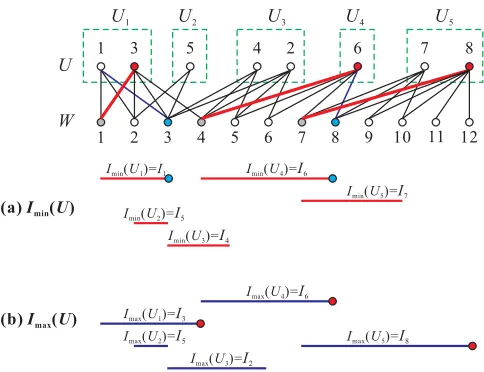
Fig. 4: (a) Imin(U) and (b) Imax(U) for the convex bi-partite graph shown in Fig. 3, where the pairs in a mini-mum paired-dominating set of the graph are highlighted in bold.
let Imin(Ui) = [min(Ui).begin,min(Ui).end] and let Imax(Ui) = [max(Ui).begin,max(Ui).end]. We can see that for a ∈ Ui, Imin(Ui) ⊆ Ia ⊆ Imax(Ui), where Ia = [a.begin, a.end]. In addition, every vertex of Ui is adjacent to all vertices of Imin(Ui) in W. The ver-tices of W in Imin(Ui) are called common neighbors of vertices of Ui. For example, let U1 be a cluster of U shown in Fig. 3. Then, min(U1) = 1, Imin(U1) = [1,3], max(U1) = 3, and Imax(U1) = [1,4]. Let U1, U2,· · ·, Uk be the disjoint sorted clusters ofU. We defineImin(U) =
∪1ikImin(Ui) and Imax(U) = ∪1ikImax(Ui). Note
that the number of intervals inImin(U) orImax(U) equals the number of clusters of U. For example, Fig. 4 showsImin(U) andImax(U) for the convex bipartite graph shown in Fig. 3.
3
The Algorithm
In this section, we will present an O(|U|log|U|)-time al-gorithm to solve the paired-domination problem on a con-vex bipartite graph G= (U, W, E). Let WD andUD be the subsets ofW andU, respectively. U (resp. W) is said to be dominated byWD (resp. UD) if every vertex ofU (resp. W) is adjacent to at least one vertex ofWD (resp.
UD). Let U1, U2,· · · , Uk be the disjoint sorted clusters of U. By Lemma 2.2,γp(G)2k. In the following, we will obtain the lower bound ofγp(G). Our basic idea is sketched as follows. We first find a minimum subsetWD of W such that WD dominates U, and find a minimum subset UD ofU such that UD dominates W. Note that every vertex ofW orUis represented by an integer. Since each edge (u, w) in G is such that u ∈ U and w ∈ W, it is easy to see that γp(G) 2·max{|WD|,|UD|}. Fi-nally, we construct a paired-dominating set ofGwith size 2·max{|WD|,|UD|}. In the following, we will show how to construct such two setsWD andUD.
We first construct a minimum subsetWDofW that dom-inates U. Observe that if there exists a vertex j in WD such that it is not in any Imin(Ui), 1 i k, then U is clearly not dominated byWD. Thus, we only consider the vertices of W in Imin(Ui), 1i k. Then, we are given by Imin(U). The problem of finding a minimum subset of W dominating U is equivalent to seek a min-imum set of integers in [1,|W|] such that they together dominate intervals of Imin(U). We introduce Procedure GD-Wto compute such a minimum set of integers that dominates all intervals of Imin(U). Given a set Imin(U) of intervals, Procedure GD-W uses a greedy principle to obtain a subset WD of W as follows. Initially, let
WD =∅, let Imin = Imin(U), and let s(Imin) be the in-terval inImin with the least rightmost integer. Letz be the rightmost integer of s(Imin) and let Iz be the set of intervals in Imin dominated by z. Let WD =WD∪ {z} and letImin=Imin−Iz. Repeat the above process until Imin = ∅. Then it outputs WD and stops. For exam-ple, given a set Imin(U) of intervals shown in Fig. 4(a), ProcedureGD-W outputsWD={3,8}.
By similar strategy in computingWD, we can find a min-imum subsetUDofU that dominatesW. Observe that if there exists a vertexjinUDsuch thatIj∈Imax(U), then j can be replaced by one vertex i, where Ii ∈ Imax(U) and Ij ⊆ Ii. That is, UD− {j} ∪ {i} is still a mini-mum subset of U such that it dominates W. Thus, we can only consider the vertices whose representing inter-vals are in Imax(Ui), 1 i k. Then, we are given by Imax(U). Our strategy for finding a subset UD of U dominating W uses a greedy principle. Initially, let
[image:3.595.49.291.279.465.2]
be a vertex of U such that its representing interval Iz
is the interval with the largest rightmost integer among I; otherwise, let z = s. Let UD = UD ∪ {z}. Let
I={Ii∈Imax|Iiis dominated by integerzand the right-most integer ofIi is larger than the rightmost integer of Iz}. For Ii ∈I, letIi= [z+ 1, i.end], i.e.,Ii is obtained from Ii by removing [i.begin, z]. Let I = ∪I
i∈I{Ii}. Then, let Imax=Imax− {s(Imax)} −I−I∪I. Repeat the above process until Imax = ∅. Then it outputs UD and stops. We call the above process as Procedure GD-U. For example, given a set Imax(U) of intervals shown in Fig. 4(b), Procedure GD-U outputsUD ={3,6,8}. The following two lemmas show the optimality of Proce-dures GD-W and GD-U. Due to the space limitation, we omit the proofs of these lemmas.
Lemma 3.1. Given a setImin(U)of intervals, Procedure
GD-Wfinds a minimum subsetWD ofW such thatWD
dominates U.
Lemma 3.2. Given a setImax(U)of intervals, Procedure
GD-U finds a minimum subset UD of U such that UD
dominates W.
Let WD and UD be the minimum subsets of W and U output by ProcedureGD-W and ProcedureGD-U, re-spectively. By definition of a convex bipartite graph G, no edge of G can join two vertices of W or U. Let P D be any paired-dominating set ofG, and letM be a per-fect matching in the subgraph induced by P D. Then, the number of edges of M is at least max{|WD|,|UD|}. Thus,γp(G)2·max{|WD|,|UD|}, and, hence, we have the following lemma.
Lemma 3.3. Let WD and UD be the minimum subsets of W andU output by Procedure GD-Wand Procedure
GD-U, respectively. Then,γp(G)2·max{|WD|,|UD|}.
Based upon the above three lemmas, our algorithm is given by a convex bipartite graphG= (U, V, E) and con-tains the following four stages.
Stage 1: Partition U into kdisjoint sorted clusters U1, U2,· · ·, Uk;
Stage 2: Compute the interval representation I(U) of U, and constructImin(U) andImax(U) fromI(U); Stage 3: Call ProcedureGD-WonImin(U) to findWD, and call ProcedureGD-UonImax(U) to findUD; Stage 4: Compute γp(G) = 2·max{|WD|,|UD|}, con-struct a minimum paired-dominating set M P D of Gof size γp(G), and outputM P D.
In Stage 4, we construct a minimum paired-dominating set M P D of G of size γp(G) as follows. Sup-pose that |WD| = max{|WD|,|UD|}. Let WD =
{w1, w2,· · ·, w|W
D|}, and let wi, 1 i |WD|, be the rightmost integer of interval Iui in Imin(U), where
ui is a vertex of U. By the construction of Procedure GD-W, all vertices of {u1, u2,· · · , u|W
D|} are distinct. By pairing wi with ui for 1 i |WD|, we obtain a minimum paired-dominating set M P D of G of size 2·|WD|, whereM P D=∪1i|W
D|{wi, ui}. On the other hand, suppose that|UD|= max{|WD|,|UD|}. Let UD =
{u1, u2,· · · , u|U
D|}, and let wi = ui.begin for 1 i
|WD|, where wi is a vertex ofW. By the construction of ProcedureGD-U, no two vertices ofUD are in the same cluster ofU. Thus, all vertices of{w1, w2,· · ·, w|U
D|}are distinct. By pairing ui with wi for 1i|UD|, we ob-tain a minimum paired-dominating setM P DofGof size 2· |UD|, whereM P D=∪1i|U
D|{ui, wi}. For example, given Imin(U) and Imax(U) shown in Fig. 4, Procedure GD-WoutputsWD={3,8}, and ProcedureGD-U out-putsUD={3,6,8}. Then, max{|WD|,|UD|}=|UD|= 3. By the above construction, we obtain a set of pairs (3,1),(6,4),(8,7) and a minimum paired-dominating set M P D of size 6. Let k be the number of disjoint clus-ters of U. By Lemmas 2.2 and 3.3, 2k γp(G) 2·max{|WD|,|UD|}. Then, |U|kmax{|WD|,|UD|}. Thus, the above process for constructing a minimum paired-dominating set of G runs in O(|U|) time, and, hence, Stage 4 can be done inO(|U|) time.
Further, Stages 2–3 of the algorithm can be done in O(|U|) time. In addition, Stage 1 runs inO(|U|log|U|) time. Thus, the algorithm runs inO(|U|log|U|) time and we conclude with the following theorem.
Theorem 3.4. The paired-domination problem on a convex bipartite graph G = (U, W, E) can be solved in
O(|U|log|U|) time.
4
Concluding Remarks
The pair-domination problem can be applied to allocate guards on vertices such that these guards protect every vertex, each guard is assigned another adjacent one, and they are designed as backup for each other. The paired-domination problem on bipartite graphs has been shown to be NP-complete. In this paper, we investigate the com-plexity of the problem on convex bipartite graphs, which form a subclass of bipartite graphs. We show that the paired-domination problem on a convex bipartite graph G= (U, W, E) can be solved inO(|U|log|U|) time.
References
[1] K. Booth and G. Lueker, Testing for the consecutive ones property, interval graphs, and graph planarity using PQ-tree algorithms, J. Comput. Syst. Sci. 13 (1976) 335–379.
bipar-tite graphs, In: 13th International Parallel Process-ing Symposium (IPPS’99), 1999, pp. 125–129.
[3] L. Chen, C. Lu, and Z. Zeng, Labelling algorithms for paired-domination problems in block and interval graphs, to appear in: J. Comb. Optim.
[4] T.C.E. Cheng, L. Kang, and C.T. Ng, Paired domi-nation on interval and circular-arc graphs, Discrete Appl. Math. 155 (2007) 2077–2086.
[5] T.C.E. Cheng, L. Kang, and E. Shan, A polynomial-time algorithm for the paired-domination problem on permutation graphs, Discrete Appl. Math. 157 (2009) 262–271.
[6] E. Dekel and S. Sahni, A parallel matching for con-vex bipartite graphs and applications to scheduling, J. Parallel Distrib. Comput. 1 (1984) 185–205.
[7] F. Glover, Maximum matching in a convex bipartite graph, Nav. Res. Logist. Q. 14 (1967) 313–316.
[8] T.W. Haynes, S.T. Hedetniemi, and P.J. Slater, Fun-damentals of Domination in Graphs, Marcel Dekker, New York, 1998.
[9] T.W. Haynes, S.T. Hedetniemi, and P.J. Slater, Domination in Graphs: Advanced Topics, Marcel Dekker, New York, 1998.
[10] T.W. Haynes and P.J. Slater, Paired-domination in graphs, Networks 32 (1998) 199–206.
[11] W. Lipski and F. Preparata, Efficient algorithms for finding maximum matchings in convex bipartite graphs and related problems, Acta Inform. 15 (1981) 329–346.
[12] H. Qiao, L. Kang, M. Cardei, and D.Z. Du, Paired-domination of trees, J. Global Optim. 25 (2003) 43– 54.
[13] J. Soares and M.A. Stefanes, Algorithms for max-imum independent set in convex bipartite graphs, Algorithmica 53 (2009) 35–49.