Fast(er) Exact Decoding and Global Training for Transition-Based
Dependency Parsing via a Minimal Feature Set
Tianze Shi
Cornell University [email protected]
Liang Huang
Oregon State University [email protected]
Lillian Lee
Cornell University [email protected]
Abstract
We first present a minimal feature set for transition-based dependency parsing, con-tinuing a recent trend started by Kiper-wasser and Goldberg (2016a) and Cross and Huang(2016a) of using bi-directional LSTM features. We plug our minimal feature set into the dynamic-programming framework of Huang and Sagae (2010) andKuhlmann et al.(2011) to produce the first implementation of worst-caseOpn3q exact decoders for hybrid and arc-eager transition systems. With our mini-mal features, we also presentOpn3qglobal training methods. Finally, using ensem-bles including our new parsers, we achieve the best unlabeled attachment score re-ported (to our knowledge) on the Chinese Treebank and the “second-best-in-class” result on the English Penn Treebank.
1 Introduction
It used to be the case that the most accurate de-pendency parsers made global decisions and em-ployed exact decoding. But transition-based de-pendency parsers (TBDPs) have recently achieved state-of-the-art performance, despite the fact that for efficiency reasons, they are usually trained to make local, rather than global, decisions and the decoding process is done approximately, rather than exactly (Weiss et al.,2015;Dyer et al.,2015; Andor et al., 2016). The key efficiency issue for decoding is as follows. In order to make accurate (local) attachment decisions, historically, TBDPs have required a large set of features in order to ac-cess rich information about particularpositionsin the stack and buffer of the current parser configu-ration. But consulting many positions means that although polynomial-time exact-decoding
algo-rithms do exist, having been introduced byHuang and Sagae(2010) andKuhlmann et al.(2011), un-fortunately, they are prohibitively costly in prac-tice, since the number of positions considered can factor into the exponent of the running time. For instance, Huang and Sagae employ a fairly re-duced set of nine positions, but the worst-case run-ning time for the exact-decoding version of their algorithm isOpn6q(originally reported asOpn7q) for a length-nsentence. As an extreme case,Dyer et al.(2015) use an LSTM to summarizearbitrary
information on the stack, which completely rules out dynamic programming.
Recently, Kiperwasser and Goldberg (2016a) and Cross and Huang (2016a) applied bi-directional long short-term memory networks (Graves and Schmidhuber, 2005, bi-LSTMs) to derive feature representations for parsing, because these networks capture wide-window contextual information well. Collectively, these two sets of authors demonstrated that with bi-LSTMs, four
positional features suffice for the arc-hybrid pars-ing system (K&G), and three suffice for arc-standard (C&H).1
Inspired by their work, we arrive at a minimal
feature set for arc-hybrid and arc-eager: it con-tains only two positional bi-LSTM vectors, suf-fers almost no loss in performance in comparison to larger sets, and out-performs a single position. (Details regarding the situation with arc-standard can be found in§2.)
Our minimal feature set plugs intoHuang and Sagae’s andKuhlmann et al.’s dynamic
program-1We note that K&G were not focused on minimizing posi-tions, although they explicitly noted the implications of doing so: “While not explored in this work, [fewer positions] re-sults in very compact state signatures, [which is] very appeal-ing for use in transition-based parsers that employ dynamic-programming search” (pg. 319). C&H also noted in their follow-up (Cross and Huang,2016b) the possibility of future work using dynamic programming thanks to simple features.
ming framework to produce the first implementa-tion of Opn3q exact decoders for arc-hybrid and arc-eager parsers. We also enable and implement
Opn3q globaltraining methods. Empirically,
en-semblescontaining our minimal-feature, globally-trained and exactly-decoded models produce the best unlabeled attachment score (UAS) reported (to our knowledge) on the Chinese Treebank and the “second-best-in-class” result on the English Penn Treebank.2
Additionally, we provide a slight update to the theoretical connections previously drawn by G´omez-Rodr´ıguez, Carroll, and Weir(2008,2011) between TBDPs and thegraph-baseddependency parsing algorithms of Eisner (1996) and Eisner and Satta (1999), including results regarding the arc-eager parsing system.
2 A Minimal Feature Set
TBDPs incrementally process a sentence by mak-ing transitions through search states representmak-ing parser configurations. Three of the main transition systems in use today (formal introduction in§3.1) all maintain the following two data structures in their configurations: (1) a stack of partially parsed subtrees and (2) a buffer (mostly) of unprocessed sentence tokens.
To featurize configurations for use in a scoring function, it is common to have features that extract information about the first several elements on the stack and the buffer, such as their word forms and part-of-speech (POS) tags. We refer to these as po-sitional features, as each feature relates to a partic-ular position in the stack or buffer. Typically, mil-lions of sparse indicator features (often developed via manual engineering) are used.
In contrast, Chen and Manning (2014) intro-duce a feature set consisting ofdenseword-, POS-, and dependency-label embeddings. While dense, these features are for the same 18 positions that have been typically used in prior work. Re-cently, Kiperwasser and Goldberg (2016a) and Cross and Huang (2016a) adopt bi-directional LSTMs, which have nice expressiveness and context-sensitivity properties, to reduce the num-ber of positions considered down to four and three,
2Our ideas were subsequently adapted to thelabeled set-ting byShi, Wu, Chen, and Cheng(2017) in their submis-sion to the CoNLL 2017 shared task on Universal Dependen-cies parsing. Their team achieved the second-highestlabeled attachment score in general and had the top average perfor-mance on the surprise languages.
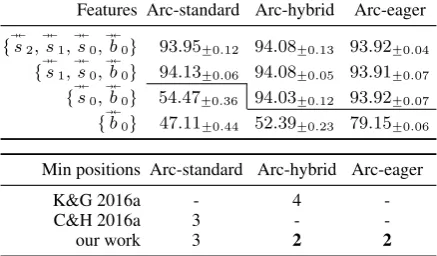
Features Arc-standard Arc-hybrid Arc-eager
tÑÐs2,ÑÐs1,ÑÐs0,ÑÐb0u 93.95˘0.12 94.08˘0.13 93.92˘0.04 tÑÐs1,ÑÐs0,ÑÐb0u 94.13˘0.06 94.08˘0.05 93.91˘0.07 tÑÐs0,ÑÐb0u 54.47˘0.36 94.03˘0.12 93.92˘0.07 tÑÐb0u 47.11˘0.44 52.39˘0.23 79.15˘0.06
Min positions Arc-standard Arc-hybrid Arc-eager
K&G 2016a - 4
-C&H 2016a 3 -
[image:2.595.307.526.72.200.2]-our work 3 2 2
Table 1: Top: English PTB dev-set UAS% for progressively smaller sets of positional features, for greedy parsers with different transition sys-tems. The “double-arrow” notation indicates vec-tors produced by abi-directional LSTM. Internal lines highlight large performance drop-offs when a feature is deleted. Bottom: sizes of the minimal feature sets inKiperwasser and Goldberg(2016a), Cross and Huang(2016a), and our work.
for different transition systems, respectively. This naturally begs the question, what is the lower limit on the number of positional features necessary for a parser to perform well? Kiper-wasser and Goldberg (2016a) reason that for the arc-hybrid system, the first and second items on the stack and the first buffer item — denoted bys0,
s1, andb0, respectively — are required; they addi-tionally include the third stack item, s2, because it may not be adjacent to the others in the origi-nal sentence. For arc-standard,Cross and Huang (2016a) argue for the necessity ofs0,s1, andb0.
We address the lower-limit question empiri-cally, and find that, surprisingly, two positions suffice for the greedy arc-eager and arc-hybrid parsers. We also provide empirical support for Cross and Huang’s argument for the necessity of three features for arc-standard. In the rest of this section, we explain our experiments, run only on an English development set, that support this con-clusion; the results are depicted in Table 1. We later explore the implementation implications in
§3-4and thentest-setparsing-accuracy in§6.
is the output of the bi-LSTM at time stepi. (The double-arrow notation for these vectors empha-sizes the bi-directionality of their origin). Then, for a given parser configuration, stack positions are represented by ÑÐ
sj, defined as ÑÐwipsjq where
ipsjq gives the position in the sentence of the to-ken that is the head of the tree in sj. Similarly, buffer positions are represented byÑÐbj, defined as ÑÐ
wipbjq for the token at buffer position j. Finally, as inChen and Manning(2014), we use a multi-layer perceptron to score possible transitions from the given configuration, where the input is the con-catenation of some selection of theÑÐ
sjs and ÑÐbks.
We use greedy decoders, and train the models with dynamic oracles (Goldberg and Nivre,2013).
Table 1 reports the parsing accuracy that re-sults for feature sets of size four, three, two, and one for three commonly-used transition systems. The data is the development section of the English Penn Treebank (PTB), and experimental settings are as described in our other experimental section,
§6. We see that we can go down to three or, in the arc-hybrid and arc-eager transition systems, even two positions with very little loss in performance, but not further. We therefore call tÑÐs0,ÑÐb0u our
minimalfeature set with respect to arc-hybrid and arc-eager, and empirically confirm thatCross and Huang’stÑÐs0,ÑÐs1,ÑÐb0uis minimal for arc-standard; see Table1for a summary.3
3 Dynamic Programming for TBDPs
As stated in the introduction, our minimal fea-ture set from§2plugs intoHuang and Sagae and Kuhlmann et al.’s dynamic programming (DP) framework. To help explain the connection, this section provides an overview of the DP frame-work. We draw heavily from the presentation of Kuhlmann et al.(2011).
3.1 Three Transition Systems
Transition-based parsing (Nivre, 2008; K¨ubler et al.,2009) is an incremental parsing framework based on transitions between parser
configura-3We tentatively conjecture that the following might ex-plain the observed phenomena, but stress that we don’t cur-rently see a concrete way to test the following hypothesis. WithtÑÐs0,ÑÐb0u, in the arc-standard case, situations can arise
where there are multiple possible transitions with missing in-formation. In contrast, in the arc-hybrid case, there is only one possible transition with missing information (namely, reñ, introduced in§3.1); perhapsÑÐs1is therefore not so cru-cial for arc-hybrid in practice?
tions. For a sentence to be parsed, the system starts from a corresponding initial configuration, and attempts to sequentially apply transitions un-til a configuration corresponding to a full parse is produced. Formally, a transition system is defined asS “ pC, T, cs, Cτq, whereCis a nonempty set of configurations, eachtPT :C áCis a transi-tion functransi-tion between configuratransi-tions,csis an
ini-tialization function that maps an input sentence to an initial configuration, and Cτ Ď C is a set of terminal configurations.
All systems we consider share a common tri-partite representation for configurations: when we writec “ pσ, β, Aq for some c P C, we are re-ferring to a stackσ of partially parsed subtrees; a bufferβof unprocessed tokens and, optionally, at its beginning, a subtree with only left descendants; and a setA of elementsph, mq, each of which is an attachment (dependency arc) with head h and modifier m.4 We writemðh to indicate that m
left-modifiesh, andhñmto indicate thatm
right-modifies h. For a sentencew “ w1, ..., wn, the initial configuration ispσ0, β0, A0q, whereσ0 and
A0are empty andβ0 “ rROOT|w1, ..., wns;ROOT is a special node denoting the root of the parse tree5 (vertical bars are a notational convenience for indicating different parts of the buffer or stack; our convention is to depict the buffer first element leftmost, and to depict the stack first element right-most). All terminal configurations have an empty buffer and a stack containing onlyROOT.
Arc-Standard The arc-standard system (Nivre, 2004) is motivated by bottom-up parsing: each de-pendent has to be complete before being attached. The three transitions, shift (sh, move a token from the buffer to the stack), right-reduce (reñ, reduce
and attach a right modifier), and left-reduce (reð,
reduce and attach a left modifier), are defined as:
shrpσ, b0|β, Aqs “ pσ|b0, β, Aq
reñrpσ|s1|s0, β, Aqs “ pσ|s1, β, AY tps1, s0quq reðrpσ|s1|s0, β, Aqs “ pσ|s0, β, AY tps0, s1quq
Arc-Hybrid The arc-hybrid system (Yamada and Matsumoto, 2003; G´omez-Rodr´ıguez et al., 2008;Kuhlmann et al., 2011) has the same defi-nitions ofsh andreñ as arc-standard, but forces 4For simplicity, we only present unlabeled parsing here. SeeShi et al.(2017) for labeled-parsing results.
the collection of left modifiers before right modi-fiers via itsb0-modifierreðtransition. This
con-trasts with arc-standard, where the attachment of left and right modifiers can be interleaved on the stack.
shrpσ, b0|β, Aqs “ pσ|b0, β, Aq
reñrpσ|s1|s0, β, Aqs “ pσ|s1, β, AY tps1, s0quq reðrpσ|s0, b0|β, Aqs “ pσ, b0|β, AY tpb0, s0quq
Arc-Eager In contrast to the former two sys-tems, the arc-eager system (Nivre, 2003) makes attachments as early as possible — even if a modi-fier has not yet received all of its own modimodi-fiers. This behavior is accomplished by decomposing the right-reduce transition into two independent transitions, one making the attachment (ra) and one reducing the right-attached child (re).
shrpσ, b0|β, Aqs “ pσ|b0, β, Aq
reðrpσ|s0, b0|β, Aqs “ pσ, b0|β, AY tpb0, s0quq
(precondition:s0not attached to any word)
rarpσ|s0, b0|β, Aqs “ pσ|s0|b0, β, AY tps0, b0quq
rerpσ|s0, β, Aqs “ pσ, β, Aq
(precondition:s0has been attached to its head)
3.2 Deduction and Dynamic Programming
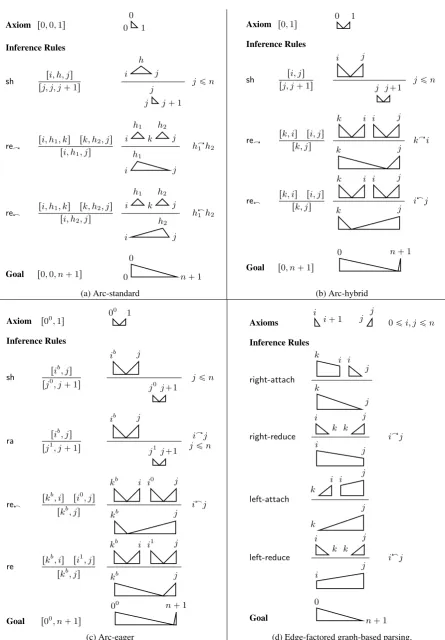
Kuhlmann et al.(2011) reformulate the three tran-sition systems just discussed as deduction systems (Pereira and Warren, 1983;Shieber et al.,1995), wherein transitions serve as inference rules; these are given as the lefthand sides of the first three sub-figures in Figure1. For a givenw “ w1, ..., wn, assertions take the formri, j, ks(or, when applica-ble, a two-index shorthand to be discussed soon), meaning that there exists a sequence of transi-tions that, starting from a configuration wherein headps0q “ wi, results in an ending configura-tion whereinheadps0q “wj andheadpb0q “wk. If we define w0 as ROOT and wn`1 as an end-of-sentence marker, then the goal theorem can be stated asr0,0, n`1s.
For arc-standard, we depict an assertionri, h, ks as a subtree whose root (head) is the token at h. Assertions of the form ri, i, ksplay an important role for arc-hybrid and arc-eager, and we employ the special shorthand ri, ks for them in Figure1. In that figure, we also graphically depict such sit-uations as two consecutive half-trees with rootswi
andwk, where all tokens betweeniandkare al-ready attached. The superscriptbin an arc-eager
assertionrib, jsis an indicator variable for whether
wi has been attached to its head (b “ 1) or not (b“0) after the transition sequence is applied.
Kuhlmann et al. (2011) show that all three de-duction systems can be directly “tabularized” and dynamic programming (DP) can be applied, such that, ignoring for the moment the issue of incor-porating complex features(we return to this later), time and space needs are low-order polynomial. Specifically, as the two-index shorthandri, js sug-gests, arc-eager and arc-hybrid systems can be im-plemented to takeOpn2q space andOpn3q time; the arc-standard system requiresOpn3qspace and
Opn4qtime (if one applies the so-called hook trick (Eisner and Satta,1999)).
Since anOpn4qrunning time is not sufficiently practical even in the simple-feature case,in the re-mainder of this paper we consider only the arc-hybrid and arc-eager systems, not arc-standard.
4 Practical Optimal Algorithms Enabled By Our Minimal Feature Set
Until now, no one had suggested a set of positional features that was both information-rich enough for accurate parsing and small enough to obtain the
Opn3qrunning-time promised above. Fortunately, our bi-LSTM-basedtÑÐs0,ÑÐb0ufeature set qualifies, and enables the fast optimal procedures described in this section.
4.1 Exact Decoding
Given an input sentence, a TBDP must choose among a potentially exponential number of cor-responding transition sequences. We assume ac-cess to functionsftthat score individual
configu-rations, where these functions are indexed by the transition functionst P T. For a fixed transition sequencet “ t1, t2, . . ., we useci to denote the configuration that results after applyingti.
Typically, for efficiency reasons, greedy left-to-right decoding is employed: the next transitiont˚
i
out ofci´1 isarg maxtftpci´1q, so that past and future decisions are not taken into account. The scoreFptq for the transition sequence is induced by summing the relevantftipci´1qvalues.
ad-Axiom r0,0,1s 0
0 1
Inference Rules
sh ri, h, js
rj, j, j`1s
i h
j
j j
j`1 jďn
reñ
ri, h1, ks rk, h2, js ri, h1, js
i h1
k h2
j
i h1
j hñ
1 h2
reð
ri, h1, ks rk, h2, js ri, h2, js
i h1
k h2
j
i
h2 j
hð 1 h2
Goal r0,0, n`1s 0
0
n`1
(a) Arc-standard
Axiom r0,1s 0 1
Inference Rules
sh ri, js
rj, j`1s
i j
j j`1 jďn
reñ
rk, is ri, js rk, js
k i i j
k j k
ñi
reð
rk, is ri, js rk, js
k i i j
k j i
ðj
Goal r0, n`1s
0 n`1
(b) Arc-hybrid
Axiom r00,1s 0 0 1
Inference Rules
sh rib, js
rj0, j`1s
ib j
j0 j`1 jďn
ra rib, js
rj1, j`1s
ib j
j1 j`1 iñj jďn
reð
rkb, is ri0, js
rkb, js
kb i i0 j
kb j i
ðj
re rkb, is ri1, js
rkb, js
kb i i1 j
kb j
Goal r00, n`1s
00 n`1
(c) Arc-eager
Axioms i i`1 j j 0ďi, jďn
Inference Rules
right-attach
k i i
j
k
j
right-reduce
i k k
j
i j i
ñj
left-attach k
i i j
k
j
left-reduce
i k k
j
i j
iðj
Goal
0
n`1
[image:5.595.75.521.61.702.2](d) Edge-factored graph-based parsing.
ditional state-keeping.
We show how to integrate the scoring functions for the arc-eager system; the arc-hybrid system is handled similarly. The score-annotated rules are as follows:
rib, js:v rj0, j`1s: 0pshq
rkb, is:v1 ri0, js:v2 rkb, js:v1`v2`∆ preðq where∆“fshpÑÐwk,ÑÐwiq `freðp
ÑÐ wi,
ÑÐ
wjq— abus-ing notation by referrabus-ing to configurations by their features. The left-reduce rule says that we can first take the sequence of transitions asserted byrkb, is, which has a score ofv1, and then a shift transition movingwifromb0 tos0. This means that the ini-tial condition forri0, jsis met, so we can take the sequence of transitions asserted byri0, js— say it has scorev2— and finally a left-reduce transition to finish composing the larger transition sequence. Notice that the scores for shandra are 0, as the scoring of these transitions is accounted for by re-duce rules elsewhere in the sequence.
4.2 Global Training
We employ large-margin training that considers each transition sequence globally. Formally, for a training sentencew“w1, . . . , wnwith gold tran-sition sequence tgold, our loss function is
max t
´
Fptq `costptgold,tq ´Fptgoldq
¯
where costptgold,tq is a custom margin for tak-ingt instead of tgold — specifically, the number of mis-attached nodes. Computing this max can again be done efficiently with a slight modifica-tion to the scoring of reduce transimodifica-tions:
rkb, is:v1 ri0, js:v2 rkb, js:v1`v2`∆1preðq where∆1 “ ∆`1pheadpw
iq ‰wjq. This loss-augmented inference or cost-loss-augmented decoding (Taskar et al., 2005;Smith, 2011) technique has previously been applied to graph-based parsing by Kiperwasser and Goldberg(2016a).
Efficiency Note The computation decomposes into two parts: scoring all feature combinations, and using DP to find a proof for the goal theorem in the deduction system. Time-complexity analy-sis is usually given in terms of the latter, but the former might have a large constant factor, such as104or worse for neural-network-based scoring
functions. As a result, in practice, with a small
n, scoring with the feature settÑÐs0,ÑÐb0u (Opn2q) can be as time-consuming as the decoding steps (Opn3q) for the arc-hybrid and arc-eager systems.
5 Theoretical Connections
Our minimal feature set brings implementation of practical optimal algorithms to TBDPs, whereas previously only graph-based dependency parsers (GBDPs) — a radically different, non-incremental paradigm — enjoyed the ability to deploy them. Interestingly, for both the transition- and graph-based paradigms, the optimal algorithms build de-pendency trees bottom-up from local structures. It is thus natural to wonder if there are deeper, more formal connections between the two.
In previous work, Kuhlmann et al. (2011) re-lated the arc-standard system to the classic CKY algorithm (Cocke,1969;Kasami,1965;Younger, 1967) in a manner clearly suggested by Figure1a; CKY can be viewed as a very simple graph-based approach. G´omez-Rodr´ıguez et al. (2008, 2011) formally prove that sequences of steps in the edge-factoredGBDP (Eisner,1996) can be used to em-ulate any individual step in the arc-hybrid system (Yamada and Matsumoto, 2003) and the Eisner and Satta (1999, Figure 1d) version. However, they did not draw an explicitly direct connection betweenEisner and Satta(1999) and TBDPs.
Here, we provide an update to these previous findings, stated in terms of the expressiveness of scoring functions, considered as parameterization. For the edge-factored GBDP, we write the score for an edge asfGpÑÐh,mÑÐq, wherehis the head and
m the modifier. A tree’s score is the sum of its edge scores. We say that a parameterized depen-dency parsing model Acontainsmodel B if for ev-ery instance of parameterization in model B, there exists an instance of model A such that the two models assign the same score to every parse tree. We claim:
Lemma 1. The arc-eager model presented in§4.1 contains the edge-factored model.
Proof Sketch. Consider a given edge-factored GBDP parameterized byfG. For any parse tree, every edgeiðjinvolves two deduction rules, and
their contribution to the score of the final proof is
fsh(ÑÐwk,wÑÐi)`freðp ÑÐ
wi,ÑÐwjq. We setfsh(ÑÐwk,ÑÐwi) “
0 and freðp ÑÐ
Model Training Features UAS (%) UEM (%)PTB UAS (%) UEM (%)CTB
Arc-standard Local tÑÐs2,ÑÐs1,ÑÐs0,ÑÐb0u 93.95˘0.12 52.29˘0.66 88.01˘0.26 36.87˘0.53
Arc-hybrid Local
tÑÐs2,ÑÐs1,ÑÐs0,ÑÐb0u 93.89˘0.10 50.82˘0.75 87.87˘0.17 35.47˘0.48 Local tÑÐs0,ÑÐb0u 93.80˘0.12 49.66˘0.43 87.78˘0.09 35.09˘0.40
Global tÑÐs0,ÑÐb0u 94.43˘0.08 53.03˘0.71 88.38˘0.11 36.59˘0.27
Arc-eager Local
tÑÐs2,ÑÐs1,ÑÐs0,ÑÐb0u 93.80˘0.12 49.66˘0.43 87.49˘0.20 33.15˘0.72
Local tÑÐs0,ÑÐb0u 93.77˘0.08 49.71˘0.24 87.33˘0.11 34.17˘0.41
Global tÑÐs0,ÑÐb0u 94.53˘0.05 53.77˘0.46 88.62˘0.09 37.75˘0.87 Edge-factored Global tÑÐh ,mÑÐu 94.50˘0.13 53.86˘0.78 88.25˘0.12 36.42˘0.52
Table 2: Test set performance for different training regimes and feature sets. The models use the same decoders for testing and training. For each setting, the average and standard deviation across 5 runs with different random initializations are reported. Boldface: best (averaged) result per dataset/measure.
fra(ÑÐwk,ÑÐwi) “ fGpwÑÐk,wÑÐiq and frepwÑÐi,ÑÐwjq “ 0. The parameterization we arrive at emulates ex-actly the scoring model offG.
We further claim that the arc-eager model is more expressive than not only the edge-factored GBDP, but also the arc-hybrid model in our paper.
Lemma 2. The eager model contains the arc-hybrid model.
Proof Sketch. We leverage the fact that the arc-eager model divides the sh transition in the arc-hybrid model into two separate transitions,shand
ra. When we constrain the parametersfsh “frain the arc-eager model, the model hypothesis space becomes exactly the same as arc-hybrid’s.
The extra expressiveness of the arc-eager model comes from the scoring functions fsh and fre that capture structural contexts other than head-modifier relations. Unlike traditional higher-order graph-based parsing that directly models relations such as siblinghood (McDonald and Pereira,2006) or grandparenthood (Carreras,2007), however, the arguments in those two functions do not have any fixed type of structural interactions.
6 Experiments
Data and Evaluation We experimented with English and Chinese. For English, we used the Stanford Dependencies (de Marneffe and Man-ning, 2008) conversion (via the Stanford parser 3.3.0) of the Penn Treebank (Marcus et al.,1993, PTB). As is standard, we used §2-21 of the Wall Street Journal for training, §22 for development,
and§23 for testing; POS tags were predicted using 10-way jackknifing with the Stanford max entropy tagger (Toutanova et al.,2003). For Chinese, we used the Penn Chinese Treebank 5.1 (Xue et al., 2002, CTB), with the same splits and head-finding rules for conversion to dependencies as Zhang and Clark (2008). We adopted the CTB’s gold-standard tokenization and POS tags. We report unlabeled attachment score (UAS) and sentence-level unlabeled exact match (UEM). Following prior work, all punctuation is excluded from eval-uation. For each model, we initialized the network parameters with 5 different random seeds and re-port performance average and standard deviation.
Implementation Details Our model structures reproduce those of Kiperwasser and Goldberg (2016a). We use 2-layer bi-directional LSTMs with 256 hidden cell units. Inputs are concatena-tions of 28-dimensional randomly-initialized part-of-speech embeddings and 100-dimensional word vectors initialized from GloVe vectors (Penning-ton et al., 2014) (English) and pre-trained skip-gram-model vectors (Mikolov et al., 2013) (Chi-nese). The concatenation of the bi-LSTM feature vectors is passed through a multi-layer perceptron (MLP) with 1 hidden layer which has 256 hid-den units and activation function tanh. We set the dropout rate for the bi-LSTM (Gal and Ghahra-mani,2016) and MLP (Srivastava et al.,2014) for each model according to development-set perfor-mance.6 All parameters except the word
📍BGDS16
📍CH16
📍DBLMS15 📍KG16a
📍KG16b
🌐CFHGD16
🌐DM17
🌐KG16a
🌐KBKDS16
🌐WC16
📍Our best local
🌐Our arc-eager DP 🌐Our arc-hybrid DP
💼15 Our all global
💼20 KBKDS16 💼5 Our arc-eager DP
💼5 Our arc-hybrid DP
86.0 86.5 87.0 87.5 88.0 88.5 89.0 89.5 90.0 90.5
93.0 93.5 94.0 94.5 95.0 95.5 96.0
UAS
o
n
CTB (
%)
UAS on PTB (%)
[image:8.595.108.490.63.311.2]📍Local 🌐Global 📍Our Local 🌐Our Global 💼Ensemble
Figure 2: Comparing our UAS results with results from the literature. x-axis: PTB; y-axis: CTB. Most datapoint labels give author initials and publication year; citations are in the bibliography. Ensemble datapoints are annotated with ensemble size.Weiss et al.(2015) andAndor et al.(2016) achieve UAS of 94.26 and 94.61 on PTB with beam search, but did not report CTB results, and are therefore omitted.
dings are initialized uniformly (Glorot and Ben-gio, 2010). Approximately 1,000 tokens form a mini-batch for sub-gradient computation. We train each model for 20 epochs and perform model se-lection based on development UAS. The proposed structured loss function is optimized via Adam (Kingma and Ba,2015). The neural network com-putation is based on the python interface to DyNet (Neubig et al., 2017), and the exact decoding al-gorithms are implemented in Cython.7
Main Results We implement exact decoders for the arc-hybrid and arc-eager systems, and present the test performance of different model configu-rations in Table2, comparing global models with local models. All models use the same decoder for testing as during the training process. Though no global decoder for the arc-standard system has been explored in this paper, its local models are listed for comparison. We also include an edge-factored graph-based model, which is convention-ally trained globconvention-ally. The edge-factored model scores bi-LSTM features for each head-modifier pair; a maximum spanning tree algorithm is used to find the tree with the highest sum of edge scores. For this model, we useDozat and
Man-7Seehttps://github.com/tzshi/dp-parser-emnlp17.
ning’s (2017) biaffine scoring model, although in our case the model size is smaller.8
Analogously to the dev-set results given in §2, on the test data, the minimal feature sets perform as well as larger ones in locally-trained models. And there exists a clear trend of global models out-performing local models for the two different tran-sition systems on both datasets. This illustrates the effectiveness of exact decoding and global train-ing. Of the three types of global models, the arc-eager arguably has the edge, an empirical finding resonating with our theoretical comparison of their model expressiveness.
Comparison with State-of-the-Art Models
Figure 2 compares our algorithms’ results with those of the state-of-the-art.9 Our models are competitive and an ensemble of 15 globally-trained models (5 models each for arc-eager DP, arc-hybrid DP and edge-factored) achieves 95.33 and 90.22 on PTB and CTB, respectively,
reach-8The same architecture and model size as other transition-based global models is used for fair comparison.
ing the highest reported UAS on the CTB dataset, and the second highest reported on the PTB dataset among dependency-based approaches.
7 Related Work Not Yet Mentioned Approximate Optimal Decoding/Training Be-sides dynamic programming (Huang and Sagae, 2010; Kuhlmann et al., 2011), various other ap-proaches have been proposed for approaching global training and exact decoding. Best-first and A* search (Klein and Manning, 2003;Sagae and Lavie, 2006; Sagae and Tsujii, 2007; Zhao et al.,2013;Thang et al.,2015;Lee et al.,2016) give optimality certificates when solutions are found, but have the same worst-case time com-plexity as the original search framework. Other common approaches to search a larger space at training or test time include beam search (Zhang and Clark,2011), dynamic oracles (Goldberg and Nivre,2012,2013;Cross and Huang,2016b) and error states (Vaswani and Sagae, 2016). Beam search records the k best-scoring transition pre-fixes to delay local hard decisions, while the lat-ter two leverage configurations deviating from the gold transition path during training to better simu-late the test-time environment.
Neural Parsing Neural-network-based models are widely used in state-of-the-art dependency parsers (Henderson, 2003, 2004;Chen and Man-ning,2014;Weiss et al.,2015;Andor et al.,2016; Dozat and Manning, 2017) because of their ex-pressive representation power. Recently, Stern et al. (2017) have proposed minimal span-based features for constituency parsing.
Recurrent and recursive neural networks can be used to build representations that encode complete configuration information or the entire parse tree (Le and Zuidema,2014;Dyer et al.,2015; Kiper-wasser and Goldberg, 2016b), but these models cannot be readily combined with DP approaches, because their state spaces cannot be merged into smaller sets and thus remain exponentially large.
8 Concluding Remarks
In this paper, we have shown the following.
• The bi-LSTM-powered feature settÑÐs0,ÑÐb0u is minimal yet highly effective for arc-hybrid and arc-eager transition-based parsing.
• Since DP algorithms for exact decoding (Huang and Sagae, 2010; Kuhlmann et al.,
2011) have a run-time dependence on the number of positional features, using our mere two effective positional features results in a running time ofOpn3q, feasible for practice.
• Combining exact decoding with global train-ing — which is also enabled by our minimal feature set — with an ensemble of parsers achieves 90.22 UAS on the Chinese Treebank and 95.33 UAS on the Penn Treebank: these are, to our knowledge, the best and second-best results to date on these data sets among “purely” dependency-based approaches. There are many directions for further explo-ration. Two possibilities are to create even better training methods, and to find some way to extend our run-time improvements to other transition sys-tems. It would also be interesting to further in-vestigate relationships between graph-based and dependency-based parsing. In §5 we have men-tioned important earlier work in this regard, and provided an update to those formal findings.
In our work, we have brought exact decoding, which was formerly the province solely of graph-based parsing, to the transition-graph-based paradigm. We hope that the future will bring more inspira-tion from an integrainspira-tion of the two perspectives.
Acknowledgments: an author-reviewer suc-cess story We sincerely thank all the reviewers for their extraordinarily careful and helpful com-ments. Indeed, this paper originated as a short pa-per submission by TS&LL to ACL 2017, where an anonymous reviewer explained in the review comments how, among other things, the DP run-time could be improved fromOpn4qtoOpn3q. In their author response, TS&LL invited the reviewer to co-author, suggesting that they ask the confer-ence organizers to make the connection between anonymous reviewer and anonymous authors. All three of us are truly grateful to PC co-chair Regina Barzilay for implementing this idea, bringing us together!
References
Daniel Andor, Chris Alberti, David Weiss, Aliaksei Severyn, Alessandro Presta, Kuzman Ganchev, Slav Petrov, and Michael Collins. 2016. Globally nor-malized transition-based neural networks. In Pro-ceedings of the Annual Meeting of the Association for Computational Linguistics (Volume 1: Long
Pa-pers), pages 2442–2452, Berlin, Germany.
Miguel Ballesteros, Yoav Goldberg, Chris Dyer, and Noah A. Smith. 2016. Training with exploration im-proves a greedy stack LSTM parser. InProceedings of the Conference on Empirical Methods in Natural
Language Processing, pages 2005–2010.
Miguel Ballesteros and Joakim Nivre. 2013. Going to the roots of dependency parsing. Computational
Linguistics, 39(1):5–13.
Xavier Carreras. 2007. Experiments with a higher-order projective dependency parser. In Proceed-ings of the Joint Conference on Empirical Methods in Natural Language Processing and Computational
Natural Language Learning, pages 957–961.
Danqi Chen and Christopher D. Manning. 2014. A fast and accurate dependency parser using neural net-works. InProceedings of the Conference on
Empiri-cal Methods in Natural Language Processing, pages
740–750, Doha, Qatar.
Hao Cheng, Hao Fang, Xiaodong He, Jianfeng Gao, and Li Deng. 2016. Bi-directional attention with agreement for dependency parsing. InProceedings of the Conference on Empirical Methods in Natural
Language Processing, pages 2204–2214.
Do Kook Choe and Eugene Charniak. 2016. Parsing as language modeling. InProceedings of the Con-ference on Empirical Methods in Natural Language
Processing, pages 2331–2336, Austin, Texas.
John Cocke. 1969. Programming languages and their compilers: Preliminary notes. Technical report, Courant Institute of Mathematical Sciences, New York University.
James Cross and Liang Huang. 2016a. Incremental parsing with minimal features using bi-directional LSTM. In Proceedings of the 54th Annual Meet-ing of the Association for Computational LMeet-inguistics
(Volume 2: Short Papers), pages 32–37.
James Cross and Liang Huang. 2016b. Span-based constituency parsing with a structure-label system and provably optimal dynamic oracles. In Proceed-ings of the Conference on Empirical Methods in
Nat-ural Language Processing, pages 1–11.
Timothy Dozat and Christopher D. Manning. 2017. Deep biaffine attention for neural dependency pars-ing. InProceedings of the 5th International
Confer-ence on Learning Representations.
Chris Dyer, Miguel Ballesteros, Wang Ling, Austin Matthews, and Noah A. Smith. 2015. Transition-based dependency parsing with stack long short-term memory. InProceedings of the 53rd Annual Meeting of the Association for Computational Lin-guistics and the 7th International Joint Conference on Natural Language Processing (Volume 1: Long
Papers), pages 334–343.
Jason Eisner. 1996. Three new probabilistic models for dependency parsing: An exploration. In Proceed-ings of the 16th International Conference on
Com-putational Linguistics, pages 340–345.
Jason Eisner and Giorgio Satta. 1999. Efficient pars-ing for bilexical context-free grammars and head au-tomaton grammars. InProceedings of the 37th An-nual Meeting of the Association for Computational
Linguistics, pages 457–464.
Yarin Gal and Zoubin Ghahramani. 2016. A theoret-ically grounded application of dropout in recurrent neural networks. InAdvances in Neural Information
Processing Systems, pages 1019–1027.
Xavier Glorot and Yoshua Bengio. 2010. Understand-ing the difficulty of trainUnderstand-ing deep feedforward neural networks. InProceedings of the 13th International
Conference on Artificial Intelligence and Statistics,
pages 249–256.
Yoav Goldberg and Joakim Nivre. 2012.A dynamic or-acle for arc-eager dependency parsing. In Proceed-ings of the 24th International Conference on
Com-putational Linguistics, pages 959–976.
Yoav Goldberg and Joakim Nivre. 2013. Training de-terministic parsers with non-dede-terministic oracles.
Transactions of the Association for Computational
Linguistics, 1:403–414.
Carlos G´omez-Rodr´ıguez, John Carroll, and David Weir. 2008. A deductive approach to dependency parsing. InProceedings of the 46th Annual Meet-ing of the Association for Computational LMeet-inguis-
Linguis-tics: Human Language Technology, pages 968–976.
Carlos G´omez-Rodr´ıguez, John Carroll, and David Weir. 2011. Dependency parsing schemata and mildly non-projective dependency parsing.
Compu-tational Linguistics, 37(3):541–586.
Alex Graves and J¨urgen Schmidhuber. 2005. Frame-wise phoneme classification with bidirectional LSTM and other neural network architectures.
Neu-ral Networks, 18(5-6):602–610.
James Henderson. 2003. Inducing history representa-tions for broad coverage statistical parsing. In Pro-ceedings of the Human Language Technology Con-ference of the North American Chapter of the
Asso-ciation for Computational Linguistics, pages 24–31.
James Henderson. 2004. Discriminative training of a neural network statistical parser. In Proceedings of the 42nd Annual Meeting of the Association for
Liang Huang and Kenji Sagae. 2010. Dynamic pro-gramming for linear-time incremental parsing. In
Proceedings of the 48th Annual Meeting of the
Asso-ciation for Computational Linguistics, pages 1077–
1086.
Tadao Kasami. 1965. An efficient recognition and syntax-analysis algorithm for context-free lan-guages. Technical report, Hawaii University Hon-olulu Department of Electrical Engineering.
Diederik Kingma and Jimmy Ba. 2015. Adam: A method for stochastic optimization. In Proceed-ings of the 4th International Conference on
Learn-ing Representations.
Eliyahu Kiperwasser and Yoav Goldberg. 2016a. Sim-ple and accurate dependency parsing using bidirec-tional LSTM feature representations. Transactions
of the Association for Computational Linguistics,
4:313–327.
Eliyahu Kiperwasser and Yoav Goldberg. 2016b. Easy-first dependency parsing with hierarchical tree LSTMs. Transactions of the Association for
Com-putational Linguistics, 4:445–461.
Dan Klein and Christopher D. Manning. 2003. Ac-curate unlexicalized parsing. InProceedings of the 41st Annual Meeting of the Association for
Compu-tational Linguistics, pages 423–430.
Sandra K¨ubler, Ryan McDonald, and Joakim Nivre. 2009. Dependency parsing, volume 2 ofSynthesis
Lectures on Human Language Technologies.
Mor-gan & Claypool Publishers.
Marco Kuhlmann, Carlos G´omez-Rodr´ıguez, and Gior-gio Satta. 2011. Dynamic programming algorithms for transition-based dependency parsers. In Pro-ceedings of the 49th Annual Meeting of the Asso-ciation for Computational Linguistics: Human
Lan-guage Technologies, pages 673–682.
Adhiguna Kuncoro, Miguel Ballesteros, Lingpeng Kong, Chris Dyer, Graham Neubig, and Noah A. Smith. 2017. What do recurrent neural network grammars learn about syntax? In Proceedings of the 15th Conference of the European Chapter of the Association for Computational Linguistics: Volume
1, Long Papers, pages 1249–1258, Valencia, Spain.
Adhiguna Kuncoro, Miguel Ballesteros, Lingpeng Kong, Chris Dyer, and Noah A. Smith. 2016. Dis-tilling an ensemble of greedy dependency parsers into one MST parser. InProceedings of the Con-ference on Empirical Methods in Natural Language
Processing, pages 1744–1753.
Phong Le and Willem Zuidema. 2014. The inside-outside recursive neural network model for depen-dency parsing. InProceedings of the Conference on Empirical Methods in Natural Language Process-ing, pages 729–739.
Kenton Lee, Mike Lewis, and Luke Zettlemoyer. 2016. Global neural CCG parsing with optimality guaran-tees. InProceedings of the Conference on
Empiri-cal Methods in Natural Language Processing, pages
2366–2376.
Jiangming Liu and Yue Zhang. 2017. In-order transition-based constituent parsing. Transactions
of the Association for Computational Linguistics.
To appear.
Mitchell Marcus, Beatrice Santorini, and Mary Ann Marcinkiewicz. 1993. Building a large anno-tated corpus of English: The Penn Treebank.
Com-putational Linguistics, 19(2):313–330.
Marie-Catherine de Marneffe and Christopher D. Man-ning. 2008. Stanford typed dependencies manual. Technical report, Stanford University.
Ryan McDonald and Fernando Pereira. 2006. Online learning of approximate dependency parsing algo-rithms. In Proceedings of the 11th Conference of the European Chapter of the Association for
Com-putational Linguistics, pages 81–88.
Tomas Mikolov, Ilya Sutskever, Kai Chen, Greg S. Cor-rado, and Jeff Dean. 2013. Distributed representa-tions of words and phrases and their compositional-ity. InAdvances in Neural Information Processing
Systems, pages 3111–3119.
Graham Neubig, Chris Dyer, Yoav Goldberg, Austin Matthews, Waleed Ammar, Antonios Anastasopou-los, Miguel Ballesteros, David Chiang, Daniel Clothiaux, Trevor Cohn, Kevin Duh, Manaal Faruqui, Cynthia Gan, Dan Garrette, Yangfeng Ji, Lingpeng Kong, Adhiguna Kuncoro, Gaurav Ku-mar, Chaitanya Malaviya, Paul Michel, Yusuke Oda, Matthew Richardson, Naomi Saphra, Swabha Swayamdipta, and Pengcheng Yin. 2017. DyNet: The dynamic neural network toolkit. arXiv preprint
arXiv:1701.03980.
Joakim Nivre. 2003. An efficient algorithm for pro-jective dependency parsing. In Proceedings of the 8th International Workshop on Parsing Technolo-gies, pages 149–160.
Joakim Nivre. 2004. Incrementality in deterministic dependency parsing. InProceedings of the Work-shop on Incremental Parsing: Bringing Engineering
and Cognition Together, pages 50–57.
Joakim Nivre. 2008. Algorithms for deterministic in-cremental dependency parsing. Computational
Lin-guistics, 34(4):513–553.
Jeffrey Pennington, Richard Socher, and Christo-pher D. Manning. 2014. GloVe: Global vectors for word representation. In Proceedings of the Con-ference on Empirical Methods in Natural Language
Fernando C. N. Pereira and David H. D. Warren. 1983. Parsing as deduction. InProceedings of the 21st An-nual Meeting on Association for Computational
Lin-guistics, pages 137–144.
Kenji Sagae and Alon Lavie. 2006. A best-first prob-abilistic shift-reduce parser. In Proceedings of the 21st International Conference on Computational Linguistics and 44th Annual Meeting of the
Associa-tion for ComputaAssocia-tional Linguistics, pages 691–698.
Kenji Sagae and Jun’ichi Tsujii. 2007. Dependency parsing and domain adaptation with LR models and parser ensembles. InProceedings of the Joint Con-ference on Empirical Methods in Natural Language Processing and Computational Natural Language
Learning, pages 1044–1050.
Tianze Shi, Felix G. Wu, Xilun Chen, and Yao Cheng. 2017. Combining global models for parsing Uni-versal Dependencies. InProceedings of the CoNLL 2017 Shared Task: Multilingual Parsing from Raw
Text to Universal Dependencies, pages 31–39,
Van-couver, Canada.
Stuart M. Shieber, Yves Schabes, and Fernando C. N. Pereira. 1995. Principles and implementation of de-ductive parsing. The Journal of Logic Program-ming, 24(1):3–36.
Noah A. Smith. 2011. Linguistic Structure Prediction, volume 13 of Synthesis Lectures on Human
Lan-guage Technologies. Morgan & Claypool
Publish-ers.
Nitish Srivastava, Geoffrey E. Hinton, Alex Krizhevsky, Ilya Sutskever, and Ruslan Salakhutdi-nov. 2014. Dropout: A simple way to prevent neural networks from overfitting. Journal of Machine
Learning Research, 15:1929–1958.
Mitchell Stern, Jacob Andreas, and Dan Klein. 2017. A minimal span-based neural constituent parser. In
Proceedings of the 55th Annual Meeting of the
As-sociation for Computational Linguistics. To appear.
Ben Taskar, Vassil Chatalbashev, Daphne Koller, and Carlos Guestrin. 2005. Learning structured predic-tion models: A large margin approach. In Proceed-ings of the 22nd International Conference on
Ma-chine Learning, pages 896–903.
Quang Le Thang, Hiroshi Noji, and Yusuke Miyao. 2015. Optimal shift-reduce constituent parsing with structured perceptron. InProceedings of the 53rd Annual Meeting of the Association for Computa-tional Linguistics and the 7th InternaComputa-tional Joint Conference on Natural Language Processing
(Vol-ume 1: Long Papers), pages 1534–1544.
Kristina Toutanova, Dan Klein, Christopher D. Man-ning, and Yoram Singer. 2003. Feature-rich part-of-speech tagging with a cyclic dependency network.
InProceedings of the Human Language Technology
Conference of the North American Chapter of the
Association for Computational Linguistics, pages
173–180.
Ashish Vaswani and Kenji Sagae. 2016.Efficient struc-tured inference for transition-based parsing with neural networks and error states.Transactions of the
Association for Computational Linguistics, 4:183–
196.
Wenhui Wang and Baobao Chang. 2016. Graph-based dependency parsing with bidirectional LSTM. In
Proceedings of the 54th Annual Meeting of the As-sociation for Computational Linguistics (Volume 1:
Long Papers), pages 2306–2315.
David Weiss, Chris Alberti, Michael Collins, and Slav Petrov. 2015. Structured training for neural net-work transition-based parsing. In Proceedings of the 53rd Annual Meeting of the Association for Computational Linguistics and the 7th International Joint Conference on Natural Language Processing
(Volume 1: Long Papers), pages 323–333, Beijing,
China.
Nianwen Xue, Fu-Dong Chiou, and Martha Palmer. 2002.Building a large-scale annotated Chinese cor-pus. InProceedings of the 19th International
Con-ference on Computational Linguistics.
Hiroyasu Yamada and Yuji Matsumoto. 2003. Statis-tical dependency analysis with support vector ma-chines. In Proceedings of the 8th International
Workshop on Parsing Technologies, pages 195–206.
Daniel H. Younger. 1967. Recognition and parsing of context-free languages in timen3. Information and
Control, 10(2):189 – 208.
Yue Zhang and Stephen Clark. 2008. A tale of two parsers: Investigating and combining graph-based and transition-based dependency parsing. In Pro-ceedings of the Conference on Empirical Methods
in Natural Language Processing, pages 562–571.
Yue Zhang and Stephen Clark. 2011. Syntactic pro-cessing using the generalized perceptron and beam search. Computational Linguistics, 37(1):105–151. Kai Zhao, James Cross, and Liang Huang. 2013.