Proceedings of NAACL-HLT 2019, pages 1184–1197 1184
Consistency by Agreement in Zero-shot Neural Machine Translation
Maruan Al-Shedivat∗ Carnegie Mellon University
Pittsburgh, PA 15213 [email protected]
Ankur P. Parikh Google AI Language New York, NY 10011 [email protected]
Abstract
Generalization and reliability of multilingual translation often highly depend on the amount of available parallel data for each language pair of interest. In this paper, we focus on zero-shot generalization—a challenging setup that tests models on translation directions they have not been optimized for at training time. To solve the problem, we (i) reformulate mul-tilingual translation as probabilistic inference, (ii) define the notion of zero-shot consistency and show why standard training often results in models unsuitable for zero-shot tasks, and (iii) introduce a consistent agreement-based training method that encourages the model to produce equivalent translations of parallel sen-tences in auxiliary languages. We test our mul-tilingual NMT models on multiple public zero-shot translation benchmarks (IWSLT17, UN corpus, Europarl) and show that agreement-based learning often results in 2-3 BLEU zero-shot improvement over strong baselines with-out any loss in performance on supervised translation directions.
1 Introduction
Machine translation (MT) has made remarkable advances with the advent of deep learning ap-proaches (Bojar et al.,2016;Wu et al.,2016;Crego et al.,2016;Junczys-Dowmunt et al.,2016). The progress was largely driven by the encoder-decoder framework (Sutskever et al.,2014;Cho et al.,2014) and typically supplemented with an attention mech-anism (Bahdanau et al.,2014;Luong et al.,2015b). Compared to the traditional phrase-based sys-tems (Koehn, 2009), neural machine translation (NMT) requires large amounts of data in order to reach high performance (Koehn and Knowles, 2017). Using NMT in a multilingual setting exacer-bates the problem by the fact that givenklanguages
∗
Work done at Google.
En De
En Fr
parallel data
FrDe FrEn
Loss( , ) agreement on Fr
DeEn DeFr
[image:1.595.311.521.224.361.2]Loss( , ) agreement on De
Figure 1: Agreement-based training of a multilingual NMT. At training time, given English-French (En ↔ Fr) and English-German (En↔De) parallel sentences, the model not only is trained to translate between the pair but also to agree on translations into a third language.
translating between all pairs would requireO(k2)
parallel training corpora (andO(k2)models). In an effort to address the problem, different multilingual NMT approaches have been proposed recently.Luong et al.(2015a);Firat et al.(2016a) proposed to useO(k)encoders/decoders that are then intermixed to translate between language pairs. Johnson et al. (2016) proposed to use a single model and prepend special symbols to the source text to indicate the target language, which has later been extended to other text preprocessing ap-proaches (Ha et al., 2017) as well as language-conditional parameter generation for encoders and decoders of a single model (Platanios et al.,2018).
Johnson et al. (2016) also show that a single multilingual system could potentially enable zero-shottranslation,i.e., it can translate between lan-guage pairs not seen in training. For example, given 3 languages—German (De), English (En), and French (Fr)—and training parallel data only for (De,En) and (En,Fr), at test time, the system could additionally translate between (De,Fr).
be able to generalize and translate between any of theO(k2)language pairs after being trained only onO(k)parallel corpora. However, performance on zero-shot tasks is often unstable and signifi-cantly lags behind the supervised directions. More-over, attempts to improve zero-shot performance by fine-tuning (Firat et al.,2016b;Sestorain et al., 2018) may negatively impact other directions.
In this work, we take a different approach and aim to improve the training procedure ofJohnson et al.(2016). First, we analyze multilingual transla-tion problem from a probabilistic perspective and define the notion ofzero-shot consistencythat gives insights as to why the vanilla training method may not yield models with good zero-shot performance. Next, we propose a novel training objective and a modified learning algorithm that achieves consis-tency via agreement-based learning (Liang et al., 2006, 2008) and improves zero-shot translation. Our training procedure encourages the model to produce equivalent translations of parallel train-ing sentences into an auxiliary language (Figure1) and is provably zero-shot consistent. In addition, we make a simple change to the neural decoder to make the agreement losses fully differentiable.
We conduct experiments on IWSLT17 (Mauro et al.,2017), UN corpus (Ziemski et al.,2016), and Europarl (Koehn,2017), carefully removing com-plete pivots from the training corpora. Agreement-based learning results in up to +3 BLEU zero-shot improvement over the baseline, compares favorably (up to +2.4 BLEU) to other approaches in the lit-erature (Cheng et al.,2017;Sestorain et al.,2018), is competitive with pivoting, and does not lose in performance on supervised directions.
2 Related work
A simple (and yet effective) baseline for zero-shot translation is pivoting that chain-translates, first to a pivot language, then to a target (Cohn and Lapata, 2007;Wu and Wang,2007;Utiyama and Isahara, 2007). Despite being a pipeline, pivoting gets better as the supervised models improve, which makes it a strong baseline in the zero-shot setting.Cheng et al. (2017) proposed a joint pivoting learning strategy that leads to further improvements.
Lu et al.(2018) andArivazhagan et al.(2018) proposed different techniques to obtain “neural in-terlingual” representations that are passed to the decoder.Sestorain et al.(2018) proposed another fine-tuning technique that uses dual learning (He
et al.,2016), where a language model is used to pro-vide a signal for fine-tuning zero-shot directions.
Another family of approaches is based on distil-lation (Hinton et al.,2014;Kim and Rush,2016). Along these lines,Firat et al.(2016b) proposed to fine tune a multilingual model to a specified zero-shot-direction with pseudo-parallel data andChen et al.(2017) proposed a teacher-student framework. While this can yield solid performance improve-ments, it also adds multi-staging overhead and often does not preserve performance of a single model on the supervised directions. We note that our approach (and agreement-based learning in gen-eral) is somewhat similar to distillation at train-ing time, which has been explored for large-scale single-task prediction problems (Anil et al.,2018).
A setting harder than zero-shot is that of fully unsupervised translation (Ravi and Knight,2011; Artetxe et al.,2017;Lample et al.,2017,2018) in which no parallel data is available for training. The ideas proposed in these works (e.g., bilingual dictio-naries (Conneau et al.,2017), backtranslation (Sen-nrich et al.,2015a) and language models (He et al., 2016)) are complementary to our approach, which encourages agreement among different translation directions in the zero-shot multilingual setting.
3 Background
We start by establishing more formal notation and briefly reviewing some background on encoder-decoder multilingual machine translation from a probabilistic perspective.
3.1 Notation
Languages. We assume that we are given a
col-lection of k languages, L1, . . . , Lk, that share a
common vocabulary,V. A language,Li, is defined
by the marginal probabilityP(xi)it assigns to
sen-tences (i.e., sequences of tokens from the vocab-ulary), denotedxi := (x1, . . . , xl), wherelis the
length of the sequence. All languages together de-fine a joint probability distribution,P(x1, . . . ,xk),
overk-tuples ofequivalent sentences.
Corpora. While each sentence may have an
equivalent representation in all languages, we as-sume that we have access to only partial sets of equivalent sentences, which form corpora. In this work, we considerbilingualcorpora, denoted
Cij, that contain pairs of sentences sampled from
P(xi,xj) and monolingual corpora, denoted Ci,
En
Es Fr
Ru
CEnEs CEnFr
[image:3.595.112.246.63.177.2]CEnRu
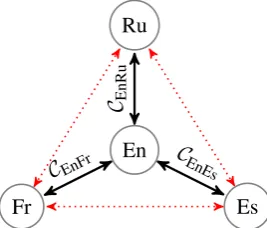
Figure 2: Translation graph: Languages (nodes), parallel corpora (solid edges), and zero-shot directions (dotted edges).
Translation. Finally, we define atranslation task
from languageLi toLj as learning to model the
conditional distributionP(xj |xi). The set ofk
languages along with translation tasks can be rep-resented as a directed graphG(V,E)with a set of
knodes,V, that represent languages and edges,E, that indicate translation directions. We further dis-tinguish between two disjoint subsets of edges: (i) supervised edges,Es, for which we have parallel
data, and (ii) zero-shot edges,E0, that correspond
to zero-shot translation tasks. Figure2presents an example translation graph with supervised edges (En ↔ Es,En↔ Fr,En ↔ Ru) and zero-shot edges (Es↔Fr,Es↔Ru,Fr↔ Ru). We will use this graph as our running example.
3.2 Encoder-decoder framework
First, consider a purely bilingual setting, where we learn to translate from a source language,Ls, to
a target language,Lt. We can train a translation
model by optimizing the conditional log-likelihood of the bilingual data under the model:
ˆ
θ:= arg maxθX
Cst
logPθ(xt|xs) (1)
whereθˆare the estimated parameters of the model. The encoder-decoder framework introduces a latent sequence,u, and represents the model as:
Pθ(xt|xs) =Pdecθ (xt|u=fθenc(xs)) (2)
wherefθenc(xs)is the encoder that maps a source
sequence to a sequence of latent representations,u, and the decoder definesPdecθ (xt|u).1 Note thatu
is usually deterministic with respect toxsand
ac-curate representation of the conditional distribution highly depends on the decoder. In neural machine translation, the exact forms of encoder and decoder are specified using RNNs (Sutskever et al.,2014),
1Slightly abusing the notation, we useθto denote all
pa-rameters of the model: embeddings, encoder, and decoder.
CNNs (Gehring et al.,2016), and attention (Bah-danau et al.,2014;Vaswani et al.,2017) as building blocks. The decoding distribution,Pdecθ (xt|u), is
typically modeled autoregressively.
3.3 Multilingual neural machine translation
In the multilingual setting, we would like to learn to translate inall directionshaving access to only few parallel bilingual corpora. In other words, we would like to learn a collection of models,
{Pθ(xj |xi)}i,j∈E. We can assume that models
are independent and choose to learn them by maxi-mizing the following objective:
Lind(θ) = X
i,j∈Es X
(xi,xj)∈Cij
logPθ(xj |xi) (3)
In the statistics literature, this estimation approach is calledmaximum composite likelihood (Besag, 1975; Lindsay, 1988) as it composes the objec-tive out of (sometimes weighted) terms that rep-resent conditional sub-likelihoods (in our exam-ple,Pθ(xj |xi)). Composite likelihoods are easy
to construct and tractable to optimize as they do not require representing the full likelihood, which would involve integrating out variables unobserved in the data (see AppendixA.1).
Johnson et al.(2016) proposed to train a multi-lingual NMT systems by optimizing a composite likelihood objective (3) while representing all con-ditional distributions,Pθ(xj |xi), with ashared
encoder and decoder and using language tags,lt,
to distinguish between translation directions:
P(xt|xs) =Pdecθ (xt|ust =fθenc(xs, lt)) (4)
This approach has numerous advantages includ-ing: (a) simplicity of training and the architecture (by slightly changing the training data, we con-vert a bilingual NMT into a multilingual one), (b) sharing parameters of the model between differ-ent translation tasks that may lead to better and more robust representations.Johnson et al.(2016) also show that resulting models seem to exhibit some degree of zero-shot generalization enabled by parameter sharing. However, since we lack data for zero-shot directions, composite likelihood (3) misses the terms that correspond to the zero-shot models, and hence has no statistical guarantees for performance on zero-shot tasks.2
2
4 Zero-shot generalization & consistency
Multilingual MT systems can be evaluated in terms ofzero-shot performance, or quality of translation along the directions they have not been optimized for (e.g., due to lack of data). We formally define zero-shot generalization via consistency.
Definition 1 (Expected Zero-shot Consistency)
LetEs andE0 be supervised and zero-shot tasks,
respectively. Let `(·) be a non-negative loss
function and M be a model with maximum
expected supervised loss bounded by someε >0 :
max
(i,j)∈Es
Exi,xj[`(M)]< ε
We callMzero-shot consistent with respect to`(·) if for someκ(ε)>0
max
(i,j)∈E0
Exi,xj[`(M)]< κ(ε),
whereκ(ε)→0asε→0.
In other words, we say that a machine translation system is zero-shot consistent if low error on super-vised tasks implies a low error on zero-shot tasks in expectation (i.e., the system generalizes). We also note that our notion of consistency somewhat resembles error bounds in the domain adaptation literature (Ben-David et al.,2010).
In practice, it is attractive to have MT systems that are guaranteed to exhibit zero-shot general-ization since the access to parallel data is always limited and training is computationally expensive. While the training method ofJohnson et al.(2016) does not have guarantees, we show that our pro-posed approach is provably zero-shot consistent.
5 Approach
We propose a new training objective for multilin-gual NMT architectures with shared encoders and decoders that avoids the limitations of pure com-posite likelihoods. Our method is based on the idea of agreement-based learning initially proposed for learning consistent alignments in phrase-based sta-tistical machine translation (SMT) systems (Liang et al.,2006,2008). In terms of the final objective function, the method ends up being reminiscent of distillation (Kim and Rush,2016), but suitable for joint multilingual training.
5.1 Agreement-based likelihood
To introduce agreement-based objective, we use the graph from Figure2that defines translation tasks between 4 languages (En,Es,Fr,Ru). In particu-lar, consider the composite likelihood objective (3) for a pair ofEn−Frsentences,(xEn,xFr):
Lind
EnFr(θ) (5)
= log [Pθ(xFr |xEn)Pθ(xEn |xFr)]
= log
X
z0Es,z
0
Ru
Pθ xFr,z0Es,z
0
Ru |xEn
×
X
z00
Es,z00Ru
Pθ xEn,z00Es,z
00
Ru |xFr
where we introduced latent translations into Span-ish (Es) and Russian (Ru) and marginalized them out (by virtually summing over all sequences in the corresponding languages). Again, note that this objective assumes independence ofEn→Frand
Fr→Enmodels.
Following Liang et al. (2008), we propose to tie together the single prime and the double prime latent variables,zEs andzRu, to encourage agreement between Pθ(xEn,zEs,zRu |xFr) and
Pθ(xFr,zEs,zRu |xEn)on the latent translations.
We interchange the sum and the product operations inside the log in (5), denote z := (zEs,zRu) to simplify notation, and arrive at the following new objective function:
LagreeEnFr(θ) := (6)
logX
z
Pθ(xFr,z|xEn)Pθ(xEn,z|xFr)
Next, we factorize each term as:
P(x,z|y) =P(x|z,y)Pθ(z|y)
Assuming Pθ(xFr |z,xEn) ≈ Pθ(xFr |xEn),3
the objective (6) decomposes into two terms:
LagreeEnFr(θ) (7)
≈logPθ(xFr|xEn) + logPθ(xEn |xFr)
| {z }
composite likelihood terms
+
logX
z
Pθ(z|xEn)Pθ(z|xFr)
| {z }
agreement term
3This means that it is sufficient to condition on a sentence
We call the expression given in (7)
agreement-based likelihood. Intuitively, this objective is
the likelihood of observing parallel sentences
(xEn,xFr) and having sub-models Pθ(z|xEn)
andPθ(z|xFr)agree on all translations intoEs
andRuat the same time.
Lower bound. Summation in the agreement
term overz(i.e., over possible translations intoEs
andRuin our case) is intractable. Switching back from zto(zEs,zRu)notation and using Jensen’s inequality, we lower bound it with cross-entropy:4
logX
z
Pθ(z|xEn)Pθ(z|xFr)
≥EzEs|xEn[logPθ(zEs |xFr)] + (8)
EzRu|xEn[logPθ(zRu |xFr)]
We can estimate the expectations in the lower bound on the agreement terms by samplingzEs ∼
Pθ(zEs |xEn)andzRu ∼Pθ(zRu|xEn). In
prac-tice, instead of sampling we use greedy, continuous decoding (with a fixed maximum sequence length) that also makes zEs and zRu differentiable with respect to parameters of the model.
5.2 Consistency by agreement
We argue that models produced by maximizing agreement-based likelihood (7) are zero-shot con-sistent. Informally, consider again our running example from Figure 2. Given a pair of paral-lel sentences in(En,Fr), agreement loss encour-ages translations fromEnto{Es,Ru}and trans-lations from Fr to {Es,Ru} to coincide. Note that En → {Es,Fr,Ru} are supervised direc-tions. Therefore, agreement ensures that transla-tions along the zero-shot edges in the graph match supervised translations. Formally, we state it as:
Theorem 2 (Agreement Zero-shot Consistency) LetL1, L2, andL3 be a collection of languages
withL1 ↔L2 andL2 ↔L3 be supervised while
L1 ↔L3be a zero-shot direction. LetPθ(xj |xi) be sub-models represented by a multilingual MT
system. If the expected agreement-based loss,
Ex1,x2,x3[L
agree
12 (θ) +L agree
23 (θ)], is bounded by
some ε > 0, then, under some mild technical assumptions on the true distribution of the equivalent translations, the zero-shot cross-entropy
4Note that expectations in (8) are conditional onx En.
Sym-metrically, we can have a lower bound with expectations con-ditional onxFr. In practice, we symmetrize the objective.
Algorithm 1Agreement-based M-NMT training
input Architecture (GNMT), agreement coefficient (γ) 1: Initialize:θ←θ0
2: whilenot (converged or step limit reached)do
3: Get a mini-batch of parallel src-tgt pairs,(Xs,Xt) 4: Supervised loss:Lsup(θ)←log
Pθ(Xt|Xs) 5: Auxiliary languages:La∼Unif({1, . . . , k}) 6: Auxiliary translations:
Za←s←Decode (Za|fθenc(Xs, La))
Za←t←Decode (Za|fθenc(Xt, La)) 7: Agreement log-probabilities:
`t
a←s←logPθ(Za←s|Xt)
`s
a←t←logPθ(Za←t|Xs) 8: Apply stop-gradients to supervised`t
a←sand`sa←t 9: Total loss:Ltotal(θ)← Lsup(θ) +γ(`t
a←s+`sa←t) 10: Update:θ←optimizer update(Ltotal, θ)
11: end while output θ
loss is bounded as follows:
Ex1,x3[−logPθ(x3 |x1)]≤κ(ε)
whereκ(ε)→0asε→0.
For discussion of the assumptions and details on the proof of the bound, see AppendixA.2. Note that Theorem2is straightforward to extend from triplets of languages to arbitrary connected graphs, as given in the following corollary.
Corollary 3 Agreement-based learning yields zero shot consistent MT models (with respect to the cross entropy loss) for arbitrary translation graphs as long as supervised directions span the graph.
Alternative ways to ensure consistency. Note
that there are other ways to ensure zero-shot con-sistency,e.g., by fine-tuning or post-processing a trained multilingual model. For instance, pivot-ing through an intermediate language is also zero-shot consistent, but the proof requires stronger assumptions about the quality of the supervised source-pivot model.5 Similarly, using model dis-tillation (Kim and Rush,2016;Chen et al.,2017) would be also provably consistent under the same assumptions as given in Theorem2, but for a sin-gle, pre-selected zero-shot direction. Note that our proposed agreement-based learning framework is provably consistent forallzero-shot directions and does not require any post-processing. For discus-sion of the alternative approaches and consistency proof for pivoting, see AppendixA.3.
5Intuitively, we have to assume that source-pivot model
<2En> Comment ça marche réellement?
How does this actually work? <2Fr>
Embeddings 512 dim
Encoder biLSTM x 2
Representation (domain, <2lang>)
SubWord preprocessing
Agreement Loss
log P(Es | En) log P(Es | Fr)Fr En
Representation (target, <2Es>)
Comment ça marche réellement?
Representation (source, <2Es>)
How does this actually work?
A A
Decoder Greedy (continuous) Decoder Teacher forcing
Decoded embeddings (Es )
¿Cómo funciona esto realmente? En
Decoder Greedy (continuous) Decoded embeddings (Es )
¿Cómo funciona realmente? Fr Decoder Teacher forcing
[image:6.595.77.527.61.237.2]A B
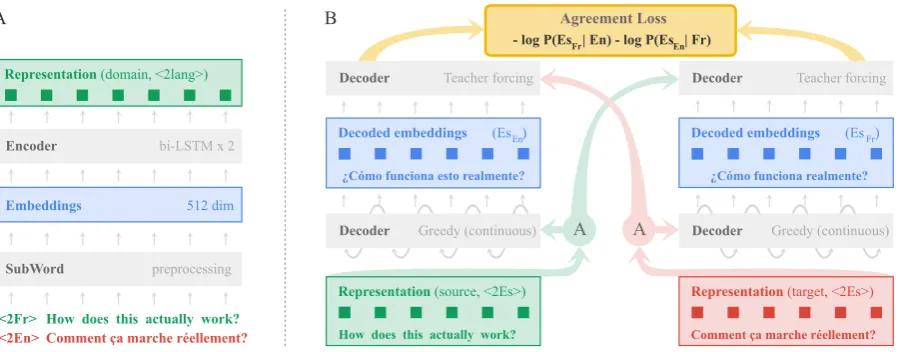
Figure 3:A.Computation graph for the encoder. The representations depend on the input sequence and the target language tag.
B.Computation graph for the agreement loss. First, encode source and target sequences with the auxiliary language tags. Next, decodezEsfrom bothxEnandxFrusing continuous greedy decoder. Finally, evaluate log probabilities,logPθ(zEs(xEn)|xFr)
andlogPθ(zEs(xFr)|xEn), and compute a sample estimate of the agreement loss.
5.3 Agreement-based learning algorithm
Having derived a new objective function (7), we can now learn consistent multilingual NMT models using stochastic gradient method with a couple of extra tricks (Algorithm1). The computation graph for the agreement loss is given in Figure3.
Subsampling auxiliary languages. Computing
agreement overalllanguages for each pair of sen-tences at training time would be quite computa-tionally expensive (to agree onktranslations, we would need to encode-decode the source and target sequencesktimes each). However, since the agree-ment lower bound is a sum over expectations (8), we can approximate it by subsampling: at each training step (and for each sample in the mini-batch), we pick an auxiliary language uniformly at random and compute stochastic approximation of the agreement lower bound (8) for that language only. This stochastic approximation is simple, unbi-ased, and reduces per step computational overhead for the agreement term fromO(k)toO(1).6
Overview of the agreement loss computation.
Given a pair of parallel sentences,xEnandxFr, and an auxiliary language, sayEs, an estimate of the lower bound on the agreement term (8) is computed as follows. First, we concatenateEslanguage tags to bothxEnandxFrand encode the sequences so that both can be translated intoEs(the encoding
6
In practice, note that there is still a constant factor over-head due to extra encoding-decoding steps to/from auxiliary languages, which is about×4when training on a single GPU. Parallelizing the model across multiple GPUs would easily compensate this overhead.
process is depicted in Figure3A). Next, we decode each of the encoded sentences and obtain auxiliary translations,zEs(xEn)andzEs(xFr), depicted as blue blocks in Figure3B. Note that we now can treat pairs(xFr,zEs(xEn))and(xEn,zEs(xFr))as new parallel data forEn→EsandFr→Es.
Finally, using these pairs, we can compute two log-probability terms (Figure3B):
logPθ(zEs(xFr)|xEn)
logPθ(zEs(xEn)|xFr)
(9)
using encoding-decoding with teacher forcing (same way as typically done for the supervised directions). Crucially, note that zEs(xEn) corre-sponds to a supervised direction,En→Es, while
zEs(xFr)corresponds to zero-shot,Fr→Es. We want each of the components to (i) improve the zero-shot direction while (ii) minimally affecting the supervised direction. To achieve (i), we use con-tinuous decoding, and for (ii) we use stop-gradient-based protection of the supervised directions. Both techniques are described below.
Greedy continuous decoding. In order to make
zEs(xEn)andzEs(xFr)differentiable with respect toθ(hence,continuousdecoding), at each decod-ing stept, we treat the output of the RNN,ht, as
the key and use dot-product attention over the em-bedding vocabulary,V, to constructztEs:
ztEs := softmax
n
(ht)>V
o
V (10)
In other words, auxiliary translations, zEs(xEn)
Protecting supervised directions. Algorithm1 scales agreement losses by a small coefficient γ. We found experimentally that training could be sensitive to this hyperparameter since the agree-ment loss also affects the supervised sub-models. For example, agreement ofEn→Es(supervised) and Fr → Es(zero-shot) may push the former towards a worse translation, especially at the be-ginning of training. To stabilize training, we apply thestop gradientoperator to the log probabil-ities and samples produced by the supervised sub-models before computing the agreement terms (9), to zero-out the corresponding gradient updates.
6 Experiments
We evaluate agreement-based training against base-lines from the literature on three public datasets that have multi-parallelevaluation datathat allows assessing zero-shot performance. We report results in terms of the BLEU score (Papineni et al.,2002) that was computed usingmteval-v13a.perl.
6.1 Datasets
UN corpus. Following the setup introduced in
Sestorain et al. (2018), we use two datasets,
UNcorpus-1 and UNcorpus-2, derived from the
United Nations Parallel Corpus (Ziemski et al., 2016).UNcorpus-1consists of data in 3 languages,
En,Es,Fr, whereUNcorpus-2hasRuas the 4th language. For training, we use parallel corpora between Enand the rest of the languages, each about 1M sentences, sub-sampled from the official training data in a way that ensures no multi-parallel training data. Thedevandtestsets contain 4,000 sentences and are all multi-parallel.
Europarl v77. We consider the following lan-guages: De, En, Es, Fr. For training, we use parallel data between Enand the rest of the lan-guages (about 1M sentences per corpus), prepro-cessed to avoid multi-parallel sentences, as was also done byCheng et al.(2017) andChen et al. (2017) and described below. Thedevandtestsets contain 2,000 multi-parallel sentences.
IWSLT178. We use data from the official
mul-tilingual task: 5 languages (De, En, It, Nl,
Ro), 20 translation tasks of which 4 zero-shot (De ↔ Nl and It ↔ Ro) and the rest 16 su-pervised. Note that this dataset has a significant
7
http://www.statmt.org/europarl/ 8https://sites.google.com/site/
iwsltevaluation2017/TED-tasks
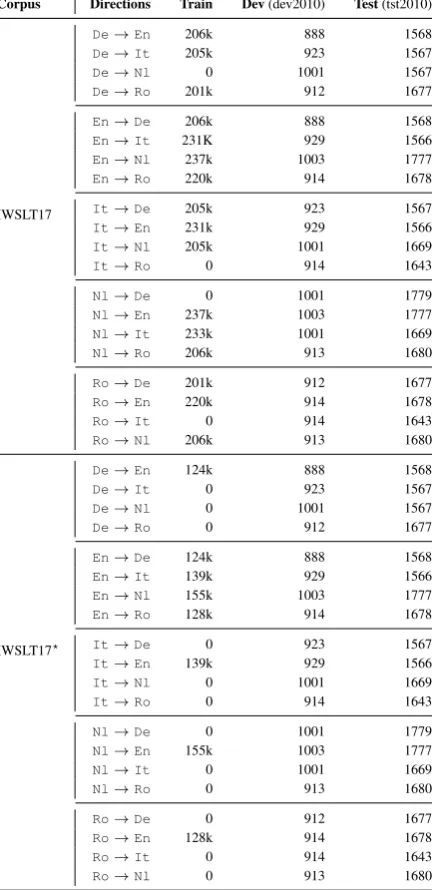
overlap between parallel corpora in the supervised directions (up to 100K sentence pairs per direc-tion). This implicitly makes the dataset multi-parallel and defeats the purpose of zero-shot eval-uation (Dabre et al.,2017). To avoid spurious ef-fects, we also derivedIWSLT17?dataset from the original one by restricting supervised data to only
En ↔ {De,Nl,It,Ro} and removing overlap-ping pivoting sentences. We report results on both the official and preprocessed datasets.
Preprocessing. To properly evaluate systems in terms of zero-shot generalization, we preprocess Europarl and IWSLT?to avoid multi-lingual paral-lel sentences of the formsource-pivot-target, where
source-targetis a zero-shot direction. To do so, we followCheng et al.(2017);Chen et al.(2017) and randomly split the overlapping pivot sentences of the originalsource-pivotandpivot-targetcorpora into two parts and merge them separately with the non-overlapping parts for each pair. Along with each parallel training sentence, we save informa-tion about source and target tags, after which all the data is combined and shuffled. Finally, we use a shared multilingual subword vocabulary (Sennrich et al.,2015b) on the training data (with 32K merge ops), separately for each dataset. Data statistics are provided in AppendixA.5.
6.2 Training and evaluation
Additional details on the hyperparameters can be found in AppendixA.4.
Models. We use a smaller version of the GNMT
architecture (Wu et al.,2016) in all our experiments: 512-dimensional embeddings (separate for source and target sides), 2 bidirectional LSTM layers of 512 units each for encoding, and GNMT-style, 4-layer, 512-unit LSMT decoder with residual con-nections from the 2nd layer onward.
Training. We trained the above model using the
standard methodofJohnson et al.(2016) and
us-ing our proposedagreement-basedtraining (Algo-rithm1). In both cases, the model was optimized using Adafactor (Shazeer and Stern, 2018) on a machine with 4 P100 GPUs for up to 500K steps, with early stopping on the dev set.
Evaluation. We focus our evaluation mainly on
Sestorain et al.(2018)† Our baselines PBSMT NMT-0 Dual-0 Basic Pivot Agree
En→Es 61.26 51.93 — 56.58 56.58 56.36
En→Fr 50.09 40.56 — 44.27 44.27 44.80
Es→En 59.89 51.58 — 55.70 55.70 55.24
Fr→En 52.22 43.33 — 46.46 46.46 46.17 Supervised (avg.) 55.87 46.85 — 50.75 50.75 50.64
Es→Fr 52.44 20.29 36.68 34.75 38.10 37.54
Fr→Es 49.79 19.01 39.19 37.67 40.84 40.02 Zero-shot (avg.) 51.11 19.69 37.93 36.21 39.47 38.78
[image:8.595.307.527.62.208.2]†Source:https://openreview.net/forum?id=ByecAoAqK7.
Table 1: Results on UNCorpus-1.
Sestorain et al.(2018) Our baselines
PBSMT NMT-0 Dual-0 Basic Pivot Agree
En→Es 61.26 47.51 44.30 55.15 55.15 54.30
En→Fr 50.09 36.70 34.34 43.42 43.42 42.57
En→Ru 43.25 30.45 29.47 36.26 36.26 35.89
Es→En 59.89 48.56 45.55 54.35 54.35 54.33
Fr→En 52.22 40.75 37.75 45.55 45.55 45.87
Ru→En 52.59 39.35 37.96 45.52 45.52 44.67 Supervised (avg.) 53.22 40.55 36.74 46.71 46.71 46.27
Es→Fr 52.44 25.85 34.51 34.73 35.93 36.02 Fr→Es 49.79 22.68 37.71 38.20 39.51 39.94 Es→Ru 39.69 9.36 24.55 26.29 27.15 28.08 Ru→Es 49.61 26.26 33.23 33.43 37.17 35.01
[image:8.595.73.291.63.171.2]Fr→Ru 36.48 9.35 22.76 23.88 24.99 25.13 Ru→Fr 43.37 22.43 26.49 28.52 30.06 29.53 Zero-shot (avg.) 45.23 26.26 29.88 30.84 32.47 32.29
Table 2: Results on UNCorpus-2.
(b)Pivot, which performs pivoting-based infer-ence using a multilingual GNMT model (after stan-dard training); often regarded as gold-stanstan-dard. (c)Agree, which applies a multilingual GNMT model trained with agreement losses directly to zero-shot directions.
To ensure a fair comparison in terms of model capacity, all the techniques above use the same multilingual GNMT architecture described in the previous section. All other results provided in the tables are as reported in the literature.
Implementation. All our methods were
imple-mented using TensorFlow (Abadi et al.,2016) on top of tensor2tensor library (Vaswani et al.,2018). Our code will be made publicly available.9
6.3 Results on UN Corpus and Europarl
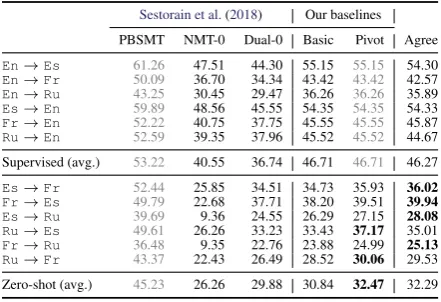
UN Corpus. Tables 1 and 2 show results on
the UNCorpus datasets. Our approach consis-tently outperformsBasicandDual-0, despite the latter being trained with additional monolin-gual data (Sestorain et al.,2018). We see that mod-els trained with agreement perform comparably to
Pivot, outperforming it in some cases,e.g., when the target is Russian, perhaps because it is quite
9
www.cs.cmu.edu/˜mshediva/code/
Previous work Our baselines
Soft‡ Distill† Basic Pivot Agree
En→Es — — 34.69 34.69 33.80
En→De — — 23.06 23.06 22.44
En→Fr 31.40 — 33.87 33.87 32.55
Es→En 31.96 — 34.77 34.77 34.53
De→En 26.55 — 29.06 29.06 29.07
Fr→En — — 33.67 33.67 33.30
Supervised (avg.) — — 31.52 31.52 30.95
Es→De — — 18.23 20.14 20.70
De→Es — — 20.28 26.50 22.45
Es→Fr 30.57 33.86 27.99 32.56 30.94
Fr→Es — — 27.12 32.96 29.91
De→Fr 23.79 27.03 21.36 25.67 24.45
Fr→De — — 18.57 19.86 19.15
Zero-shot (avg.) — — 22.25 26.28 24.60
†Soft pivoting (Cheng et al.,2017).‡Distillation (Chen et al.,2017).
Table 3: Zero-shot results on Europarl. Note thatSoftand
Distillare not multilingual systems.
Previous work Our baselines
SOTA† CPG‡ Basic Pivot Agree Supervised (avg.) 24.10 19.75 24.63 24.63 23.97 Zero-shot (avg.) 20.55 11.69 19.86 19.26 20.58
†Table 2 fromDabre et al.(2017).‡Table 2 fromPlatanios et al.(2018).
Table 4: Results on the official IWSLT17 multilingual task.
Basic Pivot Agree
Supervised (avg.) 28.72 28.72 29.17
Zero-shot (avg.) 12.61 17.68 15.23
Table 5: Results on our proposed IWSLT17?.
different linguistically from the English pivot. Furthermore, unlike Dual-0, Agree main-tains high performance in the supervised directions (within 1 BLEU point compared toBasic), indi-cating that our agreement-based approach is effec-tive as a part of a single multilingual system.
Europarl. Table3shows the results on the Eu-roparl corpus. On this dataset, our approach con-sistently outperformsBasicby 2-3 BLEU points but lags a bit behindPivoton average (except on
Es→Dewhere it is better).Cheng et al.(2017)10 andChen et al.(2017) have reported zero-resource results on a subset of these directions and our ap-proach outperforms the former but not the latter on these pairs. Note that bothCheng et al.(2017) andChen et al. (2017) train separate models for each language pair and the approach ofChen et al. (2017) would require trainingO(k2)models to en-compass all the pairs. In contrast, we use a single multilingual architecture which has more limited model capacity (although in theory, our approach is also compatible with using separate models for each direction).
10We only show their best zero-resource result in the table
[image:8.595.71.292.205.356.2]200 400 0
10 20 30
BLEU
Es→De
200 400
0 10 20
30 Es→Fr
200 400
0 10 20
30 De→Fr
200 400
0 10 20 30
BLEU
De→Es
200 400
0 10 20
30 Fr→Es
200 400
0 10 20
30 Fr→De
Training parallel sentences (thousands)
[image:9.595.73.288.72.232.2]Basic Pivoting Agreement
Figure 4: BLEU on the dev set forAgreeand the baselines trained on smaller subsets of the Europarl corpus.
6.4 Analysis of IWSLT17 zero-shot tasks
Table4presents results on the original IWSLT17 task. We note that because of the large amount of data overlap and presence of many supervised translation pairs (16) the vanilla training method (Johnson et al.,2016) achieves very high zero shot performance, even outperformingPivot. While our approach gives small gains over these baselines, we believe the dataset’s pecularities make it not reliable for evaluating zero-shot generalization.
On the other hand, on our proposed preprocessed IWSLT17?that eliminates the overlap and reduces the number of supervised directions (8), there is a considerable gap between the supervised and zero-shot performance ofBasic.Agreeperforms bet-ter thanBasicand is slightly worse thanPivot.
6.5 Small data regime
To better understand the dynamics of different methods in the small data regime, we also trained all our methods on subsets of the Europarl for 200K steps and evaluated on the dev set. The training set size varied from 50 to 450K parallel sentences. From Figure4,Basictends to perform extremely poorly whileAgree is the most robust (also in terms of variance across zero-shot directions). We see thatAgree generally upper-boundsPivot, except for the(Es,Fr)pair, perhaps due to fewer cascading errors along these directions.
7 Conclusion
In this work, we studied zero-shot generalization in the context of multilingual neural machine transla-tion. First, we introduced the concept of zero-shot
consistency that implies generalization. Next, we proposed a provably consistent agreement-based learning approach for zero-shot translation. Empiri-cal results on three datasets showed that agreement-based learning results in up to +3 BLEU zero-shot improvement over theJohnson et al.(2016) base-line, compares favorably to other approaches in the literature (Cheng et al.,2017;Sestorain et al., 2018), is competitive with pivoting, and does not lose in performance on supervised directions.
We believe that the theory and methodology hind agreement-based learning could be useful be-yond translation, especially in multi-modal settings. For instance, it could be applied to tasks such as cross-lingual natural language inference (Conneau et al.,2018), style-transfer (Shen et al.,2017;Fu et al., 2017;Prabhumoye et al., 2018), or multi-lingual image or video captioning. Another in-teresting future direction would be to explore dif-ferent hand-engineered or learned data representa-tions, which one could use to encourage models to agree on during training (e.g., make translation models agree on latent semantic parses, summaries, or potentially other data representations available at training time).
Acknowledgments
We thank Ian Tenney and Anthony Platanios for many insightful discussions, Emily Pitler for the helpful comments on the early draft of the paper, and anonymous reviewers for careful reading and useful feedback.
References
Mart´ın Abadi, Paul Barham, Jianmin Chen, Zhifeng Chen, Andy Davis, Jeffrey Dean, Matthieu Devin, Sanjay Ghemawat, Geoffrey Irving, Michael Isard, et al. 2016. Tensorflow: a system for large-scale machine learning. InOSDI, volume 16, pages 265– 283.
Rohan Anil, Gabriel Pereyra, Alexandre Passos, Robert Ormandi, George E Dahl, and Geoffrey E Hin-ton. 2018. Large scale distributed neural network training through online distillation. arXiv preprint arXiv:1804.03235.
Naveen Arivazhagan, Ankur Bapna, Orhan Firat, Roee Aharoni, Melvin Johnson, and Wolfgang Macherey. 2018. The missing ingredient in zero-shot neural machine translation. OpenReview.net.
Dzmitry Bahdanau, Kyunghyun Cho, and Yoshua Ben-gio. 2014. Neural machine translation by jointly learning to align and translate. arXiv preprint arXiv:1409.0473.
Shai Ben-David, John Blitzer, Koby Crammer, Alex Kulesza, Fernando Pereira, and Jennifer Wortman Vaughan. 2010. A theory of learning from different domains. Machine learning, 79(1-2):151–175.
Julian Besag. 1975. Statistical analysis of non-lattice data.The statistician, pages 179–195.
Ondrej Bojar, Rajen Chatterjee, Christian Federmann, Yvette Graham, Barry Haddow, Matthias Huck, An-tonio Jimeno Yepes, Philipp Koehn, Varvara Lo-gacheva, Christof Monz, et al. 2016. Findings of the 2016 conference on machine translation. In ACL 2016 FIRST CONFERENCE ON MACHINE TRANSLATION (WMT16), pages 131–198. The As-sociation for Computational Linguistics.
Yun Chen, Yang Liu, Yong Cheng, and Victor OK Li. 2017. A teacher-student framework for zero-resource neural machine translation. arXiv preprint arXiv:1705.00753.
Yong Cheng, Qian Yang, Yang Liu, Maosong Sun, and Wei Xu. 2017. Joint training for pivot-based neural machine translation. InProceedings of IJCAI.
Kyunghyun Cho, Bart Van Merri¨enboer, Caglar Gul-cehre, Dzmitry Bahdanau, Fethi Bougares, Holger Schwenk, and Yoshua Bengio. 2014. Learning phrase representations using rnn encoder-decoder for statistical machine translation. arXiv preprint arXiv:1406.1078.
Trevor Cohn and Mirella Lapata. 2007. Machine trans-lation by triangutrans-lation: Making effective use of multi-parallel corpora. In Proceedings of the 45th Annual Meeting of the Association of Computational Linguistics, pages 728–735.
Alexis Conneau, Guillaume Lample, Marc’Aurelio Ranzato, Ludovic Denoyer, and Herv´e J´egou. 2017. Word translation without parallel data. arXiv preprint arXiv:1710.04087.
Alexis Conneau, Guillaume Lample, Ruty Rinott, Ad-ina Williams, Samuel R Bowman, Holger Schwenk, and Veselin Stoyanov. 2018. Xnli: Evaluating cross-lingual sentence representations. arXiv preprint arXiv:1809.05053.
Josep Crego, Jungi Kim, Guillaume Klein, An-abel Rebollo, Kathy Yang, Jean Senellart, Egor Akhanov, Patrice Brunelle, Aurelien Coquard, Yongchao Deng, et al. 2016. Systran’s pure neu-ral machine translation systems. arXiv preprint arXiv:1610.05540.
Raj Dabre, Fabien Cromieres, and Sadao Kurohashi. 2017. Kyoto university mt system description for iwslt 2017. Proc. of IWSLT, Tokyo, Japan.
Orhan Firat, Kyunghyun Cho, and Yoshua Ben-gio. 2016a. Multi-way, multilingual neural ma-chine translation with a shared attention mechanism. arXiv preprint arXiv:1601.01073.
Orhan Firat, Baskaran Sankaran, Yaser Al-Onaizan, Fatos T Yarman Vural, and Kyunghyun Cho. 2016b. Zero-resource translation with multi-lingual neural machine translation. arXiv preprint arXiv:1606.04164.
Zhenxin Fu, Xiaoye Tan, Nanyun Peng, Dongyan Zhao, and Rui Yan. 2017. Style transfer in text: Exploration and evaluation. arXiv preprint arXiv:1711.06861.
Jonas Gehring, Michael Auli, David Grangier, and Yann N Dauphin. 2016. A convolutional encoder model for neural machine translation. arXiv preprint arXiv:1611.02344.
Thanh-Le Ha, Jan Niehues, and Alexander Waibel. 2017. Effective strategies in zero-shot neural ma-chine translation. arXiv preprint arXiv:1711.07893.
Di He, Yingce Xia, Tao Qin, Liwei Wang, Nenghai Yu, Tieyan Liu, and Wei-Ying Ma. 2016. Dual learning for machine translation. InAdvances in Neural In-formation Processing Systems, pages 820–828.
Geoffrey Hinton, Oriol Vinyals, and Jeff Dean. 2014. Dark knowledge. Presented as the keynote in BayLearn, 2.
Melvin Johnson, Mike Schuster, Quoc V Le, Maxim Krikun, Yonghui Wu, Zhifeng Chen, Nikhil Thorat, Fernanda Vi´egas, Martin Wattenberg, Greg Corrado, et al. 2016. Google’s multilingual neural machine translation system: enabling zero-shot translation. arXiv preprint arXiv:1611.04558.
Marcin Junczys-Dowmunt, Tomasz Dwojak, and Hieu Hoang. 2016. Is neural machine translation ready for deployment? a case study on 30 translation di-rections. arXiv preprint arXiv:1610.01108.
Yoon Kim and Alexander M Rush. 2016. Sequence-level knowledge distillation. arXiv preprint arXiv:1606.07947.
Philip Koehn. 2017. Europarl: A parallel corpus for statistical machine translation.
Philipp Koehn. 2009. Statistical machine translation. Cambridge University Press.
Philipp Koehn and Rebecca Knowles. 2017. Six challenges for neural machine translation. arXiv preprint arXiv:1706.03872.
Guillaume Lample, Myle Ott, Alexis Conneau, Lu-dovic Denoyer, and Marc’Aurelio Ranzato. 2018. Phrase-based & neural unsupervised machine trans-lation. arXiv preprint arXiv:1804.07755.
Percy Liang, Ben Taskar, and Dan Klein. 2006. Align-ment by agreeAlign-ment. In Proceedings of the main conference on Human Language Technology Confer-ence of the North American Chapter of the Associa-tion of ComputaAssocia-tional Linguistics, pages 104–111. Association for Computational Linguistics.
Percy S Liang, Dan Klein, and Michael I Jordan. 2008. Agreement-based learning. InAdvances in Neural Information Processing Systems, pages 913–920.
Bruce G Lindsay. 1988. Composite likelihood meth-ods. Contemporary mathematics, 80(1):221–239.
Yichao Lu, Phillip Keung, Faisal Ladhak, Vikas Bhard-waj, Shaonan Zhang, and Jason Sun. 2018. A neu-ral interlingua for multilingual machine translation. arXiv preprint arXiv:1804.08198.
Minh-Thang Luong, Quoc V Le, Ilya Sutskever, Oriol Vinyals, and Lukasz Kaiser. 2015a. Multi-task sequence to sequence learning. arXiv preprint arXiv:1511.06114.
Minh-Thang Luong, Hieu Pham, and Christopher D Manning. 2015b. Effective approaches to attention-based neural machine translation. arXiv preprint arXiv:1508.04025.
Cettolo Mauro, Federico Marcello, Bentivogli Luisa, Niehues Jan, St¨uker Sebastian, Sudoh Katsuitho, Yoshino Koichiro, and Federmann Christian. 2017. Overview of the iwslt 2017 evaluation campaign. In International Workshop on Spoken Language Trans-lation, pages 2–14.
Kishore Papineni, Salim Roukos, Todd Ward, and Wei-Jing Zhu. 2002. Bleu: a method for automatic eval-uation of machine translation. In Proceedings of the 40th annual meeting on association for compu-tational linguistics, pages 311–318. Association for Computational Linguistics.
Emmanouil Antonios Platanios, Mrinmaya Sachan, Graham Neubig, and Tom Mitchell. 2018. Contex-tual parameter generation for universal neural ma-chine translation. arXiv preprint arXiv:1808.08493.
Shrimai Prabhumoye, Yulia Tsvetkov, Ruslan Salakhut-dinov, and Alan W Black. 2018. Style trans-fer through back-translation. arXiv preprint arXiv:1804.09000.
Sujith Ravi and Kevin Knight. 2011. Deciphering for-eign language. In Proceedings of the 49th Annual Meeting of the Association for Computational Lin-guistics: Human Language Technologies-Volume 1, pages 12–21. Association for Computational Lin-guistics.
Rico Sennrich, Barry Haddow, and Alexandra Birch. 2015a. Improving neural machine translation models with monolingual data. arXiv preprint arXiv:1511.06709.
Rico Sennrich, Barry Haddow, and Alexandra Birch. 2015b. Neural machine translation of rare words with subword units. arXiv preprint arXiv:1508.07909.
Lierni Sestorain, Massimiliano Ciaramita, Christian
Buck, and Thomas Hofmann. 2018.
Zero-shot dual machine translation. arXiv preprint arXiv:1805.10338.
Noam Shazeer and Mitchell Stern. 2018. Adafactor: Adaptive learning rates with sublinear memory cost. arXiv preprint arXiv:1804.04235.
Tianxiao Shen, Tao Lei, Regina Barzilay, and Tommi Jaakkola. 2017. Style transfer from non-parallel text by cross-alignment. InAdvances in Neural Informa-tion Processing Systems, pages 6830–6841.
Ilya Sutskever, Oriol Vinyals, and Quoc V Le. 2014. Sequence to sequence learning with neural networks. In Advances in neural information processing sys-tems, pages 3104–3112.
Masao Utiyama and Hitoshi Isahara. 2007. A com-parison of pivot methods for phrase-based statistical machine translation. InHuman Language Technolo-gies 2007: The Conference of the North American Chapter of the Association for Computational Lin-guistics; Proceedings of the Main Conference, pages 484–491.
Ashish Vaswani, Samy Bengio, Eugene Brevdo, Fran-cois Chollet, Aidan N Gomez, Stephan Gouws, Llion Jones, Łukasz Kaiser, Nal Kalchbrenner, Niki Parmar, et al. 2018. Tensor2tensor for neural ma-chine translation. arXiv preprint arXiv:1803.07416.
Ashish Vaswani, Noam Shazeer, Niki Parmar, Jakob Uszkoreit, Llion Jones, Aidan N Gomez, Łukasz Kaiser, and Illia Polosukhin. 2017. Attention is all you need. InAdvances in Neural Information Pro-cessing Systems, pages 5998–6008.
Hua Wu and Haifeng Wang. 2007. Pivot language ap-proach for phrase-based statistical machine transla-tion. Machine Translation, 21(3):165–181.
Yonghui Wu, Mike Schuster, Zhifeng Chen, Quoc V Le, Mohammad Norouzi, Wolfgang Macherey,
Maxim Krikun, Yuan Cao, Qin Gao, Klaus
Macherey, et al. 2016. Google’s neural machine translation system: Bridging the gap between hu-man and machine translation. arXiv preprint arXiv:1609.08144.
A Appendices
A.1 Complete likelihood
Given a set of conditional models,{Pθ(xj |xi)},
we can write out the full likelihood over equivalent translations,(x1, . . . ,xk), as follows:
Pθ(x1, . . . ,xk) :=
1 Z
Y
i,j∈E
Pθ(xj |xi) (11)
where Z := P
x1,...,xk Q
i,j∈EPθ(xj |xi) is the
normalizing constant andEdenotesalledges in the graph (Figure5). Given only bilingual parallel cor-pora,Cij fori, j∈ Es, we can observe only certain
pairs of variables. Therefore, the log-likelihood of the data can be written as:
L(θ) :=
X
i,j∈Es X
xi,xj∈Cij
logX
z
Pθ(x1, . . . ,xk)
(12)
Here, the outer sum iterates over available corpora. The middle sum iterates over parallel sentences in a corpus. The most inner sum marginalizes out unobservable sequences, denotedz := {xl}l6=i,j,
which are sentences equivalent under this model to
xi andxj in languages other thanLiandLj. Note
that due to the inner-most summation, computing the log-likelihood is intractable.
We claim the following.
Claim 4 Maximizing the full log-likelihood yields zero-shot consistent models (Definition1).
Proof. To better understand why this is the case, let us consider example in Figure5and compute the log-likelihood of(x1,x2):
logPθ(x1,x2)
= logX
x3,x4Pθ
(x1,x2,x3,x4)
∝logPθ(x1 |x2) + logPθ(x2 |x1) +
logX
x3,x4Pθ
(x1|x3)Pθ(x3|x1)×
Pθ(x2 |x3)Pθ(x3 |x2)×
Pθ(x1 |x4)Pθ(x4 |x1)×
Pθ(x2 |x4)Pθ(x4 |x2)×
Pθ(x3 |x4)Pθ(x4 |x3)
Note that the terms that encourage agreement on the translation intoL3are colored ingreen
(simi-larly, terms that encourage agreement on the trans-lation intoL4are colored inblue). Since all other
terms are probabilities and bounded by 1, we have:
L1
L2 L3
L4
C12 C13
[image:12.595.345.485.62.179.2]C14
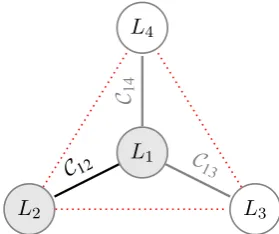
Figure 5: Probabilistic graphical model for a multilingual system with four languages(L1, L2, L3, L4). Variables can
only be observed only in pairs (shaded in the graph).
logPθ(x1,x2) + logZ
≤logPθ(x1 |x2) + logPθ(x2 |x1) +
logX
x3,x4Pθ
(x3 |x1)Pθ(x3 |x2)×
Pθ(x4 |x1)Pθ(x4|x2)
≡ Lagree(θ)
In other words, the full log likelihood lower-bounds the agreement objective (up to a constant
logZ). Since optimizing for agreement leads to consistency (Theorem 2), and maximizing the full likelihood would necessarily improve the agreement, the claim follows.
Remark 5 Note that the other terms in the full likelihood also have a non-trivial purpose: (a) the termsPθ(x1 |x3),Pθ(x1|x4),Pθ(x2 |x3),
Pθ(x2 |x4), encourage the model to correctly
re-constructx1 andx2 when back-translating from
unobserved languages,L3 andL4, and (b) terms
Pθ(x3 |x4),Pθ(x4|x3)enforce consistency
be-tween the latent representations. In other words, full likelihood accounts for a combination of agree-ment, back-translation, and latent consistency.
A.2 Proof of agreement consistency
The statement of Theorem2mentions an assump-tion on the true distribuassump-tion of the equivalent trans-lations. The assumption is as follows.
Assumption 6 Let P(xi |xj,xk) be the ground truth conditional distribution that specifies the probability ofxito be a translation ofxj andxk into languageLi, given that(xj,xk)are correct translations of each other in languagesLj andLk, respectively. We assume:
This assumption means that, even though there might be multiple equivalent translations, there must be not too many of them (implied by the
δ lower bound) and none of them must be much more preferable than the rest (implied by theξ up-per bound). Given this assumption, we can prove the following simple lemma.
Lemma 7 LetLi →Lj be one of the supervised directions, Exi,xj[−logPθ(xj |xi)] ≤ ε. Then
the following holds:
Exi|xj,xk
Pθ(xj |xi)
P(xj |xi,xk)
≥log1
ξ −εδ
Proof. First, using Jensen’s inequality, we have:
logExi|xj,xk
Pθ(xj |xi)
P(xj |xi,xk)
≥
Exi|xj,xk[logPθ(xj |xi)−logP(xj |xi,xk)]
The bound on the supervised direction implies that
Exi|xj,xk[−logPθ(xj |xi)]≥ −εδ
To bound the second term, we use Assumption6:
Exi|xj,xk[−logP(xj |xi,xk)]≥log
1 ξ
Putting these together yields the bound.
Now, using Lemma7, we can prove Theorem2.
Proof. By assumption, the agreement-based loss is bounded byε. Therefore, expected cross-entropy on all supervised terms,L1 ↔L2, is bounded by
ε. Moreover, the agreement term (which is part of the objective) is also bounded:
−Exi,xj "
X
xk
Pθ(xk|xj) logPθ(xk|xi)
#
≤ε
Expanding this expectation, we have:
X
xi,xj
P(xi,xj)
X
xk
Pθ(xk|xj) logPθ(xk|xi)]
= X
xi,xj,xk
P(xi,xj,xk)×
Pθ(xk |xj)
P(xk|xi,xj)
logPθ(xk|xi)
= X
xi,xk
Exj|xi,xk
Pθ(xk|xj)
P(xk|xi,xj)
×
P(xi,xk) logPθ(xk |xi)
Combining that with Lemma7, we have:
Exi,xk[−logPθ(xk |xi)]≤
ε
log1ξ −δε ≡κ(ε)
Since by Assumption6,δandξare some constants,
κ(ε)→0asε→0.
A.3 Consistency of distillation and pivoting
As we mentioned in the main text of the paper, distillation (Chen et al.,2017) and pivoting yield zero-shot consistent models. Let us understand why this is the case.
In our notation, givenL1→L2andL2→L3as
supervised directions, distillation optimizes a KL-divergence betweenPθ(x3 |x2)andPθ(x3 |x1),
where the latter is a zero-shot model and the former is supervised. Noting that KL-divergence lower-bounds cross-entropy, it is a loser bound on the agreeement loss. Hence, by ensuring that KL is low, we also ensure that the models agree, which implies consistency (a more formal proof would exactly follow the same steps as the proof of Theorem2).
To prove consistency of pivoting, we need an additional assumption on the quality of the source-pivot model.
Assumption 8 Let Pθ(xj |xi) be the source-pivot model. We assume the following bound holds for each pair of equivalent translations,(xj,xk):
Exi|xj,xk
Pθ(xj |xi)
P(xj |xi,xk)
≤C
whereC >0is some constant.
Theorem 9 (Pivoting consistency) Given the
conditions of Theorem 2 and Assumption 8,
pivoting is zero-shot consistent.
Proof. We can bound the expected error on piv-oting as follows (using Jensen’s inequality and the conditions from our assumptions):
Exi,xk
−log X
xj
Pθ(xj |xi)Pθ(xk|xj)
≤Exi,xj,xk[−Pθ(xj |xi) logPθ(xk |xj)]
≤ X
xi,xk
Exj|xi,xk
Pθ(xk|xj)
P(xk |xi,xj)
×
P(xi,xk) logPθ(xk|xi)
A.4 Details on the models and training
Architecture. All our NMT models used the
GNMT (Wu et al.,2016) architecture with Luong attention (Luong et al.,2015b), 2 bidirectional en-coder, and 4-layer decoder with residual connec-tions. All hidden layers (including embeddings) had 512 units. Additionally, we used separate em-beddings on the encoder and decoder sides as well as tied weights of the softmax that produced log-its with the decoder-side (i.e., target) embeddings. Standard dropout of 0.2 was used on all hidden layers. Most of the other hyperparameters we set to default in the T2T (Vaswani et al.,2018) library for the text2text type of problems.
Training and hyperparameters. We scaled
agreement terms in the loss by γ = 0.01. The training was done using Adafactor (Shazeer and Stern,2018) optimizer with 10,000 burn-in steps at 0.01 learning rate and further standard square root decay (with the default settings for the decay from the T2T library). Additionally, implemented agree-ment loss as a subgraph as a loss was not computed if γ was set to 0. This allowed us to start train-ing multiltrain-ingual NMT models in the burn-in mode using the composite likelihood objective and then switch on agreement starting some point during optimization (typically, after the first 100K itera-tions; we also experimented with 0, 50K, 200K, but did not notice any difference in terms of final performance). Since the agreement subgraph was not computed during the initial training phase, it tended to accelerate training of agreement models.
A.5 Details on the datasets
Statistics of the IWSLT17 and IWSLT17?datasets are summarized in Table 6. UNCorpus and and Europarl datasets were exactly as described by Ses-torain et al.(2018) andChen et al.(2017);Cheng et al.(2017), respectively.
Corpus Directions Train Dev(dev2010) Test(tst2010)
IWSLT17
De→En 206k 888 1568
De→It 205k 923 1567
De→Nl 0 1001 1567
De→Ro 201k 912 1677
En→De 206k 888 1568
En→It 231K 929 1566
En→Nl 237k 1003 1777
En→Ro 220k 914 1678
It→De 205k 923 1567
It→En 231k 929 1566
It→Nl 205k 1001 1669
It→Ro 0 914 1643
Nl→De 0 1001 1779
Nl→En 237k 1003 1777
Nl→It 233k 1001 1669
Nl→Ro 206k 913 1680
Ro→De 201k 912 1677
Ro→En 220k 914 1678
Ro→It 0 914 1643
Ro→Nl 206k 913 1680
IWSLT17?
De→En 124k 888 1568
De→It 0 923 1567
De→Nl 0 1001 1567
De→Ro 0 912 1677
En→De 124k 888 1568
En→It 139k 929 1566
En→Nl 155k 1003 1777
En→Ro 128k 914 1678
It→De 0 923 1567
It→En 139k 929 1566
It→Nl 0 1001 1669
It→Ro 0 914 1643
Nl→De 0 1001 1779
Nl→En 155k 1003 1777
Nl→It 0 1001 1669
Nl→Ro 0 913 1680
Ro→De 0 912 1677
Ro→En 128k 914 1678
Ro→It 0 914 1643
[image:14.595.309.527.75.521.2]Ro→Nl 0 913 1680