Improv
e
d S
e
nt
e
n
ce
Alignm
e
nt on Parall
e
l W
e
b Pag
e
s Using a
Sto
c
hasti
c
T r
ee
Alignm
e
nt Mod
e
l
L
ei Shi
Microsoft Research Asia
5F Sigma Center, 49 Zhichun Road, Beijing
100190, P. R. China
[email protected]
Ming Zhou
Microsoft Research Asia
5F Sigma Center, 49 Zhichun Road, Beijing
100190, P. R. China
[email protected]
Ab
s
tract
Parallel web pages are important source of training data for statistical machine translation. In this paper, we present a new approach to sentence alignment on parallel web pages. Parallel web pages tend to have parallel structures,and the structural correspondence can be indica-tive information for identifying parallel sentences. In our approach, the web page is represented as a tree, and a stochastic tree alignment model is used to exploit the structural correspondence for sentence alignment. Experiments show that this method significantly enhances alignment accuracy and robustness for parallel web pages which are much more diverse and noisy than standard parallel corpora such as “Hansard”. With improved sentence alignment performance, web mining sys-tems are able to acquire parallel sentences of higher quality from the web.
1
Introduction
Sentence-aligned parallel bilingual corpora have been essential resources for statistical machine translation (Brown et al. 1993), and many other multi-lingual natural language processing applica-tions. The task of aligning parallel sentences has received considerable attention since the renais-sance of data driven machine translation in late 1980s.
During the past decades, a number of methods have been proposed to address the sentence align-ment problem. Although excellent performance
was reported on clean corpora, they are less robust with presence of noise. A recent study by (Singh and Husain 2005) completed a systematic evalua-tion on different sentence aligners under various conditions. Their experiments showed that the per-formance of sentence aligners are sensitive to properties of the text, such as format complexity (presence of elements other than text), structural distance (a scale from literal to free translation), the amount of noise (text deletions or preprocess-ing errors) and typological distance between lan-guages. Their performance varies on different type of texts and they all demonstrate marked perfor-mance degradation over noisy data. The results suggest that there is currently no universal solution to sentence alignment under all conditions, and different methods should be applied to different types of texts.
In this paper, we specifically address sentence alignment on parallel web pages. It has come to attention with the increasing trend of acquiring large-scale parallel data from the web. Currently, large-scale parallel data are not readily available for most language pairs and domains. But due to a sharply increasing number of bilingual web sites, web mining shows great promise as a solution to this knowledge bottleneck problem. Many systems (Ma 1999; Chen 2000; Yang 2002; Resnik 2003; Chen 2004) have been developed to discover paral-lel web pages, and sentence aligners are used to extract parallel sentences from the mined web cor-pora. Sentence alignment performance on parallel web pages, therefore, becomes an increasingly im-portant issue for large-scale high-quality parallel data acquisition.
Compared with clean parallel corpora such as "Hansard" (Brown et al. 1993), which consists of
French-English translations of political debates in the Canadian parliament, texts from the web are far more diverse and noisy. They are from many dif-ferent domains and of various genres. Their trans-lation may be non-literal or written in disparate language pairs. Noise is abundant with frequent insertions, deletions or non-translations. And there are many very short sentences of 1-3 words. Due to the characteristics of web corpora, direct appli-cation of conventional alignment methods without exploiting additional web document information
yields unsatisfactory alignment results.
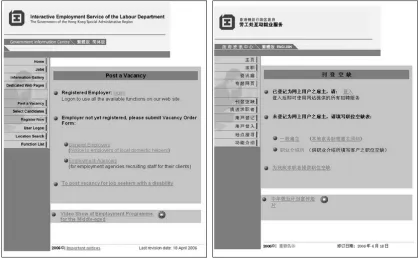
Our approach to this problem is to make use of the structural parallelism between parallel web pages. Structural parallelism is the phenomenon, that when representing the same content in two different languages, authors have a very strong tendency to use the same document structure. As is shown in Figure 1, sentences located in similar position on both pages are more likely to be trans-lations. Hence, correspondence in the web page structure is an informative indication of parallel sentences. In our approach, the web page is represented as a tree, and a stochastic tree align-ment model is used to find the most probable alignment of the tree pair based on their structure and the texts in tree nodes. The tree alignment then
acts as useful information to constrain the scope of search for parallel sentences.
The paper is organized as follows: In section 2, we briefly survey previous approaches to sentence alignment. In section 3, we present the stochastic tree alignment model, including parameter estima-tion and decoding. Then in secestima-tion 4, we describe how to use the tree alignment model in sentence alignment. Benchmarks are shown in section 5, and the paper is concluded in section 6.
2
Se
ntence Alignment Model
s
Sentence alignment methods can be categorized into three major categories: the length-based, lex-icon-based and hybrid method which combines the length-based model and lexicon-based model as complement to each other.
[image:2.612.84.503.216.474.2]with an error rate of 4% on average. But they are not robust with respect to non-literal translations, deletions and disparate language pairs.
Unlike the length-based model, which totally ignores word identity, lexicon-based methods use lexical information to align parallel sentences. Kay’s (Kay and Roscheisen 1993) approach is based on the idea that words that are translations of each other will have similar distribution in source and target texts. By adopting the IBM model 1, (Chen 1993) used word translation probabilities, which he showed gives better accuracy than the sentence length based method. Melamed (Me-lamed 1996) rather used word correspondence from a different perspective as geometric corres-pondence for sentence alignment.
The hybrid method combines the length model with the lexical method. (Simard and Plamondon 1996) used a two-pass approach, where the first pass performs length-based alignment at the cha-racter level as in (Gale and Church 1993) and the second pass uses IBM Model 1, following (Chen 1993). Moore’s (Moore 2002) approach is similar to Simard’s. The difference is that Moore used the data obtained in the first pass to train the IBM model in the second pass, so that his approach does not require a priori knowledge about the language pair. Instead of using a two-pass approach, (Zhao and Vogel 2002) combines the length model and the IBM model 1 in a unified framework under a maximum likelihood criterion. To make it more robust on noisy text, they developed a background model to handle text deletions.
To further improve sentence alignment accuracy and robustness, methods that make use of addi-tional language or corpus specific information were developed. In Brown and Church’s length-based aligner, they assume prior alignment on some corpus specific anchor points to constrain and keep the Viterbi search on track. (Wu 1994) implemented a length-based model for Chinese-English with language specific lexical clues to im-prove accuracy. (Simard et al. 1992) used cognates, which only exists in closely related language pairs. (Chuang and Yeh 2005) exploited the statistically ordered matching of punctuation marks in two lan-guages to achieve high accuracy sentence align-ment. In their web parallel data mining system, (Chen and Nie 2000) used HTML tags in the same way as cognates in (Simard et al. 1992) for align-ing Chinese-English parallel sentences. Tree based
alignment models have been successfully applied in machine translation (Wu 1997, Yamada & Knight 2001, Gildea 2003).
3
The Stocha
s
tic T ree Alignment Model
The structure of the HTML document is recursive, with HTML markup tags embedded within other markup tags. While converting an HTML docu-ment into the tree representation, such hierarchical order is maintained. Each node of the tree is la-beled with their corresponding HTML tag (e.g.
body, title, img etc.) and in labeling tree nodes, only markup tags are used and attribute value pairs are dropped. Among all markup tags in the HTML file, those of our most interest are tags containing content text, which is what we want to align. These tags are those surrounding a text chunk or have the attribute of “ALT”. Comments, scripts and style specifications are not regarded as content text and hence are eliminated. Figure 2 illustrates the tree representation of an example HTML document.
html
head body a
#text2 div title
#text1
. . .
#text3Img <html><head><title>text1</title></head> <body>
<a href=”.html”>text2</a> <div> … </div>
<img src=”.jpg”,alt=text3> </body>
</html>
Figure. 2 An example HTML document and its tree representation
3.1 T ree Alignment Model
Given two trees, the tree alignment is the non-directional alignments of their nodes. A node in one tree can be aligned with at most one node in the other tree. It is valid for a node to be aligned with nothing (NULL) and such case is regarded as node deletion in tree alignment. To comply with the tree hierarchical structure, we constrain that the alignments keep the tree hierarchy invariant i.e. if node A is aligned with node B, then the children of
A are either deleted or aligned with the children of
sequential order invariant, i.e. if node A is aligned with node B, then the left sibling nodes of A cannot be aligned with the right sibling nodes of B.
The stochastic tree alignment model assigns probabilities to tree alignments, based on the par-ticular configuration of the alignment and model parameters. Then, the decoder is able to find the most probable (optimal) alignment of two trees. To facilitate the presentation of the tree alignment model, the following symbols are introduced: giv-en a HTML documgiv-ent D, 𝑇𝐷denotes the corres-ponding tree; 𝑁𝑖𝐷 denotes the ith node of 𝑇𝐷 , and 𝑇𝑖𝐷 denotes the sub-tree rooted at 𝑁
𝑖𝐷. Espe-cially, 𝑇1𝐷 is the root of the tree 𝑇𝐷. 𝑇
[𝑖,𝑗𝐷 ] denotes the forest consisting of the sub-trees rooted at sibl-ing nodes from 𝑇𝑖𝐷 to 𝑇
𝑗𝐷. 𝑁𝑖𝐷.𝑡 denotes the text in the node𝑁𝑖𝐷, and 𝑁𝑖𝐷.𝑡 denotes the label (i.e. HTML tag) of the node 𝑁𝑖𝐷; 𝑁
𝑖𝐷.𝐶𝑖 denotes the jth child of the node 𝑁𝑖𝐷; 𝑁
𝑖𝐷.𝐶[𝑚,𝑛] denotes the con-secutive sequence of 𝑁𝑖𝐷’s children nodes from
𝑁𝑖𝐷.𝐶𝑚 to 𝑁𝑖𝐷.𝐶𝑛; the sub-tree rooted at 𝑁𝑖𝐷.𝐶𝑖 is represented as 𝑁𝑖𝐷.𝐶𝑇𝑖 and the forest of the sub-trees rooted at 𝑁𝑖𝐷’s children is represented as 𝑁𝑖𝐷.𝐶𝐹. To accommodate node deletion, NULL is introduced to denote the empty node. Finally, the tree alignment is referred as A.
Given two HTML documents F (in French) and
E (in English) represented as trees 𝑇𝐹and 𝑇𝐸, the tree alignment task is defined as finding the align-ment A that maximizes the conditional probability Pr(𝐴|𝑇𝐹,𝑇𝐸). Based on the Bayes’ Rule, Pr(𝐴|𝑇𝐹,𝑇𝐸)∝ Pr(𝑇𝐹,𝑇𝐸|𝐴)Pr(𝐴), where Pr(𝑇𝐹,𝑇𝐸|𝐴) is the probability of synchronously generating 𝑇𝐹and 𝑇𝐸given the alignment A, and Pr(𝐴)is the prior knowledge of the tree alignment. To simplify computation, we assume a uniform prior probability Pr(𝐴). Hence, the tree alignment task is to find the A that maximizes the synchron-ous probability Pr(𝑇𝐹,𝑇𝐸|𝐴).
Based on the hierarchical structure of the tree, in order to facilitate the presentation and computation of the tree alignment probabilistic model, the fol-lowing alignment probabilities are defined in a hie-rarchically recursive manner:
Pr(𝑇𝑚𝐹,𝑇
𝑖𝐸|𝐴): The probability of synchronously generating sub-tree pair {𝑇𝑚𝐹,𝑇
𝑖𝐸} given the align-ment A;
Pr(𝑁𝑚𝐹,𝑁𝑖𝐸|𝐴): The probability of synchronously generating node pair {𝑁𝑚𝐹,𝑁
𝑖𝐸};
Pr(𝑇[𝑚,𝑛]𝐹 ,𝑇[𝑖,𝑗𝐸 ]|𝐴): The probability of synchron-ously generating forest pairs {𝑇[𝑚,𝑛]𝐹 ,𝑇
[𝑖,𝑗𝐸 ]} given the alignment A.
From the definition, the tree pair generative probability Pr(𝑇𝐹,𝑇𝐸|𝐴) equals to the root sub-tree pair generative probability Pr(𝑇1𝐹,𝑇
1𝐸|𝐴). The alignment of the sub-tree pair 𝑇𝑗𝐹and 𝑇𝑖𝐸 may have the following configurations, based on which the tree pair generative probability Pr(𝑇𝑗𝐹,𝑇𝑖𝐸|𝐴) can be calculated:
(1) If 𝑁𝑚𝐹 is aligned with 𝑁𝑖𝐸, and the children of
𝑁𝑚𝐹 are aligned with children of 𝑁
𝑖𝐸(as is shown in Fig. 3a), then we have
Pr.𝑇𝑚𝐹,𝑇𝑖𝐸/𝐴0= Pr(𝑁𝑚𝐹,𝑁𝑖𝐸)Pr(𝑁𝑚𝐹.𝐶𝐹,𝑁𝑖𝐸.𝐶𝐹|𝐴)
(2) If 𝑁𝑚𝐹 is deleted, and the children of 𝑁𝑚𝐹 is aligned with 𝑁𝑖𝐸 (as shown in Fig. 3b), then we have
Pr.𝑇𝑚𝐹,𝑇𝑖𝐸/𝐴0= Pr(𝑁𝑚𝐹|𝑁𝑈𝐿𝐿)Pr(𝑁𝑚𝐹.𝐶𝐹,𝑇𝑖𝐸|𝐴)
(3) If 𝑁𝑖𝐸is deleted, and 𝑁
𝑚𝐹 is aligned with child-ren of 𝑁𝑖𝐸 (as shown in Fig. 3c), then we have
Pr(𝑇𝑚𝐹,𝑇𝑖𝐸|𝐴)= Pr(𝑇𝑚𝐹,𝑁𝑖𝐸.𝐶𝐹|𝐴)Pr(𝑁𝑖𝐸|𝑁𝑈𝐿𝐿)
(a)
(b)
NULL
(c)
NULL
F m
T
F m
T
F m
T
E i
T
E i
T
E i
T
Figure. 3
The above equations involve forest pair generative probabilities. The alignment of the forest
𝑇[𝑚,𝑛]𝐹 and 𝑇
[𝑖,𝑗𝐸 ] may have the following configura-tions, based on which their forest pair generative probability Pr(𝑇[𝑚,𝑛]𝐹 ,𝑇
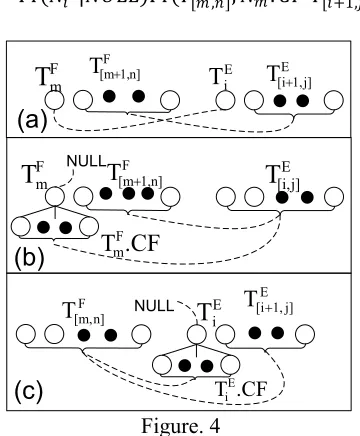
(4) If 𝑇𝑚𝐹 is aligned with 𝑇
𝑖𝐸, and 𝑇[𝑚+1,𝑛]𝐹 is aligned with 𝑇[𝑖+1,𝑗𝐸 ] (as is shown in Fig. 4a), then
Pr.𝑇[𝑚𝐹 ,𝑛],𝑇 [𝑖,𝑗𝐸 ]/𝐴0 = Pr(𝑇𝑚𝐹,𝑇
𝑖𝐸|𝐴)Pr(𝑇[𝑚+1,𝑛]𝐹 ,𝑇[𝑖+1,𝑗𝐸 ]|𝐴) (5) If 𝑁𝑚𝐹 is deleted, and the forest rooted at 𝑁
𝑚𝐹’s children 𝑁𝑚𝐹.𝐶𝐹 is combined with 𝑇
[𝑚+1,𝑛]𝐹 for alignment with 𝑇[𝑖,𝑗𝐸 ], then
Pr.𝑇[𝑚𝐹 ,𝑛],𝑇[𝑖,𝑗𝐸 ]/𝐴0
= Pr(𝑁𝑚𝐹|𝑁𝑈𝐿𝐿)Pr(𝑁
𝑚𝐹.𝐶𝐹 𝑇[𝑚𝐹 +1,𝑛],𝑇[𝑖,𝑗𝐸 ]|𝐴) (6) If 𝑁𝑖𝐸 is deleted, and the forest rooted at 𝑁𝑖𝐸’s
children 𝑁𝑖𝐸.𝐶𝐹 is combined with 𝑇[𝑖,𝑗𝐸 ] for alignment with 𝑇[𝑚,𝑛]𝐹 , then
Pr.𝑇[𝑚,𝑛]𝐹 ,𝑇 [𝑖,𝑗𝐸 ]/𝐴0
= Pr(𝑁𝑖𝐸|𝑁𝑈𝐿𝐿)Pr(𝑇[𝑚𝐹 ,𝑛],𝑁𝑚𝐹.𝐶𝐹 𝑇
[𝑖+1,𝑗𝐸 ]|𝐴)
(a)
E j] 1, [i T E iΤ
F n] 1, [m T F mΤ
(b)
E j] [i,T
F n] 1, [mT
F mΤ
.CF
T
F m(c)
E iΤ
F n] [m,T T[iE1,j]
.CF TE i NULL NULL Figure. 4
Finally, the node pair probability is modeled as Pr(𝑁𝑚𝐹,𝑁𝑖𝐸)= Pr(𝑁𝑚𝐹.𝑡,𝑁𝑖𝐸.𝑡)Pr(𝑁𝑚𝐹.𝑙,𝑁𝑖𝐸.𝑙) ,
where Pr(𝑁𝑚𝐹.𝑡,𝑁
𝑖𝐸.𝑡) is the generative probability of the translationally equivalent text chunks in 𝑁𝑚𝐹 and 𝑁
𝑖𝐸, and Pr(𝑁𝑚𝐹.𝑙,𝑁𝑖𝐸.𝑙) is their HTML tag pair probability. The text chunk generative probability Pr(𝑁𝑚𝐹.𝑡,𝑁
𝑖𝐸.𝑡) can be modeled in a variety of ways. The conventional length-based, lexicon-based or hybrid methods used for sentence alignment can be applied here. In the next
sub-section, we focus on how to estimate the tag pair probability Pr(𝑁𝑚𝐹.𝑙,𝑁𝑖𝐸.𝑙) from a set of parallel web pages. We expect pairs of the same or similar HTML tags to have high probabilities and the probabilities for pairs of disparate tags to be low.
3.2 Parameter Estimation Using Expec tation-Maximization
One way to estimate the tag pair generative proba-bility Pr(𝑙,𝑙′) is to manually align nodes between parallel trees, and use the manually aligned trees as the training data for maximum likelihood estima-tion. However, this is a time-consuming and error-prone procedure. Instead, the Expectation Maximi-zation (EM) (Dempster, Laird and Rubin 1977) algorithm is used to estimate the parameters Pr(𝑙,𝑙′) on 5615 manually verified parallel web page pairs from 45 different bilingual web sites. The parameter estimation proceeds as follows:
1. Start with initial parameter values.
2. Expectation: estimate count:::::::(𝑙,𝑙′) which is the expectation of aligning tag l with
l
'
. 3. Maximization: update the parameters basedto maximum likelihood estimation
' ' ' ' , , , Pr l l l count l l count ll and
' ] , , [ , , ) Pr( ' ' l NULL l count l NULL count NULL l count l NULL count NULL l4. Repeat step 2 and 3 until the parameters stabilize
In step 2, count:::::::(𝑙,𝑙′) is the expected count of
l
being aligned withl
' in the training corpus. By definition, count:::::::(𝑙,𝑙′) is calculated ascount
:::::::(𝑙,𝑙′)=;Pr(𝐴|𝑇𝐹 𝐴
,𝑇𝐸)count(𝑙,𝑙′) where count(𝑙,𝑙′) is the number of occurrence of l being aligned with l’ in the tree alignment A.
To efficiently compute count:::::::(𝑙,𝑙′) without
enumerating the exponential number of A’s in the above equation, we extended the inside-outside algorithm presented in (Lari and Young, 1990). The inside probability 𝛼(𝑁𝑗𝐹,𝑁
[image:5.612.91.271.352.570.2]probability of generating sub-tree pair {𝑇𝑗𝐹,𝑇𝑖𝐸} when 𝑁𝑖𝐸 is aligned with 𝑁𝑗𝐹. It is estimated as:
N
N
N
N
N
CF
N
ECF
i F m E i F m E i F
m, Pr ,
. , .
where 𝛼(𝑁𝑚𝐹.𝐶𝐹,𝑁
𝑖𝐸.𝐶𝐹) is the inside probability for the forest pair (𝑁𝑚𝐹.𝐶𝐹,𝑁
𝑖𝐸.𝐶𝐹)
A E i F m E i Fm C F N C F N C F N C F A
N . , . Pr . , .
.
The inside probability can be estimated recursively according to the various alignment configurations presented in Figure 3 and Figure 4. The outside probability 𝛽(𝑁𝑗𝐹,𝑁𝑖𝐸) is defined as the probability of generating the part of 𝑇𝐸and 𝑇𝐹 excluding the sub-trees 𝑇𝑗𝐹and 𝑇𝑖𝐸, when 𝑁𝑖𝐸 is aligned with 𝑁𝑗𝐹. It is estimated as:
qk k p
E k i F k m E i E p i F m F q m E i E p i F m F q m q p E p i F q m E i F m NULL a NULL a N RC F a N RC F a N LC F a N LC F a a a N N ] ) | Pr( ) | Pr( . , . . , . , [ , , , , , , , , , ,
where 𝑎𝑚,𝑞𝐹 is the qth ancestor of 𝑁
𝑚𝐹, and 𝑎𝑖,𝑞𝐸 is the pth ancestor of 𝑁
𝑖𝐸. 𝑎𝑚𝐹,𝑘(𝑘<𝑞) is an ancestor of 𝑁𝑚𝐹 and a decedent of 𝑎
𝑚,𝑞
𝐹 . Similarly 𝑎 𝑖,𝑘𝐸 (𝑘<
𝑝 is an ancestor of 𝑁𝑖𝐸, and a decedent of 𝑎𝑖,𝑝𝐸.
a.LC F(N) is the forest rooted at aand to the left of
N, and a.RC F(N). a.RC F(N) is the forest rooted as
a and to the right of N. Once inside and outside probabilities are computed, the expected counts can be calculated as
E F F m E i T T l l N l lN F E
E i F m E i F m T T N N N N l l count , . . '
' Pr( , )
, ,
,
where Pr(𝑇𝐹,𝑇𝐸) is the generative probability of the tree pair {𝑇𝐹,𝑇𝐸} over all possible alignment configurations. Pr(𝑇𝐹,𝑇𝐸) can be estimated using dynamic programming techniques that will be pre-sented in the next sub-section. Furthermore, the expected count of tag deletion is estimated as:
count
:::::::(𝑙,𝑁𝑈𝐿𝐿)=;count(𝑙,𝑙′)
𝑖
− ; count:::::::(𝑙,𝑙′) 𝑖≠𝑁𝑈𝐿𝐿
count
:::::::(𝑁𝑈𝐿𝐿,𝑙)=;count(𝑙′,𝑙)
𝑖
− ; count:::::::(𝑙′,𝑙) 𝑖≠𝑁𝑈𝐿𝐿
3.3 Dynamic Programming for Decoding An intuitive way to find the optimal tree alignment is to enumerate all alignments and pick the one with the highest probability. But it is intractable since the total number of alignments is exponential. Based on the observation that if two trees are op-timally aligned, the alignment of their sub-trees must also be optimal, dynamic programming can be applied to find the optimal tree alignment using that of the sub-trees in a bottom-up manner. That is we first compute the optimal alignment probabili-ties of small trees and use them to compute that of the bigger tree by trying different alignment confi-gurations. This procedure is recursive until the op-timal alignment probability of the whole tree is obtained. The following is the pseudo-code of the bottom-up decoding algorithm:
where |𝑇𝐹| and |𝑇𝐸| are the number of nodes in
𝑇𝐹and 𝑇𝐸. The decoding algorithm finds the op-timal alignment and its probability for every sub-trees and forests. By replacing the selection opera-tion with summing probabilities of all configura-tions, the sub-tree pair generative probability Pr(𝑇𝐹,𝑇𝐸) can be calculated along the way. The worst-case time complexity of the algorithm is 𝑂(|𝑇𝐹||𝑇𝐸|.𝑑𝑒𝑔𝑟(𝑇𝐹)+𝑑𝑒𝑔𝑟(𝑇𝐸)02) , where the degree of a tree is defined as the largest degree of its nodes.
4
Se
ntence Alignment with T r
ee
Align-ment Mod
el
Since the tree alignment model aligns parallel web pages at the tree node level instead of the sentence level, we integrate the tree alignment model with the sentence alignment model in a cascaded mode, in which the whole sentence alignment process is divided into two steps. In the first step, the tree alignment decoder finds the optimal alignment of the two trees. Nodes having texts should be aligned with nodes containing their translations. Then in the second step, the conventional sentence aligner is used to align sentences within text chunks in the
for i=|𝑇𝐸| to 1 (bottom-up) {
for j=|𝑇𝐹| to 1 (bottom-up) {
Select and store optimal alignments of their children fo-rests 𝑇𝑚𝐹. CF and 𝑇𝑖𝐸. CFby testing configurations 4-6; Select and store the optimal alignment of the sub-tree pair 𝑇𝑚𝐹 and 𝑇𝑖𝐸 by testing configurations 1-3;
aligned nodes. In this step, various sentence align-ment models can be applied, including the length-based model, the lexicon-length-based model and the hy-brid model. Language or corpus specific informa-tion may also be used to further improve sentence alignment accuracy. The tree alignment acts as constraints that confine the scope of the search of sentence aligners.
5
Evaluation
To evaluate the effectiveness of exploiting web page document structure with the tree alignment model for improving sentence alignment accuracy, we compared the performance of three types of sentence alignment methods on parallel web pages.
The first type is to simply discard web page layout information. Web pages are converted to plain texts, and HTML tags are removed prior to performing sentence alignment. The second type is the baseline method of using web page document information. Instead of exploiting full HTML doc-ument structure, it follows Chen’s approach (Chen and Nie 2000) which uses HTML tags in the same way as cognates used in (Simard et al. 1992). The third type is the combination of tree alignment model and conventional sentence models.
Each type of the web page sentence aligner makes use of three conventional sentence align-ment models, one is the length based model fol-lowing (Brown 1991), one is the lexicon based model following (Chen 1993), and the other one is the hybrid model presented in (Zhao 2002). To be fair in performance comparisons, the text genera-tive probability Pr(𝑁𝐹.𝑡,𝑁𝐸.𝑡) in tree node alignment is modeled in accordance with that in the sentence alignment model. All these sentence aligners are implemented to handle sentence bead types of “1-0”, “0-1”,“1-1”, “1-2”,”1-3”,”2-1” and “3-1”.
The test corpus is 150 parallel web page pairs randomly drawn from 20 Chinese-English bilin-gual web sites on topics related to politics, sports,
computer and literature. By manual annotation, 9,824 parallel sentence pairs are found. All sen-tence aligners run through the test parallel web pages, and each extracts a set of sentence pairs that it regards as parallel. The output pairs are matched with the annotated parallel sentences from the test corpus. Only exact matches of the sentence pairs are counted as correct.
Our evaluation metrics are precision (P), recall (R) and F-measure (F) defined as:
pairs output total
of #
pairs sentence aligned
correctly of
# P
pairs parallel true
of #
pairs sentence aligned
correctly of
# R
R
P
R
*
P
*
2
F
Based on the results in table 1, we can see that both Type 2 and Type 3 aligners outperform con-ventional sentence alignment models. Leveraging HTML document information can enhance sen-tence alignment quality. Especially, by using the tree alignment model, Type 3 aligners achieve a
significant increase of around 7% on both preci-sion and recall. Compared with the tree alignment model, the improvement by the Type 2 aligners is marginal. A reason for this is that the tree align-ment model not only exploits HTML tag similari-ties as in the Type 2 method, but also takes into account location of texts. In the tree alignment model, texts at similar locations in the tree hierar-chical structure are more probable to be transla-tions than those in disparate locatransla-tions, even though they all have the same tag.
We also evaluate the performance of the tree aligner. Since sentence alignment is performed within the text chunks of aligned nodes, tree alignment accuracy is very important for correct sentence alignment. We measure the alignment
Length Lexicon Hybrid
P R F P R F P R F
[image:7.612.83.521.414.493.2]Type I 85.6% 72.8% 78.7% 83.1% 75.2% 78.9% 87.3% 76.4% 81.5% Type II 86.3% 74.8% 80.1% 85.7% 77.0% 81.1% 88.1% 78.6% 83.1% Type III 93.2% 79.3% 85.7% 92.9% 80.4% 86.2% 94.3% 83.1% 88.3%
accuracy on all nodes as well as that specifically on text nodes on the test corpus. The evaluation result is shown in table 2.
Benchmarks in Table 2 show that the tree alignment model yields very reliable results with high accuracy in aligning both text nodes and non-text nodes. After an analysis on non-text node align-ment errors, we find that 79.7% of them have texts of very short length (no more than 4 words), which may not contain sufficient information to be identi-fied as parallel.
6
Conclu
s
ion
s
In this paper, we present a new approach to sen-tence alignment on parallel web pages. Due to the diversity and noisy nature of web corpora, a sto-chastic tree alignment model is employed to ex-ploit document structure in parallel web pages as useful information for identifying parallel sen-tences. The tree alignment model can be combined with various conventional sentence alignment models to extract parallel sentences from parallel web pages. Experimental results show that exploit-ing structural parallelism inherent in parallel web pages provides superior alignment performance over conventional sentence alignment methods and significant improvement (around 7% in both preci-sion and recall) is achieved by using the stochastic tree alignment model. With improved sentence alignment performance, web parallel data mining systems are able to acquire parallel sentences of higher quality and quantity from the web.
R
eference
s
:
Brown, P. F., J. C. Lai and R. L. Mercer. 1991. Aligning Sentences in Parallel Corpora. Proceedings of ACL 1991.
Brown, P. E., S. A. D. Pietra, V. J. D. Pietra, and R. L. Mercer. 1993. The Mathematics of Statistical
Ma-chine Translation: Parameter Estimation, Computa-tional Linguistics V19(2), 1993
Chen Jisong., Chau R. and C.-H. Yeh. 2004. Discove r-ing Parallel Textfrom the World Wide Web, Proceed-ings of the second workshop on Australasian
Infor-mation Security, Data Mining and Web Intelligence, and Software Internationalization.
Chen Jiang and Nie Jianyun. 2000. Automaticconstruc -tion of parallel English-Chinese corpus for cross -language information retrieval. Proceedings of the sixth conference on applied natural language processing
Chen Stanley. 1993. Aligning Sentences in Bilingual Corpora Using Lexical Information. Proceedings of ACL 1993
Chuang T.C. and Yeh.K.C. 2005. Aligning Parallel Bi-lingual Corpora Statistically with Punctuation Crite -ria. Computational Linguistics and Chinese Lan-guage Processing. Vol. 10, 2005, pp. 95-122
Dempster, A., Laird, N., and Rubin, D. 1977. Maximum likelihood from incomplete data via the EM algo-rithm. Journal of the Royal Statistical Society, Series B, 39(1):1–38.
Gale W. A. and K. Church. 1993. A Program for Align-ing Sentences in Parallel Corpora, Computational Linguistics, 19(1):75—102
Gildea. D. 2003. Loosely Tree-Based Alignment for Machine Translation.In Proceedings of ACL 2003 Kay Martin and Roscheisen Martin 1993. Text Trans
la-tion Alignment. Computational Linguistics 19(1):121--142.
Lari K. and S. J. Young. 1990. The estimation of st
o-chastic context free grammars using the Inside -Outside algorithm, Computer Speech and Language, 4:35—56
Ma, Xiaoyi and M. Liberman. 1999. Bits: A Method for Bilingual Text Search over the Web. Proceedings of Machine Translation Summit VII.
Melamed. I. Dan. 1996. A Geometric Approach to Mapping Bitext Correspondence. Proceedings of EMNLP 96
Moore Robert. C. 2002. Fast and Accurate Sentence
Alignment of Bilingual Corpora. Proceedings of 5th Conference of the Association for Machine Transla-tion in the Americas, pp. 135-244
Resnik, P. and N.A. Smith. 2003. The Web as a Parallel Corpus.Computational Linguistics, 29(3)
Simard, M. and Plamondon, P. 1996 Bilingual Sentence
Alignment: Balancing Robustness and Accuracy.
Proceedings of AMTA-96, Canada.
Simard, M., Foster, G. and Isabelle, P. 1992, Using Cognates to Align Sentences in Bilingual Corpora.
Proceedings of the Fourth International Conference total correct accuracy
all node alignment 18492 17966 97.2% text node alignment 3646 3577 98.1%
on Theoretical and Methodological Issues in Ma-chine translation (TMI92)
Singh, A. K. and Husain, S. (2005). Comparison,selec -tion and use of sentence alignment algorithms for new language pairs. Proceedings of the ACL Work-shop on Building and Using Parallel Texts.
Wu. Dekai. 1994. Aligning a parallel English-Chinese corpusstatistically with lexical criterias. Proceedings of ACL 1994.
Wu. Dekai. “Stochastic Inversion Transduction Gram-mar and Bilingual Parsing of Parallel Corpora”
Computational Linguistics, 23(3):374(1997)
Yamada H. and Knight K. 2001 A Syntax based statis -tical translation model. In Proceedings of ACL-01 Yang C. C., and Li K. W., Mining English/Chinese
Pa-rallel Documents from the World Wide Web, Pro-ceedings of the International World Wide Web Con-ference, Honolulu, Hawaii, 2002.