Discriminative Induction of Sub-Tree Alignment
using Limited Labeled Data
Jun Sun
1,2Min Zhang
1Chew Lim Tan
2 1Institute for Infocomm Research
2School of Computing, National University of Singapore
[email protected] [email protected] [email protected]
Abstract
We employ Maximum Entropy model to con-duct sub-tree alignment between bilingual phrasal structure trees. Various lexical and structural knowledge is explored to measure the syntactic similarity across Chinese-English bi-lingual tree pairs. In the experiment, we evalu-ate the sub-tree alignment using both gold standard tree bank and the automatically parsed corpus with manually annotated sub-tree align-ment. Compared with a heuristic similarity based method, the proposed method significant-ly improves the performance with onsignificant-ly limited sub-tree aligned data. To examine its effective-ness for multilingual applications, we further at-tempt different approaches to apply the sub-tree alignment in both phrase and syntax based SMT systems. We then compare the performance with that of the widely used word alignment. Experimental results on benchmark data show that sub-tree alignment benefits both systems by relaxing the constraint of the word alignment.
1
Introduction
Recent research in Statistical Machine Translation (SMT) tends to incorporate more linguistically grammatical information into the translation mod-el known as linguistically motivated syntax-based models. To develop such models, the phrasal structure parse tree is usually adopted as the repre-sentation of bilingual sentence pairs either on the source side (Huang et al., 2006; Liu et al., 2006) or on the target side (Galley et al., 2006; Marcu et al., 2006), or even on both sides (Graehl and Knight, 2004; Zhang et al., 2007). Most of the above models either construct a pipeline to trans-form from/to tree structure, or synchronously gen-erate two trees in parallel (i.e., synchronous pars-ing). Both cases require syntactically rich transla-tional equivalences to handle non-local reordering. However, most current works obtain the syntactic translational equivalences by initially conducting alignment on the word level. To employ word
alignment as a hard constraint for rule extraction has difficulty in capturing such non-local phenom-ena and will fully propagate the word alignment error to the later stage of rule extraction.
Alternatively, some initial attempts have been made to directly conduct syntactic structure alignment. As mentioned in Tinsley et al. (2007), the early work usually constructs the structure alignment by hand, which is time-consuming. Re-cent research tries to automatically align the bilin-gual syntactic sub-trees. However, most of these works suffer from the following problems. Firstly, the alignment is conducted based on heuristic rules, which may lose extensibility and generality in spite of accommodating some common cases (Groves et al., 2004). Secondly, various similarity computation methods are used based merely on lexical translation probabilities (Tinsley et al., 2007; Imamura, 2001) regardless of structural fea-tures. We believe the structure information is an important issue to capture the non-local structural divergence of languages by modeling beyond the plain text.
To address the above issues, we present a statis-tical framework based on Maximum Entropy (MaxEnt) model. Specifically, we consider sub-tree alignment as a binary classification problem and use Maximum Entropy model to classify each instance as aligned or unaligned. Then, we per-form a greedy search within the reduced search space to conduct sub-tree alignment links based on the alignment probabilities obtained from the clas-sifier.
Unlike the previous approaches that can only measure the structural divergence via lexical fea-tures, our approach can incorporate both lexical and structural features. Additionally, instead of explicitly describing the instances of sub-tree pairs as factorized sub-structures, we frame most of our features as score based feature functions, which helps solve the problem using limited sub-tree alignment annotated data. To train the model and evaluate the alignment performance, we adopt
HIT Chinese-English parallel tree bank for gold standard evaluation. To explore its effectiveness in SMT systems, we also manually annotate sub-tree alignment on automatically parsed tree pairs and perform the noisy data evaluation. Experimental results show that by only using limited sub-tree aligned data of both corpora, the proposed ap-proach significantly outperforms the baseline method (Tinsley et al., 2007). The proposed fea-tures are very effective in modeling the bilingual structural similarity. We further apply the sub-tree alignment to relax the constraint of word align-ment for both phrase and syntax based SMT sys-tems and gain an improvement in BLEU.
2
Problem definition
A tree alignment process pairs up the sub-trees across bilingual parse sub-trees, whose lexical leaf nodes covered are translational equivalent, i.e., sharing the same semantics. Grammatically, the task conducts links between syntactic constituents with the maximum tree structures generated over their word sequences in bilingual tree pairs.
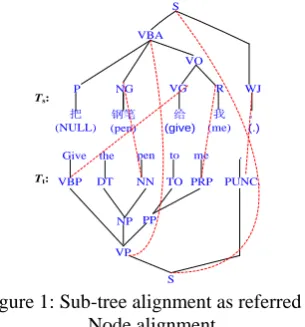
In general, sub-tree alignment can also be inter-preted as conducting multiple links across internal nodes between sentence-aligned tree pairs as shown in Fig. 1. The aligned sub-tree pairs usually maintain a non-isomorphic relation with each oth-er especially for highoth-er layoth-ers. We adapt the same criteria as Tinsley et al. (2007) in our study:
(i) a node can only be linked once;
(ii) descendants of a source linked node may only link to descendants of its target linked counterpart;
(iii) ancestors of a source linked node may on-ly link to ancestors of its target linked counterpart.
where the term “node” refers to root of a sub-tree, which can be used to represent the sub-tree.
3
Model
We solve the problem as binary classification and employ MaxEnt model with a greedy search.
Given a bilingual tree pair and
,
{ } is the source tree consisting of sub-trees,where is also the number of nodes in the source tree { } is the tar-get tree consisting of sub-trees, where is also the number of nodes in the target tree .
For each sub-tree pair in the given bilin-gual parse trees , the sub-tree alignment probability is given by:
( | ) ∑ [∑ [∑ ( )]
( )]
(1)
where
{ ( )
(2)
Feature functions are defined in a quadruple
( ). is an additional variable to incorpo-rate new dependencies other than the sub-tree pairs. For each feature function ( ), a weight is applied to tailor the distribution.
After classifying the candidate sub-tree pairs as
aligned or unaligned, we perform a greedy search within the reduced search space to conduct sure
links based on the conditional probability
( | ) obtained from the classifier. The alignment probability is independently normalized for each sub-tree pair and hence suitable as a searching metric.
The greedy search algorithm can be described as an automaton. A state in the search space is a partial alignment with respect to the given bilin-gual tree pair. A transition is to add one more link of node pairs to the current state. The initial state has no link. The terminal state is a state where no more links can be added according to the defini-tion in Secdefini-tion 2. We use greedy search to gener-ate the best-links at the early stage. There are cas-es that the correctly-aligned tree pairs have very few links, while we have a bunch of candidates with lower alignment probabilities. However, the sum of the lower probabilities is larger than that of the correct links’, since the number of correct links is much fewer. This makes the alignment results biased to be with more links. The greedy search helps avoid this asymmetric problem.
4
Feature Functions
In this section, we introduce a variety of feature functions to capture the semantically equivalent
S VBA
把
(NULL)
我
(me)
给 (give) 钢笔
(pen)
。 (.)
P NG VG R WJ
VO
Give the pen to me . VBP DT NN TO PRP PUNC.
NP PP
VP S Ts:
[image:2.595.96.249.68.232.2]Tt:
counterparts and structural divergence across lan-guages. For the semantic equivalence, we define lexical and word alignment feature functions. Since those feature functions are directional, we describe most of these functions as conditional feature functions based on the conditional lexical probabilities. We also introduce the tree structural features to deal with the structural divergence of bilingual parse trees. Inspired by Burkett and Klein (2008), we introduce the feature functions in an internal-external manner based on the fact that the feature scores for an aligned sub-tree pair tend to be high inside both sub-trees, while they tend to be low inside one sub-tree and outside the other.
4.1 Internal Lexical Features
We use this feature to measure the degree of se-mantic equivalence of the sub-tree pair. According to the definition of sub-tree alignment in Section 2, the word sequence covered by the sub-tree pair should be translational equivalence. Therefore, the lexicons within the two corresponding sub-spans should be highly related in semantics. We define the internal lexical features as follows:
( | ) (∏ ∑ ) ( )
( | ) (∏ ∑ ) ( )
where refers to the lexical translation probability from the source word to the target word within the sub-tree spans, while refers to that from target to source; refers to the word set for the internal span of the source sub-tree , while ( ) refers to that of the target sub-tree .
4.2 Internal-External Lexical Features
Intuitively, lexical translation probabilities tend to be high within the translational equivalence, while low within the non-equivalent counterparts. Ac-cording to this, we define the internal-external lex-ical feature functions as follows:
( | ) ∑ ( ) ( ){( )}
| ( )|
( | ) ∑ ( ) ( ){( ) }
where refers to the word set for the ex-ternal span of the source sub-tree , while refers to that of the target sub-tree . We choose a representation different from the internal lexical feature scores, since for cases with small inner
span and large outer span, the sum of internal-external scores may be overestimated. As a result, we change the sum operation into max, which is easy to be normalized.
4.3 Internal Word Alignment Features
Although the word alignment information within bilingual sentence pairs is to some extent not reli-able, the links of word alignment account much for the co-occurrence of the aligned terms. We define the internal word alignment features as fol-lows:
( ) ∑ ( )∑ ( ) ( )
( | ( )|)
where
{
The binary function is introduced to trigger the computation only when a word aligned link exists for the two words within the sub-tree span.
4.4 Internal-External Word Alignment Fea-tures
Similar to lexical features, we also introduce in-ternal-external word alignment features as follows:
( ) ∑ ( )∑ ( ) ( | ( )|)
( ) ∑ ( )∑ ( ) ( | ( )|)
where
{
4.5 Tree Structural Features
In addition to the lexical correspondence, we also capture the structural divergence by introducing the tree structural features as follows:
Span difference: Translational equivalent sub-tree pairs tend to share similar length of spans. Thus the model will penalize the candidate sub-tree pairs with largely different length of spans.
( ) |
( ) |
Number of Descendants: Similarly, the num-ber of the root’s descendants of the aligned sub-trees should also correspond.
( ) |
where refers to the descendant set of the root to an individual sub-tree.
Tree Depth difference: Intuitively, translation-al equivtranslation-alent sub-tree pairs tend to have similar depth from the root node of the parse tree. We can further allow the model to penalize the candidate sub-tree pairs with different distance from the root node.
( ) | ( ) ( ( ))|
4.6 Binary Grammatical Features
In the previous sections, we design some score based feature functions to describe syntactic tree structural similarities, rather than directly using the substructures. This is because for limited anno-tated tree alignment data, features like tokens and grammar rules are rather sparse. In spite of this, we still have a closed set of grammatical tags which can be covered by a small amount of data. Therefore, we use the combination of root gram-mar tags of the sub-tree pairs as binary features.
5
Training
We train the sub-tree alignment model in two steps:
Firstly, we learn the various feature functions. On one hand, GIZA++ is offline trained on a large amount of bilingual sentences to compute the lexi-cal and word alignment features. On the other hand, the tree structural features, similar to word and phrase penalty features in phrase based SMT models, are computed online for both training and testing.
Secondly, we train the MaxEnt model in Eq. 1, using the training corpus which consists of the bilingual parse tree pairs with manually annotated sub-tree alignment. We apply the widely used GIS (Generalized Iterative Scaling) algorithm (Darroch and Ratcliff, 1972) to optimize . In practice, we modify Och’s implementation YASMET.
Since we consider each sub-tree pair as an indi-vidual instance, it is easy to see that the negative samples heavily overwhelm the positive ones. For GIS training, such a skewed distribution easily drives the parameters to facilitate the negative in-stances. We address this problem by giving more weight to the positive training instances.
6
Experiments on Sub-Tree Alignments
We utilize two different corpora to evaluate the proposed sub-tree alignment method and its capa-bility to plug in the related applications
respective-ly. One is HIT English Chinese parallel tree bank with both tree structure and sub-tree alignment manually annotated. The other is the automatically parsed bilingual tree pairs (allowing minor parsing errors) with manually annotated sub-tree align-ment. The latter benefits MT task, since most lin-guistically motivated syntax SMT systems require a held-out automatic parser to achieve rule induc-tion.
6.1 Data preparation
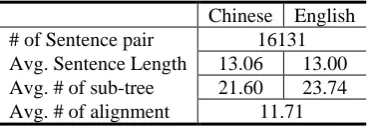
For the gold standard corpus based experiment, we use HIT 1 Chinese-English parallel tree bank, which is collected from English learning text books in China as well as example sentences in dictionaries. It consists of 16131 gold standard parse tree pairs with manually annotated sub-tree alignments. The annotation strictly preserves the semantic equivalence, i.e., it only conducts sure
links in the internal node level, while ignoring
possible links adopted in word alignment. In con-trast, in the POS level, n-to-n links are allowed in annotation. In order to be consistent with the defi-nition in Section 2, we delete those n-to-n links in POS level. The word segmentation, tokenization and parse-tree in the corpus are manually con-structed or checked. The Chinese parse tree in HIT tree bank adopts a different annotation criterion from the Penn TreeBank annotation, which is de-signed by the HIT research team. The new criteri-on can better facilitate the descripticriteri-on of some rare structural phenomena in Chinese. The English parse tree still uses Penn TreeBank annotation. The statistics of HIT corpus is shown in Table 1.
Chinese English
# of Sentence pair 16131
Avg. Sentence Length 13.06 13.00
Avg. # of sub-tree 21.60 23.74
[image:4.595.327.511.505.569.2]Avg. # of alignment 11.71
Table 1. Statistics for HIT gold standard Tree bank
Since the induction of sub-tree alignment is de-signed to benefit the machine translation modeling, it is preferable to conduct the sub-tree alignment experiment on the corpus for MT evaluation. However, most syntax based SMT systems use an automatic parser to facilitate training and decoding, which introduces parsing errors. Additionally, the gold standard HIT corpus is not applicable for MT
1
HIT corpus is designed and constructed by HIT mitlab.
experiment due to problems of domain divergence, annotation discrepancy (Chinese parse tree adopts a different grammar from Penn Treebank annota-tions) and degree of tolerance for parsing errors.
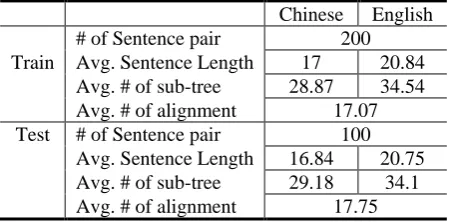
Due to the above issues, we annotate a new data set to apply the sub-tree alignment in machine translation. We randomly select 300 bilingual sen-tence pairs from the Chinese-English FBIS corpus with the length in both the source and target sides. The selected plain sentence pairs are further parsed by Stanford parser (Klein and Manning, 2003) on both the English and Chinese sides. We manually annotate the sub-tree alignment for the automatically parsed tree pairs according to the definition in Section 2. To be fully consistent with the definition, we strictly preserve the semantic equivalence for the aligned sub-trees to keep a high precision. In other words, we do not conduct any doubtful links. The corpus is further divided into 200 aligned tree pairs for training and 100 for testing. Some initial statistic of the automatically parsed corpus is shown in Table 2.
6.2 Baseline approach
We implement the work in Tinsley et al. (2007) as our baseline methodology.
Given a tree pair , the baseline ap-proach first takes all the links between the sub-tree pairs as alignment hypotheses, i.e., the Cartesian product of the two sub-tree sets:
{ } { }
By using the lexical translation probabilities, each hypothesis is assigned an alignment score. All hypotheses with zero score are pruned out. Then the algorithm iteratively selects the link of the sub-tree pairs with the maximum score as a
sure link, and blocks all hypotheses that contradict with this link and itself, until no non-blocked hy-potheses remain.
The baseline system uses many heuristics in searching the optimal solutions with alternative score functions. Heuristic skip1 skips the tied
hy-potheses with the same score, until it finds the highest-scoring hypothesis with no competitors of the same score. Heuristic skip2 deals with the same problem. Initially, it skips over the tied hy-potheses. When a hypothesis sub-tree pair without any competitor of the same score is found, where neither nor has been skipped over, the hypothesis is chosen as a sure link. Heuristic
span1 postpones the selection of the hypotheses on the POS level. Since the highest-scoring hy-potheses tend to appear on the leaf nodes, it may introduce ambiguity when conducting the align-ment for a POS node whose child word appears twice in a sentence.
The baseline method proposes two score func-tions based on the lexical translation probability. They also compute the score function by splitting the tree into the internal and external components.
Tinsley et al. (2007) adopt the lexical transla-tion probabilities dumped by GIZA++ (Och and Ney, 2003) to compute the span based scores for each pair of sub-trees. Although all of their heuris-tics combinations are re-implemented in our study, we only present the best result among them with the highest Recall and F-value as our baseline, denoted as skip2_s1_span12.
6.3 Experimental settings
To examine the effectiveness of the proposed features, we
(1) learn the word alignment using the combina-tion of the 14k of HIT tree bank and FBIS (240k) corpus for both our approach and the baseline method, and divide the remaining HIT corpus as 1k for training and 1k for testing.
(2) learn the word alignment on the entire FBIS training corpus (240k) for both our approach and the baseline method. We then train and test on FBIS corpus of 200 and 100 respectively as stated in Table 2.
In our task, annotating large amount of sub-tree alignment corpus is time consuming and more dif-ficult compared with the tasks like sequence label-ing. One of the important issues we are concerned about is whether we can achieve an acceptable performance with limited training data. We
(3) adopt the entire FBIS data (240k) to learn the word alignment and various amount of HIT gold standard corpus to train the MaxEnt model. Then we test the alignment performance on the same HIT test set (1k) as (1).
2
s1 denotes score function 1 in Tinsley et al. (2007)
Chinese English
# of Sentence pair 200
Train Avg. Sentence Length 17 20.84
Avg. # of sub-tree 28.87 34.54
Avg. # of alignment 17.07
Test # of Sentence pair 100
Avg. Sentence Length 16.84 20.75
Avg. # of sub-tree 29.18 34.1
[image:5.595.66.291.349.460.2]Avg. # of alignment 17.75
We further test the robustness of our method under different amount of data to learn the lexical and word alignment feature functions. We gradu-ally change the amount of FBIS corpus to train the word alignment. Then we
(4) use the same training (1k) and testing data (1k) with (1);
(5) use FBIS corpus 200 to train MaxEnt model and 100 for testing similar to (2).
6.4 Experimental results
We use Precision, Recall and F-score to measure the alignment performance and obtain the results as follows:
In Table 3 and 4 for Exp(1) and (2) respectively, we show that by incrementally adding new fea-tures in a certain order, the F-value consistently increases and both outperform the baseline method. From both tables, we find that the Binary fea-tures, with the combination of root grammar tags of the sub-tree pairs, significantly improve the alignment performance. We also try the different combinations of the parent, child or even siblings to the root nodes. However, all these derivative configurations decrease the performance. We at-tribute the ineffectiveness to data sparseness. Fur-ther exploration suggests that the binary feature in HIT gold standard corpus exhibits a substantially larger improvement against other features than FBIS corpus (Table 3 against Table 4). The reason could be that the grammar tags in the gold stand-ard corpus are accurate, while FBIS corpus suffers from parsing errors. Apart from that, the lexi-cal/word-alignment features in Table 3 do not per-form well, since the word alignment is trained mainly on the cross domain FBIS corpus. This is also an important reason why there is a large gap in performance between Table 3 and 4, where the automatic parsed FBIS corpus performs better than HIT gold standard tree bank in all configura-tions as well as the baseline.
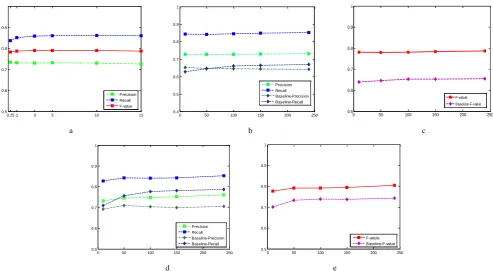
In Fig. 2(a) for Exp (3), we examine perfor-mance under different amount of training data from 1k to 15k. The results change very little with over the amount of 1k. Even with only 0.25k train-ing data, we are able to gain a result close to the best performance. This suggests that by utilizing only a small amount of sub-tree aligned corpus, we can still achieve a satisfactory alignment result. The benefits come from the usage of the score based feature functions by avoiding using sub-structures as binary features, which suffers from the data sparseness problem.
In Fig. 2(b-e) for Exp (4&5), we find that in-creasing the amount of corpus to train GIZA++ does not improve much for the proposed method on both HIT gold standard corpus (Fig. 2: b, c) and the automatic parsed data (Fig. 2: d, e). This is due to the various kinds of features utilized by the MaxEnt model, which does not bet on the lexical and word alignment feature too much. As for the baseline method, we can only detect a relatively large improvement in the initial increment of cor-pus, while later additions do not help. This result suggests that the baseline method is relatively less extensible since it works completely on the lexical similarities which can be only learned from the word alignment corpus.
7
Experiments on Machine Translation
In addition to the alignment evaluation, we con-duct MT evaluation as well. We explore the effec-tiveness of sub-tree alignment for both phrase and linguistically motivated syntax based systems.
7.1 Experimental configuration
In the experiments, we train the translation model on FBIS corpus (7.2M (Chinese) + 9.2M (English) words in 240,000 sentence pairs) and train a 4-gram language model on the Xinhua portion of the English Gigaword corpus (181M words) using the SRILM Toolkits (Stolcke, 2002). We use these
Features Precision Recall F-value
In Lexical 50.96 48.11 49.49
+ InOut Lexical 55.26 53.84 54.54
+ In word align 56.16 60.59 58.29
+ InOut word align 55.80 62.25 58.85
+ Tree Structure 57.64 63.11 60.25
+ Binary Feature 73.14 85.11 78.67
Baseline [Tinsley 2007] 64.14 66.99 65.53
Table 3. Sub-tree alignment of different feature combination for HIT gold standard test set
Features Precision Recall F-value
In Lexical 63.53 54.87 58.88
+ InOut Lexical 66.00 63.66 64.81
+ In word align 70.89 75.88 73.30
+ InOut word align 72.05 80.16 75.89
+ Tree Structure 72.03 80.95 76.23
+ Binary Feature 76.08 85.29 80.42
Baseline[Tinsley 2007] 70.48 78.70 74.36
sentences with less than 50 characters from the NIST MT-2002 test set as the development set (to speed up tuning for syntax based system) and the NIST MT-2005 test set as our test set. We use the Stanford parser (Klein and Manning, 2003) to parse bilingual sentences on the training set and Chinese sentences on the development and test set. The evaluation metric is case-sensitive BLEU-4.
For the phrase based system, we use Moses (Koehn et al, 2007) with its default settings. For the syntax based system, since sub-tree alignment can directly benefit Tree-2-Tree based systems, we apply the sub-tree alignment in an SMT system based on Synchronous Tree Substitution Grammar (STSG) (Zhang et al., 2007). The STSG based decoder uses a pair of elementary tree as a basic translation unit. Recent research on tree based sys-tems shows that relaxing the restriction from tree structure to tree sequence structure (Synchronous Tree Sequence Substitution Grammar: STSSG) significantly improves the translation performance (Zhang et al., 2008). We implement the STSG/STSSG based model in Pisces decoder with the same features and settings in Sun et al. (2009). The STSSG based decoder translates each span iteratively in a bottom up manner which guaran-tees that when translating a source span, any of its sub-spans has already been translated. The STSG
based experiment can be easily achieved by re-stricting the translation rule set in the STSSG de-coder to be elementary tree pairs only.
For the alignment setting of the baselines, we use the word alignment trained on the entire FBIS(240k) corpus by GIZA++ with heuristic grow-diag-final for Moses and the syntax systems and perform rule extraction constrained on the word alignment. As for the experiments adopting sub-tree alignment, we use the above word align-ment to learn lexical/word alignalign-ment features, and train the sub-tree alignment model with FBIS training data (200).
7.2 Experimental results
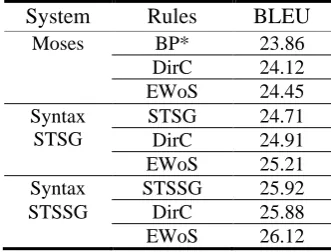
Utilizing the syntactic rules only has been argued to be ineffective (Koehn et al., 2003). Therefore, instead of using the sub-tree aligned rules only, we try to improve the word alignment constrained rule set by sub-tree alignment as shown in Table 5.
Firstly, we try to Directly Concatenate (DirC) the sub-tree alignment constraint rule set3 to the original syntax/phrase rule set based on word alignment. Then we re-train the MT model based
3
For syntax based system, it’s just the sub-tree pairs deducted from the sub-tree alignment; for phrase based system, it's the phrases with context equivalent to the aligned sub-tree pairs.
a b c
[image:7.595.53.547.61.332.2]d e
Figure 2: a. Precision/Recall/F-score for various amount of training data (k). b~e. Various amount of data to train word alignment
b. Precision/Recall for HIT test set. c. F-score for HIT test set. d. Precision/Recall for FBIS test set. e. F-score for FBIS test set.
0.25 1 3 5 10 15
0.5 0.6 0.7 0.8 0.9
Precision Recall F-value
0 50 100 150 200 250
0.4 0.5 0.6 0.7 0.8 0.9 1
Precision Recall Baseline-Precision Baseline-Recall
0 50 100 150 200 250
0.5 0.6 0.7 0.8 0.9 1
F-valule
Baseline-F-value
0 50 100 150 200 250
0.5 0.6 0.7 0.8 0.9 1
Precision Recall Baseline-Precision Baseline-Recall
0 50 100 150 200 250
0.5 0.6 0.7 0.8 0.9 1
on the obtained rule set. Tinsley et al. (2009) at-tempts different duplication of sub-tree alignment constraint rule set to append to the original phrase rule set and reports positive results. However, as shown in Table 5, we only achieve very minor improvement (in STSSG based model the score even drops) by direct introducing the new rules.
Secondly, we propose a new approach to utilize sub-tree alignment by modifying the rule extrac-tion process. We allow the bilingual phrases which are consistent with EitherWord alignment orS ub-tree alignment (EWoS) instead of to be consistent with word alignment only. The results in Table 5 show that EWoS achieves consistently better per-formance than the baseline and DirC method. We also find that sub-tree alignment benefits the STSSG based model less compared with other systems. This is probably due to the fact that the STSSG based system relies much on the tree se-quence rules.
To benefit intuitive understanding, we provide two alignment snippets in the MT training corpus in Fig. 3, where the red lines across the non-terminal nodes are the sub-tree aligned links con-ducted by our model, while the purple lines across the terminal nodes are the word alignment links trained by GIZA++. In the first example, the word
Israel is wrongly aligned to two “以色列”s by GIZA++, where the wrong link is denoted by the dash line. This is common, since in a compound sentence in English, the entities appeared more than once are often replaced by pronouns at its later appearances. Therefore, the syntactic rules constraint by NR1-NNP1, IP2-VP2 and PP3-VP3 respectively cannot be extracted for syntax sys-tems; while for phrase systems, context around the first “以色列” cannot be fully explored. In the
second example, the empty word “了” is wrongly aligned, which usually occurs in Chinese-English word alignment. As shown in Fig. 3, both cases can be resolved by sub-tree alignment conducted by our model, indicating that sub-tree alignment is a decent supplement to the word alignment rule set.
8
Conclusion
In this paper, we propose a framework for bilin-gual sub-tree alignment using Maximum Entropy model. We explore various lexical and structural features to improve the alignment performance. We also manually annotated the automatic parsed tree pairs for both alignment evaluation and MT experiment. Experimental results show that our alignment framework significantly outperforms the baseline method and the proposed features are very effective to capture the bilingual structural similarity. Additionally, we find that our approach can perform well using only a small amount of sub-tree aligned training corpus. Further experi-ment shows that our approach benefits both phrase and syntax based MT systems.
System Rules BLEU
Moses BP* 23.86
DirC 24.12
EWoS 24.45
Syntax STSG
STSG 24.71
DirC 24.91
EWoS 25.21
Syntax STSSG 25.92
STSSG DirC 25.88
[image:8.595.136.449.57.240.2]EWoS 26.12
Table 5. MT evaluation on various systems
BP* denotes bilingual phrases.
BP, STSG, STSSG are baseline rule sets using word alignment to constrain rule extraction.
S1:
T1:
VP2
PP3
TO
VP3
P IP2
CP VP
VP DEC AD VV
VV NR1
为 (to)
反对 (oppose)
以色列 (Israel) 的 (`s)
非法 (illegal)
占领 (occupation)
NP NN NP
VB
JJ
NNP1 POS
To oppose Israel `s illegal occupation 以色列
(Israel)
...
NP VP
NR NN VV AS
巴拉克 (Barak)
政府 (government)
选择 (choose)
了 (NULL)
NP NNP
DT NNP
the Barak Government
NNP
chose
S2:
T2:
[image:8.595.329.495.270.396.2]References
David Burkett and Dan Klein. 2008. Two languages
are better than one (for syntactic parsing). In Pro-ceedings of EMNLP-08. 877-886.
Michel Galley, Jonathan Graehl, Kevin Knight, Daniel Marcu, Steve DeNeefe, Wei Wang and Ignacio
Thayer. 2006. Scalable Inference and training of
context-rich syntactic translation models. In Pro-ceedings of COLING-ACL-06. 961-968.
Jonathan Graehl and Kevin Knight. 2004. Training tree
transducers. In Proceedings of HLT-NAACL-2004. 105-112.
Declan Groves, Mary Hearne, and Andy Way. 2004. Robust sub-sentential alignment of phrase-structure trees. In Proceedings of COLING-04, pages 1072-1078.
Liang Huang, Kevin Knight and Aravind Joshi. 2006. Statistical syntax-directed translation with extended domain of Locality. In Proceedings of AMTA-06.
Kenji Imamura. 2001. Hierarchical Phrase Alignment
Harmonized with Parsing. In Proceedings of NLPRS. 377-384.
Dan Klein and Christopher D. Manning. 2003.
Accu-rate Unlexicalized Parsing. In Proceedings of ACL-03. 423-430.
Philipp Koehn, Hieu Hoang, Alexandra Birch, Chris Callison-Burch, Marcello Federico, Nicola Bertoldi, Brooke Cowan, Wade Shen, Christine Moran, Rich-ard Zens, Chris Dyer, Ondrej Bojar, Alexandra
Con-stantin and Evan Herbst. 2007. Moses: Open Source
Toolkit for Statistical Machine Translation. In Pro-ceedings of ACL-07. 177-180.
Philipp Koehn, Franz Josef Och and Daniel Marcu.
2003. Statistical Phrase-based Translation. In
Pro-ceedings of HLT-NAACL-2003. 48-54.
Yang Liu, Qun Liu and Shouxun Lin. 2006.
Tree-to-String alignment template for statistical machine translation. In Proceedings of ACL-06, 609-616.
Daniel Marcu, Wei Wang, Abdessamad Echihabi and
Kevin Knight. 2006. SPMT: statistical machine
translation with syntactified target language phrases. In Proceedings of EMNLP-06. 44-52.
Franz Josef Och and Hermann Ney. 2003. A systematic
comparison of various statistical alignment models. Computational Linguistics, 29(1):19-51, March.
Andreas Stolcke. 2002. SRILM - an extensible
lan-guage modeling toolkit. In Proceedings of ICSLP-02. 901-904.
Jun Sun, Min Zhang and Chew Lim Tan. 2009. A
non-contiguous Tree Sequence Alignment-based Model
for Statistical Machine Translation. In Proceedings of ACL-IJCNLP-09. 914-922.
John Tinsley, Ventsislav Zhechev, Mary Hearne, and
Andy Way. 2007. Robust language pair-independent
sub-tree alignment. In Proceedings of Machine Translation Summit-XI-07.
John Tinsley, Mary Hearne, and Andy Way. 2009. Parallel treebanks in phrase-based statistical ma-chine translation. In Proceedings of CICLING-09.
Min Zhang, Hongfei Jiang, AiTi Aw, Jun Sun, Sheng
Li and Chew Lim Tan. 2007. A tree-to-tree
align-ment-based model for statistical machine translation. In Proceedings of MT Summit-XI -07. 535-542.
Min Zhang, Hongfei Jiang, AiTi Aw, Haizhou Li,
Chew Lim Tan and Sheng Li. 2008. A tree sequence