Original Article
Randomized controlled trial of
continuous positive airway pressure treatment
of resistant hypertensive patients combined
with obstructive sleep apnea/hypopnea syndrome
Bin Zou1, Xiaoying Guo2, Yu Liu3, Rong Zou1, Guangming Li2, Jihua Liu1, Junfu Song1, Zhenni Xiong1
Departments of 1Cardiovascular, 2Respiration, 3Pharmacy, Jiangxi Province Chest Hospital, Nanchang, China
Received February 17, 2018; Accepted September 13, 2018; Epub November 15, 2018; Published November 30, 2018
Abstract:Background: The aim of this study was to determine whether continuous positive airway pressure (CPAP) could reduce blood pressure in resistant hypertensive patients with obstructive sleep apnea/hypopnea syndrome (OSAHS). Methods: A total of 90 patients with resistant hypertension and moderate to severe OSAHS were random-ized to the control group (n = 47) or CPAP group (n = 43), with anti-hypertensive treatment or anti-hypertensive plus CPAP treatment for 3 months, respectively. Main outcomes were changes in 24-hour mean and systolic and diastolic blood pressure using an ambulatory blood pressure monitoring system. Results: Ninety patients completed the follow-up. Compared to the control group, the CPAP group achieved a greater decrease in 24-hour mean blood pressure (-2.2 ± 4.6 vs 1.7 ± 5.2 mm Hg; P < 0.001), 24-h SBP (-2.3 ± 10.6 vs 2.8 ± 7.5 mm Hg; P = 0.010), 24-h DBP (-2.1 ± 6.2 vs 1.1 ± 7.8 mm Hg; P = 0.033), nocturnal SBP (-3.9 ± 11.5 vs 4.4 ± 10.7 mm Hg; P < 0.001), and DBP (-3.1 ± 7.0 vs 1.6 ± 13.2 mm Hg; P = 0.042). There was a significant positive correlation between hours of CPAP
use and decrease in 24-hour mean blood pressure (r = 0.653, P < 0.001), SBP (r = 0.619, P < 0.001), and DBP (r = 0.570, P < 0.001). Conclusion: Among patients with OSAHS and resistant hypertension, CPAP treatment for 3
months significantly reduced 24-hour mean and systolic and diastolic blood pressure. Therefore, the present study reinforces the therapeutic efficacy of CPAP in resistant hypertensive patients with OSAHS in a Chinese population.
Keywords: Obstructive sleep apnea syndrome, continuous positive airway pressure, hypertensive, resistant hyper-tension, ambulatory blood pressure monitoring
Introduction
Obstructive sleep apnea/hypopnea syndrome (OSAHS), the most common form of sleep-dis-ordered breathing, is characterized by disrup-tive snoring, recurrent episodes of hypopneas and apneas, arousal, and nocturnal intermit-tent hypoxemia during sleep [1]. OSAHS has been increasingly recognized as an indepen-dent risk factor for development of hyperten-sion [2-4]. In particular, moderate or severe OSAHS [apnea-hypopnea index (AHI) ≥ 15 ev- ents/hour] is present in 30% or more of patients with primary hypertension and in up to 80% of those with drug-resistant hypertension [5, 6], defined as blood pressure that is higher than normal values despite treatment with at least three classes of anti-hypertensive medications
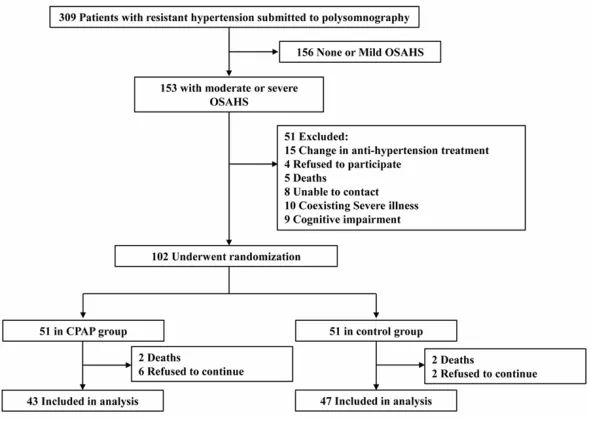
Figure 1. Flowchart of the study.
severe OSAHS patients with resistant hyper- tension. However, the effectiveness of CPAP on blood pressure in patients with mild OSAHS has been inconsistent, compared to moderate or severe OSAHS patients [14, 15]. Notably, most studies have recruited a relatively small number of participants and have not imple-mented a prolonged assessment of CPAP ther-apy on blood pressure in patients with OSAHS in a Caucasian population [6, 7]. Moreover, there are few reports demonstrating the signifi-cance of CPAP in a Chinese population with resistant hypertension and OSAHS.
The present study aimed to identify the effects of CPAP treatment on blood pressure of pa- tients with resistant hypertension and OSAHS in a Chinese population.
Patients and methods
Patients
Three hundred and nine patients with resistant hypertension were recruited from the Jiangxi Province Chest Hospital, between January 20- 13 and June 2017. Patients were aged 18 to 80 years and provided informed consent. The 24-hour ambulatory blood pressure monitoring (ABPM) criteria were used to define resistant hypertension, with blood pressure remaining above the goal (i.e., average SBP ≥ 130 mm Hg, average DBP ≥ 80 mm Hg, or both) despite con-current use of at least 3 anti-hypertensive med-ications, as described previously [13]. Subse-
er than 1.5 mg/dL in peripheral blood samples). The local Ethics Committee approved the pro- tocol (approval No. 2013/A093). No patients were included in the protocol before study registration.
24-hour ambulatory blood pressure monitoring (ABPM)
24-hour ABPM (SpaceLabs 90217; SpaceLabs, Medical Inc, Redmond, Washington, USA) was performed, as described previously [16, 17]. Summary values in the ABPM report of each patient were used for data analysis. Data relat-ed to average diurnal and nocturnal systolic blood pressure (SBP), diastolic blood pressu- re (DBP), and 24-hour mean blood pressure [defined as (2/3DBP value) + (1/3SBP value)] were analyzed [18].
Continuous positive airway pressure (CPAP) treatment
Patients randomized to the CPAP treatment gr- oup were titrated in the sleep laboratory on a second night by an auto CPAP device (REMstar ProMSeries with C-Flex, Philips Respironics), within a period of less than 15 days after the diagnostic study, to obtain fixed CPAP pressure values, according to previous descriptions [13]. Statistical analysis
Continuous data are described as mean (stan-dard deviation, SD). A two-tailed unpaired Stu-
high-nography. A total of 153 patients had mo- derate/severe OSAHS (AHI ≥ 15), while 156 patients were exclud- ed with none or mild OSAHS. In addition, 51 patients were exclud- ed while 102 patients were randomized, inclu- ding 51 to the control group (2 died before the beginning and 2 re- fused to continue) and 51 to the CPAP group (2 died before the be- ginning and 6 refus- ed to continue). Finally, there were a total of 47 patients in the con-trol group and 43 pa- tients in the CPAP gr- oup, eligible for clini- cal parameter analys- es (Figure 1).
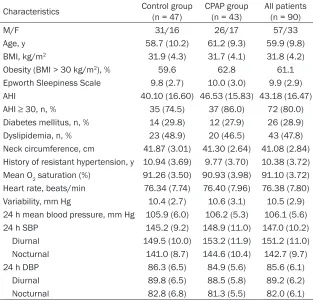
[image:3.612.90.403.98.398.2]Baseline characteristi- cs of all 90 partici-pants of the CPAP and control groups are su- mmarized in Table 1. The gender ratio am- Table 1. Baseline characteristics of all patients randomized to the control
group and CPAP group
Characteristics Control group (n = 47) CPAP group (n = 43) All patients (n = 90)
M/F 31/16 26/17 57/33
Age, y 58.7 (10.2) 61.2 (9.3) 59.9 (9.8) BMI, kg/m2 31.9 (4.3) 31.7 (4.1) 31.8 (4.2)
Obesity (BMI > 30 kg/m2), % 59.6 62.8 61.1
Epworth Sleepiness Scale 9.8 (2.7) 10.0 (3.0) 9.9 (2.9) AHI 40.10 (16.60) 46.53 (15.83) 43.18 (16.47) AHI ≥ 30, n, % 35 (74.5) 37 (86.0) 72 (80.0) Diabetes mellitus, n, % 14 (29.8) 12 (27.9) 26 (28.9) Dyslipidemia, n, % 23 (48.9) 20 (46.5) 43 (47.8) Neck circumference, cm 41.87 (3.01) 41.30 (2.64) 41.08 (2.84) History of resistant hypertension, y 10.94 (3.69) 9.77 (3.70) 10.38 (3.72) Mean O2 saturation (%) 91.26 (3.50) 90.93 (3.98) 91.10 (3.72) Heart rate, beats/min 76.34 (7.74) 76.40 (7.96) 76.38 (7.80) Variability, mm Hg 10.4 (2.7) 10.6 (3.1) 10.5 (2.9) 24 h mean blood pressure, mm Hg 105.9 (6.0) 106.2 (5.3) 106.1 (5.6) 24 h SBP 145.2 (9.2) 148.9 (11.0) 147.0 (10.2) Diurnal 149.5 (10.0) 153.2 (11.9) 151.2 (11.0) Nocturnal 141.0 (8.7) 144.6 (10.4) 142.7 (9.7) 24 h DBP 86.3 (6.5) 84.9 (5.6) 85.6 (6.1) Diurnal 89.8 (6.5) 88.5 (5.8) 89.2 (6.2) Nocturnal 82.8 (6.8) 81.3 (5.5) 82.0 (6.1)
Abbreviations: CPAP, continuous positive airway pressure; M, male; F, female; y, year; BMI, body mass index; AHI, apnea-hypopnea index; SBP, systolic blood pressure; DBP, diastolic blood pressure.
dent’s t-test for independent samples or χ2 test
was used to compare baseline variables in the two groups. Differences between quantitative variables were analyzed using Student’s t-test for unpaired data. Spearman’s rank analysis was used to identify the correlation of number of hours of CPAP use and decrease in 24-hour mean blood pressure, SBP, and DBP in pati- ents with resistant hypertension and OSAHS. Version 17 of SPSS (SPSS, Inc., Chicago, IL, USA) for Windows statistical program was us- ed. GraphPad Prism Version 7.0 (GraphPad Software, Inc., La Jolla, CA, USA) was used to draw the histogram. P < 0.05 indicates statisti-cally significant differences.
Results
Study population
This study initially recruited 309 patients with clinical suspicion of resistant hypertension and OSAHS was screened using complete
polysom-ong participants was 57/33 (M/F). The mean (SD) for age was 59.9 (9.8) years, while body mass index (BMI) was 31.8 (4.2), AHI was 43.18 (16.47) events per hour, and obesity ratio was 61.1%. The mean Epworth Sleepiness Scale (ESS) was 9.9. Data were similar in the two groups of patients. Incidence of diabetes mellitus and dyslipidemia, neck circumference, history of resistant hypertension, mean O2 sat-uration, heart rates, and variability were dis-played, showing no significant differences be- tween the two groups. Furthermore, baseline values of 24-hour mean blood pressure, 24- hour SBP and DBP, diurnal SBP and DBP, and nocturnal SBP and DBP were measured using an ambulatory blood pressure monitoring sys-tem. Comparing baseline values, there were no significant differences between the control group and CPAP group (Table 1).
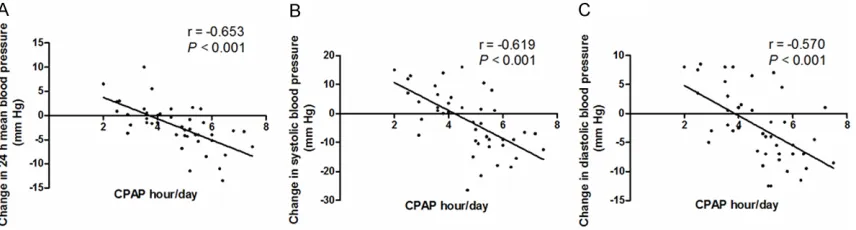
anti-hyperten-DBP (Figure 4). The- re were significant reductions in noctur-nal SBP (Figure 3) and DBP (Figure 4) in the CPAP treat-ment group, where-as no significant ch- anges in diurnal SBP and DBP were obser- ved with CPAP treat-ment. Figure 5 sh- ows a positive linear correlation between number of hours of sive medications, 22% with four drugs, and
42% with more than five drugs. Use of anti-hypertensive medications is detailed in Table 2.
Outcomes
In the CPAP group, mean (SD) use of CPAP treatment was 4.7 (1.4) hours/night, with 67.4% of patients with more than 4 hours/night. Mean use of CPAP pressure was 8.8 (2.4) mm Hg. As shown in Table 3, differences between the con-trol group and CPAP group regarding blood pressure changes during follow-ups are pre-sented. The 24-hour mean blood pressure at study entry and termination was 105.9 (6.0) mm Hg and 107.6 (5.8) mm Hg vs 106.2 (5.3) mm Hg and 104.0 (4.5) mm Hg in the con- trol group and CPAP group, respectively. The 24-hour SBP, diurnal, or nocturnal SBP at study entry and termination was 145.2 (9.2) mm Hg and 148.0 (9.2) mm Hg, 149.5 (10.0) mm Hg and 150.6 (10.3) mm Hg or 141.0 (8.7) mm Hg and 145.4 (12.2) mm Hg vs 148.9 (11.0) mm Hg and 146.6 (7.7) mm Hg, 153.2 (11.9) mm Hg and 152.5 (9.7) mm Hg or 144.6 (10.4) mm Hg and 140.7 (9.5) mm Hg in the control group and CPAP group, respectively. The 24-h DBP, diurnal, or nocturnal DBP at study entry and ter-mination was 86.3 (6.5) mm Hg and 87.4 (7.3) mm Hg, 89.8 (6.5) mm Hg and 90.4 (5.9) mm Hg or 82.8 (6.8) mm Hg and 84.4 (13.4) mm Hg vs 84.9 (5.6) mm Hg and 82.8 (6.3) mm Hg, 88.5 (5.8) mm Hg and 87.3 (6.8) mm Hg or 81.3 (5.5) mm Hg and 78.2 (8.0) mm Hg in the control group and CPAP group, respectively. Compared to the control group, the CPAP group achieved a greater decrease in 24-hour mean blood pressure (Figure 2), SBP (Figure 3), and
CPAP use and decrease in 24-hour mean blood pressure (r = 0.653, P < 0.001; Figure 5A), SBP (r = 0.619, P < 0.001; Figure 5B), and DBP (r = 0.570, P < 0.001; Figure 5C).
Discussion
Resistant hypertension has been closely asso-ciated with OSAHS, contributing to poor control of blood pressure [19]. International guidelines have affirmed that minimal reduction in SBP (even 2-3 mm Hg) could dramatically reduce subsequent cardiovascular mortality in routine clinical practice [13]. Therefore, effective blood pressure control may effectively reduce adver- se outcomes by OSAHS in patients with resis-tant hypertension. Emerging evidence has sug-gested that CPAP can effectively reduce AHI, cardiovascular morbidity, and cardiovascular mortality, one of the most effective therapies for OSAHS [7, 20]. However, there remains con-flicting conclusions about whether CPAP can effectively control blood pressure in resistant hypertensive patients with OSAHS. Currently, at least four meta-analyses [6, 7, 21, 22] and six randomized controlled trials [10, 13, 23-26] have suggested that CPAP therapy is accom- panied by a reduction in blood pressure in patients with resistant hypertension and OS- AHS. However, Muxfeldt et al. found that CPAP treatment only had a beneficial effect on night-time systolic blood pressure, with no significant effects on clinic and ambulatory blood pres-sure in patients with resistant hypertension and OSAHS [25].
The present study showed that 3 months of CPAP treatment achieved a mean reduction of 2.3 mm Hg and 2.1 mm Hg in 24-hour SBP and Table 2. Description of anti-hypertensive medications in randomized patients
Control group
(n = 47) CPAP group (n = 43) All patients (n = 90) No. of anti-hypertensive drugs 4.5 (1.5) 4.2 (1.2) 4.4 (1.4) Diuretic, n, % 40 (85.1) 37 (86.0) 77 (85.6) Calcium channel blockers, n, % 31 (66.0) 29 (67.4) 60 (66.7)
β-Blockers, n, % 29 (61.7) 25 (58.1) 54 (60.0)
Figure 4. Effects of CPAP treatment on diastolic blood pressure in patients with resistant hyperten-sion and OSAHS.
Figure 2. Effects of CPAP treatment on 24-hour mean blood pressure in patients with resistant hyperten-sion and OSAHS.
DBP, respectively. Moreover, a reduction of nocturnal SBP (3.9 mm Hg) and DBP (3.1 mm Hg) also occurred in patients with resistant hypertension and OSAHS. Muxfeldt et al. showed a significant reduction in night-time SBP (4.7 mm Hg) with 6-months of CPAP
treat-ment in 46 patients with ABPM-confirmed resistant hypertension [25]. Pedrosa et al. found that treatment of OSAHS with CPAP sig-nificantly reduced daytime SBP (6.5 mm Hg) and DBP (4.5 mm Hg) in patients with resistant hypertension [26]. Martínez-García et al. found a significant decrease in 24-hour mean blood pressure (3.1 mm Hg) and 24-hour DBP (3.2 mm Hg), but not in 24-hour SBP after 3 months of CPAP treatment on 98 patients with resis-tant hypertension, compared with 96 controls [13]. Lozano and his colleagues showed a decrease in 24-hour DBP (4.9 mm Hg), 24-hour DBP (6.98 mm Hg), and 24-hour SBP (9.71 mm Hg) in resistant hypertensive patients with OSAHS via CPAP treatment [10]. These studies provided evidence of the effects of CPAP in reducing blood pressure in patients with resis-tant hypertension and OSAHS.
Iftikhar et al. [21] performed a meta-analysis of the effects of CPAP on blood pressure in patients with resistant hypertension and OSAHS, finding that CPAP treatment cannot sig-Table 3. Effects of 3 months of continuous positive airway pressure treatment on blood pressure levels
Blood pressure, mm Hg Control group (n = 47) CPAP group (n = 43) P value Baseline Follow-up Difference Baseline Follow-up Difference
24 h mean blood pressure 105.9 (6.0) 107.6 (5.8) 1.7 (5.2) 106.2 (5.3) 104.0 (4.5) -2.2 (4.6) < 0.001 24 h SBP 145.2 (9.2) 148.0 (9.2) 2.8 (7.5) 148.9 (11.0) 146.6 (7.7) -2.3 (10.6) 0.010 Diurnal 149.5 (10.0) 150.6 (10.3) 1.1 (8.8) 153.2 (11.9) 152.5 (9.7) -0.7 (12.8) 0.446 Nocturnal 141.0 (8.7) 145.4 (12.2) 4.4 (10.7) 144.6 (10.4) 140.7 (9.5) -3.9 (11.5) < 0.001 24 h DBP 86.3 (6.5) 87.4 (7.3) 1.1 (7.8) 84.9 (5.6) 82.8 (6.3) -2.1 (6.2) 0.033 Diurnal 89.8 (6.5) 90.4 (5.9) 0.6 (7.4) 88.5 (5.8) 87.3 (6.8) -1.2 (7.7) 0.268 Nocturnal 82.8 (6.8) 84.4 (13.4) 1.6 (13.2) 81.3 (5.5) 78.2 (8.0) -3.1 (7.0) 0.042
[image:5.612.91.286.444.585.2]Figure 5. Correlation between continuous positive airway pressure (CPAP) use times and changes in 24-hour mean blood pressure (A), systolic blood pressure (B), and diastolic blood pressure (C) in the patients of the CPAP group
that finished the follow-up.
nificantly improve nocturnal SBP/DBP but can significantly improve diurnal SBP/DBP. Similar results were reported by Pedrosa and his col-leagues [26]. However, Hu et al. [27] summa-rized that CPAP led to more significant improve-ments in nocturnal SBP than in diurnal SBP in patients with resistant hypertension and OSAHS. Results obtained by Martínez-García et al. [13] were consistent with those obtained by Hu et al. [27]. The present study also found that nocturnal SBP/DBP, but not diurnal SBP/DBP, was decreased by 3.9 mm Hg and 3.1 mm Hg, respectively, in patients with OSAHS and resis-tant hypertension undergoing CPAP treatment. Therefore, patients with resistant hypertension and OSAHS should undergo combination the- rapy with antihypertensive medications and CPAP. Combination therapy is more significant than treatment with anti-hypertensive drugs alone.
Previous studies have indicated that the effects of CPAP on blood pressure levels are closely associated with the time of CPAP therapy [7, 10]. Lozano et al. found that CPAP treatment of more than 5.8 hours showed a greater re- duction in night-time SBP and 24-hour DBP in patients with resistant hypertension and OSAHS than those with CPAP times less than 5.8 hours [10]. Martínez-García et al. showed a positive linear correlation between the time of CPAP therapy and decrease in 24-hour mean blood pressure, SBP, and DBP [13]. The present study corroborated these finding with a signifi-cant correlation between the hours of CPAP use and decrease in 24-hour mean blood pressure, SBP, and DBP in patients with OSAHS and resis-tant hypertension. Therefore, time of CPAP use was important in reducing blood pressure in
patients with resistant hypertension and OS- AHS. However, there is no uniform standard for time of CPAP use in clinical practice.
This study had several limitations. First, 3 months of follow-ups may have been insuffi-cient to detect higher blood pressure reduc-tions in patients with resistant hypertension and OSAHS. Some researchers, however, have suggested that 3 months of follow-ups result- ed in significant changes in blood pressure with CPAP treatment [13, 28], while another study found significant changes in blood pres-sure only after 6 months [11]. Second, the num-ber of RCTs included in this study was rather small, which may be biased toward meaning-less results. Third, subgroups analysis of treat-ment times of CPAP was not performed in patients with resistant hypertension and OS- AHS. Despite these limitations, the current study findings can be used to evaluate the ma- gnitude of effects of CPAP on blood pressure with a larger number of participants and longer follow-up period.
In conclusion, CPAP treatment for 3 months resulted in the decrease of 24-hour mean, sys-tolic, and diastolic blood pressure in patients with OSA and resistant hypertension. Moreover, correlation analysis indicated that decrease of 24-hour mean, systolic, or diastolic blood pres-sure is positively related to CPAP treatment times.
Acknowledgements
Disclosure of conflict of interest
None.
Address correspondence to: Dr. Bin Zou, Depart- ment of Cardiovascular, Jiangxi Province Chest Hos- pital, 346 Dieshan Road, Donghu District, Nan-
chang 330006, China. Tel: (+86)791-86773946;
E-mail: [email protected]
References
[1] Weinstock TG, Rosen CL, Marcus CL, Garetz S, Mitchell RB, Amin R, Paruthi S, Katz E, Arens R, Weng J, Ross K, Chervin RD, Ellenberg S, Wang R and Redline S. Predictors of obstructive sleep apnea severity in adenotonsillectomy candidates. Sleep 2014; 37: 261-269.
[2] Wang Y, Li C, Feng L, Feng J, Cao J and Chen B. Prevalence of hypertension and circadian blood pressure variations in patients with ob-structive sleep apnoea-hypopnoea syndrome. J Int Med Res 2014; 42: 773-780.
[3] Furlan SF, Braz CV, Lorenzi-Filho G and Drager LF. Management of hypertension in obstruc-tive sleep apnea. Curr Cardiol Rep 2015; 17: 108.
[4] Pensuksan WC, Chen X, Lohsoonthorn V, Lert-maharit S, Gelaye B and Williams MA. High risk for obstructive sleep apnea in relation to hypertension among southeast Asian young
adults: role of obesity as an effect modifier. Am
J Hypertens 2014; 27: 229-236.
[5] Floras JS. Obstructive sleep apnea syndrome, continuous positive airway pressure and treat-ment of hypertension. Eur J Pharmacol 2015; 763: 28-37.
[6] Liu L, Cao Q, Guo Z and Dai Q. Continuous pos-itive airway pressure in patients with obstruc-tive sleep apnea and resistant hypertension: a meta-analysis of randomized controlled trials. J Clin Hypertens (Greenwich) 2016; 18: 153-158.
[7] Lei Q, Lv Y, Li K, Ma L, Du G, Xiang Y and Li X. Effects of continuous positive airway pressure on blood pressure in patients with resistant hypertension and obstructive sleep apnea: a systematic review and meta-analysis of six randomized controlled trials. J Bras Pneumol 2017; 43: 373-379.
[8] Marin JM, Agusti A, Villar I, Forner M, Nieto D, Carrizo SJ, Barbe F, Vicente E, Wei Y, Nieto FJ and Jelic S. Association between treated and untreated obstructive sleep apnea and risk of hypertension. JAMA 2012; 307: 2169-2176. [9] Giles TL, Lasserson TJ, Smith BH, White J,
Wright J and Cates CJ. Continuous positive air-ways pressure for obstructive sleep apnoea in
adults. Cochrane Database Syst Rev 2006; CD001106.
[10] Lozano L, Tovar JL, Sampol G, Romero O, Jura-do MJ, Segarra A, Espinel E, Rios J, Untoria MD and Lloberes P. Continuous positive airway pressure treatment in sleep apnea patients with resistant hypertension: a randomized, controlled trial. J Hypertens 2010; 28: 2161-2168.
[11] Dernaika TA, Kinasewitz GT and Tawk MM. Ef-fects of nocturnal continuous positive airway pressure therapy in patients with resistant hypertension and obstructive sleep apnea. J Clin Sleep Med 2009; 5: 103-107.
[12] Frent SM, Tudorache VM, Ardelean C and Mi-haicuta S. Long-term effects of nocturnal con-tinuous positive airway pressure therapy in patients with resistant hypertension and ob-structive sleep apnea. Pneumologia 2014; 63: 204, 207-211.
[13] Martinez-Garcia MA, Capote F, Campos-Rodri-guez F, Lloberes P, Diaz de Atauri MJ, Somoza M, Masa JF, Gonzalez M, Sacristan L, Barbe F, Duran-Cantolla J, Aizpuru F, Manas E, Barreiro B, Mosteiro M, Cebrian JJ, de la Pena M, Gar-cia-Rio F, Maimo A, Zapater J, Hernandez C, Grau SanMarti N and Montserrat JM. Effect of CPAP on blood pressure in patients with ob-structive sleep apnea and resistant hyperten-sion: the HIPARCO randomized clinical trial. JAMA 2013; 310: 2407-2415.
[14] Barnes M, Houston D, Worsnop CJ, Neill AM, Mykytyn IJ, Kay A, Trinder J, Saunders NA, Douglas McEvoy R and Pierce RJ. A random-ized controlled trial of continuous positive air-way pressure in mild obstructive sleep apnea. Am J Respir Crit Care Med 2002; 165: 773-780.
[15] Monasterio C, Vidal S, Duran J, Ferrer M, Car-mona C, Barbe F, Mayos M, Gonzalez-Mangado N, Juncadella M, Navarro A, Barreira R, Capote F, Mayoralas LR, Peces-Barba G, Alonso J and Montserrat JM. Effectiveness of continuous positive airway pressure in mild sleep apnea-hypopnea syndrome. Am J Respir Crit Care Med 2001; 164: 939-943.
[16] Pickering TG, Hall JE, Appel LJ, Falkner BE, Graves J, Hill MN, Jones DW, Kurtz T, Sheps SG and Roccella EJ. Recommendations for blood pressure measurement in humans and experi-mental animals: Part 1: blood pressure mea-surement in humans: a statement for pro- fessionals from the subcommittee of profes-sional and public education of the American heart association council on high blood pres-sure research. Hypertension 2005; 45: 142-161.
Cowley D, Brown MA, Ruta LA and Wilson A. Ambulatory blood pressure monitoring in Aus-tralia: 2011 consensus position statement. J Hypertens 2012; 30: 253-266.
[18] Franklin SS, Gustin Wt, Wong ND, Larson MG, Weber MA, Kannel WB and Levy D. Hemody-namic patterns of age-related changes in blood pressure. The framingham heart study. Circulation 1997; 96: 308-315.
[19] Peppard PE, Young T, Palta M and Skatrud J. Prospective study of the association between sleep-disordered breathing and hypertension. N Engl J Med 2000; 342: 1378-1384.
[20] Mannarino MR, Di Filippo F and Pirro M. Ob-structive sleep apnea syndrome. Eur J Intern Med 2012; 23: 586-593.
[21] Iftikhar IH, Valentine CW, Bittencourt LR, Co-hen DL, Fedson AC, Gislason T, Penzel T, Phil-lips CL, Yu-Sheng L, Pack AI and Magalang UJ. Effects of continuous positive airway pressure on blood pressure in patients with resistant hy-pertension and obstructive sleep apnea: a meta-analysis. J Hypertens 2014; 32: 2341-2350; discussion 2350.
[22] Varounis C, Katsi V, Kallikazaros IE, Tousoulis D, Stefanadis C, Parissis J, Lekakis J, Siristati-dis C, Manolis AJ and Makris T. Effect of CPAP on blood pressure in patients with obstructive sleep apnea and resistant hypertension: a sys-tematic review and meta-analysis. Int J Cardiol 2014; 175: 195-198.
[23] de Oliveira AC, Martinez D, Massierer D, Gus M, Goncalves SC, Ghizzoni F, Steinhorst AM, Moreira LB, Fuchs SC and Fuchs FD. The anti-hypertensive effect of positive airway pressure on resistant hypertension of patients with ob-structive sleep apnea: a randomized, double-blind, clinical trial. Am J Respir Crit Care Med 2014; 190: 345-347.
[24] Lloberes P, Sampol G, Espinel E, Segarra A, Ra-mon MA, Romero O, Ferrer R, Martinez-Garcia MA and Tovar JL. A randomized controlled study of CPAP effect on plasma aldosterone concentration in patients with resistant hyper-tension and obstructive sleep apnea. J Hyper-tens 2014; 32: 1650-1657; discussion 1657. [25] Muxfeldt ES, Margallo V, Costa LM, Guimaraes
G, Cavalcante AH, Azevedo JC, de Souza F, Car-doso CR and Salles GF. Effects of continuous positive airway pressure treatment on clinic and ambulatory blood pressures in patients with obstructive sleep apnea and resistant hy-pertension: a randomized controlled trial. Hy-pertension 2015; 65: 736-742.
[26] Pedrosa RP, Drager LF, de Paula LK, Amaro AC, Bortolotto LA and Lorenzi-Filho G. Effects of OSA treatment on BP in patients with resistant hypertension: a randomized trial. Chest 2013; 144: 1487-1494.
[27] Hu X, Fan J, Chen S, Yin Y and Zrenner B. The role of continuous positive airway pressure in blood pressure control for patients with ob-structive sleep apnea and hypertension: a meta-analysis of randomized controlled trials. J Clin Hypertens (Greenwich) 2015; 17: 215-222.
[28] Logan AG, Tkacova R, Perlikowski SM, Leung RS, Tisler A, Floras JS and Bradley TD. Refrac-tory hypertension and sleep apnoea: effect of
CPAP on blood pressure and baroreflex. Eur