Joint Unsupervised Coreference Resolution with Markov Logic
Hoifung Poon Pedro Domingos
Department of Computer Science and Engineering University of Washington
Seattle, WA 98195-2350, U.S.A.
{hoifung,pedrod}@cs.washington.edu
Abstract
Machine learning approaches to coreference resolution are typically supervised, and re-quire expensive labeled data. Some unsuper-vised approaches have been proposed (e.g., Haghighi and Klein (2007)), but they are less accurate. In this paper, we present the first un-supervised approach that is competitive with supervised ones. This is made possible by performing joint inference across mentions, in contrast to the pairwise classification typ-ically used in supervised methods, and by us-ing Markov logic as a representation language, which enables us to easily express relations like apposition and predicate nominals. On MUC and ACE datasets, our model outper-forms Haghigi and Klein’s one using only a fraction of the training data, and often matches or exceeds the accuracy of state-of-the-art su-pervised models.
1 Introduction
The goal of coreference resolution is to identify mentions (typically noun phrases) that refer to the sameentities. This is a key subtask in many NLP applications, including information extraction, ques-tion answering, machine translaques-tion, and others. Su-pervised learning approaches treat the problem as one of classification: for each pair of mentions, predict whether they corefer or not (e.g., McCal-lum & Wellner (2005)). While successful, these approaches require labeled training data, consisting of mention pairs and the correct decisions for them. This limits their applicability.
Unsupervised approaches are attractive due to the availability of large quantities of unlabeled text. However, unsupervised coreference resolution is much more difficult. Haghighi and Klein’s (2007) model, the most sophisticated to date, still lags su-pervised ones by a substantial margin. Extending it appears difficult, due to the limitations of its Dirich-let process-based representation.
The lack of label information in unsupervised coreference resolution can potentially be overcome by performing joint inference, which leverages the “easy” decisions to help make related “hard” ones. Relations that have been exploited in supervised coreference resolution include transitivity (McCal-lum & Wellner, 2005) and anaphoricity (Denis & Baldridge, 2007). However, there is little work to date on joint inference for unsupervised resolution.
We address this problem using Markov logic, a powerful and flexible language that combines probabilistic graphical models and first-order logic (Richardson & Domingos, 2006). Markov logic allows us to easily build models involving rela-tions among menrela-tions, like apposition and predi-cate nominals. By extending the state-of-the-art al-gorithms for inference and learning, we developed the first generpurpose unsupervised learning al-gorithm for Markov logic, and applied it to unsuper-vised coreference resolution.
We test our approach on standard MUC and ACE datasets. Our basic model, trained on a minimum of data, suffices to outperform Haghighi and Klein’s (2007) one. Our full model, using apposition and other relations for joint inference, is often as accu-rate as the best supervised models, or more.
We begin by reviewing the necessary background on Markov logic. We then describe our Markov logic network for joint unsupervised coreference resolution, and the learning and inference algorithms we used. Finally, we present our experiments and re-sults.
2 Related Work
Most existing supervised learning approaches for coreference resolution are suboptimal since they re-solve each mention pair independently, only impos-ing transitivity in postprocessimpos-ing (Ng, 2005). More-over, many of them break up the resolution step into subtasks (e.g., first determine whether a mention is anaphoric, then classify whether it is coreferent with an antecedent), which further forsakes opportunities for joint inference that have been shown to be help-ful (Poon & Domingos, 2007). Using graph parti-tioning, McCallum & Wellner (2005) incorporated transitivity into pairwise classification and achieved the state-of-the-art result on the MUC-6 dataset, but their approach can only leverage one binary relation at a time, not arbitrary relations among mentions. Denis & Baldridge (2007) determined anaphoricity and pairwise classification jointly using integer pro-gramming, but they did not incorporate transitivity or other relations.
While potentially more appealing, unsupervised learning is very challenging, and unsupervised coreference resolution systems are still rare to this date. Prior to our work, the best performance in unsupervised coreference resolution was achieved by Haghighi & Klein (2007), using a nonparamet-ric Bayesian model based on hierarchical Dinonparamet-richlet processes. At the heart of their system is a mixture model with a few linguistically motivated features such as head words, entity properties and salience. Their approach is a major step forward in unsuper-vised coreference resolution, but extending it is chal-lenging. The main advantage of Dirichlet processes is that they are exchangeable, allowing parameters to be integrated out, but Haghighi and Klein forgo this when they introduce salience. Their model thus requires Gibbs sampling over both assignments and parameters, which can be very expensive. Haghighi and Klein circumvent this by making approxima-tions that potentially hurt accuracy. At the same
time, the Dirichlet process prior favors skewed clus-ter sizes and a number of clusclus-ters that grows loga-rithmically with the number of data points, neither of which seems generally appropriate for coreference resolution.
Further, deterministic or strong non-deterministic dependencies cause Gibbs sampling to break down (Poon & Domingos, 2006), making it difficult to leverage many linguistic regularities. For exam-ple, apposition (as in “Bill Gates, the chairman of Microsoft”) suggests coreference, and thus the two mentions it relates should always be placed in the same cluster. However, Gibbs sampling can only move one mention at a time from one cluster to another, and this is unlikely to happen, because it would require breaking the apposition rule. Blocked sampling can alleviate this problem by sampling multiple mentions together, but it requires that the block size be predetermined to a small fixed number. When we incorporate apposition and other regular-ities the blocks can become arbitrarily large, mak-ing this infeasible. For example, suppose we also want to leverage predicate nominals (i.e., the sub-ject and the predicating noun of a copular verb are likely coreferent). Then a sentence like “He is Bill Gates, the chairman of Microsoft” requires a block of four mentions: “He”, “Bill Gates”, “the chair-man of Microsoft”, and “Bill Gates, the chairchair-man of Microsoft”. Similar difficulties occur with other inference methods. Thus, extending Haghighi and Klein’s model to include richer linguistic features is a challenging problem.
It is worth noticing that Markov logic is also well suited for joint inference in supervised systems (e.g., transitivity, which took McCallum & Wellner (2005) nontrivial effort to incorporate, can be handled in Markov logic with the addition of a single formula (Poon & Domingos, 2008)).
3 Markov Logic
In many NLP applications, there exist rich relations among objects, and recent work in statistical rela-tional learning (Getoor & Taskar, 2007) and struc-tured prediction (Bakiret al., 2007) has shown that leveraging these can greatly improve accuracy. One of the most powerful representations for joint infer-ence is Markov logic, a probabilistic extension of first-order logic (Richardson & Domingos, 2006). A Markov logic network (MLN) is a set of weighted first-order clauses. Together with a set of con-stants, it defines a Markov network with one node per ground atom and one feature per ground clause. The weight of a feature is the weight of the first-order clause that originated it. The probability of a state x in such a network is given by P(x) = (1/Z) exp (P
iwifi(x)), where Z is a
normaliza-tion constant, wi is the weight of the ith clause,
fi = 1 if theith clause is true, and fi = 0
other-wise.
Markov logic makes it possible to compactly specify probability distributions over complex re-lational domains. Efficient inference can be per-formed using MC-SAT (Poon & Domingos, 2006). MC-SAT is a “slice sampling” Markov chain Monte Carlo algorithm. Slice sampling introduces auxil-iary variables u that decouple the original ones x, and alternately samplesuconditioned onxand vice-versa. To sample from the slice (the set of statesx
consistent with the currentu), MC-SAT calls Sam-pleSAT (Wei et al., 2004), which uses a combina-tion of satisfiability testing and simulated annealing. The advantage of using a satisfiability solver (Walk-SAT) is that it efficiently finds isolated modes in the distribution, and as a result the Markov chain mixes very rapidly. The slice sampling scheme ensures that detailed balance is (approximately) preserved. MC-SAT is orders of magnitude faster than previous MCMC algorithms like Gibbs sampling, making ef-ficient sampling possible on a scale that was
previ-Algorithm 1 MC-SAT(clauses, weights, num samples)
x(0)←Satisfy(hardclauses) fori←1tonum samplesdo
M ← ∅
for allck∈clausessatisfied byx(i−1)do
With probability1−e−wkaddc
ktoM
end for
Samplex(i) ∼ USAT(M)
end for
ously out of reach.
Algorithm 1 gives pseudo-code for MC-SAT. At iteration i − 1, the factor φk for clause ck is
ei-ther ewk if c
k is satisfied inx(i−1), or 1 otherwise.
MC-SAT first samples the auxiliary variableuk
uni-formly from(0, φk), then samples a new state
uni-formly from the set of states that satisfy φ0k ≥ uk
for allk (the slice). Equivalently, for eachk, with probability1−e−wk the next state must satisfyc
k.
In general, we can factorize the probability distribu-tion in any way that facilitates inference, sample the
uk’s, and make sure that the next state is drawn
uni-formly from solutions that satisfy φ0k ≥ uk for all
factors.
MC-SAT, like most existing relational inference algorithms, grounds all predicates and clauses, thus requiring memory and time exponential in the pred-icate and clause arities. We developed a general method for producing a “lazy” version of relational inference algorithms (Poon & Domingos, 2008), which carries exactly the same inference steps as the original algorithm, but only maintains a small sub-set of “active” predicates/clauses, grounding more as needed. We showed that Lazy-MC-SAT, the lazy version of MC-SAT, reduced memory and time by orders of magnitude in several domains. We use Lazy-MC-SAT in this paper.
descent, with the gradient being
∂
∂wiL(y) = ni(y)−
P
y0P(Y =y0)ni(y0)
= ni(y)−EY[ni].
whereniis the number of true groundings of clause
i. The expected count can be approximated as
EY[ni]≈
1 N
N
X
k=1 ni(yk)
where yk are samples generated by MC-SAT. To
combat overfitting, a Gaussian prior is imposed on all weights.
In practice, it is difficult to tune the learning rate for gradient descent, especially when the number of groundings varies widely among clauses. Lowd & Domingos (2007) used a preconditioned scaled conjugate gradient algorithm (PSCG) to address this problem. This estimates the optimal step size in each step as
α= −d
Tg
dTHd+λdTd.
wheregis the gradient,dthe conjugate update direc-tion, andλa parameter that is automatically tuned to trade off second-order information with gradient descent. H is the Hessian matrix, with the(i, j)th entry being
∂2
∂wi∂wjL(y) = EY[ni]·EY[nj]−EY[ni·nj] = −CovY[ni, nj].
The Hessian can be approximated with the same samples used for the gradient. Its negative inverse diagonal is used as the preconditioner.1
The open-source Alchemy package (Kok et al., 2007) provides implementations of existing algo-rithms for Markov logic. In Section 5, we develop the first generpurpose unsupervised learning al-gorithm for Markov logic by extending the existing algorithms to handle hidden predicates.2
1
Lowd & Domingos showed thatαcan be computed more efficiently, without explicitly approximating or storing the Hes-sian. Readers are referred to their paper for details.
2Alchemy includes a discriminative EM algorithm, but it
as-sumes that only a few values are missing, and cannot handle completely hidden predicates. Kok & Domingos (2007) applied Markov logic to relational clustering, but they used hard EM.
4 An MLN for Joint Unsupervised Coreference Resolution
In this section, we present our MLN for joint unsu-pervised coreference resolution. Our model deviates from Haghighi & Klein’s (2007) in several impor-tant ways. First, our MLN does not model saliences for proper nouns or nominals, as their influence is marginal compared to other features; for pronoun salience, it uses a more intuitive and simpler def-inition based on distance, and incorporated it as a prior. Another difference is in identifying heads. For the ACE datasets, Haghighi and Klein used the gold heads; for the MUC-6 dataset, where labels are not available, they crudely picked the rightmost token in a mention. We show that a better way is to determine the heads using head rules in a parser. This improves resolution accuracy and is always applicable. Cru-cially, our MLN leverages syntactic relations such as apposition and predicate nominals, which are not used by Haghighi and Klein. In our approach, what it takes is just adding two formulas to the MLN.
As common in previous work, we assume that true mention boundaries are given. We do not as-sume any other labeled information. In particu-lar, we do not assume gold name entity recogni-tion (NER) labels, and unlike Haghighi & Klein (2007), we do not assume gold mention types (for ACE datasets, they also used gold head words). We determined the head of a mention either by taking its rightmost token, or by using the head rules in a parser. We detected pronouns using a list.
4.1 Base MLN
The main query predicate isInClust(m,c!), which is true iff mentionmis in clusterc. The “t!” notation signifies that for eachm, this predicate is true for a unique value ofc. The main evidence predicate is
Head(m,t!), wheremis a mention andta token, and which is true ifftis the head ofm. A key component in our MLN is a simple head mixture model, where the mixture component priors are represented by the unit clause
InClust(+m,+c)
and the head distribution is represented by thehead prediction rule
All free variables are implicitly universally quanti-fied. The “+” notation signifies that the MLN con-tains an instance of the rule, with a separate weight, for each value combination of the variables with a plus sign.
By convention, at each inference step we name each non-empty cluster after the earliest mention it contains. This helps break the symmetry among mentions, which otherwise produces multiple op-tima and makes learning unnecessarily harder. To encourage clustering, we impose an exponential prior on the number of non-empty clusters with weight−1.
The above model only clusters mentions with the same head, and does not work well for pronouns. To address this, we introduce the predicate IsPrn(m), which is true iff the mention m is a pronoun, and adapt the head prediction rule as follows:
¬IsPrn(m)∧InClust(m,+c)∧Head(m,+t)
This is always false whenmis a pronoun, and thus applies only to non-pronouns.
Pronouns tend to resolve with men-tions that are semantically compatible with them. Thus we introduce predicates that represent entity type, number, and gender:
Type(x,e!), Number(x,n!), Gender(x,g!), where x can be either a cluster or mention,
e ∈ {Person,Organization,Location,Other},
n ∈ {Singular,Plural} and g ∈
{Male,Female,Neuter}. Many of these are known for pronouns, and some can be inferred from simple linguistic cues (e.g., “Ms. Galen” is a singular female person, while “XYZ Corp.” is an organization).3 Entity type assignment is represented by the unit clause
Type(+x,+e)
and similarly for number and gender. A mention should agree with its cluster in entity type. This is ensured by the hard rule (which has infinite weight and must be satisfied)
InClust(m,c)⇒(Type(m,e)⇔Type(c,e))
3
We used the following cues: Mr., Ms., Jr., Inc., Corp., cor-poration, company. The proportions of known properties range from 14% to 26%.
There are similar hard rules for number and gender. Different pronouns prefer different entity types, as represented by
IsPrn(m)∧InClust(m,c) ∧Head(m,+t)∧Type(c,+e)
which only applies to pronouns, and whose weight is positive if pronountis likely to assume entity type
eand negative otherwise. There are similar rules for number and gender.
Aside from semantic compatibility, pronouns tend to resolve with nearby mentions. To model this, we impose an exponential prior on the distance (number of mentions) between a pronoun and its antecedent, with weight−1.4 This is similar to Haghighi and Klein’s treatment of salience, but simpler.
4.2 Full MLN
Syntactic relations among mentions often suggest coreference. Incorporating such relations into our MLN is straightforward. We illustrate this with two examples: apposition and predicate nominals. We introduce a predicate for apposition,Appo(x,y), wherex,yare mentions, and which is true iffyis an appositive ofx. We then add the rule
Appo(x,y)⇒(InClust(x,c)⇔InClust(y,c))
which ensures thatx, yare in the same cluster ifyis an appositive ofx. Similarly, we introduce a predi-cate for predipredi-cate nominals,PredNom(x,y), and the corresponding rule.5 The weights of both rules can be learned from data with a positive prior mean. For simplicity, in this paper we treat them as hard con-straints.
4.3 Rule-Based MLN
We also consider a rule-based system that clusters non-pronouns by their heads, and attaches a pro-noun to the cluster which has no known conflicting
4
For simplicity, if a pronoun has no antecedent, we define the distance to be∞. So a pronoun must have an antecedent in our model, unless it is the first mention in the document or it can not resolve with previous mentions without violating hard con-straints. It is straightforward to soften this with a finite penalty.
5We detected apposition and predicate nominatives using
type, number, or gender, and contains the closest an-tecedent for the pronoun. This system can be en-coded in an MLN with just four rules. Three of them are the ones for enforcing agreement in type, num-ber, and gender between a cluster and its members, as defined in the base MLN. The fourth rule is
¬IsPrn(m1)∧ ¬IsPrn(m2) ∧Head(m1,h1)∧Head(m2,h2) ∧InClust(m1,c1)∧InClust(m2,c2)
⇒(c1=c2⇔h1=h2).
With a large but not infinite weight (e.g., 100), this rule has the effect of clustering non-pronouns by their heads, except when it violates the hard rules. The MLN can also include the apposition and predicate-nominal rules. As in the base MLN, we impose the same exponential prior on the number of non-empty clusters and that on the distance between a pronoun and its antecedent. This simple MLN is remarkably competitive, as we will see in the exper-iment section.
5 Learning and Inference
Unsupervised learning in Markov logic maximizes the conditional log-likelihood
L(x, y) = logP(Y =y|X=x)
= logP
zP(Y =y, Z =z|X=x)
where Z are unknown predicates. In our coref-erence resolution MLN, Y includes Head and known groundings of Type,Number and Gender,
Z includes InClust and unknown groundings of
Type,Number,Gender, and X includes IsPrn,
Appo and PredNom. (For simplicity, from now on we drop X from the formula.) With Z, the opti-mization problem is no longer convex. However, we can still find a local optimum using gradient descent, with the gradient being
∂ ∂wi
L(y) =EZ|y[ni]−EY,Z[ni]
whereniis the number of true groundings of theith
clause. We extended PSCG for unsupervised learn-ing. The gradient is the difference of two expec-tations, each of which can be approximated using samples generated by MC-SAT. The(i, j)th entry of
the Hessian is now
∂2 ∂wi∂wj
L(y) =CovZ|y[ni, nj]−CovY,Z[ni, nj]
and the step size can be computed accordingly. Since our problem is no longer convex, the nega-tive diagonal Hessian may contain zero or neganega-tive entries, so we first took the absolute values of the diagonal and added 1, then used the inverse as the preconditioner. We also adjustedλmore conserva-tively than Lowd & Domingos (2007).
Notice that when the objects form independent subsets (in our cases, mentions in each document), we can process them in parallel and then gather suf-ficient statistics for learning. We developed an ef-ficient parallelized implementation of our unsuper-vised learning algorithm using the message-passing interface (MPI). Learning in MUC-6 took only one hour, and in ACE-2004 two and a half.
To reduce burn-in time, we initialized MC-SAT with the state returned by MaxWalkSAT (Kautzet al., 1997), rather than a random solution to the hard clauses. In the existing implementation in Alchemy (Koket al., 2007), SampleSAT flips only one atom in each step, which is inefficient for predicates with unique-value constraints (e.g., Head(m,c!)). Such predicates can be viewed as multi-valued predi-cates (e.g., Head(m) with value ranging over all
c’s) and are prevalent in NLP applications. We adapted SampleSAT to flip two or more atoms in each step so that the unique-value constraints are automatically satisfied. By default, MC-SAT treats each ground clause as a separate factor while de-termining the slice. This can be very inefficient for highly correlated clauses. For example, given a non-pronoun mentionmcurrently in clustercand with headt, among the mixture prior rules involv-ingm InClust(m,c)is the only one that is satisfied, and among those head-prediction rules involvingm,
¬IsPrn(m)∧InClust(m,c)∧Head(m,t)is the only one that is satisfied; the factors for these rules mul-tiply toφ = exp(wm,c+wm,c,t), wherewm,c is the
weight forInClust(m,c), and wm,c,t is the weight
for¬IsPrn(m)∧InClust(m,c)∧Head(m,t), since an unsatisfied rule contributes a factor ofe0= 1. We
from(0, φ), and requires that in the next stateφ0 be no less than u. Equivalently, the new cluster and head formshould satisfywm,c0 +wm,c0,t0 ≥ log(u).
We extended SampleSAT so that when it consid-ers flipping any variable involved in such constraints (e.g.,cortabove), it ensures that their new values still satisfy these constraints.
The final clustering is found using the MaxWalk-SAT weighted satisfiability solver (Kautz et al., 1997), with the appropriate extensions. We first ran a MaxWalkSAT pass with only finite-weight formu-las, then ran another pass with all formulas. We found that this significantly improved the quality of the results that MaxWalkSAT returned.
6 Experiments
6.1 System
We implemented our method as an extension to the Alchemy system (Koket al., 2007). Since our learn-ing uses sampllearn-ing, all results are the average of five runs using different random seeds. Our optimiza-tion problem is not convex, so initializaoptimiza-tion is im-portant. The core of our model (head mixture) tends to cluster non-pronouns with the same head. There-fore, we initialized by setting all weights to zero, and running the same learning algorithm on the base MLN, while assuming that in the ground truth, non-pronouns are clustered by their heads. (Effectively, the corresponding InClust atoms are assigned to appropriate values and are included inY rather than
Z during learning.) We used 30 iterations of PSCG for learning. (In preliminary experiments, additional iterations had little effect on coreference accuracy.) We generated 100 samples using MC-SAT for each expectation approximation.6
6.2 Methodology
We conducted experiments on MUC-6, ACE-2004, and ACE Phrase-2 (ACE-2). We evaluated our sys-tems using two commonly-used scoring programs: MUC (Vilain et al., 1995) and B3 (Amit & Bald-win, 1998). To gain more insight, we also report pairwise resolution scores and mean absolute error in the number of clusters.
6
Each sample actually contains a large number of ground-ings, so 100 samples yield sufficiently accurate statistics for learning.
The MUC-6 dataset consists of 30 documents for testing and 221 for training. To evaluate the contri-bution of the major components in our model, we conducted five experiments, each differing from the previous one in a single aspect. We emphasize that our approach is unsupervised, and thus the data only contains raw text plus true mention boundaries.
MLN-1 In this experiment, the base MLN was used, and the head was chosen crudely as the rightmost token in a mention. Our system was run on each test document separately, using a minimum of training data (the document itself).
MLN-30 Our system was trained on all 30 test doc-uments together. This tests how much can be gained by pooling information.
MLN-H The heads were determined using the head rules in the Stanford parser (Klein & Manning, 2003), plus simple heuristics to handle suffixes such as “Corp.” and “Inc.”
MLN-HA The apposition rule was added.
MLN-HAN The predicate-nominal rule was added. This is our full model.
We also compared with two rule-based MLNs: RULEchose the head crudely as the rightmost token in a mention, and did not include the apposition rule and predicate-nominal rule;RULE-HANchose the head using the head rules in the Stanford parser, and included the apposition rule and predicate-nominal rule.
Table 1: Comparison of coreference results in MUC scores on the MUC-6 dataset.
# Doc. Prec. Rec. F1
H&K 60 80.8 52.8 63.9
H&K 381 80.4 62.4 70.3
M&W 221 - - 73.4
RULE - 76.0 65.9 70.5
RULE-HAN - 81.3 72.7 76.7
MLN-1 1 76.5 66.4 71.1
MLN-30 30 77.5 67.3 72.0
MLN-H 30 81.8 70.1 75.5
MLN-HA 30 82.7 75.1 78.7
[image:8.612.345.510.93.267.2]MLN-HAN 30 83.0 75.8 79.2
Table 2: Comparison of coreference results in MUC scores on the ACE-2004 (English) datasets.
EN-BNEWS Prec. Rec. F1
H&K 63.2 61.3 62.3
MLN-HAN 66.8 67.8 67.3
EN-NWIRE Prec. Rec. F1
H&K 66.7 62.3 64.2
MLN-HAN 71.3 70.5 70.9
training set and a test set. In our experiments, we only used the test set, which contains three sections, BNEWS, NWIRE, and NPAPER, with 51, 29, and 17 documents, respectively.
6.3 Results
Table 1 compares our system with previous ap-proaches on the MUC-6 dataset, in MUC scores. Our approach greatly outperformed Haghighi & Klein (2007), the state-of-the-art unsupervised sys-tem. Our system, trained on individual documents, achieved an F1 score more than 7% higher than theirs trained on 60 documents, and still outper-formed it trained on 381 documents. Training on the 30 test documents together resulted in a signif-icant gain. (We also ran experiments using more documents, and the results were similar.) Better head identification (MLN-H) led to a large improve-ment in accuracy, which is expected since for men-tions with a right modifier, the rightmost tokens con-fuse rather than help coreference (e.g., “the chair-man of Microsoft”). Notice that with this improve-ment our system already outperforms a
state-of-the-Table 3: Comparison of coreference results in MUC scores on the ACE-2 datasets.
BNEWS Prec. Rec. F1
Ng 67.9 62.2 64.9
D&B 78.0 62.1 69.2 MLN-HAN 68.3 66.6 67.4 NWIRE Prec. Rec. F1
Ng 60.3 50.1 54.7
D&B 75.8 60.8 67.5 MLN-HAN 67.7 67.3 67.4 NPAPER Prec. Rec. F1
Ng 71.4 67.4 69.3
[image:8.612.103.269.292.380.2]D&B 77.6 68.0 72.5 MLN-HAN 69.2 71.7 70.4
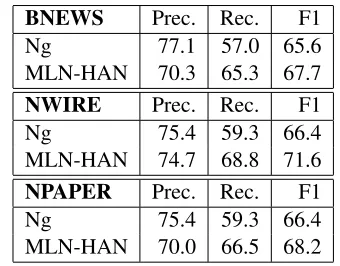
Table 4: Comparison of coreference results inB3scores
on the ACE-2 datasets.
BNEWS Prec. Rec. F1
Ng 77.1 57.0 65.6
MLN-HAN 70.3 65.3 67.7 NWIRE Prec. Rec. F1
Ng 75.4 59.3 66.4
MLN-HAN 74.7 68.8 71.6 NPAPER Prec. Rec. F1
Ng 75.4 59.3 66.4
MLN-HAN 70.0 66.5 68.2
art supervised system (McCallum & Wellner, 2005). Leveraging apposition resulted in another large im-provement, and predicate nominals also helped. Our full model scores about 9% higher than Haghighi & Klein (2007), and about 6% higher than McCallum & Wellner (2005). To our knowledge, this is the best coreference accuracy reported on MUC-6 to date.7 TheB3scores of MLN-HAN on the MUC-6 dataset are 77.4 (precision), 67.6 (recall) and 72.2 (F1). (The other systems did not report B3.) Interest-ingly, the rule-based MLN (RULE) sufficed to out-perform Haghighi & Klein (2007), and by using bet-ter heads and the apposition and predicate-nominal rules (RULE-HAN), it outperformed McCallum & Wellner (2005), the supervised system. The MLNs with learning (MLN-30 and MLN-HAN), on the
7
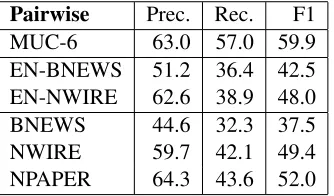
[image:8.612.340.510.308.441.2]Table 5: Our coreference results in precision, recall, and F1 for pairwise resolution.
Pairwise Prec. Rec. F1
MUC-6 63.0 57.0 59.9
EN-BNEWS 51.2 36.4 42.5 EN-NWIRE 62.6 38.9 48.0
BNEWS 44.6 32.3 37.5
NWIRE 59.7 42.1 49.4
NPAPER 64.3 43.6 52.0
Table 6: Average gold number of clusters per document vs. the mean absolute error of our system.
# Clusters MUC-6 EN-BN EN-NW
Gold 15.4 22.3 37.2
Mean Error 4.7 3.0 4.8
# Clusters BNEWS NWIRE NPAPER
Gold 20.4 39.2 55.2
Mean Error 2.5 5.6 6.6
other hand, substantially outperformed the corre-sponding rule-based ones.
Table 2 compares our system to Haghighi & Klein (2007) on the ACE-2004 training set in MUC scores. Again, our system outperformed theirs by a large margin. TheB3 scores of MLN-HAN on the
ACE-2004 dataset are 71.6 (precision), 68.4 (recall) and 70.0 (F1) for BNEWS, and 75.7 (precision), 69.2 (recall) and 72.3 (F1) for NWIRE. (Haghighi & Klein (2007) did not reportB3.) Due to license re-strictions, we could not compare directly to Culotta et al.(2007), who reported overallB3-F1 of 79.3 on
the formal test set.
Tables 3 and 4 compare our system to two re-cent supervised systems, Ng (2005) and Denis & Baldridge (2007). Our approach significantly outperformed Ng (2005). It tied with Denis & Baldridge (2007) on NWIRE, and was somewhat less accurate on BNEWS and NPAPER.
Luo et al. (2004) pointed out that one can ob-tain a very high MUC score simply by lumping all mentions together. B3 suffers less from this prob-lem but is not perfect. Thus we also report pairwise resolution scores (Table 5), the gold number of clus-ters, and our mean absolute error in the number of clusters (Table 6). Systems that simply merge all mentions will have exceedingly low pairwise
preci-sion (far below 50%), and very large errors in the number of clusters. Our system has fairly good pair-wise precisions and small mean error in the number of clusters, which verifies that our results are sound.
6.4 Error Analysis
Many of our system’s remaining errors involve nom-inals. Additional features should be considered to distinguish mentions that have the same head but are different entities. For pronouns, many remaining er-rors can be corrected using linguistic knowledge like binding theory and salience hierarchy. Our heuris-tics for identifying appositives and predicate nomi-nals also make many errors, which often can be fixed with additional name entity recognition capabilities (e.g., given “Mike Sullivan, VOA News”, it helps to know that the former is a person and the latter an organization). The most challenging case involves phrases with different heads that are both proper nouns (e.g., “Mr. Bush” and “the White House”). Handling these cases requires domain knowledge and/or more powerful joint inference.
7 Conclusion
This paper introduces the first unsupervised coref-erence resolution system that is as accurate as su-pervised systems. It performs joint inference among mentions, using relations like apposition and predi-cate nominals. It uses Markov logic as a representa-tion language, which allows it to be easily extended to incorporate additional linguistic and world knowl-edge. Future directions include incorporating addi-tional knowledge, conducting joint entity detection and coreference resolution, and combining corefer-ence resolution with other NLP tasks.
8 Acknowledgements
References
Amit, B. & Baldwin, B. 1998. Algorithms for scoring coreference chains. InProc. MUC-7.
Bakir, G.; Hofmann, T.; Sch¨olkopf, B.; Smola, A.; Taskar, B. and Vishwanathan, S. (eds.) 2007. Pre-dicting Structured Data. MIT Press.
Culotta, A.; Wick, M.; Hall, R. and McCallum, A. 2007. First-order probabilistic models for coreference reso-lution. InProc. NAACL-07.
Denis, P. & Baldridge, J. 2007. Joint determination of anaphoricity and coreference resolution using integer programming. InProc. NAACL-07.
Getoor, L. & Taskar, B. (eds.) 2007. Introduction to Statistical Relational Learning. MIT Press.
Haghighi, A. & Klein, D. 2007. Unsupervised corefer-ence resolution in a nonparametric Bayesian model. In
Proc. ACL-07.
Kautz, H.; Selman, B.; and Jiang, Y. 1997. A general stochastic approach to solving problems with hard and soft constraints. InThe Satisfiability Problem: Theory and Applications. AMS.
Klein, D. & Manning, C. 2003. Accurate unlexicalized parsing. InProc. ACL-03.
Kok, S.; Singla, P.; Richardson, M.; Domingos, P.; Sumner, M.; Poon, H. & Lowd, D. 2007. The Alchemy system for statistical relational AI. http://alchemy.cs.washington.edu/.
Lowd, D. & Domingos, D. 2007. Efficient weight learn-ing for Markov logic networks. InProc. PKDD-07. Luo, X.; Ittycheriah, A.; Jing, H.; Kambhatla, N. and
Roukos, S. 2004. A mention-synchronous corefer-ence resolution algorithm based on the bell tree. In
Proc. ACL-04.
McCallum, A. & Wellner, B. 2005. Conditional models of identity uncertainty with application to noun coref-erence. InProc. NIPS-04.
Ng, V. 2005. Machine Learning for Coreference Resolu-tion: From Local Classification to Global Ranking. In
Proc. ACL-05.
Poon, H. & Domingos, P. 2006. Sound and efficient inference with probabilistic and deterministic depen-dencies. InProc. AAAI-06.
Poon, H. & Domingos, P. 2007. Joint inference in infor-mation extraction. InProc. AAAI-07.
Poon, H. & Domingos, P. 2008. A general method for reducing the complexity of relational inference and its application to MCMC. InProc. AAAI-08.
Richardson, M. & Domingos, P. 2006. Markov logic networks. Machine Learning62:107–136.
Vilain, M.; Burger, J.; Aberdeen, J.; Connolly, D. & Hirschman, L. 1995. A model-theoretic coreference scoring scheme. InProc. MUC-6.