163
When science journalism meets artificial intelligence : An interactive
demonstration
Raghuram Vadapalli1∗, Bakhtiyar Syed1∗, Nishant Prabhu1∗, Balaji Vasan Srinivasan2, Vasudeva Varma3
1, 3IIIT Hyderabad,2Adobe Research
{raghuram.vadapalli, syed.b, nishant.prabhu}@research.iiit.ac.in balsrini@adoWhen be.com, [email protected]
Abstract
We present an online interactive tool1that gen-erates titles of blog titles and thus take the first step toward automating science journal-ism. Science journalism aims to transform jargon-laden scientific articles into a form that the common reader can comprehend while en-suring that the underlying meaning of the arti-cle is retained. In this work, we present a tool, which, given the title and abstract of a research paper will generate a blog title by mimicking a human science journalist. The tool makes use of a model trained on a corpus of87,328 pairs of research papers and their correspond-ing blogs, built from two science news aggre-gators. The architecture of the model is a two-stage mechanism which generates blog titles. Evaluation using standard metrics indicate the viability of the proposed system.
1 Introduction
With approximately2.5million new scientific pa-pers being published every year (Jinha, 2010), there is an ever growing need to make this vast trove of scientific knowledge accessible to the common man. This accessibility of scientific knowledge plays an important role in key politi-cal, economic, cultural and social policy discus-sions and also in public dialogue. Websites like sciencedaily.com, phys.org, eurekalert.orgaim to address this problem by aggregating and showcas-ing the top science news stories from the worlds leading universities and research organizations.
News-writing bots have captured the headlines in the recent past, leading to the growing popular-ity of “Robo Reporting”2,3. However, extending
∗
* The authors contributed equally.
1
https://irel.iiit.ac.in/science-ai/ 2
Washington Post’s robot reporter has published 850 arti-cles.
3New York Times is using bots to create more one-to-one
experiences.
this framework to be used for science journalism is a non-trivial task as that would entail understand-ing scientific content and translatunderstand-ing it to simpler language without distorting its underlying seman-tics. To our knowledge, there have been no prior attempts within the scientific community to extend “Robo Reporting” to science journalism, and this dearth of research in this area can be partially at-tributed to the lack of suitable data for AI algo-rithms to be trained. To address this lack of an appropriate training corpus, we have created a par-allel corpus of scientific paper titles and abstracts, and their corresponding blog titles with the aim of initiating this foray into automated science jour-nalism and engendering further research.
This initiative is an initial step towards the larger goal of understanding the entire research paper and generating a complete blog. The sys-tem makes use of a pipeline-based architecture that uses a combination of the title of the research paper and its abstract to generate the title of the blog. Sample of an abstract, paper title and its cor-responding blog title is given in Table1.
Table 1: Sample - Blog Title, Paper Title and Abstract from our corpus
Blog title: Applying machine learning to the universe’s mysteries
Paper title: An equation-of-state-meter of quantum chromodynamics transition from deep learning
Abstract:A primordial state of matter consist-ing of free quarks and gluons... Here we use supervised learning with a deep convolutional neural network to identify the EoS employed...
Figure 1: Layout of the web application for our prototype, demonstrating blog title generation
paper and then it it uses the extracted informa-tion to generate the blog title. The state-of-the-art sequence-to-sequence neural networks for nat-ural language generation like the Pointer Genera-tor Network (See et al.,2017) are used in the sec-ond stage of the pipeline. The generated blog titles are evaluated using all standard metrics for natu-ral language generation tasks and the results indi-cate the viability of the proposed model to produce semantically sound blog titles. Our contributions can be summed up as follows:
1. A new parallel corpus of87,328pairs of re-search paper titles and abstracts and their cor-responding blog titles.
2. Demonstrating the web application, which uses a pipeline-based architecture that can generate blog titles in a step-by-step fashion, while enabling the user to choose between various heuristic functions as well as the neu-ral model to be used for generating the blog title.
3. Analyzing the outcomes of the experiments conducted to find the best heuristic function as well as network architecture.
We have thus taken the first steps towards build-ing an automated science journalism system by generating blog titles with a long-term vision of
generating an entire blog from a given research pa-per - thereby paving the way for future research in the area.
2 Related Work
Recently, a lot of activity in the space of ad-vances in natural language generation has resulted from pioneering works in building sequence-to-sequence neural networks. Among these ad-vances, two particular areas relevant to the prob-lem we have formulated areneural headline gen-erationandstyle transfer.
Figure 2: Model of pipeline architecture, describing the two stages in which we model blog title generation
Existing literature innon-parallel style trans-ferassumes the unavailability of sufficient paral-lel data (Shen et al., 2017;Fu et al., 2018; Kab-bara and Cheung,2016). In first trying to address the problem of style transfer on non-parallel data, Shen et al. (2017) tried to separate the content from the style of the article. It was assumed that a shared latent content distribution exists across dif-ferent text corpora, and proposed a method that leveraged refined alignment of latent representa-tions to perform style transfer. WhileShen et al. (2017) demonstrated their results on sentiment transfer, this cannot be accepted as style transfer from a linguistic point of view.
In other recent works, Fu et al.(2018) address the style-transfer problem by learning separate content and style representations using adversarial networks. Their reported results are on their cus-tom Paper-News Title dataset and the samples re-ported by the authors either copy the entire source text or replace a few words. Their evaluation crite-ria leaves a lot to be desired as they evaluate trans-fer strength using a classifier and content preser-vation using word embeddings. A lack of parallel data again presents a drawback. While Kabbara and Cheung(2016) presented a variant of an auto-encoder where the latent representation had two separate components: one for style and one for content, the authors do not report results on any dataset and hence is not useful in our context.
One key assumption across all the non-parallel style transfer works is a significant overlap be-tween the vocabulary of the source and target style. On the other hand, in the context of sci-ence journalism - the overlap in vocabulary
be-tween the source and the target is not significant which is one of the prime reasons why the non-parallel style transfer methods cannot be directly extended to our problem. This puts our problem in the bracket of content re-purposing, for which we give a demonstrable prototype.
3 Parallel Corpus for Science Journalism
In the process of building a solution to address the problem of automated science journalism, we built a corpus of parallel data consisting of sci-entific papers and their corresponding blog arti-cles from two science news aggregation websites: sciencedaily.com and phys.org. Both these web-sites publish articles explaining the latest scien-tific advancements and are rich sources of parallel data. Though we were able to obtain over300,000 blog titles, only around 100,000 of those arti-cles had links to original research papers. These 100,000or so research papers were published on over1000different research publication websites and we used manual rules to extract abstracts and titles from the research papers that were published on the more frequent research publication web-sites likenature.com, pnas.org. Our final dataset comprises of 87,328 (blog title, paper title, ab-stract) triples.
Out of87,328triples,77,604are obtained from sciencedaily.com, 9724 tuples are obtained from phys.org. The statistical analysis of the dataset is as presented below:
1. Average length of blog titles:9.55words 2. Average length of research paper titles:12.07
words
179.54words
4. Average word overlap between blog titles and paper titles:1.93words
5. Average word overlap between the paper ab-stracts and blog titles:3.64words.
The models must therefore learn which words in the target vocabulary correspond to which words in the source, so that the generated output adheres to the target style.
4 Blog Title Generation
Figure2illustrates the proposed architecture. Our demonstrable prototype consists of a two-stage pipeline, which is described in detail as follows:
1. A heuristic function takes the title and ab-stract of the research paper and extracts rel-evant information which is then used for fur-ther processing.
2. The output of the previous step is fed into a sequence-to-sequence neural generation model in order to generate the title of the blog post.
The dataset is of the format T =
{ (bt, pt, abs) }, where, bt is the blog ti-tle, pt is the paper title and abs is the abstract. We define a heuristic function H(pt, abs)
which takes a paper title and abstract as param-eters and outputs a sequence s. The various heuristic functions H we explored are outlined below:
H(pt, abs) = pt: In this heuristic, we as-sume that the paper title will encapsulate sufficient information to generate the blog title.
H(pt, abs) = RP(abs) : TF-IDF based measure that selects the sentence that best repre-sents the abstract. (Allahyari et al.,2017)
H(pt, abs) = RD(abs) : Flesch Reading Ease based measure that selects the most readable sentence in the abstract.
H(pt, abs) =RPD(abs): Selects the sen-tence that maximizes the product of normalized
RD(abs)andRP(abs)scores, where normal-ization is performed across all sentences.
We also experimented with different combina-tions of the above heuristics: H(pt, abs) =
pt| RD(abs),H(pt, abs) =pt| RP(abs),
H(pt, abs) = pt | RPD(abs) and
H(pt, abs) = pt| abs; where| implies
con-catenation of the associated heuristics.
In stage 2, neural natural language generation models are used to generate the blog title. The sys-tem provides a baselineattention networkwhich defines ‘attention’ over the input sequence to allow the network to focus on specific parts of the input text and thepointer-generator (See et al.,2017) network which extends the attention-network to compute a probability Pgen that decides whether
the next word in sequence should be copied from the source or generated from the rest of the vo-cabulary. The pointer-generator aids in copying factual information from the source, and we hy-pothesize that this will be useful when generat-ing blog titles. Formally, the sequencesobtained from the first stage is the input to the neural natural language generation model which generatesbt0as output with a loss functionL(bt, bt0), given by sum of cross entropy loss at all time-steps:
L(bt, bt0)=− t=T
X
t=0
P(bt0t)
5 Demonstration
BLEU ROUGE L CIDEr
SkipThought
Sim. Reading EaseFlesch
H(pt, abs) PG Attn PG Attn PG Attn PG Attn PG Attn
pt 0.157 0.149 0.157 0.138 0.453 0.433 0.430 0.432 46.481 43.069
abs 0.135 0.095 0.136 0.089 0.359 0.123 0.444 0.119 45.484 39.021
RD(abs) 0.091 0.142 0.09 0.137 0.161 0.450 0.403 0.431 57.468 47.521 RP(abs) 0.101 0.143 0.105 0.134 0.183 0.571 0.414 0.429 46.338 41.179
RPD(abs) 0.096 0.134 0.097 0.126 0.179 0.543 0.415 0.428 43.89 40.761
pt| RD(abs) 0.139 0.152 0.129 0.145 0.351 0.754 0.435 0.444 49.504 42.964
pt| RP(abs) 0.142 0.153 0.137 0.144 0.372 0.745 0.431 0.448 40.856 35.311
pt| RPD(abs) 0.151 0.152 0.158 0.140 0.399 0.759 0.435 0.433 40.193 44.339
[image:5.595.75.522.66.234.2]pt|abs 0.171 0.096 0.172 0.091 0.523 0.123 0.446 0.219 41.307 45.641
Table 2: Performance of the various heuristic functions contrasted with the proposed sequence-to-sequence generation framework
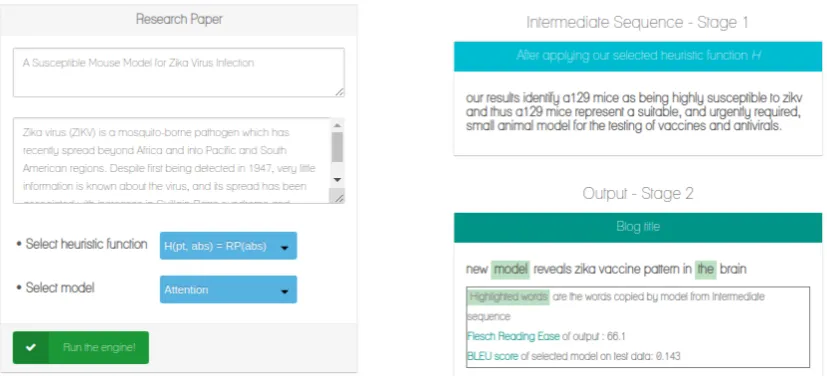
Figure 3: Results in the application
It is important to note that our research proto-type is still in a nascent stage and the problem of automated science journalism is far from being solved. The same heuristic function or neural gen-eration model might not exhibit the best results for all possible inputs. Thus, it is of exceptional im-portance to provide the users fine grained control over the individual components of the model. The system does this by allowing the user the freedom to select a heuristic function and neural genera-tion model of their choice. This allows for more flexibility for the users to experiment with vari-ous heuristic functions and neural generation mod-els and ensures better results than forcing the user to use one particular configuration for all inputs.
If not selected by the user, the heuristic function
H(pt, abs) = pt and the attention network
neural generation model are used as defaults as this configuration has consistently exhibited good results.
In order to further facilitate experimentation by the user, the web application shows the perfor-mance of the user-selected configuration on our test dataset, it displays the readability scores of the generated output, and also highlights the words in the output that were copied from the source. All these features give anyone using this system a de-tailed view of how various configurations work and provide the flexibility to select the one that works best of their use-case. Figure3 showcases the above mentioned features.
6 Evaluation and Analysis
We evaluate the generated titles using various met-rics surveyed by Sharma et al. (2017) for task-oriented language generation.
1. BLEU (Papineni et al., 2002): It uses a modified precision to compare generated text against multiple reference texts
2. ROUGE L (Lin, 2004): It is an F-measure that is based on the Longest Common Subse-quence (LCS) between the candidate and ref-erence utterances
3. CIDEr (Vedantam et al., 2015): It is based on n-gram overlap
5. Flesch Reading Ease(Flesch,1948): It mea-sures the readability of the sentence based on the number of syllables and words
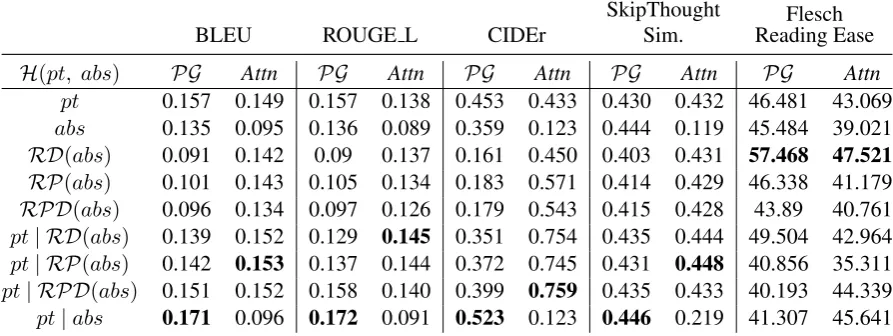
Table2shows the performance of our proposed input functions of the architecture contrasted with the proposed neural generation models pointer-generator (abbr. PG) and the attention-network (abbr. Attn).
The blogs had aFlesch Reading Easeof around 30-35, while the research paper’s reading ease was between 15-20. Our generated samples have a reading ease (>30) highlighting the transfer in style from research paper to the blog. The higher FREindicates that the generated titles are easier to understand than the paper titles.
To further shed some light on the quality of the generated blog titles, Table3shows a few sampled sentences generated by the best performing mod-els in our architecture. Based on our experiments, we conclude that our system learns to generate ti-tles similar to a human expert for scientific blogs.
Table 3: Samples generated by our prototype
Blog title: Safer alternatives to nonsteroidal antinflamatory pain killers
Model-generated title: New hope for treating inflammatory cardiovascular disease
Blog title: The effects of soy and whey protein supplementation on acute hormonal responses to resistance exercise in men
Model-generated title: Soy protein supple-mentation linked to resistance exercise in men
Blog title: Scientists reconcile three unrelated theories of schizophrenia
Model-generated title:A new way to fight psy-chiatric disorders
7 Conclusion and Future Work
This work serves as a baseline first attempt toward automating science journalism. We proposed an architecture with a two stage pipeline and have de-veloped a demonstrable web application that ac-cepts the title and abstract of a research paper and outputs a blog title, while also giving the user the flexibility to tinker with the individual components of the system. Future work would include using more advanced architectures to generate the body of the blog.
References
Mehdi Allahyari, Seyed Amin Pouriyeh, Mehdi Assefi, Saeid Safaei, Elizabeth D. Trippe, Juan B. Gutier-rez, and Krys Kochut. 2017. Text summarization
techniques: A brief survey. International Journal of Advanced Computer Science and Applications.
Ayana, Shi-Qi Shen, Yan-Kai Lin, Cun-Chao Tu, Yu Zhao, Zhi-Yuan Liu, and Mao-Song Sun. 2017. Recent advances on neural headline generation.
Journal of Computer Science and Technology.
Rudolph Flesch. 1948. A new readability yardstick.
Journal of Applied Psychology.
Zhenxin Fu, Xiaoye Tan, Nanyun Peng, Dongyan Zhao, and Rui Yan. 2018. Style transfer in text: Ex-ploration and evaluation. AAAI.
Arif E. Jinha. 2010. Article 50 million: an estimate of the number of scholarly articles in existence.
Learned Publishing.
Jad Kabbara and Jackie Chi Kit Cheung. 2016. Stylis-tic transfer in natural language generation systems using recurrent neural networks. In Proceedings of the Workshop on Uphill Battles in Language Processing: Scaling Early Achievements to Robust Methods.
Ryan Kiros, Yukun Zhu, Ruslan R Salakhutdinov, Richard Zemel, Raquel Urtasun, Antonio Torralba, and Sanja Fidler. 2015. Skip-thought vectors. In
Advances in Neural Information Processing Systems 28.
Chin-Yew Lin. 2004. Rouge: A package for automatic evaluation of summaries. InProc. ACL workshop on Text Summarization Branches Out.
Kishore Papineni, Salim Roukos, Todd Ward, and Wei-Jing Zhu. 2002. Bleu: A method for automatic eval-uation of machine translation. In40th Annual Meet-ing on Association for Computational LMeet-inguistics.
Abigail See, Peter J. Liu, and Christopher D. Manning. 2017. Get to the point: Summarization with pointer-generator networks. In55th Annual Meeting of the Association for Computational Linguistics.
Shikhar Sharma, Layla El Asri, Hannes Schulz, and Jeremie Zumer. 2017. Relevance of unsupervised metrics in task-oriented dialogue for evaluating nat-ural language generation. CoRR.
Tianxiao Shen, Tao Lei, Regina Barzilay, and Tommi S. Jaakkola. 2017. Style transfer from non-parallel text by cross-alignment. Advances in Neural Informa-tion Processing Systems.