Cross-Lingual Discriminative Learning of Sequence Models
with Posterior Regularization
Kuzman Ganchev Google Research
76 9th Avenue New York, NY 10011 [email protected]
Dipanjan Das Google Research
76 9th Avenue New York, NY 10011 [email protected]
Abstract
We present a framework for cross-lingual transfer of sequence information from a rich source language to a resource-impoverished target language that incorporates soft constraints via posterior regularization. To this end, we use automatically word aligned bitext between the source and target language pair, and learn a discriminative conditional ran-dom field model on the target side. Our poste-rior regularization constraints are derived from simple intuitions about the task at hand and from cross-lingual alignment information. We show improvements over strong baselines for two tasks: part-of-speech tagging and named-entity segmentation.
1 Introduction
Supervised systems for NLP tasks are available for a handful of languages. These systems achieve high accuracy for many applications; a variety of robust algorithms to train them from labeled data have been developed. Here, we focus on learning sequence mod-els for the languages that lack annotated resources. For a given resource-poor target language of inter-est, we assume that parallel data with a resource-rich source language exists. With the help of this bitext and a supervised system in the source language, we infer constraints over the label distribution in the tar-get language, and train a discriminative model using posterior regularization (Ganchev et al., 2010).
Cross-lingual learning of structured prediction models via parallel data has been applied for several natural language processing problems, including part-of-speech (POS) tagging (Yarowsky and Ngai, 2001), syntactic parsing (Hwa et al., 2005) and named-entity recognition (Kim et al., 2012). These methods are
useful in several ways. First, they help in fast proto-typing of natural language systems for new languages that do not boast human annotations. Second, the output of such systems could be used to bootstrap more extensive human annotation projects (Vlachos, 2006). Finally, they are significantly more accurate than purely unsupervised systems (McDonald et al., 2011; Das and Petrov, 2011).
Recently, T¨ackstr¨om et al. (2013) presented a tech-nique for coupling token constraints derived from pro-jected cross-lingual information and type constraints derived from noisy tag dictionaries to learn POS tag-gers. Although this technique resulted in state-of-the-art weakly supervised taggers, the authors used a heuristic to combine the aforementioned two sources of constraints: the dictionary constraints pruned the tagger’s search space, and the intersected token-level projections were treated as hard observations. On the other hand, Ganchev et al. (2009) presented a framework for learning weakly-supervised systems (in their case, dependency parsers) that incorporated alignment-based information too, but used the cross-lingual information only as soft constraints, via poste-rior regularization. The advantage of this framework lay in the fact that the projections were only trusted to a certain degree, determined by a strength hyper-parameter, which unfortunately the authors did not have an elegant way to tune. In this paper, we ex-ploit the better aspects of these two lines of work: first, we extend the framework of T¨ackstr¨om et al. by treating the alignment-based projections only as soft constraints (see§3.4); second, we choose the constraint strength by utilizing the tag ambiguity of tokens for a given resource-poor language (see§6.1).
Other than validating our framework on part-of-speech tagging, we experiment on named-entity seg-mentation in a cross-lingual framework. For this
task, we present a novel method to perform high-precision phrase-level entity transfer (§5.2.2); we also provide ways to balance precision and recall with posterior regularization (§6.2) by incorporating intuitive soft constraints during learning. We mea-sure performance on standard benchmark datasets for both of these tasks, and report improvements over state-of-the-art baselines.
2 Prior Work
Cross-lingual projection methods can be classified by their use of two very broad ideas. The first idea utilizes parallel data to create full or partial annota-tions in the low-resource language and trains from this data. This was popularized by Yarowsky and Ngai (2001) who applied this to POS tagging and shallow parsing. It was later applied to parsing (Hwa et al., 2005) and named entity recognition (Kim et al., 2012). The second idea, first proposed by Ze-man and Resnik (2008) and applied more broadly by McDonald et al. (2011), is to train a model on a rich language and apply it to a resource-poor language directly. The disparity between the languages is mitigated by the choice of features. In addition to cross-lingual projection, purely unsuper-vised methods have been explored but with limited success (Christodoulopoulos et al., 2010). Here, we resort to cross-lingual projection and incorporate the first idea; we also follow Li et al. (2012) and use Wiktionary to further constrain the POS tagging task.
Our learning setup is similar to that of Ganchev et al. (2009), who also use posterior regularization but focus on dependency parsing alone. Our work differs with respect to the tasks, the learning algorithm and also in that we use corpus-wide constraints, while Ganchev et al. use one constraint per sentence. For the part-of-speech tagging task, our approach is sim-ilar to that of T¨ackstr¨om et al. (2013), who use an almost identical learning setup but only make use of hard constraints. By relaxing these constraints, we allow the model to identify and ignore inconsistently labeled parts of sentences, and achieve better results using identical training and test data.
3 Approach
We give an overview of our approach, and present the details of our model used for cross-lingual learning.
Algorithm 1Cross-Lingual Learning with Posterior Regularization
Require: Parallel source and target language data
DeandDf, source language model(M)e, task-specific target language constraintsC.
Ensure: Θf, a set of target language parameters. 1: De↔f ←word-align-bitext(De,Df)
2: Dce←label-supervised(De)
3: Dcf ←project-and-filter-labels(De↔f,Dce) 4: Θf ←learn-posterior-constrained(Dcf,C) 5: ReturnΘf
3.1 General Overview
The general overview of our framework is provided in Algorithm 1. The process of learning parame-ters for a target language for a given task involves four subtasks. First, we run word alignment over a large corpus of parallel data between the resource-rich source language and the resource-impoverished target language (see §4.3). In the second step, we use a supervised model to label the source side of the parallel data (see§5.1.1 and§5.2.1). The third step involves a task-specific word-alignment filter-ing step; this step involves heuristics for which we use cues from prior state-of-the-art (Das and Petrov, 2011; T¨ackstr¨om et al., 2013, see§5.1.2) and also introduce some novel ones for the NE segmentation problem (see§5.2.2). In the fourth step, we train a linear chain conditional random field (Lafferty et al., 2001, CRF henceforth) using posterior regularization. In the next subsection, we turn to a brief summary of this final step of estimating parameters of a discrimi-native model with posterior regularization.
3.2 Learning with Posterior Regularization
In this work, we utilize discriminative CRF mod-els, and use posterior regularization (PR) to optimize their parameters. As a framework, posterior regular-ization is described in detail by Ganchev et al. (2010). However in our work, we adopt a different optimiza-tion technique; in what follows, we summarize the optimization algorithm in the context of CRF models.
a corpus of sentences and labelings for the corpus respectively. A CRF models the probability distri-bution over possible labels for a sentencepθ(y|x) as:
pθ(y|x)∝exp(θ·f(x,y)) (1)
whereθare the model parameters andf(.)is a fea-ture function. The model examines sentences in iso-lation, and the probability of a particular labeling for a corpus is defined as a product over the individual sentences:
pθ(Y |X) =
Y
(x,y)∈(X,Y)
pθ(y|x). (2)
Traditionally, CRF models have been trained to op-timize the regularized log-likelihood of the training data
max
θ L(θ) = maxθ log(pθ(Y|X))−γ||θ|| (3) In our setting, we do not have a fully labeled cor-pus, but we have constraints on the distribution of labels. For example, we may know that a particular token could be labeled only by a label inventory li-censed by a dictionary, or that a labeling projected from a source language is usually (but not always) correct. We define these constraints in terms of fea-ture expectations. Letq(Y)be a distribution over all possible labelings of our corpusY(X). LetQbe a set of distributions defined by:
Q={q(Y) :Eq[φ(X,Y)]≤b}, (4)
whereφis aconstraintfeature function andbis a vec-tor of non-negative values that serve as upper bounds to the expectations of every constraint feature. The vectorbis used to encode our prior knowledge about desirable distributionsq(Y). Note that the constraint featuresφare not related to the model featuresf. The model features, together with the model parametersθ
define the CRF model; the model features need to be computed at inference time for prediction. By con-trast, the constraint features and their corresponding constraint values are used to define our training ob-jective function (and are only used during learning). The PR objective with no labeled data is defined with respect toQas:
PR: max
θ JQ(θ) =
max
θ −KL(Qkpθ(Y |X))−γ||θ|| (5)
where KL(Q||p) = minq∈QKL(q||p) is the
KL-divergence (Kullback and Leibler, 1951) from a set to a point. Note that as we add more constraints, Q becomes a smaller set. In the limit,Q = {q(Y) : q( ˆY) = 1} contains just one distribution concentrated on a single labeling Yˆ. In this limit, posterior regularization degenerates into the convex log-likelihood objective normally used for supervised dataJQ(θ) =L(θ). However,
in the general case, the PR objective JQ is not
necessarily convex. Prior work, including that of Ganchev et al. propose an algorithm similar to Expectation-Maximization (Dempster et al., 1977, EM henceforth) to optimizeJQ, but we follow Liang
et al. (2009) in using a schochastic update-based algorithm described below.
Note: To make it easier to reason about constraint valuesb, we scale constraint featuresφ(X,Y)to lie in[0,1]by computingmaxYφ(X,Y)for the corpus
to whichφis applied.
3.3 Optimization
The optimization procedure proposed by
Ganchev et al. is similar to the EM algorithm, and computes the minimization minq∈QKL(q||p)
at each step, using its dual form; this minimization is convex, so there is no duality gap. They show that the optimal primal variablesq∗(Y)are related to the optimal dual variablesλ∗ by:
q∗(Y) =pθ(Y|X)e
−λ∗·φ(X,Y)
Z(λ∗) . (6)
whereZ(λ∗)is the normalizer. The dual problem is given by:
max
λ≥0 −b·λ−logZ(λ). (7)
Substituting Eq. 7 into the objective in Eq. 5, we get the saddle-point problem:
max
θ minλ≥0 b·λ+ log
X
Y
pθ(Y|X)e−λ
∗·φ(X,Y)
−γ||θ||. (8)
To optimize the above objective function, we need to compute partial derivatives with respect to bothθand
with respect toθ, we need to find expectations of the model featuresf given the current distributionpθand the constraint distributionq. To perform tractable inference, a linear-chain CRF model assumes that the feature function factorizes according to smaller parts; in particular the factorization uses the follow-ing structure:
f(x,y) =X
i
f(x, yi, yi−1) (9)
whereiranges over the tokens in the sentence. This factorization allows us to efficiently compute expec-tations over the labelsyi and label-pairs(yi, yi+1). To compute the partial gradient of Eq. 8 with respect to λ, we need to find the expectations of the con-straint featuresφ. In order to be tractable here too, we ensure thatφalso factorize according to the same structure asf. Therefore, the gradient computation w.r.t. λturns out to be straightforward.
For all the experiments in this paper, we optimize Eq. 8 using stochastic projected gradient. For each training sentence, we compute the gradient ofθand
λwith respect to Eq. 8, take a gradient step in each one, and truncate the negative entries inλto zero. We use a step size of 1 for all experiments.1
3.4 Relationship with T¨ackstr¨om et al. (2013)
In this subsection, we focus briefly on the relationship between this work and the work of T¨ackstr¨om et al. (2013), who focused on constrained learning of POS taggers. T¨ackstr¨om et al. define constrained lattices and train by optimizing marginal conditional log-likelihood. In our notation, they define their objective as:
max
θ log X
Y∈Yb(X)
pθ(Y|X)−γkθk (10)
whereYb(X)are the constrained lattices of label
se-quences that agree with both a dictionary and cross-lingually projected POS tags for each sentence of the training corpus. Let us define a constraint fea-tureφ(X,Y)which counts the number of tags inY which are outside the constraint setYb(X)and require φ(X,Y)≤0. Note that,
arg min
q
KL(q||pθ(Y|X)) s.t. φ(X,Y)≤0
1
Note that we did not implement regularization ofθin the stochastic optimizer, hence our PR objective (Eq. 8) was unregu-larized; however, the baseline models use`2regularization.
gives the same distribution as Eq. 10. Given this equivalence, it is easy to see that the gradient of Eq. 5 with respect toθis the same as that of Eq. 10. By using such constrained lattices, T¨ackstr¨om et al. avoid maintaining a parameter for the constraint, but lose the ability to relax the constraint value and al-low some probability mass outside the pruned lat-tice. Their paper also differs from ours in that they use L-BFGS (Liu and Nocedal, 1989), while we use an online optimization procedure. Since the objec-tives are non-convex, the two optimization techniques could lead to different local optima even when the constraint is not relaxed (b= 0).
4 Tasks and Data
In this section, we focus on the nature of the two tasks that we attempt to solve, describe the source language datasets we use to train our supervised models for transfer, the target language datasets on which we evaluate our models and the parallel data we use for cross-lingual transfer.
4.1 Part-of-Speech Tagging
First, we focus on the task of part-of-speech tagging. Following previous work on cross-lingual POS tag-ging (Das and Petrov, 2011; T¨ackstr¨om et al., 2013), we adopt the POS tags of Petrov et al. (2012), ver-sion 1.03;2we use the October 2012 version of Wik-tionary3as our tag dictionary.
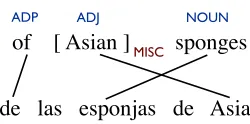
After pruning the search space with the dictionary, we place soft constraints derived by projecting POS tags across word alignments. The alignments are fil-tered for confidence (see§5.1.2), but we also filter any projected tags that are not licensed by the dictio-nary. The example in Figure 1 illustrates why this dictionary filtering step is important. Consider the English-Spanish phrase pair from Figure 1, which we observed in our training data. Our supervised tag-ger correctly tagsAsianwith theADJtag as shown in the figure. Asianis aligned to the Spanish word Asia, which should be tagged NOUN. Because the Spanish Wiktionary only allows theNOUNtag for Asia, we do not project theADJtag from the English wordAsian. By contrast, we do project theNOUN tag from the English wordspongesto the Spanish
2
http://code.google.com/p/universal-pos-tags
of [ Asian ] sponges
de las esponjas de Asia
ADP ADJ NOUN
[image:5.612.125.250.57.119.2]MISC
Figure 1: An English (top) – Spanish (bottom) phrase pair from our parallel data. The correct POS tags and NER annotations are shown for the English phrase. Word align-ments are shown as links between English and Spanish words.
wordesponjasbecause this tag is in our dictionary for the latter word.
For all our POS experiments, we evaluate on sev-enteen target languages. Fifteen of these languages were part of the experiments conducted by T¨ackstr¨om et al. (2013); we add Arabic and Hungarian to the set. The first column of Table 1 lists all seventeen lan-guages using their two-letter abbreviation codes from the ISO 639-1 standard. The evaluation datasets cor-respond to the test sets from the CoNLL shared tasks on dependency parsing (Buchholz and Marsi, 2006; Nivre et al., 2007). For French we use the treebank of Abeill´e et al. (2003). English serves as our source language and we use the Penn Treebank (Marcus et al., 1993, with tags mapped to the universal tags) to train our supervised source-side model.
4.2 Named-Entity Segmentation
Second, we investigate the task of named-entity seg-mentation. The goal of this task is to identify the boundaries of named-entities for a given language without classifying them by type. This is the un-labeledversion of named-entity recognition, and is more amenable to cross-lingual supervision. To un-derstand why that is, consider again the example from Figure 1. The English supervised NE tagger correctly identifiesAsianas a named entity of type MISC (miscellaneous). The word-alignments sug-gest we should transfer this annotation to the Spanish word Asiawhich is also an entity. However, this should be labeled LOC (location) according to the CoNLL annotation guidelines (Tjong Kim Sang and De Meulder, 2003). Because syntactic variations of this kind are common, it makes cross-lingual
de-tection of NE boundaries as well as types hard.4 In this paper, we focus on named-entity segmentation alone, consider the full NER task out of scope. We use English as a source language and train a super-vised English named-entity tagger with the labels in place, using the CoNLL 2003 shared task data (Tjong Kim Sang and De Meulder, 2003). We project the spans using the maximal-span heuristic (Yarowsky and Ngai, 2001). We project into Dutch, German and Spanish and evaluate on the standard CoNLL 2002 and 2003 shared task data sets (Tjong Kim Sang, 2002; Tjong Kim Sang and De Meulder, 2003).
4.3 Parallel Data
For both tasks we use parallel data gathered automat-ically from the web using the method of Uszkoreit et al. (2010), as well as data from Europarl (Koehn, 2005) and the UN parallel corpus (UN, 2006), for languages covered by the latter two corpora. The parallel sentences are word aligned with the aligner of DeNero and Macherey (2011). The size of the parallel corpus is larger than we need for our tasks, so we follow T¨ackstr¨om et al. (2013) in sampling 500k tokens for POS tagging and 10k sentences for named-entity segmentation (see§5.1.2 and§5.2.2).
5 Experimental Details
In this section, we provide details about task-specific implementations of the supervised source-side model and the word-alignment filtering tech-niques (steps 2 and 3 in Algorithm 1 respectively); we also briefly describe the setup of the cross-lingual experiments for each task.
5.1 Part-of-Speech Tagging
We first focus on the experimental setup for the POS tagging task. When describing feature sets we refer to features conjoined with just a single tag asemission featuresand with consecutive tag pairs astransition features.
4
5.1.1 Supervised Source-Side Model
We tag the English side of our parallel data with a supervised first-order linear-chain CRF POS tag-ger. We use standard features for tagging. Our emis-sion features are a bias feature, the current word, its suffixes up to length 3, its capitalization shape, whether it contains a hyphen, digit or punctuation and its cluster identity. Our transition features are a bias feature and the cluster identities of each word in the transition. For the cluster-based features, we use monolingual word clusters induced with the ex-change algorithm of Uszkoreit and Brants (2008), which implements the same objective as Brown et al. (1992); these clusters have shown improvements for sequence labeling tasks (Turian et al., 2010; T¨ack-str¨om et al., 2012). We set the number of clusters to 256 for both the source side tagger and all the other languages. On Section 23 of the WSJ section of the Penn Treebank, the source side tagger achieves an accuracy of 96.2%.
5.1.2 Word Alignment Filtering
Following T¨ackstr¨om et al. (2013), we tag the En-glish side of our parallel data using the source-side POS tagger, intersect the word alignments and filter alignments with confidence below 0.95. We sam-ple 500,000 tokens of target side sentences for each language, and use this as training data for learning weakly-supervised taggers.
5.1.3 Setup for Cross-Lingual Experiments
Following T¨ackstr¨om et al. (2013) we use a re-duced feature set for the cross-lingual models. The emission features are the same as the supervised model but without the punctuation feature,5and we use only the bias transition feature. Because this limits the ability of the model to use context, we also experiment with an extended feature set that has transition features for the clusters of each word in the transition, and their suffixes up to length 3. We refer to the extended-feature models as “BASE+” and “PR+” to distinguish them from the models with fewer features, labeled “BASE” and “PR”.
We train BASEand BASE+ using L-BFGS with an`2 regularization weight of 1 for 100 iterations to reproduce the setup used by T¨ackstr¨om et al. (2013).
5
The dictionary licenses punctuations, only by the ‘.’ tag.
We have only one constraint feature in our poste-rior regularization models that fires for the unpruned projected tags on words xi. This feature controls how often our model trusts a projected tag; we ex-plain how its strength is chosen in§6.1. The PR and PR+ models are trained using the stochastic gradient method described in§3.3.
5.2 Named-Entity Segmentation
In this subsection, we turn to the experimental details of the named-entity segmentation system.
5.2.1 Supervised Source-Side Model
To train our supervised source-side NER model, we implemented a linear-chain first order CRF model. Our feature set was inspired by the model of Kazama and Torisawa (2007,§6.1); we used all the local fea-tures from their model except the gazetteer feafea-tures, and added cluster emission features for offsets in the range [-2, 2] and transition features for offsets in the range [-1, 1] as well as a sentence-start feature. We use automatic POS tags for all the experiments.
We use a BIO encoding of the four NER labels (PER, LOC, ORG and MISC). We also experi-mented with omitting the NE labels from the tagger, still with a BIO encoding for segments, but the results were worse on average than what we report in Table 2. We train the source-side model on the CoNLL 2003 English training set with log-loss using L-BFGS for 100 iterations with`2 regularization weight of 0.1. The model gets 90.9% and 87.5% labeledF1on the CoNLL development and test sets respectively.6
5.2.2 Word-Alignment Filtering
Projecting named entities across languages can be error prone for several reasons. Mistakes intro-duced by the automatic word aligner is one of them. Word alignment errors are particularly problematic for entity mentions because of the garbage collector effect (Brown et al., 1993); due to differences in the word order between languages, a few alignment er-rors can result in many erer-rors in the other language. Additionally, entities can occur on just one side of the bitext.7 Another source of error is the automatic
6
These performance values would place us among the top three competitors of the CoNLL 2003 shared task.
7For example, “It’s all Greek to me.” in one language and “I
labeling on the source side, which is inaccurate if the parallel corpus is out of domain. To mitigate these errors, we aggressively filter the training data for this task. We discard sentence pairs where more than 30% of the source language tokens are unaligned, where any source entities are unaligned or where any source entities are more than 4 tokens long. We also compute a confidence score over entity anno-tations as the minimum posterior over the tags that comprise the entity and discard sentence pairs that have an entity with confidence below 0.9. Finally, we discard any sentences that contain no projected entities. These filtering steps allow us to keep 7.4%, 9.7% and 10.4% of the aligned sentence pairs for Ger-man, Spanish and Dutch, respectively, resulting in very high-precision named-entity projections (see Ta-ble 2). For comparison, we also perform experiments without this filtering step.
5.2.3 Setup for Cross-Lingual Experiments
We use a CRF with the same feature set and BIO encoding for the cross-lingual models as the source-side NER model. We compare our approach (“PR” in Table 2) to a baseline (“BASE” in Table 2) which treats the projected annotations as fully observed. The PR model treats the projected NE spans of a sentence as observed, and allows all labels on the remaining tokens. Since the “O” tag is never seen, an unconstrained model would learn to never predict it. We add two features that fire when the current word is tagged “O”: a bias feature and a feature that fires when the automatic POS tag is a proper noun. We set upQso the desired expectations are at least 0.98 and at most 0.1 for these constraint features respectively.
6 Results
In this section, we turn to our experimental results; first, we focus on POS tagging and then turn to the NE segmentation task.
6.1 Part-of-Speech Tagging
Constraint Strength: As discussed in §4.1, it is important to filter out projected annotations not li-censed by Wiktionary. Thus, the quality of weakly-supervised POS taggers learned from projections is closely correlated with the coverage of the Wik-tionary. To quantify the effect of Wiktionary cover-age, we counted the expected number of possible tags
0.7 0.8 0.9 1
0.1 0.2 0.3 0.4
optimal b
[image:7.612.326.528.60.179.2]1/TpT
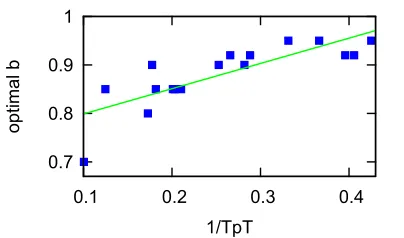
Figure 2: Correlation between optimal constraint valueb
and dictionary pruning efficiency. Each blue square is a language, the green line is a linear approximation of the data.
per token (TpT) for our unlabeled corpora. Specif-ically, for each token, we counted the number of tags licensed by the dictionary, or all tags for word forms not in the dictionary. For each language, we also ran our system with constraint strengths in{0.7, 0.75, 0.8, 0.85, 0.9, 0.92, 0.95, 0.98, 1.00}, and com-puted the optimal constraint strength from this set. We found that the best constraint strength is closely correlated with the average number of tags available for each token. Figure 2 shows the best constraint strength as a function of the inverse of the number of unpruned tags per token. As observed in the figure, the relationship between the optimal strength and 1/TpT is roughly linear. Figure 2 also shows a linear approximation to the data plotted. When applying this technique to a new language, we would not be able to estimate the optimal constraint strength, but we could use the linear approximation and knowl-edge of 1/TpT to estimate it. For our experiments below, we perform this estimation for each language using the linear approximation computed from the remaining languages.
BASE BASE+ PR PR+ ar 37.84 44.96∗ 49.04∗ 50.10∗
bg 88.04 87.93 88.02 88.42∗
cs 79.67 80.01∗ 80.20∗ 80.68∗
da 88.14 87.92 88.24∗ 87.90
de 90.32 89.97 90.41∗ 90.29
el 90.03 89.03 90.63∗ 90.24∗ es 86.99 86.81 87.20∗ 87.21∗
fr 87.07 87.53∗ 87.44∗ 87.48∗
hu 82.05 82.05 82.14∗ 83.13∗
it 89.48 89.89∗ 89.52 89.72∗ ja 80.63 78.54 80.02 79.68
nl 85.89 85.77 85.59 85.98∗
pt 90.93 91.60∗ 91.48∗ 91.56∗ sl 82.46 82.08 83.16∗ 83.49∗
sv 89.06 88.72 89.25∗ 88.77
tr 64.39 65.74∗ 63.88 66.47∗
zh 73.98 72.82 74.51∗ 68.43
[image:8.612.73.280.55.333.2]Avg 81.59 81.85∗ 82.40∗ 82.33∗ -zh-ar 85.01 84.91 85.15∗ 85.40∗
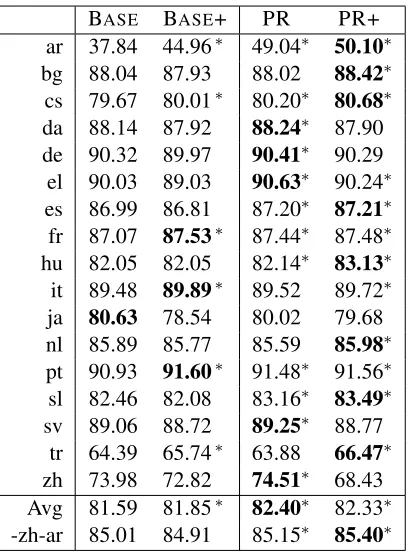
Table 1: POS tagging results. BASErepresents the best model of T¨ackstr¨om et al. (2013). PR is a system with the same features but with relaxed constraints. BASE+ and PR+ add additional model features (see§5.2.3). ∗ in-dicates improvements over the previous state of the art (BASE), and bold values indicate the best score for a guage. “Avg” indicates averaged results for all 17 lan-guages, while “-zh-ar” shows averaged results without Chinese and Arabic.
better than BASE+ for 13 out of 17 languages. Ad-ditionally, adding features does not tend to help the baseline model to a large extent (the wins are for 6 languages), but does tend to help the PR model (for 11 languages); however, there is a large drop in performance for Chinese.
Error Analysis: Here, we analyze the nature of improvements that the PR models get. For the lan-guages where PR results in large improvements, it stems from the ability to allow the sentential con-text to sometimes override the tag projected via the parallel data. For example, the Czech wordsecan either be a reflexive pronoun (such asourselvesin English) or translate to the preposition with. The pronominal sense comprises about 95% of occur-rences in the Czech annotations, but it would not appear in an English translation. For example, the phrase “pod´ıvali jsme se” translates to “we looked”,
and the wordjsmewould typically be aligned towe; se, which serves as a reflexive pronoun here, remains unaligned. Consequently, in our data, over 7000 oc-currences ofseappear, but only 17 instances have a tag projection that is not filtered by Wiktionary. Since the remaining are tagged with the preposition tag, the hard-constrained baseline always tagsseas a prepo-sition. By contrast, the soft-constrained PR model predicts the pronominal sense in cases where the con-text is most indicative of a pronoun – 38% of the time. It still mistags many of the pronominal cases where the contextual evidence is not strong enough. We get very similar behavior with the Hungarian wordhogy which can translate to the conjunctionthat(as in “I see that you are here”) or the adverbhow.
We found that the drastic drop in performance for Chinese under the PR+ model is due to the possessive marker “的” which serves exclusively as a particle in the test data. Wiktionary also allows the noun and adverb tags. The adverbial use is actually a different token (的确 ↔ really, truly) containing the same character. Because the cross-lingual training data is based on machine-learned alignments, 99.4% of the training examples of的have no annotations, and only 0.6% have the particle annotation projected from the English’spossessive marker. If we remove the noun and adverb senses from the Wiktionary performance of PR+ improves to 72.87%. Alternatively, we could add another constraint to prefer closed-class words over open-class words when both are licensed by the dictionary. When we add such a constraint to Chinese with a constraint value of 0.95, we recover most of the loss (68.43→72.94); however, we do not report this specific change to the Chinese experimental setup in Table 1 to maintain generality.
6.2 Named-Entity Segmentation
No Filtering Filtering (§5.2.2)
Lang Metric BASE PR BASE PR
Prec 74.29 73.85 75.36 76.47
de Recall 41.69 54.50 54.71 64.61
F1 53.41 62.71 63.39 70.04
Prec 74.53 62.10 82.50 70.22
es Recall 56.39 78.33 67.27 81.10
F1 64.20 69.28 74.11 75.27
Prec 81.90 75.12 86.39 76.09
nl Recall 50.54 76.11 65.45 79.11
F1 62.51 75.61 74.47 77.57
Above: dev, below: test
Prec 73.23 71.67 69.90 70.94
de Recall 39.70 51.81 52.52 61.42
F1 51.49 60.14 59.97 65.84
Prec 75.38 65.40 83.50 73.68
es Recall 56.00 80.30 67.55 83.31
F1 64.26 72.09 74.68 78.20
Prec 79.45 73.55 86.01 77.05
nl Recall 47.45 75.37 65.16 80.11
[image:9.612.72.304.56.344.2]F1 59.42 74.45 74.14 78.55
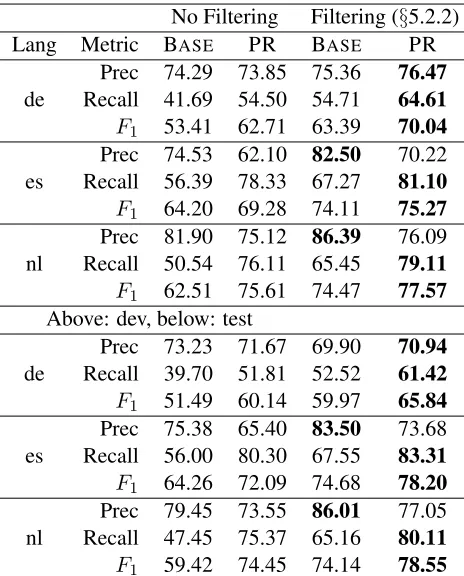
Table 2: Result for the named-entity segmentation exper-iments. The highest score in each category is shown in bold. Note that “No Filtering” still discards sentences with no projected entities.
and in turn an improvedF1 score. On average the PR model improves F-score by 3.6% on the develop-ment set and 4.6% on the test set over the baseline (when filtering is used). Note that because we focus on named entity segmentation, our results are not directly comparable to those of T¨ackstr¨om (2012), who train a de-lexicalized named entity recognizer on one language and apply it to other languages.
Error Analysis: In order to get a sense for the types of errors made by the baseline which are corrected by the PR model, we collected statistics about the most frequent errors in the segments extracted by the baseline and by our model. We divided the er-rors into missing segments, extraneous segments and overlapping segments.
From Table 2, it is clear that the most common errors for the baseline models are missing entities. From our analysis of the CoNLL development data, we found that the entities that occur with little context (such as the location and publisher of an item) at the onset of news articles are most frequently missed. For
German,dpa(Deutsche Presse-Agentur) andReuter are the two most common missing segmentations; the Spanish counterparts areGobierno(Government) andBarcelona, while for Dutch they areDe Morgen andBrussel. While filtering parallel sentences and using a soft constraint both increase recall, even our strongest model does not get enough information to predict these entities, and they continue to be major sources of error. By contrast, the names mentioned in context are the ones that are most frequently added to the analysis when PR is used. In a sense this is desirable, since a machine-learned named-entity segmentation system is most useful for the long tail of entity mentions.
If we filter the training data and use the PR model to further increase recall, precision errors tend to become relatively more frequent (this trend is ob-servable in Table 2). For German, the most frequent precision error is Mark referring to the Deutsche Mark. For Spanish, the most frequent precision er-rors are due to boundary erer-rors. The Spanish an-notation guidelines include enclosing quotes as part of the entity name, and failing to include them ac-counts for just under 1% of the precision errors of the PR system that uses filtering. The second most frequent error is failing to segmentInter de Mil´an. The model segments out eitherInterorMil´anor both by themselves depending on context.
7 Conclusions
Across seventeen languages, our models outperform the previous state of the art by an average of 0.8% (greater than 4% error reduction), and outperforms it on twelve out of seventeen languages. For named-entity segmentation, our model results in 3.6% and 4.6% absolute improvements inF1-score on our de-velopment and test sets respectively, when averaged across three languages.
Acknowledgments
We would like to thank Ryan McDonald, Fernando Pereira, Slav Petrov and Oscar T¨ackstr¨om for numer-ous discussions on this topic and providing detailed feedback on early drafts of this paper. We are also grateful to the four anonymous reviewers for their valuable comments.
References
Anne Abeill´e, Lionel Cl´ement, and Franc¸ois Toussenel. 2003. Building a Treebank for French. In A. Abeill´e, editor,Treebanks: Building and Using Parsed Corpora, chapter 10. Kluwer.
Peter F. Brown, Peter V. deSouza, Robert L. Mercer, Vin-cent J. Della Pietra, and Jenifer C. Lai. 1992. Class-based n-gram models of natural language. Computa-tional Linguistics, 18:467–479.
Peter F. Brown, Stephen A. Della Pietra, Vincent J. Della Pietra, Meredith J. Goldsmith, Jan Hajic, Robert L. Mercer, and Surya Mohanty. 1993. But dictionaries are data too. InProceedings of the Work-shop on Human Language Technology.
Sabine Buchholz and Erwin Marsi. 2006. CoNLL-X shared task on multilingual dependency parsing. In
Proceedings of CoNLL.
Christos Christodoulopoulos, Sharon Goldwater, and Mark Steedman. 2010. Two decades of unsupervised POS induction: How far have we come? In Proceed-ings of EMNLP.
Dipanjan Das and Slav Petrov. 2011. Unsupervised part-of-speech tagging with bilingual graph-based projec-tions. InProceedings of ACL-HLT.
Arthur P. Dempster, Nan M. Laird, and Donald B. Ru-bin. 1977. Maximum likelihood from incomplete data via the em algorithm.Journal of the Royal Statistical Society, Series B, 39(1):1–38.
John DeNero and Klaus Macherey. 2011. Model-based aligner combination using dual decomposition. In Pro-ceedings of ACL-HLT.
Kuzman Ganchev, Jennifer Gillenwater, and Ben Taskar. 2009. Dependency grammar induction via bitext pro-jection constraints. InProceedings of ACL-IJCNLP.
Kuzman Ganchev, Jo˜ao Grac¸a, Jennifer Gillenwater, and Ben Taskar. 2010. Posterior regularization for struc-tured latent variable models. Journal of Machine Learn-ing Research, 11:2001–2049.
Rebecca Hwa, Philip Resnik, Amy Weinberg, Clara Cabezas, and Okan Kolak. 2005. Bootstrapping parsers via syntactic projection across parallel texts.
Natural Language Engineering, 11(03):311–325. Jun’ichi Kazama and Kentaro Torisawa. 2007. A new
perceptron algorithm for sequence labeling with non-local features. InProceedings of EMNLP.
Sungchul Kim, Kristina Toutanova, and Hwanjo Yu. 2012. Multilingual named entity recognition using parallel data and metadata from wikipedia. InProceedings of ACL.
Philipp Koehn. 2005. Europarl: A parallel corpus for statistical machine translation. InProceedings of MT Summit.
Solomon Kullback and Richard A. Leibler. 1951. On information and sufficiency. Annals of Mathematical Statistics, 22:49–86.
John D. Lafferty, Andrew McCallum, and Fernando C. N. Pereira. 2001. Conditional random fields: Probabilistic models for segmenting and labeling sequence data. In
Proceedings of ICML.
Shen Li, Jo˜ao Grac¸a, and Ben Taskar. 2012. Wiki-ly supervised part-of-speech tagging. InProceedings of EMNLP-CoNLL.
Percy Liang, Michael I. Jordan, and Dan Klein. 2009. Learning from measurements in exponential families. InProceedings of ICML.
Dong C. Liu and Jorge Nocedal. 1989. On the limited memory BFGS method for large scale optimization.
Mathematical Programming, 45:503–528.
Mitchell P. Marcus, Mary Ann Marcinkiewicz, and Beat-rice Santorini. 1993. Building a large annotated corpus of English: the Penn treebank. Computational Linguis-tics, 19(2):313–330.
Ryan McDonald, Slav Petrov, and Keith Hall. 2011. Multi-source transfer of delexicalized dependency parsers. InProceedings of EMNLP.
Joakim Nivre, Johan Hall, Sandra K¨ubler, Ryan McDon-ald, Jens Nilsson, Sebastian Riedel, and Deniz Yuret. 2007. The CoNLL 2007 shared task on dependency parsing. InProceedings of EMNLP-CoNLL.
Slav Petrov, Dipanjan Das, and Ryan McDonald. 2012. A universal part-of-speech tagset. InProceedings of LREC.
Oscar T¨ackstr¨om, Dipanjan Das, Slav Petrov, Ryan Mc-Donald, and Joakim Nivre. 2013. Token and type con-straints for cross-lingual part-of-speech tagging. Trans-actions of the Association for Computational Linguis-tics, 1:1–12.
Oscar T¨ackstr¨om. 2012. Nudging the envelope of direct transfer methods for multilingual named entity recogni-tion. InProceedings of the NAACL-HLT Workshop on the Induction of Linguistic Structure.
Erik F. Tjong Kim Sang and Fien De Meulder. 2003. Introduction to the CoNLL-2003 shared task: language-independent named entity recognition. InProceedings of CoNLL.
Erik F. Tjong Kim Sang. 2002. Introduction to the CoNLL-2002 shared task: Language-independent named entity recognition. InProceedings of CoNLL. Joseph Turian, Lev-Arie Ratinov, and Yoshua Bengio.
2010. Word representations: A simple and general method for semi-supervised learning. InProceedings of ACL.
UN. 2006. ODS UN parallel corpus.
Jakob Uszkoreit and Thorsten Brants. 2008. Distributed word clustering for large scale class-based language modeling in machine translation. In Proceedings of ACL-HLT.
Jakob Uszkoreit, Jay Ponte, Ashok Popat, and Moshe Dubiner. 2010. Large scale parallel document mining for machine translation. InProceedings of COLING. Andreas Vlachos. 2006. Active annotation.Proceedings
of EACL.
David Yarowsky and Grace Ngai. 2001. Inducing mul-tilingual POS taggers and NP bracketers via robust projection across aligned corpora. InProceedings of NAACL.