Relational Inference for Wikification
Xiao Cheng Dan Roth Department of Computer Science University of Illinois at Urbana-Champaign
Urbana, IL 61801
{cheng88,danr}@illinois.edu
Abstract
Wikification, commonly referred to as Disam-biguation to Wikipedia (D2W), is the task of identifying concepts and entities in text and disambiguating them into the most specific corresponding Wikipedia pages. Previous ap-proaches to D2W focused on the use of lo-cal and global statistics over the given text, Wikipedia articles and its link structures, to evaluate context compatibility among a list of probable candidates. However, these meth-ods fail (often, embarrassingly), when some level of text understanding is needed to sup-port Wikification. In this paper we introduce a novel approach to Wikification by incorpo-rating, along with statistical methods, richer relational analysis of the text. We provide an extensible, efficient and modular Integer Lin-ear Programming (ILP) formulation of Wik-ification that incorporates the entity-relation inference problem, and show that the ability to identify relations in text helps both candi-date generation and ranking Wikipedia titles considerably. Our results show significant im-provements in both Wikification and the TAC Entity Linking task.
1 Introduction
Wikification (D2W), the task of identifying concepts and entities in text and disambiguating them into their corresponding Wikipedia page, is an important step toward supporting deeper textual understand-ing, by augmenting the ability to ground text in ex-isting knowledge and facilitating knowledge expan-sion.
D2W has been studied extensively recently (Cucerzan, 2007; Mihalcea and Csomai, 2007;
Milne and Witten, 2008; Ferragina and Scaiella, 2010; Ratinov et al., 2011) and has already found broad applications in NLP, Information Extraction, and Knowledge Acquisition from text, from coref-erence resolution (Ratinov and Roth, 2012) to entity linking and knowledge population (Ellis et al., 2011; Ji et al., 2010; Cucerzan, 2011).
Given a documentDcontaining a set of concept and entity mentionsM( referred to later assurface), the goal of Wikification is to find the most accurate mapping from mentions to Wikipedia titlesT; this mapping needs to take into account our understand-ing of the text as well as background knowledge that is often needed to determine the most appropriate ti-tle. We also allow a special NIL title that captures all mentions that are outside Wikipedia.
Earlier approaches treated this task as a word-sense disambiguation (WSD) problem, which was later enhanced with a certain level of global rea-soning, but essentially all approaches focused on generic statistical features in order to achieve robust disambiguation. It was shown that by disambiguat-ing to the most likely title for every surface, in-dependently maximizing the conditional probability
Pr(title|surf ace), we already achieve a very com-petitive baseline on several Wikification datasets (Ratinov et al., 2011). This strong statistical baseline makes use of the relatively comprehensive coverage of the existing Wikipedia links from surface strings to Wikipedia titles. Although more involved statis-tical features are required in order to make substan-tial improvements, global features such as context TF-IDF, better string similarity, etc., statistics-based Wikification systems give a fairly coherent set of disambiguation when sufficient context is available. Consider the following example: Earth’s biosphere
then significantly altered the atmospheric and other ba-sic phyba-sical conditions, which enabled the proliferation of organisms. The atmosphere is composed of 78.09% nitrogen, 20.95% oxygen, 0.93% argon, 0.039% carbon dioxide, and small amounts of...
The baseline system we adopted (Ratinov et al., 2011), one of the best Wikification systems, al-ready disambiguatesatmospherecorrectly to the ti-tle Earth’s atmosphereinstead of the more general titleAtmosphere, making use of the conceptEarthin its local context to resolve the mention to the more specific title that better coheres with the topic. How-ever, consider the following example:
Ex. 1 “AsMubarak, the wife of deposed Egyptian President Hosni Mubarak got older, her influence...”
The bold faced name should be mapped toSuzanne Mubarak, but all existing Wikification systems map both names in this sentence to the dominant page (the most linked page) ofHosni Mubarak, failing to understand the relation between them, which should prevent them from being mapped to the same page. A certain level of text understanding is required even to be able to generate a good list of title candidates. For example, in:
Ex. 2 “...ousted long time Yugoslav President Slo-bodan Miloˇsevi´c in October. Mr. Miloˇsevi´c’s So-cialist Party...”
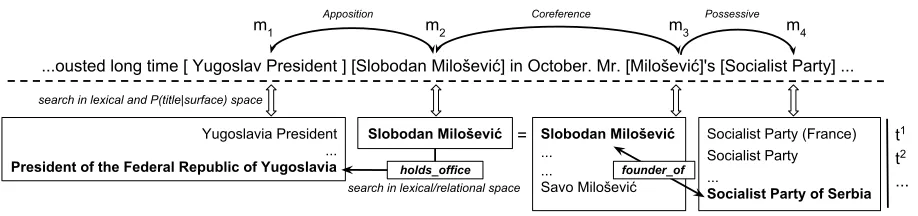
the bold-faced concept should be mapped to the page of the Socialist Party of Serbia, which is far down the list of titles that could be related to “So-cialist Party”; making this title a likely candidate requires understanding the possessive relation with Miloˇsevi´c and then making the knowledge-informed decision that he is more related toSocialist Party of Serbiathan any other possible titles. Finally, in
Ex. 3 “James Senn, director ofRobinson College’s Center for Global Business Leadership at Georgia State University...”
we must link Robinson College to J. Mack Robin-son College of Business which is located at Geor-gia State University instead of Robinson College, Cambridge, which is the only probable title linked by the surface Robinson College in the version of the Wikipedia dump we used.
These examples further illustrate that, along with understanding the relation expressed in the text, we
need to access background knowledge sources and to deal with variability in surface representation across the text, Wikipedia, and knowledge, in order to reliably address the Wikification problem.
In this paper we focus on understanding those nat-ural language constructs that will allow eliminat-ing these “obvious” (to a human reader) mistakes from Wikification. In particular, we focus on resolv-ing coreference and a collection of local syntactico-semantic relations (Chan and Roth, 2011); better un-derstanding the relational structure of the text allows us to generate title candidates more accurately given the text, rank these candidates better and determine when a mention in text has no corresponding title in Wikipedia and should be mapped to NIL, a key problem in Wikification. Moreover, it allows us to access external knowledge based resources more ef-fectively in order to support these decisions.
We incorporate the outcome of our relational analysis, along with the associated features extracted from external sources and the “standard” wikifica-tion statistical features, into an ILP-based inference framework that globally determines the best assign-ment of assign-mentions to titles in a given docuassign-ment. We show that by leveraging a better understanding of the textual relations, we can substantially improve the Wikification performance. Our system signifi-cantly outperforms all the top Wikification systems on the widely adopted standard datasets and shows state-of-the-art results when evaluated (without be-ing trained directly) on the TAC 2011 Entity Linkbe-ing task.
2 The Wikification Approach
A general Wikification decision consists of three computational components: (1) generating a ranked list of title candidates for each mention, (2) rank-ing candidates globally, and (3) dealrank-ing with NIL mentions. For (1), the “standard” way of using
the anchor texts cover many possible ways of para-phrasing the Wikipedia article titles and thus using the top Pr(title|surf ace) is proven to be a fairly strong baseline, it is never comprehensive. There is a need to disambiguate titles that were never linked by any anchor text, and to disambiguate mentions that have never been observed as the linked text. For (3) the Wikifier needs to determine when a mention corresponds to no title, and map it to a NIL entity. Simply training a classifier using coherency features or topical models turns out to be insufficient, since it has a predetermined granularity at which it can dis-tinguish entities.
Next we provide a high-level description (Alg. 1) of our approach to improve Wikification by leverag-ing textual relations in these three stages.
Algorithm 1Relational Inference for Wikification
Note:Γ :M → T is the sought after mapping from all mentions in the document to all candidate titles in Wikipedia.
Require: Document D, Knowledge Base K con-sisting of relation triplesσ = (ta, p, tb), where
pis the relation predicate.
1: Generate initial mentionsM ={mi}fromD.
2: Generate candidatesti = {tki}for mentionmi
and initialize candidate priors Pr(tki|mi) with
existing Wikification system, for allmi ∈M.
3: Instantiate non-coreference relational con-straints and add relational candidates.
4: Instantiate coreference relational constraints and add relational candidates.
5: Construct an ILP objective function and solve for thearg maxΓPr(Γ).
6: return Γ.
Most of our discussion addresses the relational analysis and its impact on stage (2) and (3) above. We will only briefly discuss improvements to the standard candidate generation stage in Sec. 4.4
3 Problem Formulation
We now describe how we formulate our global deci-sion problem as an Integer Linear Program (ILP).
We use two types of boolean variables: ek i is
used to denote whether we disambiguate mi to tki
(Γ(mi) = tki) or not. r (k,l)
ij is used to denote if
titles tki and tlj are chosen simultaneously, that is,
rij(k,l)=eki ∧elj.
Our models determine two types of score for the boolean variables above: sk
i = Pr(eki) = Pr(Γ(mi) =tki), represents the initial score for the kth candidate title being chosen for mentionmi. For
a pair of titles(tk
i, tlj), we denote the confidence of
finding a relation between them bywij(k,l). Its value depends on the textual relation type and on how co-herent it is with our existing knowledge.
Our goal is to find the best assignment to vari-ableseki, such that it satisfies some legitimacy (hard) constraints and the soft constraints dictated by the relational constraints (via scoresw(ijk,l)). To accom-plish that we define our objective function as a Con-strained Conditional Model (CCM) (Roth and Yih, 2004; Chang et al., 2012) that is used to reward or penalize a pair of candidates tki, tlj by wij(k,l) when they are chosen in the same document. Specifically, we choose the assignmentΓDthat optimizes:
ΓD = arg max Γ
X
i X
k
skieki +X i,j
X
k,l
w(ijk,l)r(ijk,l)
s.t. r(ijk,l)∈ {0,1} Integral constraints
eki ∈ {0,1} Integral constraints
∀iP
keki = 1 Unique solution
2r(ijk,l)≤eki +elj Relation definition
Note that as in most NLP problems, the prob-lem is very sparse, resulting in a tractable ILP that is solved quickly by off-the-shelf ILP packages (Gurobi Optimization, 2013). In our case the key reason for the sparseness is thatw(ijk,l)= 0for most pairs considered, which does not require explicit in-stantiation ofrij(k,l).
4 Relational Analysis
Slobodan Milošević
... ...
Savo Milošević
Slobodan Milošević Socialist Party (France) Socialist Party ...
Socialist Party of Serbia
Yugoslavia President ...
President of the Federal Republic of Yugoslavia
...ousted long time [ Yugoslav President] [Slobodan Milošević] in October. Mr. [Milošević]'s [Socialist Party] ... Coreference
Apposition
search in lexical/relational space search in lexical and P(title|surface) space
Possessive
m1 m2 m3 m4
t1
t2
... founder_of
[image:4.612.85.544.59.167.2]holds_office =
Figure 1: Textual relation inference framework: The goal is to maximize the objective function assigning mentions to titles while enforcing coherency with relations extracted from both text and an external knowledge base. Here, searching the external KB reveals thatSlobodan Miloˇsevi´cis the founder of theSocialist Party of Serbia, which can be referred to by the surfaceSocialist Party; we therefore reward the output containing this pair of candidates. The same idea applies for the relation “Slobodan Miloˇsevi´cholds office asPresident of the Federal Republic of Yugoslavia” as well as to the coreference relation between two mentions ofSlobodan Miloˇsevi´c.
we need to assign weights to these semantic rela-tions. We determine the weights by combining type and confidence of the relation extracted from text with the confidence in relations retrieved from an ex-ternal Knowledge Base (KB) by using the mention pairs as a query. It is noteworthy that although con-text window based coherency objective functions capture many proximity relations, using these unfil-tered relations as constraints in our experiments in-troduced excessive amount of false-positives for the intrinsically sparse textual relations and resulted in severe performance hit.
In Sec. 4.1 we describe how we extract relations from text; our goal is to reliably identifyarguments
that we hypothesize to be in a relation; we show that this is essential both to our candidate genera-tion, our ranking and the mapping to NIL. Sec. 4.2 describes how we use an external KB to verify that these arguments are indeed in a relation. Finally, Sec. 4.3 shows how we generate scores for the men-tions and relamen-tions, as coefficients in the objective function of Sec. 3. The process is illustrated in Fig-ure 1. Overall, our approach is an ambiguity-aware approach that identifies, filters and scores the rele-vant relations; this is essential due to the ambiguity, variability and noise inherent in directly matching surface forms to titles.
4.1 Relation Extraction
Even though relation extraction is an open prob-lem, analysis on the ACE2004 Relation Detection and Characterization (RDC) dataset shows that
ap-proximately 80% of the relations are expressed through syntactico-semantic structures (Chan and Roth, 2011) that are easy to extract with high pre-cision. Unlike the general ACE RDC task, we can restrict relation arguments to be named entities and thus leverage the large number of known relations in existing databases (e.g. Wikipedia infoboxes). We also consider conference relations that potentially aid mapping different mentions to the same title.
4.1.1 Syntactico-semantic Relations
We introduce our approach using the following example. Consider a news article discussing Israeli politics while briefly mentioning:
Ex. 4 An official at the [Iranian]1 [Ministry of
Defense]2told Tehran Radio that...
A purely statistical approach would very likely map the entity[Ministry of Defense]2 toMinistry of
De-fense (Israel) instead of Ministry of Defense and Armed Forces Logistics (Iran)because the context is more coherent with concepts related to Israel rather than to Iran. Nevertheless, the pre-modifier relation between[Iranian]1 and[Ministry of Defense]2
de-mands the answer to be tightly related to Iran. Even though human readers may not know the correct ti-tle needed here, understanding the pmodifier re-lation allows them to easily filter through a list of candidates and enforce constraints that are derived jointly from the relation expressed in the text and their background knowledge.
a range of local relations that are used to retrieve relevant background knowledge, and consequently integrated into our inference framework. Our in-put for relation extraction is any segment matched by the regular expression to be mentioned in sec-tion 4.4 in the candidate generasec-tion stage; we ana-lyze its constituents by decomposing it into the two largest sub-entities that have (in Wikipedia) corre-sponding candidates. In the above example, Ira-nian Ministry of Defensewould be decomposed into
Iranianand Ministry of Defense and our relation extraction process hypothesizes a relation between these arguments.
Note that we do not use any full parsing since it does not address our needs directly nor does it scale well with the typical amount of data used in Wikifi-cation.
4.1.2 Coreference Relations
In addition to syntactico-semantic relations, we could also encounter other textual relations. The fol-lowing example illustrates the importance of under-standing co-reference relations in Wikification:
Ex. 5 [Al Goldman]1, chief market strategist at
A.G. Edwards, said ... [Goldman]2told us that...
There is no Wikipedia entry (or redirection) that matches the nameAl Goldman. Clearly[Goldman]2
refers to the same person and should be mapped to the same entity (or to NIL) rather than popular en-tities frequently referred to as Goldman, coherent with context or not, such asGoldman Sachs. To ac-complish that, we cluster named entities that share tokens or are acronyms of each other when there is no ambiguity (e.g. no other longer named en-tity mentions containingGoldmanin the document) and use a voting algorithm (Algorithm 2) to generate candidates locally from within the clusters. We also experimented with using full-fledged coference sys-tems, but found it to be time consuming while pro-viding no significant end-to-end performance differ-ence.
4.1.3 Coreferent Nominal Mentions
Document level coreference also provides impor-tant relations between named entities and nominal mentions. Extracting these relations proved to be very useful for classifying NIL entities, as unfamil-iar concepts tend to be introduced with these
suc-cinct appositional nominal mentions. These descrip-tions provide a clean “definition” of the entity, al-lowing us to abstract the inference to a limited “noun phrase entailment problem”. That is, it allows us to determine whether the target mention corresponds to a candidate title. Consider, for example, wikifying
Dorothy Byrnein: Dorothy Byrne, a state coordi-nator for the Florida Green Party, . . .
Identifying the apposition relation allows us to de-termine that thisDorothy Byrne is notthe baseline Wikipedia title. We use the TF-IDF cosine similar-ity between the nominal description and the lexical context (Ratinov et al., 2011) of the candidate page, head word attributes and entity relation (i.e. between
Dorothy Byrne andFlorida Green Party) to deter-mine whether any candidates ofDorothy Byrnecan entail the nominal mention.
4.2 Relational Queries
Statistics based candidate generation algorithms al-ways generate the same list of candidates given the same surface string; even though this approach has a competitive coverage rate, it will not work well in some “obvious” (to human) cases; for example, it offers very little information on highly ambigu-ous surface strings such as “President” for which it is even intractable to rank all the candidates. Top-K lists which were used in previous literature suf-fer from the same problem. Instead, we make use of relational queries to generate a more likely set of candidates.
Once mention pairs are generated from text us-ing the syntactico-semantic structures and corefer-ence, we use these to query our KB of relational triples. We first indexed all Wikipedia links and DB-pedia relations as unordered triplesσ = (ti, p, tj),
where the arguments ti, tj are tokenized, stemmed
and lowercased for best recall. pis either a relation predicate from the DBpedia ontology or the predi-cate LIN K indicating a hyperlink relation. Since our baseline system has approximately 80% accu-racy at this stage, it is reasonable to assume that at least one of the argument mentions is correctly dis-ambiguated. Therefore we prune the search space by making only two queries for each mention pair
(mi, mj): q0 = (t∗i, mj)andq1 = (mi, t∗j) where
re-spectively.
We also aggressively prune the search results in a way similar to the process in Sec. 4.4, only keep-ing the arguments that are known to be possible or very likely candidates of the mention, based on the ambiguity that exists in the query result.
4.3 Relation Scoring
For the final assignment made using our objective function (Sec. 3) we need to normalize and rescale the output of individual components of our system as they come from different scoring functions. We con-sider adding new title candidates from two sources, through the coreference module and through the combined DBpedia and Wikipedia inter-page link structures. Next we describe how to compute and combine these scores.
4.3.1 Scoring Knowledge Base Relations
Our model uses both explicit relations p 6=
LIN K from DBpedia and Wikipedia hyperlinks p = LIN K (implicit relation). We want to favor relations with explicit predicate, each weighted asφ implicit relation (we useφ= 5in our experiments, noting the results are insensitive to slight changes of this parameter).
For each query, we denote the score returned by our KB search engine1 given query q and triple σ asSimσ,q. The relational weightwi,jk,lbetween two
candidates (see Sec. 3) is determined as:
wi,jk,l= 1
Z
X
σ
ασSimσ,q
where the sum is over the top 20KB triples, ασ is
the relation type scaling constant (φor1), andZ is a normalization factor that normalizes allwi,jk,lto the range[0,1].
Note that we do not check the type of the relation against the textual relation. The key reason is that explicit relations are not as robust, especially con-sidering that we restrict one of the arguments in the relation and constraining the other argument’s lexi-cal form. Moreover, we back off to restricting the re-lations to be between known candidates when mul-tiple lexically matched arguments are retrieved with high ambiguity. Additionally, most of our relations
1http://lucene.apache.org/
Algorithm 2Coreferent Candidates Voting
Require: Coreference clusterC
1: Vote collectorvtdenotes the score for a
candi-datet, which by default is0.
2: ti ={t1i . . . tni}is the set of candidates of
men-tionmi.
3: liis the token count ofmi
4: for allmi ∈C, li ≥2do
5: for alltki ∈ti do
6: vtk
i =vtki +s
k i
7: end for
8: end for
9: LetAllSingledenote whether∀i, li = 1
10: for allmi ∈Cwhereli = 1do
11: for alltk
i ∈ti do
12: ifAllSingleorvtk
i >0then
13: vtk
i =vtki +s
k i
14: end if
15: end for 16: end for
17: return v
do not have explicit predicates in the text anyhow, and extracting a type would add noise to our deci-sion.
4.3.2 Scoring Coreference Relations
For coreference relations, we simply use hard constraints by assigning candidates in the same coreference cluster a high relational weight, which is a cheap approximation to penalizing the output where the coreferent mentions disambiguate to dif-ferent titles. In practice, using a weight of10is suf-ficient. Another important issue here is that the cor-rect coreferent candidate might not exist in the can-didate list of the shorter mentions in the cluster. For example, if a mention has the surfaceRichard, the number of potential candidates is so large that any top K list of titles will not be informative. We there-fore ignore candidates generated from short surface strings and give it the same candidate list as the head mentions in its cluster. Figure 2 shows the voting al-gorithm we use to elect the potential candidates for the cluster.
is determined, longer mentions in the cluster should dictate what this cluster should collectively refer to.
4.4 Candidate Generation
Beyond the algorithmic improvements, the mention and candidate generation stage is aided by a few systematic preprocessing improvement briefly de-scribed below.
4.4.1 Mention Segmentation
Since named entities may sometimes overlap with each other, we use regular expressions to match longer surface forms that are often incorrectly seg-mented or ignored by NER 2 due to different
an-notation standards. For example, this will capture:
Prime Minister of the United Kingdom. The regu-lar expression pattern we used for Step 1 in Algo-rithm 1 simply adds mentions formed by any two consecutive capitalized word chunks connected by up to2punctuation marks, prepositions, and the to-kens “the”, “’s” & “and”. These segments are also used as arguments for relation extraction.
4.4.2 Lexical Search
We link certain mentions directly to their exact matching titles in Step 3 when there is very low am-biguity. Specifically, when no title is known for a mention that is relatively long and fuzzily matches the lexically retrieved title, we perform this aggres-sive linking. The lexical similarity metrics are com-puted using the publicly available NESim3package (Do et al., 2009) with a threshold tuned on a subset of Wikipedia redirects, and by insisting that ORG type entities must have the same head word as the candidate titles. We only accept the link if there ex-ists exactly one title in the lexical searching result after pruning.
5 Experiments and Evaluation
This section describes our experimental evaluation. We compare our system against the top D2W sys-tems and perform several experiments to analyze and better understand the power of our approach. We based our work on the GLOW system from
2
We used the IllinoisNER packagehttp://cogcomp. cs.illinois.edu/page/software_view/4
3http://cogcomp.cs.illinois.edu/page/
software_view/22
(Ratinov et al., 2011) to initialize the candidates and corresponding priors ski in our objective function. Both the baseline system and our new system are publicly available4.
5.1 Comparison with other Wikification systems
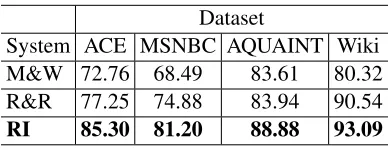
We first evaluate on the same 4 datasets5 used in (Ratinov et al., 2011). The AQUAINT dataset, orig-inally introduced in (Milne and Witten, 2008), re-sembles the Wikipedia annotation structure in that only the first mention of a title is linked, and is thus less sensitive to coreference capabilities. The MSNBC dataset is from (Cucerzan, 2007) and in-cludes many mentions that do not easily map to Wikipedia titles due to rare surface or other idiosyn-cratic lexicalization (Cucerzan, 2007; Ratinov et al., 2011). Both of these datasets came from the news domain and do not contain any annotated NIL enti-ties. The ACE and Wikipedia datasets are both taken from (Ratinov et al., 2011) where ACE is a subset of ACE2004 Coreference documents annotated by Amazon Mechanical Turkers in a similar standard as in AQUAINT but with NIL entities. The Wikipedia dataset is a sample of Wikipedia pages with its orig-inal hyperlink annotation.
The evaluation methodology Bag of Titles (BOT) F1 was used in both (Milne and Witten, 2008; Rati-nov et al., 2011). For each document, the goldbag
of titles is evaluated against ourbag of system out-put titles requiring exact segmentation match.
Dataset
System ACE MSNBC AQUAINT Wiki M&W 72.76 68.49 83.61 80.32 R&R 77.25 74.88 83.94 90.54
[image:7.612.328.524.500.575.2]RI 85.30 81.20 88.88 93.09
Table 1: Performance on Wikification datasets, BOT F1 Performance. Our system,Relational Inference (RI) ex-hibits significant improvements over M&W (Milne and Witten, 2008) and R&R (Ratinov et al., 2011).
4
http://cogcomp.cs.illinois.edu/page/ download_view/Wikifier
5http://cogcomp.cs.illinois.edu/page/
5.2 Ablation study
We incrementally add various components to the system and study their impact on the end perfor-mance. Due to the changes in Wikipedia since the datasets were generated, some of the pages no longer exist; in order to minimize the interference caused by these inconsistencies to an accurate evaluation of various componenents, we consider all non-NIL gold annotations that do not exist in the current Wikipedia index as NIL entities. Additionally in the MSNBC dataset, 127 out of 756 surface forms are known to be non-recallable. This explains the per-formance difference between the final rows in Tab. 1 and 2.
Dataset
Components ACE MSNBC AQUAINT Wiki Baseline 80.68 83.00 83.93 91.93 +Lexical Match 83.47 84.13 88.88 93.41 +Coreference 83.40 87.88 88.88 93.09
[image:8.612.320.527.422.534.2]RI 85.83 88.16 88.88 93.09
Table 2: Ablation study on Wikification datasets, BOT F1 Performance
TheBaselinerefers to the best performing configu-ration that was used in (Ratinov et al., 2011) except for using the current Wikipedia redirects. The Lexi-cal Matchrefers to the applying solely the method-ology introduced in Sec. 4.4. TheCoreference per-formance includes all the inference performed with-out the KB triples, while theRelational Inference (RI) line represents all aspects of the proposed re-lational inference. It is clear that different datasets show somewhat different characteristics and conse-quently different gains from the various aspects of our approach but that, overall, all aspects contribute to improved performance.
5.3 TAC Entity Linking 2011
Next we evaluate our approach on the TAC English Entity Linking Task, which provides standardized evaluation metrics, allowing us to compare to a large number of other systems. We did not evaluate on the 2012 English Entity Linking due to the significant amount of ambiguous NIL entities included (Ellis et
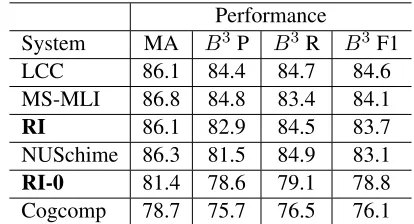
al., 2011) in the queries and the need to cluster them, which our D2W task definition does not address in depth. We compare our system with the Top 3 TAC 2011 systems (LCC, MS-MLI and NUSchime) as well as our baseline system GLOW that participated in TAC 2011 English Entity Linking (Ratinov and Roth, 2011) in table 3. The evaluation metric is the official modified B3 and Micro-Average explained in (Ji et al., 2011).
Given the TAC Knowledge Base (TKB), which is a subset of the 2009 Wikipedia Dump, the TAC En-tity Linking objective is to answer a named enEn-tity query string with either a TKB entry ID or a NIL entity ID, where the NIL entity IDs should be clus-tered across documents.
It is important to note that we did not retrain our system on the TAC data as the top three systems did, even though the objective function is slightly differ-ent. Instead, we ran our system on the TAC doc-uments directly without any query expansion. For the final output of each query, we simply use the most confident candidate among all matched men-tions. Due to the clustering requirement, we also trivially cluster NIL entities that either are mapped to the same out-of-KB Wikipedia URL or have the same surface form.
Performance
System MA B3 P B3R B3F1 LCC 86.1 84.4 84.7 84.6 MS-MLI 86.8 84.8 83.4 84.1
RI 86.1 82.9 84.5 83.7
NUSchime 86.3 81.5 84.9 83.1
RI-0 81.4 78.6 79.1 78.8
Cogcomp 78.7 75.7 76.5 76.1
Table 3: TAC2011 Entity Linking performance. MA is Micro-Average. LLC (Monahan et al., 2011) is the best performing system in terms of B3 F1 while MS-MLI (Cucerzan, 2011) is the best in terms of Micro-Average. Cogcomp (Ratinov and Roth, 2011) is the GLOW based system that participated in TAC 2011.RIis the complete relational inference system described in this paper; as de-scribed in the text,RIwas not trained on the TAC data, unlike the other top systems.
0.65 0.7 0.75 0.8 0.85 0.9
LCC MS_MLI
RI
NUSchime
CUNY_UIUC_SRI COGCOMPCMCRC
Stanford_UBC CUNY_BLENDER
HLTCOETHUNLP HIT
[image:9.612.75.294.63.223.2]DMIR_INESID MSRAWBSG Micro−averaged Accuracy B−cubed+ F−Measure B−cubed+ Precision B−cubed+ Recall
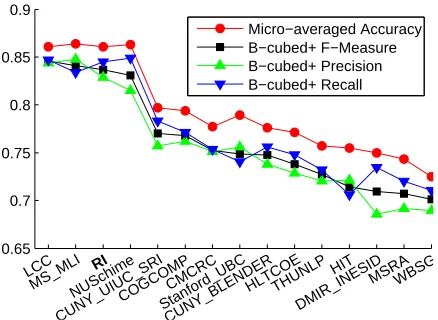
Figure 2: The RI compared with the other top 14 TAC2011 English Entity Linking systems ranked by modifiedB3F1 measure. Original figure from (Ji et al., 2011).
redirects for lexical matching without any inference, which scored 2.7% higher than the original GLOW system (Cogcomp). We can regard this performance as the new baseline that benefited from the fuzzy lexical matching capabilities that we have added, as well as the broader set of surface forms and redirects from the current Wikipedia dump. In the second run,
RI, the complete relational inference described in this paper, scored 4.9% higher than the new base-line and sits on par with the top tier systems despite not being trained on the given data. The LCC sys-tem used sophisticated clustering algorithms trained on the TAC development set (Monahan et al., 2011). The second-ranked MS-MLI system relied on topic modeling, external web search engine logs as well as training on the development data (Cucerzan, 2011). This shows the robustness of our methods as well as the general importance of understanding textual relations in the task of Entity Linking and Wikifica-tion.
6 Related Work and Discussion
Earlier works on Wikification formulated the task as a WSD problem (Bunescu and Pasca, 2006; Mi-halcea and Csomai, 2007) and focused primarily on training a model using local context. Later, various global statistical approaches were proposed to em-phasize different coherence measures between the ti-tles of the disambiguated mentions in the same
doc-ument (Cucerzan, 2007; Milne and Witten, 2008; Ratinov et al., 2011). Built on top of the statisti-cal models, our work focuses on leveraging deeper understanding of the text to more effectively and ac-curately utilize existing knowledge.
We have demonstrated that, by incorporating tex-tual relations and semantic knowledge as linguistic constraints in an inference framework, it is possible to significantly improve Wikification performance. In particular, we have shown that our system is ca-pable of making “intelligent” inferences that makes use of basic text understanding and has the ability to reason with it and verify it against relevant informa-tion sources. This allows our Relainforma-tional Inference approach to resolve a variety of difficult examples illustrated in the Introduction.
Our system features high modularity since the re-lations are considered only at inference time; con-sequently, we can use any underlying Wikification system as long as it outputs a distribution of title candidates for each mention.
One possibility for future work is to supply this framework with a richer set of relations from the text, such as verbal relations. It will also be inter-esting to incorporate high-level typed relations and relax the relation arguments to be general concepts rather than only named entities.
Acknowledgments
policies or endorsements, either expressed or im-plied, of DARPA, IARPA, DoI/NBC, ARL, or the U.S. Government.
References
R. Bunescu and M. Pasca. 2006. Using encyclopedic knowledge for named entity disambiguation. In Pro-ceedings of the European Chapter of the ACL (EACL). Y. Chan and D. Roth. 2011. Exploiting syntactico-semantic structures for relation extraction. In Pro-ceedings of the Annual Meeting of the Association for Computational Linguistics (ACL), Portland, Oregon. M. Chang, L. Ratinov, and D. Roth. 2012. Structured
learning with constrained conditional models. Ma-chine Learning, 88(3):399–431, 6.
Silviu Cucerzan. 2007. Large-scale named entity disam-biguation based on Wikipedia data. InProceedings of the 2007 Joint Conference of EMNLP-CoNLL, pages 708–716.
Silviu Cucerzan. 2011. Tac entity linking by perform-ing full-document entity extraction and disambigua-tion. InProceedings of the Text Analysis Conference. Q. Do, D. Roth, M. Sammons, Y. Tu, and V. Vydiswaran.
2009. Robust, light-weight approaches to compute lexical similarity. Technical report, Computer Science Department, University of Illinois.
Joe Ellis, Xuansong Li, Kira Griffitt, Stephanie M Strassel, and Jonathan Wright. 2011. Linguistic re-sources for 2012 knowledge base population evalua-tions.
Paolo Ferragina and Ugo Scaiella. 2010. Tagme: on-the-fly annotation of short text fragments (by wikipedia entities). In Proceedings of the 19th ACM interna-tional conference on Information and knowledge man-agement, CIKM ’10, pages 1625–1628, New York, NY, USA. ACM.
Inc. Gurobi Optimization. 2013. Gurobi optimizer refer-ence manual.
Heng Ji, Ralph Grishman, Hoa Trang Dang, Kira Grif-fitt, and Joe Ellis. 2010. Overview of the tac 2010 knowledge base population track. InThird Text Anal-ysis Conference (TAC 2010).
Heng Ji, Ralph Grishman, and Hoa Trang Dang. 2011. Overview of the tac 2011 knowledge base population track. InFourth Text Analysis Conference (TAC 2011). R. Mihalcea and A. Csomai. 2007. Wikify!: linking doc-uments to encyclopedic knowledge. In Proceedings of ACM Conference on Information and Knowledge Management (CIKM), pages 233–242.
D. Milne and I. H. Witten. 2008. Learning to link with wikipedia. In Proceedings of ACM Conference
on Information and Knowledge Management (CIKM), pages 509–518.
Sean Monahan, John Lehmann, Timothy Nyberg, Jesse Plymale, and Arnold Jung. 2011. Cross-lingual cross-document coreference with entity linking. In Proceed-ings of the Text Analysis Conference.
L. Ratinov and D. Roth. 2011. Glow tac-kbp 2011 entity linking system. InTAC. Text Analysis Conference, 11. L. Ratinov and D. Roth. 2012. Learning-based multi-sieve co-reference resolution with knowledge. In EMNLP.
L. Ratinov, D. Roth, D. Downey, and M. Anderson. 2011. Local and global algorithms for disambiguation to wikipedia. InACL.