A Novel Dependency-to-String Model for Statistical Machine Translation
Jun Xie, Haitao Mi and Qun Liu
Key Laboratory of Intelligent Information Processiong Institute of Computing Technology
Chinese Academy of Sciences P.O. Box 2704, Beijing 100190, China
{junxie,htmi,liuqun}@ict.ac.cn
Abstract
Dependency structure, as a first step towards semantics, is believed to be helpful to improve translation quality. However, previous works on dependency structure based models typi-cally resort to insertion operations to complete translations, which make it difficult to spec-ify ordering information in translation rules. In our model of this paper, we handle this problem by directly specifying the ordering information in head-dependents rules which represent the source side as head-dependents relations and the target side as strings. The head-dependents rules require only substitu-tion operasubstitu-tion, thus our model requires no heuristics or separate ordering models of the previous works to control the word order of translations. Large-scale experiments show that our model performs well on long dis-tance reordering, and outperforms the state-of-the-art constituency-to-string model (+1.47 BLEU on average) and hierarchical phrase-based model (+0.46 BLEU on average) on two Chinese-English NIST test sets without resort to phrases or parse forest. For the first time, a source dependency structure based model catches up with and surpasses the state-of-the-art translation models.
1 Introduction
Dependency structure represents the grammatical relations that hold between the words in a sentence. It encodes semantic relations directly, and has the best inter-lingual phrasal cohesion properties (Fox, 2002). Those attractive characteristics make it
pos-sible to improve translation quality by using depen-dency structures.
Some researchers pay more attention to use de-pendency structure on the target side. (Shen et al., 2008) presents a string-to-dependency model, which restricts the target side of each hierarchical rule to be a well-formed dependency tree fragment, and em-ploys a dependency language model to make the out-put more grammatically. This model significantly outperforms the state-of-the-art hierarchical phrase-based model (Chiang, 2005). However, those string-to-tree systems run slowly in cubic time (Huang et al., 2006).
Using dependency structure on the source side is also a promising way, as tree-based systems run much faster (linear time vs. cubic time, see (Huang et al., 2006)). Conventional dependency structure based models (Lin, 2004; Quirk et al., 2005; Ding and Palmer, 2005; Xiong et al., 2007) typically employ both substitution and insertion operation to complete translations, which make it difficult to specify ordering information directly in the transla-tion rules. As a result, they have to resort to either heuristics (Lin, 2004; Xiong et al., 2007) or sepa-rate ordering models (Quirk et al., 2005; Ding and Palmer, 2005) to control the word order of transla-tions.
In this paper, we handle this problem by di-rectly specifying the ordering information in head-dependents rules that represent the source side as head-dependents relations and the target side as string. The head-dependents rules have only one substitution operation, thus we don’t face the prob-lems appeared in previous work and get rid of the
heuristics and ordering model. To alleviate data sparseness problem, we generalize the lexicalized words in head-dependents relations with their cor-responding categories.
In the following parts, we first describe the moti-vation of using head-dependents relations (Section 2). Then we formalize our grammar (Section 3), present our rule acquisition algorithm (Section 4), our model (Section 5) and decoding algorithm (Sec-tion 6). Finally, large-scale experiments (Sec(Sec-tion 7) show that our model exhibits good performance on long distance reordering, and outperforms the state-of-the-art tree-to-string model (+1.47 BLEU on av-erage) and hierarchical phrase-based model (+0.46 BLEU on average) on two Chinese-English NIST test sets. For the first time, a source dependency tree based model catches up with and surpasses the state-of-the-art translation models.
2 Dependency Structure and Head-Dependents Relation
2.1 Dependency Sturcture
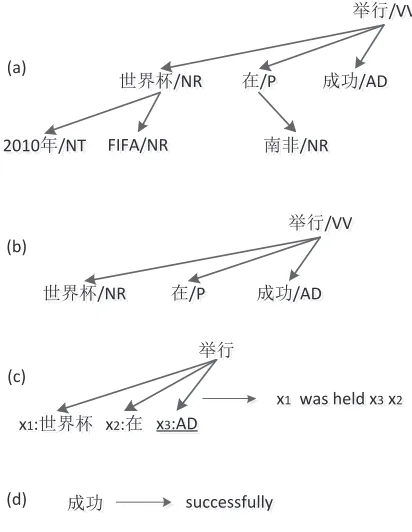
A dependency structure for a sentence is a directed acyclic graph with words as nodes and modification relations as edges. Each edge direct from a head to a dependent. Figure 1 (a) shows an example depen-dency structure of a Chinese sentence.
2010年FIFA世界杯 在 南非 成功 举行
2010 FIFA [World Cup] in/at [South Africa] successfully hold
Each node is annotated with the part-of-speech (POS) of the related word.
For convenience, we use the lexicon dependency grammar (Hellwig, 2006) which adopts a bracket representation to express a projective dependency structure. The dependency structure of Figure 1 (a) can be expressed as:
((2010年) (FIFA)世界杯) (在(南非)) (成功)举行
where the lexicon in brackets represents the depen-dents, while the lexicon out the brackets is the head. To construct the dependency structure of a sen-tence, the most important thing is to establish de-pendency relations and distinguish the head from the dependent. Here are some criteria (Zwicky, 1985;
x2:൘ x2:൘
x1:ц⭼ᶟ
x1:ц⭼ᶟ xx33:AD:AD Ѯ
Ѯ Ѯ Ѯ㹼
Ѯ㹼
x1 was held x3x2 x1 was held x3 x2
൘/P
൘/P ц⭼ᶟ/NR
ц⭼ᶟ/NR
ই䶎/NR
ই䶎/NR ᡀ࣏/AD
ᡀ࣏/AD
2010ᒤ/NT
2010ᒤ/NT FIFA/NRFIFA/NR
Ѯ㹼/VV
Ѯ㹼/VV
/P
൘/P ц⭼ᶟ/NR
ц⭼ᶟ/NR ᡀ࣏ᡀ࣏/AD/AD
Ѯ㹼/VV
Ѯ㹼/VV (a)
(b)
(c)
ᡀ࣏
[image:2.612.332.538.56.322.2]ᡀ࣏ successfullysuccessfully (d)
Figure 1: Examples of dependency structure (a), head-dependents relation (b), head-head-dependents rule (r1of Fig-ure 2) and head rule (d). Where “x1:世 界 杯” and “x2:在” indicate substitution sites which can be replaced by a subtree rooted at “世界杯” and “在” respectively. “x3:AD”indicates a substitution site that can be replaced
by a subtree whose root has part-of-speech “AD”. The underline denotes a leaf node.
Hudson, 1990) for identifying a syntactic relation between a head and a dependent between a head-dependent pair:
1. head determines the syntactic category of C, and can often replaceC;
2. head determines the semantic category of C; dependentgives semantic specification.
2.2 Head-Dependents Relation
A head-dependents relation is composed of a head and all its dependents as shown in Figure 1(b).
recur-sively replace the bottom level head-dependent re-lations of a dependency structure with their heads until the root. This implies an representation of the generation of a dependency structure on the basis of head-dependents relation.
Inspired by this, we represent the translation rules of our dependency-to-string model on the founda-tion of head-dependents relafounda-tions.
3 Dependency-to-String Grammar
Figure 1 (c) and (d) show two examples of the trans-lation rules used in our dependency-to-string model. The former is an example ofhead-dependent rules that represent the source side as head-dependents re-lations and act as both translation rules and reorder-ing rules. The latter is an example of head rules which are used for translating words.
Formally, a dependency-to-string grammar is de-fined as a tuple⟨Σ, N,∆, R⟩, where Σis a set of source language terminals,N is a set of categories for the terminals inΣ,∆is a set of target language terminals, andRis a set of translation rules. A rule rinRis a tuple⟨t, s, ϕ⟩, where:
- t is a node labeled by terminal from Σ; or a head-dependents relation of the source depen-dency structures, with each node labeled by a terminal from Σor a variable from a set X = {x1, x2, ...}constrained by a terminal from Σ
or a category fromN;
- s∈(X∪∆)∗ is the target side string;
- ϕ is a one-to-one mapping from nonterminals intto variables ins.
For example, the head-dependents rule shown in Figure 1 (c) can be formalized as:
t= ((x1:世界杯) (x2:在) (x3:AD)举行)
s=x1was heldx3x2
ϕ={x1:世界杯↔x1, x2:在↔x2, x3:AD↔x3}
where the underline indicates a leaf node, and xi:letters indicates a pair of variable and its con-straint.
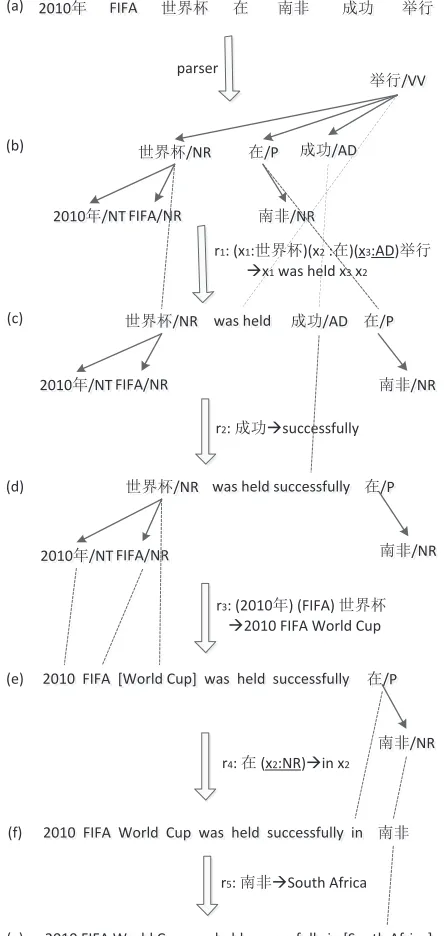
A derivation is informally defined as a sequence of steps converting a source dependency structure into a target language string, with each step apply-ing one translation rule. As an example, Figure 2
൘/P ൘/P
ц⭼ᶟ/NR ц⭼ᶟ/NR
ই䶎//NNRR ই䶎/NR
ᡀ࣏/AADD ᡀ࣏/AD
2010ᒤ/NT
2010ᒤ/NTFIFA/NRFIFA//NNRR
Ѯ㹼/VV Ѯ㹼/VV
2010ᒤ
2010ᒤ FIFAFIFA ц⭼ᶟц⭼ᶟ ൘൘ ই䶎ই䶎 ᡀ࣏ᡀ࣏ Ѯ㹼Ѯ㹼
൘/P ൘/P
ц⭼ᶟ/NR ц⭼ᶟ/NR
ই䶎/NR ই䶎/NR
ᡀ࣏/AD ᡀ࣏/AD
2010ᒤ/NT
2010ᒤ/NTFIFA/NRFIFA/NR
was held
was held
൘/P ൘/P
ц⭼ᶟ/NR ц⭼ᶟ/NR
ই䶎/NR ই䶎/NR
2010ᒤ/NT
2010ᒤ/NTFIFA/NRFIFA/NRR
was held successfully
was held successfully
൘/P ൘/P
ই䶎/NR ই䶎/NR
2010 FIFA [World Cup] was held successfully
2010 FIFA [World Cup] was held successfully
ই䶎 ই䶎 2010 FIFA World Cup was held successfully in
2010 FIFA World Cup was held successfully in
2010 FIFA World Cup was held successfully in [South Africa]
2010 FIFA World Cup was held successfully in [South Africa] parser
(a)
(b)
(c)
(d)
(e)
(f)
(g)
NRRRRRR
D D D
R
R R
N N
N N
N N N N
R R
r3: (2010ᒤ) (FIFA) ц⭼ᶟ à2010 FIFA World Cup
r2: ᡀ࣏àsuccessfully
r1: (x1:ц⭼ᶟ)(x2 :൘)(x3:AD)Ѯ㹼 àx1 was held x3 x2
r4: ൘ (x2:NR)àin x2
r5: ই䶎àSouth Africa e
Figure 2: An example derivation of dependency-to-string translation. The dash lines indicate the reordering when employing a head-dependents rule.
shows the derivation for translating a Chinese (CH) sentence into an English (EN) string.
CH 2010年FIFA世界杯 在 南非 成功 举行
[image:3.612.327.549.58.526.2]The Chinese sentence (a) is first parsed into a de-pendency structure (b), which is converted into an English string in five steps. First, at the root node, we apply head-dependents ruler1 shown in Figure
1(c) to translate the top level head-dependents rela-tion and result in three unfinished substructures and target string in (c). The rule is particular interesting since it captures the fact: in Chinese prepositional phrases and adverbs typically modify verbs on the left, whereas in English prepositional phrases and adverbs typically modify verbs on the right. Second, we use head ruler2translating “成功” into
“success-fully” and reach situation (d). Third, we apply head-dependents ruler3 translating the head-dependents
relation rooted at “世界杯” and yield (e). Fourth, head-dependents rulesr5 partially translate the
sub-tree rooted at “在” and arrive situation in (f). Finally, we apply head ruler5 translating the residual node
“南非” and obtain the final translation in (g).
4 Rule Acquisition
The rule acquisition begins with a word-aligned cor-pus: a set of triples⟨T, S, A⟩, whereT is a source dependency structure, S is a target side sentence, and A is an alignment relation between T and S. We extract from each triple⟨T, S, A⟩head rules that are consistent with the word alignments and head-dependents rules that satisfy the intuition that syn-tactically close items tend to stay close across lan-guages. We accomplish the rule acquisition through three steps: tree annotation, head-dependents frag-ments identification and rule induction.
4.1 Tree Annotation
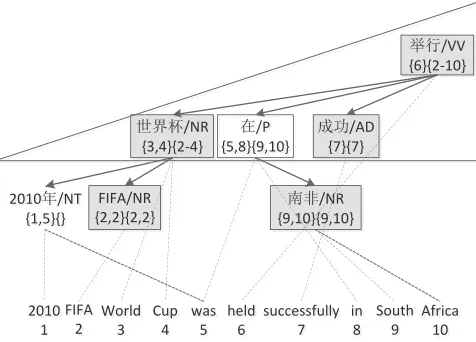
Given a triple ⟨T, S, A⟩ as shown in Figure 3, we first annotate each nodenofT with two attributes: head span and dependency span, which are defined as follows.
Definition 1. Given a noden, itshead spanhsp(n) is a set of index of the target words aligned ton.
For example, hsp(2010年)={1,5}, which corre-sponds to the target words “2010” and “was”.
Definition 2. A head spanhsp(n)isconsistentif it satisfies the following property:
∀n′̸=nhsp(n′)∩hsp(n) =∅.
൘/P {5,8}{9,10}
൘/P {5,8}{9,10}
ц⭼ᶟ/NR {3,4}{2-4}
ই䶎/NR {9,10}{9,10}
ᡀ࣏/AD {7}{7}
2010ᒤ/NT {1,5}{} 2010ᒤ/NT
{1,5}{}
FIFA/NR {2,2}{2,2}
Ѯ㹼/VV {6}{2-10}
2010 1 2010
1 FIFFA
2 FIFA
2 World
3 World
3
held 6 held
6
successfully 7 successfully
7 in 8 in 8
South 9 South
9
1 ই
}}{{9 N NRR }}
R R
Cup 4 Cup
4 was
5 was
5
Africa 10 Africa
[image:4.612.324.562.54.225.2]10
Figure 3: An annotated dependency structure. Each node is annotated with two spans, the former is head span and the latter dependency span. The nodes inacceptable head setare displayed in gray, and the nodes inacceptable de-pendent setare denoted by boxes. The triangle denotes the only acceptable head-dependents fragment.
For example, hsp(南非) is consistent, while hsp(2010年)is not consistent sincehsp(2010年)∩ hsp(在) = 5.
Definition 3. Given a head spanhsp(n), itsclosure
cloz(hsp(n)) is the smallest contiguous head span that is a superset ofhsp(n).
For example,cloz(hsp(2010年))={1,2,3,4,5}, which corresponds to the target side word sequence “2010 FIFA World Cup was”. For simplicity, we use {1-5}to denotes the contiguous span{1,2,3,4,5}.
Definition 4. Given a subtree T′ rooted at n, the
dependency spandsp(n)ofnis defined as:
dsp(n) =cloz( ∪
n′∈T′ hsp(n′)is consistent
hsp(n′)).
If the head spans of all the nodes ofT′ is not consis-tent,dsp(n) =∅.
For example, since hsp(在) is not consistent, dsp(在)=dsp(南非)={9,10}, which corresponds to the target words “South” and “Africa”.
the following, we focus on head-dependents rules acquisition.
4.2 Head-Dependents Fragments Identification
We then identify the head-dependents fragments that are suitable for rule induction from the annotated de-pendency structure.
To facilitate the identification process, we first de-fine two sets of dependency structure related to head spans and dependency spans.
Definition 5. Aacceptable head setahs(T) of a de-pendency structure T is a set of nodes, each of which has a consistent head span.
For example, the elements of the acceptable head set of the dependency structure in Figure 3 are dis-played in gray.
Definition 6. Aacceptable dependent setadt(T) of a dependency structure T is a set of nodes, each of which satisfies:dep(n)̸=∅.
For example, the elements of the acceptable de-pendent set of the dependency structure in Figure 3 are denoted by boxes.
Definition 7. We say a head-dependents fragments isacceptableif it satisfies the following properties:
1. the root falls into acceptable head set;
2. all the sinks fall into acceptable dependent set. An acceptable head-dependents fragment holds the property that the head span of the root and the de-pendency spans of the sinks do not overlap with each other, which enables us to determine the reordering in the target side.
The identification ofacceptablehead-dependents fragments can be achieved by a single preorder transversal of the annotated dependency structure. For each accessed internal node n, we check whether the head-dependents fragment f rooted at n is acceptable. If f is acceptable, we output an acceptable head-dependents fragment; otherwise we access the next node.
Typically, each acceptable head-dependents frag-ment has three types of nodes:internal nodes, inter-nal nodes of the dependency structure; leaf nodes, leaf nodes of the dependency structure;head node, a special internal node acting as the head of the related head-dependents relation.
൘/P {5,8}{9,10}
൘/P {5,8}{9,10}
ц⭼ᶟ/NR
{3,4}{2-4}
ᡀ࣏/AD
{7}{7}
Ѯ㹼/VV
{6}{2-10}
}
held
heldsuccessfullysuccessfully [FIFA World Cup]
[FIFA World Cup] [South Africa]South Africa]
Input:
Output:
x2:൘ x2:൘
x1:ц⭼ᶟ
x1:ц⭼ᶟ ᡀ࣏ᡀ࣏ Ѯ㹼
Ѯ㹼
x1 held successfully x2 x1 held successfully x2
(x1:ц⭼ᶟ)(x2:൘)(ᡀ࣏) Ѯ㹼 à x1 held successfully x2 (a)
[image:5.612.344.538.56.270.2](b)
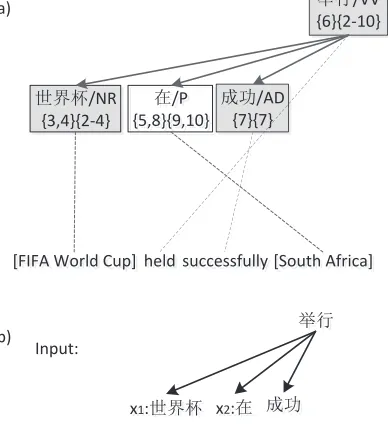
Figure 4: A lexicalized head-dependents rule (b) induced from the only acceptable head-dependents fragment (a) of Figure 3.
4.3 Rule Induction
From each acceptable head-dependents fragment, we induce a set of lexicalized and unlexicalized head-dependents rules.
4.3.1 Lexicalized Rule
We induce a lexicalized head-dependents rule from an acceptable head-dependents fragment by the following procedure:
1. extract the head-dependents relation and mark the internal nodes as substitution sites. This forms the input of a head-dependents rule;
2. place the nodes in order according to the head span of the root and the dependency spans of the sinks, then replace the internal nodes with variables and the other nodes with the target words covered by their head spans. This forms the output of a head-dependents rule.
in-duced from it.
4.3.2 Unlexicalized Rules
Since head-dependents relations with verbs as heads typically consist of more than four nodes, em-ploying only lexicalized head-dependents rules will result in severe sparseness problem. To alleviate this problem, we generalize the lexicalized head-dependents rules and induce rules with unlexicalized nodes.
As we know, the modification relation of a head-dependents relation is determined by the edges. Therefore, we can replace the lexical word of each node with its categories (i.e. POS) and obtain new head-dependents relations with unlexicalized nodes holding the same modification relation. Here we call the lexicalized and unlexicalized head-dependents relations as instances of the modification relation. For a head-dependents relation withmnode, we can produce2m−1instances with unlexicalized nodes. Each instance represents the modification relation with a different specification.
Based on this observation, from each lexical-ized dependent rule, we generate new head-dependents rules with unlexicalized nodes according to the following principles:
1. change the aligned part of the target string into a new variable when turning a head node or a leaf node into its category;
2. keep the target side unchanged when turning a internal node into its category.
Restrictions: Since head-dependents relations with verbs as heads typically consists of more than four nodes, enumerating all the instances will re-sult in a massive grammar with too many kinds of rules and inflexibility in decoding. To alleviate these problems, we filter the grammar with the following principles:
1. nodes of the same type turn into their categories simultaneously.
2. as for leaf nodes, only those with open class words can be turned into their categories. In our experiments of this paper, we only turn those dependents with POS tag in the set of{CD,DT,OD,JJ,NN,NR,NT,AD,FW,PN} into their categories.
x2:൘ x2:൘
x1:ц⭼ᶟ
x1:ц⭼ᶟ ᡀ࣏ᡀᡀᡀ࣏࣏
heldd
held successfullysuccessfully
ᡀ ᡀ
ᡀ
ᡀ ᡀ
ᡀ࣏࣏࣏࣏࣏࣏
Ѯ Ѯ Ѯ Ѯ Ѯ Ѯ Ѯ㹼㹼
Ѯ㹼
x1
x1 x2x2
(x1:ц⭼ᶟ)(x2:൘)(ᡀ࣏) Ѯ㹼 à x1 held successfully x2
x2:൘ x2:൘
x1:ц⭼ᶟ
x1:ц⭼ᶟ xx33:AD::AAADD
heldd held x3x3
A A A AD A ADDD
Ѯ
Ѯ Ѯ Ѯ Ѯ㹼
Ѯ㹼
x1
x1 x2x2
(x1:ц⭼ᶟ)(x2:൘)(x3:AD) Ѯ㹼 à x1 held x3 x2
x2:P x2:P x1:NR
x1:NR ᡀ࣏ᡀᡀ࣏࣏
heldd
held successfullysuccessfully
࣏ ࣏ ࣏ ࣏ ࣏ ࣏ Ѯ Ѯ Ѯ Ѯ Ѯ㹼
Ѯ㹼
x1
x1 x2x2
(x1:NR)(x2:P)(ᡀ࣏) Ѯ㹼 à x1 held successfully x2
x2:P x2:P x1:NR
x1:NR x3:ADx3::AAADD
heldd heldl x3x3
ADDDDDD Ѯ
Ѯ Ѯ Ѯ Ѯ㹼
Ѯ㹼
x1
x1 x2x2
(x1:NR)(x2:P)(x3:AD) Ѯ㹼 à x1 held x3 x2
x2:൘ x2:൘
x1:ц⭼ᶟ
x1:ц⭼ᶟ ᡀ࣏ᡀᡀᡀ࣏࣏
x4
x4 successfullysuccessfully
ᡀ࣏
ᡀ
ᡀ࣏࣏࣏࣏࣏
x4:VV x4:VV
x1
x1 x2x2
(x1:ц⭼ᶟ)(x2:൘)(ᡀ࣏) x4:VV
à x1 x4 successfully x2 x2:൘
x2:൘
x1:ц⭼ᶟ
x1:ц⭼ᶟ x3:ADx3::AAADD
x4 x4 x3x3
A A A A ADDDDDD
x4:VV x4:VV
x1
x1 x2x2
(x1:ц⭼ᶟ)(x2:൘)(x3:AD) x4:VV
à x1 x4 x3 x2
x2:P x2:P x1:NR
x1:NR ᡀ࣏ᡀᡀ࣏࣏
x4
x4 successfullysuccessfully
࣏ ࣏ ࣏ ࣏ ࣏ ࣏
x4:VV x4:VV
x1
x1 x2x2
(x1:NR)(x2:P)(ᡀ࣏) x4:VV
à x1 x4 successfully x2
x2:P x2:P x1:NR
x1:NR x3:ADx3::AAADD
x4 x4 x3x3
A AD A ADDDDDD
x4:VV x4:VV
x1
x1 x2x2
(x1:NR)(x2:P)(x3:AD) x4:VV
à x1 x4 x3 x2
generalize leaf generalize leaf
generalize internal generalize internal
generalize leaf generalize leaf
[image:6.612.323.575.51.444.2]generalize head
Figure 5: An illustration of rule generalization. Where “x1:世 界 杯” and “x2:在” indicate substitution sites which can be replaced by a subtree rooted at “世界杯” and “在” respectively. “x3:AD”indicates a substitution
site that can be replaced by a subtree whose root has part-of-speech “AD”. The underline denotes a leaf node. The box indicates the starting lexicalized head-dependents rule.
Figure 5 illustrates the rule generalization process under these restrictions.
4.3.3 Unaligned Words
Algorithm 1:Algorithm for Rule Acquisition
Input: Source dependency structureT, target stringS, alignmentA
Output: Translation rule setR
1 HSet←ACCEPTABLE HEAD(T,S,A) 2 DSet←ACCEPTABLE DEPENDENT(T,S,A) 3 foreach node n∈HSetdo
4 extract head rules
5 append the extracted rules toR 6 if ∀n′ ∈child(n)n′∈DSet
7 then
8 obtain a head-dependent fragmentf
9 induce lexicalized and unlexicalized head-dependents rules fromf 10 append the induced rules toR
11 end
12 end
spans simultaneously. In this process, we might ob-tainm(m ≥1)dependents rules from a head-dependent fragment in handling unaligned words. Each of these rules is assigned with a fractional count1/m.
4.4 Algorithm for Rule Acquisition
The rule acquisition is a three-step process, which is summarized in Algorithm 1.
We take the extracted rule set as observed data and make use of relative frequency estimator to obtain the translation probabilitiesP(t|s)andP(s|t).
5 The model
Following (Och and Ney, 2002), we adopt a general log-linear model. Letdbe a derivation that convert a source dependency structureT into a target string e. The probability ofdis defined as:
P(d)∝∏ i
ϕi(d)λi (1)
whereϕi are features defined on derivations andλi are feature weights. In our experiments of this paper, we used seven features as follows:
- translation probabilitiesP(t|s)andP(s|t); - lexical translation probabilities Plex(t|s) and
Plex(s|t);
- rule penaltyexp(−1);
- language modelPlm(e); - word penaltyexp(|e|). 6 Decoding
Our decoder is based on bottom up chart parsing. It finds the best derivationd∗ that convert the input dependency structure into a target string among all possible derivationsD:
d∗=argmaxd∈DP(D) (2)
Given a source dependency structureT, the decoder transverses T in post-order. For each accessed in-ternal noden, it enumerates all instances of the re-lated modification relation of the head-dependents relation rooted at n, and checks the rule set for matched translation rules. If there is no matched rule, we construct apseudo translation rule accord-ing to the word order of the head-dependents rela-tion. For example, suppose that we can not find any translation rule about to “(2010年) (FIFA) 世 界杯”, we will construct a pseudo translation rule “(x1:2010年) (x2:FIFA) x3:世界杯 → x1 x2 x3”.
A larger translation is generated by substituting the variables in the target side of a translation rule with the translations of the corresponding dependents. We make use of cube pruning (Chiang, 2007; Huang and Chiang, 2007) to find the k-best items with inte-grated language model for each node.
thresh-oldβ, items with a score worse thanβ times of the best score in the same cell will be discarded; sec-ond, beam sizeb, items with a score worse than the bth best item in the same cell will be discarded. The item consist of the necessary information used in de-coding. Each cell contains all the items standing for the subtree rooted at it. For our experiments, we set β= 10−3andb= 300. Additionally, we also prune rules that have the same source side (b= 100).
7 Experiments
We evaluated the performance of our dependency-to-string model by comparison with replications of the hierarchical phrase-based model and the tree-to-string models on Chinese-English translation.
7.1 Data preparation
Our training corpus consists of 1.5M sentence pairs from LDC data, including LDC2002E18, LDC2003E07, LDC2003E14, Hansards portion of LDC2004T07, LDC2004T08 and LDC2005T06.
We parse the source sentences with Stanford Parser (Klein and Manning, 2003) into projective dependency structures, whose nodes are annotated by POS tags and edges by typed dependencies. In our implementation of this paper, we make use of the POS tags only.
We obtain the word alignments by running GIZA++ (Och and Ney, 2003) on the corpus in both directions and applying “grow-diag-and” re-finement(Koehn et al., 2003).
We apply SRI Language Modeling Toolkit (Stol-cke, 2002) to train a 4-gram language model with modified Kneser-Ney smoothing on the Xinhua por-tion of the Gigaword corpus.
We use NIST MT Evaluation test set 2002 as our development set, NIST MT Evaluation test set 2004 (MT04) and 2005 (MT05) as our test set. The qual-ity of translations is evaluated by thecase insensitive NIST BLEU-4 metric (Papineni et al., 2002).1
We make use of the standard MERT (Och, 2003) to tune the feature weights in order to maximize the system’s BLEU score on the development set.
1ftp://jaguar.ncsl.nist.gov/mt/resources/mteval-v11b.pl
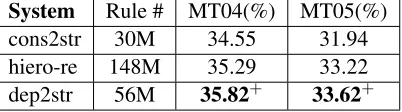
System Rule # MT04(%) MT05(%)
cons2str 30M 34.55 31.94
hiero-re 148M 35.29 33.22
[image:8.612.336.537.48.104.2]dep2str 56M 35.82+ 33.62+
Table 1: Statistics of the extracted rules on training cor-pus and the BLEU scores on the test sets. Where “+” meansdep2strsignificantly better thancons2strwithp <
0.01.
7.2 The baseline models
We take a replication of Hiero (Chiang, 2007) as the hierarchical phrase-based model baseline. In our experiments of this paper, we set the beam size b = 200and the beam thresholdβ = 0. The maxi-mum initial phrase length is 10.
We use constituency-to-string model (Liu et al., 2006) as the syntax-based model baseline which make use of composed rules (Galley et al., 2006) without handling the unaligned words. In our exper-iments of this paper, we set the tatTable-limit=20, tatTable-threshold=10−1, limit=100, stack-threshold=10−1,hight-limit=3, and length-limit=7.
7.3 Results
We display the results of our experiments in Table 1. Our dependency-to-string model dep2str signif-icantly outperforms its constituency structure-based counterpart (cons2str) with +1.27 and +1.68 BLEU on MT04 and MT05 respectively. Moreover, with-out resort to phrases or parse forest, dep2str sur-passes the hierarchical phrase-based model ( hiero-re) over +0.53 and +0.4 BLEU on MT04 and MT05 respectively on the basis of a 62% smaller rule set.
Furthermore, We compare some actual transla-tions generated by cons2str, hiero-re and dep2str. Figure 6 shows two translations of our test sets MT04 and MT05, which are selected because each holds a long distance dependency commonly used in Chinese.
mistak-ᐤቬ㙦
ᐤቬ㙦 ൘൘ 㖾ഭ㖾ഭ ഭ࣑䲒ഭ࣑䲒 оо 劽ቄ劽ቄ ⸝Ჲ⸝Ჲ Պ䈸Պ䈸 ਾਾ 㺘⽪㺘⽪ ˖˖
After
After briefbrief talkstalks withwith PowellPowell ,, thethe USUS State DepartmentState Department BarnierBarnier saidsaid ,, MT05----Segment 163
Reference: After a brief talk with Powell at the US State
Department, Barnier said:
Cons2str: Barnier after brief talks in US State Department and Powell said:
Hiero-re: After a short meeting with Barnier on the US State Department, Powell said:
Dep2str: After brief talks with Powell, the US State Department Barnier said,
ѝഭ
ѝഭ䎎䍿䎎䍿৽৽ ငઈՊငઈՊѪѪ ׳䘋׳䘋 ᢗ㹼ᢗᢗ㹼 13731373 20012001˅˅
China
China appreciatesappreciates effortsefforts ofof Anti -Anti - TerrorismTerrorism CommitteeCommittee toto promotepromote allall countriescountries inin MT04----Segment 1096
Reference: China appreciates the efforts of the Counter-Terrorism Committee to promote the implementation of the resolution 1373(2001) in all states and to help enhance the anti-terrorist capabilities of developing countries.
Cons2str: China appreciates Anti - Terrorist Committee for promoting implementation of the resolution No. 1373(2001) and help developing countries strength counter-terrorism capability building for the efforts,
Hiero-re: China appreciates Anti - Terrorism Committee to promote countries implement resolution No . 1373 ( 2001 ) and help developing countries strengthen anti-terrorism capacity building support for efforts
Dep2str: China appreciates efforts of Anti - Terrorism Committee to promote all countries in the implementation of resolution 1373 ( 2001 ) , to help strengthen the anti-terrorism capability building of developing countries
ഭ
ഭ ㅜㅜ ˄˄˄˄ ਧਧߣ䇞ߣ䇞ǃǃᑞࣙᑞࣙਁኅѝഭᇦਁኅѝഭᇦ৽৽ ڊڊ nsubj
prep
prep
ᡰ ᡰ ᔪ䇮 ᔪ䇮 㜭࣋
㜭࣋ ⲴⲴ ࣚ࣋ࣚ࣋ˈˈ
the
the implementationimplementation ofof ......
[image:9.612.92.540.68.352.2]nsubj dobj
Figure 6: Actual translations produced by the baselines and our system. For our system, we also display the long distance dependencies correspondence in Chinese and English. Here we omit the edges irrelevant to the long distance dependencies.
enly treat “鲍 尔(Powell)” as the subjective, thus result in translations with different meaning from the source sentence. Conversely, although “在” is falsely translated into a comma, dep2str captures this complex dependency and translates it into “Af-ter ... ,(should beat) Barnier said”, which accords with the reordering of the reference.
In the second example, the Chinese input holds a long distance dependency “中 国 赞 赏 ... 努 力” which corresponds to a simple pattern “noun phrase+verb+noun phrase”. However, due to the modifiers of “努 力” which contains two sub-sentences including 24 words, the sentence looks rather complicated. Cons2str and hiero-re fail to capture this long distance dependency and provide monotonic translations which do not reflect the meaning of the source sentence. In contrast,dep2str successfully captures this long distance dependency and translates it into “China appreciates efforts of
...”, which is almost the same with the reference “China appreciates the efforts of ...”.
While constituency structure-based models typically constrain the number of internal nodes (Galley et al., 2006) and/or the height (Liu et al., 2006) of translation rules so as to balance the grammar size and performance. Both strategies limit the ability of the models in processing long distance reordering of sentences with long and complex modification rela-tions.
8 Related Works
As a first step towards semantics, dependency struc-tures are attractive to machine translation. And many efforts have been made to incorporating this desirable knowledge into machine translation.
(Lin, 2004; Quirk et al., 2005; Ding and Palmer, 2005; Xiong et al., 2007) make use of source depen-dency structures. (Lin, 2004) employs linear paths as phrases and view translation as minimal path cov-ering. (Quirk et al., 2005) extends paths to treelets, arbitrary connected subgraphs of dependency struc-tures, and propose a model based on treelet pairs. Both models require projection of the source depen-dency structure to the target side via word alignment, and thus can not handle non-isomorphism between languages. To alleviate this problem, (Xiong et al., 2007) presents a dependency treelet string corre-spondence model which directly map a dependency structure to a target string. (Ding and Palmer, 2005) presents a translation model based on Synchronous Dependency Insertion Grammar(SDIG), which han-dles some of the non-isomorphism but requires both source and target dependency structures. Most im-portant, all these works do not specify the ordering information directly in translation rules, and resort to either heuristics (Lin, 2004; Xiong et al., 2007) or separate ordering models(Quirk et al., 2005; Ding and Palmer, 2005) to control the word order of translations. By comparison, our model requires only source dependency structure, and handles non-isomorphism and ordering problems simultaneously by directly specifying the ordering information in the head-dependents rules that represent the source side as head-dependents relations and the target side as strings.
(Shen et al., 2008) exploits target dependency structures as dependency language models to ensure the grammaticality of the target string. (Shen et al.,
2008) extends the hierarchical phrase-based model and present a string-to-dependency model, which employs string-to-dependency rules whose source side are string and the target as well-formed depen-dency structures. In contrast, our model exploits source dependency structures, as a tree-based sys-tem, it run much faster (linear time vs. cubic time, see (Huang et al., 2006)).
9 Conclusions and future work
In this paper, we present a novel dependency-to-string model, which employs head-dependents rules that represent the source side as head-dependents relations and the target side as string. The head-dependents rules specify the ordering information directly and require only substitution operation. Thus, our model does not need heuristics or order-ing model of the previous works to control the word order of translations. Large scale experiments show that our model exhibits good performance in long distance reordering and outperforms the state-of-the-art constituency-to-string model and hierarchi-cal phrase-based model without resort to phrases and parse forest. For the first time, a source dependency-based model shows improvement over the state-of-the-art translation models.
In our future works, we will exploit the semantic information encoded in the dependency structures which is expected to further improve the transla-tions, and replace 1-best dependency structures with dependency forests so as to alleviate the influence caused by parse errors.
Acknowledgments
This work was supported by National Natural Sci-ence Foundation of China, Contract 60736014, 60873167, 90920004. We are grateful to the anony-mous reviewers for their thorough reviewing and valuable suggestions. We appreciate Yajuan Lv, Wenbin Jiang, Hao Xiong, Yang Liu, Xinyan Xiao, Tian Xia and Yun Huang for the insightful advices in both experiments and writing. Special thanks goes to Qian Chen for supporting my pursuit all through.
References
ACL 2005, pages 263–270.
David Chiang. 2007. Hierarchical phrase-based transla-tion.Computational Linguistics, 33.
Yuan Ding and Martha Palmer. 2005. Machine trans-lation using probabilistic synchronous dependency in-sertion grammars. InProceedings of ACL 2005. Heidi J. Fox. 2002. Phrasal cohesion and statistical
ma-chine translation. InIn Proceedings of EMNLP 2002, pages 304–311.
Michel Galley, Jonathan Graehl, Kevin Knight, Daniel Marcu, Steve DeNeefe, Wei Wang, and Ignacio Thayer. 2006. Scalable inference and training of context-rich syntactic translation models. In Proceed-ings of ACL 2006, pages 961–968, Sydney, Australia, July. Association for Computational Linguistics. Peter Hellwig. 2006. Parsing with dependency
gram-mars. InDependenz und Valenz / Dependency and Va-lency, volume 2, pages 1081–1109. Berlin, New York. Liang Huang and David Chiang. 2007. Forest rescor-ing: Faster decoding with integrated language models. InProceedings of ACL 2007, pages 144–151, Prague, Czech Republic, June.
Liang Huang, Kevin Knight, and Aravind Joshi. 2006. A syntax-directed translator with extended domain of locality. InProceedings of the Workshop on Computa-tionally Hard Problems and Joint Inference in Speech and Language Processing, pages 1–8, New York City, New York, June. Association for Computational Lin-guistics.
Richard Hudson. 1990. English Word Grammar. Black-ell.
Dan Klein and Christopher D. Manning. 2003. Fast exact inference with a factored model for natural language parsing. InIn Advances in Neural Information Pro-cessing Systems 15 (NIPS, pages 3–10. MIT Press. Philipp Koehn, Franz J. Och, and Daniel Marcu. 2003.
Statistical phrase-based translation. In Proceedings of the 2003 Human Language Technology Conference of the North American Chapter of the Association for Computational Linguistics, Edmonton, Canada, July. Dekang Lin. 2004. A path-based transfer model for
machine translation. InProceedings of Coling 2004, pages 625–630, Geneva, Switzerland, Aug 23–Aug 27.
Yang Liu, Qun Liu, and Shouxun Lin. 2006. Tree-to-string alignment template for statistical machine trans-lation. InProceedings of ACL 2006, pages 609–616, Sydney, Australia, July.
Franz Josef Och and Hermann Ney. 2002. Discrimi-native training and maximum entropy models for sta-tistical machine translation. In Proceedings of 40th Annual Meeting of the Association for Computational Linguistics, pages 295–302, Philadelphia, Pennsylva-nia, USA, July.
Franz Josef Och and Hermann Ney. 2003. A system-atic comparison of various statistical alignment mod-els.Computational Linguistics, 29(1):19–51.
Franz Josef Och and Hermann Ney. 2004. The alignment template approach to statistical machine translation. Franz Josef Och. 2003. Minimum error rate training in
statistical machine translation. InProceedings of ACL-2003, pages 160–167, Sapporo, Japan, July.
Kishore Papineni, Salim Roukos, Todd Ward, and Wei-Jing Zhu. 2002. Bleu: a method for automatic evaluation of machine translation. InProceedings of ACL 2002, pages 311–318, Philadelphia, Pennsylva-nia, USA, July.
Chris Quirk, Arul Menezes, and Colin Cherry. 2005. De-pendency treelet translation: Syntactically informed phrasal smt. InProceedings of ACL 2005, pages 271– 279.
Libin Shen, Jinxi Xu, and Ralph Weischedel. 2008. A new string-to-dependency machine translation al-gorithm with a target dependency language model. In Proceedings of ACL 2008: HLT, pages 577–585, Columbus, Ohio, June. Association for Computational Linguistics.
Andreas Stolcke. 2002. Srilm - an extensible language modeling toolkit. InProceedings of ICSLP, volume 30, pages 901–904.
Deyi Xiong, Qun Liu, and Shouxun Lin. 2007. A depen-dency treelet string correspondence model for statisti-cal machine translation. InProceedings of the Second Workshop on Statistical Machine Translation, pages 40–47, Prague, Czech Republic, June.