Original citation:
Godsell, Janet, Masi, Donato and Day, Steven (2017) Exploring the role of a MOOC as a platform for impact based learning in O&SCM. In: EurOMA 17, Edinburgh, Scotland, 3-5 Jul 2017. Published in: Proceedings of EurOMA.
Permanent WRAP URL:
http://wrap.warwick.ac.uk/89936
Copyright and reuse:
The Warwick Research Archive Portal (WRAP) makes this work by researchers of the University of Warwick available open access under the following conditions. Copyright © and all moral rights to the version of the paper presented here belong to the individual author(s) and/or other copyright owners. To the extent reasonable and practicable the material made available in WRAP has been checked for eligibility before being made available.
Copies of full items can be used for personal research or study, educational, or not-for-profit purposes without prior permission or charge. Provided that the authors, title and full bibliographic details are credited, a hyperlink and/or URL is given for the original metadata page and the content is not changed in any way.
A note on versions:
The version presented in WRAP is the published version or, version of record, and may be cited as it appears here.
Exploring the role of a MOOC as a platform for
impact based learning in O&SCM
Professor Janet Godsell WMG – University of Warwick, UK
Dr. Donato Masi ([email protected]) WMG – University of Warwick, UK
Steven Day
WMG – University of Warwick, UK
David Hopkins
WBS – University of Warwick, UK
Abstract
The concept of Engaged Scholarship emerged as reaction to the failure of business schools to produce research that advances practice and creates value for individuals outside the academy. The literature proposes several models of engaged scholarship, but there is a paucity of studies presenting and testing practical ways of implementing an engaged scholarship. This paper fills this gap by exploring the role of a Massive Open Online Course as tool for the implementation of an engaged scholarship in Operations and Supply Chain Management. The test is based on the analysis of the comments of a MOOC on Supply Chains.
Keywords: MOOC, engaged scholarship, O&SCM
Introduction
whether a very cheap product can ensure a fair return to everyone in the supply chain. From an environmental perspective, the environmental footprint of products can raise questions on whether consumers should reduce the consumption of certain items or buy seasonally. The pivotal role of individuals raises the question on how specific behaviours can be encouraged, how the knowledge on supply chains can be enhanced among individuals outside academia, and, more generally, how academia should relate to individuals outside the academy.
The concept of engaged scholarship (see e.g. Van de Ven and Johnson, 2006) emerged with the purpose of promoting research that advances practice and creates value for individuals outside of the academy, as current education approaches by business schools failed to bridge the gap between academia and society (see e.g. Mckelvey, 2006). Therefore, engaged scholarship models propose specific approaches for developing a new engaged relationship between academics and individuals outside the academy.
While these studies create the theoretical background for the development of an engaged scholarship, there is a paucity of studies presenting and testing practical ways of implementing an engaged scholarship.
This paper aims at filling this gap by exploring the role of a Massive Open Online Course (MOOC) as a platform for impact based learning in Operations and Supply Chain Management (O&SCM). A MOOC is an open educational resource consisting of “digitised materials offered freely and openly for educators, students and self-learners to use and reuse for teaching, learning and research” (Hylén and Schuller, 2007, p. 30). This type of tool has a high potential for the implementation of an engaged scholarship because of its accessibility, flexibility, and the possibility of engaging a broad audience of learners with different perspectives and backgrounds. The conditions and the design choices that allow the exploitation of this potential are however unclear.
The paper is structured as follows. Section 2 presents an overview of the literature on engaged scholarship and MOOCs. Section 3 explains the research methodology. Section 4 presents the results that are then discussed in section 5. Finally, section 6 summarises the conclusions of the study.
Literature Review
This study builds on two different streams of research: engaged scholarship and role of MOOCS in higher education. The following section presents an overview of these two research streams and proposes a conceptual framework used as basis for the empirical work.
Engaged Scholarship
The studies on engaged scholarship emerged as reaction to the failure of business schools to produce research that advances practice and promotes collaboration between academics and individuals outside the academy (McKelvey 2006).
Building on Boyer’s studies, Van de Ven and Johnson (2006) reflect on the difficulty of creating an engaged scholarship because of how academic knowledge in transferred and because academics and practitioners live in different knowledge worlds. One of these differences regards, for instance, the fact that scientists study generalizable and context free problems while practitioners use knowledge that is site- and situation-specific, customised, and derived from experience. Having reflected on these difficulties, Van de Ven and Johnson propose a solution for an engaged scholarship that consists of four steps in a participatory research process. The steps, which are not necessarily sequential, include (1) the creation of researcher collectives involving both business school scientists and practitioners, (2) a dialectical method of inquiry based on a confrontation of divergent theses and antitheses, (3) a creative conflict management that encourages task conflict is and avoids personal conflict, and (4) a dialectical form of engaged scholarship. The “dialectical form of engaged scholarship” then consists of five “dimensions” (2006, pp. 809–815): a focus on big questions grounded in reality, a collaborative learning community, an extended time over which to build relationships, multiple models and methods, a re-examination of researchers’ assumptions and researchers’ self-reflection.
Hyman et al. (2000, 2002) propose the UniSCOPE model of scholarship as a “continuously iterative process wherein the knowledge and creativity of the academy are brought to the field and are, in turn, reinvigorated in the processes of application, education, and integration” (Hyman et al., 2002, p. 49). This model distinguishes between three forms of scholarship (teaching, research, and service) that can perform four functions (discovery, integration, application, and education).
Franz (2009) highlights the difficulty of the previous concepts in addressing the day-to-day context of faculty involved in engaged scholarship and therefore proposes a holistic model of engaged scholarship that combines the three models proposed by Boyer (1990, 1996), Van de Ven and Johnson (2006), and Hyman et al. (2000, 2002). The model, shown in Figure 1, is configured as a group of circles. In the innermost circle the model proposes a simplified definition of engaged scholarship as a link between academia and community in a two-way relationship. The three university missions of teaching, research, and outreach are broken into six “entry points”. These points include: (1) discovery of new knowledge, (2) development of new knowledge, (3) dissemination of new knowledge, (4) change in learning, (5) change in behaviour, and (6) change in conditions. The engagement between the scholar and communities can take place at any or all of these six entry points. Finally, the outer circle in the model suggests three sets of factors that impact the success of engaged scholarship: (1) internal factors, (2) external factors, and (3) assumptions about engaged scholarship. This study focuses on these six “entry points”, that will be assumed as potential engagement mechanisms between academics and individuals outside the academy that a MOOC should be able to promote.
Role of MOOCs in Engaged Scholarship
much controversy surrounds the idea of MOOCs, several studies analyse the features of MOOCs that make them appropriate for the implementation of an engaged scholarship.
Figure 1 - Holistic model of engaged scholarship Franz (2009)
Pomerol et al. (2015) highlight the flexibility of MOOCs and observe that a priori there are no limitations, boundaries or limits to the domain and to the level of MOOCs. The variety of performances and intended learning outcomes achieved by different MOOCs suggest that this new learning tool is extremely versatile and flexible compared to previous tools and approaches. Carver and Harrison (2013) highlight the accessibility of MOOCs that give low-income students the opportunity to participate in courses that might otherwise be unaffordable, and at the same time increases the diversity of the student body, giving learners access to support from a large learning community (Chen et al., 2013; Ferguson and Sharples, 2014). Another factor fostering the success of MOOCs is their increased potential in engaging both learners and instructors (Chen et al., 2013; Hew and Cheung, 2014). Apart from the desire of knowledge, other factors determining the potential of MOOCs in engaging learners are the curiosity of experiencing a new tool, a sense of personal challenge, and the perception of online lectures as a pastime. Similarly, some instructors decide to offer MOOCs because they want to experience a new teaching approach and connect to a large and global audience. Others want to increase their personal reputation and some instructors mention altruism and feelings of personal reward as the reason for offering MOOCs (Hew and Cheung, 2014). Finally Pomerol et al. (2015) observe that MOOCs can be an effective and relatively cheap tool that universities can use to build or maintain reputation and ranking on the international scale, and an effective tool for distance learning and initial training.
available in a one-size-fits-all MOOC. Furthermore they argue that MOOCs are becoming so popular within universities because cheap online education can replace costly faculty. This kind of change would be in line with an industry demanding ready-made employees while resisting supporting public education through taxation. On the other hand, they believe that “education in a democracy must be focused on responsible citizenship”, that requires a complex mix of information, attitudes, solidarity and moral commitment that MOOCs cannot transfer. Although students have the convenience of working through a MOOC at their own time and pace, the average completion rate for massive open online courses is less than 7 percent (Parr, 2103). Learners drop out due to a variety of reasons, such as a learning experience that does not match their expectations, other priorities (Canvas, 2013) or a lack of incentive (Fini, 2009).
For instructors it can be very difficult to find the right approach to teach advanced topics to a potentially wide range of students and backgrounds. The risk is that the content is over-simplified to reach a lower common denominator of pre-existing knowledge. Grading can also be an issue because of difficulties in setting the proper grading metrics (Head, 2013). Another key issue is the heavy demands of time and money required for the completion of a MOOC. To give an idea of the amount of work required, Head (2013) argues that to prepare the three lectures offered in a single week her team spent about 20 hours planning and developing the content.
Research Objectives and Methodology
This paper explores the role of a Massive Open Online Course (MOOC) as a platform for impact based learning in Operations and Supply Chain Management (O&SCM). More specifically, the study analyses whether a MOOC can enable the six engagement mechanisms between academics and individuals outside the academy proposed by Franz (2009). This objective is achieved thorough the study of the case of the MOOC “Supply Chains in Practice” developed by the authors of this paper and hosted by the Future Learn platform.
Case Description
Data Collection
The data used for analysing whether the MOOC can enable the six engagement mechanisms proposed by Franz (2009) are the comments of the learners provided during the different learning elements of the MOOC, together with data on MOOC attendance.
The course opened on the 17th of October 2016 and all comments left by learners on the learning elements of the MOOC were analysed until the cut-off point on the 15th of April 2017. Each comment was anonymised, gathered in a database, and coded by the researchers as relevant for one of the six engagement mechanisms proposed by Franz or as non-relevant. Comments were coded as relevant for one of the six engagement mechanisms proposed by Franz (2009) when they represented both an input for a particular engagement mechanisms or when they provided evidence of the success of a step in enabling an engagement mechanism.
Results
The following section will present the different engagement mechanisms between academia and community enabled by the MOOC. The engagement mechanisms are presented following the classification of Franz (2009) and distinguishing discovery of new knowledge, development of new knowledge, dissemination of new knowledge, change in learning, change in behaviour, and change in conditions.
Following Franz (2009, p. 36), discovery of new knowledge “involves scholars and communities working together in joint research to answer important questions of mutual interest”. Table 1 shows the comments classified as input or output for this engagement mechanism. A total of 307 comments fall into this category, representing 5.8% of all comments and 13.6% of the comments with any engagement mechanism.
Table 1 - Comments displaying the discovery of new knowledge by week/ type of activity. Week
Activity 1 2 3 4 5 6
Text 22 15 5 2 15 -
Video 15 4 1 - 12 15
Article 5 2 - 2 8 7
Explorative talking point 13 75 6 4 14 9
Attitude and opinion - 3 - 6 13 13
Personal decision 4 1 2 - - 14
A meaningful example of this engagement mechanism is a talking point of the first week, when the learners were asked to provide definitions of supply chain and supply network. The answers were quite heterogeneous, and in some cases highly conditioned from specific industrial experiences. One of the learners highlighted that “to move to a common definition is quite complex considering that different views exist not only between academics and practitioners, but also within companies in the same industry”. He also highlighted how “usually production is considered a vital part of Supply Chain, but I worked in a company that separates [the] “Supply Chain” department from [the] “Operations” department, having different managers for each of them. Some companies include forecasting in Supply Chain, while others prefer to consider Forecast as part of Sales department”. All these comments, apart from enabling the learning process, allowed the discovery of new knowledge because they were the input for a study on alternative definitions of supply chain and supply chain management.
category, namely 15.9% of the total or 36.8% of comments useful for any engagement mechanism.
Table 2: Comments displaying the development of new knowledge by week/ type of activity. Week
Activity 1 2 3 4 5 6
Text 29 89 22 12 25 -
Video 109 13 4 12 12 24
Article 4 11 2 4 8 9
Explorative talking point 73 115 20 35 31 18
Attitude and opinion - 6 16 15 14 16
Personal decision 8 11 27 12 - 38
Exemplary comments for this engagement mechanisms emerged when the learners were contextualising theory into their professional contexts. For instance, one of the learners reflected on the role of supply chains in his firm and highlighted how “Speaking from experience … too many businesses do not consider the supply chain as they develop their business strategy. Many companies just see supply chain at the back end of the business. We once won a major project … yet no consultation with the supply chain was made until after we were awarded the project”.
Following Franz (2009, p. 36), dissemination of new knowledge happens when “faculty and community members share with others what they’ve discovered together”. Attendance and activity data of the learners can demonstrate the effectiveness of MOOCS in the dissemination of knowledge. Table 3 shows that while 4,548 people registered and joined the course, 48.2% participated by opening at least one learning element. 28.5% of these learners participated continuously, with 519 learners contributing to discussions by commenting.
Table 3 – Total attendance and activity data of learners.
Group Total Percentages
Joiners 4,548
Learners 2,193 48.2% (% of joiners)
Active learners 1,466 66.8% (% of learners)
Returning learners 626 28.5% (% of learners)
Social learners 519 23.7% (% of learners)
A change in learning happens when “individuals actually learn something new from the information created through previous work in the engaged scholarship circle” (Franz, 2009, p. 37). In 294 comments learners declared a change in learning. These comments represent 5.6% of the total number of comments and 13% of comments showing any EP as per Table 4.
Table 4 - Comments showing a change in learning by week/ type of activity. Week
Activity
1 2 3 4 5 6
Text 19 16 4 4 4 -
Video 81 1 6 2 9 2
Article 16 2 6 1 1 2
Explorative talking point 26 16 5 10 2 1
Attitude and opinion - 8 1 1 - 1
Personal decision 6 2 5 1 - 33
[image:8.595.79.512.611.697.2]submitted, which amounts to 5.3% of all comments made and 12.3% of all comments displaying any engagement mechanism (refer to Table 5)
Table 5 - Comments displaying a change in behaviour by week/ type of activity. Week
Activity 1 2 3 4 5 6
Text 2 1 19 - 1 -
Video 3 - 5 - 3 29
Article 1 - 1 - - 8
Explorative talking point 4 11 14 - 1 13
Attitude and opinion - 1 15 - 4 29
Personal decision 22 2 14 - - 75
Exemplary comments for this engagement mechanisms emerged in regards to the learners’ role as consumers. When being faced with a personal decision talking point in week 6, after having learnt of social and environmental sustainability issues in modern supply chains, one learner wrote: “I don't consider myself a responsible consumer. Sometimes I got carried away by emotion or anxiety instead of reason and end up buying things I don't need... and that will probably end up disposed somewhere… shame on me. This block will definitely help me to re-think my purchasing behaviors from today.”
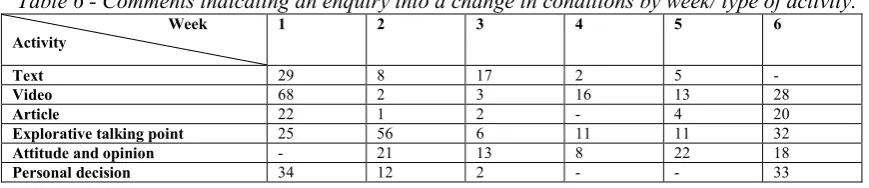
A change in conditions happens when there is a “lasting change in economic, environmental, social, and/or civic conditions in families, communities, businesses, or organizations” (Franz, 2009, p. 37). In the context of a MOOC, the authors of this study interpreted this engagement mechanism as a change in the perception of learners of economic, environmental, social, and/or civil conditions, rather than a simple individual behaviour. Table 6 shows comments classified as indicating a desire to change conditions by week and by type of activity. A total of 544 comments were given that match this entry point, which represents 10.4% of the total and 24.1% of any comment displaying an EP.
Table 6 - Comments indicating an enquiry into a change in conditions by week/ type of activity. Week
Activity 1 2 3 4 5 6
Text 29 8 17 2 5 -
Video 68 2 3 16 13 28
Article 22 1 2 - 4 20
Explorative talking point 25 56 6 11 11 32
Attitude and opinion - 21 13 8 22 18
Personal decision 34 12 2 - - 33
Exemplary comments for this engagement mechanisms emerged in week 6, in an explorative talking point on drivers and barriers for the circular economy. One of the learners highlighted how “some of the major constraints in development of the circular economy is the people mind-set and culture in adopting this philosophy either in their organizations or at home. Probably the profit driver (or saving in the long term) might make them more sensible but they should be more convinced at that choice will save us and our future generations from the abuse and depletion of the planet resources.”
Discussion
[image:9.595.79.514.493.587.2]sufficient to stimulate learners’ engagement in the discussion board. This result suggests that it is not possible to simply extend to MOOCs previous studies on learners’ engagement and that researchers should analyse the potential of the different learning activities in the new context of a MOOCs. A further consideration regards the type of knowledge discovered thanks to this engagement mechanism. The nature of the comments highlights the complementarity in terms of knowledge creation between the different actors involved in the MOOC. Van de Ven and Johnson (2006) observe that scientists study generalizable and context free problems while practitioners use knowledge that is site specific, customised, derived from experience, and aimed at specific situations. The comments show how these two different types of inputs were synthesised and lead to a sort of mutual development during the MOOC. The comment reported for this engagement mechanism shows how the learner builds on the academic task of developing a shared definition for supply chain to provide insights on the causes of the complexity of such a task based on his experience. Similarly, the MOOC allowed a proper mix between different levels of expertise. Learners not familiar with the topic struggled to make contributions but engaged with contributions by others.
While development of new knowledge occurred throughout the course, the distribution of the comments across the weeks shows that these contributions were mainly concentrated in the first weeks, when basic knowledge about the MOOCs’ topics was established. The result suggests that knowledge development in a MOOC context might work better for general rather than for specific topics. The knowledge development consisted essentially in the analysis of topics in different contexts and the identification of new ways of explaining and communicating the topics. Professional learners used their experience to analyse the concepts into their professional contexts, while non-professionals learners were often better able to combine key concepts with own experiences in accessible language.
The data confirm the potential of a MOOC for the dissemination of knowledge, but they also confirm that low completion rates are still a key issue, in line with the findings of previous studies (Parr, 2103).
Changes in learning were reported in several comments and add evidence to the validity of MOOCs as educational tools. The distribution of the comments across the weeks and across the different types of activities suggests that this engagement mechanism tended to operate most in the first week. In this week the learners had a breakthrough experience, namely the visualisation of a supply chain as a network or web, whereas many learners initially conceptualised supply chains as short and linear. This result suggests that the adoption of innovative and interdisciplinary approaches can be effective to promote changes in learning. The gradual drop-off of this engagement mechanism over the weeks can be explained differently - one possibility is that the first weeks equipped the learners with the key concepts, while in the last weeks learners started applying this knowledge in discussions rather than learning new concepts.
relatively early on in the course, but this did not trigger a critical reflection on personal behaviours as consumers.
The engagement mechanisms determining changes in conditions were prevalent in week 6 on the sustainability of supply chains. As in the previous case, the topic rather than the specific activities seems to drive the frequency of related comments. Indeed, this engagement mechanism was prevalent for weeks 1 and 6, which focused on more engaging topics from a societal perspective such as sustainability and global supply chains.
Conclusion
This study explored the role of a MOOC as a platform for impact based learning in O&SCM, and the results show that the MOOC effectively promoted the six engagement mechanisms proposed by Franz (2009) for engaged scholarship. Specific features of the MOOC that enabled its success were the adoption of innovative and interdisciplinary activities and the formulation of activities able to disseminate knowledge and generate an input for research at the same time. Another aspect enabling the success of the MOOC was the way of formulating the Intended Learning Outcome, since the course aimed at getting learners to be able to do one thing differently when dealing with supply chains. Such a practical Intended Learning Outcome paved the way for innovative engagement mechanisms between academics and individuals outside the academy, since it focused on the consequences of knowledge for individual change rather than on the knowledge itself. A potential limitation of this study is the fact that claims about changes in behaviour are based on the learners’ own comments. A further study might verify whether these behavioural changes actually happened.
References
Boyer, E. L. (1990), Scholarship reconsidered: Priorities of the professorate, Carnegie Foundation, Princeton, NJ. Boyer, E. L. (1996), “The scholarship of engagement”, Journal of Public Service & Outreach, Vol. 1, No. 1, pp. 11-20. Canvas. (2013), “Qualtrics and Instructure Partner to Reveal Top Motivations for MOOC Students”,
https://www.canvaslms.com/news/press-releases/qualtrics-and-instructure-reveal-mooc-students-top-motivations
Carver, L. and Harrison, L. M. (2013), “MOOCs and Democratic Education”, Liberal Education, Vol. 99, No. 4, pp. 20-25.
Chen, X., Barnett, D. R. and Stephens, C. (2013), “Fad or Future: The Advantages and Challenges of Massive Open Online Courses (MOOCs)”, Research-to Practice Conference in Adult and Higher Education, pp. 20–21.
Ferguson, R. and Sharples, M. (2014), “Innovative pedagogy at massive scale: teaching and learning in MOOCs”, European Conference on Technology Enhanced Learning, pp. 98-111.
Fini, A. (2009), “The Technological Dimension of a Massive Open Online Course: The Case of CCKo8 Course Tools”, International Review of Research in Open and Distance Learning, Vol. 10, No. 5.
Forbes. (2016), “Use of MOOCs and Online Education is Exploding: Here’s Why”, https://www.forbes.com/sites/joshbersin/ 2016/01/05/use-of-moocs-and-online-education-is-exploding-heres-why/#2cfd071c7649
Franz, N. (2009), “A holistic model of engaged scholarship: Telling the story across higher education’s missions”, Journal of Higher Education Outreach and Engagement, Vol. 13, No. 4, pp. 31-50.
Head, K. (2013), "Massive open online adventure", Chronicle of Higher Education, Vol. 59, No. 34, pp. 24–25.
Hew, K. F. and Cheung, W. S. (2014), “Students’ and instructors’ use of massive open online courses (MOOCs): Motivations and challenges”, Educational Research Review, Vol. 12, pp. 45–58.
Hylén, J., & Schuller, T. (2007). Giving knowledge for free. OECD Observer. http://doi.org/10.1787/9789264032125-en Hyman, D., Ayers, J.E., Cash, E.H., Fahnline, D.E., Gold, D.P., Gurgevich, E.A., Herrmann, R.O., Jurs, P.C., Roth, D.E., Swisher,
J.D. and Whittington, M.S. (2000), UniScope 2000: A multidimensional model of scholarship for the 21st century, The
UniScope Learning Community, University Park, PA.
Hyman, D., Gurgevich, E., Alter, T., Ayers, J., Cash, E., Fahnline, D., Gold, D., Herrmann, R., Jurs, P., Roth, D. and Swisher, J.
(2002), “Beyond Boyer: The UniSCOPE model of scholarship for the 21st century” Journal of Higher Education Outreach and
Engagement, Vol. 7, No. 1&2, pp. 41-65.
McKelvey, B. (2006), “Van De Ven and Johnson's “engaged scholarship”: Nice try, but….”, Academy of Management Review, Vol.
31, No. 4, pp. 822-829.
Parr, C. (2013), “Not Staying the Course”, Times Higher Education. [online] Accessed 23 January 2016: https://www.insidehighered.com/news/2013/05/10/new-study-low-mooc-completion-rates
Pomerol, J.-C., Epelboin, Y. and Thoury, C. (2015), “A MOOC for Whom and for What Purposes?” in Pomerol, J.-C., Epelboin, Y. and Thoury, C. (Eds.), MOOCs, John Wiley & Sons, Hoboken, NJ, pp. 49-69.
San José State University - Philosophy Department. (2013), “An Open Letter to Professor Michael Sandel from the Philosophy Department at San José State University”, The Chronicle of Higher Education.