warwick.ac.uk/lib-publications
Original citation:
Packwood, David, Kermode, James R., Mones, Letif, Bernstein, Noam, Woolley, John, Gould,
Nicholas, Ortner, Christoph and Csanyi, Gabor. (2016) A universal preconditioner for
simulating condensed phase materials. The Journal of Chemical Physics, 144 (16). 164109.
Permanent WRAP URL:
http://wrap.warwick.ac.uk/78515
Copyright and reuse:
The Warwick Research Archive Portal (WRAP) makes this work of researchers of the
University of Warwick available open access under the following conditions.
This article is made available under the Creative Commons Attribution 4.0 International
license (CC BY 4.0) and may be reused according to the conditions of the license. For more
details see:
http://creativecommons.org/licenses/by/4.0/
A note on versions:
The version presented in WRAP is the published version, or, version of record, and may be
cited as it appears here.
A universal preconditioner for simulating condensed phase materials
David Packwood,1James Kermode,2,a)Letif Mones,1,3Noam Bernstein,4John Woolley,5 Nicholas Gould,6Christoph Ortner,1,b)and Gábor Csányi3,c)
1Mathematics Institute, University of Warwick, Coventry CV4 7AL, United Kingdom
2Warwick Centre for Predictive Modelling, School of Engineering, University of Warwick, Coventry CV4 7AL, United Kingdom
3Engineering Laboratory, University of Cambridge, Trumpington Street, Cambridge CB2 1PZ, United Kingdom 4Center for Materials Physics and Technology, Naval Research Laboratory, Washington, DC 20375, USA 5Department of Physics, University of Warwick, Coventry CV4 7AL, United Kingdom
6Scientific Computing Department, STFC-Rutherford Appleton Laboratory Chilton, Oxfordshire OX11 0QX, United Kingdom
(Received 3 February 2016; accepted 5 April 2016; published online 26 April 2016)
We introduce a universal sparse preconditioner that accelerates geometry optimisation and saddle point search tasks that are common in the atomic scale simulation of materials. Our preconditioner is based on the neighbourhood structure and we demonstrate the gain in computational efficiency in a wide range of materials that include metals, insulators, and molecular solids. The simple structure of the preconditioner means that the gains can be realised in practice not only when using expensive electronic structure models but also for fast empirical potentials. Even for relatively small systems of a few hundred atoms, we observe speedups of a factor of two or more, and the gain grows with system size. An open source Python implementation within the Atomic Simulation Environment is available, offering interfaces to a wide range of atomistic codes. C 2016 Author(s). All article content, except where otherwise noted, is licensed under a Creative Commons Attribution (CC BY) license (http://creativecommons.org/licenses/by/4.0/).[http://dx.doi.org/10.1063/1.4947024]
I. INTRODUCTION
Geometry optimisation, i.e., finding a nearby local minimum of the potential energy surface, is the most common routine task of atomistic modelling, not only used for finding the equilibrium geometries of molecules and crystals, but also used as a fundamental building block of more complex algorithms for global optimisation,1 structure prediction by
random search,2 and sampling.3 The closely related task
of finding saddle points is also used for finding transition states of reactions, global optimisation, and accelerated sampling.
It is well recognised in the optimisation community how important preconditioners are in creating efficient algorithms. An example familiar in the electronic structure community is using the kinetic energy operator as a preconditioner when solving the electronic energy minimisation problem in plane wave pseudopotential density functional theory (DFT) codes.4Preconditioning in linear algebra and numerical partial differential equation problems is well established, but “universal” preconditioners do not work particularly well, and most practitioners advocate constructing preconditioners specifically designed to suit each problem.5 There is a
middle ground, which is to reduce the domain enough to be able to give a good preconditioner but keep it general enough that many problems that need solving fall into it.
a)Electronic mail: [email protected] b)Electronic mail: [email protected] c)Electronic mail: [email protected]
The hallmark of a good preconditioner is that it captures some aspects of the local curvature of the potential energy landscape, e.g., some of the directions in which the minimum is much shallower than in other directions. In this way, using the preconditioner enhances the convergence by reducing the condition number (see (2)). For example, it was recognised by many that geometry optimisation with a computationally expensive electronic structure model can be preconditioned using a cheap empirical interatomic model. This approach is clearly not feasible for large scale problems in which the modeling method itself is a relatively cheap interatomic model.
A universal goal in preconditioning of condensed phase atomistic systems is to take account of the long wavelength vibrational modes, whose energies tend towards zero as the system size increases, while the eigenvalues corresponding to the high frequency optical modes stay constant. In order to capture this geometry, due to the intrinsic locality of the interaction Hamiltonian, it is enough to build a model that is aware of the neighbourhood structure of the constituent atoms or molecules.
In this work, we use the simplest preconditioner that is capable of capturing this structure, the adjacency matrix of the atoms, or a smoothed variant using a distance cutoff. The only requirement of the cutoffis that it is chosen such that all atoms are assigned some neighbours. We choose example systems of current interest, which have a wide range of system sizes.
For a steepest descent (SD) or nonlinear conjugate gradient (CG) scheme with preconditioner P, one expects that the numbernP of iterations required to reach a relative
164109-2 Packwoodet al. J. Chem. Phys.144, 164109 (2016)
residualτis6
nP∼|logτ|×
κP (SD)
√
κP (CG), (1)
where κP is the condition number of the preconditioned HessianHat equilibrium,
κP=λmax/λmin, (2)
and
λmax=max u
uTHu
uTPu, (3)
λmin=min u
uTHu
uTPu (4)
are the largest and smallest eigenvalues.
For a material system with a diameter of Ratomic spac-ings, without preconditioning (i.e.,P≡I), one expectsκI∼R
while our preconditioner achieves thatκPis independent ofR. Therefore the expected efficiency gain is
nP
nI
≈
R−1 (SD)
R−1/2 (CG). (5)
The theory of the most commonly used Broyden-Fletcher-Goldfarb-Shanno (BFGS) and similar quasi-Newton type schemes are less clear, but numerical evidence suggests that a similar conclusion as in the CG case can be drawn.
II. METHODS
A. Geometry optimisation
Throughout, we let f(x) denote the energy for a configurationx. Ifxkis an iterate of an optimization algorithm,
then we denote the gradient and Hessian atxk, bygk =∇f(xk)
andHk=∇2f(xk), respectively.
The most basic geometry optimisation schemes are steepest descent and (undamped) Newton’s method,
xk+1=xk−αkgk, (6)
xk+1=xk−Hk−1gk. (7)
While the former suffers from slow convergence to equili-brium due to ill-conditioning of the energy-landscape, the latter is usually impractical since analytical Hessians (i) are typically unavailable for complex interatomic potentials and electronic structure methods and (ii) are expensive to invert.
Line search is an essential part of all the above gradient descent algorithms, and preconditioning the line search (as opposed to preconditioning the Newton step) can be thought of as a middle ground, replacing Hk with an approximate
HessianPk,
xk+1=xk−αkPk−1gk. (8)
The usual requirements onPkare that it is (1) cheap to build;
(2) cheap to invert; and (3) positive definite to ensure descent in energy.
The most common way to construct Pk is via a
quasi-Newton approach, typically BFGS or Limited-memory BFGS
(LBFGS). This works poorly for large systems since many iterations are required to “learn the Hessian” to a useful degree of accuracy. Physical intuition and mathematical analysis can be used to develop an improved initial guess for the Hessian to speed up convergence.7
An alternative approach (sometimes used in the electronic structure community8) is to take Pk =∇2f˜(xk) to be the
Hessian of a surrogate interatomic potential model ˜f. This has considerable potential for performance gains if a good surrogate model ˜f can be found. Downsides of this approach are (i) the challenge of finding or constructing such a surrogate model; (ii) indefiniteness of the surrogate Hessian in the nonlinear regime (and potentially even in the asymptotic regime); and (iii) lack of transferability of the preconditioner: changing the system requires the construction of a new surrogate model.
B. Metric preconditioning
Assume, for the moment, that we use the same preconditioner throughout the optimization process, Pk ≡P
in (8). An alternative point of view, which is common in the numerical linear algebra and nonlinear optimisation communities, is to think ofPas defining a metric on the space of configurations. To see this, note that calling−gk =−∇f(xk)
the direction of steepest descent is with reference to the ℓ2-norm ∥u∥IB(|ui|2)1/2 (where u is a direction in
configuration space). If we measure distances in configuration space with respect to theP-norm,∥u∥P=(uTPu)1/2, then the
direction of steepest descent becomes
arg min ∥u∥P=1
uT∇f(x)∝ −P−1∇f(x). (9)
That is,(8)is the natural steepest descent scheme with respect to the metric Pk. The advantage of this point of view is
that it frees us from the constraint of aiming to approximate the Hessian. Instead we are now searching for an alternative notion of distance in configuration space, which is a more general concept, and a fixed choice of metric may exist that is suitable for a wide range of atomistic systems.
Equivalently, we may think of(8)in terms of a change of coordinates. Let ˜xkBP1/2xk, andF(x˜)= f(P−1/2x˜), then the
“standard” gradient descent scheme ˜xk+1=x˜k−αk∇F(x˜k)is
equivalent to(8).
Since ∇2F(x˜)=P−1/2∇2f(P−1/2x˜)P−1/2, it follows that the rate of convergencexk → xof(8)to a limitxis given by9
∥xk−x∥P. κκP−1 P+1
k
∥x0−x∥P,
whereκPis the condition number ofP−1/2H P−1/2. The latter
can be computed from the generalised eigenvalue problem
Hv =λPv. (10)
While approximating the Hessian would lead us to aim forPsuch thatκP≈1, we shall be content with a good notion
of distance, which will lead to a Psuch that κP is bounded
by some moderate constant for a wide range of systems of interest.
Our final remark in this abstract context is that while the discussion of convergence rates applies strictly to the
asymptotic regime of the iteration, preconditioning also improves performance in the pre-asymptotic regime: a moderate upper bound on κP implies, loosely speaking, that
(8) relaxes all wavelength modes simultaneously rather than focusing on short wavelength modes first.
C. Preconditioned LBFGS
The usage of a preconditioner is not restricted to the steepest descent method, but it can be readily applied to improved optimisation algorithms such as nonlinear conjugate gradients. It is particularly effective when combined with the LBFGS scheme,6 for which we briefly outline the implementation.
Using sk=xk−xk−1, yk=∇f(xk)− ∇f(xk−1), ρk
=1/yT
ksk, the action of the inverse Hessian can be efficiently
approximated,
inputq=∇f(xk),
outputz≈ ∇2f(xk)−1∇f(xk),
fori=k, . . . ,k−m,
αi=ρisTiq, q=q−αiyi,
z=Pk−1q
fori=k−m, . . . ,k,
βi=ρiyT i z,
z=z+(αi−βi)si.
(11)
This formulation of LBFGS does not require the approximate Hessian itself to be stored, only the positions and gradients at previous iterates. For the initial iterate, we simply obtain z=P−1
0 ∇f(x0). The boxed step is the only modification needed to the standard algorithm to achieve preconditioning. After obtaining the outputpk=zfrom(11), the LBFGS step
takes the form
xk+1=xk+αkpk, (12)
for a suitable choice of step lengthαk.
D. A simple and general metric for materials
Changes in energy of atomistic systems occur through changes in bonding, for which the simplest measure is change in bond length. Motivated by this observation, we propose the following preconditioner for materials systems: given parametersrcut,rnn,A, µ(we will discuss below how to choose these automatically), we definePvia the quadratic form
uTPu=µ 0<|ri j|<rcut
ci j|ui−uj|2,
ci j=exp
( −A(rri j
nn−1 ) )
,
or, written in matrix form
Pi j=
−µci j, |ri j|<rcut
0, |ri j|≥rcut ,
Pii=−
j,i
Pi j.
(13)
Default parameters are discussed in SectionII E.
Remarks. (i) The exponential form of ci j is for
convenience and has no deeper physical meaning; A=0 corresponds to using the adjacency matrix with a hard cutoff. (ii) We use this metric even for multi-component systems; however, if the interaction strength and/or distances between different components vary significantly, then it would be straightforward to generalise it by distinguishing different types of bonds. (iii) As shown in Appendix B, for Bravais lattices, phonon stability is equivalent to the lower bound uTHu≥cuTPufor some constantc>0.
Together with the generic and elementary upper bound uTHu≤CuTPuand Equations(2)-(4), we obtain that for finite
periodic supercells in a Bravais lattice state, the condition number κP for the preconditioned system is bounded above byC/cindependently of the system size. In the presence of defects (crystal surfaces, point defects, dislocation lines) or even disorder, partial results in this direction likely still hold becausePcontains the nearest neighbour bonds that dominate inH.
E. Default parameters
The parameters A and rcut are user inputs; however, P is fairly insensitive to their choice, provided their interdependency illustrated in Figure1is taken into account. Hence, we suggest generic default parameters below. The parameters µandrnn are computed in a preprocessing step from the initial configuration of the optimisation.
1. The nearest-neighbour distance rnn is obtained as the maximum of nearest neighbour bond lengths: if rnn(i)=minj,iri j, thenrnn=maxir(
i) nn.
[image:4.594.310.549.512.706.2]2. The exponent A should be large enough to ensure that nearest neighbours dominate but not so large that small changes in the configuration lead to large changes in P. All our tests are performed with A=0 and A=3, with A=3 giving slightly better performance.
FIG. 1. Spectra of the Lennard-Jones Hessian in the fcc ground state and of the preconditioner with A∈{0,3} and rcut∈{1.2,2.5,5.1}rnn(top to
bottom, with increasing line thickness). The graphs forA=0,3 withrcut=1.2
164109-4 Packwoodet al. J. Chem. Phys.144, 164109 (2016)
3. The cutoff rcut should be larger than rnn; however, then exponential decay of the preconditioner entries ensures that additional entries have a small influence. For A=0, we choosercut=1.1rnn, and whenA=3, we usercut=2rnn. The latter choice is intuitively preferable since it accommodates the possibility of significant bond stretching.
4. Finally, the energy-scaleµis chosen to ensure that the LBFGS algorithm can choose the unit step-length as default. We achieve this by equating
vT ∇E
(x0+v)− ∇E(x0)
=µvTP
µ=1v, (14)
wherePµ=1is the metric withµ=1 andvis a test displacement of the form
v(x, y,z)=M sin(x/Lx),sin(y/Ly),sin(z/Lz)
,
(15)
whereLiare the lengths of the periodic lattice vectors andM
is a user-defined matrix with default value M=10−2rnnI.
F. Implementation details
1. Preconditioner application
It is important that the cost of applying the preconditioner does not dominate the cost of the calculation over the evaluation of energy and gradient. For inexpensive models (Lennard-Jones, Embedded Atom Method, Stillinger–Weber, etc.), the choice of method to solvez=Pk−1qin(11)is crucial. Our implementation uses a smoothed aggregation algebraic multigrid method.10As a further optimisation, we only rebuild the preconditioner when the maximum atomic displacement since the last update exceedsrnn/2.
2. Line search
Irrespective of the choice of the search direction used (e.g., SD (8), CG,6 or LBFGS(12)), a line search algorithm must be implemented to choose the length of the step, αk.
The standard choice is a bracketing algorithm, which enforces sufficient decrease and approximate orthogonality between subsequent directions (Wolfe conditions). We observed in our tests that a backtracking algorithm imposing only sufficient decrease (Armijo condition), although less robust in theory, was more efficient in practice. We give the details of our implementation, and additional discussion, inAppendix A.
3. Robust energy differences
The computation of the energy differences and inner products in the Wolfe conditions (A1) and (A2) must be performed with a high degree of accuracy, since the optimization algorithm relies on robustly detecting the change in energy. A common difficulty in implementing a line search strategy based on (A1) and(A2)is the numerical round-off error that arises for large numbers of atoms (typically 105 or higher). Numerically robust inner products are equally important in the inversion of the preconditioner and in the LBFGS algorithm. Numerically robust evaluation of energy differences and inner products may, for example, be implemented using compensated summation algorithms.11A
simpler strategy that proved sufficient in our case is to use 128 bit floating point numbers for these steps.
4. Stabilisation
If the system contains clamped atoms, then the preconditioner defined in (13) is strictly positive definite, but in order to improve its conditioning and ensure positive definiteness for cases where there are no clamped atoms, we stabilize the preconditioner by adding a diagonal term,
Pi j=
−µci j |ri j|<rcut
0 |ri j|≥rcut ,
Pii=−
j,i
Pi j+µCstab.
(16)
In all our results, we choose Cstab=0.1. Even when there are clamped atoms, we find that settingCstab=0.1 improves overall performance.
5. Variable cell optimisation
We confirmed that our preconditioner also gives good performance when degrees of freedom associated with the periodic unit cell are included as well as the atomic positions. Following the approach of Tadmor et al.,12 we consider a combined objective function Φ(x,D)= f(Dx) with 3N+9 degrees of freedom: 3N for the atomic positions x and 9 components of the deformation tensor D, which is with respect to the original undeformed unit cell. The combined gradient is then given by
∇x,DΦ(x,D)= (
D∇xf(x),
V
µc
σ D−1T
)
, (17)
whereV is the cell volume andσ the stress tensor, and we have introduced an additional preconditioner parameter µcto
set the energy scale for the cell degrees of freedom.µccan be
pre-computed at the same time as µfor no additional cost by including a trial perturbation of the cell in(15), with default
v(xc)=M/rnn=10−2I.
III. RESULTS
We have selected a broad range of materials’ examples to test our preconditioner. The first is a 160 Si atom 1×1×20 supercell of the cubic diamond structure cell in a slab geometry, with periodic boundary conditions along x and y and free boundaries in z, simulated with the Stillinger-Weber interatomic potential.13 The two halves of
the cell (alongz) are uniformly displaced toward each other by 0.5 Å, creating a large but very localized strain in the center of the slab. The problem is ill-conditioned because the initial strain is localized, but reaching the relaxed geometry requires all the slab atoms to move out towards the free surfaces. As shown in Fig. 2, both the A=0 and A=3 preconditioners dramatically reduce the computational cost of the minimization, by a factor of about 6 compared to the non-preconditioned minimizer. Results using the Pfrommer et al.7 block-diagonal approximation to the initial inverse
FIG. 2. Convergence of the geometry optimisation of a 160-atom silicon slab using the Stillinger-Weber potential in fixed unit cell. The parameters of the preconditioner (or not using a preconditioner) are given in the legend. The lower panel shows the time required to solve the problem in each case, indicating that the overhead of constructing and applying the preconditioner is minimal in comparison to the cost of computing forces with the interatomic potential.
Hessian are also shown for comparison. Note that even for this relatively fast interatomic potential, the computational cost of applying the preconditioner is nearly negligible, so the reduction in computational time is nearly equal to the reduction in number of energy evaluations.
Next we consider a 33 696-atom Si model of the (111)[11¯2] cleavage system (Fig.3) in a quasi-two-dimensional thin strip geometry with dimensions 717×242 ×3.84 Å3. The applied strain was chosen so that the crack is lattice trapped,14 leading to a stable ground state with
the Stillinger-Weber13 interatomic potential. Strong coupling
[image:6.594.43.286.518.697.2]between length scales makes this a difficult system to optimize and hence a good test of our preconditioner. A
FIG. 3. Convergence of the geometry optimisation of a silicon crack using the Stillinger-Weber potential in a fixed unit cell with 33 696 atoms. Solid and dashed lines correspond to using line searches enforcing Armijo and Wolfe conditions, respectively. The parameters of the preconditioner (or not using a preconditioner) are given in the legend.
complex trade offbetween local chemical cost and long-range elastic relaxation makes it favourable for a 5–7 crack tip reconstruction to form via a bond rotation.15 Here, we find that both the A=0 and A=3 preconditioners lead to a significant speed up over both unpreconditioned LBFGS and the approach of Pfrommer et al.7 Fig. 3 also includes a comparison between the Armijo and Wolfe line searches. As noted above, enforcing only the Armijo condition leads to a further increase in performance.
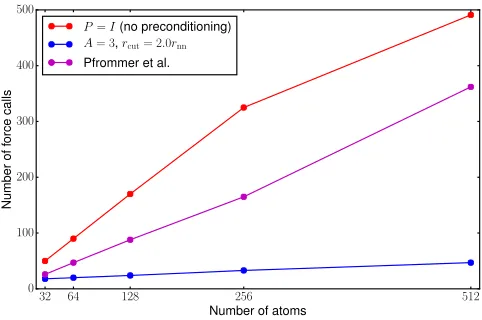
To investigate whether the theoretical independence of the cost of preconditioned minimisations from system size (Eq.(5)) is achieved in real systems, we carried out tests in a series ofN×1×1 Si supercells, again using the Stillinger-Weber potential. The atomic positions were perturbed by random displacements of magnitude 0.1 Å and also subjected to a compressive strain of 0.5% to introduce a long-wavelength deformation. The results shown in Fig. 4 indicate that our preconditioner achieves convergence after an approximately constant number of force evaluations as the system is made larger, in contrast to not using a preconditioner or to the approach of Pfrommeret al.,7which does not use connectivity information. Our new method is therefore expected to be particularly useful for very large systems.
Since large systems inherently have a wide range of displacement wavelengths and corresponding stiffnesses, it is not obviousa priorihow much preconditioning will help for a smaller system, for example, one that can feasibly be simulated using density functional theory. We therefore simulated a perovskite structure oxide, LaAlO3, in a 220-atom slab geometry with periodic boundary conditions in-plane and free surfaces separated by a vacuum region in the normal direction. Energy and force evaluations used DFT with the Perdew, Burke and Ernzerhof (PBE) generalised gradient approximation (GGA) to the exchange correlation functional, projector-augmented waves (PAW) with a 282.8 eV cutoffplane-wave basis, and a 2×2×1 Monkhorst-Pack k-point sampling, evaluated using the QUIP interface to the VASP software.16–18 In this system, as shown in Fig.5, we
find that the preconditioning still significantly reduces the computational cost, but the improvement is not as dramatic as
[image:6.594.308.549.548.708.2]164109-6 Packwoodet al. J. Chem. Phys.144, 164109 (2016)
FIG. 5. Convergence of the geometry optimisation of a 220-atom LaAlO3
slab using DFT in a fixed unit cell. The parameters of the preconditioner (or not using a preconditioner) are given in the legend.
for the larger systems discussed above. With our convergence criterion, the reduction is about a factor of two, although the non-preconditioned minimization stagnates just before reaching convergence, and with a slightly looser criterion, the reduction would only be a factor of 1.6. Note that the computational cost of the DFT energy and force evaluations is so large that the application of the preconditioner is completely negligible in comparison. In this case, the approach of Pfrommeret al.7does not make a significant improvement
over not using a preconditioner.
For a test of the relaxation of both atomic positions and unit cell size and shape, we used a 1×1×2 supercell of a
γ-Al2O3 structure, with methods similar to those described above for LaAlO3, except for a 530 eV plane wave cutoffand a Γ-centered k-point mesh. For this system, plotted in Fig.6, the reduction in computations for both preconditioners is about a factor of 5, a very significant improvement. While the non-preconditioned minimizer fails to make progress at several points during the relaxation, both our new preconditioners allow the LBFGS minimizer to rapidly and steadily reduce the gradient until convergence. Here, the approach of Pfrommer et al.7 actually results in slightly worse performance than
[image:7.594.44.286.49.204.2]unpreconditioned LBFGS. This could perhaps be improved
FIG. 6. Convergence of the geometry optimisation of a 106-atomγ-Al2O3
system in a variable cell. The parameters of the preconditioner (or not using a preconditioner) are given in the legend.
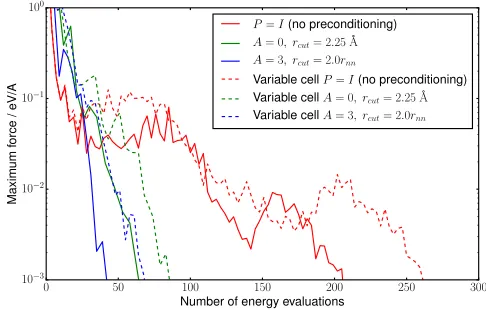
FIG. 7. Convergence of the geometry optimisation of a 432-atom ice VIII system with fixed (solid lines) and variable (dashed lines) unit cells. The parameters of the preconditioner (or not using a preconditioner) are given in the legend.
by careful tuning of the bulk modulus and optical phonon frequency parameters used to construct the approximation to the inverse Hessian; however, we note that our new preconditioner does not require any user input as all parameters are computed automatically. The addition of the cell degrees of freedom, which are preconditioned in magnitude but not coupled to the positional degrees of freedom, does not reduce the effectiveness of our preconditioners.
Finally, we tested the new preconditioner for a molecular system, ice VIII. The system contained 432 atoms with an initial cell dimension of 13.65×13.65×13.16 Å3. A DFT potential with BLYP exchange-correlation functional was used with DZVP basis set and Goedecker-Teter-Hutter (GTH) pseudopotentials. Calculations were performed by the CP2K program package using the QUIP interface.16,19,20Fig.7shows the number of energy evaluations of the different optimisations for fixed and variable cells using a maximum force threshold of 10−3 eV Å−1. Similarly to previous systems, the Armijo condition performed better than Wolfe, so we present here only the results with the former line search. In theA=0 case, we slightly increased the default cutoffparameter (rcut=2.25 Å) to include hydrogen bonded neighbours too. For both the fixed and variable cells, the computational costs compared to the unpreconditioned optimisation were reduced by 3 and 4 times usingA=0 and A=3, respectively.
IV. SADDLE SEARCH
To demonstrate the transferability of our preconditioner not only across problem classes but also across algorithms, we apply it to the dimer saddle search algorithm.21,22A modified
variant of the algorithm proposed in Ref.22reads as
xk+1=xk−α Pk−1−2vkv T k
∇f(xk+hvk)+∇f(xk−hvk)
2 ,
v′
k+1=vk−β I−Pkvkv T k
∇f(xk+hvk)−∇f(xk−hvk)
2h ,
vk+1=vk′+1/∥v
′ k+1∥Pk+1.
The translation step is obtained as coordinate transfor-mation of the standard dimer step with the variables ˜xk
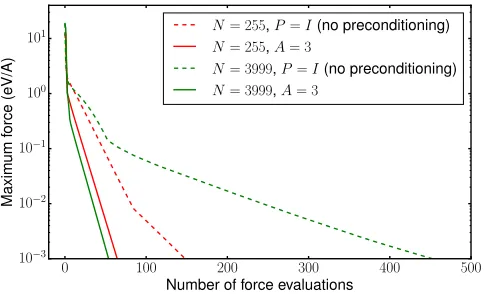
[image:7.594.45.287.559.716.2]FIG. 8. Performance of the preconditioned dimer method for a vacancy in a Lennard-Jones fcc crystal (solid lines), and without a preconditioner (dashed lines), for two system sizes.
=Pk1/2xk,vk˜ =Pk1/2vk (cf. Section II B). The orientation step is an ℓ2-steepest descent step (without preconditioning) for the Rayleigh-quotient vT∇2f
(xk)v/vTPkv, with a
finite-difference approximation of ∇2f(x
k)v. Interestingly, naive
preconditioning of the orientation steps led to poorer performance in our tests.
We test this preconditioned dimer algorithm by computing the saddle configuration of a vacancy in a Lennard-Jones fcc crystal, with a cubic computational cell. Given two states x(0),x(1), which have two neighbouring lattice sites removed, we choose the starting configuration x0=13x(0)+23x(1) and v0∝x(1)−x(0). The step sizes are chosen by hand-optimising for a small setup with 33unit cells:α=0.01, β=0.005 for the unpreconditioned variant (Pk=I) andα=0.5, β=0.01 for
our preconditioner with parameters A=3.0,rrcut=2rnn. For both variants, we chose h=10−2. The results are displayed in Figure 8, demonstrating analogous improvements to the energy minimisation examples.
V. CONCLUSIONS
In summary, we have presented a simple preconditioner for geometry optimisation and saddle search that is universally applicable in a wide range of atomistic and molecular condensed phase systems, offering at least a factor of two in performance gain in our examples of small systems and up to factor of ten in systems of tens of thousands of atoms. The extra cost of using the preconditioner is small enough that it is worth using even with inexpensive interatomic potentials, while the performance gain is expected to scale as the square root of the system size. A Python implementation within the Atomic Simulation Environment23 is available at https://gitlab.com/jameskermode/ase, offering interfaces to a wide range of atomistic codes such as VASP,17 CASTEP,24
CP2K,19 LAMMPS,25 and many others. All data created
during this research are openly available from the Uni-versity of Warwick Research Archive Portal (WRAP) at
http://wrap.warwick.ac.uk/78579.
ACKNOWLEDGMENTS
This work was supported by the Engineering and Physical Sciences Research Council (EPSRC) under Grant Nos.
EP/J022055/1, EP/L014742/1, EP/L027682/1, EP/J010847/1, and EP/J021377/1. An award of computer time was provided by the Innovative and Novel Computational Impact on Theory and Experiment (INCITE) program. This research used resources of the Argonne Leadership Computing Facility, which is a DOE Office of Science User Facility supported under Contract No. DE-AC02-06CH11357. Additional computing facilities were provided by the Centre for Scientific Computing of the University of Warwick with support from the Science Research Investment Fund. The work of N.B. was supported by the Office of Naval Research through the Naval Research Laboratory’s basic research program. The work of C.O. and L.M. was also supported by ERC Starting Grant 335120. We thank C. S. Hellberg and M. D. Johannes for the LaAlO3andγ-Al2O3atomic configurations.
APPENDIX A: LINESEARCH
We present the details of our line search algorithm. The standard requirement for the LBFGS and CG methods is that the step-size,α, satisfies the Wolfe conditions
f(xk+αpk)≤ f(xk)+c1α∇fkTpk, (A1)
|∇f(xk+αpk)Tpk|≤c2|∇fkTpk|, (A2)
where 0<c2<c1<1. Line search methods that guarantee
(A1) and (A2) employ a bracketing strategy, which often requires several additional energy and force evaluations at each iteration.
For the steepest descent method, it is theoretically sufficient to impose only Armijo condition (A1). We have observed that this was also sufficient in all our tests to ensure convergence of the LBFGS method and leads to a consistent performance improvement. Our implementation minimises the quadratic interpolating fk,∇fkTpk, and f(xk+αpk), iterating
until(A1)is satisfied. Forc1<1/2, this yields a backtracking guarantee and hence ensures that the line search terminates after finitely many steps. Our default parameter is c1=0.1. The initial estimate on the step length is ˜α=1.0,
inputx,α >˜ 0,c1∈(0,1/2),ps.t.∇f(x)·p<0,
outputα,˜
whilef(x+α˜p)> f(x)+c1α˜∇f(x)·p,
˜
α′← −
1
2α˜∇f(x)·p f(x+α˜p)−f(x)
˜
α − ∇f(x)·p
,
˜
α← max(α˜′,α/˜ 10).
(A3)
Unlike for a bracketing line-search, the only additional evaluations required during line search are energy evaluations at the end-point of the search interval, which reduces compu-tational cost in the pre-asymptotic regime of the optimisation. In the asymptotic regime, the step-lengthαk =1 is always accepted and will satisfy both Wolfe conditions (A1) and
164109-8 Packwoodet al. J. Chem. Phys.144, 164109 (2016)
history and repeat the linesearch, which removes any concern about robustness.
APPENDIX B: PHONON STABILITY
Consider ad-dimensional Bravais latticeΛ=AZd, where
Z is the set of integers and the columns of A are the lattice
directions, which is the ground state for some material system under a potential energy f. Let H=∇2f denote the Hessian of the potential energy in the ground state. For displacements urof each atomr∈Λ, we can write
[Hu]r=
s∈Λ
Hr sus, (B1)
where Hr s∈Rd×d are the blocks of H. We now prove
the claim that phonon stability is equivalent to the bound uTHu≥uTPu, wherePis the preconditioner defined in(13),
for all displacements of the lattice.
The discrete translation invariance of the lattice, Λ+r =Λ for allr ∈Λ, implies that Hr s=H0,s−rChs−r, where
h∈Rd×d. For any virtual displacementu=(ur)with compact
support, we have
uTHu=
BZ ˆ
u∗hˆu dkˆ , (B2)
where ˆu and ˆh denote the Fourier transforms of u and h, respectively, and the integration is over the first Brillouin zone. Phonon stability means that the natural frequencies are positive and linear near the origin. In terms of ˆh, this translates to ˆh(k)≥cH|k|2Ifor some constantcH >0. The upper bound
ˆ
h(k)≤CH|k|2Ifollows from the boundedness of the phonon
bandwidth. (A sufficient condition is that
r∈Λ|hr||r|2<∞.)
Let Pr s=ps−r ∈Rd×d denote the corresponding blocks
of the preconditioner operator. The upper bound ˆp ≤CP|k|2I
follows simply from the fact that the preconditioner has a finite interaction range. This upper bound and phonon stability of Himply
uTHu≥cH
BZ
|k|2|uˆ|2dk
≥ cH CP
BZ ˆ u∗pˆuˆ
= cH
CP
uTPu.
Conversely, ifuTHu≥cuTPu, then phonon stability ofP implies phonon stability ofH. But the former is an immediate consequence of the fact that the coefficients in the definition ofPare positive.26
1D. Wales,Energy Landscapes: Applications to Clusters, Biomolecules and Glasses(Cambridge University Press, 2003).
2C. J. Pickard and R. J. Needs,J. Phys. B: Condens. Matter23, 053201
(2011).
3A. Voter,Phys. Rev. Lett.78, 3908 (1997).
4M. C. Payne, M. P. Teter, D. C. Allan, T. A. Arias, and J. D. Joannopoulos,
Rev. Mod. Phys.64, 1045 (1992).
5H. C. Elman, D. J. Silvester, and A. J. Wathen,Finite Elements and Fast Iter-ative Solvers: With Applications in Incompressible Fluid Dynamics(Oxford University Press, 2014).
6J. Nocedal and S. J. Wright,Numerical Optimisation, Springer Series in
Operations Research and Financial Engineering (Springer, New York, 2006).
7B. G. Pfrommer, M. Côté, S. G. Louie, and M. L. Cohen,J. Comput. Phys. 131, 233 (1997).
8M. V. Fernandex-Serra, E. Artacho, and J. M. Soler,Phys. Rev. B67, 100101
(2013).
9D. P. Bertsekas,Nonlinear Programming, 2nd ed. (Athena Scientific, 1999). 10W. N. Bell, L. N. Olson, and J. B. Schroder, PyAMG: Algebraic multigrid
solvers in Python v2.0, 2011 release 2.0.
11N. Higham, Accuracy and Stability of Numerical Algorithms (SIAM
, 2002).
12E. B. Tadmor, G. S. Smith, N. Bernstein, and E. Kaxiras,Phys. Rev. B59,
235 (1999).
13F. H. Stillinger and T. A. Weber,Phys. Rev. B31, 5262 (1985). 14R. Thomson, C. Hsieh, and V. Rana,J. Appl. Phys.42, 3154 (1971). 15J. R. Kermode, T. Albaret, D. Sherman, N. Bernstein, P. Gumbsch, M. C.
Payne, G. Csányi, and A. De Vita,Nature455, 1224 (2008).
16G. Csányi, S. Winfield, J. Kermode, A. Comisso, A. De Vita, N. Bernstein,
and M. C. Payne, “Expressive programming for computational physics in Fortran 95+,” in IoP Comput. Phys. Newsletter, Spring 2007,http://www. libatoms.org.
17G. Kresse and J. Hafner,Phys. Rev. B49, 14251 (1994). 18G. Kresse and J. Furthmüller,Phys. Rev. B54, 11169 (1996).
19J. VandeVondele, M. Krack, F. Mohamed, M. Parrinello, T. Chassaing, and
J. Hutter,Comput. Phys. Commun.167, 103 (2005).
20J. Hutter, M. Iannuzzi, F. Schiffmann, and J. VandeVondele,Wiley
Interdis-cip. Rev.: Comput. Mol. Sci.4, 15 (2014).
21G. Henkelman and H. Jónsson,J. Chem. Phys.111, 7010 (1999). 22N. Gould, C. Ortner, and D. Packwood, “An efficient dimer method
with preconditioning and linesearch,” Math. Comput. (to be published); e-printarXiv:1407.2817.
23S. R. Bahn and K. W. Jacobsen,Comput. Sci. Eng.4, 56 (2002). 24S. J. Clark, M. D. Segall, C. J. Pickard, P. J. Hasnip, M. I. J. Probert, K.
Refson, and M. C. Payne,Z. Kristallogr. - Cryst. Mater.220, 567 (2005).
25S. Plimpton,J. Comput. Phys.117, 1 (1995).
26M. Born and K. Huang,Dynamical Theory of Crystal Lattices(Clarendon
Press, 1998).